







Abstract
Does market orientation impede breakthrough innovation? To date, researchers have presented opposing arguments with respect to this important issue. To address this controversy, the authors conceptualize and empirically test a model that links different types of strategic orientations and market forces, through organizational learning, to breakthrough innovations and firm performance. The results show that a market orientation facilitates innovations that use advanced technology and offer greater benefits to mainstream customers (i.e., technology-based innovations) but inhibits innovations that target emerging market segments (i.e., market-based innovations). A technology orientation is beneficial to technology-based innovations but has no impact on market-based innovations, and an entrepreneurial orientation facilitates both types of breakthroughs. Different market forces (demand uncertainty, technology turbulence, and competitive intensity) exert significant influence on technology- and market-based innovations, and these two types of innovations affect firm performance differently. The results have significant implications for firm strategies to facilitate product innovations and achieve competitive advantages.
However, some researchers have raised doubts about the unquestioning focus that firms may place on their markets (e.g., Bennett and Cooper 1979; Christensen and Bower 1996; Frosch 1996; Meredith 2002). They caution that an overemphasis on customers could lead to trivial innovations and myopic research and development (R&D), which might lower the firm's innovative competence. Because customers are inherently shortsighted, market-oriented firms may risk losing the foresight of innovating creatively in their attempt to serve customers’ existing needs (Hamel and Prahalad 1994). Moreover, customers do not necessarily know what they really want, because they are not completely knowledgeable about the latest market trends or technologies (MacDonald 1995; Von Hippel 1988). Thus, being market oriented may not provide a firm with true insight into product innovation (Frosch 1996; Leonard-Barton and Doyle 1996; Workman 1993). Therefore, firms should “ignore your customers” or “don't listen to your customers” while pursuing breakthrough innovations (Martin 1995, p. 123; Meredith 2002 p. 59).
Whereas early evidence against market orientation was largely anecdotal and drew its implications from selected case studies, Christensen and Bower (1996) add to the criticism with a historical analysis of the computer disk-drive industry. They find that financially strong, rationally managed, and well-established leading firms may fail to embrace breakthrough innovations and may be surpassed by competitors because they are too customer oriented. Recent studies in Journal of Marketing also provide evidence that indirectly bears on this concern. For example, Voss and Voss (2000) find that a customer orientation has a negative impact on firm performance in professional theaters, possibly because of the lack of breakthrough innovation. Grewal and Tansuhaj (2001) find that a market orientation is detrimental to firm performance after an economic crisis, which they attribute to the lack of foresight of market-oriented firms.
The findings have provoked a series of debates. Commenting on Christensen and Bower's (1996) work, Slater and Narver (1998, p. 1001) distinguish customer-led strategies from market-oriented ones: The former focuses on satisfying customers’ expressed needs, whereas the latter “goes beyond satisfying expressed needs to understanding and satisfying customers’ latent needs.” Conner (1999) argues that Slater and Narver's distinction may be too simplistic, and he suggests that to be successful, a firm should balance satisfying its customers’ current, expressed needs (i.e., customer-led) with satisfying their future, potential needs (i.e., market-oriented). In response, Slater and Narver (1999) argue that a market orientation considers both expressed and latent needs and thus is more than simply being customer led. Hult and Ketchen (2001) show that as a component of positional advantage, market orientation positively affects firm performance, but they note that the potential value of market orientation should be considered together with other important firm capabilities, such as entrepreneurship and organizational learning. Matsuno, Mentzer, and Özsomer (2002) also find that entrepreneur-ship in combination with market orientation positively affects firm performance. They encourage additional research to inquire into the process by which firms implement strategic orientations, such as through organizational learning. Most recently, Im and Workman (2004) find that a customer orientation is the driving force of new product success, despite its negative effect on new product novelty. They recommend further studies to examine innovation and its performance implications directly and together with other intangible assets, such as entrepreneurship.
Despite growing interest in this debate, the central issue of whether market orientation facilitates or impedes breakthrough innovation remains unanswered. In this study, we present a model that links strategic orientation, market force, organizational learning, breakthrough innovation, and firm performance in an attempt to contribute to the literature in four ways. First, we differentiate between two types of breakthrough innovations (i.e., technology versus market based) and argue that market orientation may have both positive and negative effects, depending on the type of innovation. In this way, we provide some insights that may resolve the ongoing debate. Second, we examine two important yet less-researched types of strategic orientations, technology and entrepreneurial, and assess how they affect breakthrough innovations through organizational learning. Third, we investigate the effects of different market forces on breakthrough innovations. Fourth, we explore the differential impacts of technology- and market-based innovations on performance. To our knowledge, this study represents the first attempt to distinguish empirically between technology- and market-based innovations and to assess their performance impacts.
Breakthrough Innovation
Innovation is the generation and/or acceptance of ideas, processes, products, or services that the relevant adopting unit perceives as new (Garcia and Calantone 2002). It can be new to either the firm or the firm's customers. Depending on their “newness,” innovations can be incremental (continuous) or breakthrough (discontinuous). Incremental innovations refer to minor changes in technology, simple product improvements, or line extensions that minimally improve the existing performance. In contrast, breakthrough innovations are novel, unique, or state-of-the-art technological advances in a product category that significantly alter the consumption patterns of a market (Wind and Mahajan 1997).
Recent studies further differentiate two types of breakthrough innovations on the basis of their (1) advances of existing technology and (2) departure from the existing market segment (Benner and Tushman 2003). The first type, which we define as “technology-based innovations” (hereinafter, tech-based innovations), adopts new and advanced technologies and improves customer benefits relative to existing products for customers in existing markets. The second type, which we define as “market-based innovations,” departs from serving existing, mainstream markets. Market-based innovations involve new and different technologies and create a set of fringe, and usually new, customer values for emerging markets (Benner and Tushman 2003; Christensen and Bower 1996).
Tech- and market-based innovations differ in both the technology and the market dimensions. On the technology side, though both employ new technologies, the former usually represent state-of-the-art technological advances (Benner and Tushman 2003; Chandy and Tellis 1998). In contrast, the latter are not necessarily technologically advanced; instead, market-based innovations often use simpler new technology (e.g., off-road versus over-the-road motorcycles, personal computers [PCs] versus minicomputers) and sometimes can be new ideas about business operations (e.g., discount retailing such as Wal-Mart versus traditional retailing such as Sears, health maintenance versus conventional health insurance) (Benner and Tushman 2003; Christensen 1997). On the market side, tech-based innovations address the needs of existing markets and provide greater customer benefits than do existing products (Chandy and Tellis 1998). In contrast, market-based innovations are designed for new or emerging markets and offer benefits that the new segments value, and their performance along traditional dimensions often may be worse than that of existing products (Christensen 1997). In other words, they disrupt the existing customer-preference structure by introducing new benefit dimensions. Therefore, market-based innovations are often perceived as highly different, and they require current mainstream customers to undergo major changes in thinking and behavior (Benner and Tushman 2003). Mainstream customers may not easily recognize or appreciate the new benefits, and market-based innovations may be initially difficult for mainstream customers to adopt or use (Adner 2002).
Tech-based innovations that fundamentally change the technological trajectory and improve customer benefits are called “radical innovations” (e.g., color versus black-and-white television, diesel versus steam locomotive, jets versus turbojets) (Benner and Tushman 2003; Chandy and Tellis 1998; Tushman and Anderson 1986). Market-based innovations that improve performance through subsequent development to a level superior to existing products and that eventually overtake existing products in mainstream markets are called “disruptive innovations” (Christensen 1997). The introduction of PCs serves as an example.
Personal computers were designed to meet the needs of customers, such as small businesses and individual customers, who were not served by minicomputers. Mainstream customers of minicomputers were large businesses and organizations that mostly used minicomputers for scientific computation. When PCs were introduced, minicomputer users showed little interest, because PCs performed much worse than minicomputers along traditionally valued dimensions, such as scientific computation. At that time, PCs were a market-based innovation. However, PC technology developed much faster than that of minicomputers. Over time, PCs overtook minicomputers, even in the latter's mainstream market. As a result, PCs became a disruptive innovation (Christensen 1997; Schnaars 1994).
Both tech- and market-based innovations are highly risky to pursue. A tech-based innovation is technologically risky because developing state-of-the-art technology is extremely expensive and requires substantial investment (Sorescu, Chandy, and Prabhu 2003; Wind and Mahajan 1997). However, because it addresses the well-understood needs of mainstream customers, the perceived market risk is low. In contrast, a market-based innovation may be technologically straightforward, but it is extremely risky on the market side because the customers do not yet exist (Christensen and Bower 1996). Therefore, companies often are reluctant to invest in either type of innovation. In turn, it is important to understand what drives a firm's willingness to undertake risky activities and to introduce breakthroughs to achieve a sustainable competitive advantage.
To answer this question, we refer to the competitive force perspective and the resource-based view (RBV), two major theories about how competitive advantage is achieved. The former represents an “outside-in” perspective and argues that external market forces, such as demand uncertainty, technological turbulence, and competitive intensity, primarily drive competitive advantage (Porter 1980, 1985). In contrast, the RBV reflects an “inside-out” approach and suggests that a firm's competitive advantage stems from its unique assets and distinctive capabilities (Barney 1991; Wernerfelt 1984). Although the two views diverge, both are influential in the explanation of a firm's competitive advantage. Thus, recent studies have encouraged researchers to consider their complementary nature (e.g., Spanos and Lioukas 2001). Building on the two views, we present a framework that links a firm's strategic orientations (from the RBV) and market forces (from the competitive force perspective), through organizational learning, to breakthrough innovations and firm performance (see Figure 1).
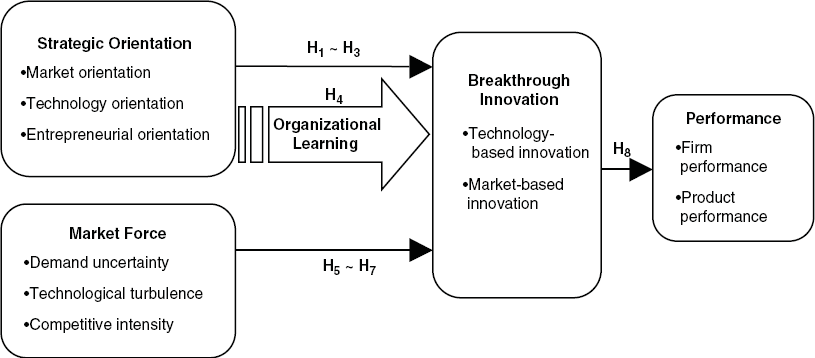
The Conceptual Model
Hypotheses Development
Strategic Orientation and Breakthrough Innovation
The RBV focuses on resource heterogeneity and immobility as potential sources of competitive advantage (Barney 1991). Firm resources can be classified as assets and capabilities (Day 1994; Hunt and Morgan 1995). Assets are the more tangible resources that the organization has accumulated, such as an economy of scale, reputation, spatial preemption, and brand equity. Capabilities are the glue that brings these assets together and enables a firm to deploy them advantageously, such as the skills underlying the innovativeness and the superior quality of a firm's offerings. Capabilities differ from assets in that they are difficult to quantify monetarily, and they encompass skills that are embedded deeply in organizational routines and practices (Barney 1991; Day 1994).
An important firm capability is its strategic orientation. Strategic orientation reflects the firm's philosophy of how to conduct business through a deeply rooted set of values and beliefs that guides the firm's attempt to achieve superior performance (Gatignon and Xuereb 1997). These values and beliefs define the resources to be used, transcend individual capabilities, and unify the resources and capabilities into a cohesive whole (Day 1994). Such capabilities are intangible and interaction based. They are difficult to trade, imitate, or duplicate, and thus they are the most likely sources of competitive advantage (Day 1994; Hunt and Morgan 1995).
Our study focuses on three important types of strategic orientations: market, technology, and entrepreneurial. Market orientation is of central interest because of the market orientation debate we identified previously. Technology orientation focuses predominantly on new technologies and thus has direct implications for product innovations (Gatignon and Xuereb 1997; Hamel and Prahalad 1994; Tushman and Anderson 1986). Entrepreneurial orientation also deserves consideration because it has long been recognized as the key for initiating innovative activities (Miller 1983; Slater and Narver 1995).
Market orientation
Market orientation places the highest priority on the profitable creation and maintenance of superior customer value (Narver and Slater 1990). It emphasizes the need for the entire organization to acquire, disseminate, and respond to market intelligence from the firm's target buyers and current and potential competitors (Jaworski and Kohli 1993). Some researchers suggest that market orientation is essentially customer orientation (Deshpandé, Farley, and Webster 1993), representing the concept of “customer pull” in a firm's strategic planning and implementation (Day 1994).
By prioritizing customers, a market-oriented firm excels in its ability to seek and use market information to create and deliver superior customer value. Unlike a customer-led firm, which simply listens to its customers, a market-oriented firm commits to understanding both the expressed and the latent needs of its customers (Slater and Narver 1999). Its ability to uncover consumers’ latent needs can be enhanced further by the lead-user technique; that is, putting the most advanced technology available into the hands of the “most sophisticated and demanding users” often “leads to the discovery of new solutions to unexpressed needs” (Slater and Narver 1998, p. 1003; see also Von Hippel, Thomke, and Sonnack 1999).
Such insights are beneficial for fostering tech-based innovations, which can greatly improve customer benefits in existing markets and cater to the needs of the most sophisticated customers (Chandy and Tellis 1998). Although investment in technology is substantial and risky, signs from the market are clear and certain. With a strong commitment to serving its customers, a market-oriented firm is willing to direct the resources necessary to fulfill customers’ latent needs through developing tech-based innovations (Slater and Narver 1995). Some studies also indicate that many breakthrough innovations are generated from consumers’ insights. For example, Von Hippel (1988) shows that lead users contribute to a considerable percentage of breakthroughs—some as high as 70%–85%—in various product classes. Thus, market orientation is more than being customer led, and it can lead to tech-based innovations.
Market orientation has a positive effect on tech-based innovations.
The primary focus of a market orientation is to create “superior customer value, which is based on knowledge derived from customer and competitor analysis” (Slater and Narver 1995, p. 68). However, such a focus may risk overlooking the potential contributions of other sources, such as firms in different industries (Achrol 1991); threats from new, nontraditional competitors (Stalk, Evans, and Shulman 1992); or opportunities in future markets (Chandy and Tellis 1998), thus lowering the possibility of generating innovations for emerging markets. In addition, intelligence generated from existing customers or even lead users may not provide critical guidelines for introducing products that are desired by new markets with different preferences. As Von Hippel, Thomke, and Sonnack (1999) note, lead users—the most sophisticated and demanding users of current products—can offer insights into existing value systems but not into markets with different values. Im and Workman's (2004) unexpected finding that customer orientation negatively affects new product novelty provides some support for this logic.
Although market-based innovations may be straightforward in terms of technology, they are extremely risky on the demand side because managers can only guess at the size of the new market, the profitability of the new products, or the desirable product attributes (Christensen and Bower 1996; Hamel and Prahalad 1994; Tellis and Golder 2001). However, “a market orientation may not encourage a sufficient willingness to take [such] risks…. This danger is the result of narrowly focusing market intelligence efforts on current customers and competitors, thus ignoring emerging markets and/or competitors” (Slater and Narver 1995, p. 67, emphasis added). As such, a market-oriented firm may risk itself in the “tyranny of the served market”: The firm aggressively pursues tech-based innovations that directly address existing customers’ unsatisfied needs and that promise the best return, but it is unlikely to invest substantially in market-based innovations that have an unknown future (Christensen 1997; Hamel and Prahalad 1994). Thus:
Market orientation has a negative effect on market-based innovations.
Technology orientation
Unlike the customer-pull philosophy of market orientation, technology orientation reflects the philosophy of “technological push,” which posits that consumers prefer technologically superior products and services (Gatignon and Xuereb 1997; Wind and Mahajan 1997). Accordingly, a technology-oriented firm advocates a commitment to R&D, the acquisition of new technologies, and the application of the latest technology (Gatignon and Xuereb 1997). Although both market and technology orientations promote openness to new ideas, market orientation favors ideas that better satisfy customer needs, whereas technology orientation prefers those that employ state-of-the-art technologies.
Because a technology-oriented firm champions the use of the latest technologies in its new products and heavily devotes its resources to R&D, it excels in technical proficiency and flexibility, which are critical drivers for break-through innovations (Ali 1994; Workman 1993). Furthermore, in a technology-oriented firm, creativity and invention are the organizational norms and values that guide its activities and strategies. A technology-oriented firm tolerates and often encourages employees with “crazy ideas” or an instinctive interest in inventing something drastically new. In such a firm, introducing breakthroughs becomes a strategic and cultural priority (Hamel and Prahalad 1994; Hurley and Hult 1998). Because tech-based innovations employ state-of-the-art technology, they should be highly valued by a technology-oriented firm. However, a technology-oriented firm may not value market-based innovations, because such innovations may be too technologically straightforward. Therefore, we hypothesize the following:
Technology orientation has a positive effect on tech-based innovations.
Entrepreneurial orientation
Entrepreneurial orientation reflects a firm's propensity to engage in “the pursuit of new market opportunities and the renewal of existing areas of operation” (Hult and Ketchen 2001, p. 901). It promotes values such as being highly proactive toward market opportunities, tolerant of risk, and receptive to innovations (Lumpkin and Dess 1996; Matsuno, Mentzer, and Özsomer 2002). Accordingly, the ability to initiate change, take risks, and innovate distinguishes entrepreneurial firms (Naman and Slevin 1993).
Entrepreneurial orientation highlights the spirit of creating new business out of ongoing practices and rejuvenating stagnant companies, which is often accomplished through the introduction of breakthrough innovations (Lumpkin and Dess 1996). As Miller (1983, p. 771) notes, an entrepreneurial firm is one that “engages in product market innovations, undertakes somewhat risky ventures, and is the first to come up with ‘proactive’ innovations.” In particular, the emphasis on being proactive toward new opportunities cultivates capacities that enable the firm to create products not only ahead of competitors but also ahead of the recognition of existing customers (Slater and Narver 1995). Often, this proactive quality requires substantial financial and managerial commitment. With its risk-taking nature, an entrepreneurial firm is willing to devote the necessary resources to opportunities that may result in costly failures (Naman and Slevin 1993). In such conditions, both tech- and market-based innovations are likely to occur. Therefore, the essential outcome of entrepreneurial orientation is the firm's entry into new or established markets through breakthroughs (Lumpkin and Dess 1996).
Entrepreneurial orientation has a positive effect on both tech- and market-based innovations.
Organizational learning as a mediating process
Recently, more effort has been strongly called for to uncover the process (in particular, organizational learning) through which strategic orientations affect organizational outcomes (e.g., Matsuno, Mentzer, and Özsomer 2002; Slater and Narver 1995). Organizational learning represents the development of new knowledge or insights that facilitate performance-enhancing organizational changes (Sinkula 1994; Slater and Narver 1995). Dickson (1992) emphasizes the importance of learning in the transferring of information into knowledge, arguing that in dynamic and turbulent markets, the ability to learn more quickly than competitors may be the only source of sustainable competitive advantage. Slater and Narver (1995, p. 63) concur: “[T]he critical challenge for any business is to create the combination of culture and climate that maximizes organizational learning.” They further indicate that market-oriented and entrepreneurial cultures, with their focus on market information processing and proactivity toward change, greatly enhance a firm's ability to learn. Similarly, Noble, Sinha, and Kumar (2002) suggest that a technology orientation is an important factor that leads to more knowledge-learning behaviors.
Organizational learning as a process includes information acquisition, information dissemination, shared interpretation, and organizational memory (Sinkula 1994; Slater and Narver 1995). Information, which can be acquired through the market, direct experience, or the experiences of others, is a pivotal aspect of innovation development because firms cannot generate insights for breakthroughs without it (Sinkula, Baker, and Noordewier 1997). Effective information dissemination further increases the value of information. When different organizational units view the information from various angles, they respond with feedback that often provides new insights into the process of new product development (Slater and Narver 1995). However, before an organization can use the information, it must interpret the information to determine its meaning and implications, and it must reach a consensus (Day 1994). At this stage, a relatively high level of disagreement is actually beneficial for generating truly insightful knowledge, but there must still be effective conflict resolution to reach consensus in a timely manner (Slater and Narver 1995). Finally, organizational memory, or the ability to store and access prior lessons, enables a firm to maintain a steady pace of long-term learning (Sinkula 1994). Because of its inherent flexibility, a learning organization can reconfigure its structure and reallocate its resources to foster breakthroughs, including those for emerging markets (Slater and Narver 1995). Therefore, we hypothesize the following:
Organizational learning mediates the relationships between strategic orientations and breakthrough innovations.
Market Force and Breakthrough Innovation
The competitive-force perspective argues that competitive advantage lies in a firm's correct positioning in a market (Porter 1985). The sustainability of the competitive advantage that stems from such a position critically depends on the relative influence of the market forces that the firm encounters (Porter 1980). In line with the work of Voss and Voss (2000), we break market forces down into three categories: demand (e.g., demand uncertainty, market growth), competition (e.g., competitive intensity, hostility), and supply (e.g., technological turbulence, supply power) characteristics. Of these, demand uncertainty, technological turbulence, and competitive intensity are the three most fundamental characteristics because they represent the influences of customers, technology, and competition in the market (Li and Calantone 1998). Although research has noted their potential impact on product innovation, formal conceptualizations and empirical validations are scarce (Ali 1994; Gatingon and Xuereb 1997). We attempt to extend the existing research by examining how these market forces drive breakthrough innovations.
Demand uncertainty
Demand uncertainty refers to the instability of consumer preferences and expectations. In a stable market in which consumer preferences remain unchanged, there is no need for firms to modify their products drastically to satisfy customers. As a result, incremental but not breakthrough innovations are likely to occur because introducing breakthrough innovations is risky and requires substantial resources (Ali 1994; Sorescu, Chandy, and Prabhu 2003). However, if consumer preferences are unstable and change quickly, identification of consumers’ changing needs becomes increasingly difficult, and incremental innovations are unlikely to satisfy them (Wind and Mahajan 1997). In such a market, companies could turn to breakthrough innovations to provide offerings that precede customer needs and create customer demand by reshaping the way customers behave (Hamel and Prahalad 1994; Porter 1985). Because consumer preferences are difficult to predict, the external guidelines by which firms judge whether a tech- or a market-based innovation is more promising are blurred. Thus, firms value both types of innovations. Therefore, we hypothesize the following:
Demand uncertainty has a positive effect on both tech-and market-based innovations.
Technological turbulence
Technological turbulence refers to the rate of technological advances within an industry. In an industry in which technology is undergoing rapid change, firms must promote more breakthroughs. Fast technological advances significantly shorten the life cycle of existing products, erode the competitive advantage of even well-entrenched firms, and propel other firms to the forefront (Porter 1985; Tushman and Anderson 1986). Firms must enhance their R&D strength and seize the opportunities that new technologies create to advance next-generation products; otherwise, they will be squeezed from the market (Li and Calantone 1998). Furthermore, fast-changing technologies make breakthrough innovations more possible by changing the way the existing value chain works. For example, technological development may “raise or lower scale economies, make interrelationships possible where they were not before, create the opportunity for advantages in timing, and influence nearly any of the other drivers of cost or uniqueness” (Porter 1985, p. 171). In such conditions, firms can take advantage of technological advances to alter components of the existing value chain significantly. As a result, both tech- and market-based innovations are likely to occur.
Technological turbulence has a positive effect on both tech- and market-based innovations.
Competitive intensity
Competitive intensity refers to the degree of competition that a firm faces within its industry. Intense competition is characterized by severe price wars, heavy advertising, diverse product alternatives, and added services (Porter 1980). In such conditions, two options are especially desirable. First, firms can internalize their competitors’ strength simply through imitation. Porter (1985) suggests that in a highly competitive market, companies should pay special attention to costs because of the greater pressure that price wars cause. Thus, imitation becomes an obvious choice to reduce the high cost of product innovation (Day and Wensley 1988). Accordingly, firms may mimic their competitors’ behavior and copy their technologies, thereby leading to fewer tech-based innovations.
Second, firms can nullify their competitors’ strength by identifying a new segment and serving new customers who have a different value system (Porter 1985). Instead of competing head-to-head with their rivals by imitating or introducing more advanced products for the existing market (i.e., tech-based innovations), firms can introduce market-based innovations that target a new, unserved market (Porter 1985). Some of these market-based innovations may have the potential to outperform technological advances in the existing market in the future and thus may succeed in invading the existing market and replacing existing products. In other words, competitive intensity is conducive to market-based innovations. Therefore,
Competitive intensity has (a) a negative effect on tech-based innovations and (b) a positive effect on market-based innovations.
Breakthrough Innovation and Performance
Empirical assessments of the performance impact of breakthrough innovations are limited, partly because innovation is portrayed as a “universally useful and productive end in and of itself” (Drazin and Schoonhoven 1996, p. 1067; Sorescu, Chandy, and Prabhu 2003). In response, we explore the performance outcomes of tech- and market-based innovations.
Unlike incremental innovations, breakthroughs have the potential to create markets, shape consumers’ preferences, and change consumers’ basic behavior; sometimes the changes are so fundamental that soon after they are implemented, people cannot imagine living any other way (Hamel and Prahalad 1994). Thus, breakthrough innovations can contribute significantly to profitability (Wind and Mahajan 1997). Hamel and Prahalad (1994) also argue that the introduction of breakthrough innovations is the key to survival in turbulent environments. In particular, because tech-based innovations provide greater benefits to a firm's mainstream customers and market-based innovations are embraced by new or emerging markets (Benner and Tushman 2003), both should positively affect performance. Thus:
Both tech- and market-based innovations have a positive effect on performance.
Methodology
Sampling and Data Collection
As does previous research on innovation (e.g., Gatignon and Xuereb 1997), we test our hypotheses by examining brands at the strategic business unit (SBU) level in consumer product categories. We obtained the sample as follows: First, we acquired a sampling frame of 2260 brands of commonly used consumer durable and nondurable products in 48 categories from the Sino-Monitor International Company's (2000) annual China Marketing & Media Study. 1 Second, we used a stratified random sampling to select the brands for the survey. We divided the brands in each product category into two groups on the basis of their market share. The first group included the 10 brands with the highest share; the second group consisted of the rest of the brands. We selected at least 3 brands at random from each brand group in each product category, for a total of 150 and 250 brands from the first and second groups, respectively. Third, for each brand in the sample, we called the company to identify a senior manager (e.g., marketing director, general manager, regional brand manager) as the key informant. We further screened the key informant to ensure that he or she possessed well-rounded knowledge about the brand's various functional areas and was committed to cooperating with the research project. 2 Each respondent reported in reference to a single brand.
One of the largest surveys of its type conducted in China, the China Marketing & Media Study sample consists of 50,000 residents aged 15–64 years. The sample includes residents of 20 major cities in China: Beijing, Shanghai, Guangzhou, Chengdu, Tianjin, Jinan, Zhengzhou, Nanjing, Xian, Shengyang, Haerbin, Kunming, Fuzhou, Xiamen, Chongqing, Shenzhen, Qingdao, Hangzhou, Wuhan, and Dalian. Respondents are sampled in urban and suburban areas of the 20 cities through a stratified random sampling method according to population density.
The screening questions included whether the respondent was responsible for formulating the brand's marketing and sales strategy plan, implementing the brand's marketing plan, managing the sales of the brand, and planning the brand's image.
Hoskisson and colleagues (2000) suggest that in an emerging economy, collaboration with local researchers is a key means of obtaining reliable and valid information; in addition, face-to-face interviews are desirable because they increase response rates and generate more valid information. For these reasons, we commissioned a national marketing research firm to administer the survey through personal interviews. 3 All respondents were informed in advance of the confidentiality of their responses, and an enclosed official university letter explained the academic purpose of the project to them. Each respondent received a valuable gift and was promised a summary report of the survey. These efforts were highly effective. We obtained a total of 350 completed surveys, 139 from the 150 brands in the first brand group (92.7%) and 211 from the 250 brands in the second brand group (84.4%). Of the participating brands, 61.1% were domestic brands, and 38.9% were foreign brands. Product categories included appliances (23.4%), beverages (13.4%), snacks (10.6%), cosmetics (10.3%), clothes and shoes (10%), cigarettes and liquors (7.1%), cleaning products (6.9%), automobiles (4%), PCs (3.7%), and others (10.6%).
The firm's headquarters are in Beijing, and it has branches and affiliates across China. It has long-standing multinational clients, such as AT&T and Procter & Gamble, that have awarded the firm quality-service certificates for its marketing research services.
Tech- and Market-Based Innovations in the Chinese Market
We chose the Chinese market because, with its prevalence of tech- and market-based innovations, it offers an appropriate context to test our model. On the firm or supply side, companies are introducing more and more new products into the market as product innovation becomes increasingly important for business success (Finance Channel 2003; Wong and Maher 1997). As China moves toward a market economy, foreign firms have rushed into the market, many with more advanced or newer technologies. To survive the competition, local firms are updating their technologies through internal R&D, knowledge transfer in joint ventures, and/or direct imports from developed countries. To sustain their competitive advantage, foreign firms must not only exploit their existing capabilities but also develop new ones specifically for the Chinese market. For example, General Motors has invested more than $1 billion since 1994 in its Volvo project in China, focusing on the design, development, and production of a Chinese version that is “completely adapted to local buyers” (Luo 2002, p. 60). In 2003, Ford also announced a $1 billion investment to develop new Focus models for the Chinese market (BBC News 2003).
On the consumer or demand side, Chinese consumers perceive many new products as breakthrough innovations for two reasons. First, Chinese consumers have limited exposure to and knowledge of Western products (Zhou, Su, and Bao 2002). 4 Thus, Chinese consumers may perceive many products that are developed for the West as new when the products are initially introduced into the Chinese market. Second, both local and foreign companies that are betting on China's huge market potential are constantly introducing many truly breakthrough innovations into the market (China Daily 2004; Luo 2002).
According to a survey that the Horizon Group (1998) conducted of 5764 consumers in 11 major cities in China, consumers’ knowledge and understanding of Western products is limited; they scored only 2 on a scale for which 4 was the highest possible score.
The various innovative products included in our sample (see Appendix A) 5 also support the use of the Chinese market for our study. For example, Panasonic introduced a tech-based innovation in the color television category that employs some of the most advanced video technologies, such as movement compensation, high-resolution display tube, and gigahertz picture handling. The innovation offers clearer, more continuous, and smoother pictures than do existing products, attributes that mainstream television buyers value. Similarly, Shinco's air conditioner adopts several leading technologies, including “oxygen bar” technology, a high-efficiency air filter, and a negative ion generator. Such advanced technologies help provide an oxygen-enriched, healthier indoor environment and improved allergen and bacteria control, and mainstream consumers have welcomed these benefits.
Because of length constraints, Appendix A presents only a few examples of the tech- and market-based innovations in our sample. A table with more examples is available on request.
The Royal Jelly brand of chocolate is an example of market-based innovation. It employs a different technology to preserve the efficacy of royal jelly when it is added to chocolate. The benefit of royal jelly (building up the human immune system) appeals to health-conscious customers but not to mainstream consumers (mostly young people, who focus on the taste and enjoyment benefits of chocolate). Another example is the Langchao brand of laptop computers, which employs a sturdy design and associated technologies that focus exclusively on protecting the laptop against damage, shock, water, dust, and even electromagnetic radiation. These benefits are targeted at a new segment of consumers who use their laptops in harsh and hazardous conditions.
Measures
All the measures were professionally translated with back translation to ensure conceptual equivalence (Hoskisson et al. 2000). The questionnaire items were pretested on a sample of ten senior managers. On the basis of their responses, we revised a small number of questionnaire items to enhance the clarity. Unless specifically indicated, we measured all the items using a seven-point Likert scale (1 = “strongly disagree,” 7 = “strongly agree”) (see Appendix B).
Strategic orientation
We adopted Narver and Slater's (1990) scale to measure market orientation, and we treated it as a second-order factor with three first-order indicators: customer orientation, competitor orientation, and interfunctional coordination. We adapted the measure of technology orientation from the work of Gatignon and Xuereb (1997) and Hurley and Hult (1998), with items assessing a firm's proactivity in using state-of-the-art technologies in new product development. We developed the measure of entrepreneurial orientation on the basis of Naman and Slevin's (1993) and Hult and Ketchen's (2001) work. The items emphasize a firm's proactivity in preparing for change because China has been experiencing extensive changes during its transition to a market economy.
Organizational learning
Consistent with previous conceptual (e.g., Day 1994; Slater and Narver 1995) and empirical (Sinkula 1994; Sinkula, Baker, and Noordewier 1997) studies, we operationalized organizational learning as a second-order factor that consists of four first-order indicators: information acquisition, dissemination, shared interpretation, and organizational memory. We assessed information acquisition as the extent to which an organization learns from various sources, information dissemination as the degree to which an organization shares learned knowledge (Sinkula, Baker, and Noordewier 1997), shared interpretation as team decision making and conflict resolution (Slater and Narver 1995, p. 65), and organizational memory as the amount of knowledge and experience an organization has in new product development (Moorman and Miner 1997).
Breakthrough innovation
We adapted the measure of tech-based innovation from Gatignon and Xuereb's (1997) work. It captures the degree of technological advances and improved benefits over existing products; this is also consistent with Chandy and Tellis's (2000) measure of radicalness, which has two items that assess the degree of technological advances and benefit improvement. However, our informants (i.e., managers) differ from those in Chandy and Tellis's study (i.e., three expert raters).
We developed the measure of market-based innovation on the basis of Benner and Tushman's (2003) and Christensen and Bower's (1996) conceptualizations. They emphasize that such innovation is characterized not by its technological difficulty but rather by its difficulty in evaluation and the lack of ready acceptance by mainstream customers (see also Adner 2002). Thus, we adapted four items from Eliashberg and Robertson's (1988) work to capture the characteristics of market-based innovation from the customer's viewpoint: (1) difficulty in evaluating the product concept, (2) higher switching cost, (3) extra effort needed to learn the new product, and (4) additional time required to understand the product's full benefits.
To examine the validity of our innovation measures across different methods, we collected relevant brand information from secondary sources and asked two trained judges (Chinese consumers) to classify the brands in our sample according to the definitions of innovations (i.e., newness of the technology and the consumer benefit) because consumers are the ultimate judges of innovativeness (Im and Workman 2004). The judges’ classification results are consistent with managers’ ratings of tech- and market-based innovations. This supports the convergent validity of the measures and suggests that managers’ responses can represent customers’ perceptions. A summary of the judging exercise and its results appears in Appendix C.
Market force
We measured both demand uncertainty and competitive intensity with a two-item scale that we adapted from Jaworski and Kohli's (1993) work. Also on the basis of Jaworski and Kohli's (1993) work, we developed a scale of technological turbulence specifically for this study to capture the characteristics of the technological environment in China.
Performance
As has been done in previous studies (e.g., Slater and Narver 1994), we included two types of indicators: firm (i.e., SBU) performance and product performance. We measured firm (SBU) performance by asking respondents to assess their firm's sales growth, return on investment, and profit level relative to that of their major competitors (1 = “much worse,” 7 = “much better”). We measured product performance by assessing the product quality and value to customers relative to competing products (adapted from Gatignon and Xuereb 1997). We used relative measures because they are not subject to product category- or industry-specific effects.
Construct validity
We refined the measures and assessed their construct validity as follows: First, we ran exploratory factor analyses for each set of focal constructs (i.e., strategic orientations, organizational learning, innovations, market forces, and performance), which resulted in factor solutions as theoretically expected. Second, we ran confirmatory factor analyses for each set of focal constructs. After we dropped some items that possessed either low factor loadings or high cross-loadings, the confirmatory models fit the data satisfactorily (see Appendix B).
Furthermore, we assessed the convergent and discriminant validity of the focal constructs by estimating an 11-factor confirmatory measurement model. All 11 constructs were latent variables. Each questionnaire item loaded only on its latent construct (or first-order factor). We allowed the latent constructs to be correlated, whereas we constrained the measurement items and their error items to be uncorrelated. The model provides a satisfactory fit to the data (χ2[505] = 1202.90, p < .001; goodness-of-fit index [GFI] = .87; confirmatory fit index [CFI] = .89; incremental fit index [IFI] = .89; and root mean square error of approximation [RMSEA] = .06), indicating the unidimensionality of the measures (Anderson and Gerbing 1988). Furthermore, all factor loadings were highly significant (p < .001), and the composite reliabilities of all constructs exceeded the usual .60 benchmark (Bagozzi and Yi 1988). Thus, the measures demonstrate adequate convergent validity and reliability.
We assessed the discriminant validity of the measures in two ways. First, we ran chi-square difference tests for all the constructs in pairs (55 tests) to determine whether the restricted model (correlation fixed as 1) was significantly worse than the freely estimated model (correlation estimated freely). All chi-square differences were highly significant (e.g., the test for product performance and firm performance: Δχ2[1] = 15.24, p < .001), providing evidence of discriminant validity (Anderson and Gerbing 1988). Second, we calculated the shared variance between all possible pairs of constructs to determine whether they were lower than the average variance extracted for the individual constructs. The results show that for each construct, the average variance extracted was much higher than its highest shared variance with other constructs, providing additional support for the discriminant validity (see Appendix B) (Fornell and Larker 1981). Overall, the results show that the measures in our study possess adequate reliability and validity.
Control variables
To account for the effects of extraneous variables, we included firm size, incumbency, product category, and entry barrier as control variables. The importance of firm size and incumbency in innovation research has been well documented (Chandy and Tellis 1998, 2000). We used the logarithm of the number of an SBU's employees as an indicator of firm size. Following Ali's (1994) work, we deemed incumbency as the firm's relative position in the market (i.e., market share) and measured it as a dummy variable (1 = “brands with a higher market share,” 0 = “brands with a lower market share”). We included product category as a dummy variable to control for potential variations between “durable” (coded as 1) and “nondurable” (coded as 0) products. Finally, we controlled for entry barrier because of its influence on performance (Jaworski and Kohli 1993; Slater and Narver 1994). We measured it by asking respondents to indicate the degree to which “in the industry where our brand operates, it is difficult to enter the markets far away from our home-base city” (1 = “strongly disagree,” 7 = “strongly agree”). We present the basic descriptive statistics and correlations of the measures in Table 1.
Basic Descriptive Statistics of the Constructs

p < .05 (two–tailed).
p < .01.
Analysis
To test the hypotheses, we employed structural equation modeling with the maximum likelihood estimation method, using the model illustrated in Figure 1 as the base model. Because of the complexity of our model, we treated the two second-order factors (i.e., market orientation and organizational learning) as two latent factors with summated first-order indicators. Given the measurement validity of the overall market orientation and organizational learning scales, this technique could reduce model complexity and be used for structural model analysis and hypotheses testing (Anderson and Gerbing 1988; Matsuno, Mentzer, and Özsomer 2002). To test the mediating role of organizational learning, we followed Baron and Kenny's (1986) procedures and estimated two models: Model 1 without organizational learning and Model 2 with organizational learning as the intermediate variable (i.e., the model in Figure 1). In Model 2, we also linked market forces to organizational learning to explore whether their relationships are significant (see Slater and Narver 1995). In addition, we included the four control variables in the models and linked them directly to innovation and performance. Both models fit the data adequately, and the results appear in Tables 2 and 3, respectively.
Standardized Structural Equation Parameter Estimates (t-Value): Model 1 (Organizational Learning Excluded)

p < .05.
p < .01.
p < .001.
Notes: t-tests are one-tailed for hypothesized effects and two-tailed for controls.
Standardized Structural Equation Parameter Estimates (t-Value): Model 2 (Organizational Learning Included)

p < .05.
p < .01.
p < .001.
Notes: t-tests are one-tailed for hypothesized effects and two-tailed for controls.
Results
As Table 2 shows, market orientation has a positive effect on tech-based innovation (β = .095, p < .05) and a negative impact on market-based innovation (β = −.175, p < .001), in support of H1a and H1b. Technology orientation is positively associated with tech-based innovation (β = .250, p < .001) but is not related to market-based innovation (β = .070, p > .10), in support of H2. Entrepreneurial orientation positively affects both tech-based (β = .339, p < .001) and market-based (β = .179, p < .001) innovation, in support of H3.
H4 tests the mediating role of organizational learning. According to Baron and Kenny (1986), when the mediator (organizational learning) enters the model, the contribution of a previously significant independent variable (in Model 1) should drop significantly (in Model 2) for partial mediation and become insignificant for full mediation. Therefore, the results in both Tables 2 and 3 are needed to assess H4. Table 3 shows that all three types of strategic orientation significantly affect organizational learning (all p < .01) and that learning positively affects tech-based innovation (p < .01) but not market-based innovation (p > .10); thus, learning is not a mediator between market orientation and market-based innovation. A comparison of Tables 2 and 3 reveals that organizational learning fully mediates the relationships between market orientation and tech-based innovation and partially mediates the relationships between technology or entrepreneurial orientation and tech-based innovation. Thus, H4 receives mixed support.
As both Tables 2 and 3 show, demand uncertainty positively affects both tech-based (p < .05) and market-based (p < .001) innovations, in support of H5. Technological turbulence is positively related to tech-based innovation (p < .001) but has no relationship with market-based innovation (p > .10); thus, H6 is partially supported. The relationship between competitive intensity and tech-based innovation is negative ((3 = −.063, −.062) but not significant (p > .10). Furthermore, competitive intensity positively influences market-based innovation (p < .001), in partial support of H7. 6 In addition, because market forces have no direct impact on learning (see Table 3), learning does not mediate the relationships between market forces and innovations.
To explore the interaction effects of technology turbulence and competitive intensity on innovations, we ran another model in which we added an interaction term into Model 2, using Ping's (1995) technique. The results show that the interaction term has no impact on either tech-based (β = .010, p = .825) or market-based (β = .045, p = .334) innovations.
Consistent with our predictions in H8, the results show that both tech- and market-based innovations positively affect firm and product performance (Tables 2 and 3). To test which type of innovation has a stronger impact on performance, we conducted a chi-square difference test to compare an unconstrained model that freely estimates all the coefficients with a constrained model in which the coefficients associated with tech- and market-based innovations are fixed as equal for each performance indicator, using Model 2 as the baseline model. The results of model comparisons show that tech-based innovation has a stronger effect than market-based innovation on both firm (Δχ2[1] = 6.36, p < .01) and product (Δχ2[1] = 10.63, p < .001) performance. 7
We also tested the interaction effects of tech- and market-based innovations on performance. The results show that the interaction term is not related to either firm (β = −.003, p = .946) or product (β = .021, p = .737) performance.
In addition, as Table 3 shows, large SBUs tend to perform better than small SBUs. Incumbents appear to be superior in both firm and product performance. Furthermore, entry barriers negatively affect both performance indicators. We also performed a series of post hoc analyses, and we report the results subsequently.
Similar to our test of H4, we examined the mediating role of breakthrough innovations in the organizational learning–performance relationship. In the model without innovations, organizational learning positively affects both firm (β = .176, p < .001) and product ((3 = .230, p < .001) performance. After innovations enter the model, the effects of learning on firm (β = .161, p < .01) and product ((3 = .217, p < .001) performance become weaker. Thus, breakthrough innovations seem to mediate the relationships between learning and performance partially.
We also explored the interaction effects between innovations and market forces on performance, using Ping's (1995) technique. The results show that none of the interaction terms is significant for firm performance and that two are marginally significant for product performance: Tech-based innovation is more effective in improving product performance when demand is highly uncertain ((3 = .095, p < .10), and market-based innovation is more effective when competition is highly intensive (β = .11, p < .10).
We also tested the interaction effects between strategic orientations and market forces on innovations. The results show that only one of nine interaction terms is significant for tech-based innovation. Technology orientation has a weaker impact on tech-based innovation when technology is more turbulent ((3 = −.125, p < .05). Three of nine interaction terms are significant for market-based innovation. When demand is highly uncertain, market orientation has a more negative effect ((3 = −.138, p < .05) and technology orientation has a more positive effect ((3 = .170, p < .01) on market-based innovation. In addition, entrepreneurial orientation has a more positive impact on market-based innovation when competition is intense (β = .110, p < .05).
Discussion
Research Implications
This article provides several important implications to the breakthrough innovation area. First, this study examines the relationships between strategic orientations and breakthrough innovations, thereby filling a research gap about how firm resources affect breakthroughs (Chandy and Tellis 1998). We find that a market orientation has a positive impact on tech-based innovation but a negative impact on market-based innovation. A technology orientation is positively associated with tech-based innovation but has no effect on market-based innovation. It is possible that a technology-oriented firm has less interest in market-based innovations because the innovations may not necessarily involve state-of-the-art technologies. An entrepreneurial orientation positively affects both tech- and market-based innovations, which is in line with the work of Hamel and Prahalad (1994), who place a high priority on entrepreneurial foresight in competing in the future, and with the work of Tellis and Golder (2001), who emphasize the role of vision in generating breakthroughs. Consistent with the RBV, our findings suggest that strategic orientations are culture-based, firm-specific, complex capabilities that can lead to competitive advantages (Day 1994; Hunt and Morgan 1995).
These findings help resolve the ongoing debate about the effect of market orientation on innovation. Contrary to the long-standing concern that market orientation may impede innovations (e.g., Bennett and Cooper 1979; Frosch 1996; MacDonald 1995; Meredith 2002), our results indicate that a market orientation facilitates tech-based innovations, which address the needs of mainstream customers. These findings support Slater and Narver's (1998, 1999) contention that market orientation is more than just a customer-led concept; rather, it can help identify and fulfill mainstream customers’ latent or unmet needs and enable a firm to achieve a competitive advantage and superior performance.
However, our findings also reveal a limitation of market orientation; that is, it hinders market-based innovations, which initially address the needs of new and emerging markets. A market-oriented firm, with a goal of serving its best customers, is less likely to invest sufficiently in pursuing opportunities in emerging markets (Christensen and Bower 1996; Conner 1999). This result helps explain Voss and Voss's (2000) unexpected finding that a customer orientation negatively influences performance in an artistic environment. Taken together, our findings suggest that market orientation is a pivotal resource that affects a firm's strategy and operation, but its potential value should be complemented with other firm capabilities, such as entrepreneurship.
Second, whereas extant studies of strategic orientation have focused mainly on the orientation–performance relationship and left the underlying process largely untapped (see Noble, Sinha, and Kumar 2002), we explore the mediating role of organizational learning. We find that it acts as a partial mediator between strategic orientations and tech-based innovation. This suggests that strategic orientations as firm capabilities do not automatically lead to better performance. Instead, they represent deeply rooted values and beliefs that bring about certain behaviors, which in turn affect firm performance.
Third, this article adds to the breakthrough innovation literature by examining the effects of different market forces. We find market forces to be significant contributors to innovations. Demand uncertainty positively affects both tech- and market-based innovations. It seems that when consumer preferences change quickly, firms tend to introduce more creative products to lead rather than follow the market. Technological turbulence leads to more tech-based innovations but has no impact on market-based innovations. This suggests that possessing new technology is not sufficient to develop market-based innovations; a favorable attitude toward change (i.e., entrepreneurial orientation) may be the key. Competitive intensity facilitates more market-based innovations, signifying that firms tend to explore new markets in intense competitive conditions. In summary, these results are consistent with the competitive force perspective and suggest its complementary nature with the RBV in explaining competitive advantage.
Fourth, our study represents an initial effort to distinguish empirically between tech- and market-based innovations and to assess their differential effects on performance. Both types of innovations are beneficial to performance, but tech-based innovation has a greater impact on performance than does market-based innovation, possibly because the former provides improved benefits for mainstream customers in established markets. These findings echo the call for more research to assess the performance effects of different types of innovations (Drazin and Schoonhoven 1996; Sorescu, Chandy, and Prabhu 2003).
Fifth, this study adds to the innovation literature by testing a model with data from companies in an emerging economy. Most extant innovation research focuses on firms in developed countries (mostly the United States), calling into question the generalizability of the findings to other economies (Drazin and Schoonhoven 1996). In an emerging economy, such as China, the fast-changing environment poses serious challenges to the theoretical development and strategic choices of firms (Hoskission et al. 2000). Our findings indicate that though the RBV and competitive force perspective originate in developed economies, they appear applicable to emerging economies as well, given that the results support most of our hypothesized effects. The results also extend research on emerging economies by showing how firms should strategize during fundamental transitions (Peng 2003).
Managerial Implications
This study provides several managerial implications for firms to facilitate product innovations. Firms can foster tech-based innovations by following a market, a technology, or an entrepreneurial orientation. Practitioners have recognized the importance of a market orientation in achieving competitive advantage (e.g., slogans such as “putting people first” [British Airways] or “have it your way” [Burger King]). Our results reinforce this belief: Market-oriented firms are able to identify customers’ latent needs and satisfy those needs by offering tech-based innovations. However, adopting a market orientation alone hinders the market-based innovations that initially address the needs of new and emerging markets. To resolve this issue, firms should couple a market orientation with entrepreneurial values, which encourages frame-breaking actions, enhances truly innovative abilities, and enables firms to escape the myopia of their served markets.
When a market becomes highly competitive, it is increasingly difficult for firms to differentiate themselves from their competitors (Gatignon and Xuereb 1997). This study suggests that a focus on market-based innovation is a feasible strategy. By targeting new and unserved segments, firms can introduce innovations that seize opportunities in emerging markets.
Some anecdotal experiences suggest that in emerging economies, because of consumers’ low consumption power and limited product exposure, an imitation strategy with a low price is the key to business success (Kotler 2002). Our findings suggest that an innovation strategy is also a viable option. Although consumers in emerging economies may have limited exposure to new technologies, they are eager to learn and try new and innovative products that offer genuine benefits over existing products. Thus, introducing creative products to shape rather than respond to consumer preferences may enable a firm to become the dominant player in the market, as demonstrated by the success of innovative firms, such as Haier and Oriental Communication in China (Finance Channel 2003).
Limitations and Further Research
As an initial effort to address a complicated phenomenon, this study is subject to several limitations. Insights provided on the breakthrough innovation–performance relationship are limited by the cross-sectional nature of this study. As Chandy and Tellis (1998) note, it may take a long time for breakthrough innovation to demonstrate its effects on performance fully. A longitudinal study is warranted to examine this issue further.
In addition, this study focuses mainly on the link between strategic orientations and breakthrough innovations. Additional research should expand our model by considering other important firm resources and capabilities, such as physical assets and learning orientation. Furthermore, this study explores only the mediating role of organizational learning. However, strategic orientation as culture-level values and norms and organizational learning as a learning process do not automatically lead to superior performance. Instead, they accomplish this by guiding actions based on learned information and knowledge. Therefore, further research should identify the underlying action components to understand how strategic orientation works. In addition, because this is the first study to differentiate between tech- and market-based innovations, the measures need further development. We encourage further research to develop a more systematic measure of different types of breakthrough innovations.
Moreover, our empirical findings are based on data from China. Although China shares many characteristics with other emerging economies and emerging industries in developed economies in terms of technology development, consumer behavior, and market conditions (Hoskisson et al. 2000; Peng 2003), it also possesses some idiosyncrasies. This may limit the generalizability of our findings. Therefore, further research should corroborate our strategic orientation–breakthrough innovation study in other developing and developed markets. In addition, our research context is consumer products. The sources of breakthrough innovations may be different for industrial products or in service markets. Therefore, additional research using samples from industrial or service markets is needed to ascertain the generalizability of our findings.
Footnotes
Exemplar Brands of Tech- and Market-Based Innovations

| Tech-Based Innovations | Market-Based Innovations |
|---|---|
|
Used the world's leading technologies, such as “oxygen bar” technology (increases indoor oxygen content from 21% to 30% by forcing outdoor air through an oxygen-enriching membrane), high-efficiency air filter, negative ion generator, and auto opening/closing of air-intake door. The oxygen-enriching function provides a healthier indoor environment, cleaner and more refreshing indoor air, and improved allergen and bacteria control.
Used the world's most advanced high-technology reverse osmosis process (every drop of water is passed through 27 rigorous stages) to produce high-quality, pure water that is easily absorbed by body cells.
Applied the world's most advanced “movement compensation” technology to produce smooth pictures of quick movement and adopted high-resolution display tube and gigahertz picture-handling technology for displaying clearer, continuous, and smoother-changing pictures.
Cooperated with French companies in technology exchange. Adopted advanced technology from France. Applied self-developed and patented high-end, intelligent mobile telephone technology and introduced the preset “information wizard” function for extensive access to information about sports, news, weather, financial, and stock markets.
Used advanced technology and developed super coolant (R134a) from own R&D center. Provides continuous control of odor-causing bacteria and other potential contaminants; intelligent, computerized temperature control; and cool-air distribution/circulation across compartments for reducing energy consumption.
Adopted the most advanced product and manufacturing technology from Japan, such as artificial intelligence, fuzzy logic control, three-dimensional jet-spray design, and so forth. Products provide automatic control of detergent, water level, and washing time based on weight, materials, and other attributes of clothes that are detected by various sensors, which improves cleaning, avoids twisting clothes, and reduces wear and tear, time, energy, and water requirements. |
Imported new battery-manufacturing technology. Self-developed and applied latest nanotechnology in battery making. This product emphasizes a unique benefit, namely, an extra antileaking feature that differentiates the product from others as being environmentally safe. Consumers believe this benefit appeals only to those who are environmentally aware; most customers would consider it unimportant.
Developed the latest automatic beer production and packing technology. Uniquely produced beer without heat treatment to preserve nutrients and freshness. This product emphasizes its different feature: a 24-hour expiration and freshness guarantee. Consumers believe it is difficult to control the freshness when the beer expires in one day. Some are concerned about the inconvenience of not being able to keep a stock at home.
Manufactured using latest foreign-imported chocolate-making technology and uniquely adds royal jelly to chocolate. Provides the significant benefit of building up human immune system; differentiated from other brands of chocolate by positioning itself as a healthy chocolate. Consumers consider chocolate and royal jelly two incompatible benefit-positioning concepts (enjoyment versus healthy). Some consumers are concerned about the taste of chocolate when it is mixed with royal jelly.
Used new wine-making technology and production methods. Produces a completely and uniquely different grape wine by adding traditional herbal medicine, Wu Wei Zi, which helps improve heart and lung functions. Most consumers will not focus on whether herbal medicine is added. Some are concerned about the bitter taste of Wu Wei Zi.
Developed new technology and employed a sturdy design that focuses exclusively on stronger protection against damage, shock, water, dust, electromagnetic radiation, and so forth. Consumers believe that the claimed benefits (ultraprotection) will appeal only to specific segments. The extra weight would be considered a disadvantage.
Used new foreign production technology and set up own R&D center to develop a cholesterol-controlling tea that helps reduce cholesterol level in the body and encourages weight loss (positioned as a weight-loss product as opposed to a beverage). Consumers find the benefits difficult to believe and to evaluate. Some raise concerns about side effects. |
Notes: At the micro level, product innovation is viewed as “new to the firm or new to the firm's customers” (Garcia and Calantone 2002, p. 119). Therefore, the examination and interpretation of tech- and market-based innovations, particularly in terms of the “newness” of technology and consumer benefits, should take place from the perspectives of firms and consumers in China because it is still a developing economy.
Measurement Items and Validity Assessment

| Standardized Factor Loading | ||
|---|---|---|
| Market orientation: second-order factor, CR = .82, AVE = .60, HSV = .28 | ||
| Customer orientation: first-order factor, CR = .73 | .844 | |
| •Customer commitment | .502 | |
| •Create customer value | .396 | |
| •Understand customer needs | .539 | |
| •Customer satisfaction objectives | .562 | |
| •Measure customer satisfaction | .667 | |
| •After-sales service | .656 | |
| Competitor orientation: first-order factor, CR = .70 | .640 | |
| •Salespeople share competitor information | .664 | |
| •Respond rapidly to competitors’ actions | .671 | |
| •Top managers discuss competitors’ strategies | .654 | |
| •Target opportunities for competitor advantagea | * | |
| Interfunctional coordination: first-order factor, CR = .87 | .820 | |
| •Interfunctional customer calls | .680 | |
| •Information shared among functions | .813 | |
| •Functional integration in strategy | .812 | |
| •All functions contribute to customer value | .768 | |
| •Share resources with other business units | .704 | |
| Technology orientation: CR = .73, AVE = .41, HSV = .28 | ||
| •We use sophisticated technologies in our new product development. | .463 | |
| •Our new products always use state-of-the-art technology. | .552 | |
| •Technological innovation based on research results is readily accepted in our organization. | .784 | |
| •Technological innovation is readily accepted in our program/project management. | .711 | |
| Entrepreneurial orientation: CR = .81, AVE = .52, HSV = .26 | ||
| •We actively build our capacity to react effectively to market changes. | .615 | |
| •We ensure that our advantages can withstand changes in the industry. | .706 | |
| •We actively prepare for the changes brought by China's entry to the World Trade Organization. | .857 | |
| •We are ready to face the challenges brought by the e-commerce trend. | .695 | |
| Demand uncertainty: CR = .74, AVE = .60, HSV = .29 | ||
| •It is difficult to understand consumers’ expectations of a brand. | .594 | |
| •Consumers always look for novelty; they are never loyal to a single brand. | .922 | |
| Technological turbulence: CR = .73, AVE = .41, HSV = .12 | ||
| Over the last 5 years, we see that in the industry where our brand operates, | ||
| •The diversity in production technology has dramatically increased. | .472 | |
| •The leading foreign firms have introduced their state-of-the-art products into China at the same time as their home market. | .547 | |
| With China entering the World Trade Organization, the impacts on the industry where our brand operates will include | ||
| •More new product ideas. | .679 | |
| •More state-of-the-art manufacturing methods. | .809 | |
| Competitive intensity: CR = .61, AVE = .44, HSV = .29 | ||
| •There are too many similar products in the market; it is very difficult to differentiate our brand. | .710 | |
| •This market is too competitive; price wars often occur. | .611 | |
| Tech-based innovation: CR = .74, AVE = .60, HSV = .25 | ||
| •Our product is highly innovative, replacing an inferior alternative. | .755 | |
| •Our product incorporates a radically new technological knowledge. | .764 | |
| •Overall, our product is similar to our main competitors’ products (reversed item). | * | |
| •The application of our product is totally different from that of our main competitors’ products. | * | |
| Market-based innovation: CR = .83, AVE = .56, HSV = .26 | ||
| •Our product concept is difficult for mainstream customers to evaluate or understand. | .791 | |
| •Our product involves high switching costs for mainstream customers. | .862 | |
| •The use of our product requires a major learning effort by mainstream customers. | .759 | |
| •It takes a long time for mainstream customers to understand our product's full benefits. | .550 | |
| Organizational learning: second-order factor. CR = .81, AVE = .53, HSV = .26 | ||
| Information acquisition: first-order factor, CR = .79 | .825 | |
| •We often visit other companies to improve our knowledge of production, marketing, and management. | 645 | |
| •We often attend all sorts of expert presentations to improve our knowledge of production, marketing, and management. | .833 | |
| •We often attend training programs to improve our knowledge of production, marketing, and management. | .750 | |
| Information dissemination: first-order factor, CR = .82 | .927 | |
| •We often exchange ideas on learned knowledge to improve our knowledge of production, marketing, and management. | .802 | |
| •Our employees often share the learned knowledge with top managers. | .855 | |
| Shared interpretation: first-order factor, CR = .88 | .615 | |
| •We encourage teamwork, team decision making, and internal communication. | .850 | |
| •We are good at resolving conflicts among the staff. | .919 | |
| Organizational memory: first-order factor, CR = .83 | .439 | |
| •We have extensive knowledge of and experience in developing new products. | .797 | |
| •We have extensive experience in formulating new production processes. | .878 | |
| Firm (SBU) performance: CR = .88, AVE = .64, HSV = .33 | ||
| •Sales growth in the past two years | .921 | |
| •Return on investment | .697 | |
| •Profit level | .620 | |
| •Market share | .946 | |
| Product performance: CR = .67, AVE = .47, HSV = .33 | ||
| •Product quality | .682 | |
| •Value to customer (quality/price) | .692 | |
| Overall Model Fit: χ2(505) = 1202.90, p < .001; GFI = .87; CFI = .89; IFI = .89; RMSEA = .06 | ||
We deleted these items from further analysis because of low factor loadings or high cross-loadings.
Notes: CR = composite reliability, AVE = average variance extracted, and HSV = highest shared variance with other constructs.