







Abstract
This article develops a conceptual framework of roles in marketing relationships. Drawing on emerging theory from economic sociology and March's (1994) notion of decision “logics,” the authors discuss two prototypical relationship roles, namely (1) a “friend,” who uses a “logic of appropriateness” and follows established rules, and (2) a “businessperson,” whose decisions are guided by utility-maximizing considerations under a “logic of consequences.” Next, they use extant theories of interfirm governance to suggest that firms’ relationship strategies can be used both to create different relationship roles in the first place and to activate them over time. The authors posit that activation can have several different outcomes, including reinforcement of an existing dominant role or actual switching to a new one. Theoretically, the conceptual framework allows for integration of different perspectives on interfirm relationships, some of which have provided seemingly inconsistent accounts of firm behavior. From a managerial perspective, the framework identifies specific matches between particular relationship roles on the one hand and firms’ governance strategies on the other hand. In general, the framework suggests that an in-depth understanding of roles is a prerequisite for the deployment of relationship management initiatives toward resellers, customers, and suppliers.
Notably, although these economic and sociological perspectives provide different accounts of relationship behavior, they actually share a fundamental underlying assumption, namely, that exchange partners are “unitary actors” who play a single role over time and consistently make decisions according to a fixed pattern (i.e., in a calculative or heuristic manner). However, this assumption has been challenged. For example, Montgomery (1998) argues that attributing global characteristics to exchange partners, either calculative or heuristic, is potentially misleading. Using a “prisoner's dilemma” game as an illustration, he suggests that the “players” are not individuals with fixed traits or predispositions, as is often assumed, but rather collections of roles. In his analysis, Montgomery distinguishes between two role archetypes: (1) a “businessperson,” whose decisions are guided by utility maximization considerations and who will “defect” if such a move is individually profitable, and (2) a “friend,” who will cooperate as a matter of principle. 1
We acknowledge that these particular labels carry surplus meaning and can be misleading. Any given friend is unlikely to be devoid of task orientation, and real-life businesspeople frequently show exemplary service. Nevertheless, we rely on these particular terms for two reasons: First, they have been used in the literature (e.g., Montgomery 1998) as “ideal type” (in a Weberian sense) theoretical constructions. Second, field studies have shown that these specific labels are used in actual industry settings.
In this article, we build on this general view of relationship parties and interactions to develop a conceptual framework of roles in marketing relationships. Our framework explicitly accounts for the possibility that different orientations (calculative and heuristic) and the associated roles (businessperson and friend) can coexist and that switching among them is both possible and likely. Moreover, we argue that firms’ governance strategies (e.g., socialization and monitoring) are capable of (1) creating relationship roles, (2) reinforcing existing roles over time, and (3) producing role switching (e.g., from friend to businessperson).
From a theoretical standpoint, our framework provides a novel perspective on relationship management. As we discuss subsequently, our perspective can explain empirical results that run counter to established governance theory; for example, certain governance mechanisms actually promote rather than suppress opportunistic behavior (e.g., John 1984).
The role concept also has important practical implications. Ridgway (1957, p. 465) noted this early on, claiming that “the establishment and maintenance of the manufacturer-dealer system itself—that is, the provision of mutually satisfying roles in the relationship—is a major administrative responsibility.” Importantly, although industry observers have since made a case for the importance of relationship roles (e.g., Normann and Ramirez 1993), specific guidelines for decision making are almost absent from the literature. Frazier (1999, p. 235) has argued that (1) “little is known about the specification of channel roles” and (2) “many manufacturers make role decisions very poorly.”
We organize the article as follows: We provide a brief synthesis of existing theoretical perspectives and propose a new decision-theoretic conceptualization of relationship roles. Then, we present our conceptual framework, discuss the implications, and suggest areas for further research.
Role Theory: Origins and Emergent Views
According to Biddle (1986, p. 68), role theory began as a “theatrical metaphor.” Over time, the general domain of role theory has become the “study of behaviors that are characteristic of actors within contexts” (Biddle 1979, p. 56). Although several different approaches to role theory exist (e.g., Kahn et al. 1964; Mead 1932; Sherif 1936), the two branches, known as functional (e.g., Bates and Harvey 1975; Parsons 1937) and structural (e.g., Burt 1982; Win-ship and Mandel 1983) role theory, have historically enjoyed some prominence and have also received attention in the marketing literature. For example, applications of functional role theory in marketing are evident in the use of terms such as “wholesaler” and “retailer” to describe particular channel positions with associated functions and activities (e.g., El-Ansary and Stern 1972). Structural role theory has been used in marketing to describe the properties of distribution networks and their interaction patterns (e.g., Anderson, Håkansson, and Johanson 1994; Iacobucci 1996). In general, however, despite Stern's (1969) early call, role theory has not been extensively used in research on interfirm phenomena. 2
Role theory has been used more extensively in research on intraorganizational phenomena (e.g., Behrman and Perreault 1984; Churchill et al. 1985; Singh 2000; Webster and Wind 1972).
Although conventional role theory has generated important insights, it has also been criticized (e.g., Powell and Smith-Doerr 1994; Salancik 1995) for, among other reasons, not going far enough in terms of articulating the properties of the relevant parties and their decision-making patterns. For example, Blau (1993) notes that a party's actual behavior in a relationship is not necessarily isomorphic with its position. This is consistent with Larson's (1992) observation that standard role designations, such as “principal” and “agent,” often provide little information about the actual properties of a set of parties and their relationship.
Emerging role theory has attempted to address these limitations. In this article, we draw on recent role research in economic sociology (e.g., Montgomery 1998) and define an organizational role as an organizational “identity” or a “collective mind” (Kohli and Jaworski 1990), which provides the foundation for shared perceptions and coordinated decision making (Albert and Whetten 1985; Messick 1999; Tajfel and Turner 1986). Our focus is on two particular archetypes of roles or identities—friend and business-person—which differ systematically in their decision-making patterns.
Role of a Friend: The Logic of Appropriateness
Most versions of role theory presume that expectations, broadly defined, are major determinants of role behavior (Biddle 1986). The term “expectation” is commonly used in a prescriptive sense, referring to behaviors that “ought to” be performed (Turner 1974). In certain branches of role theory (e.g., Montgomery 1998), the term “rule” is used to describe how expectations guide organizational decision making.
Montgomery's (1998) role-theoretic arguments are derived from the work of March (1994), who argues that decision makers explicitly or implicitly ask three key basic questions. These questions pertain to (1) recognition (“What kind of situation is this?”), (2) identity (“What kind of organization is this?”), and (3) rules (“What does an organization such as this do in a situation such as this?”). Conceptually, the first two questions involve categorization tasks (Turner et al. 1987)—for example, the categorization of a firm's exchange partner and the firm itself—and the third question involves the matching of behaviors to categories (Forgas 1982). For example, a distributor that agrees to carry additional inventory for a manufacturer may be categorized as “cooperative” and, subsequently, may be granted “gold partner” status.
Research in contract law and marketing (e.g., Dwyer, Schurr, and Oh 1987; Heide and John 1992; Macaulay 1963) describes how rules of behavior in interfirm relationships may manifest themselves as norms. For example, a supplier and a buyer may develop a norm of flexibility, which specifies how certain aspects of the relationship will be modified under changing circumstances. March (1994) uses the term “logic of appropriateness” to describe such a rule-driven decision-making mode.
Montgomery (1998) uses March's (1994) logic of appropriateness to coin a prototypical relationship role, namely, that of a friend. Using a game-theoretic analogy, Montgomery defines a friend role in terms of a tendency to play a game based on fixed rules that prescribe cooperative moves, even when such moves undermine a party's individual payoff. Uzzi's (1997) study provides several “thick descriptions” of such a role. For example, a production manager in an apparel company described how her firm would forgo self-gain by contracting early for services to help a friend suffering from slow business. In the process, the company purposely sacrificed potential profits from alternative contractor relationships.
Role of a Businessperson: The Logic of Consequences
Although rules may serve as explanations for behavior, and roles themselves (e.g., a friend) can be conceptualized on the basis of rule-following behavior, some researchers suggest that roles are induced through the consequences of behavior (Biddle 1979). This principle is the cornerstone of rational choice theory (e.g., Becker 1976; Hogarth and Reder 1987), which tends to describe decision-making processes in utility maximization terms. March (1994, 1999) refers to such processes as involving a “logic of consequences.”
Many of the extant theories of interfirm relationships, including transaction cost, agency, and game theory, share the idea of anticipatory, consequential choice. For example, a common explanation for sustained cooperation between firms is “calculative trust” (Williamson 1993). 3 For example, a manufacturer may trust a distributor to fulfill its role because the known short-term benefits to the distributor from opportunism are outweighed by the long-term benefits from cooperation.
Barney and Hansen (1994) make a distinction between “semi-strong” and “strong” or “hardcore” forms of trust. Semistrong trust corresponds to Williamson's (1993) and Uzzi's (1997) notion of calculative trust and reflects a calculative decision logic in line with the work of March (1994). Conversely, strong trust corresponds to Uzzi's (1997) notion of heuristic trust and reflects a rule-based decision logic in line with the work of March (1994). As Barney and Hansen note (p. 179), hardcore trustworthy exchange partners are trustworthy because “that is who they are.”
The prototypical relationship role that corresponds to a logic of consequences is that of a businessperson, who is not bound by rules per se but whose primary motivation is utility maximization. In the terminology of game theory (Axelrod 1984), a businessperson plays the game by choosing the strategy (cooperation or defection) that maximizes individual payoffs. A businessperson may even pursue opportunistic behaviors (e.g., quality shirking) at the expense of a partner, if the gains from doing so are sufficiently large (Klein 1996).
Distinctions between the Two Logics
Importantly, although rational choice theory does not deny the importance of rules, it tends to view them as being derived from, or somehow supported by, underlying utility maximization considerations (Scott 2000). For example, although Gibbons (1999) recognizes the importance of informal rules within relational contracts, he also notes how such rules must be explicitly enforced in a relationship (e.g., through a pattern of repeated interaction). As such, rule-following behavior (and, indeed, the very notion of relational contracting) is inherently tied to (economic) consequences.
However, other scholars argue that the standard rational choice characterization of utility maximization is incomplete. For example, Montgomery (1998, p. 100) argues,
Rational choice theorists have trouble explaining adherence to “social norms” not because these rules would be difficult to derive from utility maximization, but because the associated maximization problems (entailing merely “psychic” costs and benefits) often seem vacuous. The need to construct nontrivial utility-maximization problems have led rational choice theorists to emphasize external sanctions (I follow a norm because others are watching me) over internalization (I follow a norm because of who I am). To the extent that a role has been internalized (i.e., the individual's self-assessed “degree of membership” is positive), the cost of disobeying the norm is found not merely in external sanctions (which are completely irrelevant if the individual knows that she is not being monitored), but in the violation of self-consistency— individuals would no longer recognize themselves.
Montgomery's account of an “appropriateness” mode of decision making is consistent with the “moral imperative” view that Durkheim (1915), Etzioni (1975), and Elster (1989) describe. For example, Etzioni argues (p. 24) that “utilitarian satisfaction should not be confused with the sense of affirmation that accompanies discharging one's moral commitments, commitments that are often in themselves taxing rather than pleasurable.” 4 Moreover, Elster writes (p. 104), “When norms are internalized, they are followed even when violation would be unobserved and not exposed to sanctions. People have an internal gyroscope that keeps them adhering steadily to norms, independently of current reactions of others.” On this note, and in contrast with Gibbons's (1999) view, Hackett (1994) provides evidence of “pure” relational contracts, in which the rules themselves are capable of guiding decision making, even in the absence of explicit enforcement devices.
Work within the rational choice paradigm has tried to reconcile these perspectives by suggesting that decision makers possess multiple utility functions for individual and social welfare, respectively (e.g., Harsanyi 1955; Margolis 1982). As such, utility may exist at different levels. In the marketing literature, Rokkan, Heide, and Wathne (2003) describe how solidarity norms prescribe behaviors that maximize relationship utility. In addition, it has been argued that utility exists in different forms, including that of psychological “warm glow” (Andreoni 1989, p. 1448). Still, the assumption that decision makers engage in calculations to maximize utility (conceptually, a logic of consequences) is consistent across all these models.
On the basis of the previous discussion, we suggest that two distinct decision logics exist and that they can be used to delineate two prototypical relationship roles, namely, friend and businessperson. We summarize the preceding discussion in Table 1.
Prototypical Relationship Roles
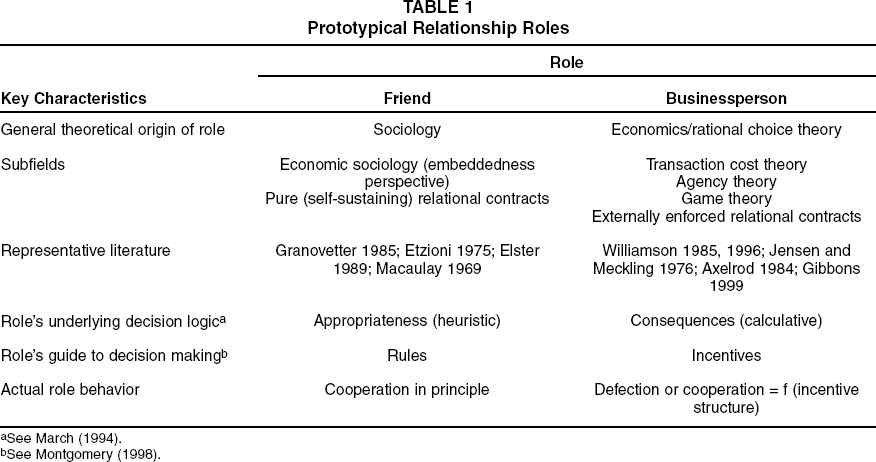
See March (1994).
See Montgomery (1998).
The Coexistence of Logics: A Decision-Theoretic Perspective on Relationship Roles
Notably, although the bodies of theory that provide the basis for the two prototypical relationship roles are quite different, as Table 1 shows, they tend to converge on the same general assumption, namely, that decision makers either follow rules or maximize utility or, more generally, that they play a single role (friend or businessperson) over time. In Gambetta's (1996) terminology, a decision maker either (1) “is pushed from behind” (by preexisting rules) or (2) “jumps” (toward the alternative with the highest payoff).
We wish to challenge this assumption. Although we view the two roles as distinct, in the sense that one or the other may be applied to an individual decision, we believe that the two can also coexist within a given party in the form of latent predispositions (Friedberg 2000; Greenwald and Pratkanis 1984). This is consistent with Powell and Smith-Doerr's (1994, p. 371) argument that “identities are forged out of porous, multi-stranded relations in which business, reputation, and friendship are entangled.”
A largely unaddressed issue, however, pertains to the specific manner in which roles coexist. Consider again the argument that an organizational role represents a form of identity or mental model of a relationship (Albert and Whetten 1985; Messick 1999). At a given time, based in part on a relationship's unique interaction history, a particular identity will dominate a party's approach to that relationship (Oakes 1987). For example, a manufacturer may view a certain supplier as a friend, and the manufacturer's general approach to the relationship may be reflected in friend types of actions, as in Uzzi's (1997) example, which we described previously.
However, although the supplier in question may have friend status, the manufacturer can simultaneously possess a mental model of businessperson suppliers based on actual experiences in other relationships or on general industry observation. Over time, depending on the focal supplier's actions, the established relationship roles may be subject to reassessment.
Research in organization theory (e.g., Albert and Whet-ten 1985) describes how identities are formed by inter-organizational comparison processes that directly affect organizational action. If a given comparison process produces a sufficiently large “identity gap,” certain congruence-enhancing responses are triggered, such as a reassessment of a party's own identity and/or the partner's. For example, to the extent that a supplier pursues actions normally associated with a businessperson role, a complex process of role switching may be initiated. For example, the former supplier friend may be assigned to a new category (a businessperson), and the manufacturer's own role may receive a similar designation.
Larson (1992, pp. 86–100) provides an example of how a role shift can also be triggered by external factors:
[T]he role shift occurred when “Support Products” (SP) was acquired by a much larger corporation. Before it was acquired, the company had a reputation for developing close supplier relationships, characterized by an ethos of friendship and mutual assistance. SP's procurement manager described the philosophy behind the firm's key supplier partnerships: “These people are extensions of your own organization—they are part of your family.” When SP was acquired, the new parent imposed internal sourcing requirements on its newly acquired division that dramatically altered the terms and character of SP's supplier alliances. The partnership philosophy was replaced by a short-term, cost-only focus. SP's purchasing manager explained that as a consequence, the relationships shifted, and collaboration and special treatment became increasingly unlikely.
At a general level, role-switching processes have been described as transitions between “primary and secondary frameworks” (Goffman 1969) or between “quasi-stationary equilibria” (Ashforth 2001). The actual transitions have sometimes been described in terms of “unfreezing” and “refreezing,” suggesting that role switching is subject to inertia pertaining to both (1) a partner's new designation and (2) a party's own role and associated behaviors. Regarding the former, a given event or situational cue (e.g., a supplier that used to be viewed as a friend refuses to adapt to changing circumstances) may trigger doubts about the viability of the existing role. However, an actual recategorization of the supplier need not take place, at least not without additional confirmatory evidence. A chief executive officer who Uzzi (1997, pp. 44–45) interviewed provided the following description: “Sometimes they ask for a favor (e.g., a low price) and we'll do it. But if they always do that, they're ripping me off.”
Similarly, the focal party (i.e., the manufacturer) may continue to play an existing role, even in the face of evidence about a partner's new role, to the extent that the focal actions reaffirm the firm's own identity and, in general, reduce uncertainty (Turner et al. 1987). In addition, an existing role may be “sticky” (Bolton and Reed 2004) to the extent that it is shared by other parties or referents (Ash-forth 2001). For example, a manufacturer that has a global reputation as a friend in a larger industrial network may continue to enact a friend role, even toward suppliers whose actions belong to a standard businessperson repertoire. Decision makers may have a baseline tendency to pursue behaviors that reaffirm existing roles.
Numerous accounts of firms’ struggles to change their relationship orientations provide evidence of role stickiness. For example, Lyons, Krachenberg, and Henke (1990, p. 33) report the following statement that a senior executive made about his firm's attempted change in supplier strategy: “We've had to outplace or retire some of our most experienced, veteran buyers. It was just too much to expect them to change from playing poker with suppliers to cooperating with them. The old ways and the new game just didn't match.”
Despite the possibility of role stickiness, the general conclusion from the previous discussion is that parties may possess multiple identities over time, even within the context of an individual relationship. As such, rather than applying fixed characterizations, such as calculative or heuristic, we view relationship parties as collections of roles. Although the dual role conceptualization of friend and businessperson is admittedly somewhat simplistic, it nonetheless provides a useful starting point for building a theory of relationship roles.
Roles and Governance Decisions: A Conceptual Framework
In this section, we outline a framework that specifies how roles are (1) initially created in relationships and (2) subsequently activated. We also sketch out possible linkages between roles and particular relationship outcomes. As we discuss throughout the section, these outcomes pertain both to the roles themselves (e.g., reinforcement of current roles or switching) and to various economic dimensions. For example, the consequence of a firm's decision to begin monitoring a supplier “friend,” which, by definition, would not require external surveillance, may be an economic opportunity cost.
In developing the framework, we integrate the notion of a role with extant frameworks of interfirm governance (e.g., Cannon and Perreault 1999; Heide 1994; Ouchi 1979; Wathne and Heide 2000). The governance literature provides a useful building block because it identifies particular relationship management mechanisms with different time dimensions, which can be expected to serve particular role creation and activation purposes. We first review a core set of governance mechanisms and their general properties. Then, we discuss their particular purposes in relation to relationship roles.
General Governance Mechanisms
Ouchi (1979) discusses two broad relationship management strategies available to firms: A firm can (1) identify parties that “fit its needs exactly” (p. 840) or (2) design a managerial system that specifically promotes desired behaviors. In practice, as suggested by extant governance typologies (e.g., Heide 1994; Wathne and Heide 2000), the former approach can be implemented through selection and socialization efforts, whereas the latter tends to be based on incentives and monitoring. Although our primary focus is not on these mechanisms per se, a brief review of each, including examples of actual industry practice, provides a useful foundation for the presentation of our role framework.
Selection
Relationship governance through selection involves identifying exchange partners a priori that exhibit a good fit on particular criteria. The selection criteria may involve both skills (e.g., product quality and human resources) and values (e.g., cultural compatibility). Recent industry accounts (Killian 2003) show how companies such as Culver's and Home Depot rely on both types of criteria to select their franchisees and suppliers, respectively. Ford Motor Company has formalized its selection efforts through specialized supplier qualification programs, which serve as a trial period for prospective suppliers (Purchasing 1995). For some companies, such as the food retailers Whole Foods Market and Pret A Manger, selection is such an integral part of the companies’ overall strategies that their elaborate practices are explicitly communicated to their stakeholders. For example, Pret A Manger's promotional materials describe its selection practices as “treasure hunting.”
Socialization
Conceptually, socialization is the process by which new parties learn skills and internalize another party's values, goals, and rules (Chatman 1991). Socialization can happen informally over the normal course of a relationship, or processes can be explicitly designed to promote learning and internalization. As an example of the latter, many corporations have established their own universities as a way to both develop particular skills and promote particular values. These efforts range from McDonald's attempt to get franchisees to “March to a single McDrum” (The Economist 1999), to Saturn's investments in “Saturnizing” dealership employees (Meister 1998), to Motorola's training of supplier and distributor “Black Belts” (Corporate University Review 2000). Supplier qualification programs, as we discussed previously, may also serve distinct socialization purposes, in that a party is asked to take on a future role in an “anticipatory” way (Biddle 1979; Dubinsky et al. 1986).
Incentives
A cornerstone of agency theory (e.g., Jensen and Meckling 1976) is relationship management through explicit incentives. For example, manufacturers can manage their reseller relationships through commissions (John and Weitz 1989), margins (Dutta, Bergen, and John 1994), bonuses (Gilliland 2003), or some combination thereof. Cisco recently launched a reseller program called “Take Stock in Cisco,” which provides “share points” in return for selling particular Cisco products (Schick 2001). In general, the rationale for the use of incentives is to structure a relationship in such a way that particular actions are explicitly rewarded or punished (Telser 1980).
Monitoring
The final governance strategy involves explicit measurement of partner performance relative to some preexisting agreement or standard (Anderson and Oliver 1987). In principle, a firm's monitoring may include a partner's output or behavior, and it can be implemented in various ways. For example, industrial buyers may monitor their component suppliers using incoming inspection, evaluation of statistical process control charts, or actual audits of a supplier's plant. Firms such as Sears have formalized their monitoring process by developing “vendor report cards” (Aron 1998). Franchisors such as McDonald's rely on “undercover” agents who evaluate franchisees on attributes such as food quality, speed, and store cleanliness (Tatge 2001). Recently, Arby's and 7-Eleven have begun to experiment with electronic surveillance systems (Shirouzu and Bigness 1997).
Our conceptual framework (see Figure 1) is based on the premise of inherent matches between particular governance mechanisms on the one hand and different relationship roles on the other hand. Specifically, we propose that relationship strategies, which emphasize “clanlike” selection and socialization, are inherently linked with the role of a friend and rule-based decision making under a logic of appropriateness. In contrast, the “harder” governance mechanisms of incentives and monitoring are linked to a businessperson role and its logic of consequences. Our framework suggests that a firm's governance decisions can affect both (1) the creation of relationship roles ex ante and (2) the activation of roles over time.

Conceptual Framework
Ex Ante Role Creation
In principle, all the governance mechanisms we discussed previously are capable of creating relationship roles. However, the specific manner in which the relevant roles are created may differ dramatically.
Consider selection and socialization as a starting point. Such efforts are inherently associated with a logic of appropriateness, in the sense that a firm attempts either (1) to identify a friend that already possesses the relevant rules or (2) to develop one through social processes. Supplier qualification programs, which we discussed previously, may create friend roles in both of these manners. Note that the role creation process under a qualification program is direct, in that one firm (e.g., a buyer) targets its governance efforts toward a particular party (e.g., an individual supplier). Theoretically, role creation in this manner involves creating an “embedded” market through social processes (Granovetter 1985). We illustrate the relevant processes in Figure 1 through the top-left vertical arrow.
Governance mechanisms may also establish roles in an indirect way by allowing parties to signal their predispositions and self-select into the relationship. Consider the previously discussed businessperson role and governance efforts in the form of incentives and monitoring. As we discuss in further detail subsequently, such strategies may be inherently incompatible with a friend role. However, to the extent that a given firm has a known reputation ex ante for relying on monitoring and incentives, it allows other parties, which already possess dominant businessperson roles and for which such mechanisms are consistent with their decision-making mode (i.e., a logic of consequences), to self-select into the relationship.
As Stryker (1968) describes, people have a tendency to seek out opportunities to enact a “salient identity.” Gambetta (1996) provides an interesting account of how publicly known incentive systems serve as distinct self-selection devices into academic institutions. Similarly, franchisors attract franchisees to run their independent stores whose mind-sets are consistent with incentive systems based on “residual claims” (Brickley and Dark 1987). The Swedish furniture company IKEA has a well-known system of supplier competition, in which both incumbent and integrated suppliers must compete like independent contractors with new suppliers on an ongoing basis (Margonelli 2002). This system creates a particular form of incentive structure, which allows “appropriate” suppliers (i.e., those that possess compatible orientations) to self-select into the manufacturer relationship. The (indirect) creation of a businessperson role in this manner involves the establishment of a conventional “market” rather than an “embedded” relationship (Baker 1990; Williamson 1975). The top-right vertical arrow in Figure 1 depicts these processes. 5
For simplicity, in the previous discussion (and in Figure 1), we associated direct governance efforts with selection and socialization and a friend role, but firms may also rely on such efforts to create a businessperson. For example, Ryan and Deci (2000) describe how one party may internalize another's economic goals. Conceptually, however, the ongoing behavior that follows from this form of internalization is guided by utility-maximizing considerations under a logic of consequences. Moreover, although we discussed the possibility of (indirect) self-selection in the context of monitoring and incentives and a businessperson role, self-selection can also be associated with other governance mechanisms (e.g., socialization). For example, Camerer and Vepsalainen (1988) discuss how companies that make their cultures visible create opportunities for self-selection.
Ex Post Role Activation
In addition to creating roles ex ante, as we discussed previously, governance mechanisms also play important ex post functions in relation to relationship roles. As was the case previously, our framework is based on the assumption that certain linkages exist between (1) the decision “logics” that underlie particular roles and (2) the inherent nature of particular governance mechanisms.
These linkages may manifest themselves in two different ways: First, the role that currently dominates a party's approach to a certain relationship may be reinforced by the other party's governance choices. The reinforcement scenarios, which involve “matches” between roles and governance mechanisms, appear in Cells 1, 5, and 6 in Figure 1. Alternatively, to the extent that a particular governance mechanism is incompatible with the current role's decision logic, a mismatch scenario is created, as we show in Cells 2, 3 and 4. If the current role is sticky, as we previously discussed, the immediate outcome of a mismatch scenario may be maintenance or perhaps dilution of the current role. However, there is also the possibility that a mismatch will produce actual role switching.
As we discuss subsequently, the upshot of our framework is that the different ex post scenarios produce immediate outcomes with respect to the roles themselves (e.g., reinforcement or switching). In addition, the different scenarios have long-term consequences of both a behavioral and an economic nature. We first discuss the possible ex post scenarios for an existing friend role, and then we sketch out the parallel scenarios for a businessperson role.
Existing friend role
Assume that a firm's initial governance efforts toward a particular exchange partner involved selection or socialization and that these efforts succeeded in establishing a friend role for the partner. Given these initial efforts, the relationship will end up in Cell 1, Cell 2, or Cell 3, depending on the subsequent governance choices. If the firm continues to rely on socialization (Cell 1), the partner's current role will be reinforced. For example, a supplier that has achieved friend status may sustain and possibly increase the original level of rule-based cooperation. Given the evidence that initial socialization effects tend to decay over time (Harrison and Caroll 1991), this form of role reinforcement may be an important relationship initiative. As a specific example, Tupperware organizes regular “homecoming jubilees” for its top sellers, which include the singing of an anthem called “I've got that Tupper Feeling” (Brooks 2004).
However, if the firm in question deploys explicit incentives (Cell 2) or monitoring (Cell 3), there is a distinct possibility of a mismatch between (1) the decision logic inherent in the established role (i.e., a friend's logic of appropriateness) and (2) the use of governance mechanisms that are inherently tied to a logic of consequences. From a purely descriptive perspective, the available evidence suggests that such mismatches are not unlikely. For example, Gardiner (2003, p. 18) argues that firms “are not good at judging motivations” and, consequently, are prone to “heavy and misplaced” reliance on incentive-based strategies.
What are the potential outcomes of a mismatch? It is possible that the existing role will continue to be enacted by the partner, though in a weakened or diluted state. Specifically, a new governance regime may create an “identity gap,” as we previously discussed, and trigger doubts about the viability of the existing relationship roles. For example, a supplier that historically has categorized a given buyer as a friend but subsequently becomes subjected to a stringent monitoring system may reclassify the buyer as a business-person. 6 It is conceivable that the supplier itself, as a result of role stickiness, will continue to enact the friend role. However, going forward, the supplier's behaviors are likely to be in the form of perfunctory compliance with the buyer's strategy (Moschandreas 1997). For example, the supplier may continue to deliver components according to a fixed delivery schedule but refuse to accommodate special requests during unusual demand conditions (Wathne and Heide 2000). In this scenario, the buyer's governance efforts are actually dysfunctional and associated with opportunity costs because costly initiatives are deployed toward a party that has already internalized a friend role.
Technically, such determinations are made on the basis of stylized “if–then” statements (Hayek 1945). For example, if a buyer monitors, then he or she will be recognized as a businessperson.
Perhaps more seriously, it is also possible that the buyer's use of market-based governance mechanisms in such situations produces actual role switching. The identity gap may lead to a recategorization for the supplier, resulting in a matching businessperson role with an entirely new behavioral repertoire. As a specific example of role switching, consider 7-Eleven's decision to impose an electronic monitoring system on its franchisees. As various sources (e.g., Coughlan et al. 2001; Lal and Han 2005) describe, 7-Eleven franchisees are frequently attracted to the system in the first place because of perceived compatibility between the company's operating philosophy and their own mind-sets. However, the implementation of a “draconian” electronic surveillance system was viewed as such a fundamental shift in management philosophy that it caused severe reactions among the franchisees, some of which were subsequently described as “militant radicals” (Shirouzu and Bigness 1997).
In addition to the direct effects on roles themselves, the mismatch scenarios may produce various long-term outcomes. For example, the new behavioral repertoire that follows from a role switch may include retaliatory actions, which are “characteristically opportunistic” in nature (John 1984, p. 280). Over time, this may have economic consequences in the form of high direct transaction costs in the ongoing relationship.
Importantly, both the general possibility and consequences of role switching are well documented. Kreps (1997, p. 363) notes that a firm that historically has not monitored closely in a given relationship and that has not relied on strong extrinsic incentives may create “muddiness” and a shift in relationship orientation. Tenbrunsel and Messick (1999) show empirically that surveillance and sanctioning systems can change both (1) a party's orientation toward a partner and (2) the actual choice rule used. Specifically, they show that the use of such hard relationship features increased the likelihood that a business type of frame was evoked, which in turn induced a calculative decision rule. Notably, Tenbrunsel and Messick also show that after a business frame was evoked, a weak surveillance and sanctioning system that was intended to increase cooperation actually decreased the likelihood of cooperative behaviors.
The preceding discussion implies that a perceived role switch by an exchange partner may affect a party's own decision logic and that the shift may have nonintuitive (and negative) consequences. In Nagin and colleagues’ (2002) terminology, these consequences follow from applying a “rational cheater” model and its underlying assumption (i.e., logic of consequences) to situations in which decision makers are currently working under a “conscience model” or under a logic of appropriateness. Notably, and somewhat disturbingly, Anderson and Jap (2005) cite fieldwork and psychological research that document that close interfirm relationships are particularly vulnerable to showing a “dark side.”
Existing businessperson role
We now consider a situation in which a party already makes decisions as part of a businessperson role and in which the focal behavioral repertoire is based on a logic of consequences. In Figure 1, the possible scenarios appear in Cells 4, 5, and 6. The matches are represented by Cells 5 and 6, in which incentives and monitoring are deployed toward a party whose current role is consistent with the use of such mechanisms. We expect that the outcome of these scenarios is reinforcement of the current role. Notably, there is evidence that suggests that such matches have distinct performance implications. For example, Tenbrunsel and Messick (1999) show that when a business type of decision frame was evoked in a relationship, strong sanctions indeed increased cooperation.
The mismatch scenario for an existing businessperson role appears in Cell 4. A party whose current mental model is based on a logic of consequences is subsequently subjected to socialization. Although this scenario involves a mismatch, we do not necessarily predict a role switch. Instead, relying on socialization in such a situation may simply cause a resource waste, to the extent that the relevant efforts fail to convert the businessperson to a friend. The magnitude of the socialization efforts needed to induce such a switch is likely to be substantial, as evidenced by Mitsubishi Motor Corporation's efforts to reverse its adversarial supplier relationships (Smitka 2001). To regain its suppliers’ support, Mitsubishi Motor Corporation went so far as to establish a formal supplier association and a technical support center staffed with 70 full-time engineers.
Notably, to the extent that a firm's relationship efforts involve dedicated investments, as in the preceding example, a failure to bring about a role switch in a businessperson may produce a mismatch scenario with substantial economic implications. To illustrate, consider Jackson's (1985) analysis of the risks associated with using “relationship marketing” initiatives toward customers that operate under a “transaction” orientation. For example, a supplier that develops a dedicated product and delivery system for a buyer that is looking for only a temporary source of capacity may not only fail to reap the returns from the investments but also subsequently face a significant lock-in condition (Klein, Crawford, and Alchian 1978). This suggests that explicit attention to roles can be an important prerequisite for relationship investment decisions.
Discussion
Theoretical Implications and Relationships with Prior Research
Much of the extant research on interfirm relationships has focused, explicitly or implicitly, on the orientations that parties bring to bear on their interaction. In some of this literature, a sharp distinction has been drawn between different types of orientations. For example, one particular body of research emphasizes calculative orientations, which correspond to March's (1994) logic of consequences. Many of the theoretical frameworks used to study interfirm relationships (e.g., Axelrod 1984; Eisenhardt 1989; Williamson 1985) belong to this category. At the same time, there are theoretical accounts and empirical evidence, primarily from sociology and contract law (e.g., Macaulay 1963; Uzzi 1997) of heuristic orientations, which are consistent with a logic of appropriateness. Overall, however, the extant literature tends to take an “either–or” type of approach, implicitly assuming that relationships can be described in terms of a single orientation.
Our central argument is that such categorical distinctions may be too simplistic. On the one hand, we subscribe to the general distinction between the logics of consequences and appropriateness, as they pertain to individual relationship episodes. As such, our framework is consistent with prior work that describes relationships in terms of locations on particular continuums, such as the degree of trust, commitment, and long-term orientation. Specifically, a high “score” on such a dimension in a given situation would most likely reflect the strength of a prevailing friend role. On the other hand, the upshot of our framework is that descriptions along single dimensions may not fully capture the true nature of relationship interactions. We posit that exchange relationships may simultaneously involve different types of orientations. Importantly, this goes beyond acknowledging that relationships are multidimensional, in the sense of joint descriptions on intercorrelated attributes (e.g., different relational norms). Although we endorse this view as it applies to individual transactions, our framework is based on the assumption that actual shifts among fundamentally different relationship orientations are both possible and likely.
Theoretically, our framework begins to provide an interactive perspective on relationship formation and management. For example, a firm may rely simultaneously on (direct) selection processes and on (indirect) opportunities for self-selection through various incentive and monitoring devices. The notion of self-selection suggests that though a particular governance process can be initiated by one party, its ultimate success depends on the other party's tendency to seek out a salient role. As such, our framework suggests that certain governance mechanisms, which have often been described primarily from the perspective of a single firm (i.e., the principal), actually involve and, in a broader sense, are available to both relationship parties. Moreover, interactivity follows from the notion that firms judge a partner's role on the basis of the particular governance choices made, and these judgments ultimately influence the focal firm's own role and relationship decisions. Our framework conceptualizes relationship roles as the products of complex processes that involve multiple parties, governance repertoires, and judgments.
In a recent article, Stout and Blair (2001) criticize certain branches of extant social science research for treating decision making as a “black box” and for being limited to observing particular antecedents and outcomes without accounting for the underlying process. Similar critiques have been voiced by others, who have asked for greater attention to what lies behind choices (Hodgson 1997) and for “mechanism-based explanations” (Hedström and Swedberg 1998, p. 9). In a broad sense, our framework is an attempt to shed some light on this issue. We propose that the concept of a role may yield some insight into the black box and that it may help integrate discrepant theoretical perspectives on relationships and interactions.
Finally, we believe that our role framework has the potential to generate new insights into the unit-of-analysis issue in relationship research. Consider the literature on transaction costs as an example. In this literature, the individual transaction has been suggested as the key unit of analysis (Williamson 1996). Rindfleisch and Heide (1997) note how this assumption has manifested itself in empirical work in the form of a focus on dyadic relationships. Recently, however, this particular focus has been described as being too restrictive, insofar as it ignores the effects of related relationship dyads. As a consequence, researchers have begun to adopt larger units of analysis, such as multiple dyads and networks (e.g., Wathne and Heide 2004).
For all practical purposes, adopting a network perspective means broadening the unit of analysis and taking a macro perspective on relationship research. Although we acknowledge the importance of such a perspective, our framework represents a call for disaggregation, that is, for a micro-level account of relationships and parties. Specifically, our role framework suggests that relationships cannot be properly understood without explicit recognition of both (1) the set of roles with which firms approach relationships in the first place and (2) the ability of relationship management strategies to reinforce or dilute those roles or to cause actual switching. In certain respects, our framework recognizes the “decision premise” as an important unit of analysis, consistent with Simon's (1947) early recommendation.
Importantly, this does not diminish the need to study larger marketing networks. However, accounting for roles suggests that certain phenomena are more complex than frequently assumed. For example, it is possible that the use of particular strategies in one relationship influences not only the pattern of roles in that particular relationship but also the possibility of role switching in related ones. Heide (2003) recently showed that market relationships that coexist with an integrated operation within a so-called plural system exhibit more hierarchical characteristics than singular ones, as a result of spillover effects across connected relationships. In general, we believe that a role-theoretic model of relationship governance may be useful in documenting processes at both a micro and a macro level and both within and across parties and relationships.
Managerial Implications
A considerable body of literature has emerged in marketing on the general topic of governance and relationship management strategies. Both academic research and industry observation suggest that firms’ governance decisions are important parts of their overall marketing strategies (Ghosh and John 1999). Moreover, firms’ governance choices have been shown to have distinct performance implications (e.g., Buvik and John 2000).
However, the focus in prior research has often been strictly on the governance mechanisms themselves. For example, Baker and Faulkner (1991) develop a set of general recommendations for relationship management, which include the explicit use of incentives (“link pay with performance”), monitoring (“increase accountability”), and related initiatives. Although we do not dispute the possible usefulness of such efforts, we suggest a caveat about the generic use of any governance program. Our conceptual framework accounts for the notion that inherent linkages exist between roles and governance mechanisms and that firms’ governance decisions must be made in a context-sensitive manner and with explicit attention to the ability of governance mechanisms both to create roles initially and to activate them over time. In general, understanding relationship roles is an important prerequisite for governance deployment.
In managing relationships, firms must also carefully consider both roles and functions. Consistent with recent role theory, we draw an explicit distinction between the two. For example, in a supply chain context, there is a crucial difference between functions such as inventory maintenance and forecasting and the specific manner in which they are carried out (i.e., as a friend or businessperson). As Kahn (2003) notes, the implementation of efficient-consumer-response and quick-response types of initiatives requires fundamental changes in relationships between supply chain partners with respect to both the allocation of functions and overall relationship orientation.
To some extent, the focus of our conceptual framework is on mismatches between governance decisions and roles and on their potential outcomes. For example, we suggest that incentives and monitoring, which have been recommended as generic relationship management initiatives (e.g., Baker and Faulkner 1991), are intrinsically linked with only one type of role, namely, that of a businessperson. Crucially, deploying such strategies in other contexts (i.e., toward friends) not only may be ineffective or cause resource waste but also may cause role switching and subsequent activation of behavioral repertoires that may include opportunism.
Notably, although the concept of relationship roles has received little systematic attention in extant research, it is frequently suggested as a key explanation of relationship problems. For example, Solomon and colleagues (1985, p. 105) note how a “failure to read from a common script” is a typical cause of difficulties in relationships between clients and service providers. Similarly, Uzzi (1999, p. 502) concludes that it is inherently difficult to form ties between parties that “use alternate scripts.” Although more fine-grained guidelines for managerial decision making require a body of empirical evidence, our general conclusion is that firms’ governance decisions are inherently more complex than is frequently assumed and that such decisions may hinge crucially on detailed assessments of relationship roles.
Issues for Further Research
Our conceptual framework in Figure 1 involves a series of research issues and hypotheses that can be tested empirically. In general, the underlying philosophy of the frame-work is that linkages exist among (1) ex ante roles or “initial conditions” (Cowen 1998), (2) governance strategies, and (3) outcomes. Clarification of the specific nature of these linkages requires empirical testing, including efforts to measure directly and account for relationship roles. We echo Kreps's (1997, p. 364) sentiments that such empirical efforts are “likely to be messy.” Nonetheless, increasing the understanding of roles and their interplay with established relationship constructs seems to be an important research priority.
In addition to the general research agenda inherent in our conceptual framework, there are additional, more specific research issues that should be systematically examined. We discuss some of them next.
Relationship investments and resource allocation decisions
Important issues pertain to the linkage between roles and profitability. Most likely, the two particular roles we discuss herein differ substantially in terms of their cashflow patterns. For example, creating a friend role may require significant up-front investments, for example, in the form of selection and socialization efforts. At the same time, after a friend is established, it may be cheaper to maintain than a businessperson. However, note that certain types of exchange partners that may fit a friend profile can become demanding and costly to serve (Reinartz and Kumar 2003).
It is also important to document how strongly roles are held and how easily they can be switched or “unfrozen.” For example, if certain customers have undesirable cost implications, as suggested in Reinartz and Kumar's (2003) research, and if established roles are indeed sticky, it suggests that a firm's role creation decisions must be approached in a deliberate and forward-looking manner.
At the same time, although existing sticky roles may have nontrivial cost implications, they may also represent sources of competitive advantage. For example, consider an industrial supplier that enjoys sticky friend relationships with its buyers. From the standpoint of a competing supplier, this raises important questions about both (1) the specific sources of role stickiness and (2) the particular “corrective procedures” (Bolton and Reed 2004) that may undermine the incumbent supplier's relationships.
Finally, a related profitability issue pertains to resource allocation decisions across relationship types within an overall portfolio (Johnson, Sohi, and Grewal 2004; Johnson and Selnes 2004). At a given time, a firm may possess a mix of roles in its portfolio, and decisions must be made about how to allocate scarce resources among them. Dickson and colleagues (2004) note how firms may need to make fundamental allocation choices between (1) using scarce resources to reinforce prior behavior (e.g., in a current friend relationship) and (2) using them to solve problems in others (e.g., trying to convert a businessperson). These types of issues require firms to consider both initiation and maintenance costs carefully, at the relationship and the portfolio levels.
Relationship perceptions
As we noted previously, deploying governance mechanisms without a careful consideration of existing relationship roles may have unintended consequences, such as resource waste and role switching. Given the well-documented finding that firms have divergent perceptions about their interaction (e.g., Wathne, Biong, and Heide 2001), such scenarios are not unlikely. Indeed, on the basis of previous research, it might be expected that the potential for mismatches between governance deployment and prevailing roles is high and that this may be a possible explanation of relationship failure. Research could be directed usefully toward documenting (1) the manner in which role perceptions are established and (2) whether particular roles are uniquely held by an individual party or are shared in some way. A related question is whether a party may misrepresent a given role. In The Republic, Plato discusses how Socrates defines a friend as “one who both seems and is an honest man.” 7 It is clear that distinct opportunities exist, at least in the short run, for “seeming” and for the misrepresentation of roles. This raises important relationship management challenges in its own right.
See Plato (2000), The Republic, trans. Tom Griffith. Cambridge, UK: Cambridge University Press.
In general, role theory suggests that a distinction can be made between perceptions that pertain to (1) a specific exchange partner, as per our framework, and (2) certain positions or organizational forms (Biddle 1979; Forman and Whetten 2002), as per conventional role theory. For example, a manufacturer may have a perception of retailers in general, which will influence its approach to a particular partner. As a specific example, a manufacturer whose prior interaction has primarily involved smaller retail clients may perceive retailers in general as friends and therefore approach new retail relationships with this particular orientation. Our framework highlights the risks associated with such mental shortcuts, insofar as they produce costly mismatched governance initiatives.
Issues such as those we present in the preceding discussion illustrate how roles can be conceptualized at multiple levels of analysis. With increasing demand for cross-level constructs and theories (e.g., Klein and Kozlowski 2000; Rousseau 1985), role theory represents a promising avenue for further research. Our discussion also reinforces the importance of continuing to direct relationship research toward improving the understanding of human behavior. Notably, Williamson (1996, p. 266), who is frequently criticized for the particular behavioral assumptions that underlie transaction cost economics, explicitly suggests that “more microanalytic attention to the processes through which trading relationships evolve is indeed a rewarding research enterprise.” Similarly, Tenbrunsel and Messick (1999, p. 706) emphasize the “need to explore assumptions” about decision makers and their reactions to the mechanisms that are deployed in exchange relationships. Although continued theoretical integration and empirical research may turn out to be messy, the resultant insights could be considerable.