







Abstract
The current understanding of reference pricing requires broadening to reflect contemporary advertising practices and shopping behavior. A content analysis of 13,594 newspaper retail advertisements reveals that it is uncommon for reference pricing to be used alone in advertisements: 87.2% of the advertisements featuring reference pricing also include limited-time availability (i.e., “Three days only!”) or sale announcements in the headline or copy. Using dual-process theories of persuasion as a conceptual framework, the authors conduct three field experiments that compare the conditions under which the use of limited-time availability and sale announcements in advertisements that feature reference prices affects consumer price perceptions and store shopping intentions. The findings yield three insights for reference price advertising. First, reference pricing results in favorable price perceptions and store shopping intentions only when consumers are shopping for a product. Second, when consumers are shopping for a product, reference pricing paired with limited-time availability results in more favorable price perceptions and store shopping intentions than the use of either technique alone. Third, the use of sale announcements and limited-time availability in reference price advertisements has a favorable effect on price perceptions and store shopping intentions when consumers are not shopping for a product.
Regularly: $599; Now: $359 Sale! Three Days Only
Although reference pricing, limited-time availability, and sale announcements appear with some regularity in retail advertising, little empirical evidence documents the incidence and coincidence of their use. For example, a content analysis of sales advertisements by six major retail chains over the 2001 Labor Day weekend revealed that approximately 72% employed reference pricing in their advertisements (Chandrashekaran, Monroe, and Viswanathan 2004). Although not reported, it is reasonable to speculate that many, if not most, of these advertisements also contained headlines or copy heralding a “Three days only!” Labor Day weekend sale to convey the limited-time availability of price reductions offered.
To obtain a broader perspective on the incidence and coincidence of reference pricing, limited-time availability, and sale announcements in retail advertising, we conducted a content analysis of 13,594 retail advertisements in four major, geographically dispersed U.S. newspapers over a six-month period in 2004. 1 We examined the Chicago Tribune, The Dallas Morning News, Los Angeles Times, and The New York Times. Each advertisement was coded to identify whether reference pricing, limited-time availability, and sale announcements were included in the advertisement's headline or copy. Table 1 presents the frequency counts based on the content analysis. Several findings deserve mention. Approximately 29% of the advertisements featured reference pricing, limited-time availability, or a sale announcement in the headline or copy either alone or in combination. Sale announcements alone were displayed most often (9.0% of advertisements), followed by limited-time availability alone (7.9% of advertisements), and reference pricing alone (.9% of advertisements). All three appeared concurrently in 2.7% of the advertisements. Limited-time availability was present in 58.8% of the advertisements that featured reference pricing, and sale announcements appeared in 69.3% of those advertisements. Sale announcements appeared in 47.0% of the advertisements that contained limited-time offers. Finally, and most important, 87.2% of the 912 advertisements that displayed reference prices also included sale announcements or limited-time availability in the headline or copy. These findings demonstrate that retailers commonly pair reference price information with limited-time availability and sale announcements in their newspaper advertisements.
Sources for all four newspapers confirmed that advertisements that are 17 square inches or larger in size (e.g., two columns wide x four inches in height) account for more than 90% of the display ad revenues, and we examined all such advertisements. We collected data from four newspapers to provide representation of different regions of the country for a 195-day period that included Memorial Day through Thanksgiving. Two research assistants performed the coding, and we confirmed it. Reference pricing included all forms of price comparisons in which high/low dollar amounts were explicitly stated (e.g., “Regularly $_____, Now $_____ ”; “Manufacturer's List Price $_____, Sale Price $_____ ”). Limited-time availability included wording such as “_____ Days (Hours) Only”; “Hurry! Offer Ends Soon”; and “This Weekend Only!” Sale included the word “sale” and synonyms, such as “clearance/closeout,” “liquidation,” “going out of business,” “deal,” or “special” (with the word “sale” itself accounting for 80.1% of the occurrences).
Incidence of Reference Pricing, Limited-Time Offers, and Sale Announcements Featured in Newspaper Advertisements (N = 13,594)
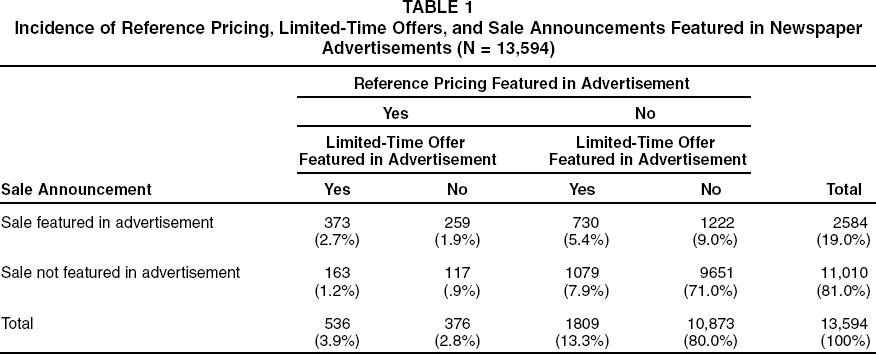
Our finding that reference pricing is rarely used in isolation in retail advertisement headlines and copy stands in stark contrast to behavioral research on reference price effects (for literature reviews, see Biswas, Wilson, and Licata 1993; Compeau and Grewal 1998). Prior behavioral reference-pricing research has focused almost exclusively on price comparisons and the manner in which they are portrayed but does not consider the coincidental use of limited-time availability and sale cues, which is the more common practice in retail advertisements.
The managerial significance of understanding why and when these variables influence consumer price and value perceptions becomes apparent in light of the dollar expenditures for retail newspaper advertisements that display them. Assuming that our content analysis of retail advertisements in four major newspapers generalize nationally, we estimated that $8.2 billion was spent in 2004 on retail advertising that contained one or more of these appeals, or approximately 18.3% of total retail newspaper advertising expenditures. 2
These estimates for 2004 assume zero ad revenue growth from $44.939 billion spent in 2003 (Newspaper Association of America 2006), with 70% of ad revenues coming from display advertisements (Belch and Belch 2004) and 90% of display revenues coming from advertisements that are 17 square inches or larger in size.
Theoretical Perspectives and Research Purpose
The elaboration likelihood model (Petty and Cacioppo 1986) and the heuristic-systematic model (Chaiken 1980, 1987) are dual-process theories of persuasion that provide a foundation for this research. Both models postulate that high versus low motivation to process advertising information, operationalized through consumer involvement, results in different routes to persuasion: central/systematic (engaged through high-involvement processing) versus peripheral/heuristic (engaged through low-involvement processing). Different types of information are believed to have a persuasive impact under these different routes. This research examines the possibility that reference pricing, limited-time availability, and sale cues have inherent differences in their information-processing requirements, and thus consumers who are shopping (high involvement) versus those who are not shopping (low involvement) for a product featured in an advertisement respond to them differently. In particular, we argue that comprehending the full value implications inherent in reference price information requires more thought and effort and, thus, greater involvement than limited time or sale cues.
The purpose of this investigation is to broaden the scope of reference price research to reflect contemporary retail advertising practices. Specifically, we examine the context in which and extent to which limited-time availability and sale cues in retail advertisements that feature reference pricing affect consumer price persuasion and store shopping intentions. We provide an overview of research on the major variables we examine, present our hypothesized expectations, and report our findings from three field experiments.
Reference Price Effects
A reference price advertisement is one in which a lower, current price is compared with a higher price either previously offered or offered by someone else. Considerable research in the marketing literature confirms the presence of reference price effects (Biswas, Wilson, and Licata 1993; Compeau and Grewal 1998; Kalyanaram and Winer 1995; Krishna et al. 2002; Mazumdar, Raj, and Sinha 2005). That is, when reference and retail (offering) prices are presented together, they are compared, and this comparison has a favorable effect on consumer deal perceptions relative to a condition in which reference prices are not presented. Different theoretical arguments have been advanced to account for reference price effects, including assimilation–contrast (Sherif, Sherif, and Nebergall 1965), adaptation-level theory (Helson 1964), and anchoring-adjustment principles (Tversky and Kahneman 1971). Although these theories make different predictions, they also share commonalities (see Mussweiler 2003). Each agrees that all judgments are relative and how a person evaluates something depends on what he or she uses as a basis for comparison. Furthermore, the location of an initial stimulus on an evaluative continuum (e.g., good versus bad and high versus low) can influence perceptions of a second stimulus on the same continuum, such that if the second is sufficiently different from the first, a person will judge it to be more different than it really is. In this way, a person may perceive a low price for a product as lower relative to a high reference price than when he or she evaluates the same low price in the absence of a reference price, all else being equal.
However, there is research that questions the magnitude and, indeed, the presence of reference price effects. This research suggests that for price- and promotion-sensitive consumers in particular, reference pricing effects may be confounded by other variables (Chang, Siddarth, and Weinberg 1999; Krishna, Currim, and Shoemaker 1991). In summarizing these and related studies, Neslin (2002) concludes that research is necessary to understand how other information contained in advertised promotions influences reference price effects. Our content analysis of retail newspaper advertisements confirms the need for such research.
Limited-Time Availability and Sale Cue Effects
With considerably less attention, the marketing literature has addressed limited-time availability or, more broadly, scarcity and sale cues in retail advertisements. 3 The evidence that exists suggests that limiting a consumer's opportunity to obtain a product makes the product more attractive and affects value perceptions. Empirical data in support of the effectiveness of scarcity in influencing value perceptions have been reported for fast food (Brannon and Brock 2001), batteries (Inman, Peter, and Raghubir 1997), nylon hosiery (Fromkin et al. 1971), and women's suits (Szybillo 1976). Anecdotal evidence of its effectiveness in selling other products also has been reported (see The New York Times 1999; The Wall Street Journal 2003).
Our newspaper content analysis examined different scarcity variations. We based our decision to focus on limited time in this research on the finding that limited time not only was the most frequently used but also was used 3.5 times more often than the next most common variation (limited number/quantity).
With limited-time appeals in advertising, consumers are informed that they have a limited amount of time (e.g., “Three days only!”) to act on an offering. Although there are disagreements about the mechanism by which scarcity cues, in general, affect value perceptions (see Lynn 1992), limited-time availability, in particular, seems to imply value because people have learned over the course of their lives to associate limited-time events with price deals (Cialdini 2001). Thus, favorable price inferences are readily accessible in memory on exposure to limited-time availability cues. Notably, research has documented the same response to sale cues that use this rationale (Inman and McAlister 1993; Inman, McAlister, and Hoyer 1990), and it has been suggested that retail advertisements that contain reference price information should include terms such as “sale” or “special” to communicate that the lower price or discount is only temporary (Grewal et al. 1998). Similarly, the need to include time limits in reference price research and to study their effect on consumer response to advertised price deals has been emphasized (Krishna et al. 2002). However, no research has systematically examined these cues in a reference price advertising context.
Consumer Involvement Effects
Following the work of Zaichkowsky (1985), we define “involvement” as the level of personal relevance that a product or purchase decision has for a consumer. Thus, we contend that people who are shopping for a product are more highly involved with information in an advertisement for that product than people who are shopping for something else. Consumer involvement has been shown to influence both the extent to which people process an advertisement and the type of information included (Chaiken 1980, 1987; Petty and Cacioppo 1986). Highly involved consumers are motivated to scrutinize information, such as prices, more fully, whereas less involved consumers are likely to apply simple heuristics, or judgment-relevant cues that are easily understood (Chen and Chaiken 1999), when processing information (Meyers-Levy and Peracchio 1996), such as the presence of limited-time availability and sale notifications in an advertisement.
From an information-processing perspective, we propose that people should make favorable price inferences more easily on the basis of limited-time availability and sale cues than reference price information in retail advertisements. We expect to find this because the implications of limited-time availability and sale announcements have been learned (Cialdini 2001) and can function as heuristic or peripheral cues (Chaiken 1980, 1987; Petty and Cacioppo 1986) that signal value. However, the value implied by reference pricing is not as easily inferred. Given the great variability that exists in the use of discounts in reference price advertisements (our content analysis revealed that offering prices ranged from 1% to 90% off advertised reference prices), consumers who want to have confidence in the accuracy of their judgments about price must derive, at some level, the value being offered rather than retrieve it from memory, as with limited-time availability and sale related cues. Thus, the cognitive processes involved in judging price favorability should be more complex when using reference price information than when using limited-time availability and sale cues. These differences in information-processing requirements should affect consumers when reference price information and limited-time availability or sale cues are most persuasively presented in retail advertisements.
Although multiple methods of conceptualizing and manipulating involvement have been used (for an overview, see Peter and Olson 2005), an operationalization that directly links active purchase intent among consumers with the processing of information common to retail advertisements in the marketplace is notably absent in the reference pricing literature. This is understandable because approximately 90% of the behavioral studies on reference pricing have been conducted in laboratory settings with student samples (Biswas, Wilson, and Licata 1993; Compeau and Grewal 1998). We contend that a clear stratification of personal product relevance is evident among actual consumers who are (are not) actively shopping for a particular good. 4 For example, a consumer who is engaged in shopping for a bedroom set will be more likely to process information in an advertisement for that product carefully than will a person who is interested in buying a sofa. A consumer who is shopping for a sofa may only incidentally or peripherally process information in an advertisement for a bedroom set. To our knowledge, no reference price advertising research has operationalized consumer involvement in a field setting and examined its influence on consumer price perceptions.
Involvement may be conceptualized as either “enduring” or “situational” (see Hoyer and MacInnis 2004). Enduring involvement reflects an inherent interest in a product independent of a purchase situation (see Chandrashekaran 2004; Chandrashekaran and Grewal 2003). Situational involvement reflects interest in a product caused by situational events, such as a purchase situation. We designed our manipulation of involvement to be situational: We wanted to evaluate ad effects on consumers who were actively engaged in marketplace shopping behavior.
Study 1
Hypothesis
We designed Study 1 to examine the effects of reference price information and a limited-time availability cue on consumer price perceptions across levels of consumer involvement. We hypothesize that reference price information in an advertisement is likely to be effective in favorably influencing price perceptions only for consumers who are in the market for a product (high involvement). We expect that only these consumers will be motivated to expend the cognitive effort necessary to process reference price information fully. Conversely, we expect that consumers who are not in the market for a product (low involvement) will not have an interest in processing information to the degree necessary to make an informed judgment about the value represented by the reference price. This expectation is consistent with Yalch and Elmore-Yalch's (1984) suggestion that peripheral processors sometimes avoid numerical information. Thus, reference price information in advertisements should affect consumer price attitudes under high- but not low-involvement conditions.
We also hypothesize that limited-time availability in an advertisement should have a favorable effect on price judgments under both high- and low-involvement situations. As Petty and Wegener (1999) note, the same information can have an effect on persuasion across conditions of involvement, but different information-processing mechanisms are used. Specifically, although limited-time information can operate as a peripheral cue under low-involvement conditions, it would be evaluated “like all other available information” (Petty and Wegener 1999, p. 59) under high-involvement conditions. Its effect on price persuasion under high-involvement conditions would then depend on whether the limited-time availability of the offer has merit in evaluating price. Inman, Peter, and Raghubir (1997) argue that scarcity can operate both as a peripheral cue and as information evaluated on its merits. They find that consumers believe that limited-time availability has merit as an indicator of likely demand for the product. We believe that this should be especially true in times of consumer uncertainty, for example, when people consider the purchase of infrequently shopped goods, such as consumer durables. Under such conditions, and before the advertised product is physically examined, limited-time information should prove useful as a market valuation attribute, and therefore people should consider it along with other knowledge structures when evaluating price.
Limited-time availability significantly affects price attitudes among consumers who are not shopping for a product.
Limited-time availability and reference pricing significantly affect price attitudes among consumers who are shopping for a product.
These hypotheses are based on our expectation that consumers who are shopping (not shopping) for a product will (will not) allocate the cognitive effort necessary to process fully the value implications of reference prices in an advertisement for that product. Reference prices should affect price perceptions under high- but not under low-involvement conditions. However, the value implications of limited-time information should be easily cued from memory and used when consumers form price attitudes under both high- and low-involvement conditions. Thus, the type of ad information (limited-time availability, reference pricing) to which consumers are exposed will be differentially persuasive depending on the level of consumer shopping involvement.
Products and Prices
We tested our hypothesis over two different products: bedroom sets and sofas. Both products come in a wide range of prices and quality grades within and across furniture stores. Most people infrequently purchase bedroom sets and sofas and are inexperienced shoppers for these goods. Interviews with personnel at the store chain we used in this study, coupled with furniture industry research (Roy 2002), indicate that brand familiarity, store loyalty, and purchase frequency are low among furniture shoppers. We selected these products with the intent of heightening marketplace ambiguity for even high-involvement consumers. As Chandrashekaran (2004; see also Chandrashekaran and Grewal 2003) discusses, when consumers have a high degree of product and price knowledge, reference pricing may not work. Indeed, the effectiveness of advertised reference prices appears to depend on some level of consumer uncertainty about product price levels in the marketplace. We believe that such uncertainty will be true in general for infrequently purchased goods with low levels of brand familiarity.
Another reason for selecting bedroom sets and sofas is that they are often priced differently, thus allowing an examination of whether experimental results generalize across products with such prices. Store personnel and prospective customers (from stores in which study participants were obtained) were interviewed to determine the purchase price range for the advertised products and the content and layout of the advertisements. As a result of these interviews, we set reference prices at the upper end of the most common purchase price range, and we set the offering prices at the lower end of the most common purchase price range. We did this to enhance respondent perceptions of the lower prices as “deals” (Lichtenstein and Bearden 1989). 5 The offering prices for both products represent a 40% markdown from the reference price. Our ad review revealed that the mean markdown (off reference price) for furniture advertised in the area was 40.2%. Retail store personnel and prospective customers were also shown copies of the test advertisements. We confirmed that the reference prices were credible for the products being sold (see Compeau, Grewal, and Chandrashekaran 2002) and that the ad content and layout were representative of what was common to newspaper furniture advertisements in the area.
This pricing procedure also makes theoretical sense. By setting the advertised reference prices at the upper end of the most common purchase price range, we maximized the likelihood that the prices would influence consumers’ internal reference prices, which are often conceptualized as expected or normal market prices or willingness to pay (see, e.g., Chandrashekaran 2004).
Procedure
Furniture shoppers were intercepted entering four different outlets of a well-known, moderately priced, regional furniture store chain in a large city in the Southwest. Bedroom sets and sofas constitute approximately 60% of the retailer's unit sales.
Shoppers were first asked to participate in a research study that was being jointly conducted by a local university and a (fictitious) local advertising association. Participants verbally responded to three questions, including what furniture they were shopping for that day. Those who answered either bedroom sets or sofas (but not both) were asked to participate in an advertising test. Participants were told they would examine print advertisements scheduled to be run the next day in an area newspaper. Those who agreed were handed a portfolio of seven professionally produced black-and-white print advertisements (8 × 10 inch reproductions of newspaper advertisements) and were verbally asked to look through them as they normally would. 6 After participants examined the advertisements, they filled out a questionnaire and were debriefed. No participant compensation was provided.
We used black-and-white test advertisements on the basis of our ad review, which revealed that a majority (72.2%) of limited-time and reference price advertisements were black and white. This percentage was about the same for furniture advertisements. For consistency with the test advertisements, all control advertisements were also in black and white.
Experimental Manipulations and Design
We manipulated product involvement using the portfolio of seven advertisements to which participants were exposed. Six advertisements were filler advertisements for products or services unrelated to furniture. The fourth (target) advertisement was for a fictitious store (Furniture Direct) that sold either bedroom sets or sofas. Half of the consumers shopping for bedroom sets were given a portfolio with the advertisement for the bedroom set in the fourth position (high-involvement condition), and half were given the advertisement for the sofa in the fourth position (low-involvement condition). Likewise, half of the consumers shopping for sofas were given a portfolio with the sofa advertisement in the fourth position (high-involvement condition), and half were given the advertisement for the bedroom set in the fourth position (low-involvement condition). Sawyer and Howard (1991; see also Petty, Cacioppo, and Schumann 1983) use a similar involvement manipulation, in which different product advertisements alternatively served as the high- versus low-processing targets for people making a choice (versus not making a choice) for that product. This manipulation provides maximum design efficiency because it also allows a test of whether the results generalize across different products.
The two product test advertisements were similarly designed. The top (which stated the store name, Furniture Direct), subheadline (which stated, “We have more choices than anyone in town”), bottom (which provided a geographic address, a Web address, and a telephone number), and left-hand column (which provided financing-related information) of the advertisements were identical. However, one advertisement had a headline that asked, “Looking for a Bedroom Set?” and the other asked, “Looking for a Sofa?” Under the subheadline was either a photo of a five-piece bedroom set or photos of two sofas. Brief descriptions were provided for both products. Under the second sofa photo was the statement, “Take Your Pick—Either Sofa!” and under the bedroom set picture was the statement, “Five Piece Bedroom Set.” There was additional information presented both under and above these statements that manipulated the presence of a “deal.”
In the “no-deal” condition, the bedroom set was priced at “Now: $1725,” and the sofas were priced at “Now: $734.” In the limited-time condition, the words “Three Days Only!” were displayed above the statements “Five Piece Bedroom Set” or “Take Your Pick—Either Sofa.” Again, the products were priced either “Now: $1725” (bedroom set) or “Now: $734” (sofas). In the reference price conditions, “Regularly $2876” (bedroom set) or “Regularly $1223” (sofas) was stated to the left of the current (“Now”) prices. The combined condition was defined by the presence of both the reference price and the limited-time information (see Figure 1). 7
In all conditions across experiments, the advertised selling price (“Now”) was presented. Only in the reference price and combined conditions was the higher reference price also included in the advertisements.

Reference Price Advertisement with Limited-Time Appeal
We used a 2 (involvement: high versus low) x 4 (deal: no deal versus limited-time availability versus reference price versus combined) x 2 (product: bedroom set versus sofa) between-subjects design. A sample of 160 consumers participated in the experiment.
Measures
In the opinion book, participants were informed that different people were being asked questions about different advertisements from the portfolio. They were being asked for their opinions about the advertisement for the bedroom set or sofas. After opening the opinion book, participants were not permitted to review the advertisements again.
The dependent variable was consumer attitude toward the advertised product price. 8 Participants were asked, “I personally feel that the advertised selling price for the bedroom set/sofas is,…” and they responded on seven-point scales anchored by “good/bad,” “undesirable/desirable,” and “satisfactory/unsatisfactory.” We performed a check on the involvement manipulation using two items. Participants were asked, “I found the advertisement for the bedroom set/ sofas to be,…” and they responded on seven-point scales anchored by “personally involving/not personally involving” and “not relevant to me/relevant to me” (see Chaiken and Maheswaran 1994; Petty and Cacioppo 1979; Zaichkowsky 1985). All scale items were coded so that higher scores indicated more favorable price attitudes and greater involvement/relevance. Finally, we used three open-ended items to check for the possibility of hypothesis guessing and demand artifacts. These items revealed no problems in any of the experiments, and thus we do not discuss them further. We performed multiple comparisons using t-tests, with critical value adjustments based on the Bonferroni procedure (Rosenthal and Rosnow 1985; Rosenthal and Rubin 1984).
This dependent variable is conceptually similar to “attitude toward the offer” used in previous studies (Bobinski, Cox, and Cox 1996; Lichtenstein and Bearden 1989).
Manipulation Checks
We first performed a check of the involvement manipulation. Analysis of variance (ANOVA) results for both items revealed an involvement main effect. Consumers who were shopping for a bedroom set (sofa) rated advertisements for the respective products as more personally involving (M = 6.19; F(1, 144) = 179.47, p < .0001; ή2 = .54) and relevant (M = 5.65; F(1, 144) = 88.66, p < .0001; ή2 = .36) than those who were shopping for a sofa (bedroom set) (personally involving: M = 4.43; relevant to me: M = 4.36).
Price Persuasion Results
We found that the three items measuring attitude toward the advertised product price reliably measured the same underlying construct; we summed them (α = .90). We found a significant main effect of deal (F(3, 144) = 21.95, p < .0001; ή2 = .24), in which price attitudes were less favorable in the no-deal condition than in any other condition. However, this was qualified by a significant interaction between involvement and deal (F(3, 144) = 16.53, p < .0001; ή2 = .18). Figure 2 plots the results of the involvement x deal interaction for Study 1.

Involvement x Deal Interaction in Study 1
Under low-involvement conditions, price attitudes were significantly higher for the combined treatment (M = 15.3) than for the reference price condition (M = 13.05; t = 2.63, p < .05). The mean for the limited-time condition (M = 16.0) was also more favorable than it was for the reference price treatment (t = 3.45, p < .005). Attitudes in the reference price treatment were identical to those in the no-deal condition (M = 13.05).
Under high-involvement conditions, the most favorable price attitudes were for the combined condition (M = 18.5), which were significantly higher (t = 2.04, p < .05, one-tailed test) than the reference price treatment (M = 16.85). Participants in the reference price condition perceived the advertised price more favorably (t = 4.15, p < .0002) than those who were exposed to the limited-time treatment (M = 13.3), who, in turn, judged the price more favorably (t = 2.22, p < .05, one-tailed test) than those who examined the advertisement with no deal (M = 11.5).
Discussion
The results of Study 1 indicate that different deal information in advertisements is effective depending on whether consumers are or are not shopping for a particular product. When consumers are not shopping for a product, limited-time availability affects price perceptions, but reference pricing does not. Both the limited-time and the combined treatments resulted in more favorable price attitudes than the reference price condition, which did not differ significantly from the control (no-deal) condition. This is explained by viewing limited-time availability as a learned, value-oriented heuristic that is easily remembered and interpreted with respect to an advertised price. Limited time has utility in cuing value associations under low-involvement conditions. However, the value implications inherent in reference pricing require a level of cognitive processing that exceeds what low-involvement consumers typically expend. The equality of the attitudinal means for the reference price and the no-deal conditions is consistent with the position that low-involvement consumers do not meaningfully process the reference price information. Importantly, the lack of a difference between the reference price and the no-deal conditions further indicates that the mere presence of an advertised price reduction in the former treatment did not significantly affect price perceptions. Such a result might have occurred if simply the presence of a price reduction, in and of itself, served as an effective heuristic cue signaling a deal.
Under high-involvement conditions, consumer price attitudes in the combined condition were more favorable than the use of either reference prices or limited-time availability alone, which indicates that both factors jointly contributed to price persuasion. Given that the value indicated by the limited-time cue was directionally congruent with the reference prices, there was an additive effect on attitudes (also see Chaiken, Lieberman, and Eagly 1989). The finding that reference pricing had a stronger effect on attitudes than limited-time availability under high-involvement conditions indicates that consumers judged the former information as more salient or relevant than the latter when forming their attitudes toward the product prices. Such a judgment appears rational in that reference pricing provides information that directly (versus indirectly) addresses price. Thus, under high-involvement conditions, reference price information is more diagnostic of price value than limited-time information.
Finally, we did not obtain significant product effects (either main or interaction). This consistency in the results is notable given the different prices of the two furniture items. In summary, the results of Study 1 support the view that limited-time availability signals value when consumers are either shopping or not shopping for a product. Reference prices in advertisements are meaningfully processed only by consumers who are shopping for a particular product.
Study 2
Hypothesis
We conducted Study 2 to provide a further test of the position that the lack (presence) of respondent motivation to process reference prices in an advertisement accounts for the differential impact of that tactic in low- (high-) involvement conditions. To test this, we manipulated the use of “percentage-off” statements, which summarized the mark-down size represented by the reference prices. For example, an advertisement that states, “Regularly $1223; Now: $734” would also state “40% Off” next to the prices. Although this practice is not common (our content analysis indicated that it is used in 20.0% of the advertisements that employ reference prices), it represents a potentially advantageous one. If the size of a markdown represented by the reference prices is salient to low-involvement consumers but requires too much effort for them to process, providing the percentage off in an advertisement should result in a significant increase in perceived favorability of the price. Conversely, for high-involvement consumers, who thoughtfully weigh and consider the information in an advertisement, providing a markdown summary would be unlikely to increase price perceptions favorably. These consumers are expected to derive the value implications of the price markdown on their own. We hypothesize that providing the size of a markdown in a reference price advertisement will increase price persuasion for low-involvement consumers but not for high-involvement consumers.
Study 2 investigates an additional dependent measure to broaden the domain of effects: consumer intentions to shop at the retail store that sponsored the advertisement (i.e., Furniture Direct). We added this element to test whether the independent variables are effective at bringing consumers into the market (shopping) for the advertised products, and it responds to the call to broaden reference price research by considering store patronage intentions (Mazumdar, Raj, and Sinha 2005). As a prerequisite for purchasing the goods, consumers must first be willing to shop at the store at which the products are sold. We anticipated the same effects for both the price persuasion and the store shopping intention measures. There are two bases for this expectation. First, given what is known about the attitude–behavioral intentions relationship (e.g., Fishbein and Ajzen 1975), theoretically, we expected a similar pattern of mean effects. Second, in the current experimental context, if consumers associate the price deal in the advertisement with the sponsoring retail store, favorable shopping intentions should result. Thus, we anticipate that the effects of involvement and deal on price attitudes and shopping intentions will be similar:
Providing reference price markdown size favorably affects price attitudes and shopping intentions for low-involvement but not for high-involvement consumers.
We tested this hypothesis using an expanded version of the design implemented in Study 1.
Procedure, Manipulations, and Measures
We used the same procedure and involvement manipulation as in Study 1 with the same products (bedroom set and sofa). We also manipulated the deal variable as in Study 1, except that in certain conditions, the percentage off (“40% Off) was prominently stated (inside a shaded circle) to the left of the prices (see Figure 3). We restricted the conditions in which we used the percentage-off manipulations to those necessary for hypothesis testing. We used percentage-off statements in the reference pricing (called “reference price” versus “reference percentage off) and combined (called “combined” versus “combined percentage off) treatments.
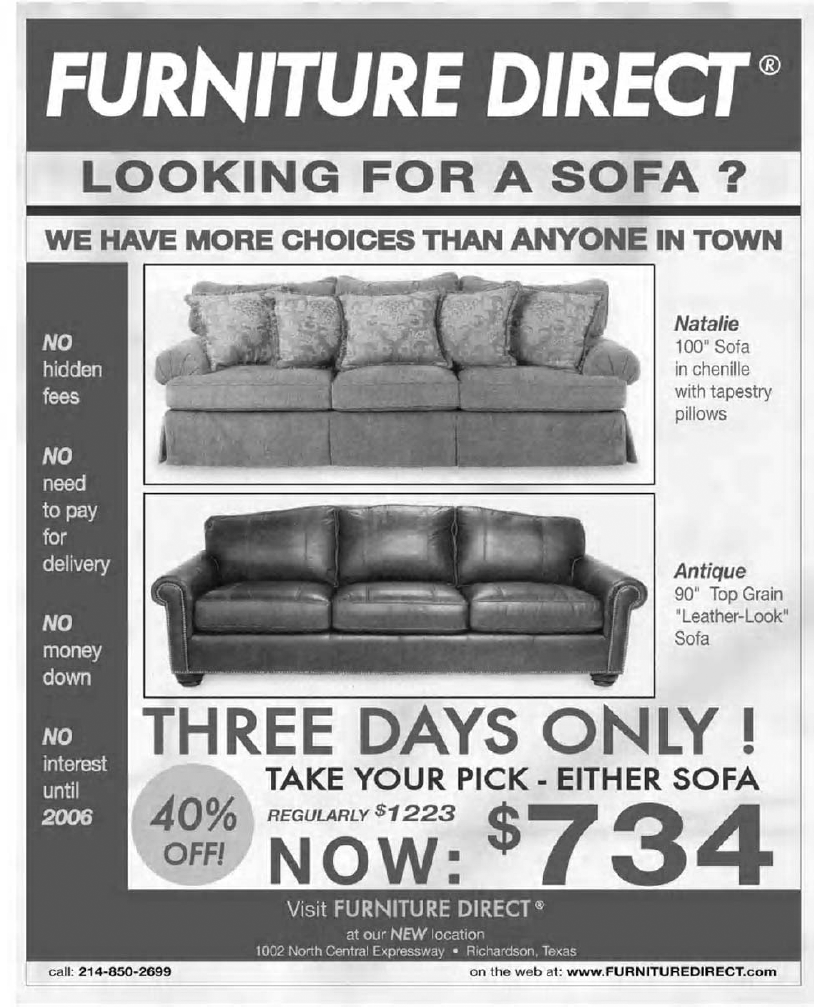
Reference Price Advertisement with Percentage-Off Summary and Limited-Time Appeal
We implemented a 2 (involvement: high versus low) x 6 (deal: no deal versus limited-time availability versus reference price versus reference percentage off versus combined versus combined percentage off) x 2 (product: bedroom set versus sofa) between-subjects design. A sample of 240 consumers participated in the experiment.
We used the price attitude items used in Study 1, followed by measures of store shopping intentions. Consumers were asked, “Think for a moment about the distance you traveled to get to this [retail furniture] store. If a Furniture Direct store were located about the same distance from where you live, how likely or unlikely would you be to shop at that Furniture Direct store?” 9 We assessed consumers’ responses on two seven-point scales anchored by “very likely/very unlikely” and “not possible/very possible.”
The wording of this item was necessary to control for distance effects on shopping intentions because the four stores used for shopper intercepts were located in different parts of the city and surrounding areas.
Manipulation Checks
As in Study 1, the ANOVA results for both manipulation check items revealed an involvement main effect. Consumers who were shopping for a bedroom set or sofa rated the respective advertisements for those products as more personally involving (M = 6.36; F(1, 216) = 296.84, p < .0001; ή2 = .55) and relevant (M = 5.69; F(1, 216) = 88.58, p < .0001; ή2 = .28) than those who were not shopping for these products (personally involving: M = 4.38; relevant to me: M = 4.19).
Price Persuasion Results
The three price attitude items reliably measured the same construct, and we summed them (α = .87). The ANOVA results revealed a main effect of deal (F(5, 216) = 14.06, p < .0001; ή2 = .21), in which participants exposed to a deal were more favorable toward the offer price than those who were not exposed. Again, this was qualified by a significant interaction between involvement and deal (F(5, 216) = 6.81, p < .0001; ή2 = .10). Figure 4 shows the results of the involvement x deal interaction for Study 2.
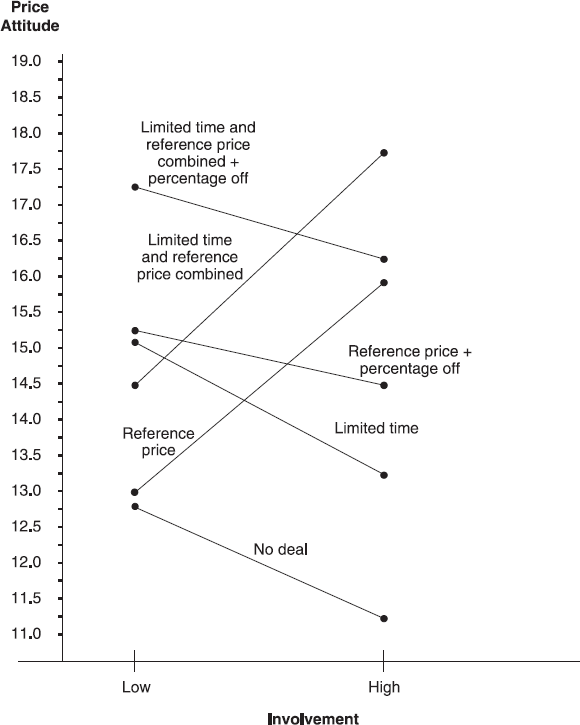
Involvement x Deal Interaction in Study 2
Under low-involvement conditions, the combined percentage-off group reported the most favorable price attitudes (M = 17.2); this was significantly higher (t = 3.10, p < .005) than the combined group (M = 14.45). Price attitudes for the reference percentage-off treatment (M = 15.2) were also higher (t = 2.53, p < .05) than the reference price group (M = 12.95). The limited-time availability treatment (M = 15.1) resulted in more favorable price attitudes (t = 2.42, p < .05) than the reference price treatment, which did not significantly differ from the no-deal treatment (M = 12.8; t < 1). Across levels of the percentage-off manipulation, the combined treatment resulted in more favorable attitudes (M = 15.83) than the reference price treatment (M = 14.08; t = 2.79, p < .05).
Under high-involvement conditions, participants who were exposed to the combined treatment reported the most favorable price attitude (M = 17.8), though they were not reliably different (t = 1.63, p > .10) from those in the combined percentage-off condition (M = 16.35). The attitudes of those in the reference price condition (M = 15.95) were also not reliably different from those in the reference percentage-off treatment (M = 14.55; t = 1.58, p > .10), though the reference price treatment was more favorable than the limited-time condition (M = 13.25; t = 3.04, p < .005). Consumers in the limited-time condition had more favorable price attitudes than those who received the no-deal treatment (M = 11.25; t = 2.25, p < .05, one-tailed test). Finally, across levels of the percentage-off manipulation, the combined treatment resulted in more favorable price attitudes (M = 17.08) than the reference price condition (M = 15.25; t = 2.91, p < .01).
Store Shopping Intentions Results
The two items measuring store shopping intentions reliably measured the same construct (α = .85); we recoded and summed them, with higher scores indicating greater store shopping intentions. The ANOVA results closely mirrored those we obtained with the price persuasion measure. There was a main effect of involvement (F(1, 216) = 11.02, p < .001; ή2 = .03), such that high-involvement consumers were more likely to shop at Furniture Direct than low-involvement customers. There was also a main effect of deal (F(5, 216) = 14.93, p < .0001; ή2 = .22), such that participants exposed to an advertisement containing a deal were more likely to shop at Furniture Direct than those in the no-deal condition. However, these main effects were qualified by a significant involvement x deal interaction (F(5, 216) = 5.91, p < .0001; ή2 = .09).
Under low-involvement conditions, store shopping intentions for the combined percentage-off group (M = 11.7) were greater than those for the combined condition (M = 9.45; t = 3.45, p < .003). Similarly, the reference percentage-off group had a higher mean (M = 10.9) than the reference price condition (M = 7.7; t = 4.91, p < .0001). Participants who were exposed to a limited-time advertisement were more likely to indicate favorable store shopping intentions (M = 9.75) than those in the reference price treatment (t = 3.15, p < .005), which did not differ from the no-deal condition (M = 7.8; t < 1). Across levels of the percentage-off manipulation, the combined treatment had higher store shopping intentions (M = 10.58) than those in the reference price condition (M = 9.3; t = 2.78, p < .01).
Under high-involvement conditions, we found no significant difference between the combined percentage-off group (M = 11.6) and the combined condition (M = 12.05; t < 1). There was no difference between the reference percentage-off treatment (M = 10.25) and the reference price group (M = 10.8; t < 1). However, participants exposed to reference prices evidenced greater store shopping intentions than those in the limited-time treatment (M = 9.5; t = 1.99, p < .05, one-tailed test). The limited-time treatment resulted in marginally higher shopping intentions than for those in the no-deal condition (M = 8.4; t = 1.69, p < .10, one-tailed test). Summed over the percentage-off manipulation, the combined condition had greater store shopping intentions (M = 11.83) than the reference price treatment (M = 10.53; t = 2.82, p < .01). 10
At the request of a reviewer, we collected additional data to provide mediational evidence of the high-involvement reference pricing effect we observed in Studies 1 and 2. We compared prior search/price knowledge versus ad price processing explanations as potential mediators. We implemented a 2 (involvement: high versus low) x 2 (deal: reference price versus none) x 2 (product: bedroom set versus sofas) design using 80 furniture shoppers. We used the same dependent measures as in Studies 1 and 2 (price attitude: α = .83; shopping intentions: α = .81). We obtained two measures of prior search/price knowledge. Respondents were asked, “Within the past 30 days, how many stores have you shopped at that have sold bedroom sets (sofas)?” (coded 0–5) and “How knowledgeable or unknowledgeable are you regarding the prices of bedroom sets (sofas)?” (measured on scales anchored by “very knowledgeable/not knowledgeable”). We also collected two measures of ad price processing. Respondents were asked, “How much effort did you devote to thinking about the price information presented in the advertisement for the bedroom set (sofas)?” (measured on scales anchored by “high effort/low effort”) and “I found the prices in the advertisement for the bedroom set (sofas) to be…” (measured on scales anchored by “not thought provoking/thought provoking”). All scaled items used seven-point scales. The two ad price processing items reliably measured the same underlying construct (α = .87); we summed them to form an ad price processing index. We first examined basic ANOVA effects. We found main effects of involvement and deal for both price attitude and store shopping intentions. More important, the critical involvement x deal interaction was also significant for both price attitude (F(1, 72) = 18.57, p < .0001; ή2 =.16) and store shopping intentions (F(1, 72) = 10.02, p < .05; ή2 = .08). The pattern of mean scores in these interactions mirrored previous findings (i.e., a differentiation between the two deal conditions for high-involvement but not for low-involvement respondents). We found main effects of involvement for the number of stores (F(1, 72) = 16.28, p < .0001; ή2 = .18), price knowledge (F(1, 72) = 19.22, p < .0001; ή2 = .21), and the ad price processing index (F(1, 72) = 82.09, p < .0001; ή2 = .48), with higher scores present in the high-involvement condition. We also found an involvement x deal interaction for the ad price processing index (F(1, 72) = 6.56, p < .01; ή2 = .04). We examined mediation of the interaction effect using Baron and Kenny's (1986) methodology. Neither the number of stores nor self-reported price knowledge was a significant or marginally significant mediator of the attitudinal or store shopping intention effects. However, the ad price processing index was a significant mediator of both (price attitude: F(1, 71) = 6.66, p < .01; ή2 = .05; store shopping intentions: F(1, 71) = 5.16, p < .03; ή2 = .04). The ad processing index partially mediated the deal x involvement interaction for price attitude (F(1, 71) = 12.51, p < .001; ή2 = .10) and store shopping intentions (F(1, 71) = 6.05, p < .02; ή2 = .05). These results support the position that scrutiny of price information presented in the advertisements by high-involvement respondents underlies the reference price effect we observed in Studies 1 and 2.
Discussion
Study 2 extends the findings we obtained in Study 1. The results indicate that summarizing reference price information in an advertisement has different effects depending on whether consumers are shopping for a product.
Under low-involvement conditions, attitudes and store shopping intentions for both the combined and the reference price treatments with the percentage-off statement were more favorable than the same respective treatments without the percentage-off statement. These findings are consistent with the position that providing summary information eases the processing requirements for comprehending the value implications of reference prices in advertisements. These results also replicate Chandrashekaran's (2004) and Chandrashekaran and Grewal's (2003) findings that reference prices with summary information can have a persuasive effect in low-involvement conditions. The lack of a significant difference in price attitudes and store shopping intentions for the low-involvement reference price and no-deal conditions indicates that without assistance, consumers who are not shopping for a product do not comprehend the value implications of reference prices; this is consistent with Study 1. However, the more favorable price attitudes and store shopping intentions for the combined and limited-time treatments than for the reference price condition indicate that limited-time availability has an effect on persuasion under low-involvement conditions.
A different pattern emerged under high-involvement conditions. When consumers were shopping for a product, we observed no reliable difference between exposure to either the combined or the reference price treatments and the same respective advertisements that included the percentage off. The price attitude and shopping intention means for the latter conditions were actually lower (less favorable) than those we obtained for treatments that did not summarize the markdown. Although the differences were not statistically significant at traditional levels, these results are conceptually congruent with the position that summarizing a benefit or conclusion for consumers who can be expected to process information actively on their own detracts from persuasion. Sawyer and Howard (1991) find that it is more persuasive for highly involved consumers to come to their own conclusions about the implications of a message. They argue that leaving an advertisement “open” (not providing a conclusion) causes central ad arguments to be processed more thoroughly, and resulting attitudes become more positive than in a condition in which conclusions are explicitly provided.
Consistent with Study 1, limited-time availability and reference pricing jointly contribute to price persuasion under high-involvement conditions in Study 2. The persuasive effect of limited-time availability under high-involvement conditions also replicates the Study 1 results. Finally, and also consistent with Study 1, we obtained no significant effects of the product variable.
Study 3
Hypothesis
We conducted Study 3 to examine informational and cue redundancy in a retail reference price advertisement under different involvement conditions. Despite the observation that multiple cues are common in many persuasion settings, limited research exists on their effectiveness (cf. Kalyanaraman and Oliver 2001). Study 3 provides insights into the operation of reference pricing and limited-time availability in retail advertisements by examining their effects when used with another value cue: the word “sale.”
The suggestion that the word “sale” has acquired cue-related properties is not surprising given that its use is associated with the other persuasion techniques we examine herein. Our content analysis found that the word “sale” and related synonyms were used in 47.0% of advertisements with limited-time offers and in 69.3% of advertisements featuring reference pricing. Similar to the limited-time cue, we argue that the word “sale,” through learned associations with advertised deals, has a favorable affect on price persuasion. Anderson and Simester's (2003) finding that simply displaying the word “sale” next to products in a store could increase sales up to 50% highlights its attention-grabbing ability, and it is consistent with the idea of automatic responding that typifies cue-related behaviors (Cialdini 2001).
Consistent with dual-process theories of persuasion (Chaiken 1987; Chen and Chaiken 1999; Petty and Cacioppo 1986), our contention has been that limited-time availability in retail advertisements operates as a peripheral or heuristic cue that facilitates persuasion under low-involvement conditions. However, under high-involvement conditions, limited-time availability is processed like other available information and is evaluated on its merits. If this is true, pairing the word “sale” with limited-time availability in an advertisement should result in no additional effect under high-involvement conditions, but it should contribute to persuasion under low-involvement conditions. We expect to find this because consumers who cogently process information in an advertisement would be more likely to deduce that limited-time prices are sales. Thus, when people examine an advertisement for a product that they are actively considering purchasing (i.e., under high-involvement conditions), the word “sale” is redundant information that should lack an effect, given the existence of a “Three days only!” price reduction.
However, redundancy between two cues should not impede the persuasive effects of either one for consumers who do not perceive them as redundant. We expect that recognizing the redundancy shared by “Three days only!” and the word “sale” will require a level of thinking that exceeds what is expended by consumers who view an advertisement for a product that does not match their current needs or interests (i.e., under low-involvement conditions). When advertisements try to communicate with people who are not shopping for a good, we believe that there is likely to be utility in stating what should be obvious because most consumers will not bother connecting the idea of the “Three days only!” message with that of the word “sale” unless the connection is made for them. In our view, leading consumers to a conclusion and then telling them what that conclusion is should have a persuasive impact in low-involvement contexts.
Finally, what would be the expectation when the word “sale” is used without being coupled with the limited-time treatment (i.e., when it is used alone with reference price information)? As a cue, it should add to persuasion under low-involvement conditions and should be evaluated on its merits under high-involvement conditions. However, we do not expect that the merits of a sale announcement under high-involvement conditions will have the same effect as announcing a limited-time event, given that the latter provides explicit parameters that define unavailability, whereas the former does not. In turn, the implied demand for a product associated with limited-time availability (Inman, Peter, and Raghubir 1997) and its corresponding market valuation utility should also be arguably stronger with limited-time availability than with sale announcements. Finally, the general idea of a sale from a consumer's perspective, though not the particulars of a limited-time event, is likely to be redundant with information logically obtained by considering reference price information under high-involvement conditions. That is, most consumers would interpret a price markdown as a sale.
In summary, we hypothesize that pairing the word “sale” with limited-time availability and reference prices in advertisements will increase price persuasion and store shopping intentions for low-involvement consumers but not for high-involvement consumers.
Sale announcements in advertisements with limited-time availability and reference price appeals favorably affect price attitudes and store shopping intentions for low-involvement but not high-involvement consumers.
Procedure and Manipulations
We used the same procedure as in Studies 1 and 2. We manipulated involvement using the same products (bedroom set and sofa). We defined the deal variable with six treatment levels. The first three levels were the reference price, limited-time availability, and combined treatments, as we defined them in Studies 1 and 2. The next three levels were identical to the first three, except that the word “sale” was prominently highlighted (in a shaded circle) to the left of the pricing information in the advertisements (see Figure 5). We did not use the no-deal condition in Study 3 for cell size reasons.

Limited-Time Sale Advertisement
We implemented a 2 (involvement: high versus low) x 6 (deal: limited time versus reference price versus combined versus limited-time sale versus reference price sale versus combined sale) x 2 (product: bedroom set versus sofa) between-subjects design. A sample of 240 consumers participated in the experiment. We used the same two dependent measures as in Study 2.
Manipulation Checks
The ANOVA results for both manipulation check items revealed a main effect of involvement. Participants who were shopping for a bedroom set or sofa rated the corresponding advertisements more personally involving (M = 5.87; F(1, 216) = 264.58, p < .00001; ή2 = .69) and relevant (M = 5.83; F(1, 216) = 153.13; p < .0001; ή2 = .57) than those who were shopping for the alternative product (sofa or bedroom set; personally involving: M = 4.28; relevant to me: M = 4.10).
Price Persuasion Results
Again, the three price persuasion items reliably measured the same construct, and we summed them to form an index (α = .83). The ANOVA results revealed main effects of involvement (F(1, 216) = 4.52, p < .04; ή2 = .01) and deal (F(5, 216) = 9.62, p < .0001; ή2 = .15), qualified by a significant interaction between them (F(2, 216) = 9.45, p < .0001; ή2 = .15).
Under low-involvement conditions, pairing reference prices with the word “sale” (M = 15.05) was more persuasive than the use of reference prices without the word “sale” (M = 12.25; t = 3.78, p < .0005). Similarly, pairing limited-time availability with the word “sale” was more persuasive (M = 17.1) than its use without the word “sale” (M = 15.2; t = 2.57, p < .005). Combining limited-time availability and reference price with the word “sale” was more persuasive (M = 16.6) than their use without the word “sale” (M = 14.95; t = 2.23, p < .05). Across levels of the sale variable, price attitudes for the combined condition (M = 15.78) were greater than those for the reference price treatment (M = 13.65; t = 4.10, p < .0002). Collapsed across levels of the sale variable, price attitudes in the limited-time availability condition (M = 16.15) were also more favorable than those in the reference price condition (t = 4.81, p < .0001).
Under high-involvement conditions, pairing limited time with the word “sale” did not result in more favorable price perceptions (M = 14.3) than its use without the word sale (M = 14.05; t < 1). Similarly, pairing reference prices with the word “sale” (M = 15.95) was not more favorable than its use without the word “sale” (M = 15.55; t < 1). The combined use of both techniques with the word “sale” (M = 17.7) was not more favorable than their use without the word “sale” (M = 17.45; t < 1). Across sale levels, the use of reference prices resulted in more favorable price attitudes (M = 15.75) than the use of limited-time availability (M = 14.18; t = 3.02, p < .05). Across sale levels, the combined reference price and limited-time condition resulted in more favorable price attitudes (M = 17.58) than the use of reference pricing by itself (M = 15.75; t = 2.47, p < .01). Figure 6 shows the results of the involvement x deal interaction.

Involvement x Deal Interaction in Study 3
Store Shopping Intentions Results
The two store shopping intentions items reliably measured the same underlying construct, and we summed them (α = .80). The results paralleled those for price persuasion. Main effects of involvement (F(1, 216) = 23.72, p < .0001; ή2 = .06) and deal (F(5, 216) = 18.26, p < .0001; ή2 = .23) were qualified by a significant interaction between those variables (F(5, 216) = 9.84, p < .0001; ή2 = .13).
Under low-involvement conditions, when limited-time availability was advertised as a sale (M = 10.45), it was more persuasive than when it was advertised without the word “sale” (M = 8.75; t = 3.47, p < .0005). The same was true for the reference price (with sale = 8.6, without sale = 7.45; t = 2.35, p < .05) and combined (with sale = 11.0, without sale = 9.95; t = 2.14, p < .05) conditions. Collapsed across levels of sale, participants who were exposed to reference prices were less inclined to shop at Furniture Direct (M = 8.03) than those who were exposed to the limited-time treatment (M = 9.6; t = 4.53, p < .0001). Across sale levels, combining reference prices and limited-time availability resulted in greater store shopping intentions (M = 10.48) than reference prices by themselves (M = 8.03; t = 5.00, p < .000001).
Under high-involvement conditions, there was no significant difference in the persuasiveness of limited-time appeals when it was (M = 8.90) or was not (M = 8.95) advertised with the word “sale” (t < 1). The same results held for the reference price (with the word “sale” = 10.3, without the word “sale” = 10.45; t < 1) and the combined (with the word “sale” = 12.05, without the word “sale” = 11.40; t = 1.33, p > .10) treatments. Across sale levels, reference pricing was more persuasive (M = 10.38) than limited-time availability (M = 8.93; t = 4.14, p < .0001) on store shopping intentions. Across sale levels, the combined condition resulted in greater store shopping intentions (M = 11.73) than the reference price condition (M = 10.38; t = 2.69, p < .01).
Discussion
Study 3's results demonstrate that under low-involvement conditions, advertised announcements of a sale and a limited time to take advantage of a lower price independently contribute to favorable consumer price perceptions and higher store shopping intentions. This can be explained by noting that though sales, by definition, are supposed to be limited-time events, when consumers are perusing advertisements without personal interest, they do not think at a level deep enough to make the connection. Thus, value cues that are otherwise logically redundant can independently contribute to persuasion under low-involvement conditions. Under high-involvement conditions, however, the value implications of the word “sale” are no different from those of a limited-time event (or reference prices). These findings do not suggest that the word “sale” has no utility under high-involvement conditions. Rather, when consumers cogently process ad-related information, sale announcements contribute nothing unique to price perceptions or shopping intentions that these consumers do not already attain when they consider limited-time availability and reference price information. Finally, this study replicates Studies 1 and 2 in terms of effect (limited-time availability and reference pricing) differentiation across levels of consumer involvement and consistency of the results across products. 11
As a reviewer requested, we gathered additional data to examine whether low-involvement furniture shoppers versus nonfurniture shoppers would respond differently to the limited-time + sale appeals. Using the same method we previously discussed, we exposed low-involvement furniture (N = 40) and nonfurniture (N = 40; electronics products) shoppers to either the bedroom set or the sofa advertisements across the limited-time + sale versus the no-deal conditions. We implemented a 2 (shopper: furniture versus electronics) x 2 (deal: limited time + sale versus no deal) x 2 (product: bedroom set versus sofa) between-subjects design. We examined price attitude (α = .85) and store shopping intentions (α = .80). Only the effect of deal was significant for attitude (F(1, 72) = 35.24, p < .0001; ή2 = .33) and store shopping intentions (F(1, 72) = 19.18, p < .0001; ή2 = .21), and the limited-time + sale advertisement resulted in more favorable price attitudes and shopping intentions at the designated store than exposure to the no-deal condition. The lack of interaction effects indicates that this finding is statistically consistent for furniture and nonfurniture shoppers across the advertised products.
General Discussion
Are limited-time availability and sale cues effective in influencing consumer attitudes toward product prices in retail newspaper advertisements that feature reference pricing? Can they also draw people into stores? If it is assumed that retailer advertising practices represent what “works” in the marketplace, the answer is yes according to our content analysis of 13,594 retail advertisements. This analysis revealed that 87.2% of retail advertisements featuring reference pricing also included limited-time availability or sale announcements in the headline or copy. However, the results of three field experiments across two different products consistently demonstrate significant variability in the effectiveness of these techniques, depending on whether consumers are or are not shopping for an advertised product.
Substantive Findings
Using dual-process theories of persuasion (the elaboration likelihood model and the heuristic-systematic model) as a foundation, we have specified the conditions under which these techniques result in more favorable price attitudes and store shopping intentions and when they do not. Under low-involvement conditions (when consumers are not actively shopping for a product), a limited-time price reduction or a sale announcement affects price perceptions and shopping intentions, but the size of the reduction, represented by reference prices, does not. Under high-involvement conditions (when consumers are actively shopping for a product), both reference prices and limited-time information favorably affect price perceptions and shopping intentions, though additional explanatory power is not achieved through the use of sale announcements.
The reference price results can be understood by recognizing that comprehension of the value implications of those prices requires a level of processing effort that exceeds (does not exceed) the level that people typically expend when viewing advertisements for products that do not have (have) immediate relevance to them. Mediational findings support the position that more diligent processing of prices presented in the advertisements, as opposed to prior store search or product price knowledge, explains the favorable effect of reference pricing under high-involvement conditions. The effects of limited-time availability and sale announcements can be understood in terms of their learned heuristic value under low-involvement conditions and their informational merit under-high involvement conditions. Under high-involvement conditions, the implications of a sale are redundant with the information derived through a careful consideration of limited-time availability and reference price information. Under low-involvement conditions, however, consumers do not perceive the redundancy between limited-time availability and sale announcements, and therefore both cues affect persuasion. Thus, in general, we argue that reference pricing, limited-time availability, and sale cues have inherent differences in terms of their information-processing requirements and outcomes. Overall, the three experiments help predict the effects of jointly using different value-oriented persuasion techniques with reference price information in retail advertisements.
Notably, not only do our findings demonstrate strength and consistency, but they are also the result of field experiments. Intercepts for all three studies used engaged shoppers who had other objectives in mind when they volunteered to participate in the studies (without compensation). The outdoor environment in which testing took place was complete with noise and other distractions. Yet, despite these interferences, the effects were reliable across multiple studies. We suspect that one reason for the strength and consistency of the effects was the nature of the involvement manipulation. We believe that intercepting consumers in the process of shopping provides a stronger manipulation of involvement as personal product relevance than is typically found in laboratory manipulations of the construct. The average variance (across experiments) explained (ή2) in the two manipulation check measures was 49.8%. The average variance explained for the critical involvement x deal interaction was 14.8% for price persuasion and 10.0% for store shopping intentions. These effect sizes are about two to three times the average sizes that Peterson, Albaum, and Beltramini (1985) report in their review of effect sizes.
Managerial Perspectives
When used by itself, reference price advertising results in favorable price perceptions and store shopping intentions only among consumers who are shopping for a particular product. Reference pricing is an effective persuasion strategy among consumers who are of the greatest interest to retailers, namely, those with an immediate product interest. Consumers who lack product involvement do not process the implications of reference prices in retail advertisements to the degree necessary to grasp the value implications. However, managers might still consider using reference pricing with a markdown summary statement to appeal to a broader audience. We found that a markdown summarization results in increased price persuasion and shopping intentions for low-involvement shoppers but does not significantly detract from persuasion for high-involvement shoppers. The value in marketing to consumers without an immediate product interest lies in the likelihood of future rather than immediate sales being facilitated by associating the retailer with favorable pricing practices in the minds of consumers.
Reference pricing paired with limited-time availability results in more favorable price perceptions and store shopping intentions than the use of either technique alone among consumers who are shopping for a product. Practitioner insight regarding this point is shown by the finding that reference pricing and limited-time availability are used together in retail advertisements more frequently than reference pricing is used alone. Importantly, however, the three studies we report herein qualify this insight by providing consistent evidence across two products that both techniques independently contribute to price persuasion and shopping intentions only when consumers are actively shopping for a product. Nevertheless, as a general statement, the joint use of reference pricing and limited-time appeals might still be advisable because the effects of the two techniques appear to compensate for each other under different conditions of involvement. Specifically, reference price effects are (are not) significant when consumers are (are not) shopping for a product, but significant limited- time effects are weaker (stronger) under those same conditions.
Sale announcements in reference price advertisements appear to have no drawbacks. In developing this study, discussions with retailers revealed a growing reluctance to use the term “sale” in advertisements because of a perception that it is overused. Markdowns in retail advertising are commonplace, and consumers often discount them (Bobinski, Cox, and Cox 1996). Our content analysis indicates that the word “sale” is used with moderate frequency. In our field studies, however, a sale announcement (when used in a reference price advertisement) did not detract from persuasion when consumers were shopping for a product, but it contributed to persuasion when they were not. The potential utility of sale cues being presented to disinterested consumers should not be underestimated, especially because those cues do not appear to lower evaluations of consumers who are currently in the market. For example, sale cues might have the potential to convert nonshoppers into shoppers.
Directions for Further Research
Further research needs to examine conditions other than involvement that have the potential to moderate the effects of reference pricing. Given their potential influence on consumer motivation, two constructs that might affect the processing of reference price information are the level of prior product knowledge (Alba and Hutchinson 1987) and deal proneness (Krishna 1994). Research should also explore variables that have the potential to magnify reference price effects. The joint effect of reference prices and limited-time availability under high-involvement conditions suggests that when consumers are shopping for a product, the value implications of reference prices are accentuated when they are limited in time. The utility of different reference price formats in converting nonshoppers into shoppers also needs to be examined.
Testing whether our limited-time findings extend to other scarcity variations would develop the generality of our results. For example, it is an empirical question whether respondents would be equally sensitive to both limited-time and limited-quantity manipulations across involvement conditions. Thus, appropriate caution needs to be taken in terms of generalizing our results across different types of scarcity because we examine only limited-time in these studies.
Further research needs to consider different methodologies for investigating reference price advertising effects. Prior research has typically employed forced exposure to print advertisements and a passive manipulation of involvement within the context of laboratory studies using student participants. The current research employed free exposure to print advertisements and an active manipulation of involvement in a field setting in which consumers were engaged in shopping behavior. Although both methodologies have merit, we selected the latter because of its closer correspondence to the processing realities of consumers in the marketplace, as Wells (1993) and Kover (1995) advocate. Nevertheless, we recognize that our manipulation of involvement also has potential limitations. For example, by intercepting shoppers, the study samples were composed of goal-directed consumers. Some commentators might argue that low-involvement consumers may have been overly dismissive of product advertisements that did not reflect their current interests. In the leisurely environment of a home, low-involvement processors might pay more attention to such advertisements than they did in our studies. We acknowledge that there are different ways to manipulate involvement, and the nature of that manipulation may manifest itself in the results obtained.
The possibility that demand characteristics explain the results appears remote given the nature of the interaction effects we obtained. Specifically, a demand explanation for our findings can account for neither the low-involvement results nor the pattern of effects observed for the high-involvement condition. Furthermore, there was no evidence of hypothesis guessing or compliant participant behavior in answers to postexperimental questions. The results varied consistently with theoretical expectations, which is also inconsistent with a demand explanation for the results.
Although much of modern advertising uses multiple persuasive techniques in the same advertisement, academic research has often focused on examining individual techniques in isolation. A particular value of our studies is that they consider how different techniques are used in advertisements that feature reference pricing and how consumers should theoretically respond to them and then test the corresponding predictions in a field setting. Further research on reference price advertising should be expanded to explore the use of multiple persuasion tools commonly employed in retail advertising practice. We hope that our efforts will provide a framework for future investigations that broaden the scope of reference price advertising research.