







Abstract
Quick responses to environmental changes have become a vital success factor for today's companies. This study aims to identify the differential mechanisms that drive responsiveness to customers and responsiveness to competitors. In particular, the authors propose a conceptual framework that distinguishes between a cognitive and an affective organizational system as two important antecedents of organizational responsiveness. The results from a large-scale, cross-industry study show that the affective organizational system is more important in driving responsiveness to customers and that the cognitive organizational system is more important in driving responsiveness to competitors. Moreover, the relative importance of the cognitive system as a driver of responsiveness is greater in firms with a low market share and in markets with low entry barriers for new competitors.
Against this background, maintaining and enhancing an organization's responsiveness to customers and competitors has become an increasingly important managerial task in today's firms. Activities for influencing a company's responsiveness to customers and competitors fall into two basic categories: (1) They can focus on improving a company's information processing (e.g., Davenport 2006; Sawhney 2001), which we refer to as the “cognitive organizational system,” and (2) they can aim to change an organization's culture (e.g., Bernick 2001; Day 2003), which we refer to as the “affective organizational system.”
Because change processes usually absorb a lot of resources, including managerial time and energy (Beer and Nohria 2000; Day 1999), managers are often forced to focus their efforts either on changes to the cognitive organizational system or on changes to the affective organizational system. Therefore, it is important for managers attempting to increase their firm's responsiveness to customers/competitors to know whether the cognitive system is a more important driver of responsiveness to customers/competitors than the affective system, or vice versa. A lack of such knowledge is likely to lead to significant managerial mistakes regarding resource allocation in change processes intended to increase a firm's responsiveness.
An examination of numerous customer relationship management (CRM) projects illustrates such managerial mistakes. In recent years, managers in many companies have invested large amounts of money in information technology–based CRM projects (Rigby and Ledingham 2004); that is, they have focused on changing the orientation of the cognitive organizational system to increase customer-related responsiveness. However, many of these projects have not delivered the projected results. As The Economist (2003, p. 21) states, “Few things in technology have promised so much and delivered so little as … CRM software…. [F]our out of five such projects fail to deliver the goods.” One possible reason for this apparent misallocation of resources into information technology–based CRM projects is that managers may have overestimated the importance of changes to the cognitive system for increasing responsiveness to customers, while neglecting the affective organizational system (Rigby, Reichheld, and Schefter 2002). In a similar vein, Day (2003, p. 79) notes, “Most companies think of information technology first when they consider CRM capabilities—instead of last, as they should.”
However, although previous research indicates that the affective system and the cognitive system are both important antecedents of responsiveness (Hult, Ketchen, and Slater 2005), the question regarding the relative importance of the cognitive versus the affective system has not been addressed. Against this background, our study focuses on the relative importance of these two systems as drivers of organizational responsiveness. We draw on systems theory to develop an integrative theoretical framework, linking the orientation of the affective system and the orientation of the cognitive system to our key outcome variables—namely, responsiveness to customers and responsiveness to competitors. We then argue that customer-related responsiveness is more strongly driven by the affective organizational system than by the cognitive organizational system, and we propose that competitor-related responsiveness is more strongly driven by the cognitive organizational system than by the affective organizational system. We develop this reasoning theoretically and test it empirically. In addition, we develop and test hypotheses regarding the impact of three environmental factors—competitive intensity, ease of market entry, and market share—on the relative importance of the affective and the cognitive organizational system in driving responsiveness.
The managerial relevance of this study is straightforward. It provides guidance for managers regarding resource allocation in change processes that aim to increasing a company's responsiveness. This should help managers avoid the mistakes we described previously.
Apart from being managerially relevant, our study is of interest for marketing theorists, particularly for researchers on market orientation. Typically, within the market orientation literature, customer-related aspects and competitor-related aspects of market orientation have been aggregated to form a general market orientation construct (Narver and Slater 1990). However, this approach may hide differences between competitor orientation and customer orientation with regard to their outcomes and antecedents. Therefore, Noble, Sinha, and Kumar (2002, p. 28) suggest that market orientation should be studied “in a disaggregated manner.” Because responsiveness is typically considered a main facet of market orientation (Hult, Ketchen, and Slater 2005), our study addresses these concerns by making an explicit distinction between antecedents of customer-related responsiveness and antecedents of competitor-related responsiveness. If the results show that customer-related responsiveness and competitor-related responsiveness are driven by differential mechanisms, this would suggest that researching customer orientation and competitor orientation as separate constructs is indeed the more suitable approach to studying market orientation.
Theoretical Framework
Systems Theory and Organizational Responsiveness to the Environment
Open systems theory (Johnson, Kast, and Rosenzweig 1963; Katz and Kahn 1978) provides the theoretical background for the general framework of our study. According to this theory, the long-term survival of an organization depends on its ability to adapt its activities adequately to environmental changes. Thus, systems theory highlights the relevance of our focal construct organizational responsiveness for a company's performance.
Furthermore, open systems theory points to the importance of timing and speed in the context of an organization's responsiveness to its environment. Thompson (1967, p. 148) points out that the timing of activities aimed at the environment “is a crucial administrative matter.” Katz and Kahn (1978, p. 131) argue that organizations need to exert internal control to respond quickly to environmental threats and changes. Thus, speed is a key element of our definition of organizational responsiveness. More specifically, we define “customer-related responsiveness” as the extent to which an organization responds quickly to customer-related changes, and we define “competitor-related responsiveness” as the extent to which an organization responds quickly to competitor-related changes.
Systems theory views organizational responsiveness to the environment as being the result of the interaction of several subsystems within the organization (Kast and Rosenzweig 1970). Guided by the market orientation literature, which emphasizes information processing (Jaworski and Kohli 1993) and organizational culture (Narver and Slater 1990), we focus on two subsystems as antecedents of responsiveness (Hult, Ketchen, and Slater 2005): organizational information processing and organizational culture.
The way information is processed within organizations is often referred to as “organizational cognition” (Sims and Gioia 1986); thus, we use the term “cognitive organizational system” when referring to organizational information processing. In line with the observation (outlined in detail subsequently) that culture and affect are closely related phenomena, we refer to organizational culture as the “affective organizational system.” We believe that these terms are more fruitful in the context of our study. They seem to describe best how organizational information processing and organizational culture influence individual responsiveness within organizations, which is key to organizational responsiveness (White, Varadarajan, and Dacin 2003). More specifically, organizational members are motivated to act on information from organizational information processing when they perceive it as having cognitive value (Hansen and Haas 2001). In contrast, as we describe subsequently, members act according to the values, beliefs, and norms provided by the organizational culture because they are emotionally attached to them.
The Cognitive Organizational System
In the context of our research, the customer and competitor orientation of the cognitive system deserve special attention. We define “customer orientation of the cognitive organizational system” as the degree of customer-related information processing within an organization and “competitor orientation of the cognitive organizational system” as the degree of competitor-related information processing within an organization.
In the marketing literature, organizational information processing has often been described as a series of consecutive processes (Day 1994; Moorman 1995). Following this tradition, we view the cognitive organizational system as consisting of all organizational activities that deal with the generation, dissemination, analysis, and storage of information (Huber 1991; Sinkula 1994). Information generation is the process by which organizations first obtain knowledge through means such as market research, published reports, and informal communication. Information dissemination is the process by which this information is distributed within the organization (Maltz and Kohli 1996), for example, through meetings, reports, or databases. Information analysis is the process that links information coming from various sources within the organization and establishes a shared interpretation. Information storage refers to the activities connected to the task of establishing an organizational memory (Walsh and Ungson 1991).
Against this background, we expect that the design of the cognitive system influences an organization's responsiveness to its environment. More specifically, we expect that a highly customer-oriented cognitive system enhances customer-related responsiveness (Jayachandran, Hewett, and Kaufman 2004). Similarly, we expect that there is a positive link between the competitor orientation of the cognitive system and competitor-related responsiveness (Smith et al. 1991).
The Affective Organizational System
In the literature on organizational culture, it has been argued that culture and affect are closely related phenomena. For example, organizational members tend to establish an emotional bond with their culture. In this regard, Trice and Beyer (1993, p. 6) specify that culture is “emotionally charged” because its values and beliefs help organizational members overcome the anxiety that is connected to environmental uncertainty. In addition, values and norms may become a defining property of a group, permitting the group to differentiate itself from other groups. As a consequence, organizational members become strongly attached to the cultural values and beliefs: “[W]e tend not to examine them but to defend them because we have emotionally invested in them” (Schein 1992, p. 12). Furthermore, the cultural environment influences the way people experience certain emotions. “[F]rom their cultures, members learn … how it is appropriate to feel and not feel in a given situation” (Beyer and Nino 2001, p. 174). Thus, organizational culture provides its members with a repertoire of accepted emotions. Finally, the close link between corporate culture and emotions becomes visible in research that identifies affective consequences of organizational culture, such as employee commitment (O'Reilly, Chatman, and Caldwell 1991) and job satisfaction (Siguaw, Brown, and Widing 1994).
Against this background, we interpret organizational culture as an organization's affective system. Deshpandέ and Webster (1989, p. 4) define organizational culture as “the pattern of shared values and beliefs that help individuals understand organizational functioning and thus provide them norms for behavior in the organization.” Therefore, we define “customer orientation of the affective organizational system” as the extent to which attention to customer needs is anchored in an organization's values, belief structures, and norms. Likewise, we define “competitor orientation of the affective organizational system” as the extent to which attention to competitor behavior is anchored in an organization's values, belief structures, and norms.
The affective system can be regarded as a mechanism that allows for decision making within organizations without intensive information processing. This is important because it is impossible for organizations and individuals alike to process all available information adequately with regard to a given problem. This problem is reflected in the growing literature on “information overload” and the limits of organizational information processing (Eppler and Mengis 2004). The values and norms stored in the organizational culture help companies and individuals cope with the large amount of information available. They guide the perception of the environment and enable organizational members to rule out irrelevant alternatives quickly.
Against this background and consistent with the findings of Hult, Ketchen, and Slater (2005), we expect that a highly customer-oriented affective system enhances customer-related responsiveness. The same effect is expected for competitor orientation of the affective system and competitor-related responsiveness.
Relative Importance of the Affective System and the Cognitive System
It is the central concern of this article to make theory-based predictions about the relative importance of the affective organizational system and the cognitive organizational system in driving organizational responsiveness. Although the unit of analysis in our study is the organization, in this section, we draw on individual-level theories borrowed from social and cognitive psychology. This approach follows a long tradition in organizational research to use theories on individual-level behavior as a starting point to understand organizational-level phenomena. Examples include the behavioral theory of the firm (e.g., March and Simon 1958) and theories on organizational learning (e.g., Huber 1991; Kim 1993; March and Olsen 1975).
Our use of individual-level theories is guided by the consideration that, to a large extent, organizational responsiveness depends on individual responses to new environmental developments (White, Varadarajan, and Dacin 2003). More specifically, we expect that the affective organizational system exerts a dominant impact on organizational responsiveness when individual responses are mostly guided by individual affective processes. Likewise, in situations in which individual responses are largely driven by individual cognitions, the cognitive system of the organization becomes the dominant driver of responsiveness. Thus, two theories from psychology that provide guidance on the role of affect and cognition in driving individual behavior deserve our attention: cognitive appraisal theory and the affect infusion model.
Cognitive appraisal theory (Lazarus 1991; Lazarus and Folkman 1985) attempts to explain how cognitive and affective processes create “action tendencies” in people confronted with a new environmental stimulus. Lazarus (1991, p. 153) describes two modes of appraisal: automatic processing and deliberate processing. In the mode of automatic processing, if a situation is initially appraised as being of goal relevance, this leads to the evolution of a first affective response, which dominates a person's immediate response. If time and opportunity are given, a person may engage in deliberate processing involving cognitive reappraisals of the situation; that is, more information is considered and the analysis of the situation is more intricate (Lazarus 1991, p. 155). Thus, deliberate processing leads to a response that is more cognitively founded.
The affect infusion model also asserts that the way affective processes influence decisions and judgments depends on the way information is processed in a particular situation (Forgas 1995; Forgas and George 2001). This theoretical concept also supports the notion that the relative impact of affect and cognition on behavior depends on several context factors, such as personal variables (e.g., processing capacity), task characteristics (e.g., task complexity), and situational factors (e.g., need for accuracy) (Forgas and George 2001, p. 10).
In summary, these theories lead us to expect that, in general, the affective system and the cognitive system influence responsiveness to customers and competitors simultaneously. However, the relative importance of these two systems as drivers of responsiveness systematically varies, depending on characteristics of the situation. In this regard, they also provide guidance regarding potentially relevant situational factors (e.g., time or task complexity).
Performance Outcomes
In the tradition of the market orientation literature (e.g., Homburg and Pflesser 2000) and following a recommendation by Lehmann (2004), our framework incorporates two performance-related constructs: market performance and financial performance. We define “market performance” as the effectiveness of an organization's marketing activities with regard to market-related goals, such as revenues, growth, and market share. We define “financial performance” as the average return on sales of a business unit relative to the industry average.
As systems theory asserts, we expect that both customer-related and competitor-related responsiveness positively affect market performance. Previous research supports this link (e.g., Gatignon, Robertson, and Fein 1997; Jayachandran, Hewett, and Kaufman 2004). Furthermore, we expect that there is a positive impact of market performance on financial performance, which is also a well-established link in the marketing literature (Rust et al. 2004).
The structural relationships implied by our theoretical framework appear in Figure 1. Note that our analysis does not focus on the links posited by our framework. Rather, given the high plausibility and previous support in the literature for these links, we use this nomological network as the basis of our analysis. The key focus of our study is to compare, within this network, the relative importance of the cognitive and the affective system as drivers of the two facets of responsiveness.
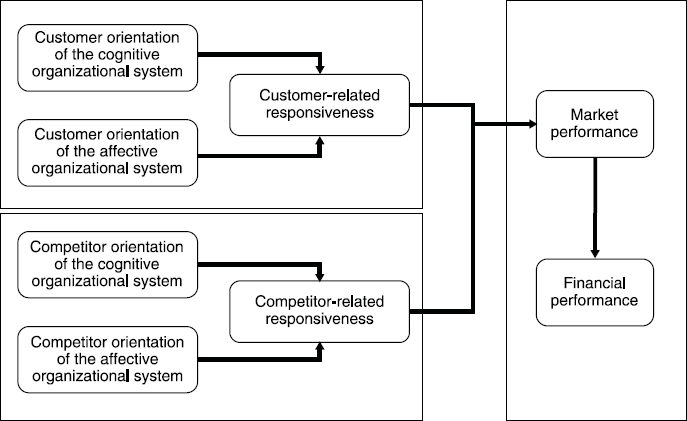
Theoretical Framework
Hypotheses Development
Main Hypotheses
We argue that contextual differences between competitor-related activities and customer-related activities lead to different patterns of importance for the affective and the cognitive organizational system as drivers of responsiveness to competitors as opposed to responsiveness to customers. More specifically, we argue that the two contexts differ with respect to (1) the degree of social interaction with the outside party (customer versus competitor), (2) the need for spontaneous decisions, and (3) the outside party's willingness to share information openly.
The importance of social interaction with customers has received much attention in recent studies in the fields of buyer–seller relationships, personal selling, and service encounters. It has been shown that positive social interaction is perceived as a benefit from the relationship (Bitner, Gwinner, and Gremler 1998; Crosby, Evans, and Cowles 1990). Trust in buyer–seller relationships is strongly influenced by social aspects of the relationship (Nicholson, Compeau, and Sethi 2001; Schultz and Evans 2002). Customer contact personnel characteristics that are helpful in situations of social interaction, such as emotional intelligence (Rozell, Pettijohn, and Parker 2004), the ability to recognize a customer's interest in socializing (Brown et al. 1993), and a positive affect toward customers (Sharma 1999), have been shown to increase the effectiveness of customer contact personnel. The role of social interaction is also important in the product or service development process because regular meetings with customers help firms identify customers' wishes and needs (e.g., Koufteros, Vonderembse, and Jayaram 2005; Sethi 2000).
In summary, there is ample support for the notion that customer-related activities take place in an affect-intensive environment in which social interaction plays an important role. Psychological research has assembled much evidence that in situations with intensive social interaction, “affect may be seen … as the major driving force behind many responses” (Forgas 2003, p. 597, emphasis added). Thus, we expect that the orientation of the affective organizational system is relatively more important than the cognitive system in driving customer-related responsiveness.
Customer contact personnel often encounter situations with a high need for spontaneous decisions—that is, situations in which they need to make a decision in a short span of time. Time can be viewed as an important resource for information processing (Lazarus 1991). As cognitive appraisal theory and the affect infusion model suggest, the availability of processing resources plays an important role in determining the relative importance of cognition and affect for behavior (Forgas and George 2001, p. 10; Lazarus 1991, p. 155). If processing resources are limited, affect has a stronger impact on the behavioral outcome, and if the availability of processing resources is high, cognitions are more important (Shiv and Fedorikhin 1999).
More specifically, in many personal encounters with customers, customer contact personnel need to act without the benefit of time for in-depth information processing or for requesting help from specialized personnel within the organization. Thus, the effectiveness of the cognitive system in driving customer-related responsiveness is reduced. At the same time, the affective system can provide salespeople with values, beliefs, and heuristics that guide them even in these situations. This reasoning further supports the notion that customer-related responsiveness is more strongly driven by the affective than by the cognitive system.
In many situations, customers have a strong self-interest in providing information about their needs and wishes (e.g., Anderson and Narus 1990; Cannon and Perreault 1999). Their resulting willingness to share information openly has at least two consequences for organizational information processing. First, it reduces the need for organizational mechanisms to generate information. Second, it reduces the need for organizational mechanisms to analyze the information because customers are usually motivated to communicate as precisely as possible what they need and expect (Thomke and Von Hippel 2002). As a result, we expect that the easy availability and lower need for interpretation of information reduces the effect of the cognitive system on responsiveness, even though the information still needs to be disseminated and stored within the organization.
In summary, we expect that because of the high degree of social interaction with customers, the need for spontaneous decisions, and customers' willingness to share information openly, the affective system is the dominant driver of responsiveness to customers. Thus:
Responsiveness to customer-related changes is more strongly influenced by the affective organizational system than by the cognitive organizational system.
Competitor-related activities take place in a different environment. There is little to no social interaction between managers of competing companies. As social interaction promotes the development and impact of emotions, responses to competitive activities take place in a less affect-intensive environment. In this context, conceptual writers on competitive strategy have emphasized the importance of cognition (e.g., Gilad 1989; Varadarajan and Jayachandran 1999). Porter (1980, p. 72) notes that organizations need “some sort of competitor intelligence system” to analyze their competitive environment successfully.
Likewise, empirical research on competitive decision making has stressed the importance of cognition in managers' assessments of their competitive environment. On an individual level, it has been shown that managers rely on a categorization process when identifying competitors (Clark and Montgomery 1999). They use mental models to impose order on ambiguous competitive environments (Reger and Huff 1993). Differences in these mental models between managers from firms within the same industry (Daniels, Johnson, and De Chernatony 2002) suggest that firm-specific processes, such as a company's information search activities (Day and Nedungadi 1994), play an important role in their development. On an organizational level, Ghoshal and Westney (1991) report that firms typically rely on information collection and interpretation processes to understand their competitive environment. Taylor (1992) finds that managers regularly express the need for even more systematic organizational competitor-related information processing. In summary, there is ample evidence that responses to changes in the competitive environment take place in an environment in which cognitions are important.
In addition, the reduced degree of social interaction and the lack of personal encounters reduce the need for spontaneous decisions with regard to competitive action. Thus, with respect to changes in the competitive environment, the availability of processing resources is typically high, leading to a high relevance of cognition compared with affect (Shiv and Fedorikhin 1999).
Finally, competitors are typically not willing to share information openly about their actions and underlying intentions. Consequently, it is difficult to obtain reliable competitive information (Montgomery, Moore, and Urbany 2005), leading to an increased importance of mechanisms to generate information (which form a component of the cognitive system). In addition, uncertainty about the behavior of competitors cannot be resolved as easily as with customers. Instead, companies must analyze “fuzzy signals” and contradictory information about their competitors (Eliashberg and Robertson 1988). Typically, environmental uncertainty is positively associated with the intensity of a firm's information-processing activities (Galbraith 1973). Thus, the role of an organization's cognitive system is important in guiding decisions regarding responses to competitive actions. Conversely, the values and norms of the affective system provide relatively little guidance in this context.
In summary, we expect that because of the low degree of social interaction with competitors, the reduced need for spontaneous decisions, and competitors' reluctance to share information, the cognitive system is the dominant driver of responsiveness to competitors. Thus:
Responsiveness to competitor-related changes is more strongly influenced by the cognitive organizational system than by the affective organizational system.
Hypotheses on Moderating Effects
In this section, we develop a set of hypotheses that posit that the relative importance of the affective and the cognitive system as antecedents of responsiveness is contingent on environmental factors. In the tradition of the market orientation literature (e.g., Slater and Narver 1994), we focus on variables that characterize the competitive environment, namely, (1) competitive intensity, (2) a firm's market share, and (3) the ease of market entry for potential competitors.
Competitive intensity refers to the degree of competition within a marketplace (Kohli and Jaworski 1990). Market environments with intense competition are typically characterized by greater pressure on prices, high levels of advertising, and strong product and technology competition (Porter 1980). In such an environment, companies and their managers often have little time to react to competitors' moves (Kumar, Subramanian, and Yauger 1998). Thus, managers lack the time to carry out a comprehensive analysis of the situation and must rely at least partly on their intuitive assessment of the circumstances. As we argued previously, in situations characterized by high time pressure, the relative impact of the affective system on competitor-related responsiveness rises.
At the same time, the effectiveness of the cognitive system as a driver of responsiveness is reduced when competitive intensity is high. More specifically, in such an environment, the half-life of competitive intelligence decreases (Maltz and Kohli 1996, p. 52), which reduces the reliability of information provided by the cognitive system. In addition, it becomes more difficult to obtain relevant competitor-related information (Slater and Narver 1994). Consequently, as Baum and Wally (2003) argue, decision makers spend less time on tedious research about competitors because they obtain little benefit. In line with this reasoning, we hypothesize the following:
The relative importance of the competitor orientation of the cognitive organizational system as a driver of competitor-related responsiveness is lower if competitive intensity is high than if competitive intensity is low.
Previous research in strategic management has repeatedly emphasized dysfunctional consequences of a firm's enduring success in the marketplace (e.g., a high market share). Examples of such consequences include the development of organizational inertia and a reduced responsiveness to new environmental developments (Miller 1994; Probst and Raisch 2005). This phenomenon, labeled the “Icarus Paradox” (Miller 1990), can partly be explained by the notion that success reduces the impact of the cognitive system on decisions made in these organizations. More specifically, prior success may trigger a process in which managers become overconfident in their own abilities and the effectiveness of their way of conducting business (e.g., Starbuck and Milliken 1988). At the same time, managers tend to develop oversimplified cognitive models of the reasons for their prior successes that they then regard as irrefutable formulas for future success (Miller 1993; Miller and Chen 1996). In such situations in which managers feel overly secure, they are inclined to discard or belittle information that challenges their worldview (Miller 1994). These findings are also consistent with research on affect infusion (Forgas and George 2001, p. 20), which posits that positive affective states (that will most likely be associated with enduring success) make people susceptible to neglecting external information in a given situation.
Thus, even if organizational information-processing activities have produced evidence for significant environmental changes, the organization does not act on them. Anecdotal evidence for this kind of behavior is abundant (e.g., Mellahi, Jackson, and Sparks 2002; Thygesen and McGowan 2002). Consequently, in firms that are successful in the marketplace, the effect of the cognitive system on responsiveness is strongly reduced. Thus, we hypothesize the following:
The relative importance of the customer orientation of the cognitive organizational system as a driver of customer-related responsiveness is lower in firms with a high market share than in firms with a low market share.
The relative importance of the competitor orientation of the cognitive organizational system as a driver of competitor-related responsiveness is lower in firms with a high market share than in firms with a low market share.
The ease of market entry for new competitors—that is, the likelihood of a new entrant being able to build up a strong competitive position within a short span of time (Slater and Narver 1994), is a central characteristic of a market (Porter 1980). The possibility to enter a new market easily represents a potential threat to the incumbent's market position (Gruca and Sudharshan 1995). However, as the ease of market entry rises, it becomes increasingly difficult for managers to anticipate entries into the market. More specifically, the number of potential entrants rises. For example, low entry barriers increase the attractiveness of local markets for foreign companies (Malhotra, Agarwal, and Ulgado 2002). Thus, it can be expected that in these environments, managers' perceived uncertainty rises. There is widespread agreement in the literature that perceived uncertainty leads to an increase in managerial information processing (Menon and Varadajan 1992). Thus, in markets in which market entry is easy, managers will use competitor-related information more intensively when making decisions than in markets in which entry is difficult. Thus, we hypothesize the following:
The relative importance of the competitor orientation of the cognitive system as a driver of competitor-related responsiveness is lower if ease of market entry is low than if ease of market entry is high.
Methodology
Data Collection and Sample
To test our hypotheses on a broad empirical basis, we conducted a large-scale survey among companies in manufacturing and service industries. The unit of analysis is a business unit within a firm or (if no specialization into different business units existed) the entire firm. For an initial set of business units in these industries, we purchased addresses from a commercial provider (n = 1869). These firms were contacted by telephone to identify the head of marketing, which was successful in 1661 cases. Subsequently, a questionnaire was sent to these managers. After a follow-up, we received 290 usable questionnaires, for an effective response rate of 17.5%. We obtained approximately half of the responses after the follow-up.
Because there is evidence that data related to organizational aspects obtained from single informants may suffer from validity problems (Van Bruggen, Lilien, and Kacker 2002), we designed our data collection to cover multiple respondents per unit. We asked the marketing managers participating in the study to name the sales managers in their business units. One hundred ninety-eight respondents provided names of their counterparts in sales management. These sales managers were also sent the questionnaire. We received 127 responses, for a response rate of 64.1%.
A key issue in the context of multiple respondents per unit pertains to the consistency of the responses. For each dyad and each construct, we calculated the average deviation from the mean ADM(J) (Burke and Dunlap 2002). We then averaged these deviations across all constructs. Kumar, Stern, and Anderson (1993, p. 1638) propose that a difference of two points on a seven-point scale (which corresponds to an ADM(J) value of 1) is a “substantial difference”; thus, we excluded ten dyads from further analysis because their average ADM(J) value was larger than 1.
For further data analysis, we averaged the responses of the marketing and the sales managers. Thus, our final sample consists of 280 units. In 117 cases, information is based on two respondents, and we used single-informant data for the remaining 163 business units. 1 Information on the composition of the final sample appears in Table 1. Our sample covers a broad range of companies in terms of industry and size.
To check whether pooling the single-informant and multiple-respondent data is appropriate, we ran the main model separately in the subsample of single informants and in the subsample of dyads. The pattern of results was stable across both subsamples; that is, customer-related responsiveness was more strongly driven by the affective organizational system, and competitor-related responsiveness was more strongly driven by the cognitive system. In addition, a test for invariance regarding the structural coefficients in both subsamples showed that the null hypothesis that there are no differences regarding the γ coefficients and the β coefficients cannot be rejected. In summary, these results support the strategy of pooling the data from both subsamples.
Sample Composition

Tests showed no significant differences among the responses from early versus late respondents on all of our major constructs and on key demographic variables, suggesting that nonresponse bias is not a problem in our data (Armstrong and Overton 1977). To test further whether nonresponse bias is a potential threat to the validity of our findings, we collected additional data by telephone from 107 (i.e., 7.8%) nonrespondents on a subset of 18 items from our original questionnaire (at least 1 item from every construct in our framework). For 15 of the 18 items included, we did not find significant differences between the item means in our original sample and the nonrespondent sample. These results provide further evidence that nonresponse bias is not a major issue with our data.
Measure Development and Assessment
We followed standard psychometric scale development procedures. Most of the scales we used were newly developed on the basis of a review of the extant literature and interviews with practitioners. We pretested the resultant questionnaire and further refined it on the basis of the comments from marketing managers and scholars during the pretest. A complete list of items, including descriptive statistics, appears in the Appendix. Because our study compares drivers of customer-related and competitor-related responsiveness, we use consistent scales for measuring these two constructs and their antecedents.
We measured the customer orientation of the cognitive organizational system with 13 items. For every facet of the cognitive system (i.e., information generation, dissemination, analysis, and storage), we employed a set of 3–4 items. We based the items measuring information generation on the work of Kohli, Jaworski, and Kumar (1993) and Moorman (1995). We measured information dissemination through items adapted from the work of Kohli, Jaworski, and Kumar. We measured information analysis and information storage through scales that we developed specifically for this study. To keep the number of parameters in our model at a manageable level while preserving the multifaceted nature of the construct, we followed Bagozzi and Edwards's (1998) and Little and colleagues' (2002) suggestions and used item parcels to measure the customer orientation of the cognitive organizational system in our structural model. More specifically, for each of the four facets of the cognitive system, we averaged the values on the respective scales and then used these four average values as indicators for the higher-level construct (i.e., customer orientation of the cognitive system). A key condition for the use of item parcels is the unidimensionality of the scales that are aggregated as item parcels (Bandalos and Finney 2001). Thus, we used confirmatory factor analysis to assess the unidimensionality of the four scales (Gerbing and Anderson 1988). The results appear in the Appendix. The generally high indicator reliabilities indicate that the items are heavily influenced by the underlying construct, thus strongly suggesting that the scales are indeed unidimensional. We applied the same measurement approach for competitor orientation of the cognitive organizational system.
We measured customer orientation of the affective organizational system with seven items that represent the values and norms of an organization with regard to customers. We based the items partly on the work of Deshpandέ, Farley, and Webster (1993). We then adapted these items to the measurement of competitor orientation of the affective organizational system.
We measured responsiveness to customer-related changes through a newly developed scale. In line with our definition, the items essentially cover speed of reaction to customer-related changes. Item generation was inspired by the work of Jayachandran, Hewett, and Kaufman (2004). We adopted a similar approach for responsiveness to competitor-related changes.
We measured market performance with three items partly adapted from the work of Homburg and Pflesser (2000). We measured financial performance with a single item that compared the return on sales of the participating business unit with the industry average return on sales. To reduce the impact of abnormal one-time effects on our performance measure, we asked respondents to answer this question with regard to the average performance over the last three years.
With regard to the moderator variables, we measured competitive intensity with three items based on the scale that Jaworski and Kohli (1993) employ. We measured market share as the market share of the participating business unit in its most important market; we assessed this on a scale with ten response categories. We measured ease of market entry with one item adopted from the work of Narver and Slater (1990); this measured the likelihood of a new competitor being able to establish a strong competitive position in the market within a short span of time. We measured business unit size (a control variable) with two indicators: the total revenues of the business unit and the number of employees within the business unit.
To assess measure reliability and validity of our constructs, we ran confirmatory factor analyses for each factor individually using LISREL 8.54 (Jöreskog and Sörbom 1996). The corresponding results appear in the Appendix. Overall, the results indicate good psychometric properties for all constructs. More specifically, no coefficient alpha values and composite reliabilities are lower than .70, thus meeting or exceeding the recommended thresholds (Bagozzi and Yi 1988). Furthermore, with few exceptions, item reliabilities are above the recommended value of .40 (Bagozzi and Baumgartner 1994). Finally, we assessed discriminant validity on the basis of the criterion that Fornell and Larcker (1981) propose. The results indicate that there are no problems with respect to discriminant validity (see Table 2).
Average Variances Extracted and Squared Correlations

Further Performance Measure Validation through Additional Data
Because performance assessments based solely on self-reported data can be problematic because of effects such as common method bias (Podsakoff et al. 2003), we collected additional data to ensure the validity of the performance information provided by the respondents. More specifically, we identified firms in our sample for which objective performance information is publicly available. This was the case for 83 firms in our sample (i.e., 29.6%).
We then collected annual reports from these companies with extensive Internet research supported by personal inquiries. Because we needed performance information for three successive years, we reviewed more than 200 annual reports. We used these reports to determine the return on sales of the business unit that participated in our study. In cases in which the publicly available objective performance information was not detailed enough to infer directly the performance of the business unit, we used information on the lowest-level organizational subunit comprising the business unit for which objective performance information was available.
Using this information, we calculated the average return on sales over the last three years for the strategic business unit that participated in our study. We then correlated this objective information with information on the average return of sales of the business unit obtained from the managers. Both measures are highly correlated (r = .73, p < .01), indicating that the managerial performance evaluations are highly valid and are not influenced by answers to other questions in the survey, as would be the case if common method bias was a threat to the validity of the results.
Results
Results Related to the Relative Impact Strength of the Cognitive and Affective System
We used LISREL 8.54 to model the structural relationships posited by our theoretical framework. We added business unit size as a control variable to the model (as an antecedent of market performance). Regarding the global fit of the model (χ2/d.f. = 3.14, goodness-of-fit index = .97, adjusted goodness-of-fit index = .96, comparative fit index = .92, and root mean square error of approximation = .09), the goodness-of-fit index, the adjusted goodness-of-fit index, and the comparative fit index values indicate good fit of the model (Bagozzi and Yi 1988; Kline 1998); the chi-square/degrees of freedom and root mean square error of approximation values indicate only acceptable model fit (MacCallum, Browne, and Sugawara 1996; Wheaton et al. 1977). Taken together with the observation that complex models, such as ours, are often associated with lower levels of fit (e.g., Baumgartner and Homburg 1996; Muthen and Kaplan 1992), we concluded that our model acceptably fits the data. Figure 2 shows the resulting parameter estimates.
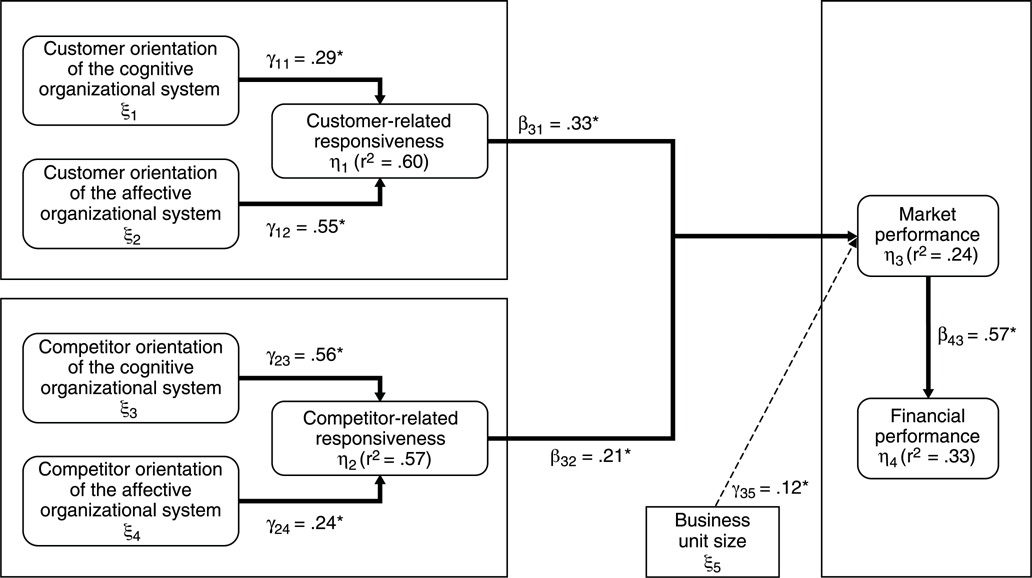
Results of Model Estimation
The results confirm the positive relationship between customer-related and competitor-related responsiveness and performance. In this context, each of the two types of responsiveness has a positive impact on market performance in a model in which we control for the other type of responsiveness. The parameter estimates further show that both types of responsiveness are affected by both types of organizational systems (i.e., the affective and the cognitive system); all four corresponding parameter estimates (γ11, γ12, γ23, γ24) are positive and highly significant.
The magnitude of these path coefficients provides initial support for our hypotheses regarding the relative importance of the cognitive and the affective system. In the context of customer-related responsiveness, the effect of the affective system (γ12 = .55, p < .01) is stronger than the effect of the cognitive system (γ11 = .29, p < .01). Conversely, as H2 suggests, in the context of competitor-related responsiveness, the effect of the cognitive system (γ23 = .56, p < .01) is much stronger than the effect of the affective system (γ24 = .24, p < .01).
To provide a sound statistical test of H1 and H2, we conducted chi-square difference tests to test whether both effects differ in their strength. First, we tested H1. We constrained the two (unstandardized) path coefficients under consideration (i.e., γ11 and γ12) to be equal. The new, restricted model is nested in the original model (which is not subject to this restriction). Therefore the chi-square difference test can be used to compare these two models (Bollen 1989). The null hypothesis in this test is that the two models do not differ in terms of fit with the data. If this null hypothesis is not rejected, there is no statistically sound support for differences between the two effects. However, if the null hypothesis is rejected, this indicates that the magnitudes of the effects differ significantly, in support of H1. Because the restricted model contains one parameter fewer than the nonrestricted model, the chi-square difference test is based on one degree of freedom. The critical value on the .05 level is 3.84.
With regard to H1, the null hypothesis is rejected (χ2diff = 20.39, p < .01). This finding (together with the observation that the standardized parameter estimate for the effect of the affective system is stronger than the one for the cognitive system; see Figure 2) supports H1; customer-related responsiveness is more strongly influenced by the customer orientation of the affective system than by the customer orientation of the cognitive system.
Second, we tested H2 in a similar manner. Again, the chi-square difference between the constrained (i.e., γ23 = γ24) and the unconstrained (χ2diff = 6.65) models was significant (p < .01). Thus, the data also support H2. Competitor-related responsiveness is more strongly influenced by the competitor orientation of the cognitive organizational system than by the competitor orientation of the affective organizational system.
Stability Tests
Because the correlations between the exogenous variables in our model are comparatively high, there is a risk that our result may not be stable to small changes in the data (Cohen et al. 2003, p. 419). Therefore, we reanalyzed our model with 50 data sets, in which 5% of the cases had been removed randomly. The results from the stability tests strongly suggest that the correlations between the exogenous variables do not compromise the validity of our results. For all 50 data sets, the pattern of results is consistent with our hypotheses. In addition, mean values (across the 50 samples) of the standardized parameter estimates for the γ coefficients are identical to those obtained in our main analysis, while their standard deviations are small (with values ranging from .03 to .05).
Results Related to Moderating Effects
We relied on multiple group structural equation modeling to test H3–H6. Consequently, for every hypothesis predicting a moderating effect, several successive steps were required, which we outline for tests of moderating effects with regard to customer-related responsiveness. We adopted a similar approach to test moderator hypotheses with regard to competitor-related responsiveness.
We first conducted a median split of our sample along the values of the moderator variable to create two subsamples, one with low values of the moderator and the other with high values of the moderator. We then analyzed the model implied by our theoretical framework simultaneously in both subsamples using LISREL. Because all moderator hypotheses predict changes in the relative importance of the cognitive system as a driver of responsiveness, we then computed the relative importance IMPcog, g of the customer orientation of the cognitive system for customer-related responsiveness in both subsamples (g = 1 refers to the subsample in which the value of the moderator is low, and g = 2 refers to the subsample in which the value of the moderator is high). Using the respective LISREL parameter estimates, we defined IMPcog, g as the ratio of the effect of the cognitive system to the sum of the effects of the cognitive (i.e., γg11) and affective (i.e., γg12) system. Stated formally,

To test statistically whether the relative importance of the cognitive system as a driver of responsiveness differs between both subsamples, we again relied on chi-square difference tests. Therefore, we reran the LISREL analysis with a constraint that forced IMPcog, g to be equal across both subsamples. If the difference between the chi-square goodness-of-fit statistics from both analyses was significant, we inferred that the relative importance of the cognitive system was different in both populations. Because constraining IMPcog, g to be equal across both groups is associated with the gain of one degree of freedom, the critical value for the chi-square difference test on the .05 level is again 3.84.
Table 3 summarizes the results we obtained following the previously outlined procedure. We now discuss the results related to each moderator variable.
Results of Multiple Group Analysis

As H3 predicted, the relative importance of the competitor orientation of the cognitive system for competitor-related responsiveness is lower when competitive intensity is high (IMPcog,2 = 48%) than when it is low (IMPcog,1 = 67%). However, the chi-square difference test reveals that this difference is significant only at the .1 level. 2 Thus, H3 is only partially supported.
Because our analysis of moderating effects with LISREL multigroup analysis is based on the dichotomization of the moderator variable, it may be associated with a reduced level of statistical power (Irwin and McClelland 2001), which could also serve as explanation for why we do not find support for H3.
Regarding H4, the customer orientation of the cognitive system has almost no effect on customer-related responsiveness when the market share of the firm is high, leading to a low relative importance of the cognitive system (IMPcog,2 = 0%). As H4 predicted, IMPcog, g is considerably higher when market share is low (IMPcog,1 = 54%). The corresponding chi-square difference is also highly significant (χ2diff = 13.86, p < .01). Thus, our data fully support H4.
Likewise, our data support H5. The relative importance of the competitor orientation of the cognitive system as a driver of competitor-related responsiveness is lower when market share is high (IMPcog,2 = 39%) than when it is low (IMPcog,1 = 88%). Consistent with this discrepancy, the chi-square difference is highly significant (χ2diff = 13.20, p < .01).
H6 predicted that the relative importance of the competitor orientation of the cognitive system as a driver of competitor-related responsiveness would be higher when ease of market entry is high. Our results fully support this hypothesis. The relative importance of the cognitive system is considerably higher when ease of entry is high (IMPcog,2 = 86%) than when it is low (IMPcog,1 = 54%). The corresponding chi-square difference is also highly significant (χ2diff = 9.35, p < .01).
Discussion
Research Issues
Despite the undisputed importance of a firm's responsiveness to customers and competitors, studies on organizational antecedents to responsiveness are scarce. Moreover, previous research has neglected the issue of whether the different antecedents affect customer-related responsiveness and competitor-related responsiveness with equal strength. Our study addresses these issues by analyzing both types of responsiveness and their organizational antecedents in an integrative model. We believe that the design of our study and the findings from the empirical analysis advance academic knowledge in several ways.
First, our study introduces the concept of an organization's affective and cognitive systems as drivers of organizational behavior. This conceptualization parallels the distinction between affect and cognition as driving forces of individual behavior. The relevance of this distinction is emphasized by the finding that the two systems differ in their impacts on organizational behavior (in our case, responsiveness to customers and competitors). Thus, we believe that this distinction might be fruitfully applied to other domains of marketing research that capture organizational phenomena, such as research on organizational buying behavior, companies' CRM, and the implementation of marketing strategy.
Second, our study develops a theoretical logic that decisions about customer-related activities are typically made in a different environment than decisions about competitor-related activities (the degree of social interaction with the outside party is one distinguishing factor). On the basis of this reasoning, we show that the affective organizational system is more important in driving responsiveness to customers, whereas the cognitive organizational system is more important in driving responsiveness to competitors. These findings have implications for research on market orientation. We suggest that research in this field should examine customer and competitor orientation separately rather than focusing on an aggregate construct of market orientation. This suggestion is supported through findings from a limited number of studies that make this distinction and reveal differential effects of customer and competitor orientation (e.g., Han, Kim, and Srivastava 1998; Im and Workman 2004). It is also in line with Noble, Sinha, and Kumar's (2002, p. 36) observation that the “focus on holistic measures may explain some of the problems and inconsistencies encountered in prior empirical market orientation research.”
Third, our results show that the relative importance of the affective and cognitive organizational systems as drivers of responsiveness to customers and competitors is strongly influenced by market characteristics. More specifically, we find that in firms with a strong market position (e.g., with a high market share or in markets with strong entry barriers for new competitors), the affective system becomes much more important as a driver of the business unit's ability to respond quickly to new market-related developments. We believe that this result can be of great interest for researchers in the field of market-related organizational learning because it hints at dysfunctional consequences of previous success.
Finally, our study illustrates that investigating the relative importance of different antecedents that drive the phenomena under consideration can yield insights into the links between constructs of interest. Research exploring the relative importance of different drivers of behavior is not uncommon in other research fields, such as research on organizational behavior (Johnson and LeBreton 2004). However, most empirical studies in marketing focus on hypothesizing the mere existence of relationships between independent and dependent variables and do not predict differences in effect sizes between competing predictors. Consequently, existing knowledge on the relative importance of predictors such as organizational subsystems, product attributes, or different attitudes is usually based on interpreting results from statistical analysis and is rarely backed by theory. We believe that studies in other domains of marketing research could also benefit from theoretically explaining different patterns of importance.
Four limitations of our study need to be mentioned. They also provide avenues for further research. First, although our study analyzes the effect of market factors on the relative importance of the affective and cognitive system as drivers of responsiveness, it does not consider other potential moderators, such as product-related factors or the type of industry (service versus manufacturing).
Second, our research focuses on only a subset of possible internal antecedents of responsiveness to customers and competitors. Although the orientation of the two subsystems included in our design explains approximately 60% of the variance of responsiveness, further research could include other variables, such as the organizational structure.
Third, our model is specified in such a way that the cognitive and the affective organizational systems are allowed to correlate freely. However, it does not investigate causal links between these constructs, because it is difficult to establish which system has causal priority. Indeed, some models of cultural change in organizations view the relationship between information processing and organizational culture as circular (e.g., Hatch 1993). Further research could explore the relationship between the cognitive and the affective system in greater detail. Given the possibly complex interrelationships between these two concepts, we suggest a dynamic study to analyze these issues.
Fourth, we find a comparatively high correlation between customer orientation and competitor orientation of the cognitive system (r = .67). Thus, the cognitive system of some firms may be highly attuned to the external environment in general (customers and competitors). Further research could explore whether both constructs are causally linked (e.g., in-depth knowledge of customers could be associated with better knowledge of competitors' actions).
Managerial Implications
A finding with managerial relevance is that customer-related and competitor-related responsiveness both affect market performance. Thus, managers should strive for responsiveness to both groups in the environment and not neglect either type of responsiveness. We believe that this finding is important because many firms seem to have established an extreme focus on responsiveness to customers, which may decrease their attention to competitive moves.
Another important implication for managers is that the two types of responsiveness depend on different major driving forces; that is, customer-related responsiveness is more strongly driven by the affective organizational system, whereas competitor-related responsiveness depends more on the cognitive organizational system. This finding provides guidance for managers on how to increase their organization's responsiveness. Because change processes typically demand a high investment of resources, managers can avoid a significant misallocation of resources by focusing on changes in that system that is more effective in driving responsiveness.
Competitor-related responsiveness is most effectively achieved by designing the process of generating, disseminating, analyzing, and storing competitor-related information. Thus, firms should focus on their competitive intelligence processes to increase competitor-related responsiveness. Designing a firm's electronic information systems (e.g., the intranet) is typically of crucial importance in this context. Conversely, our results show that customer-related responsiveness depends more strongly on the customer orientation of values, beliefs, and norms. Thus, to increase customer-related responsiveness, managers should focus more strongly on “symbolic management” (i.e., the shaping of the organizational culture through rituals, stories, and the exemplification of the cultural values in their behavior).
Our findings also inform managers that they should adopt a long-term orientation when enhancing customer-related responsiveness because changing an organization's culture is typically a long-term initiative (Schein 1992). Conversely, competitor-related responsiveness might be enhanced more quickly by improving organizational information processing.
A final important managerial implication of our study is that in firms with a strong market position (characterized by a high market share and/or effective entry barriers for new competitors), the importance of the affective organizational system as a driver of responsiveness rises. As a result of prior success, organizational members may develop a false sense of security, which may hinder them from adequately reacting to information that is possibly uncomfortable. Under these circumstances, it is important that managers instill a culturally based sense of urgency regarding new customer-related and competitor-related developments into their organization.
Footnotes
Scale Items for Construct Measurement

| Construct Name | Items | M | SD | Coefficient α | Composite Reliability | Factor Loading | Item Reliability |
|---|---|---|---|---|---|---|---|
| Customer (competitor) orientation of the cognitive organizational system (indicators are item means from the four information-processing constructs) | 4.56 (4.14) | 1.09 (1.15) | .85 (.88) | .85 (.88) | |||
| •Customer (competitor) orientation of information generation | .73 (.77) | .54 (.60) | |||||
| •Customer (competitor) orientation of information dissemination | .78 (.77) | .61 (.60) | |||||
| •Customer (competitor) orientation of information analysis | .79 (.85) | .63 (.71) | |||||
| •Customer (competitor) orientation of information storage | .76 (.83) | .58 (.68) | |||||
| Customer (competitor) orientation of information generation (seven-point rating scale anchored by “strongly disagree” [1] and “strongly agree” [7]) | 4.66 (4.44) | 1.28 (1.23) | .83 (.85) | .84 (.86) | |||
| •“We systematically and constantly gather information about our customers (competitors).” | .78 (.81) | .61 (.65) | |||||
| •“We collect information about customers (competitors) in a comprehensive and holistic way.” | .85 (.90) | .72 (.80) | |||||
| •“We systematically and constantly keep track of the behavior of our customers (competitors).” | .75 (.73) | .56 (.53) | |||||
| Customer (competitor) orientation of information dissemination (seven-point rating scale anchored by “strongly disagree” [1] and “strongly agree” [7]) | 4.31 (3.97) | 1.32 (1.33) | .78 (.80) | .78 (.80) | |||
| •“Our personnel spends a fair amount of time to exchange newest customer- (competitor-) related developments with other functional departments.” | .73 (.73) | .53 (.54) | |||||
| •“We regularly circulate documents (e.g., reports, newsletters) that provide relevant information on customers (competitors).” | .75 (.80) | .57 (.64) | |||||
| •“Members of all hierarchical levels in our business unit regularly receive information about the newest customer-related (competitor-related) developments.” | .73 (.74) | .53 (.54) | |||||
| Customer (competitor) orientation of information analysis (seven-point rating scale anchored by “strongly disagree” [1] and “strongly agree” [7]) | 4.51 (4.14) | 1.30 (1.36) | .82 (.84) | .82 (.84) | |||
| •“We systematically and regularly analyze information about customers (competitors).” | .75 (.77) | .57 (.59) | |||||
| •“Our top managers periodically analyze and interpret the gathered information on customers (competitors).” | .74 (.81) | .54 (.66) | |||||
| •“Members of different departments regularly meet to analyze customer-(competitor-) related changes.” | .83 (.82) | .70 (.68) | |||||
| Customer (competitor) orientation of information storage (seven-point rating scale anchored by “strongly disagree” [1] and “strongly agree” [7]) | 4.78 (4.00) | 1.36 (1.45) | .80 (.83) | .81 (.84) | |||
| •“We regularly and systematically store and update information about our customers (competitors) in the corresponding information systems (e.g., databases, expert systems, intranet).” | .77 (.86) | .60 (.74) | |||||
| •“We regularly and systematically store and update information about our customers (competitors) in corresponding documents (e.g., presentations, reports, newsletters).” | .79 (.86) | .63 (.73) | |||||
| •“Our personnel store all relevant information about our customers (competitors).” | .74 (.68) | .55 (.46) | |||||
| •“Members of all hierarchical levels have access to the available information about customers (competitors).” | .56 (.60) | .31 (.36) | |||||
| Customer (competitor) orientation of the affective organizational system (seven-point rating scale anchored by “strongly disagree” [1] and “strongly agree” [7]) | 5.62 (4.66) | .90 (1.05) | .91 (.89) | .91(.89) | |||
| •“We are aware that customers (competitors) are important factors that influence the success of our company.” | .69 (.66) | .48 (.44) | |||||
| •“We emphasize customer-(competitor-) related activities and success.” | .71 (.72) | .50 (.52) | |||||
| •“We have a customer-(competitor-) oriented culture.” | .84 (.82) | .71 (.67) | |||||
| •“Our customers (competitors) are a focal point of our activities.” | .86 (.81) | .75 (.65) | |||||
| •“We have a strategy that is based on the understanding of customers (competitors).” | .77 (.79) | .60 (.63) | |||||
| •“We have realized that customer needs are constantly evolving and that it is necessary to be informed about trends and customer demands. (We have realized that competitors' activities change the market environment and that it is necessary to be informed about latest shifts in the competitive environment).” | .77 (.67) | .59 (.45) | |||||
| •“We intend to constantly keep track of the activities of our customers (competitors).” | .74 (.69) | .55 (.48) | |||||
| Customer- (competitor-) related responsiveness (seven-point rating scale anchored by “strongly disagree” [1] and “strongly agree” [7]) | 5.35 (4.62) | .97 (1.22) | .88 (.92) | .88 (.92) | |||
| •“We respond rapidly if something important happens with regard to our customers (competitors).” | .74 (.83) | .54 (.69) | |||||
| •“We quickly implement our planned activities with regard to customers (competitors).” | .83 (.87) | .69 (.76) | |||||
| •“If our customer-related (competitor-related) activities do not lead to the desired effects, we are fast at changing them.” | .73 (.85) | .53 (.72) | |||||
| •“We quickly react to fundamental changes with regard to our customers (competitors).” | .90 (.87) | .81 (.76) | |||||
| Market performance (seven-point rating scale anchored by “clearly worse” [1], “competition level” [4], and “clearly better” [7]) | “In the last three years relative to your competitors, how has your business unit performed with respect to: | 4.87 | 1.16 | .90 | .90 | ||
| •Achieving the desired profit and revenue level? | |||||||
| •Achieving the desired growth? | .82 | .67 | |||||
| •Achieving/securing the desired market share?” | .97 | .94 | |||||
| .81 | .66 | ||||||
| Financial performance (seven-point rating scale anchored by “clearly worse” [1], “industry level” [4], and “clearly better” [7]) | 4.50 | 1.25 | — a | — a | |||
| “Over the last three years relative to industry average, how has your business unit performed with respect to return on sales?” | — a | — a | |||||
| Competitive intensity (seven-point rating scale anchored by “strongly disagree” [1] and “strongly agree” [7]) | 5.75 | .89 | .70 | .73 | |||
| •“Competition in our industry is cutthroat.” | .88 | .77 | |||||
| •“Our competitors are relatively strong.” | .60 | .36 | |||||
| •“Intensive competitor-related activities (e.g., intensive competition via price or product) are a hallmark of our industry.” | .57 | .33 | |||||
| Market share (ten-point rating scale: 1 = <5%, 2 = 5%–9%, 3 = 10%–14%, 4 = 15%–19%, 5 = 20%–24%, 6 = 25%–29%, 7 = 30%–39%, 8 = 40%–49%, 9 = 50%–59%, and 10 = ≥60% | 5.04 | 2.76 | — a | — a | |||
| “Over the last three years, how large was the average market share of your business unit in your most important market?” | — a | — a | |||||
| Ease of market entry (seven-point rating scale anchored by “strongly disagree” [1] and “strongly agree” [7]) | 2.06 | 1.11 | — a | — a | |||
| “The likelihood of a new competitor being able to establish a strong competitive position in the market within a short span of time is high.” | — a | — a | |||||
| Business unit size (seven-point rating scale: 1 = <200, 2 = 200–499, 3 = 500–999, 4 = 1000–2499, 5 = 2500–4999, 6 = 5000–10,000, and 7 = >10,000) | 2.84 | 1.54 | .74 | .77 b | |||
| •“How many employees work in your business unit?” | .61 b | .37 b | |||||
| Business unit size (eight-point rating scale: 1 = <$25 million, 2 = $25 million–$49 million, 3 = $50 million–$99 million, 4 = $100 million–$199 million, 5 = $200 million–$499 million, 6 = $500 million–$999 million, 7 = $1,000 million–$2,000, and 8 = >$2,000 million) | •“How large were last year's revenues of your business unit?” | .95 b | .89 b |
The construct is measured with one item. Coefficient alpha, composite reliability, factor loading, and item reliability cannot be computed.
The construct is measured with two items. Because a separate measurement model is not identified, measurement information is taken from the structural model.