







Abstract
Ensuring joint program participation by distributors is essential to channel management. Although studies confirm that firms can promote distributor participation by attending to their participation motivations, the authors argue that distributors may change their motivations over the course of a joint program, driven by an increase of program-related information and how their peer distributors behave. Drawing insights from the information asymmetry literature, the authors postulate that distributors’ ex ante commitment is driven by their motivation to avoid losses, and after they participate, their ex post adaptation reflects rent-seeking motivations. This study also examines how the participation of peer distributors operates as an information signal that moderates the motivation–participation link for the focal distributor. In the context of an actual sales program, this study confirms the postulate of motivation shift and the salience of network-based information in distributors’ program participation. The results show that a manufacturer needs to manage its distributors’ participation in a discriminant, process-oriented, and system-sensitive manner by addressing the latter's diverse motivations, changing goals in the joint program, and influences from peer distributors.
Keywords
Recent work has pointed out that distributors may have different motivations and that such motivations may shift before the start of the program and after the program is in place (Jap and Anderson 2007; Murry and Heide 1998). This is common in firm practices. For example, when Com-plan, a small dietary spin-off brand of Heinz, launched a sales program, it relied on financial incentives to encourage distributor participation. Yet the firm later found out that the real catalyst of distributors’ participation was not financial benefits but rather their perceived exigency (Montgomery 2005). In China, Ford Motor Company started a joint sales program with Xinbaoding, one of its regional distributors. The latter's initial motive was to leverage the program and build a stable distributorship. However, when Ford failed to provide proper financial incentives, the partnership dissolved, hurting Ford's reputation in the country (China Economic News 2006). We are intrigued by the diversity and shifts in distributor motivations; therefore, this study attempts to delineate the theoretical roots and verify the salience of this phenomenon. The findings add to the understanding of how firms can manage their distributor participation discretely and effectively (Frazier 1999; Murry and Heide 1998).
In particular, we draw insights from the information asymmetry literature to construct our theoretical framework (Bergen, Dutta, and Walker 1992; Mishra, Heide, and Cort 1998). Parties in a marketing relationship typically possess asymmetric amounts of information about the exchange, but this information asymmetry may change over time, affecting how the parties behave. In the context of a joint manufacturer–distributor program, we argue that the distributor has less information about program profitability than the manufacturer before the launch of the program. This precontractual information scarcity (Bergen, Dutta, and Walker 1992) constrains the distributor's participation decision a priori, causing the distributor to assume a risk-aversive orientation. After the distributor participates in the program, its knowledge about the program and its effectiveness increases. This postcontractual information clarity (Bergen, Dutta, and Walker 1992) encourages the distributor to redefine its goals, often to optimize its self-interest. This change of program information ex ante and ex post enables the distributor to reconsider its payoffs and gives rise to potential shift in its motivations before and after the program. We use two major categories of motivations—one pertaining to improved efficiency (i.e., rent-seeking motivations) (Jap 1999, 2001) and the other aiming to neutralize potential threats in an exchange relation (i.e., loss-avoidance motivations) (Ghosh and John 1999, 2005)—as a way to capture the distributor's changing motivations ex ante and ex post.
This study also examines how peer distributors’ participation affects a focal distributor's program response. We postulate that the degree of peer participation, a network construct, operates as a salient information signal because it represents the market's collective wisdom on the program as well as the potential competition among participating distributors. This signaling effect changes the strength of different motivations in affecting the focal distributor's behavior. From a broader perspective, this moderating effect demonstrates how network behavior affects dyadic relationships, as suggested by Antia and Frazier (2001), Heide and John (1992), and Wathne and Heide (2004).
Using data collected from distributors in a real-life joint sales program, this study makes three contributions. First, we enrich the current understanding of distributor motivations and participation in joint sales programs (Jap 1999, 2001; Murry and Heide 1998). Drawing from the theoretical perspective of information asymmetry, we explicate the diversity of ex ante and ex post distributor motivations and assess their impacts. This complements existing studies that use economic (Carson et al. 1999), sociological (Granovetter 1985), or transaction cost (Heide and John 1988) approaches. Second, our focus on how the distributor behaves ex ante versus ex post fills a need for more discriminant analyses on strategies to gain initial versus continuous compliance from channel partners in a program (Murry and Heide 1998). Third, by examining the moderating role of peer distributor participation, this study contributes to the network-based analysis of dyadic relationships, responding to the call Antia and Frazier (2001), Heide and John (1992), and Wathne and Heide (2004) issue.
Theoretical Background
Information Asymmetry and Motivation Shift in a Joint Program
Information is the core ingredient when firms formulate their strategies to optimize their payoffs. In channel dyads, the value of information is particularly salient given divergent and competing interests of channel members. When one member is more or better informed than the other, information asymmetry emerges (Bergen, Dutta, and Walker 1992; Eisenhardt 1989). In a typical joint sales program, information asymmetry is common because the manufacturer and distributor possess different amounts of program-related information. Over the course of the program, the balance of information asymmetry shifts, affecting how the manufacturer and distributor behave.
In the ex ante stage, information about the program, including its potential effects and how other distributors respond to the program, rests more with the manufacturer. The distributor attempts to gain accurate information from the manufacturer, in a way similar to a customer seeking information from a seller to evaluate his or her purchase decision (Mishra, Heide, and Cort 1998; Singh and Sirdeshmukh 2000). In Bergen, Dutta, and Walker's (1992) terminology, problems of “hidden information” exist in this stage.
In the ex post stage, the information asymmetry tilts in favor of the distributor. It is more informed than the manufacturer on how the market responds to the program and the amount of required efforts in executing the program. Therefore, the manufacturer attempts to know the distributor's program behavior to maximize its own return, which represents a “hidden action” problem (Bergen, Dutta, and Walker 1992). In short, we posit that this changing information status ex ante and ex post is a salient cause for the distributor's motivation shift, which sequentially affects its participation.
In each stage, we focus on a particular type of distributor behavior the manufacturer desires. In the ex ante stage, the manufacturer asks the distributor to join the new program and makes necessary investments to initiate the program. We refer to the distributor's preliminary, relationship-specific, program-enabling investments as “ex ante commitment.” To distinguish between ex ante commitment and other continuous adjustments that may entail specialized investments (Cannon and Perreault 1999), we focus on the specific investments made before the start of the program. Known also as “credible commitments” (Williamson 1983), “idiosyncratic investments” (Anderson and Weitz 1992), or “specific assets” (Bensaou and Anderson 1999), such ex ante commitments include the distributor's promotion expenses, human resources, and fixed assets specifically directed to serve and enable the joint program. These difficult-to-transfer investments create economic value for the manufacturer–distributor relationship (Jap 1999; Rokkan, Heide, and Wathne 2003; Williamson 1983), but they can also be opportunistically exploited because the manufacturer can misrepresent the program and make false benefit claims to boost distributor participation. Indeed, precontractual information scarcity prevents the distributor from accurately evaluating manufacturer claims or conducting comprehensive analysis on the program.
In the ex post stage, the manufacturer often expects the distributor to exhibit agile adaptations to environmental changes rather than remain restricted to the original terms in the contract. For example, a manufacturer prefers a distributor to adapt its promotional efforts to meet customer needs and preempt competitive offers (Murry and Heide 1998). We refer to this type of participative behavior as “ex post adaptation,” defined as the distributor's ongoing adaptation to changing market needs after the program is in place. Transaction cost theory provides prominent predictions to relate transaction-, relationship-, and environment-specific characteristics to the need for adaptation (Rindfleisch and Heide 1997; Williamson 2005). Yet, in the joint sales program, in which the manufacturer's and distributor's interests only partially overlap, the need for adaptation, as perceived by the manufacturer, does not necessarily translate into appropriate adaptive behavior by the distributor (Noordewier, John, and Nevin 1990; Wathne and Heide 2004). In the ex post stage, because the manufacturer often delegates some decision-making authority to its distributor (Jensen and Meckling 1976), the latter gains implementation-related information about the program, its effectiveness, and its profitability. Postcontractual information clarity presents the distributor an opportunity to redefine its options in ways that maximize its own payoffs.
Distributor Motivations: Loss Avoidance versus Rent Seeking
Interfirm relationships literature posits several reasons a distributor participates in a joint program with a manufacturer. These include “loss-avoidance motivations,” which focus on minimizing threats from the structural and environmental conditions in which firms operate (Fein and Anderson 1997; Ghosh and John 2005), and “rent-seeking motivations,” which attempt to maximize the use of complementary assets to improve firm efficiency (Carson et al. 1999; Jap 1999). When a distributor is requested to join a program, concerns about potential losses (e.g., due to noncompliance, which invites retaliatory actions by the manufacturer) or missed opportunities (e.g., for new revenue streams) may “push” the distributor to comply with the request. These loss apprehensions reflect the distributor's vulnerability in a world of bounded rationality and potential opportunism (Fein and Anderson 1997).
In contrast, rent-seeking motivations (i.e., the pursuit of efficiency and profits) “pull” the distributor to participate in the joint sales program. The distributor may possess insufficient information to assess the real value of the new program, but its perceptions of program benefits often regulate its level of participation (Carson et al. 1999; Klein 1996). In other words, if the manufacturer can create a strong perception that the new program will generate supernormal profits and grant benefits to all participating firms, it will enhance the distributor's rent-seeking motivations.
Although distributor motivations can be considered from multiple theoretical lenses (Murry and Heide 1998), our conceptualization of loss-avoidance and rent-seeking motivations captures the firm's fundamental goal to avoid the negative and obtain the positive—that is, prevention and promotion foci (Crowe and Higgins 1997). In the following sections, we construct a framework that delineates how these motivations affect program participation ex ante and ex post. We also incorporate the moderating role of peer distributor participation, as depicted in Figure 1.

Conceptual Framework of Distributor Participation in a Joint Sales Program
Hypotheses Development
Effects of Motivations on Ex Ante and Ex Post Participation
When requested to make an ex ante commitment, the distributor cannot make a fully informed decision because of precontractual information scarcity (Bergen, Dutta, and Walker 1992; Eisenhardt 1989). This inability to assess the true value of the program prevents the distributor from conducting an accurate rent-seeking calculation. As a result, the distributor may assume a loss-avoidance inclination in its behavior. We propose two contextual constraints that give rise to loss-avoidance motivations, which in turn drive the distributor's ex ante commitment.
The first contextual constraint, “distributor dependence,” refers to the distributor's perceived dependence on the manufacturer, which may occur for several reasons. In some cases, dependence arises when the distributor deals with the “best” manufacturer, which provides higher returns than other suppliers in the market (Heide and John 1990). For example, manufacturers with strong brand images among end customers often charge a premium for their products. Distributors are motivated to work with these higher-performing manufacturers because a bigger “pie” offers higher returns (Jap 2001). In other instances, distributors have made specific investments to support a particular manufacturer, and the “sunk” properties of these investments make it costly for distributors to replace the manufacturer (Whyte 1994). Regardless of the sources that create dependence, the notion poses a core threat to the distributor (Frazier 1999; Heide and John 1988), constraining the distributor's participation decision. When the distributor declines to comply with the manufacturer's new investment request, it risks losing a source of income, forfeiting prior specific investments, or inviting retaliatory actions. In a relational context characterized by high dependence, the distributor is likely to have higher levels of compliance with the manufacturer's request.
Such program-specific investments create greater lock-in for the distributor. We do not address ways to safeguard these investments, because prior studies, including Heide (1994) and Rindfleisch and Heide (1997), offer significant findings in this area. Instead, we focus on methods for managing the distributor's motivations to make specific investments. Perceptions of dependence induce the sense of loss avoidance in the distributor. By joining and investing in the new program, the distributor can signal its support for a long-term exchange, which should help stabilize the relationship and strengthen its bond with the manufacturer (Fein and Anderson 1997; Rokkan, Heide, and Wathne 2003).
The second construct that induces the distributor to assume loss-avoidance motivation is “market uncertainty,” or the unpredictability of the task environments in which the distributor operates (Buvik and John 2000). When the task environments, including customer demand and competitor actions, are highly uncertain, the “boundedly rational” distributor is unable to proactively search or efficiently detect valuable information to develop an optimal response (Dickson 1992). As a result, market uncertainty encourages the distributor to use familiarity as a decision heuristic (Heide and Weiss 1995). When approached by a familiar manufacturer, the distributor is likely to adopt a compliance strategy to establish a sense of control over future events (Bensaou and Anderson 1999; DiMaggio and Powell 1983).
Distributor dependence and market uncertainty are independent constructs that constrain the distributor's participation decision to make an ex ante commitment. The former indicates the manufacturer's ability to inflict negative consequences (Kumar, Scheer, and Steenkamp 1998), and the latter reflects information-searching costs required to find a best alternative opportunity (Dickson 1992). Although compliance strategies driven by loss-avoidance motivations may not be optimal, they are likely to be “satisficing” (Simon 1979) for the distributor.
Similar arguments can be derived from organization studies. O'Reilly (1982) shows that unverifiable task-specific information creates conditions in which contextual information becomes the most salient cue for firm decisions. In the ex ante stage, because program-specific information is unclear and has questionable credibility, contextual information based on distributor dependence and market uncertainty becomes more influential. Therefore, we posit the following:
H1: Loss-avoidance motivations driven by distributor dependence and market uncertainty have greater impacts on ex ante commitment than rent-seeking motivations.
In the ex post stage, detailed information about program execution and profitability is more accessible to the distributor than to the manufacturer, tilting the information asymmetry in favor of the distributor. In the joint program, although the manufacturer may know how many new products the distributor has bought and sold, the distributor possesses additional information on the required efforts to implement the program effectively in the marketplace. To the distributor, this represents postcontractual information clarity, whereas to the manufacturer, this presents the hidden action problem (Bergen, Dutta, and Walker 1992).
Thus, we posit that the distributor's motivation underlying its voluntary ex post adaptation results primarily from rent efficiency considerations. This is consistent with agency theory that the principal should construct incentives to prompt the agent, in its own best interests, to take actions the principal prefers (Kreps 1990; Lafontaine 1992). For example, if a distributor considers the joint program compatible with its own interests, it will adapt any practices that are effective for the program as the task environment changes. In contrast, if a manufacturer exploits a lock-in situation or compels a distributor to adapt, the distributor's response will be perfunctory, deviating from the good-faith modifications the manufacturer prefers (Heide and John 1992; Noordewier, John, and Nevin 1990).
This study uses two variables to capture the distributor's rent-seeking motivations in a joint program. First, “joint profit” refers to the joint program's rent-generating ability or pie-expansion capability, which enhances the efficiency of all parties involved (Carson et al. 1999; Jap 1999). Second, “expected benefits” refer to the extent to which the distributor perceives how the pie is shared for its own interests (Carson et al. 1999; Jap 2001). Positive perceptions of these two variables should heighten the distributor's self-interest and thus establish a self-enforcing mechanism (Telser 1980) that encourages effective adaptive behavior.
Rent perceptions are first formed when the manufacturer introduces the joint program to the distributor. As the program progresses, the distributor revises and updates its rent perceptions. For example, when the distributor receives customer orders, it can assess the program's joint profit more precisely. Although financial reward and program payoffs may not be fully actualized when adaptation is needed, the distributor can form more accurate expectations about future gains, which motivate its level of adaptation. In contrast, loss-avoidance considerations that dominate the distributor's ex ante behavior fade into the background in the ex post stage. 1 Thus, we propose the following:
Distributor dependence and market uncertainty might induce ex post adaptation, but joint profit and expected benefit are probably more potent predictors. Subsequently, we test this possibility in the estimated model.
H2: Rent-seeking motivations driven by joint profit and expected benefits have greater impacts on ex post adaptation than loss-avoidance motivations.
Moderating Role of Peer Distributor Participation
We define “peer distributor participation” as the focal distributor's perception of other distributors’ participative behavior in the joint program. The focal distributor may find out how its peer distributors respond to the program through formal (e.g., professional associations) and informal (e.g., private interactions) networks (Gu, Hung, and Tse 2008). Because the new program is of interest to all relevant distributors, they are motivated to conduct such information exchanges. We expect that a higher level of peer participation encourages the focal distributor's participation because of a tendency toward herd behavior (Banerjee 1992). However, we are interested in how peer behavior affects the strength of the two sets of motivations. Such an understanding will help us gain a systematic view of network influence on individual motivation–participation dynamics.
When peer distributors’ participation is high, we posit that dependence serves as a stronger motivation for ex ante commitment. Assuming that a distributor is highly dependent on the manufacturer, its fear of losing the relationship would be acute when more distributors join the program because high peer participation indicates greater future competition. This fear motivates the distributor to commit to the program and stabilize its relationship with the manufacturer. To some extent, peer participation strengthens the manufacturer's market position, resulting in greater potential loss for a noncompliant distributor.
Moreover, a high level of peer participation works in another way. It prevents the manufacturer from engaging in opportunistic behavior because such behavior will lead to potential retaliation by networked distributors, damage to its reputation, and higher costs in future transactions (Antia and Frazier 2001; Wathne and Heide 2004). To the focal distributor, the curtailed manufacturer opportunism renders the program safer for its commitments. Taken together, we expect that peer participation increases the influence that a powerful manufacturer exerts on the distributor's decision.
H3a: The higher the level of peer distributor participation, the greater is the extent to which distributor dependence increases ex ante commitment.
In contrast, we posit that the impact of market uncertainty on ex ante commitment is reduced by a high level of peer distributor participation. This is because peer participation provides the focal distributor with additional information on how other distributors think about the program. Potential program effects, such as likely benefits and risks of the program, are reflected by varying levels of peer participation and shared among participating distributors. Such information alleviates the information asymmetry that besets the focal distributor ex ante. While uncertainty arising from changing customer needs and competitive actions motivates the distributor to stabilize the manufacturer relationship, higher peer participation provides greater access to program-related information and thus enables a more informed decision for the focal distributor. As a result, the effect of market uncertainty is weakened. We propose the following:
H3b: The higher the level of peer distributor participation, the lesser is the extent to which market uncertainty increases ex ante commitment.
In the ex post stage, the focal distributor is expected to make voluntary adaptation to meet the changing needs of the program. However, as we discussed, the hidden action problem emerges because of the manufacturer's imperfect knowledge about how the distributor implements the joint program. Under such circumstances, monitoring may be less effective to promote ex post adaptation (Eisenhardt 1989). In contrast, self-interest becomes a more effective mechanism to regulate the distributor's behavior (Bergen, Dutta, and Walker 1992). We argue that such a pattern of increasing effectiveness of self-interest along with the declining role of monitoring is more pronounced as peer participation increases.
When more distributors participate in a program, the manufacturer must manage an increasingly complex web of distributor relationships. Cognitive limitations coupled with increasing information search costs prevent the manufacturer from monitoring the participating distributors completely (Bergen, Dutta, and Walker 1992; Kreps 1990). This monitoring deficiency implies that the distributors have greater freedom to act in accordance with their own best interests. Only when a self-enforcing mechanism is established—that is, the pie-expansion capability of the program is sufficiently convincing—will the distributor voluntarily perform ex post adaptation to increase gains for the program and, ultimately, for itself. This increased importance of self-interest in encouraging relational behavior echoes findings in the export marketing literature. Because exporters often lack information about overseas distributors’ behavior, control mechanisms based on self-interest are more effective than those based on information sharing (Bello and Gilliland 1997; Zhang, Hu, and Gu 2008).
Moreover, peer participation constitutes a constraint on the manufacturer's behavioral latitude. When more distributors participate, the manufacturer cannot shirk its responsibilities in the joint program, because doing so may endanger its reputation and future business opportunities (Antia and Frazier 2001). As a result, the focal distributor has fewer concerns of manufacturer opportunism, so its expectation on program benefits is more reliable and deliverable. This enhances the positive impacts of rent perceptions on ex post adaptation behavior. Overall, we hypothesize the following:
H4: The greater the peer distributors’ participation, the greater is the extent to which (a) joint profit and (b) expected benefits increase ex post adaptation.
Consequences of Program Participation
The distributor's competitive advantages represent strategic benefits that enable the focal dyad to outcompete other dyads in the marketplace (Jap 1999). We expect that both ex ante commitment and ex post adaptation help increase such competitive advantages for the distributor. First, ex ante commitment enables the joint program to explore new product opportunities or serve new market segments. The distributor's investments in the program also help develop its competitive advantages, such as enlarged market share in an area, closer bonding with end customers, and a preemptive position in a new product market. Second, ex post adaptation helps the manufacturer–distributor dyad respond in a timely manner to environmental changes and realign mutual resources proactively. This changing realignment constitutes a critical capability in the focal dyad that others likely cannot duplicate (Eisenhardt and Martin 2000). Thus, we posit the following:
H5: A distributor's participation through (a) ex ante commitment and (b) ex post adaptation strengthens the competitive advantages of the distributor.
Both ex ante commitment and ex post adaptation of the participating distributor provide positive signals to the manufacturer, which increases its continuity expectations and strengthens the relationship in the long run. Thus:
H6: The distributor's greater participation through (a) ex ante commitment and (b) ex post adaptation strengthens the distributor's long-term relationship with the manufacturer.
Method
Research Setting and Data Collection
We test our framework using data collected from the channel of one of the leading manufacturers in a niche food product industry. The manufacturer's distribution network spans more than 60 countries. Through a joint new product launch with its independent distributors in China, the firm hopes to enhance its market position in this highly competitive market. The study focuses on the distributors’ motivations to participate in the program (referred to as “program X” for anonymity), their participation behavior, and their evaluation of program outcomes. By investigating distributors with a common manufacturer, we achieve reasonable variation in the constructs of interest while controlling for exogenous factors, such as industry and brand name, that may confound the study results.
Because this study attempts to verify postulates of a theoretical model, rather than to generalize the results to a new population, we believe that the study context is appropriate (Morgan and Hunt 1994). Moreover, the naturally observed event, involving an actual manufacturer and real-life distributors, allows the respondents to specify their motivations and participation behavior without much recall effort and evaluate the program's performance on a realtime basis (Murry and Heide 1998).
We designed an English-language questionnaire and then translated it into Chinese. To ensure conceptual equivalence, two independent translators back-translated the Chinese version into English. Any disagreements were discussed by the authors and translators until consensus was reached (Hoskisson et al. 2000). With the help from the manufacturer, we conducted in-depth interviews with seven senior managers identified from the firm's distributors list. In these interviews, we asked the managers to evaluate the questionnaire's relevance and clarity. We then revised several items on the basis of their feedback. The final survey was conducted in Chinese.
Hoskisson and colleagues (2000) recommend face-to-face interviews to obtain reliable information in emerging economies. Therefore, we randomly drew 200 names from the list of approximately 1000 distributors provided by the manufacturer as interview targets in an annual distributor conference in China. The conference is an annual event, in which the manufacturer makes important announcements for distributors and more than 80% of the firm's distributors attended. Before the conference, we called the selected distributors to (1) invite their participation, (2) ascertain whether representatives of attending firms had sufficient knowledge about the specific program, and (3) ensure that the selected distributors had been with the program for at least six months so that they could evaluate the adaptations required by the program and its outcomes. All the representatives in the sample hold titles of chief executive officer, president, director, or senior manager and serve as the key contact with the manufacturer.
The screening and invitation efforts revealed that 11 names were not qualified for the study, and 52 interviewees either could not be identified or rejected the invitation, which left 137 potential targets. The authors and two trained interviewers then attended the conference to conduct face-to-face interviews with these distributors. To ensure that the respondents adopted an organizational perspective, we explicitly asked them to focus on organizational properties and to evaluate aspects of the firm-to-firm relationship before answering the questionnaire. We also promised confidentiality to the respondents and confirmed that the data collected would not be accessible to the manufacturer and would be used only for large-sample statistical analyses. Each interview took approximately 20 minutes, and each respondent received a souvenir from the sponsoring university as a token of appreciation. We successfully conducted interviews with 131 distributors. We assessed potential nonresponse bias by comparing the respondents with all distributors on several characteristics, such as relationship age, number of employees, number of subsidiary firms/branches, and business areas. We found no significant difference among these variables, which indicates that nonresponse bias is not a significant concern.
To address the potential issue of common method bias, we obtained second-wave responses by recontacting all 131 distributing companies by telephone and asking to speak to a different person in the same company to complete the questionnaire. In this second-wave survey, we collected 49 responses; a series of t-tests and multivariate analyses of variance showed no significant differences between the original and the follow-up samples in terms of the key variables studied. Furthermore, to determine correlation stability, we used the second-wave responses pertaining to independent variables, including the two rent-seeking variables, the two loss-avoidance variables, and the peer participation variable, and then we correlated them with the first-wave responses for the mediating and outcome variables. The correlation pattern is similar to that of the original sample. This indicates that when a specific correlation is high, it reflects the actual organizational characteristic rather than any systematic response bias. Common method bias in the interaction between motivation variables and peer distributor participation is not a concern, because the respondents are not expected to find complicated interactive relationships in the framework (Aiken and West 1991). In addition, most study constructs are either externally verifiable referents or external manifestations of internal states, which alleviates concerns about common method bias (Rindfleisch et al. 2008).
Statistically, we test for the potential problem of common method bias using the hierarchically nested covariance structure model in a confirmatory factor analysis (Podsakoff et al. 2003; Williams, Cote, and Buckley 1989; Ye, Marinova, and Singh 2007). In the model estimation, we specify a common method factor in which each manifest item loads on the method factor, as well as its theoretical construct. Following Carson (2007), we calculate the percentage of method variance (19.5%), which is relatively low compared with the median amount of the method variance (25%) that Williams, Cote, and Buckley (1989) observe for survey studies. To confirm whether the method factor extracts significant systematic variance, we compare the models with and without the method factor and obtain insignificant change-in-fit statistics (Δχ 2 = 29.35, Δd.f. = 24, p > .10). 2 Therefore, we conclude that common method bias does not present a significant threat to the study.
There is a rich literature that deals with common method bias. It is acknowledged that if the method factor extracts a significant portion of systematic variance, we follow Ye, Marinova, and Singh's (2007) method to control its effects.
Measures
We adapt measurement scales from previous research to the study context. All the scales are five-point Likert scales (1 = “strongly disagree,” and 5 = “strongly agree”). In Table 1, we report the interconstruct correlation matrix and descriptive statistics.
Correlation Matrix of Variables

p < .05 (two-tailed t-test).
p < .01 (two-tailed t-test).
Notes: N = 131.
In Table 2, we provide the constructs, measurement items, and their composite reliabilities (CR). All reliability values exceed .66, suggesting acceptable levels (Bagozzi and Yi 1988). We adapted the measure of distributor dependence from Jap and Ganesan's (2000) scale of a retailer's dependence on its supplier. After removing an item with low interitem correlation, the final measure achieves a CR of .82. 3 The measure of market uncertainty is based on Jaworski and Kohli's (1993) scale, and it attains a CR of .73. Because we could not find any existing measures of joint profits and expected benefits, we developed items by adapting the concepts of pie-expansion (Jap 1999) and pie-sharing (Jap 2001) expectations to our study context. Specifically, we asked the respondents to estimate how much program X would contribute to both parties and to their own companies. Three items pertaining to channel efficiency and joint profit gains constitute the scale for joint profit (CR = .84), and three items regarding the perceived benefits that should accrue to the individual distributor appear in the scale for expected benefit (CR = .66).
Measurement and Confirmatory Factor Analysis Results
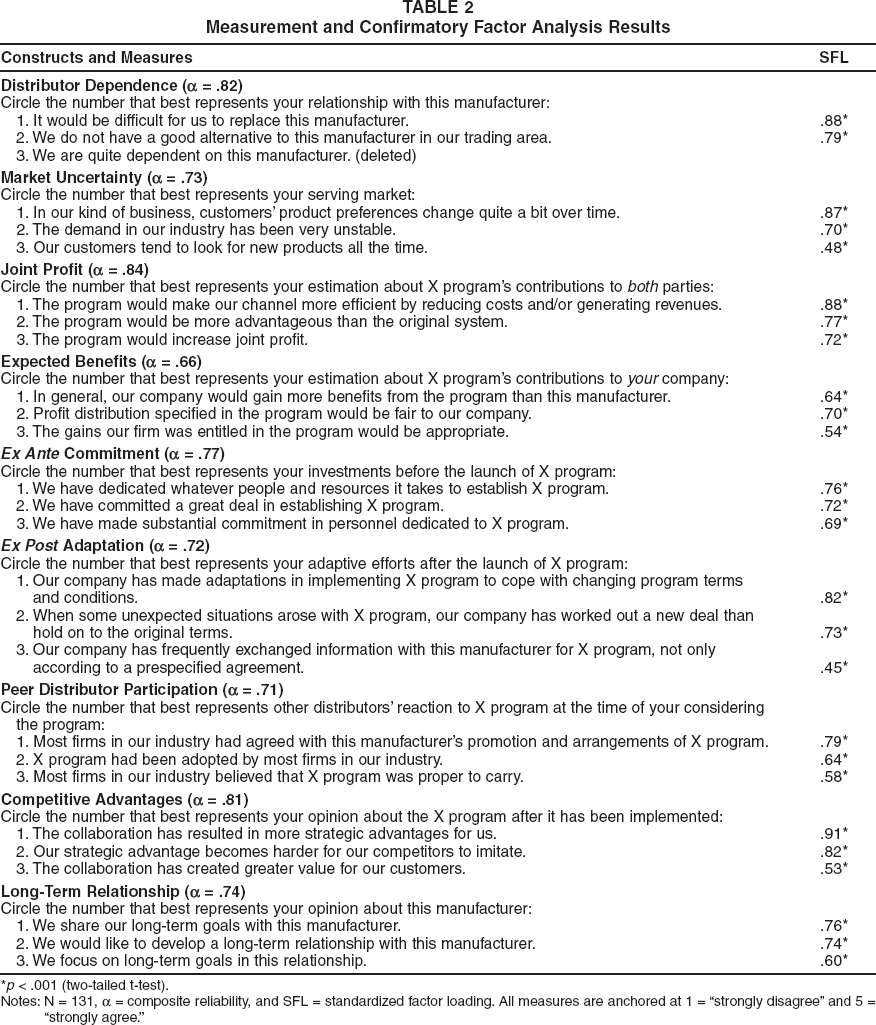
p < .001 (two-tailed t-test).
Notes: N = 131, α = composite reliability, and SFL = standardized factor loading. All measures are anchored at 1 = “strongly disagree” and 5 = “strongly agree.”
With all three items to measure distributor dependence, we achieve similar results in hypothesis testing.
We assess ex ante commitment on the basis of measures of program-specific commitments published in previous research (Anderson and Weitz 1992; Jap and Ganesan 2000). As previously noted, we focus on the distributor's initial commitments before the launch of the program. The measure has a CR of .77. To measure ex post adaptation, we adapt the measures of flexibility that Noordewier, John, and Nevin (1990) and Heide and John (1992) developed to reflect the distributor's efforts to adapt to changing circumstances during the joint program, without being restricted to prespecified agreement. Because flexible handling of unexpected situations often rests on effective communication between transaction parties, we complement two items of flexibility with a third item on information sharing. The three items exhibit satisfactory reliability, with a CR of .72.
Using Zaltman, Duncan, and Holbek's (1973) conceptualization of network participation, we operationalize peer distributors’ participation in terms of their reaction to the manufacturer's new sales program. Three items explicitly ask for the focal distributor's perception of other firms’ participative attitude and behavior. We obtained a CR of .71 for these three items. For the outcome variables, competitive advantages and long-term relationship, we adapt scales from Jap (1999) and Ganesan (1994), respectively. We ask the respondents to evaluate their competitive advantages and relationship with the manufacturer after implementation of the new sales program. The CRs of the two scales are .81 and .74, respectively.
Finally, we include control variables that appear frequently in interfirm studies (Antia and Frazier 2001; Heide and John 1990; Jap and Ganesan 2000). Relationship age measures the duration of the distributor's association with the manufacturing firm. Number of employees and number of subsidiaries serve as proxies for the size of the distributor. The manufacturer's TSIs measure the focal manufacturer's transaction-specific investments to develop the distributor's business.
Confirmatory Factor Analysis and Validity Assessment
After verifying that an exploratory factor analysis for the scale items results in the expected construct solutions, we submit all constructs to confirmatory factor analyses using AMOS 6 (Arbuckle and Wothke 1999). Because the ratio of the sample size to the number of parameter estimates is less than five, we conduct two confirmatory factor analyses, grouping measures of related constructs together (Atuahene-Gima 2005; Bentler and Chou 1987; Moorman and Miner 1997). The results indicate a satisfactory fit of the two measurement models: one that includes the four motivation constructs and two participation constructs (χ 2 = 149.99, d.f. = 104, p < .01; comparative fit index [CFI] = .91; incremental fit index [IFI] = .92; and root mean square error of approximation [RMSEA] = .058) and one with the peer distributor participation and advantage outcomes (χ 2 = 41.19, d.f. = 24, p < .05; CFI = .94; IFI = .94; and RMSEA = .074). As Table 2 shows, all measurement items have significant factor loadings on their corresponding theoretical constructs (p < .001), impling convergent validity. To establish discriminant validity, we conduct a series of chi-square difference tests for all constructs in pairs to determine whether the freely estimated model (correlation estimated freely) provides a better fit to the data than the restricted model (correlation fixed to 1) (Bagozzi, Yi, and Phillips 1991). All chi-square differences are significant (p < .01), in support of discriminant validity.
Data Analysis and Results
Main Effects of Motivations
We estimate a structural model of the conceptual framework for the whole sample (N = 131), including relationship age, number of employees, number of subsidiaries, and manufacturer's TSIs to control for their effects on the four endogenous variables, as Figure 1 depicts. Correlations among the four motivation constructs, as well as those among the four control variables, are freely estimated to account for possible relationships between these factors. The chi-square value for the structural model is 45.77 (d.f. = 25, p < .01; goodness-of-fit index [GFI] = .95; IFI = .92; CFI = .90; and RMSEA = .08). These results suggest that the conceptual model fits the data well. In Table 3, we provide estimation results for the structural path coefficients and related hypotheses.
Summary of Results: Hypothesis Testing of Main Effects

p < .05 (two-tailed t-test).
p < .001 (two-tailed t-test).
Notes: Standardized parameter estimates are provided, with t-values in parentheses. N = 131.
In H1, we predict that loss-avoidance motivations make a greater contribution to ex ante commitments than rent-seeking motivations. The results we depict in Table 3 show that loss-avoidance motivations, including distributor dependence (β = .27, p < .001) and market uncertainty (β = .27, p < .001), significantly encourage the distributor's ex ante commitments. However, we do not find any significant effects of rent-seeking motivations on ex ante commitment (p > .10). In H2, we anticipate that the effects of rent-seeking motivations will be greater than the effects of loss-avoidance motivation on ex post adaptation. The analysis results show that the two rent-seeking motivation constructs exert both positive and significant impacts on ex post adaptation (joint profit: β = .21, p < .05; expected benefits: β = .25, p < .001). However, neither of the two loss-avoidance motivations has a significant impact on ex post adaptation (p > .10). Therefore, we conclude that loss-avoidance motivations are more effective in driving ex ante participation, whereas rent-seeking motivations have greater impacts on ex post participation, in support of H1 and H2.
Interaction Effects
To test the moderating roles of peer distributor participation (H3 and H4), we split the sample into two groups—high and low peer distributor participation, relative to the median value (3.7). Following the moderation test procedure that Jaccard, Turrisi, and Wan (1990) suggest, we first conduct multigroup estimation, with all path parameters from the motivation variables to participation modes freely estimated across the high and low groups. If the resultant individual parameter estimates differ significantly across the two groups (e.g., the gamma coefficient is significant in one group but insignificant in the other), we can conclude that a significant interaction exists, in line with Aiken and West (1991) and Moorman and Miner (1997). However, if a pair of parameter estimates is significant for both groups, we proceed to an individual parameter estimation, in which we constrain this pair of parameter estimates to be equal across the two groups and then assess the change of model fit between the models. A significant chi-square value change between the two models provides evidence of interaction, and an insignificant change indicates the equivalence of parameters.
Multigroup estimation
We estimate structural models simultaneously for the high and low peer distributor participation groups, in which we specify the two loss-avoidance motivations for ex ante commitment and the two rent-seeking motivations for ex post adaptation; for model parsimony, we do not specify the insignificant main effects (i.e., rent seeking on ex ante commitment and loss avoidance on ex post adaptation). All parameters are freely estimated across groups. The overall fit is satisfactory, with the model chi-square of 24.78 (d.f. = 16, p = .074; GFI = .94; IFI = .89; CFI = .87; and RMSEA = .065). Thus, the model offers a good fit to the data for both groups. However, we are more interested in parameter differences, and in Table 4, we provide estimation results for moderating effects and the related hypotheses.
Summary of Results: Moderation Effects of Peer Distributor Participation
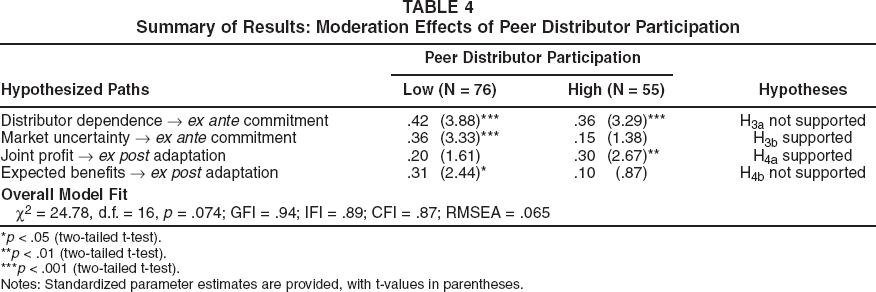
p < .05 (two-tailed t-test).
p < .01 (two-tailed t-test).
p < .001 (two-tailed t-test).
Notes: Standardized parameter estimates are provided, with t-values in parentheses.
In H3a, we posit that the greater the peer distributors’ participation, the greater is the extent to which distributor dependence increases ex ante commitment. From Table 4, we note that distributor dependence exerts significant impacts on ex ante commitment for both high and low peer participation groups (βHI = .36, p < .001; βLOW = .42, p < .001). Therefore, we proceed to the test of chi-square differences between models with and without constraints of parameter equivalence. The model that constrains the path between distributor dependence and ex ante commitment to be equal across groups results in a chi-square of 7.901 (d.f. = 11, p > .10). Compared with the baseline model, in which all parameters are freely estimated, the change in the chi-square is .006 (d.f. = 1, p > .10), which suggests equivalence of parameters. Therefore, H3a is not supported. H3b proposes a negative interaction between market uncertainty and peer distributor participation. Consistent with this prediction, the results show that market uncertainty has a positive impact on ex ante commitment when peer distributor participation is low (βLOW = .36, p < .001), but the effect becomes insignificant with high peer distributor participation (βHI = .15, p > .10). Therefore, H3b is supported.
With H4a–H4b, we consider the positive interaction between peer participation and rent-seeking motivations and its effects on ex post adaptation. H4a receives support; joint profit has a strong positive impact on ex post adaptation in the high peer participation group (βHI = .30, p < .01) but an insignificant influence in the low group (βLOW = .20, p > .10). However, the impacts of expected benefits show an opposite pattern, with significant influence in the low group (βLOW = .31, p < .05) but an insignificant impact in the high group (βHI = .10, p > .10); thus, H4b is not supported. That is, although peer participation increases the importance of joint profit motivation, as we expected, it may reduce the impact of expected benefits on ex post adaptation. This seemingly surprising result may be explained by the notion that as a greater number of peer distributors join the program, the focal distributor may feel increased competitive pressure from its peers. Thus, the focal distributor is in a weakened position to bargain for a greater slice of the pie. As a result, the focal distributor shifts its attention to the joint profit, or the overall profit-generating capability of the program. The expected benefits or the profit-sharing rule then becomes less relevant to its adaptive behavior. The results indicate that in the ex post stage, though the effectiveness of rent-seeking motivations increases in general, as more distributors participate, the manufacturer should focus more on the joint profit in the program to ensure distributors’ continuous adaptation.
Supplementary analysis
We conduct a supplementary analysis using ordinary least squares to validate the interaction results obtained from structural equation modeling. We specify two regression models in which ex post adaptation and ex ante commitments represent the dependent variable. For the regression of ex ante commitment, we include the four motivation variables and two interaction terms between peer participation and loss-avoidance motivations (H3a–H3b). For the regression of ex post adaptation, we include the same motivation variables and two interaction terms with rent-seeking motivations (H4a–H4b). The variance inflation factors indicate no significant multicollinearity (ranging from 1 to 2). The R-square for the two regression runs are .26 and .22, suggesting satisfactory explanatory power of proposed predictors. The regression results confirm the previous findings. Regarding ex ante commitment, we find a significant interaction between peer participation and market uncertainty (β = –.14, p < .05), whereas the interaction with dependence does not reach significance, in support of H3b only. Moreover, the interaction with joint profit is positively associated with ex post adaptation (β = .12, p < .10), in support of H4a. In contrast to H4b, the interaction with expected benefits negatively affects ex post adaptation (β = –.15, p < .05).
Effects of Participation Behavior
With H5 and H6, we examine the effects of the distributor's ex ante commitment and ex post adaptation on competitive advantages and long-term relationships. The results in Table 3 show that both ex ante commitment (β = .36, p < .001) and ex post adaptation (β = .28, p < .001) significantly improve the distributor's competitive advantages, in support of H5a–H5b. Ex ante commitment registers positive significance (β = .41, p < .001), whereas ex post adaptation has no significant impact (p > .10) on long-term relationships, in support of H6a but not H6b. Regarding the control variables, we find that the manufacturer's TSI contributes significantly to explaining competitive advantages, consistent with previous transaction cost analysis research (Jap and Ganesan 2000). None of the other control variables have a significant impact.
Discussion
Against the backdrop of the increasing need to collaborate, this study investigates three issues that are crucial to managing distributors’ participation in joint programs. They include (1) the motivations (loss avoidance or rent seeking) that drive participation, (2) the means to ensure continuous program engagement in both ex ante and ex post stages, and (3) the network conditions that vary the effects of motivations.
The study confirms that rent-seeking factors, such as joint profit and expected benefits, are fundamental considerations that drive a distributor's program participation. Consistent with an economizing calculus that emphasizes efficiency maximization (Ghosh and John 2005), the study validates the role of economic incentives in encouraging the distributor's continuous adaptation. Marketing channel literature has long recognized the importance of flexible handling of unexpected circumstances, sharing of valuable information, and short-term sacrifices for long-term benefits (Gundlach, Achrol, and Mentzer 1995; Heide and John 1992), all of which characterize partnering firms’ continuous efforts to adapt to changing environments. The results suggest that a positive assessment of program benefits supports such continuous and adaptive efforts.
However, this study points to a key limitation of rent-seeking motivations. The expected benefits and joint profit exert an insignificant impact on ex ante commitment, which instead is strongly influenced by market uncertainty and distributor dependence. When the distributor receives a request to make specific commitments in a joint program, it possesses insufficient information to perform an accurate cost–benefit analysis. Instead, the existing relationship structure and task environment provide more readily accessible cues for decisions. The results indicate that the distributor is more likely to comply with the manufacturer's request when the dependence structure favors the manufacturer and/or market conditions are highly unpredictable. To some extent, the distributor's participation represents a compelled action because noncompliance may bring negative consequences inflicted by a powerful manufacturer or emanating from an uncertain environment. The need to maintain the manufacturer relationship and gain control over market uncertainties leads to a more cooperative stance ex ante. This loss-avoidance motivation was expressed by one of the interviewees: “Such programs are more like a routine. Why don't we join? The manufacturer is a named brand in our industry. We certainly don't want to lose it.” Another interviewee provided the following description: “We are under great pressure these days. There are lots of competitors, many new products…. Luckily, we've got good relations with our suppliers. The business has been stable.”
The compliance strategy with a familiar manufacturer does not necessarily imply a passive measure. It accommodates active agency as a response to institutional pressures and expectations (Grewal and Dharwadkar 2002; Oliver 1991). A compliance strategy may result in various benefits, such as increased stability, external support, continued commitment, and long-term growth. Thus, when driven by loss-avoidance motivations, the distributor's compliance with the manufacturer's program request can lead to social and economic betterment, a stronger long-term relationship, and greater competitive advantages.
Furthermore, this study delineates moderating effects of peer distributor participation on links between the focal distributor's motivations and its participation behavior. In the ex ante stage, peer participation offers access to additional information because it results in more avenues for sharing market information about the program. This effect alleviates the information asymmetry that besets the focal distributor and helps balance the influence of market uncertainty. Conversely, distributor dependence significantly influences ex post commitment despite varying levels of peer participation, revealing the strong constraint of an embedded relationship structure on the distributor's decision making. In the ex post stage, as peer participation instigates hidden actions of the distributor, the distributor's expectations of positive joint profits become more important for adaptive behavior. The distributor adapts to changing needs of the program to maximize the program value for both parties in the dyad. However, this greater concern with the joint profit is accompanied by increased competitive pressures from other participating distributors. To some extent, the focal distributor must refrain from an overemphasis on individual and exclusive payoffs. In summary, peer distributors’ participation offers more behavioral discretion to the focal distributor but also requires more responsibilities for the joint program.
Contributions
This study contributes to interorganizational relationship literature in theory development and empirical validation. First, we offer an additional perspective for understanding distributors’ motivations to join a manufacturer-initiated program. Extant literature outlines environmental, organizational, and interpersonal factors that may lead to interfirm collaboration processes (Jap 1999; Murry and Heide 1998). These processes involve various participation motivations, including the use of complementary capabilities and learning of new skills. However, few research attempts have been made to differentiate ex ante participation (characterized by program-specific investments) from ex post participation (characterized by continuous adaptation and flexible handling of unexpected circumstances), nor have studies delineated the effects of unique motivations across different program stages. By drawing on the information asymmetry perspective in a marketing channel context, we demonstrate that information asymmetry helps explain the changing roles of the manufacturer and the distributor, as well as their underlying information (dis)advantage before and after the launch of the joint program. In the ex ante stage, when distributors lack sufficient information, they cannot verify the true value of the program (Mishra, Heide, and Cort 1998), and loss-avoidance dominates. In the ex post program stage, the table is turned; distributors can assess their participation through program-related benefit outcomes, and rent-seeking perceptions become more effective for encouraging cooperative behavior.
Thus, the findings demonstrate that a multistage perspective of information asymmetry offers a useful framework to explain a distributor's participation behavior. The distributor's participation motivations are nonstatic and depend on its possession of program-relevant information. In addition, distributors’ participation is not only based on a gain-and-loss calculation but also driven by a desire to neutralize both internal and external threats to its partner relationship. Overall, this study extends the current thinking on interfirm collaborative processes with particular relevance to motivation diversity and its potential dynamics.
Second, this study contributes to a better understanding of network influences on dyadic interorganizational relationships (Anderson, Håkansson, and Johanson 1994; Antia and Frazier 2001; Heide 1994; Wathne and Heide 2004). Current views of dyadic relationships recognize that dyads are part of a network of relationships that affect the focal dyad's behavior and performance. Antia and Frazier (2001) explore how structural characteristics, such as the centrality and density of a network, may affect a channel member's behavior. Wathne and Heide (2004) investigate the governance implications of an upstream relationship on a downstream relationship. We regard peer participation as an important source that produces critical signals to focal distributors, and this improved knowledge reduces the reliance on environmental cues (e.g., market uncertainty) to make ex ante decisions. Moreover, peer participation weakens the manufacturer's information position ex post, complicating its monitoring efforts. As such, the distributor has greater behavioral latitude and, to a greater degree, regulates its behavior according to the positive economic prospects the program offers.
Managerial Implications
The marketplace is increasingly characterized by intense competition, fragmented demands, rapid technological changes, and major economic shifts, which makes interfirm collaboration essential for firms. This study focuses on the manufacturer-initiated program with the distributor, a common strategy in marketing channels. The findings provide several insights into this topic. The general tenet is that manufacturers need to manage their programs in a discriminant, proactive, and system-sensitive manner.
Because distributors’ core motives may change during a joint program, manufacturers should be discriminant and proactive in managing the distributors’ perceptions before and after the program launch. Loss-avoidance considerations may arise from relationship characteristics, industry competition, and shifting customer needs. In a world of uncertainties, the bond with a familiar, reliable, and competent manufacturer gives distributors a sense of control and stability. To provide a feeling of safety, manufacturers should invest in long-term relationship management and signal their commitment through various support programs, such as training, technical aid, and promotional assistance. These programs remove distributors’ fear of opportunism and encourage their participation and investment. In a mutually beneficiary circle, this study suggests that the distributor's inclination toward loss avoidance turns into a preference for strengthening its relationship with the manufacturer because both have invested together in the joint program.
Yet distributors’ defensive motivations may become rent seeking when the situation changes and distributors gain a more advantageous position. This study indicates that to accommodate distributors’ rent-seeking motivations, manufacturers should implement a proper incentive structure, such as a clear and escalating profit-sharing plan. The conscious, proactive use of various influence strategies may enhance program success—in contrast with the “half-baked” joint programs that distributors exit or silently disengage.
Finally, manufacturers should assume a system-sensitive view in their relationship with individual distributors. Peer distributors’ participation influences how a focal distributor behaves because of its signaling effect. In a highly efficient Web-based society, the actions of peer distributors are increasingly transparent, often beyond what manufacturers realize. Diligent distributors could discover whether other distributors have committed to joint programs through distributors’ early announcements on their own Web sites. Small distributors that depend on and are highly vulnerable to manufacturers could share their program intentions with their peers to gain self-protection or fair rewards. Therefore, it is essential for manufacturers to assume a network perspective in the flat and increasingly open marketplace and to design appropriate incentive schemes for the allied distributors that are beneficial to both parties.
Limitations and Further Research
We acknowledge several limitations of this study. First, we use distinctive factors to represent the rent-seeking and loss-avoidance motivations that distributors may have toward a manufacturer-initiated program. This approach could be improved in several ways, such as using a broader and more comprehensive taxonomy of distributor motivations that would help confirm the study results. For example, researchers might explore transaction-specific benefits, such as the ease of program implementation and complementarity with existing programs, as potential rent-seeking factors. Similarly, structural or environmental constraints, including the availability of alternative suppliers and the level of competitive intensity, might serve as alternative loss-avoidance considerations. An enlarged set of distributor motivations would provide more actionable implications for managers.
Second, further research should directly gauge distributors’ loss-avoidance versus rent-seeking motivations using perceptual measures. In addition, a multistage survey in which these motivations are measured at different times would enable a more direct and detailed examination of distributors’ changing motives. These methodological advancements could help further validate and extend the research findings.
Third, to examine the network effect, we use data about the level of peer distributors’ participation, as perceived by the focal distributor. Additional research should explore more complex interactions between individual motivations and network characteristics, such as the effects of network density and interconnectedness among channel members. In addition, network centrality (i.e., the relative position of the focal distributor) may moderate distributor motives and is of interest to both researchers and managers.
Fourth, we use a real-life event as the research context. Other methods, including behavioral experimentation and longitudinal studies, are needed to complement the findings and unpack interesting theoretical perspectives on this challenging topic.