







Abstract
Although the number and importance of joint innovation projects between suppliers and their customers continue to rise, the literature has yet to resolve a key question: Do embedded ties with customers help or hurt supplier innovation? Drawing on both the tie strength and knowledge literatures, the authors theorize that embedded ties interact with supplier and customer innovation knowledge to influence supplier innovation. In a sample of 157 Dutch business-to-business innovation relationships, they observe that embedded ties weaken how much suppliers benefit from customer innovation knowledge because of worries about customer opportunism (the dark side of embedded ties). However, they uncover three moderating relationship and governance features that allow suppliers to overcome these dark-side effects and even increase innovation (the bright side of embedded ties). Finally, although the authors predicted a bright-side effect, they find that embedded ties neither help nor hinder the supplier to leverage its own innovation knowledge in the relationship.
Keywords
Our focus is on the knowledge exchange occurring in vertical (supplier–customer) interfirm innovation relationships. Such exchange is central to innovation because although supplier firms have the knowledge to produce a solution, customer firms have the most knowledge about their own needs as users (Von Hippel 1986). Thus, if the two partners can exchange what they know, the likelihood of supplier innovation increases. However, this outcome is not a given, as witnessed in the dismal 70% failure rate of B2B innovation alliances (see De Rond 2003, p. 3; Hughes and Weiss 2007; Lhuillery and Pfister 2009).
One challenge is that knowledge exchange activities take place in the context of relational attachments between firms (e.g., Lane and Lubatkin 1998; Uzzi 1997). Previous literature has studied the role of trust (Grayson and Ambler 1999; Möller and Halinen 1999; Moorman, Zaltman, and Deshpandé 1992) and embedded ties (e.g., Rindfleisch and Moorman 2001; Selnes and Sallis 2003; Uzzi and Lancaster 2003) on knowledge exchange between firms.
We focus on one unresolved issue related to these relationships: the controversial role of embedded ties as both a bright-side and dark-side influence on supplier innovation (see Mohr and Sengupta 2002). The bright-side view posits that embedded ties facilitate the transfer of complex, sensitive, and even tacit knowledge between partners (Hansen 1999; Reagans and McEvily 2003) as commitment and trust lower fears of opportunism (Rindfleisch and Moorman 2001). In turn, knowledge transfer between partners increases the likelihood of innovation.
A contrasting dark-side view argues that embedded ties can have a negative effect on knowledge sharing for innovation. This occurs because embedded partners converge in their thinking (Anderson and Jap 2005; Moorman, Zaltman, and Deshpandé 1992), fail to switch to new partners when they would offer new knowledge (Gu, Hung, and Tse 2008; Sorenson and Waguespack 2006), and have increased opportunities to use exchanged knowledge to their partners’ detriment (Anderson and Jap 2005; Grayson and Ambler 1999; Selnes and Sallis 2003).
We seek to reconcile these views by arguing that whether embedded ties produce a bright-side or dark-side effect depends on other conditions in the relationship. Following work on knowledge flows in dyadic exchange behavior (Frenzen and Nakamoto 1993; Selnes and Sallis 2003), we offer a contingency view of the effect of embedded ties as it interacts with supplier and customer innovation knowledge. We do this in three ways.
First, we theorize that embedded ties with a customer help a supplier leverage its own knowledge more effectively. We argue that this occurs because close customer ties increase supplier motivation to use its knowledge. Close ties also increase supplier opportunity to test its knowledge against customer experience early in the innovation process. In this bright-side effect, embedded ties interact with supplier innovation knowledge to increase supplier innovation. Second, we theorize that when the supplier is in an embedded relationship with a highly knowledgeable customer, this produces the two dark-side outcomes found in prior research—increased supplier worries about customer opportunism and supplier perceptions of knowledge redundancy. These, in turn, reduce supplier innovation. Thus, we predict that the dark side is caused by the interaction of embedded ties and customer innovation knowledge. Third, we theorize that this dark side can transform into a bright side when the partners agree to a set of relational and governance mechanisms. We theorize that this occurs because these mechanisms reduce supplier worries about customer opportunism and perceptions of knowledge redundancy.
We test our ideas in a sample of B2B relationships involved in innovation projects across Dutch manufacturing industries. All relationships are vertical between a supplier (the firm seeking to innovate) and a business customer (the firm the supplier has partnered with to innovate). Our focus is on supplier innovation, defined as the supplier's use of new or improved product, service, or process activities relative to the supplier's current activities (Thompson 1965; Zaltman, Duncan, and Holbek 1973). This broadened view of innovation allows the firm to innovate in all areas of marketing, not just new products and services. For example, a supplier might sell current products but introduce a new segmentation scheme or a new channel.
Theory
We begin with an overview of the literature on tie strength and partner knowledge in innovation. We then make predictions about (1) how embedded ties interact with supplier knowledge to increase supplier innovation, (2) how embedded ties interact with customer knowledge to decrease supplier innovation, and (3) three relational and governance conditions that turn this dark side into a bright side. Figure 1 summarizes our predictions.

The Role of Embedded Ties in B2B Innovation: The Dark Side and the Bright Side
The Conflicting Effects of Embedded Ties on Innovation
The tie-strength literature has examined the nature and effect of relationships in general (Granovetter 1973), in intraorganizational settings (Levin and Cross 2004), in interfirm relationships (Rindfleisch and Moorman 2001; Uzzi 1997), and in networks (Ahuja 2000), both in marketing and in strategy. This research focuses on the role of relational embeddedness between partners. Following Uzzi and Lancaster (2003), we define embedded ties as a close and reciprocal relationship between a customer firm and a supplier firm.
Embedded ties improve a wide range of relational and business performance outcomes. 1 However, research on the effect of embedded ties in the context of novel outcomes (e.g., innovation) has uncovered conflicting results. Early classic work has demonstrated that people find new jobs through weak or distant relationships. This is because weak ties provide novel information compared with strong ties, which recycle familiar information (Granovetter 1973). Consistent with this finding, follow-up research has shown that weak ties offer firms nonredundant information in intraorganizational settings (Levin and Cross 2004) and across firms in a network (Ahuja 2000). Other research, however, has found that strong or embedded ties facilitate access to novel information in interfirm settings (Hansen 1999; Uzzi and Lancaster 2003). One explanation is that partners involved in embedded ties are more willing to exchange sensitive or private knowledge because they trust each other (Reagans and McEvily 2003; Rindfleisch and Moorman 2001; Uzzi and Lancaster 2003).
Research has studied the impact of embedded ties on customer value (Palmatier 2008), cooperation (Morgan and Hunt 1994), trust (Levin and Cross 2004), expectations of continuity (Morgan and Hunt 1994; Palmatier et al. 2006), exchange of information (Hansen 1999; Reagans and McEvily 2003; Stanko, Bonner, and Calantone 2007; Uzzi and Lancaster 2003), and business performance (Rowley, Behrens, and Krackhardt 2000; Uzzi 1997).
These findings have generated insights into the role of embedded ties. However, given their conflicting nature, the extent to which firms can build innovation strategies using these ideas is limited. Furthermore, from a theoretical viewpoint, the observed conflicts in previous research indicate that other factors may influence when embedded ties have a positive or negative effect. Therefore, we investigate the conditions under which embedded ties help or hurt supplier innovation. Given the aforementioned critical role of knowledge exchange in interfirm innovation relationships (Carson 2007; Powell, Koput, and Smith-Doerr 1996; Rindfleisch and Moorman 2001; Selnes and Sallis 2003; Sivadas and Dwyer 2000), we focus our attention on the interaction of embedded ties and both customer and supplier knowledge.
The next section briefly defines innovation knowledge, which is our focus, and describes the impact of customer and supplier innovation knowledge on supplier innovation. We then turn to our predictions about the interaction of innovation knowledge and embedded ties.
The Impact of Supplier and Customer Innovation Knowledge on Supplier Innovation
The role of knowledge has a long and influential history in the innovation literature in general (e.g., De Luca and Atuahene-Gima 2007; Han, Kim, and Srivastava 1998; Henard and Szymanski 2001; Moorman 1995) and in the interfirm innovation literature specifically (Carson 2007; Powell, Koput, and Smith-Doerr 1996; Rindfleisch and Moorman 2001; Sivadas and Dwyer 2000). Following Moorman and Miner (1997, p. 93; see also Day 1994), we define firm knowledge as “stored beliefs, behavioral routines, or physical artifacts that vary in their content, level, dispersion, and accessibility.” We focus on innovation knowledge because it is a key factor in the innovation partnerships we study (Dyer and Nobeoka 2000; Lilien et al. 2002; Sivadas and Dwyer 2000). We investigate two types of partner innovation knowledge: supplier innovation knowledge and customer innovation knowledge.
First, supplier innovation knowledge should influence supplier innovation levels (e.g., Henard and Szymanski 2001). We focus on the supplier's proactive market orientation as a key type of supplier innovation knowledge. Narver, Slater, and MacLachlan (2004) define proactive market-oriented firms as exhibiting two features relevant to innovation: (1) a set of values associated with risk tolerance and entrepreneurship (Hamel 1991; Slater and Narver 1995) and (2) market information processes to uncover and meet latent, unarticulated customer needs. Both qualities have been linked to firm innovation (e.g., Atuahene-Gima and Ko 2001; Chandy and Tellis 1998; Narver, Slater, and MacLachlan 2004). Chandy and Tellis (1998, p. 479) argue that a focus on customer needs of the future makes decision makers “aware of the market-related developments and the potential effects on the firm.” Thus, firms are not overly committed to current marketing-related activities and actively screen for new ways of doing things. In a similar vein, Narver, Slater, and MacLachlan (2004) emphasize that innovation knowledge drives the development and implementation of novel activities that address latent customer needs.
Second, following the literature, we define customer innovation knowledge as reflected in two key lead-user abilities: (1) identifying needs and solutions sooner than most customers (Lilien et al. 2002) and (2) applying existing solutions in novel ways (Urban and Von Hippel 1988). 2 Both abilities play an important role in innovation outcomes (Brown and Eisenhardt 1997; Morrison, Roberts, and Von Hippel 2000; Urban and Von Hippel 1988). Because innovation is an uncertain process lacking reliable information about latent needs, suppliers can benefit from customer innovation knowledge to generate novel ideas early in the process (Bonner and Walker 2004; Lilien et al. 2002). Therefore, when engaged in joint innovation with a high innovation knowledge customer, the likelihood of supplier innovation should increase. 3
Urban and Von Hippel (1988) point out that lead-user customers also have stronger needs than typical customers. This state is a likely reason that lead users are more motivated to solve needs on their own rather than waiting for solutions from the market. We do not include this quality of lead users in our description of customer innovation knowledge, because it is more a motivational state arising from knowledge and not a quality of knowledge itself.
We do not offer main-effect hypotheses for the effects of the two types of partner innovation knowledge on supplier innovation given their more straightforward effect in the literature. Instead, we focus on how supplier innovation knowledge and customer innovation knowledge interact with embedded ties as predicted in H1 and H2.
Our discussion thus far focuses on the main effects of embedded ties and supplier and customer innovation knowledge on the supplier's innovation prospects. As shown in Figure 1, we now focus our attention on how these components interact to give rise to the bright and dark side of embedded ties documented in the literature.
The Bright Side: Embedded Ties Strengthen the Impact of Supplier Innovation Knowledge
We begin by proposing that embedded ties with a customer can help a supplier leverage its own knowledge more effectively. We offer two mechanisms for this bright-side effect: the motivation and opportunity to leverage supplier innovation knowledge.
An embedded relationship with a customer motivates the supplier to use its own market knowledge to develop innovations that meet the customer's needs (Dyer and Nobeoka 2000; Rowley, Behrens, and Krackhardt 2000). Specifically, an embedded relationship with the customer may prompt a supplier to work harder to use its own knowledge to address unmet customer needs (Cavusgil, Calantone, and Zhao 2003). In the absence of embedded ties, the supplier may instead slip back into established technologies or routines (Day 1994). Furthermore, when supplier innovation knowledge is low, there will be less knowledge to leverage. Therefore, both supplier innovation knowledge and embedded ties are essential to this effect.
An embedded relationship with the customer also gives the supplier an opportunity to test its ideas early in the innovation process. This allows the supplier to get an early understanding of what does and does not work to improve innovations. If supplier innovation knowledge is low, there will be less need for this opportunity. Moreover, if the supplier does not have a strong bond with the customer, it may not be willing to risk exposing underdeveloped ideas. As an example, Danfoss A/S, a $4.5 billion Danish company in the research and development (R&D) and production of control technology for the water treatment industry, engaged in months of new product testing in the production environment of several of its customers’ plants, which posed the risk of affecting local water supplies. Danfoss's close relationship with these lead-user customers allowed it to use this early learning strategy (Buur and Matthews 2008). Therefore, both supplier innovation knowledge and embedded ties are important. We predict the following:
H1: Embedded ties between a supplier and customer strengthen the positive effect of supplier innovation knowledge on supplier innovation.
The Dark Side: Embedded Ties Weaken the Impact of Customer Innovation Knowledge
One reason suppliers form a relationship with a knowledgeable customer is to improve innovation prospects. However, as ties become embedded, the supplier faces a set of risks associated with working with a knowledgeable customer. Specifically, when ties are strong and customers are knowledgeable, two potential problems are likely to occur: increased worries of partner opportunism and increased perceptions of knowledge redundancy.
Previous researchers have extensively studied the first mechanism, opportunism, in marketing relationships (e.g., Jap 2003; Wathne and Heide 2000). We use Williamson's (1975, p. 6) definition of opportunism as “self-interest seeking with guile” and focus on the harm that a customer can inflict on a supplier. Research has acknowledged that embedded partners have an increased opportunity to take advantage of one another. Granovetter (1985, p. 491) describes this risk as an “enhanced opportunity for malfeasance” and notes that “a person's trust in you results in a position far more vulnerable than that of a stranger.” Selnes and Sallis (2003, p. 80) refer to this problem as the “hidden costs of trust,” and they observe a negative interaction between trust and knowledge exchange activities on relationship performance.
We argue that as embeddedness increases, the risk of opportunism weakens the effect of customer innovation knowledge on supplier innovation. A key risk that suppliers perceive is that customers will use supplier information to vertically integrate backward and compete directly with the supplier. Mohr and Sengupta (2002) refer to this as the risk that the customer will “internalize” supplier information and compete against the supplier. 4 As a supplier becomes increasingly concerned about a customer using supplier information in this way (Jap 2003), suppliers begin to withhold sensitive information. In turn, this provokes similar and reciprocal responses from the customer. When this happens, the supplier is less able to obtain and less likely to use customer innovation knowledge to bolster its own innovation. This risk is much lower when the customer has low innovation knowledge because the customer has less to give and is less likely to innovate on its own (Frazier et al. 2009). Furthermore, in nonembedded relationships, these concerns do not arise because suppliers and customers share less confidential information with one another. Therefore, we argue that the opportunity for malfeasance is higher when ties are embedded and customers are knowledgeable.
This risk is similar to the opportunism worries that firms in horizontal new product alliances face, given that competitors can commercialize ideas and reap innovation benefits (Rindfleisch and Moorman 2001).
A second reason embedded relationships weaken the effect of customer innovation knowledge on supplier innovation is the tendency for partners in embedded relationships to have redundant knowledge (Anderson and Jap 2005; Grayson and Ambler 1999; Selnes and Sallis 2003). We follow Rindfleisch and Moorman (2001, p. 3) and define redundant knowledge as the degree of similarity in partner knowledge, capabilities, and skills. As embeddedness increases, suppliers obtain more innovation knowledge from customers and use it to focus products and marketing actions on customer needs (Dyer and Nobeoka 2000; Rowley, Behrens, and Krackhardt 2000). When this occurs, suppliers tend to assume they know much of what the customer can share with them. As Moorman, Zaltman, and Deshpandé (1992, p. 323) describe, partners come to view each other as “stale or too similar to them in their thinking and therefore have less value to add.” As a result, the supplier is less likely to seek and/or receive customer innovation knowledge. This reduces the effect of customer innovation knowledge on supplier innovation. These problems do not arise when the customer has low innovation knowledge or the relationship is weak, because suppliers do not seek as much information from less knowledgeable customers. Likewise, in nonembedded relationships, customers will share less information with suppliers. Thus, the opportunity for redundant knowledge occurs only when ties are embedded and customers are knowledgeable.
In summary, we hypothesize that embedded ties weaken the positive effect of customer innovation knowledge on supplier innovation and that the responsible mechanisms are partner opportunism and perceived knowledge redundancy. We predict the following:
H2: Embedded ties between a supplier and customer weaken the positive effect of customer innovation knowledge on supplier innovation.
The Bright Side: When Embedded Ties Strengthen the Impact of Customer Innovation Knowledge
Our second prediction focused on how embedded ties weaken a supplier's ability to leverage its customer's innovation knowledge. We now investigate three solutions that can attenuate this problem and convert the dark-side effect predicted in H2 into a bright-side effect. First, given the importance of relationship length in the interorganizational literature (e.g., Dwyer, Schurr, and Oh 1987; Jap and Anderson 2007), we consider whether it may be a potential antidote to the dark-side effects. Second, we examine two formal governance mechanisms—relationship formalization and customer relationship-specific investments—that offer safeguards against the predicted dark-side effects. We consider how each of these three factors reduces suspicions of customer opportunism and perceptions of customer knowledge redundancy (the two mechanisms creating the proposed dark-side effects in H2).
We begin with relationship length, defined as the amount of time the supplier and customer firms have been in a relationship. Research on interfirm relationships offers conflicting ideas about the effect of length. Some researchers have argued that relationships evolve through a predictable cycle from awareness to exploration, expansion, and commitment and ultimately to dissolution, with trust increasing and then decreasing (Dwyer, Schurr, and Oh 1987). Other researchers have shown that a close relationship can emerge rapidly and that long-term relationships can be superficial (Buchan, Croson, and Dawes 2002). Finally, still other research finds that relationships reach their peak during the second stage of a four-stage process (Jap and Anderson 2007) and that partners can revive relationships gone awry (Ring and Van de Ven 1994).
Given these findings, we separate relationship length from embeddedness and focus on two reasons the ability to sustain a long-term relationship may reduce the predicted dark-side effects of embeddedness in H2. First, as relationships lengthen, suppliers and customers may be less worried about opportunism. Specifically, after cooperating for many years, partners are more likely to have developed safeguards and increased confidence that partners will not use shared knowledge opportunistically (Buvik and John 2000; Grayson and Ambler 1999; Jap and Anderson 2007). The long-standing relationship between VCST, a producer of components for the automotive industry, and market leader Mitsubishi Motors Corporation (MMC) illustrates this point. Commenting on the relationship, the R&D director of VCST notes, “We have been supplying MMC directly and indirectly for decades and product innovation has been key to our collaboration. However, only after more than a decade of bilateral cooperation, were we able and allowed to descend deep enough into their R&D and production systems which really boosted the efficacy of our innovation efforts” (VCST 2003). Second, time in the relationship increases partners’ confidence in the quality of each other's knowledge (Anderson and Weitz 1989; Palmatier et al. 2006). In turn, this confidence may decrease perceptions of knowledge redundancy as supplier's motivation to work with the customer increases. Given this, the predicted dark-side effect should weaken. We predict the following:
H3: Longer relationships weaken the negative effect of embedded ties on the customer innovation knowledge– supplier innovation relationship.
Relationship formalization refers to the degree to which partners rely on explicit rules in managing their relationship (Sivadas and Dwyer 2000). How does formalization reduce the worries about customer opportunism and knowledge redundancy that produce the dark-side effects in H2? First, formalization is a governance mechanism used to address opportunism in transaction cost analysis (Wathne and Heide 2000). Following this literature, formalization should bring a level of transparency to information exchanges, which reduces worries about customer opportunism (Wathne and Heide 2000). For example, the dairy group Campina requires partners to formalize procedures and property rights of both companies involved in innovation activities (De Vries 2008). An unwillingness to comply with such requirements may signal an increased likelihood of future opportunism. Formalization also has a positive effect on the degree of cooperation between partners (Dahlstrom, Dwyer, and Chandrashekaran 1995; Sivadas and Dwyer 2000). In support of these effects, Carson (2007) observes that as client skills increase, stronger controls improve the quality of creative tasks in outsourced innovation relationships.
Second, formalized rules reduce the likelihood of partner knowledge redundancy in three ways. To begin, formalization creates procedures, such as communication activities, completed at key points in the innovation process. This means that valuable information that may have been overlooked in an informal, less-structured process is now included. It also means that information is more structured and refined when shared, instead of communicated in bits and pieces over time. Formalizing the information in this way may mean some informal knowledge is lost. However, we suspect it will also reduce the perception of knowledge redundancy. Furthermore, by prioritizing activities, formalization should reduce trivial and repetitive informal flows of information that also feed a sense of redundancy (Deshpandé and Zaltman 1982; Maltz and Kohli 1996). Finally, John and Martin (1984) observe that formalization signals that top management values the activity, which motivates partners to contribute more novel information to the process, thereby reducing knowledge redundancy. We predict:
H4: Greater relationship formalization weakens the negative effect of embedded ties on the customer innovation knowledge–supplier innovation relationship.
Customer relationship-specific investments are nonsalvageable investments a customer makes in a supplier (e.g., Williamson 1983) and include investments in equipment, human resources, and information systems. A customer's relationship-specific assets should weaken the negative moderating effect of embedded ties for two reasons. First, these investments should reduce customer opportunism. Specifically, these investments serve as hostages, and customers are unlikely to threaten those investments by behaving opportunistically (e.g., Williamson 1983). Likewise, these investments signal customer commitment, which should reduce the supplier's worries about customer opportunism (Anderson and Weitz 1989; Wathne and Heide 2000).
Second, such investments may also improve the quality of customer insights, thereby reducing knowledge redundancy. Specifically, if a customer makes relationship-specific investments in the supplier, the customer will gain more knowledge about the supplier, which should improve the customer's ability to offer valuable insights to the innovation process (Bensaou and Anderson 1999). For example, Nikon Metrology, a global leader in noncontact 3-D measuring technologies, was able to leverage knowledgeable customers such as Airbus, Volkswagen, and GE Advanced Materials more effectively when these customers made additional investments in digital benchmarks and reengineered assembly processes (Nikon Metrology 2008). We predict the following:
H5: Greater customer relationship-specific investments weaken the negative effect of embedded ties on the customer innovation knowledge–supplier innovation relationship.
The Impact of Innovation on Supplier Performance
Figure 1 includes the effect of supplier innovation on the supplier's strategic and financial performance. Although not critical to our predictions, we examine these effects for three reasons. First, support would confirm the nomological validity of the predicted relationships (Bagozzi 1980). Second, prior research has linked innovation to firm performance (e.g., Han, Kim, and Srivastava 1998; Sorescu, Chandy, and Prabhu 2003). Third, a significant relationship between supplier innovation and performance increases the importance of our predictions.
Method
The empirical context for this study is joint innovation between a supplier and a customer (i.e., industrial buyers) in a manufacturing industry. We test our model using a cross-sectional survey methodology involving key informants from supplier firms.
Sample
We used Dun & Bradstreet's Market Direct database to obtain the phone numbers of manufacturing firms with more than 50 employees (n = 3146 firms) in the Netherlands. Firms were telephoned, and we eliminated 1376 firms not engaged in joint product development with their customers from at least the development stage onward. We eliminated another 910 firms because they were divisions of parent companies with central product development departments, were bankrupt, or had unlisted phone numbers. Our final sample was 860 firms.
A survey was mailed to a key informant in each firm. In return for participation, we promised a customized report of results. One hundred fifty-seven (18.3%) suppliers responded from firms in 19 Standard Industrial Classification codes, including food and kindred products, lumber and wood products, fabricated metals, and industrial machinery. Using number of employees as a measure, we observe the following distribution of firm size in our sample: 50–100 (35.7%), 101–200 (30.6%), 201–500 (12.7%), 501–1000 (2.5%), >1000 (3.2%), and missing (15.3%).
We examined nonresponse bias by comparing early respondents and late respondents (Armstrong and Overton 1977) and found no differences on any of our measures, in the number of employees, in the relative size of supplier and customer, or in industry classification. Finally, the percentage response per industry (i.e., two-digit Standard Industrial Classification code) is proportional to the percentage of Dutch companies operating in our industries.
Our unit of analysis is the joint innovation project. Informants were asked to report on “supplier and customer actions and outcomes in the project.” To reduce problems associated with memory decay and selection bias, informants were asked to select a joint innovation project involving a customer that met two criteria: The customer (1) helped develop a new product that was launched no longer than two years ago and (2) was involved in the joint new product development project from the development stage onward. Informants were also reminded that the customer they select “may not be your most important or appreciated customer.” We selected new product development team leaders in supplier firms as informants, given that they are in the best position to report on these projects. Consistent with this expectation, informants reported high levels of firm experience (M = 12 years, SD = 10 years), team leader experience (M = 9 years, SD = 9 years), and high involvement in the customer relationship (seven-point scale: M = 6, SD = 1.28).
Measures
Our measures are based on existing scales when available (see the Appendix). We measured supplier innovation using a scale adapted from Moorman (1995) and Kyriakopoulos and Moorman (2004). Given our definition of supplier innovation as the supplier's use of new or improved product, service, or process activities relative to the supplier's current activities, we asked suppliers to rate the extent to which “your company learned to do new or improved things during the joint innovation project.” The suppliers then evaluated a list of innovation activities (e.g., product, services, processes). 5
Our phrasing could be viewed as stopping with learning and not including action. However, given that we specifically requested respondents to focus on “supplier and customer actions and outcomes in the project” in the survey, we do not believe this is a concern. More important, we find that supplier innovation has significant effects on two firm performance outcomes. Such effects would not be possible if supplier innovation stopped at learning and did not include action. Finally, to validate our ideas, we ran a posttest among a similar sample of Dutch managers. We asked them to reflect on their most recent project and to rate two outcomes on the same seven-point scale used in our study (1 = “strongly disagree,” and 7 = “strongly agree”). Question 1 asked the managers to “rate the extent to which your company learned to do new or improved things,” and Question 2 asked managers to “rate the extent to which your company did new or improved things.” The results indicate that managers (n = 26) responded to both these phrases similarly (Mquestion1 = 4.846, SD = .880 vs. Mquestion2 = 4.885, SD = .952; t25 = −.296, n.s.).
We measured supplier innovation knowledge with a supplier proactive market orientation scale. Adapted from Narver, Slater, and MacLachlan (2004), it examines the extent to which a supplier values innovation risk and has processes for uncovering and meeting latent customer needs. Customer innovation knowledge focuses on customer's lead-user abilities using a scale designed to reflect Von Hippel and colleagues’ ideas about lead users’ skills—the ability to identify needs and new solutions and the ability to apply existing solutions in novel ways.
We measured embedded ties using Rindfleisch and Moorman's (2001) scale. We measured relationship length as the number of years the customer and supplier firms have worked with each other (Jap 1999; Johnson and Sohi 2001). Following standard practice (e.g., Buvik and John 2000), we used the log of relationship length in our analysis. We measured relationship formalization using Sividas and Dwyer's (2000) scale and customer relationship-specific investments using a scale by Rokkan, Heide, and Wathne (2003).
As shown in Figure 1, we assessed two additional supplier outcomes. Supplier financial performance measures the extent to which the product resulting from the joint innovation project has achieved its revenue and profit objectives (see Moorman 1995). Supplier strategic advantage refers to the strategic benefits of the joint project that enable the supplier to compete more effectively in the marketplace relative to competitors (adapted from Jap 1999).
We included three control variables in our model. Customer dependence is a single item adopted from Johnson and Sohi (2001). We included it as a control variable because unequal relationships are prone to fail (Sivadas and Dwyer 2000) and to reduce information sharing (Frazier et al. 2009). We included the rate of change in customer preferences (market turbulence) and technology introductions (technology turbulence) using Jaworski and Kohli's (1993) scales. Research has shown that environmental turbulence reduces the value of a firm's stored knowledge (Hanvanich, Sivakumar, and Hult 2006; Moorman and Miner 1997).
Measure Validation
Descriptive indicators for our measures appear in Table 1. To purify our reflective measures, we ran a confirmatory factor model and dropped items with low factor loadings or high cross-loadings. This involved dropping six items from a pool of 45 items. As a check, we tested the model with all items included and results replicate. Fit indexes support the resulting model (χ2 = 779.84, nonnormed fit index = .91, confirmatory fit index = .92, standardized root mean square residual = .08, and root mean square error of approximation = .04), indicating measure unidimensionality (Gerbing and Anderson 1988). Each observed indicator loads significantly on the intended latent constructs, and each factor's composite reliability exceeds acceptable thresholds (Bagozzi and Yi 1988), demonstrating convergent validity and reliability. As evidence of discriminant validity, the average variance extracted from each construct exceeds the squared correlation between constructs (Fornell and Larcker 1981). We examined our formative scales following the recommendations of Bollen and Lennox (1991) and Diamantopoulos and Winklhofer (2001). To assess item collinearity, we ran a regression analysis of all items as independent variables on each single item (dependent variables) and found no evidence of collinearity.
Measure Statistics

p < .05.
p < .01.
Notes: The composite reliability for each measure is on the diagonal. Formative and single-item scales are denoted with N.A.
Two variables—relationship length and customer dependence—suffer from missing data (33.8% and 29.9%, respectively). Because these questions are innocuous, we suspect the problem is that both appeared at the end of the questionnaire. We replaced missing values with estimated values using a multiple imputation procedure (Rubin 1987; Schafer 1999). To perform the imputation, we used the expectation-maximization algorithm to derive a set of initial parameter values on which the Markov chain Monte Carlo process is based. We repeated this process three times to create three independent data sets, enough to characterize the variability between imputations. Then we subjected each of the three data sets to the analyses and combined the results by calculating the single values reported in our results, as is standard in imputation-based analyses.
Common Method Bias Test
Beyond the procedural remedies taken to mitigate common method variance (CMV), we assessed its presence in two ways. First, Harman's one-factor test identifies multiple factors with eigenvalues greater than 1 in the unrotated factor structure, which means that CMV is not a concern (Podsakoff and Organ 1986). Second, we selected a marker variable (MV) to proxy method variance (Lindell and Whitney 2001). We selected product development speed (Rindfleisch and Moorman 2001; see the Appendix) as the MV because it is theoretically unrelated to at least one of our constructs. As an estimate for CMV, we took the most conservative option and selected the lowest positive correlation between the MV and one of our criterion variables (ρ = .08). Then we partialed out this correlation from all bivariate correlations to remove the effect of CMV. Given that variables have significant zero-order correlations, we conclude that CMV is not a concern (Grayson, Johnson, and Chen 2008).
Model and Estimation
We use mean-centered variables to construct our interactions. As a result, coefficients for the individual effects reflect the simple effect of the predictor variable (e.g., customer innovation knowledge) at the mean level of the moderator (i.e., embedded ties) instead of the effect at the zero level. This is valuable in our analysis given that the zero-level is outside the relevant range of our variables. Thus, mean-centering aids in the interpretation of our results.
We estimated a system of three equations, one for each dependent variable (supplier innovation, supplier strategic advantage, and supplier financial performance). We employed a three-stage least squares (3SLS) procedure, which is appropriate given supplier innovation and supplier strategic advantage are endogenous. Our model involves a recursive system of equations because the third outcome variable, supplier financial performance, is not endogenous. Because we expect the errors across equations to be correlated, ordinary least squares and 3SLS should produce consistent results, but 3SLS yields asymptotically more efficient parameter estimates (Gatignon 2003; Greene 2002). A Hausman specification test indicates that while the 3SLS and ordinary least square estimations are consistent, the 3SLS estimator is more efficient. The equations estimated are as follows:



Although we did not predict them, we include the three-way interactions that involve ET × SIK × LENGTH, ET × SIK × FORM, and ET × SIK × CINVEST in this model because we want to ensure that these proposed “solutions” for the dark-side effects in H2 do not also undo the proposed bright-side effects in H1. Deleting these terms from the equations does not change the results of our hypothesized effects.
We inspected bivariate correlations and variance inflation factors, neither of which indicated multicollinearity problems. Nevertheless, we also followed Echambadi and Hess's (2007) recommendation to estimate random subsets of the data to test the stability of coefficients and observed no changes in our parameter estimates across five such sets.
Results
Table 2 contains the results for Models 1-3. We begin by discussing the tests of our hypotheses. We then examine the role of knowledge redundancy and opportunism as mediators that provoke the hypothesized dark-side effects. Because we did not make formal hypotheses about these mediators, we offer this analysis as a process validation for our arguments and to sort out whether knowledge redundancy, opportunism, or both are operating. Finally, to confirm the nomological validity of the hypothesized links, we test the effect of supplier innovation on firm performance.
3SLS Model Estimation Results

p < .05.
p < .01.
Standardized coefficients with standard error in parentheses.
The reported system-weighted R-square measure is an overall fit measure across the three equations in the system.
Tests of Hypothesized Relationships
Because our hypotheses predicted both two-way interactions (H1 and H2) and three-way interactions that moderate these two-way effects (H3, H4, and H5), we tested our predictions in several steps (Aiken and West 1991; Cohen et al. 2003). First, given that the estimates for our two-way interactions are conditional on the mean value of the three-way moderators, we first examined our three-way interactions. Second, if the three-way interactions were significant, we evaluated the two-way interactions over the range of values for the three-way moderators using Schoonhoven's (1981) approach. If not, we directly interpreted the two-way effects.
Before examining the details of our hypotheses, we performed a Wald test of the model including all three-way interactions against a more restricted model of the main effects and two-way interactions only. The results confirm the improvement in fit from the three-way interactions (χ2 = 29.91, p < .01), which means we should interpret the results from the model with the three-way interactions.
Our bright-side hypothesis (H1) predicts a positive interaction between supplier innovation knowledge (SIK) and embedded ties (ET). Our results indicate no significant three-way interactions for ET × SIK. Thus, ET × SIK is not conditional on the values of a third variable. Therefore, we proceed to examine the ET × SIK coefficient directly. We find that it is not significant (β = −.03, not significant [n.s.]). On the basis of these results, we reject H1. Instead, our results indicate that SIK has a significant direct effect on supplier innovation (β = .23, p < .01).
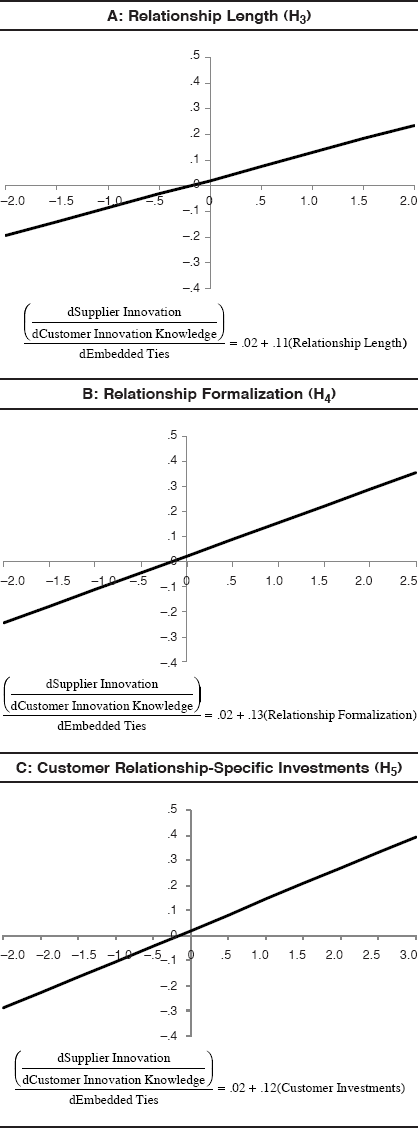
Our dark-side hypothesis (H2) predicts a negative interaction between customer innovation knowledge (CIK) and ET. We observed no interaction between these variables at the mean values of relationship length, relationship formalization, and customer investments (β = .02, n.s.). However, we do find significant three-way interactions involving ET × CIK and the moderating variables. Thus, we evaluate the ET × CIK interaction across the range of values for relationship length, relationship formalization, and customer investments using Schoonhoven's (1981) approach. This enables us to identify the conditions under which the dark-side effect in H2 occurs and when it is converted to a bright-side effect as predicted in H3, H4, and H5. Table 3 and Figure 2 show the results.
Factors Mitigating the Dark Side of Embedded Ties
How the Interaction Effect of Customer Innovation Knowledge and Embedded Ties Varies Across Different levels of the Moderators

p < .05.
p < .01.
Standardized coefficients of ET × CIK with standard error in parentheses.
In support of H3, we find a positive and significant effect of ET × CIK × LENGTH (β = .11, p < .05). As Figure 2, Panel A, shows, the moderator (relationship length) is on the x-axis, and the coefficient of the ET × CIK impact on supplier innovation is on the y-axis. In support of our prediction, the line shows that the effect of ET × CIK on supplier innovation is negative (positive) when relationship length is short (long). To determine the details of the interaction, Table 3 (second column) contains the coefficients for the ET × CIK interaction at varying length levels. There, we observe that although the interaction is negative for short relationships (-1 SD and −2 SD), the relationship is not significant, and no dark side is evident. However, the effect of ET × CIK on supplier innovation becomes significant and positive as the relationship becomes longer (+2 SD). This reflects the bright side.
In support of H4, the results indicate a positive and significant effect of ET × CIK × FORM (β = . 12, p < .05). Figure 2, Panel B, shows a negative (positive) effect of ET × CIK on supplier innovation at low (high) formalization levels. Table 3 (third column) contains the coefficients associated with the ET × CIK interaction at varying relationship formalization levels. These analyses indicate that at low levels of formalization (-1 SD and −2 SD), there is a significant dark-side effect for ET × CIK on supplier innovation. As formalization increases (+1 SD and +2 SD), this effect becomes positive and significant, reflecting the bright side.
In support of H5, results indicate a positive and significant effect of ET × CIK × CINVEST (β = .13, p < .01). Similar to the effect of the other two moderators, we show in Figure 2, Panel C, that the effect of ET × CIK on supplier innovation is negative (positive) when customer investments are low (high). Table 3 (fourth column) contains the coefficients for the ET × CIK interaction at varying customer investment levels. As with formalization, these analyses indicate that at low levels of customer investments (-1 SD and −2 SD), there is a significant dark-side effect for ET × CIK on supplier innovation. As customer investments increase (+1 SD and +2 SD), this effect becomes positive and significant, reflecting the bright side.
Our H3–H5 results lead us to conclude that H2 (the dark side) is supported for certain ranges of values of the three-way moderators. To determine the range of values for which H2 is supported, we located the point where the line crosses the x-axis in Figure 2 (Heide and Wathne 2004; Schoonhoven 1981). Results indicate that the effect of ET × CIK is positive when relationship length exceeds −.19, when relationship formalization exceeds −.16, and when customer investment exceeds −.17. These levels are just below the mean values, which are all 0 because we mean-centered them.
Mediation Process Validation: The Role of Knowledge Redundancy and Opportunism
We explain the dark side H2 interaction of ET × CIK on supplier innovation by arguing that it is caused by increased opportunism and perceptions of knowledge redundancy. In turn, the three-way interactions in H3–H5 argue that this dark side is undone by reducing opportunism and knowledge redundancy. Next we test for these mediating roles as a process validation of our arguments. 7 Given that we have moderators influencing mediation, we have a case of mediated moderation and follow Muller, Judd, and Yzerbyt (2005).
We also include this test because there is an alternative explanation for the role of knowledge redundancy. Specifically, high levels of customer innovation knowledge could lead to lower levels of knowledge redundancy because vertical partners occupy different places in the value chain. This may dampen supplier innovation because the supplier is less likely to have the necessary absorptive capacity to utilize the customer's knowledge.
We measured opportunism using Jap's (2003) supplier opportunism scale (α = .81). We measured knowledge redundancy using a single item from Rindfleisch and Moorman (2001). These measures, listed in the Appendix, were validated with the other measures (see Table 1).
Given our prior results, our analysis of this mediating role must be restricted to those conditions in which we identified a dark-side effect for ET × CIK. Table 3 indicates that this occurs when relationship formalization is low (-1 SD and −2 SD) or customer relationship-specific investments are low (-1 SD and −2 SD). To focus attention on these conditions, we used the spotlight approach (Aiken and West 1991) in our three-step test of mediation from Muller, Judd, and Yzerbyt (2005).
In Step 1, we set formalization and customer investment levels to be low (by subtracting two standard deviations from the mean-centered main effect) before constructing the interactions. This enables us to examine the simple effect of the ET × CIK interaction on supplier innovation in this condition, which is negative and significant (β = −1.00, p < .01). Step 2 involves estimating two models with the same predictor variables but with opportunism and knowledge redundancy as the dependent variables. Results indicate that ET × CIK positively affects opportunism (β = .75, p < .05) but has no effect on knowledge redundancy (β = .18, n.s.). Because ET × CIK does not predict knowledge redundancy, knowledge redundancy cannot mediate the effect of ET × CIK on supplier innovation. In the third step, we estimate the Step 1 model again but also add opportunism as a predictor. Opportunism is significant (β = −.11, p < .001) and the coefficient of the ET × CIK interaction decreases from −1.00 to −.59, which is marginally significant (Sobel z = −1.79, p = .07). This pattern indicates a case of mediated moderation for opportunism but not for knowledge redundancy.
To provide insight into the mediated moderation findings for H3–H5, we apply the same three steps to those conditions that undo the dark side of ET × CIK. Thus, we set length, formalization, and customer investments at two standard deviations above the main effect before constructing the interactions. We should observe the opposite pattern in all three steps. For Step 1, we observe a positive, significant impact for the simple effect of ET × CIK on supplier innovation (β = .95, p < .01). In Step 2, we observe a negative simple effect of ET × CIK on opportunism (β = −.82, p < .01) but no effect on knowledge redundancy (β = −.29, n.s.). In Step 3, we estimate the Step 1 model again, but also add opportunism as a predictor. We observe that opportunism is significant (β = −. 11, p < .001) and that the ET × CIK interaction decreases from .95 to .42, which is marginally significant (Sobel z = 1.78, p = .08). This pattern indicates mediated moderation as opportunism decreases when the moderators are at high levels.
Supplier Innovation and Firm Performance
Finally, according to the estimates reported in Table 2, we conclude that supplier innovation has a direct positive effect on supplier strategic advantage (β = 1.59, p < .01) but a direct negative effect on supplier financial performance (β = −1.88, p < .01). In addition, supplier strategic advantage has a direct positive effect on supplier financial performance (β = 1.39, p < .01). Using these estimates, we calculate the total impact of the direct and indirect (through strategic advantage) effects of supplier innovation on financial performance. Results indicate a positive total effect of innovation on financial performance (total effect = .33). 8
We computed the indirect effect (2.21) by multiplying the coefficient of the relationship between strategic advantage and innovation (1.59) with the coefficient of the relationship between strategic performance and financial performance (1.39). The direct effect (holding the mediator constant) of innovation on financial performance is −1.88. Summing the indirect and direct paths leads to a total effect of 2.21 - 1.88 = .33. This positive total effect, which also explains the positive correlation coefficient between supplier innovation and financial performance in Table 1, is more complex than previous research has suggested. Specifically, following Shrout and Bolger (2002), we find that the negative effect of innovation on financial performance is compensated by the positive indirect effect of innovation (through strategic advantage) on financial performance. In other words, innovation may involve short-term financial costs, despite a positive strategic advantage (e.g., Campbell and Cooper 1999; Inkpen 1996).
Discussion
Research Implications and Directions for Further Research
The effect of embedded ties
We find that embedded ties are not an inherently good or bad mechanism for managing interfirm innovation relationships. Instead, the interaction of embedded ties and customer innovation knowledge produces dark-side effects and bright-side effects on supplier innovation under certain relational and governance conditions. Given the importance of these market-based assets to the firm, further research should continue to investigate the interaction of relational and knowledge features of partnerships. For different insights, we advise ethnographic work to examine how knowledge and relationship factors evolve and interact in joint innovation activities between firms.
Our work also offers insight into why embeddedness has a dark-side effect. We find that opportunism, not knowledge redundancy, seems to be operating. These effects could be replicated in further research given our weak measure of knowledge redundancy. Moreover, research should also consider other dark-side mechanisms, including loss of objectivity (Grayson and Ambler 1999) and the tendency to rely on current partners when new partners should be sought (Sorenson and Waguespack 2006). Further research should examine whether returning to a partner is only problematic when the firm also limits its number of partners. A larger network of partners ensures not only that a firm will have access to new ideas but also that replacements are available, which may motivate partners to work harder to add value.
Opportunism as a dark-side mechanism
Our study expands research on opportunism in buyer-seller relationships (Wathne and Heide 2000). Whereas prior studies have examined opportunism as an antecedent (Jap and Anderson 2003) or an outcome (Heide, Wathne, and Rokkan 2007; Rokkan, Heide, and Wathne 2003), we examine it as a mediator. This is the direction first considered by Moorman, Zaltman, and Deshpandé's (1992) post hoc theorizing for the negative effects of trust on knowledge use in marketing research relationships and examined empirically in Grayson and Ambler (1999). Given our results, further research should examine how opportunism mediates other aspects of marketing relationships.
Knowledge redundancy as a dark-side mechanism
Rindfleisch and Moorman (2001) find that knowledge redundancy has a negative effect on information acquisition and a positive effect on information utilization in new product alliances. How can we reconcile these findings with our findings for knowledge redundancy? First, Rindfleisch and Moorman examine the independent effects of ties and shared knowledge, whereas we examine the interaction of customer innovation knowledge and embedded ties. Thus, our questions are distinct. Second, all our relationships are vertical, whereas Rindfleisch and Moorman examine both horizontal and vertical relationships. This means that redundant knowledge may be lower in our sample because partners occupy unique positions in the value chain and therefore may not have reached sufficient levels to have a positive effect. Third, perhaps knowledge redundancy due to a shared position in the value chain and knowledge redundancy due to knowledge exchange between partners affect relationships differently. Like most studies in this area, our research confounds the two. Further research should ferret out these effects.
Fourth, it is also possible that knowledge redundancy has an inverted U-shaped relationship with innovation. 9 In this view, knowledge redundancy facilitates innovation up to a point because it helps partners share and comprehend knowledge. However, after this point, knowledge redundancy begins to reduce innovation. In our study of vertical partnerships, we find the expected negative linear relationship between knowledge redundancy and supplier innovation (βKR → SI = −.08, p < .05) but not an inverted U-shaped relationship (βKR × KR → SI = 07, n.s.). Further research could consider when knowledge redundancy will have a linear or a nonlinear effect.
Thanks to one of the anonymous reviewers for suggesting this direction for further research.
The effect of supplier innovation knowledge
Our study is the first of which we are aware to consider how forming a relationship with a customer can influence a supplier's use of its own knowledge. We theorized that a closer relationship with customers would improve a supplier's use of its own knowledge. Instead, we find an unconditionally positive effect for supplier innovation knowledge on supplier innovation levels, confirming past research. As with customer knowledge, further research could benefit from a deeper or more controlled analysis of the effects of supplier innovation knowledge. Further research could also consider the interaction of supplier innovation knowledge, customer innovation knowledge, and embedded ties. 10 We see two interesting possibilities for this interaction. First, supplier innovation knowledge could function as a safeguard that mitigates the dark-side interaction of ET × CIK given that both partners are risking high levels of knowledge. This may be especially so if partners make bilateral idiosyncratic investments in the relationship (Jap and Anderson 2003). Alternatively, supplier innovation knowledge could worsen the dark-side effect by heightening the supplier's potential losses if it behaves opportunistically. If observed, research could also consider relational and governance solutions to this negative interaction, though the complexity of these higher-order interactions may weaken insight.
Thanks to one of the anonymous reviewers for sharing this interesting prediction.
Innovation and cocreation
The current study dovetails with recent work on supplier–customer cocreation (Vargo and Lusch 2008). This cocreation logic challenges the alchemy of innovation (Prahalad and Ramaswamy 2003, 2004) because it moves the epicenter of innovation from the firm to cocreation relationships (Tuli, Kohli, and Bharadwaj 2007; Vargo and Lusch 2008). Our findings build on this cocreation logic by pointing to specific ways knowledge and relationship assets interact in the cocreation process to create value. This is an attempt to marry the cocreation literature with the interorganizational relationship literature. To date, these literatures have evolved independently, with the cocreation literature emphasizing the firm's ability to create value with customers and the interorganizational literature emphasizing the firm's ability to capture value from cooperating with customers.
Role of networks
Networks are an increasingly important issue in interfirm research in general (Achrol and Kotler 1999; Anderson, Håkansson, and Johanson 1994; Heide and Wathne 2004; Swaminathan and Moorman 2009) and innovation research specifically (e.g., Ahuja 2000; Fang 2008). An issue relevant for this research is how a dense network of firms around the customer–supplier relationship might influence our results. One view is that concerns about opportunism will decrease if the partners exist in a dense network (Burt 1992) because the threat of news of bad behavior spreading to interconnected partners deters such opportunism (Ahuja 2000; Rowley, Behrens, and Krackhardt 2000). However, network density may also limit the amount of novel information available to partners, thereby reducing innovation (Fang 2008). Other network characteristics, such as efficiency and centrality, may play similarly important roles.
Toward a theory of innovation relationships
Our study contributes to an emerging body of interfirm research involving creative activities, such as design, market research, advertising, and new product development relationships. Early work shows that such relationships may require distinctive theory. For example, Carson (2007) shows that the creative needs of the project influence the relative effectiveness of various relationship control strategies. As an example from our study, we find that formalization, a control strategy, increases innovation, in contrast to Mohr, Fisher, and Nevin's (1996) study of channel relationships, which finds that control-based governance strategies weaken the effect of information exchange on relationship performance.
Generalizability of our findings
First, because our findings are from a product context, further research should investigate whether these effects are worse in a services context, in which supplier knowledge may be more difficult to protect. Second, given that our sample is limited to one country, further research should also examine whether these effects appear in cultures in which business is already deeply affected by relationships and reciprocity (e.g., guanxi in China; Grayson, Johnson, and Chen 2008; Gu, Hung, and Tse 2008). Finally, further research could improve our measures of embeddedness, formalization, and knowledge redundancy by increasing the number of items and our measure of supplier innovation by focusing on the actions firms take rather than on the degree to which firms learn to take these actions.
Managerial Implications
Manage all facets of joint innovation relationships
Under pressure to release more innovative products faster, firms are increasingly engaging in joint innovation projects with their business customers (Bonner and Walker 2004). However, our research indicates that these benefits do not evolve automatically from innovation partnerships. Instead, these relationships must be managed with attention to knowledge, relational, and governance qualities. This heightened focus has led many firms to appoint a chief relationship officer to the C-suite.
Invest in supplier innovation knowledge
Our results offer unequivocal advice to suppliers to build their innovation knowledge. This knowledge provides a strong main effect on supplier innovation regardless of the knowledge level of the customer or the embeddedness level of the relationship with the customer. Building supplier innovation knowledge should involve increasing declarative knowledge about the innovation domain as well as procedural knowledge about how to perform key tasks in the innovation process. Our findings show that managers should emphasize skills such as extrapolating customer trends into the future, brainstorming about customer use of innovation, and uncovering latent needs.
Reduce the risks of working with a smart customer
Our results indicate that suppliers perceive higher levels of customer opportunism when they work in close relationships with knowledgeable customers. However, these worries only emerge when relationship formalization is low or when customer relationship-specific investments are low. Suppliers should therefore increase these safeguards when working in close relationships with knowledgeable customers. If not, supplier innovation will decrease. Increasing formalization might involve setting timetables for deliverables and requiring regular meetings that conform to agreed-on procedures for working together, including sharing and using information in the relationship. At the same time, firms should take care not to overly bureaucratize the relationship, which may reduce creativity. Increasing the customer's relationship-specific investments could involve requiring the customer to dedicate employees specifically to this relationship and training them in the supplier's products, technologies, and procedures.
Manage the benefits of time
Close and long relationships with knowledgeable customers increase supplier innovation. Suppliers are therefore advised to be patient for these bright-side effects to emerge over the course of customer relationships and to consider what types of investments will increase the likelihood they will retain their customer relationships over time. Suppliers could also benefit from examining the quality of customer insights over time to gain a better understanding of the influence of time. Specifically, the efficiency of working with a longtime customer should be weighed against the possibility of new insights coming from a new customer. Both the customer and supplier can manage this trade-off, as we discuss in the next section.
Add value as a lead user
Following from our results, we recommend that knowledgeable customers take actions to neutralize supplier concerns. First, customers need to manage supplier perceptions of customer opportunism. We cannot determine whether customers were behaving opportunistically. However, supplier worries about a close relationship with a knowledgeable customer seem to be commonplace in our sample. This indicates that opportunism concerns may be less a function of what the customer does and more a function of the potential risks that the customer poses to the supplier. Proactive customer strategies such as making supplier-specific investments or formalizing the relationship should reduce these concerns. Second, our findings indicate that customers need to worry less about how a close relationship with suppliers will lead to perceptions of knowledge redundancy. This does not seem to be a problem in our sample. However, we find that when knowledge redundancy does occur, it reduces supplier innovation. Therefore, customers are advised to understand what actions they take or fail to take that can ensure reduced perceptions of knowledge overlap. For example, new team members and using novel research techniques could keep the relationship fresh.
Look to the strategic benefits of joint innovation
Our findings indicate that joint innovation achieves its financial performance primarily through strategic advantage. This result is remarkably consistent with prior warnings that joint innovation for customer solutions provides no immediate financial benefits and explains the difficulty firms often have persisting with innovation in cocreation (Johansson, Krishnamurthy, and Schlissberg 2003; Tuli, Kohli, and Bharadwaj 2007). Thus, managers should not base their evaluations of joint innovation only on the immediate financial performance of the innovation but should also take into account the effect of the innovation on the strategic position of the firm.
Conclusion
Joint innovation between suppliers and customers is an increasingly common strategy for B2B firms. Our study shows that there are important contingencies that determine when building embedded relationships with customers pays off for suppliers. Our findings indicate that the payoff depends on the customer's innovation knowledge and the relational and governance safeguards that suppliers put in place to manage the embedded relationship. Specifically, embedded ties weaken the supplier's ability to leverage customer knowledge for innovation under conditions of low relationship formalization and low levels of customer relationship-specific investments. These dark-side effects are caused by increased worries about customer opportunism. However, suppliers that lengthen the relationship, formalize the relationship, and ask customers to make relationship-specific investments can achieve a positive effect on innovation when forming an embedded relationship with a knowledgeable customer. This is the bright side of embedded ties. In contrast, suppliers benefit from their own innovation knowledge regardless of the strength of the customer relationship.
Footnotes
Constructs and Items
Targeting and segmentation Customer service Product positioning and differentiation Generating ideas for other products Distribution Communication and promotion Items deleted during measure purification process. Notes: Unless noted, all variables use a seven-point Likert scale (1 = “strongly disagree” and 7 = “strongly agree”). (R) = Item is reverse-coded.
Constructs and Items
Factor loadings
Please indicate to which extent
Formative scale
Please consider your company's characteristics with regard to behaviors in the market and indicate the degree to which you agree with the following statements:
Our company …
•Helps customers anticipate developments in their markets.
.66
•Continuously tries to discover additional needs of their customers of which they are unaware.
.61
•Incorporates solutions to unarticulated customer needs in its new products and services.
.71
•Brainstorms on how customers [could] use their products and services.
.83
•Extrapolates key trends to gain insight into what users in a current market will need in the future.
.67
•Our company introduces new products even at the risk of making its own products obsolete.
a
•Our company searches for opportunities in areas where customers have a difficult time expressing their needs.
a
Please consider your customer's characteristics with regard to behavior in the market and indicate the degree to which you agree with the following statements: The customer…
•Tends to conduct thorough research for the available options offered by suppliers to identify new marketing possibilities that could address our own and our customers’ needs.
.70
•Has, in the past three years, invested a substantial amount of time and money in identifying leading-edge marketing trends.
.90
•Is positioned at the leading edge of marketing trends and related needs.
.85
•Has, in the past three years, applied existing solutions in ways not anticipated by suppliers.
.61
Please indicate to which extent the following statements are an accurate reflection of the nature of the relationship.
•Our new product development team members share close social relations with the new product development team members from the customer.
.62
•The relationship with our customer can be defined as “mutually gratifying.”
.74
•We expect that we will be working with our customer in the future.
.67
•We feel indebted to our customer for what they have done for us.
a
How many years have you worked with this customer?
Please indicate to which extent you agree with the following statements regarding the joint NPD project.
•We rely extensively upon contractual rules and policies in controlling day-to-day operations of the relationship with our partner.
Formative scale
•We follow written procedures in most aspects of business in the relationship with our partner.
Please indicate the extent to which you agree with the following statements about your partner.
•Significant investments in equipment dedicated to the relationship with our company have been made.
.72
•Extensive internal adjustments have been made by our partner in order to deal effectively in the relationship.
.62
•Training people to deal with our company in the relationship has involved substantial commitments of time and money.
.95
•The logistics systems have been tailored to meet the requirements of dealing with our company in the relationship.
.71
Please rate the extent to which the product has achieved the following outcomes during the first 12 months of its life in the marketplace:
•Market share relative to its stated objective.
.90
•Sales relative to its stated objective.
.89
•Return on assets relative to its stated objective.
.92
•Profit margin relative to its stated objective.
.79
•Return on investment relative to its stated objective.
a
Please indicate the extent to which you agree with the following statements about your company.
•This innovation relationship has not resulted in strategic advantages for our firm. (R)
.82
•Our firm has gained benefits that enable us to compete more effectively in the marketplace.
.64
•This innovation relationship has not resulted in strategically important outcomes for our firm. (R)
.84
Please indicate what applies to your situation. (Dummy codes appear between brackets)
•Compared to our firm, our customer is smaller than our firm (0) … our customer is bigger or equal in size (1).
Please indicate the extent to which you agree with the following statements concerning the industry of the new product developed.
•Customers’ product preferences change quite a bit over time.
.86
•Our customers tend to look for new products all the time.
.86
•We are witnessing demand for our products and services from customers who never bought them before.
.62
•New customers tend to have product-related needs that are different from those of our existing customers.
.60
•We cater to many of the same buyers that we used to in the past. (R)
a
Please indicate the extent to which you agree with the following statements concerning the industry of the newly developed product.
•The technology in this industry is changing rapidly.
.82
•Technological changes provide big opportunities in this industry.
.69
•A large number of new product ideas have been made possible through technological breakthroughs in our industry.
.62
•Technological developments in this industry are rather minor. (R)
.70
•It is very difficult to forecast where the technology in this industry will be in the next 2 to 3 years.
a
How likely is it that your partner would do the following?
•Be unwilling to accept responsibility
.75
•Provide false information
.64
•Make false accusations
.76
•Expect my firm to pay for more than their fair share of the costs to correct a problem
.60
Please indicate to which extent the following statements are an accurate reflection of the nature of the relationship.
•Our partner's NPD team members have different knowledge from ours (1) … have the same type of knowledge (7)
Please rate the degree to which the new product generated with your customer was:
•Far ahead of time goals (1) … Far behind of time goals (7)
.67
•Slower than the industry norm (1) … Faster than the industry norm (7)
.77
•Much slower than we expected (1) … Much faster than we expected (7)
.74
•Slower than our typical product development time (1) … Faster than our typical product development time (7)
.61