







Abstract
The authors study business-to-business manufacturers' simultaneous usage of vertically integrated (direct) and third-party (indirect) channels of distribution to serve one geographical market (possibly comprising several market segments) with the same product line. Most theoretical approaches to vertical integration of the distribution function pose the classic question of whether to forward integrate or use independent entities. Having concurrent channels means doing both. This phenomenon is poorly understood, even though it has been growing rapidly. The authors argue that under certain circumstances, it is impossible for manufacturers to prevent channel types from competing with each other, either because both channel types contact the same customer or because the customer sets them in competition against each other. The authors argue that when these situations are frequent or more consequential for the parties involved, firms reduce their usage of concurrent channels to prevent severe channel conflict. The authors posit five such circumstances. Using original data from prominent manufacturers operating in competitive markets worldwide, they model usage of both types of channels to cover one geography with the same products. They find substantial support for their model. Furthermore, in a subset of firms that use both channel types in the same market, they model the degree to which direct and indirect channels compete destructively against each other when contacting the same customers. The authors find that suppliers reduce such behavior by incurring costs to differentiate each channel's offerings, setting out ”rules of engagement,” and compensating both channel types when either one makes a sale.
Concurrent channels (own and independent channels that transact in the same geography and sell the same products) have become common in business-to-business (B2B) markets (Cespedes and Corey 1990). 1 Ideally, concurrent channels are better for customers because customers can choose the channel that is better suited to their needs, and they are better for suppliers because suppliers can increase coverage and, therefore, sales while matching channel cost-and-capability structures to customer needs. Thus, a firm's going to market through concurrent channels combines customer orientation with concern for efficiency. In today's highly competitive markets, this may seem to be a good strategy, but is it?
Direct and indirect channels may serve different market segments or compete for some or all customers or customer segments in the market.
Concurrent channels eventually create intrabrand competition among the supplier's channels. The conflict that arises between the two channels is especially acrimonious because independents have grounds to suspect the supplier of creating a tilted playing field that is designed to favor its employees. In these situations, the supplier cannot offer the defense that channels are on a level playing field and that the customer (not the supplier) decides which channel wins. In short, a supplier that also distributes in-house is vulnerable to charges of conflict of interest in its dealings with independent channels. These suppliers may also find that their own employees question whether management will continue to carry the high overhead of being vertically integrated at the same time as it supports independent distribution channels.
Concurrent channels (one geography and one product line) create at least some channel conflict, but the costs (accounting and opportunity) of that conflict are difficult to estimate. 2 In any case, there are mechanisms to reduce conflict (e.g., demarcation schemes, quantity discounts). Therefore, some producers view the channel tension that accompanies concurrent channels as unpleasant but tolerable and, implicitly, worthwhile. If such firms are prominent and respected leaders in competitive industries, the dynamics of economic selection would suggest that they are right.
We consider the case in which either channel can do a transaction. We exclude using own and independent channels to divide distribution functions, reserving the ability to transact to one channel form.
There is little research to help managers decide when and to what extent to serve markets through concurrent channels. We examine go-to-market practices for 115 product markets worldwide that are covered by several strategic business units (SBUs) in 11 prominent B2B producers that operate in competitive markets in almost every region of the world. The premise is that economic selection mechanisms make the practices of these firms more likely to reflect appropriate strategic decisions. Using primary data, we model the extent to which such producers use concurrent channels of distribution as a function of the firm's environment. Our model is an ”as-if” model; that is, we make no claims as to how managers actually reason through the decision.
The Potential for Conflict and Channel Structure
There is a small body of research that empirically considers the relatively new phenomenon of concurrent channels, and it focuses on field selling functions. Dutta and colleagues (1995) find that firms using independent sales agents supplement them with some employee salespeople to reduce performance ambiguity (i.e., provide benchmarking). John and Weitz (1988) also examine selling only; they find that concurrent systems are common: 44% of the firms in their sample served product markets with both internal and independent sales forces.
Hypotheses: When Do Firms Use Concurrent Channels?
When a supplier's direct and indirect channels meet the same customer, a major point of differentiation (i.e., the brand) is absent. It becomes easier for one of the channels to free ride on the presale services that the other channel provides (Dutta, Heide, and Bergen 1999). Our overall logic is that when direct and indirect channels fight frequently for the same customers for an order and/or when the loss of an order to the other channel is more consequential to one of the channels, potential losses associated with free riding and loss of customers to the other channel increase. This leads to increased levels of conflict and decreased performance in the channel system. Manufacturers must either implement costly conflict reduction mechanisms or face the costs of conflict. Either way, concurrent channels become more costly and, thus, less attractive. Therefore, the higher the ex ante (i.e., before the manufacturer makes channel structure decisions) potential for conflict between integrated and independent channels, the more the B2B supplier should concentrate on one of the two channel types (direct or indirect) rather than use both modes simultaneously (concurrent channels). To test this overall proposition, we adopt the philosophy of ”Darwinian economics” (Anderson 1988). We model the practices of firms that have not only survived but also achieved prominence in competitive industries because such management practice has been honed over time by performance pressure. Thus, the broad patterns of their choices suggest practices that work well in many circumstances. However, we note that this is a weaker claim than optimality.
By definition, the ex ante (before the supplier's channel decisions) level of conflict is unobservable. Alternatively, we identify five environmental conditions that increase the potential for conflict between the two channel forms. We expect manufacturers to use concurrent channels more only when these conditions indicate that lower levels of conflict between them are likely.
Whenever the supplier uses both channel types, they can encounter each other spontaneously, or they can be put in competition by a motivated prospect. Previous literature has suggested several mechanisms to prevent intrabrand competition between channel types competing for the same customers. For example, manufacturers may signal customer ownership through compensation schemes, or they may target the offers (e.g., products, prices, levels of service) of the two channel forms to different target segments (e.g., Mori-arty and Moran 1990). However, in certain environments, these mechanisms may be ineffective or too costly to implement. Channels transact in a geography and frequently sell to different segments. Orders come in from customers, not segments, and those customers frequently do not behave as predicted. It is difficult for a supplier to refuse an order from the ”wrong” channel, even if the supplier can discern that the customer belongs to the wrong segment for that channel. Furthermore, customers evolve, belong to different segments, and contact different channels at different points in time. In these situations, it becomes difficult for the manufacturer to prevent its two channels types from competing for the same customer.
The more that markets are heterogeneous (i.e., the more that segments are viable), the easier it is for each channel type to specialize, each conducting business in segments in which it has the advantage in terms of effectiveness or of cost to serve. Thus, the two channel forms can more easily transact without encountering each other. Thus:
H1: Prominent suppliers in competitive markets use concurrent channels more in markets with greater levels of customer heterogeneity.
Channel types also tend to collide in low-growth markets because the base of business is fixed (Day 1986), and fixed resources tend to be underutilized, creating pressure for volume. Thus, a sale that is lost to the ”other” channel type is resented even more deeply (Corey, Cespedes, and Rangan 1989), aggravating the severity of disagreements. In contrast, when the market is growing, channels can concentrate their efforts on finding new customers or better satisfying (and increasing business with) current customers. Thus:
H2: Prominent suppliers in competitive markets use concurrent channels more in markets with greater levels of growth.
We now turn to three hypotheses that are based on the likelihood that the customer will try to arbitrage across the two channel types. Here, the extent to which the buying behavior (e.g., the products customers buy, the level of service customers request) of the same customers varies over purchasing occasions (over time) is important, and B2B segmentation schemes tend to overlook this possibility, focusing on attributes that put decision-making units (DMUs) into the same segment every time they buy (Mitchell and Wilson 1998). However, when the same DMU behaves differently when buying the same product on different occasions, complications can ensue. For example, if the DMU wants a consultative sell on one occasion and merely a price quote of the core product without services on another occasion, the DMU effectively belongs to two segments, one for each occasion. Therefore, over time, the DMU may contact the two channels in different purchasing occasions, possibly building a relationship with both of the supplier's channel types. This makes it easy for the DMU to arbitrage by inviting—indeed, obliging—both channel types to compete as business arises. At the same time, if the DMU interacts with both channels over time, investments in relationship development by each channel will have an impact on future purchases of the manufacturer brand. Thus, each channel may believe that it should be compensated for any order from that customer, and potential conflict may arise. It also becomes increasingly difficult for the manufacturer to implement any kind of demarcation scheme that targets each channel to different segments, because it is difficult to classify customers into any given segment. Thus:
H3: Prominent suppliers in competitive markets use concurrent channels more the less customers vary their behavior over purchase occasions.
A trend in B2B marketing is for buyers to come together in a buying group to augment buying power to extract a better deal. Group buyers are likely to ask for bids not only from both channels but also from different suppliers (intra-and interbrand competition). Thus, competition is fierce. The two channel types may compete so vigorously that they undermine not only each other but also, as collateral damage, the brand they each carry. Thus:
H4: Prominent suppliers in competitive markets use concurrent channels more the less customers come together to buy the supplier's products as a group.
Product differentiation is achieved when customers perceive the overall offers of different manufacturers (including the level of service) as dissimilar. Under these circumstances, it becomes easier for direct and indirect channels to provide different offers. In contrast, when buyers perceive brands as standardized, it becomes more difficult to close a sale because customers easily compare (nondifferentiated) offers and decide not only among several competing manufacturers but also between two channel types within a brand. Thus:
H5: Prominent suppliers in competitive markets use concurrent channels more the less customers perceive brand offerings in the industry as standardized.
Concurrent Channels: Controlling for other Influences
An important market factor is size. The larger the market, the greater is its ability to support both independent and owned channels. For a given supplier, other factors may be important determinants as well. The larger the firm, the more it can carry the overhead of two channel types, and the longer the firm has been in the market, the more time it has had to build the two systems, which is typically a slow process.
Some customers do not make their purchase decision in a stand-alone fashion. Instead, customers evaluate Brand A while considering a bundle of other products that the supplier does not make. This choice-making style allows each channel type to play a role in the sale when contacting the same customer. Independent channels sell the set of products, and direct channels ensure that, at the minimum, Brand A is in the set. Accordingly, concurrent channels may be used more as more customers purchase the supplier's product embedded in a bundle.
Preventing Destructive Competition between the Two Concurrent Channels
When the potential for conflict between the two channel forms is lower, manufacturers are more likely to use concurrent channels. However, on occasion, the two channels will meet. They may clash and compete aggressively when contacting the same customer for a given order. Channels may adopt destructive behaviors, such as refusing to refer leads, hiding information, and withholding any form of assistance to the other channel type. An issue for suppliers that use concurrent channels is whether to intervene to preserve the financial health of the competing channel forms, even at the expense of current supplier profits. We offer three hypotheses about the determinants of the extent to which direct and indirect channels, after they are in place, engage in destructive (rather than collaborative) behaviors when contacting the same customers.
As we described previously, manufacturers may differentiate the offers of the two channel types on any dimension (e.g., brand name, models offered, terms of trade). When channels have differentiated offers, each can find a market in which it has an advantage, and free riding is less likely. Each channel type's customers and investments are protected, which reduces their motives to engage in destructive competitive behavior.
H6: The greater the extent to which the two concurrent channels have differentiated offers from the same supplier, the lower is the extent of destructive competition between integrated and independent channels when contacting the same customers.
Differentiating offers is an unobtrusive way for suppliers to help channels compete on a nonprice basis when the customer approaches them. The obtrusive alternative is to intervene to ”direct traffic” to avoid a collision (Magrath and Hardy 1989). The manufacturer cannot impose rules on the customers with respect to how and where they buy. Instead, the supplier lays out rules for the channels, clarifying which channel form is allowed to contact a customer for a given lead or order and mediating the inevitable disputes that arise over interpretation and encroachment.
Such a traffic management system can become cumbersome, and it may be difficult to create and enforce. However, these rules signal that the manufacturer is concerned about the well-being of each channel, which should lead to improved relationships and incentives to collaborate. Both in-house and independent channels may be more receptive to the simultaneous usage of both channels if each has a de facto protected territory. Thus:
H7: The greater the extent to which the manufacturer implements a system that clarifies ownership for any given order when using concurrent channels, the lower is the extent of destructive competition between integrated and independent channels when contacting the same customers.
Differentiated offerings and ownership rules are designed to prevent head-on competition. However, when this type of competition occurs, one of the most effective ways to solve situations of conflict is to offer economic incentives that compensate the party whose interests are threatened (Pondy 1967). To this effect, manufacturers may practice ”double compensation,” that is, compensating a channel if it played an important role in a sale won by the other channel.
H8: The greater the extent to which the manufacturer double compensates when using concurrent channels, the lower is the extent of destructive competition between integrated and independent channels when contacting the same customers.
Controlling for other Influences: Destructive Competition in Concurrent Channels
Sellers bow to the B2B customer's demands far more than they do in business-to-consumer markets (Cannon and Perreault 1999). We expect that two customer demands may restrain destructive competition between channel types after concurrent channel systems are in place. The first is when some of the supplier's customers insist on being served directly. In this case, the independent channel cannot compete. The second is when some customers use integrated supply contracts in which they contract with independent channel members to provide a portfolio of brands and product lines that are backed by value-added support services. The independent channel enjoys specialization advantages in fulfilling integrated supply contracts. In this case, the direct channel cannot compete.
Methodology
Research Design
The unit of analysis is the channel decision for a product line (or set of interrelated product lines) that is produced by a given SBU of a given parent company and sold in a given territory (or set of related territories). We test the theoretical framework we develop in this article empirically by using a survey methodology to collect perceptual data. We use a cross-sectional sample of European and U.S. B2B manufacturers acting in diverse competitive industries worldwide.
A key operational issue is how to distinguish in-house from independent channels. Consistent with previous research (e.g., Rangan, Corey, and Cespedes 1993), we argue that forward integration decisions should be delimited by their most crucial function, which is selling. The selling function includes not only prospecting and qualifying customers but also interacting with potential customers with the objective of making a sale. When using direct or integrated channels, the manufacturer performs the selling function in-house. When the manufacturer uses indirect or independent channels, external entities sell the product to customers or other resellers.
Data Collection and Questionnaire Design
With the help of several academic institutions and distribution channel associations, we contacted 29 prominent manufacturers in diverse industries for cooperation. In exchange for participation, we offered each SBU a summary of the results and a benchmarking study comparing its channel decisions with the rest of the participants in the group. We randomly selected firms among the set of large, established B2B manufacturers that sell multiple product lines in different geographies and with which these organizations had established relationships. We expect that these large, established manufacturers tend to adopt long-term appropriate strategic decisions. 3
Channel structure decisions by smaller or less established manufacturers may reflect managerial and financial resource limitations, or they may be a reaction to short-term factors, such as the lack of knowledge about or the need to establish their position in the product-market.
In total, 11 firms (38%) participated in the study. Participating firms belonged to industries such as chemicals, information technology, electronics, and industrial components, and they sold different types of products, such as industrial equipment and machinery, information technology, industrial materials, and industrial components. All were large firms (average sales = $23.5 billion; number of employees = 119,000) that sell their products worldwide. The average market share of firms in the different geographies that sell a product line was 26.4%. Nonparticipating firms had average sales of $18.2 billion and an average of 62,000 employees. A multivariate test of difference in means indicates that there are no significant differences between participants and nonparticipants. 4 However, this may be due to small sample sizes. Participating firms seem to be larger than nonparticipating firms. Because these firms are extremely large and have multiple SBUs that cover many regions around the world, there is significant variance within each firm. The questionnaires returned include 28 product lines and 20 countries, as well as several regions within some of the countries. Channel decisions varied significantly for different product lines and for different locations/geographies within each firm. 5
The most frequent reason for nonparticipation was the inability to devote resources to a study in a time of restructuring and downsizing. Within different industries, some firms agreed to participate and some did not; there was no apparent industry-specific reason to decline. The decision to participate also varies for firms of similar size.
Ideally, we would have liked to have a census of these firms (all products and geographies). This was not feasible, because participating firms were large multinational corporations with multiple SBUs. Our liaisons indicated that participating SBUs were not atypical. However, we cannot be certain that our participating SBUs are completely representative of these large and complex global firms.
We determined the set of product lines and the geographies included in the study in consultations with participating firms. We instructed companies to consider different product lines or geographies only if the firm considered these decisions as separate when making channel decisions. The purpose of this was to analyze channel decisions at the level at which they are made. We sent one survey for each of the product lines/geographies included. Top management identified the most knowledgeable informants in each SBU/ product set/geography. These were typically sales or marketing managers, who are normally knowledgeable about the sales and the competitive environment the firm faced and the channel decisions to sell a given product line in a given market. Coded surveys were mailed to each respondent along with a personalized cover letter on university stationary that explained the purpose of the study, the benefits for participating firms, and the confidentiality of the responses. A total of 115 surveys were returned, for a response rate of 76%. 6 We assessed nonresponse bias by comparing early respondents with late respondents (on the basis of all the variables we considered in this study). We found no significant difference between these two groups.
One of the main reasons we did not achieve a response rate of 100% was because many of the participating firms were going through a process of restructuring.
Measures
We predefined constructs on the basis of previous literature and the theoretical framework we described previously. We then developed a set of items for each construct. We conducted nine pretests to purify the measures. With respect to construct validity, our analysis indicated that constructs were unidimensional, and we found support for measurement reliability, discriminant validity, and convergent validity. 7
The index of using integrated channels was significantly correlated with two related measures: (1) the percentage of leads allocated to independent channels and (2) the percentage of total sales represented by situations in which the customer interacts only with the integrated channel.
For the dependent variables, we begin with the extent to which a manufacturer uses integrated channels (degree of integration). We operationalize this as the percentage of total sales to business customers of a manufacturer's product line in a geography, represented by orders that customers place directly (without going through channel intermediaries) to the manufacturer or to an entity in which the manufacturer has majority equity. The assumption is that in most cases, the order is sent to the entity that had more responsibility in the sale and that had interacted more closely with the customer. Participating firms had an average degree of integration of 48.3% and an average standard deviation of 38.3.
We operationalized the dependent variable (i.e., the extent to which the manufacturer uses the two channels simultaneously), which we call ”concurrence,” as follows:
8
degree of integration/(1 - degree of integration) for degree of integration less than .5. (1 - degree of integration)/degree of integration for degree of integration greater than or equal to .5.
This operationalization of concurrent channels reflects both a manufacturer's decision and the characteristics of a market. The extent of sales generated by each channel is naturally a reflection of customer choices to transact with a given channel. If there are different segments in a market, it is more likely that these segments decide to deal with different channels. We argue that manufacturers' decisions also influence this sales mix.
Concurrence varies from zero, which represents a concentrated channel ownership design (unitary form; i.e., no concurrent channels), to one, which represents an evenly split concurrent channel (concurrent channels balanced between company-owned and independent channels). Firms in the sample had an average concurrence value of .24 and a standard deviation of .30.
Model Estimation and Results
There are 108 observations because we eliminated seven questionnaires as a result of excessive missing answers. We estimated the following concurrence model:

where
the extent to which manufacturer m uses the two channel forms simultaneously in territory t to sell product line p for a given observation i resulting from a given combination {m, p, t};
the extent to which the needs and behavior of business customers for product line p from manufacturer m vary within the market in territory t;
the overall market growth for the next years for product line p in territory t;
the extent to which the buying behavior of the same customers varies over purchasing occasions of product line p from manufacturer m in territory t;
the extent to which buyers come together in a buying group to clump their purchases and entrust the negotiation to a representative when buying product line p from manufacturer m in territory t;
the extent to which customers in territory t perceive manufacturer m's offer in terms of product line p and level of service as similar to its competitors;
the extent to which customers buy several interrelated product lines when buying product line p from manufacturer m in territory t;
the number of years firm m has been selling product line p in territory t;
the extent to which the market for product line p in territory t is large in terms of volume sales when compared with other markets; and
the total sales for manufacturer m.
To provide additional evidence of the validity of our framework, we estimated an alternative discrete logit model of adoption of concurrent channels using the same independent variables. 9
We estimate this model for different cutoff points that differentiate situations of concurrent channels from situations of use of a single channel. The cutoff point that produces a better fit and results that are consistent with the theoretical expectations is 5%; we categorized situations in which one of the two channel forms was used to serve less than 5% of the market (i.e., the degree of integration less than 5% or greater than 95%) as single-channel observations. However, the main results are consistent across different cutoff points, which indicates that the results are robust. Using the 5% cutoff criteria, we classified 42 of the 108 observations as single channels and 66 as concurrent channels. Of the manufacturers we classified as using single channels, 15 used exclusively one of the channel forms (the degree of integration was either 0% or 100%).
A potential complication is that integration/independent levels of 10/90 and 90/10 represent the same level of the dependent variable concurrence. We do not expect to find differential effects; our premise is that variables have a similar impact on the potential for conflict between the two channel forms, independent of which channel form is predominantly used. To assess this, we conducted a pooling test of whether the effects of the independent variables on concurrence differ between mostly integrated (degree of integration greater than 50) and mostly independent (degree of integration less than 50) manufacturers. 10 The pooling test failed to reject the null hypotheses that all the coefficients are the same for the two subsamples.
We excluded observations with a degree of integration of 50% in the analysis, because they can be classified in either of the two situations. An analysis of the overall model without these observations did not reveal any significant difference from the overall model with all the observations.
Heteroskedasticity is frequently present in cross-sectional studies (Judge et al. 1988). A Breusch-Pagan test rejected the null hypothesis of homoskedasticity. Thus, we estimated the model of concurrence using estimated generalized least squares (EGLS). 11 Because we drew the sample of SBUs from 11 firms, we investigated for firm-level effects. Our analysis indicates that possible firm-specific effects are not a significant source of bias.
A potential problem with the estimation process is that the range for the dependent variable is restricted to between 0 and 1. To assess whether an EGLS approach produces biased or inefficient estimates, we compared the base model with a Tobit model, with concurrence as the dependent variable (the value of which ranged from 0 to 1). The direction of the coefficients did not change for the two models, though the coefficient for Bgroup became nonsignificant at p < .14.
The Extent of Destructive Competition between the Two Channels
In an additional section of our questionnaire, we asked the manufacturer about the extent of destructive competition between the two channel forms when contacting the same customers; we instructed only those manufacturers with at least moderate use of both channel forms simultaneously to answer this section. Of the 115 observations, 63 respondents answered this section, thus designating their firm as using concurrent channels in a more than nominal fashion. 12
We expect that the more the manufacturer uses both channel forms (as indicated by concurrence), the higher is the probability that respondents self-designate as users of concurrent channels by answering this section. A high significant correlation between concurrence and a dummy variable coded as one for self-designation confirms this expectation.
After we eliminated observations with excessive missing answers, 54 observations were available to estimate the model of destructive competition between types in concurrent channel systems when contacting both customers. Our tests indicated that heteroskedasticity and possible firm-specific effects were not potential sources of bias.
Results: Concurrent Governance
Table 1 presents a summary of the hypothesized coefficients and the results for the concurrence model. We find support for H2, H3, H4, and H5. Manufacturers simultaneously use the two channel forms to a greater extent as the market growth becomes greater (.01, p < .01), and they reduce the simultaneous usage of direct and indirect channels as the variability in customers' behavior over purchase occasions becomes greater (-.05, p < .05), the more customers form a group to buy a product line (-.04, p < .01), and the more customers perceive the manufacturer's offer as standardized (-.06, p < .01). We failed to find an effect of market heterogeneity (-.01); thus, our results do not support H1. For the covariates, we also find that manufacturers use the two channel types simultaneously more often when the market is greater (.02, p < .05) and when customers are more likely to buy the manufacturer's product in a bundle (.04, p < .01). The results for the dichotomous model of the probability of simultaneous adoption of both channels are consistent with the concurrence model.
Results: Destructive Competition Given Concurrent Governance
We now examine our second dependent variable—that is, the extent to which the two channels engage in destructive competition with each other when interacting with the same customer before a sale is done or closed. The results (see Table 2) support the main predictions. The two channel forms engage less in destructive behaviors the more the two channels have differentiated offers (-.23, p < .05), the more the manufacturer double compensates the channels (-.40, p < .01), and the more the manufacturer adopts a system that clarifies order ownership (-.57, p < .01). Thus, our results support H6, H7, and H8.
Estimation Results: Simultaneous Adoption of Both Channels (Direct and Indirect) Versus Unitary Channels (Direct or Indirect)
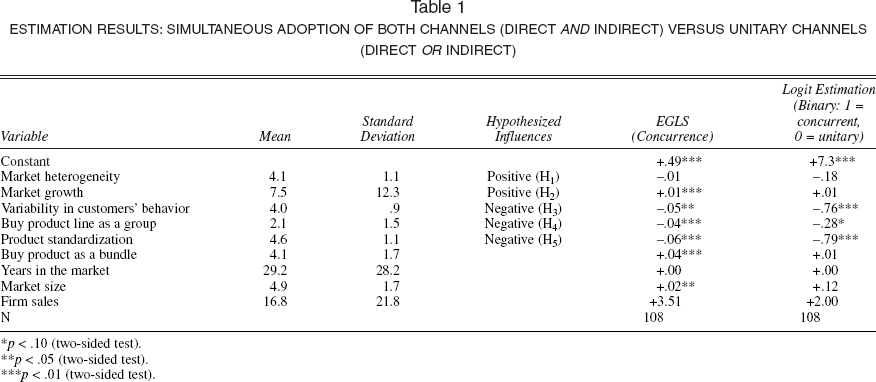
p < .10 (two-sided test).
p < .05 (two-sided test).
p < .01 (two-sided test).
Estimation Results: Extent of Destructive Competition Between the Two Channels When Contacting the Same Customers

p < .05 (two-sided test).
p < .01 (two-sided test).
Notes: Extent of destructive competition between the two channels when contacting the same customers refers to the degree to which integrated and independent channels adopt destructive behaviors, such as refusing to refer leads, hiding information, and withholding any form of assistance to the other channel type, when both channels contact the same customer before a sale is made; this variable had a mean of 4.0 and a standard deviation of 1.7. Extent to which channels have differentiated offers refers to the degree to which integrated and independent channels have differentiated offers to their business customers in a given geography in terms of brand name, models, terms of trade, and so forth. Clarity of order ownership refers to the degree to which manufacturers lay out rules on the channels, clarifying which channel form is allowed to contact a customer for a given lead or order and mediating the inevitable disputes that arise over order ownership. Extent of double compensation refers to the degree to which manufacturers compensate a channel if it plays an important role in a sale that the other channel wins. Insist on being served directly refers to the extent to which the manufacturer's customers in a given geography refuse to be served by intermediaries when buying the manufacturer's product line. Adoption of integrated supply contracts refers to the extent to which the manufacturer's customers in a given geography contract with independent channels to provide a portfolio of brands and product lines that are backed by value-added support services when buying the manufacturer's product line.
With respect to the covariates, channel types tend to collaborate more with each other when customers insist on being served directly (-.30, p < .01) and when customers adopt integrated supply contracts with independent channels to buy the manufacturer's product line (-.43, p < .01). When we control for all other variables, the degree of concurrent channels per se does not seem to have a direct effect on the extent to which the two channels compete aggressively against each other. A likely explanation for this is that firms have already eschewed concurrent channels in situations that are likely to produce high conflict, as is shown by the concurrence model (Table 1).
Discussion
Friedman and Furey (1999, p. 53) express the opinion of many practitioners: ”[T]he fact remains that worrying about channel conflict is, for most organizations, a waste of time.” In contradiction to this statement, our results suggest that firms should—and do—factor the potential for conflict into the design of their channels of distribution. We model the practices of prominent firms that operate worldwide in competitive industries; we examine these practices for patterns that have survived a vigorous economic selection process. If any manufacturers have the means and resources to deal with conflict, these manufacturers do. Yet they structure their channels to forestall or minimize the costs of conflict. In summary, we find that leading suppliers favor unitary channels the more the environment favors the collision of own and independent channel types, even though manufacturers have a set of available mechanisms to reduce the ex post level of conflict (e.g., demarcation schemes, quantity discounts). We argue that under certain circumstances, these mechanisms are either ineffective or too costly or difficult to implement. In these conditions, rather than deal with the costs of intertype conflict, manufacturers eschew simultaneous vertical integration and independent channels. We show that this is the case whether the question is posed in discrete fashion (i.e., Do they use concurrent channels?) or in continuous fashion (i.e, To what extent do they use concurrent channels?).
Collision occurs when channel types pursue the same prospects, especially when they present the same offerings. This is why suppliers limit their use of concurrent channels when going to low-growth markets. Here, channel types have fewer opportunities to make the sales that are necessary to cover their investments. Thus, they compete more fiercely and approach the same customers.
When customers are likely to invite both channel types to compete for their business, firms also eschew simultaneous use of integrated and independent channels. When customers behave very differently on different purchasing occasions, they establish relationships with both channel types. As a result, it is easy to ask both types to bid, setting them in direct competition. Similarly, when customers designate a negotiator to purchase for them as a group, the negotiator is motivated to invite both channel types to compete with each other and with other brands. Because large orders are at stake, competition is vigorous, and the channels risk undercutting each other and damaging the brand's equity.
Channel types also collide when they sell products that are standardized. In this case, there are few ways for channel members to compete other than on services and price. Customers can more readily free ride on the channel type that provides service, while extracting better prices from the low-service channel. Acrimony is inevitable. Our results indicate that prominent suppliers in competitive industries tend to avoid the possibility by using only one type of route to the market.
Conversely, when customers buy a brand as part of a bundle of other products, potential channel conflict is reduced. Both channel types have a role to play: Independents sell the assortment, and employees ensure that their brand is part of the assortment. The customer, not the manufacturer, decides whether to place multiple orders with various suppliers or whether to place one order with the independent. Thus, the competition is not skewed to one channel type or the other, and firms use concurrent channels to a greater degree.
Concurrent channel systems are an expensive proposition and involve a more complex infrastructure than unitary channel systems. Not surprisingly, the smaller the market, the less likely is the supplier to go to market by both channel types.
Given these limitations on the usage of concurrent channels, it is possible for firms to serve selected markets with both channel types, while minimizing the inherent conflict between them. Channel types can even be motivated to cooperate when interacting with the same customers by sharing information; agreeing not to compete; jointly calling or offering technical assistance; helping each other secure orders; and, in general, operating as a team. Three approaches are effective in preventing the two channel forms from competing destructively against each other when contacting the same customers: (1) differentiating each channel type's product offering, (2) creating and enforcing rules of engagement ex ante (rather than mediating disputes ex post), and (3) compensating both parties that participate in a sale regardless of which one books the order. In effect, the supplier acts as an administrator, steering the parties in different directions, giving them different means of engaging the prospect, and compensating the victims of intertype competition. As such, the supplier shows that it understands the gravity of the free-riding problem, respects a channel's investments and efforts, and is concerned about the channel's welfare whether the channel is company owned or independent. These credible signals often sacrifice short-term profit, but our results show that the payoff is a striking level of coordination between economic competitors. Such coordination should benefit the customer and raise the likelihood of a sale.
The two channel types are also less likely to engage in destructive competition with each other when there are clear reasons to use them both, such that each has a ”reserved” domain that it can dominate. When some customers insist on being served directly, the independent channel cannot compete. Conversely, when some customers use integrated supply contracts, the direct channel cannot compete. Each channel type is protected.
Notably, after all these factors are accounted for, the degree of concurrent channels per se does not influence collaboration. This is not surprising considering that the choice of concurrent channels is itself designed (apparently) to minimize the risk of head-on collision, either at the customer's instigation or at the initiative of the two channel types.
Limitations and Conclusions
This research pioneers the study of concurrent channels, but it suffers from limitations. We use only a single informant for each observation. To minimize key informant bias, we discussed the selection of this person with the upper management of each company to ensure that these individuals were knowledgeable about the sales and competitive environments the firm faces and about the firm's channel decisions. Furthermore, our hypotheses are based on a causal mechanism, which cross-sectional data cannot test directly. Longitudinal data are more appropriate in such situations. However, the data collection challenges are formidable. Another limitation is that the sample sizes of 108 (for channel structure) and 54 (for realized conflict between channel types) are not large. Notably, almost all terms in the realized conflict model are statistically significant, despite the rather small sample.
In conclusion, we find that there is a pattern to the choices that have survived a vigorous economic selection mechanism. Rather than rushing to multiply routes to market and worrying about the consequences later, prominent suppliers exercise restraint and foresight. Minimizing conflict is expensive, but our findings indicate that ignoring conflict is even more expensive.