







Abstract
In this article, the authors focus on the formation of intentions to quit among salespeople and the link between these intentions and subsequent quitting behavior. Building on the foundations of the recently developed judgment uncertainty and magnitude parameters (JUMP) model, which statistically and simultaneously separates the drivers of judgment magnitude from those of judgment uncertainty, the authors present a model of the formation of uncertain intentions that decomposes a stated intention into a magnitude and an uncertainty dimension. The authors then develop hypotheses regarding the impact of affective and continuance commitment and critical sales events on intention magnitude and the effect of critical sales events and role stress on intention uncertainty. Subsequently, the authors develop a threshold model of the intention-behavior link that articulates a psychological mechanism within which uncertainty-laden intentions translate into actual behavior. Empirically, results from sales force intention and turnover data provide strong support for the theorizing. In addition to identifying some drivers of intention-to-quit magnitude and uncertainty, the authors identify the crucial role of intention uncertainty in shaping both the probability and timing of subsequent behavior. Consistent with the psychological underpinnings of the threshold model, the authors find that intention uncertainty lowers the probability of intended behavior. The results regarding the timing of quitting support an uncertainty avoidance conjecture: Given a stated intention, likely quitters with greater intention uncertainty quit faster than those with lower intention uncertainty.
Researchers are continually interested in explaining and predicting various aspects of human behavior. In one of the more popular approaches in this agenda, marketers and psychologists have focused on people's stated intentions to engage in a behavior. Over the years, two distinct streams of intentions research have evolved independently of each other. One largely focuses on the formation (antecedents) of intentions while paying less attention to predicting behavior over time (Ajzen and Fishbein 1980; for a summary of this research, see Engel, Blackwell, and Miniard 1993). The other centers on the predictive ability of intentions data but does not examine the antecedents of intentions (e.g., Juster 1966; Morrison 1979; Morwitz and Schmittlein 1992; Theil and Kosobud 1968). In this article, we investigate both the antecedents of intentions and their subsequent translation into actual behavior. Specifically, we focus on the conceptual underpinnings of the formation of uncertain intentions to quit among salespeople and articulate a psychological mechanism within which these uncertainty-laden intentions translate into actual quitting behavior.
Research Motivations
Voluntary turnover is not a desirable outcome in any organization. Replacing the employees who leave can have significant direct and opportunity costs that run well into six figures per departure. Sales organizations in particular witness high turnover rates (Learning International 1989). This is problematic because of the associated opportunity costs. New sales representatives not only must learn how to do their jobs but also must reestablish relationships with customers, some of whom may have been temporarily lured away by competitors after the territory was vacated. Thus, it is not surprising that turnover has repeatedly drawn the attention of sales management and sales management scholars.
Despite the continuing attention, the number of studies that successfully explain actual quitting behavior has been small in comparison with those that successfully explain turnover intention (Johnston et al. 1990). The prevalent sentiment in the literature is that propensity to leave “mediates the effects of other antecedent variables on salesperson turnover” (Brown and Peterson 1993, p. 64). However, the use of turnover intention has been criticized, either because of its imperfect correlation with actual turnover (see Futrell and Parasuraman 1984) or because of concerns about its measurement. Reliance on a measure of turnover intention to predict actual turnover hinges on the presumption that sales representatives have given this issue some thought and are willing to disclose this information. 1 If the cognitive effort is absent, trust in the researchers is lacking, or the intention judgment is held with high levels of incertitude, an intention-to-quit measure may not do a good job of predicting actual quitting behavior (see McNeilly and Russ 1992).
We use the term “turnover intentions” to include withdrawal intentions, propensity to leave, intentions to quit, and intentions to remain/stay. In this article, we focus on intentions to quit.
Four major conceptual considerations motivate the present research. First, although all judgments are held with varying degrees of conviction and embody uncertainty (Koehler 1994; Wallsten and González-Vallejo 1994), all models of sales force intentions focus on the magnitude of the intention and ignore the uncertainty inherent in the intention judgment. More important, judgment uncertainty has implications for the subsequent use of the judgment, that is, whether the stated intention is acted on. Therefore, to understand better the translation of intentions to actual behavior, it is important to model the antecedents of intention magnitude (IM) and intention uncertainty (IU) simultaneously. We employ the recently developed judgment uncertainty and magnitude parameters (JUMP) model, which, given one measure of the stated judgment, statistically and simultaneously separates the drivers of judgment magnitude from those of judgment uncertainty (Chandrashekaran and Marinova 1998).
Second, whereas the previous consideration reaffirms both a conceptual and an empirical need to model intention magnitude and intention uncertainty, it also reveals a broader conceptual issue: How should the intention–behavior link be modeled? Specifically, if people vary in both intention magnitude and intention uncertainty, how are these dimensions related to actual behavior? Current approaches focus on intention magnitude and ignore the possibly more diagnostic dimension of intention uncertainty.
Third, we center on two important dimensions of actual behavior—whether the behavior is likely to occur and when it will occur. Traditional models of the timing of behavior operate under the implicit assumption that all people are equally likely to engage in the behavior, that is, homogeneity in the behavior probability. However, prior work in applying duration models demonstrates that to obtain valid estimates for the drivers of the timing of events, the likelihood and the timing of the event must be modeled simultaneously (Chandrashekaran and Sinha 1995).
The fourth consideration deals with specifying the probability of engaging in a behavior given a stated intention to engage in that behavior. Prior work has tended to focus on fitting intention and purchase behavior data to obtain better predictions (e.g., Kalwani and Silk 1982; Morrison 1979; Morwitz and Schmittlein 1992; Theil and Kosobud 1968). Although forecasting accuracy is important, these models have paid little attention to the psychological mechanisms that may govern the translation of stated intentions into behavior. For example, although Morwitz and Schmittlein (1992) find that the use of demographic/usage-context segmentation can improve the accuracy of sales forecasts based on purchase intent, the specific generative process has been left unspecified.
The central thesis of the present research is that two aspects of salespeople's intention-to-quit judgments, intention magnitude and intention uncertainty, have unique (and differential) effects on the two dimensions of salesperson quitting behavior—whether and when they quit. Uncovering these effects becomes possible only if the antecedents of intention magnitude and intention uncertainty are first separated and an appropriate model of intention–behavior is specified.
We develop the conceptual framework in two stages. In Stage 1, after a discussion of relevant background research, we present our intention model that separates a stated intention-to-quit judgment into intention magnitude and intention uncertainty and uncovers their antecedents. In Stage 2, we review extant research on intention–behavior models and sales force turnover duration. We then advance a threshold model of intention–behavior that (1) articulates a psychological mechanism within which uncertainty-laden stated intentions translate into behavior and (2) explicitly models the interplay of intention magnitude and intention uncertainty in shaping the probability and timing of quitting.
Stage 1: Formation of Intentions to Quit
Background Research
Organizational commitment
Although some models of turnover intentions treat job satisfaction as an important antecedent, the analysis of turnover intentions almost always centers on the notion of organizational commitment. The meta-analysis by Brown and Peterson (1993; see also Jaros et al. 1993) shows that the preponderance of conceptual and empirical evidence favors a model in which organizational commitment is a direct antecedent of propensity to leave.
Organizational commitment has been widely studied, but most of the research has focused on affective commitment, which represents emotional attachment to an organization (Mathieu and Zajac 1990). Another dimension of commitment that has received attention is continuance commitment, which represents economic attachment to the organization—“the degree to which an individual experiences a sense of being locked in place because of the high costs of leaving” (Jaros et al. 1993, p. 958) and the lack of better opportunities. Although there is a stream of research focused on measuring this construct (e.g., Hackett, Bycio, and Hausdorf 1994; McGee and Ford 1987), continuance commitment apparently has not been used previously in studies of sales force turnover. For the most part, sales force researchers have focused on affective commitment (however, see Sager, Futrell, and Varadarajan 1989). 2
In addition to affective and continuance commitment, some researchers have investigated the role of normative or moral commitment, which is a perceived obligation or sense of duty to support the organization (e.g., Hackett, Bycio, and Hausdorf 1994). Though conceptually distinct, it usually evidences a strong correlation with affective commitment, and correlations average .53 in three samples reported by Hackett, Bycio, and Hausdorf (1994) and Somers (1995). For this reason and because normative commitment did not add to the ability of affective commitment and continuance commitment to predict probability of leaving (Jaros et al. 1993), we focused only on affective and continuance commitment.
Role stress
In understanding the formation of turnover intentions, researchers have also considered the effects of role stress variables, that is, role conflict and role ambiguity (e.g., Singh 1998). Role conflict represents the degree to which expectations about a particular role differ with each other or reality, whereas role ambiguity represents the degree to which a person is uncertain about expectations of others regarding role performance (Rizzo, House, and Lirtzman 1970).
The extant literature evidences little convergence in the treatment of role stress in models of turnover. In one perspective, researchers treat role conflict and role ambiguity as antecedents of organizational commitment or job satisfaction and suggest that they may not have a direct link to turnover intentions (e.g., Mathieu and Zajac 1990; Netemeyer, Johnston, and Burton 1990). Mathieu and Zajac's (1990) meta-analysis, for example, treats role stress as either a correlate of organizational commitment or an antecedent. However, Brown and Peterson's (1993) meta-analysis indicates that role ambiguity influences intentions directly and that role conflict influences intentions indirectly (through its effect on organizational commitment). More recently, MacKenzie, Podsakoff, and Ahearne (1998) consider role stress variables antecedents of organizational commitment, which are then hypothesized to influence turnover. Singh (1998), however, hypothesizes direct and interactive effects of role stress variables on turnover intentions and, in contrast to Brown and Peterson, finds that role conflict has a direct effect on turnover intentions and role ambiguity does not have a direct effect but interacts with task variety in shaping turnover intentions.
Critical sales events
Job events have been shown in non-sales contexts to have negative consequences (e.g., Russell, Altmaier, and Van Velzen 1987). Stressful events have been examined in a sales context by Russ and McNeilly (1994), who borrow from the critical life event literature (e.g., Inglehart 1991) and coin the term “critical sales events” (CSEs) to refer to events in the professional life of a sales representative that are out of the ordinary. Critical sales events may have a positive or negative impact on sales representatives' attitudes and may vary in their origin (e.g., key customers, management, significant competitors). Thus, CSEs may be viewed as more or less controllable by sales representatives. Demonstrating the relevance of CSEs in sales force analysis, Russ and McNeilly find significant links between four different CSEs—two controllable and two uncontrollable—and turnover intentions.
Our Intention Model
We model the intention-to-quit judgment by building on the foundations of the JUMP model (Chandrashekaran and Marinova 1998). The JUMP model is motivated by the recognition that all judgments are associated with varying degrees of uncertainty. Possible judgment responses could be choosing between two or more alternatives, judging the attributes of a product, evaluating a course of action, stating an intention to perform a task, and so forth. The JUMP model centers on the process that generates an overt response and recognizes that when a person is exposed to a task situation, a covert analysis ensues. Within a given decision context, people are likely to differ in knowledge, experience, and decision-relevant information. Likewise, across decision contexts, a given person will possess different levels of information and knowledge. Thus, when a person in a given decision context expresses an overt judgment, it inevitably reflects a degree of incertitude. 3
Chandrashekaran and Marinova (1998) note that this fundamental uncertainty is not associated with the measuring instrument or random perturbations of the response organism as in sensory tasks. Rather, the psychological essence of judgment uncertainty lies in the heterogeneity in the covert analysis across and within individuals.
More important, the overt response contains information on two conceptually related, yet distinct, dimensions. The first, judgment magnitude, deals with the position of the judgment along a subjective continuum. The second, judgment uncertainty, sheds light on the covert analysis and can be conceptualized in terms of the strength of the judgment or the degree of certainty with which the judgment is held. For example, when people make choices, they do so with varying degrees of conviction, whether or not the choices are being recorded by a researcher. Likewise, when salespeople are asked to express their intentions to quit, the responses reflect the outcome of a covert process: The stated intention contains information about both magnitude and uncertainty dimensions. Finally, the two dimensions of the judgment are inevitably but not intractably linked and are embodied in the same overt response. Given one measure of a judgment, the JUMP model is designed to estimate simultaneously the impact of variables on judgment magnitude and uncertainty.
From a substantive viewpoint, because some independent variables may influence the magnitude of a judgment but not the uncertainty, and vice versa, it is of interest to estimate the impact of variables on judgment magnitude as well as on uncertainty. Furthermore, because some variables may drive both dimensions, richer conceptual insights will be obtained if we tease out the impact of these variables on judgment uncertainty from that on judgment magnitude. Separating judgment magnitude from judgment uncertainty is essential for understanding the subsequent utilization of the judgment, that is, whether the stated intention is acted on. To secure theoretical insights into the process by which intentions translate into actual behavior, therefore, it is important to model the antecedents of intention magnitude and intention uncertainty simultaneously.
The model structure
If INTENTION denotes the stated intention judgment and IM and IU are defined as previously, the JUMP model framework adopts the following structure (hereafter, subscript i denotes an individual):



and

Observe, therefore, that

Thus, in the JUMP model, judgment uncertainty manifests itself in the potential variability in the overt response (potential variability in responses, however, does not suggest the presence of uncertainty). The two dimensions of the stated judgment are then specified as a function of independent variables:

and

where Xi = [x1i,x2i,….,xpi] and Zi = [z1i,z2i,….,zki] denote row vectors of variables hypothesized to affect intention magnitude and intention uncertainty, respectively; a denotes the intercept term; and β = [β1,β2,…,βp] and δ = [δ1,δ2,…,δk] denote column vectors of the impacts of Xi and Zi, respectively. More important, the elements of Xi and Zi can overlap and will not affect the estimation; we can thus tease out the impact of variables on intention magnitude from their impact on intention uncertainty. The estimation and testing proceed within an iterative regression analysis (Chandrashekaran and Marinova 1998). 4
Chandrashekaran and Marinova (1998) illustrate the application of the JUMP model in three studies that are designed to address three important aspects of judgmental processes—judgment formation, judgment utilization, and judgment alteration. The results provide strong support for the JUMP model's ability to separate empirically the drivers of judgment uncertainty and magnitude across and within individuals. Across the various research contexts examined by Chandrashekaran and Marinova, the JUMP model casts light on the multiple roles that variables may play in judgment dynamics. Failure to model simultaneously the impact of theoretically derived variables on the two related, yet distinct, dimensions of an overt judgment produces limited theoretical conclusions. By simultaneously modeling the uncertainty inherent in every overt response, these authors secure deeper and more valid insights into the process of judgment formation, use, and alteration. These authors also discuss the issue of measurement-induced confounding that accompanies work that measures either judgment strength or confidence as a separate construct or infers judgment strength on the basis of observed changes in judgment magnitude.
The antecedents of intention magnitude
The background research develops most of the logic for hypotheses about antecedents of intention magnitude. Both affective and continuance commitment are expected to influence intention-to-quit magnitude. That is, the higher the level of affective or continuance commitment, the lower is the magnitude of intentions to quit (see Figure 1).

A CONCEPTUAL MODEL OF UNCERTAIN INTENTIONS AND QUITTING BEHAVIOR
We also anticipate an interaction between affective and continuance commitment in shaping intention magnitude. The underlying logic stems from our expectation that affective and continuance commitment will influence intention magnitude for vastly different reasons. Whereas affective commitment fosters a desire to stay with the organization, the effect of continuance commitment is based on a need to stay. Because “high sunk costs [continuance commitment] lead to the feeling of being trapped in an organization” (Somers 1995, p. 52), we hypothesize that as continuance commitment increases, the impact of affective commitment will decrease; that is, affective commitment will have its greatest impact when continuance commitment is low.
We also hypothesize that CSEs will affect intentions to quit (Russ and McNeilly 1994). The occurrence of positive events (controllable or uncontrollable) should make sales representatives feel better about staying with the firm, whereas the occurrence of negative events (controllable or uncontrollable) should cause them to be less interested in remaining with the firm. Controllable sales events can be viewed as having internal locus of control, whereas uncontrollable sales events can be viewed as having external locus of control (Rotter 1966; see also the distinction between controllable and uncontrollable events in Inglehart's [1991] research on life events). Controllable events (e.g., losing and gaining large customers and sales) are more likely to reflect a person's skills and efforts. Thus, we expect that controllable events will have a higher impact on intention magnitude than uncontrollable events. Specifically, negative controllable events, therefore, are likely to have a greater influence on the person's attitude than negative uncontrollable events. Likewise, positive controllable events are likely to bring more pride and feelings of competence than positive uncontrollable events. In summary, antecedents of intention magnitude are hypothesized to be affective commitment, continuance commitment, their interaction, and controllable positive and negative CSEs. 5
We do not consider the direct effects of role stress on intention magnitude for three reasons. First, there is little agreement in the literature on whether role stress influences turnover intentions directly. Moreover, it appears from recent research that the relationship may be more complex than a simple main effect (Singh 1998). Although exploring complex interactions involving role stress is indeed a worthy research objective, it is not the primary focus of the present research. Second, because role stress variables are intimately linked to affective commitment (in our sample, R2 = .22, F2,459 = 63.73, p < .0001), their effect is modeled indirectly through their effect on commitment. Although there are procedures to correct for multicollinearity that can be introduced if we consider commitment and role stress, we reiterate that this is not the focus of the present research. Rather, our main objectives at this stage are to tease out intention magnitude and intention uncertainty and isolate the effects of some variables on these two dimensions of intention to quit. Third, we believe that role stress variables shape intention uncertainty, and we subsequently develop our rationale.
The antecedents of intention uncertainty
That sales representatives or other employees in an organization may hold intention-to-quit judgments with uncertainty is not an issue. All judgments are associated with varying degrees of uncertainty, and researchers who have focused on sales force turnover appear to recognize this. For example, Jaros and colleagues (1993, p. 984) theorize that “individuals typically exhibit vague, general orientations and tendencies toward [withdrawal] rather than distinct, sequentially ordered, focused cognitions.” Intention uncertainty, however, has not been the explicit focus in the turnover literature.
Uncertainty in the work environment is a likely cause of uncertainty about whether to remain in that environment. When representatives do not understand or cannot predict what others expect of them or when representatives do not know what will happen as a result of their actions, they are likely to have ill-defined beliefs about the desirability of staying with the organization.
In contrast, if the representatives are not surprised by the result of their efforts (controllable CSEs) and have a clear and noncontroversial (nonconflicting) view of what is expected from them, they may be fairly certain about views toward remaining with the firm. Research on the effect of information diagnosticity on judgments supports this view. Controllable events are more diagnostic than uncontrollable events. From an information theoretic viewpoint, such information will reduce the uncertainty with which judgments are held (e.g., Van Wallendale and Guignard 1992).
Thus, we hypothesize that intention uncertainty will be influenced by role stress and by controllable CSEs. Specifically, as role ambiguity and conflict increase, intention uncertainty will increase. Furthermore, as controllable positive CSEs increase, intention uncertainty will decrease. As controllable negative CSEs increase, the representatives will have more doubts about their abilities, and intention uncertainty will increase. Note that these effects are conceptually distinct from the impact of CSEs or role stress (through affective commitment) on intention magnitude. It is possible for a job to be clear, but that does not indicate that the job is either liked or hated. The same is true when the job is unclear. In summary, antecedents of intention uncertainty are hypothesized to be role ambiguity and role conflict, as well as controllable and uncontrollable CSEs.
Stage 2: From Uncertain Intentions to Actual Behavior—Probability and Timing of Quitting
Background Research
In the social sciences, there is a rich tradition of linking intentions to actual behavior. The logic is simple and compelling: The greater the stated intentions to perform an act, the greater is the likelihood of engaging in the behavior. This anticipated link between intentions and behavior has spawned decades of research in psychology, statistics, and marketing. Starting with Fishbein and Ajzen's (1975) early work in social psychology, consumer behavior researchers have been fascinated with consumer intentions. Indeed, a large body of research documents the search for a possible linear link between intentions and behavior in a variety of situations (see Sheppard, Hartwick, and Warshaw's [1988] meta-analysis). In contrast, building on early work in statistics (e.g., Juster 1966; Theil and Kosobud 1968), marketing scientists have focused on prediction; the attempt has been to correct for the presence of heterogeneity in intention–behavior translation (e.g., Jamieson and Bass 1989; Morrison 1979; Morwitz and Schmittlein 1992). Although significant advances have been made, we note that (1) research in consumer behavior and psychology has focused more on the antecedents of intentions and less on the translation of intentions to actual behavior and (2) research in marketing science and statistics has focused more on the accuracy of predictions and less on the antecedents of intentions or the actual process by which intentions translate into behavior.
Several analytical approaches have been used to predict quitting among salespeople, including ordinary least squares (OLS) regression, discriminant analysis, logistic regression, and hazard or duration models. For example, using an OLS regression model with tenure, age, education, self-esteem, supervisor consideration, and job satisfaction as independent variables, Lucas and colleagues (1987) attempt to predict voluntary turnover duration in a large sales force over ten-year and six-year periods. Although they find effects of tenure and education level, no other predictors were significant. Consequently, they conclude that turnover may be more a function of age, tenure, or factors external to the firm (i.e., job opportunities) than a function of attitude. These authors do not, however, incorporate the impact of intentions to quit in their analysis. More recently, in a longitudinal study of newly hired salespeople, Johnston and colleagues (1990, p. 342) have found a significant direct link between turnover intentions and turnover and note that “empirical studies … have been much more successful in explaining turnover intentions than in explaining behavior.”
Studies of employee turnover duration have been rare in marketing (Darden, Hampton, and Boatwright 1987; Moncrief, Hoverstad, and Lucas 1989) and only began to appear in the management literature in the last fifteen years (e.g., Morita, Lee, and Mowday 1993; Sheridan and Abelson 1983). Again, researchers have focused on modeling the impact of organizational commitment. For example, Darden, Hampton, and Boatwright (1987) employ a proportional hazard model to predict retail employee turnover. As in Lucas and colleagues' (1987) findings, satisfaction was not a significant predictor of turnover, but age and job tenure were. In contrast, Morita, Lee, and Mowday (1993) find strong links between commitment and turnover duration. However, in the most recent study of sales force turnover, MacKenzie, Podsakoff, and Ahearne (1998) find that organizational commitment does not appear to influence turnover. Overall, despite the conflicting evidence regarding the effect of organizational commitment on turnover, regardless of methodology, results for the most hypothesized antecedents of turnover are mixed.
Our Model of Quitting Behavior
Our objective is to model and separate the probability and timing of quitting behavior simultaneously. We therefore seek answers to two questions: (1) What drives the likelihood of quitting? and (2) Contingent on the likelihood, what drives the timing of quitting? We note that this conceptual distinction between the likelihood and timing has not been made in the extant literature on sales force turnover. Researchers have focused solely on turnover duration (e.g., Morita, Lee, and Mowday 1993), thus ignoring an important process dimension (i.e., whether quitting is likely to occur in the first place), or on a dichotomous turnover variable (MacKenzie, Podsakoff, and Ahearne 1998) while ignoring the actual timing of quitting.
In Figure 2, we display our hypothesized model of quitting behavior. Observe that the timing of quitting is relevant only for people who are likely to quit and that the magnitude and uncertainty of intention-to-quit judgments may have unique effects on the probability and timing of quitting.

A THRESHOLD MODEL OF QUITTING BEHAVIOR
Impact of uncertain intentions on the probability of quitting behavior
Two considerations direct the specification of the probability of quitting. First, researchers have observed that people below a certain point on the intention scale have a zero probability of performing the behavior (e.g., Taylor, Houlahan, and Gabriel 1975). This observation has resulted in the industry's use of rules of thumb in predicting behavior from stated intentions (e.g., use the “top box” or “top 2 box” intention scores; see Dolan 1993). Furthermore, statistical attempts to link intention to behavior suggest that the relationship may not be a simple linear one. Rather, a two-stage process might be operative: Above a certain threshold, higher values of intention are associated with higher probabilities of performing the behavior (Kalwani and Silk 1982).
Second, researchers recognize that the diagnosticity of intentions shapes subsequent behavior. Social psychological research suggests that judgmental uncertainty influences the utilization of the associated judgment in subsequent decision making (for a review, see Kardes 1994). Specifically, the expectation is that judgments held with uncertainty are unlikely to influence subsequent behavior. Furthermore, it is well known that measurement error impairs the usefulness of a construct in predicting subsequent behavior. Important questions, however, remain: What aspect of a stated judgment assumes prominence in shaping subsequent behavior? To what extent does judgment magnitude overcome the damping effect of judgmental uncertainty and error? In the present context, we pose the following question: To what extent is intention-to-quit magnitude leveraged against intention-to-quit uncertainty and error?
To address these considerations, let
Ai* denote an unobserved variable that reflects whether or not the behavior is likely to occur eventually (Ai* = 1 if the behavior is likely to occur eventually, and Ai* = 0 otherwise) 6 and
τi denote the threshold on the stated intention continuum below which the probability of engaging in the behavior is zero (i.e., Ai* = 0).
This latent-variable approach to model probability of an event simultaneously with another aspect of the event (e.g., timing, magnitude) characterizes many Tobit-like models of behavior in economics (e.g., Blundell, Ham, and Meghir [1987], who focus on probability and magnitude of an event), criminology (e.g., Schmidt and Witte [1989], who focus on probability and timing of an event), and marketing (e.g., Krishnamurthi and Raj [1991], who focus on probability and magnitude of an event; Chandrashekaran and Sinha [1995], who focus on the probability, timing, and magnitude of an event).
The generative mechanism is then specified as follows: Ai* = 1 if f(INTENTIONi) ≥ τi, and Ai* = 0 if f(INTENTIONi) < τi.
Building on our intention model specified in Equations 1–6, we now capture the relative importance of intention magnitude and intention uncertainty in shaping behavior by specifying the following threshold structure: Ai* = 1 if λIMi + (1 - λ)(IUi½ξi + εi) ≥ τi, and Ai* = 0 if λIMi + (1 - λ)(IU½ξi + εi) < τi. In this specification, λ/(1 - λ) captures the importance of intention magnitude relative to intention uncertainty and error. Note that, in conceptual terms, 0 ≤ λ < 1 (the strictly less than one condition is important to retain the stochastic nature of the generative process; if λ = 1, the previous threshold criterion is devoid of any stochastic data generating mechanism). This leads to the following specification for the probability of behavior:

where Δi = IUi½ξi + εi. From Equations 2 and 4, observe that εi ∼ N(0, σ2ε) and ξi ∼ N(0, 1). Therefore, Δi ∼ N(0, IUi + σ2ε). We can therefore write, after simplification, the following expression for θi:

where Φ[.] denotes the standard normal cumulative distribution function.
Six issues warrant comment on a close examination of Equation 9a:
As the intention magnitude increases, the probability of the behavior increases, all other things being equal.
The threshold (τ) operates against a stated intention: As τ increases, the probability of the behavior decreases, all other things being equal.
λ/(1 - λ) reveals the extent to which the magnitude of a stated intention overcomes uncertainty (and error) in fostering behavior. As λ/(1 - λ) → 0, intention uncertainty and error assume prominence in the threshold dynamics, and as λ/(1 - λ) → 1, intention magnitude assumes equal prominence in the threshold dynamics to intention uncertainty and error. Finally, if λ/(1 - λ) > 1, intention magnitude assumes greater prominence.
The effects of intention magnitude and τ are intricately linked to the level of intention uncertainty. All else being equal, as intention uncertainty increases, the probability of behavior tends toward .5 (note that limIU → ∞ θi = .5). As uncertainty increases, there is little value in any stated intention to predict the probability of behavior. Under such conditions, the uncertainty in predictions is highest. It is here that intention uncertainty manifests its crucial role and, in a manner consistent with the psychological essence of uncertainty that we center on, a judgment associated with great levels of uncertainty is unlikely to be used to guide subsequent behavior. More important, as λ/(1 - λ) → 0 (i.e., intention uncertainty assumes importance), the effects of intention magnitude and τ diminish. In turn, as intention uncertainty assumes less prominence, both intention magnitude and τ begin to have relatively larger impacts on the probability of behavior.
Even when there is no intention uncertainty (i.e., IU = 0), a stated intention may not result in the behavior if it is associated with large measurement errors, that is, large levels of σ2ε.
If τi is specified as a function of individual variables (e.g., job tenure, sex), we can obtain richer insights into the translation of uncertain intentions to certain behavior at the individual level (we elaborate on this issue in the analysis strategy discussed subsequently).
Overall, therefore, two people with the same level of intention magnitude are likely to evidence very different probabilities of behavior because they may differ in intention uncertainty,τ, or both. Thus, at the individual level, it is the interplay of the intention magnitude, the intention uncertainty, and the level of the threshold that governs the translation of a stated intention to actual behavior.
Impact of uncertain intentions on the timing of quitting behavior
On the basis of the expectation that judgmental uncertainty influences the utilization of the associated judgment in subsequent decision making, we expect the impact of intention magnitude on the timing of quitting to depend on intention uncertainty. To examine the effects of uncertain intentions on timing of quitting behavior systematically (see Figure 2), we follow conventional duration model analyses (Greene 1997) and specify the following general interaction model:

where ti denotes the time taken for person i to quit; γ1, γ2, and γ3 are parameters that capture the effects of intention magnitude, intention uncertainty, and their interaction, respectively; and u is an error term. In this model, the effect of intention magnitude on the timing of quitting depends on intention uncertainty as follows:

Although we expect γ3 ≠ 0, two perspectives offer polar expectations for the specific role of intention uncertainty on the impact of intention magnitude. We consider each in turn:
Uncertainty resolution: This conjecture emerges from a rational analysis grounded in a classic information theoretic perspective (e.g., Raiffa 1968). The logic is that when uncertainty is high, the need for data collection is high. Decision makers are supposed to engage in more decision making by collecting information to reduce uncertainty. In terms of the model parameters, we therefore expect ∂ln t/∂IM to be positive; that is, uncertainty promotes staying longer. Within this perspective, we entertain the following expectation: The fastest quitters will be those with the largest intention magnitude and smallest intention uncertainty. Thus, for a given intention magnitude, salespeople will stay longer when intention uncertainty is high; that is, γ3 > 0.
Uncertainty avoidance: This conjecture emerges from the recognition of strategic inaction in the face of uncertainty. When uncertainty is high, paralysis results, no new information is sought, and decisions are made on the basis of simple rules that may have worked in the past (see March 1997). Because negative CSEs increase intention uncertainty and elaborating on negative events increases perceptual discomfort, the approach is to avoid uncertainty by ignoring it and choosing an exit strategy. Uncertainty avoidance may also serve as a defense mechanism that aids in preserving self-efficacy and self-esteem. Thus, within this perspective, we entertain the following expectation: The fastest quitters will be those with the largest intention magnitude and largest intention uncertainty. For a given intention magnitude, salespeople will quit sooner when intention uncertainty is high; that is, γ3 < 0.
Likelihood function for the threshold model of quitting behavior
Two specific aspects of quitting behavior have been considered in our intention-behavior model: the probability of quitting (in Equation 9a) and the timing of quitting (in Equation 10). The appropriate likelihood function for our intention–behavior model is that of the split-hazard model, which simultaneously models the likelihood and timing of an event (see Table 1 in Chandrashekaran and Sinha 1995):

DESCRIPTIVE STATISTICS FOR VARIABLES IN THE STUDY (n = 462)
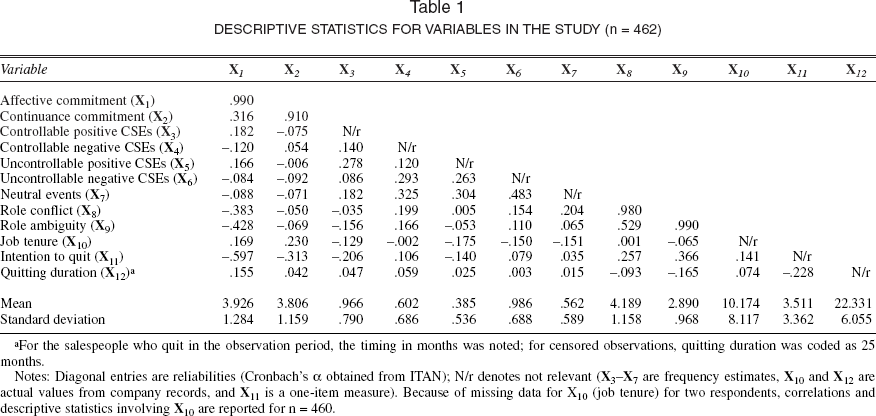
For the salespeople who quit in the observation period, the timing in months was noted; for censored observations, quitting duration was coded as 25 months.
Notes: Diagonal entries are reliabilities (Cronbach's α obtained from ITAN); N/r denotes not relevant (X3-X7 are frequency estimates, X10 and X12 are actual values from company records, and X11 is a one-item measure). Because of missing data for X10 (job tenure) for two respondents, correlations and descriptive statistics involving X10 are reported for n = 460.
where Jt = σu−1 [γ0 + γ1IMi + γ2IUi + γ3IMi x IUi - lnT]; Ht = σ1[lnti - γ0 - γ1IMi - γ2IUi - γ3IMi x IUi]; π0 and π1 denote the continuous product over censored and noncensored observations, respectively; θi is specified in Equation 9a; G(.) denotes the cumulative distribution function associated with ui and g(.) = G'(.) is the corresponding density function; and T denotes the length of the observation period.
Method
Research Setting
In return for feedback about sales representatives' attitudes, sales executives of a Fortune 500 corporation in the printing and publishing industry agreed to cooperate in a study of their entire sales force. The company operates in all 50 states, and sales representatives call on manufacturers, service businesses, retailers and wholesalers, and not-for-profit organizations. Sales representatives start their jobs in the field and receive training both centrally and locally. Compensation is commission based and, on average, representatives have approximately 12 years of selling experience, most of that at the company. The average age is approximately 35 years, most have a college education, and approximately 23% of the salespeople are women. The company had recently undergone changes at high levels of sales management and increased prices of some products. This setting is ideally suited for the present investigation, because in the two years of observation, almost 20% of a large sales force quit, which enables us to study the formation and consequences of intentions to quit.
Data Collection Procedures and Measures
We used a mail survey to collect the desired information. Company sales management sent a letter to all sales representatives to introduce the survey. Next, the questionnaires were mailed to sales representatives at their home addresses, with a cover letter from us and a stamped envelope addressed to us for returning the completed questionnaire. Two weeks later, we sent a follow-up letter along with another questionnaire and stamped response envelope. Of the 739 sales representatives who received the survey, 526 responded, which yielded a response rate of more than 71%, excellent for a survey of this type. Complete data for the required analyses were obtained from 462 sales representatives. 7 To meet our needs and those of the company, the questionnaire contained several scales and items that are not used in this research. In Table 1, we present the descriptive statistics for the relevant variables.
The high response rate makes nonresponse bias likely to be low. Following Armstrong and Overton (1977), we also compared responses to the first wave and responses to the second wave and found no significant differences between them on the variables of interest or in relationships among them. Finally, on the demographic data for which we had information for all representatives (age, sex, location), there were no significant differences between respondents and nonrespondents. We reduced response bias by having the questionnaires returned to the researchers, by promising sales representatives confidentiality, and by wording the questionnaire carefully, predominantly using questions that had been field tested in previous research.
A list of CSEs was developed by consulting with sales representatives and managers in several firms. The list was reduced to 13 items that appeared pertinent in the firm being studied. These were classified in advance as positive, negative, or neutral. Some were partially within the control of the sales representative (gain or loss of a major customer, success or failure at making a big sale). Others reflected management's actions (changes in the product line, price increases, changes in managerial policies or personnel). Still others were due to competitors' actions (entrance or departure of competitors). The frequency of these events was measured by asking how often each of these events had occurred in the sales representative's territory during the previous three months on a five-point scale (0 = never, 1 = once, 2 = twice, 3 = three times, 4+ = more). Sales representative role ambiguity and conflict were measured with the updated version (House, Schuler, and Levanoi 1983) of Rizzo, House, and Lirtzman's (1970) scale, which is widely used in organizational and sales research. The role ambiguity scale had 13 items; the role conflict scale contained 8 items. Both variables were measured on seven-point Likert scales anchored by “very false” and “very true.” Both scales have been validated in prior research (see MacKenzie, Podsakoff, and Ahearne 1998). Affective and continuance commitment were measured using the organizational commitment scale developed by Meyer and Allen (1984) and tested further by McGee and Ford (1987). Both affective and continuance commitment scales had 8 items, and both variables were measured on seven-point Likert scales anchored by “strongly agree” and “strongly disagree.” Intention to quit was measured with 3 reverse-coded items adapted from Bluedorn (1982). Each ten-point item, anchored at 0% and 100% likely to stay, was treated separately, because it measured intention to remain over a specific time period. In this project, intention to quit in two years is used, because it reflects the time period for which actual behavior was measured. Actual behavior was measured in terms of months taken to quit after the intention-to-quit data were collected. The exact date of departure was obtained from company records. 8
Unfortunately, no distinction could be made between voluntary and involuntary turnover, though the company indicated that voluntary turnover represented approximately 80% of all turnover. This distinction is less important in sales than in some other occupations, because it is fairly easy for both representatives and managers to determine when their performance is likely to lead to termination. However, the presence of involuntary turnover may reduce the predictive ability of our model. As such, our results will be conservative.
Estimation and Analysis Strategy
The analysis proceeded in two stages corresponding to the two stages of the process model. In each stage, we outline overall model tests as well as tests of specific parameters.
Stage 1: Intentions to quit
Consistent with the JUMP model testing procedure, we consider three model specifications. The first model (M0) is the null model that does not incorporate the drivers of intention magnitude or intention uncertainty. The second model (MR) considers only intention magnitude and ignores intention uncertainty. Finally, the hypothesized model (MH) simultaneously models intention magnitude and intention uncertainty. In terms of the various hypotheses developed, model MH can be represented by Equations 1 through 8 and has the following specifications for IM and IU:

and

where subscript i denotes the individual; ACOM and CCOM denote the level of affective and continuance commitment, respectively; CPOS and CNEG denote the frequency of controllable positive and negative CSEs, respectively; UCPOS and UCNEG denote the frequency of uncontrollable positive and negative CSEs, respectively; NEUT denotes the frequency of neutral sales events; and ROLEC and ROLEAM denote role conflict and role ambiguity, respectively.
Defining

and

where LJM = πi [
Three important questions can now be addressed.
Question 1: Is the overall JUMP model significant?
As in an overall model fit test, we assess the extent to which the variables included in the analysis explain intention magnitude and intention uncertainty. Essentially, this is a test of the null hypothesis H0:

Question 2: Is there a significant contribution of X?
This is test of the overall judgment magnitude specification (see Equation 7), that is, a test of the null hypothesis H0:

Question 3: Is there a significant contribution of Z?
This question can be addressed in two ways, because

Second, incorporating

Specific hypothesis testing then proceeds within the retained model.
Stage 2: Probability and timing of quitting behavior
Here we focus on estimating the threshold model of intention–behavior that simultaneously addresses the probability and timing of quitting (see Equation 12). Thus, the following likelihood function is maximized:

where ÎM, ÎU, and sε2 denote, respectively, the predicted values of IM, IU and σε2 obtained from the JUMP model estimation of Equations 1–8 and 13–14; Jt and Ht are defined as in Equation 12; and T, the length of the observation period, is 25 months.
To make an informed choice of the distributional form for u (see Equation 10), we estimate the threshold model (duration censored at the 25th month after survey administration) with alternative distributional forms for u (e.g., exponential, log-logistic, log-normal, Weibull) and select the best-fitting model using the Akaike information criterion (AIC). Hypothesis testing proceeds with the retained form for u.
We assessed the validity of the hypothesized threshold model of intention–behavior by comparing the model in Equation 21 to the standard duration model that ignores the probability of quitting. However, our intention–behavior model does not nest the standard duration model (note that under H0: λ = τ = 0, Equation 21 does not reduce to the likelihood function of the standard duration model). Consequently, we employed a nonnested test for model selection based on the likelihood dominance criterion proposed by Pollak and Wales (1991).
To assess the impact of intention magnitude compared with intention uncertainty and error on the probability of behavior, we examine if λ/(1 - λ) is different from zero and then test if this ratio is greater than 1.0 (see the fourth point following Equation 9). Regarding the threshold, we first estimate a model with a common threshold across all individuals; that is, τi = τ ∀ i. An estimate of τ > 0 will indicate that a threshold exists, providing support for our conceptual model of intention–behavior. Furthermore, if the analysis reveals that τ is large, using the stated intention to predict the timing of quitting is likely to yield little insights.
Specifying τi as a function of individual characteristics to identify individual-level thresholds is relatively straightforward. For example, if we modeled the threshold as a function of job tenure (JTEN), that is, τi = τ + τJTJTENi, maximizing the likelihood function in Equation 21 will yield an estimate for τJT, the impact of job tenure on the threshold. We can also estimate the net threshold for any given value of JTEN (say j) as (τ + jτJT), and testing can be performed using conventional methods. Other individual characteristics can be similarly incorporated.
Results
Stage 1: Intentions to Quit
Overall model testing
The three models, M0, MR, and MH, were estimated. In assessing the overall fit of the two-dimensional model of intention-to-quit judgments, three questions were addressed as outlined in the testing strategy:
Is the overall magnitude–uncertainty model (MH) significant? A likelihood-ratio test (see Equation 17) reveals that model MH fits significantly better than model M0 (χ215 = 308.45, p < .0001).
Is there a significant contribution of X, the hypothesized drivers of intention magnitude? Following the likelihood-ratio test presented in Equation 18, we find strong support for a significant contribution of the hypothesized drivers of intention magnitude (χ28 = 235, p < .0001).
Is there a significant contribution of Z, the hypothesized drivers of intention uncertainty? First, in its conceptual contribution, the significance of Z is assessed by a test of the null hypothesis H0: δ = 0. Again, a likelihood-ratio test (Equation 19) supports a significant contribution of the hypothesized drivers of intention uncertainty (χ27 = 55.4, p < .0001). Second, we compared model MH and model MR (see Equation 20). The test indicates that model MH outperforms model MR (χ27 = 17.52, p < .03); including intention uncertainty in the analysis contributes significantly to the power of the test for intention magnitude.
Overall, the results reveal strong support for our theorizing regarding the structure of intentions (i.e., the two-dimensional model of intention magnitude and intention uncertainty), as well as the composition of intentions (i.e., the groups of variables influencing intention magnitude and intention uncertainty). We therefore examine specific effects within model MH. The results of estimating model MH are presented in Table 2.
ANTECEDENTS OF INTENTION-TO-QUIT MAGNITUDE AND UNCERTAINTY

Column entries are parameter estimates (standard errors in parentheses). Estimates are obtained from the JUMP model estimation applied to the intention-to-quit judgments. A dash in a column for a covariate indicates that the model does not consider that covariate.
p < .06.
p < .05.
p < .01 (all hypotheses tests with prior expectation are one-tailed).
Intention magnitude
Observe in Table 2 that, as expected, as ACOM and CCOM increase, intention magnitude decreases (b1 = −1.89, p < .0001 and b2 = −1.06, p < .01, respectively). Furthermore, as anticipated, we find a significant interaction between ACOM and CCOM (b3 = .152, p < .05). These results suggest that the effect of ACOM depends on the level of CCOM. Indeed, as expected, as CCOM increases, the effect of ACOM (given by −1.891 + .152*CCOM) steadily decreases from −1.74 at the lowest levels of CCOM (=1) to −.83 at the highest levels of CCOM (=7). More important, however, even at the highest level of CCOM, affective commitment has a positive and significant (p < .01) effect on the intention-to-quit magnitude. In turn, as ACOM increases, the effect of CCOM decreases, and by the time ACOM reaches its 85th percentile value, the effect of CCOM is rendered insignificant.
Next, as expected, controllable CSEs had a greater impact than uncontrollable CSEs. Whereas CPOS decreased intention to quit (b4 = −.495, p < .01), CNEG increased intention to quit (b5 = .45, p < .05). However, UCPOS and UCNEG had insignificant effects. Finally, neutral events do not appear to influence intention to quit. Overall, these findings generally support our theorizing.
To examine the relative contribution of the commitment variables and CSEs, we computed effect sizes in terms of log-likelihood units after restricting the effects of the corresponding variables to zero (see Equation 15). The effect size represents a unique contribution, because it is computed as the contribution to model fit after all other variables have been included in the model. Results indicated that the unique contribution of the commitment variables is more than 11 times that of CSEs (97.2 versus 8.6 log-likelihood units).
Intention uncertainty
In terms of the model parameters, we expected ROLEC and ROLEAM to increase intention uncertainty. The results indicate that ROLEC does not appear to be related to uncertainty in intention to quit. However, the expected effect obtains for ROLEAM: As ROLEAM increases, so does intention uncertainty (d2 = .96, p < .06).
We had also anticipated significant effects of CPOS and CNEG, though in opposite directions. The results support our expectation: CPOS is associated with a decrease in intention uncertainty, whereas CNEG is associated with an increase in intention uncertainty (d3 = −1.11, p < .05; d4 = 1.81, p < .05, respectively). The results also suggest that uncontrollable positive events decrease uncertainty (d5 = −1.77, p < .01). Recall that UCPOS had no impact on the intention-to-quit magnitude. Again, neutral events do not appear to influence intention uncertainty.
Following a similar procedure as in the magnitude dimension, we compared the unique contribution of the two sets of antecedents of intention uncertainty: role stress and CSEs (see Equation 16). Results indicated that the unique contribution of the CSEs is more than 16 times that of role stress variables (26.1 versus 1.6 log-likelihood units).
Stage 2: The Probability and Timing of Quitting Behavior
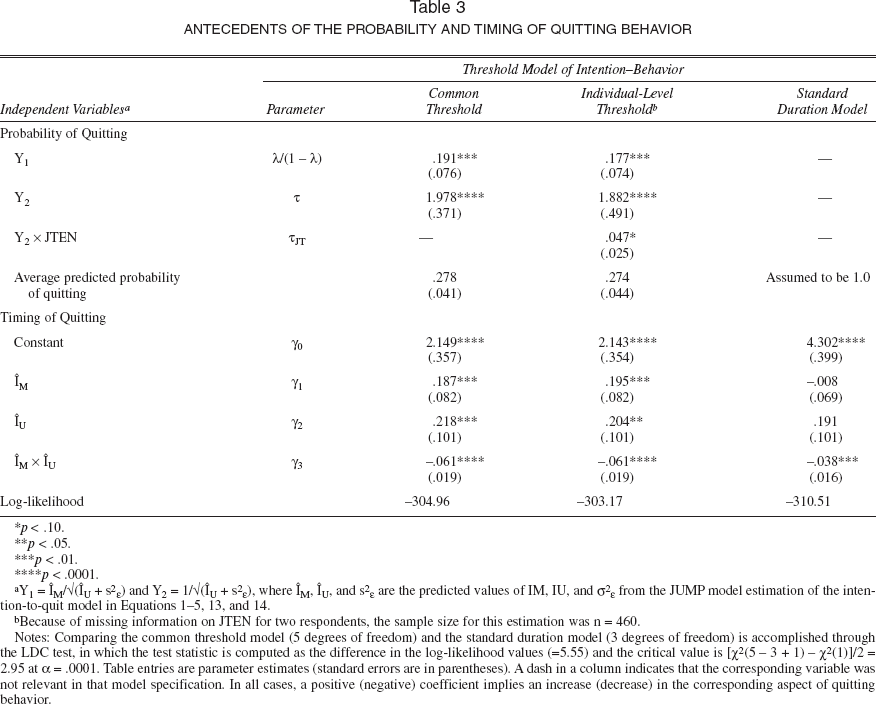
Following our analysis strategy, we first estimated the intention–behavior model with a common threshold parameter (likelihood function given in Equation 21) and with alternative distributional forms for u (e.g., exponential, logistic, normal, Weibull). On the basis of the AIC, we retained the logistic distribution for u (this implies that the turnover duration follows a log-logistic distribution). 9 To assess the validity of our threshold conceptualization of quitting behavior, we also estimated a standard log-logistic duration model that assumes that the probability of eventual quitting for all sales representatives is 1.0. We present results of the estimation in Table 3.
The AIC values were 635.02, 621.9, 622.2, and 624.38 for the exponential, logistic, normal, and Weibull distributions, respectively. Consistent with model comparison tests (Greene 1997), we retained the distribution with the lowest AIC value. Given the similar AIC values for the logistic, normal, and Weibull distributions, we examined the pattern of results across the three distributions. The pattern was identical in significance and direction.
ANTECEDENTS OF THE PROBABILITY AND TIMING OF QUITTING BEHAVIOR
p < .10.
p < .05.
p < .01.
p < .0001.
Y1 = ÎM/√(ÎU + s2ε) and Y2 = 1/√(ÎU + s2ε), where ÎM, ÎU, and s2ε are the predicted values of IM, IU, and σ2ε from the JUMP model estimation of the intention-to-quit model in Equations 1–5, 13, and 14.
Because of missing information on JTEN for two respondents, the sample size for this estimation was n = 460.
Notes: Comparing the common threshold model (5 degrees of freedom) and the standard duration model (3 degrees of freedom) is accomplished through the LDC test, in which the test statistic is computed as the difference in the log-likelihood values (=5.55) and the critical value is [χ2(5 − 3 + 1) - χ2(1)]/2 = 2.95 at α = .0001. Table entries are parameter estimates (standard errors are in parentheses). A dash in a column indicates that the corresponding variable was not relevant in that model specification. In all cases, a positive (negative) coefficient implies an increase (decrease) in the corresponding aspect of quitting behavior.
Observe that the hypothesized threshold model of quitting behavior outperforms the standard duration model (LDC = 5.55, p < .0001). This finding suggests that it is important to model both the probability and timing of quitting simultaneously. Indeed, the average predicted probability of quitting by our threshold model is estimated to be .278, well under a value of 1.00 assumed by the standard duration model (t = 6.18, p < .0001). Furthermore, our threshold model of intention–behavior predicts that 6.95% of the entire sample will have quit by the 9th month and that 13.9% of the entire sample will have quit before the 15th month. These numbers are encouraging when we note that (1) by the 9th month, 8% of the entire sample (37 of 462) and (2) by the 15th month, 13.85% of the entire sample (64 of 462) have quit. This predictive performance provides further support for our threshold model of quitting behavior. In contrast, the standard duration model ignores the probability of quitting and predicts the median quitting time to be 82 months (with a variance of almost 50 times that of the threshold model).
Probability of quitting behavior
Our analysis reveals the operation of the two dimensions of uncertain intentions to quit. The conceptual model (Equation 9a) embodies specific expectations: (1) The magnitude of stated intentions increases the probability of behavior; (2) a threshold effect, τ, decreases the probability of behavior; and (3) intention uncertainty reduces these two effects. We also sought to estimate the importance of the effect of intention magnitude relative to intention uncertainty and error in influencing the probability of behavior (captured by λ/(1 -λ) in Equation 9a).
Observe in Table 3 that λ/(1 - λ) is estimated to be .19, and is significantly greater than zero (p < .05). This reveals that, given a level of intention uncertainty, intention magnitude increases the probability of quitting. Next, our analysis reveals that λ/(1 - λ) is significantly less than 1.0 (t = 7.22, p < .0001). This implies that intention magnitude has a much smaller impact on the probability of quitting than do intention uncertainty and error (recall that an estimate of λ/(1 - λ) > 1 would have indicated a prominence of intention magnitude over uncertainty and error in increasing behavior probability).
Furthermore, note that the estimate for τ is 1.98 (p < .0001). This provides support for our threshold model of intention–behavior. Specifically, this result suggests that, on average, the magnitude of the stated intention must be greater than 2 for the timing of quitting to be even conceptually relevant. People who rate below 2 on the intention scale are identical for all practical purposes; their probability of quitting is zero, and there is little information in their stated intention to predict the timing of quitting.
More interesting findings emerge when we incorporate individual differences in the threshold specification. In Table 3, we present results from estimating the individual threshold model, which explores the effect of job tenure (JTEN) on the threshold. A significant effect of JTEN emerges (coefficient = .04, p < .07), which indicates that as JTEN increases, the threshold also increases. Indeed, for every ten years of JTEN, the threshold increases by about half a scale point. 10
We also explored the effect of sex on the threshold and found a significant effect. Specifically, we found that women have a lower threshold than men by almost one scale point (p < .05; the level of the threshold was estimated to be 2.62 for men and 1.64 for women). This finding suggests that though a stated intention of 2.0 can be reliably employed to predict quitting behavior for women, there is little information in a stated intention of this level to predict timing of quitting for men. We note here that we are not advancing and testing a theory of the various factors that may influence the threshold; rather, our objective in this project is to illustrate the individual-level threshold analysis.
Timing of quitting behavior
Our main objective in this stage was to assess the consequences of the interplay of intention uncertainty and intention magnitude for the time taken to quit, contingent on the likelihood of quitting. Accordingly, our main focus is on the interactive effect of intention magnitude and intention uncertainty (captured by γ3 in Equation 10). Within the uncertainty resolution conjecture, we anticipated γ3 > 0, and within the uncertainty avoidance conjecture, we anticipated γ3 < 0.
Observe in Table 3 that in addition to the significant main effects of intention magnitude and intention uncertainty, our analysis reveals a significant interaction between intention magnitude and intention uncertainty. More important, the results support the uncertainty avoidance conjecture (estimate for γ3 = −.061, p < .01). To examine the pattern of the interaction, we computed and tested the net effect of intention magnitude at various levels of intention uncertainty (see Equation 11).
At low levels of intention uncertainty, intention-to-quit magnitude appears to increase the time taken to quit (when intention uncertainty = 0, the impact of intention magnitude is .187, p < .0001). As intention uncertainty increases, the effect of intention magnitude decreases, and at the mean value of intention uncertainty (=3.6), the net effect of intention magnitude is −.033 and insignificant (p = .33). As intention uncertainty increases further, the net effect of intention magnitude becomes more negative, and by the 70th percentile value of intention uncertainty (=5), intention-to-quit magnitude decreases the time taken to quit (when intention uncertainty = 5, the net effect of intention magnitude = −.118, p < .01). These findings reveal the crucial role played by intention uncertainty. Whereas conventional analyses maintain that increases in intention-to-quit magnitude should result in faster quitting, our analysis finds that this is true only when the uncertainty surrounding intention-to-quit judgment is high: Certainty promotes staying longer; uncertainty promotes quitting faster.
Discussion and Conclusion
The purpose of our research was to model the formation of intention-to-quit judgments among salespeople and investigate the link between these intentions and subsequent quitting behavior. Motivated by gaps in the sales force and intention–behavior literature, we first engaged the uncertain nature of intention judgments. Employing the JUMP model to examine the formation of intention-to-quit judgments, we simultaneously estimated the drivers of the magnitude of intention-to-quit judgments and the drivers of the uncertainty with which these judgments are held. We subsequently focused on the interplay of intention magnitude and intention uncertainty in shaping actual quitting behavior. Specifically, we developed and estimated a threshold model of the intention–behavior link that articulated a psychological mechanism within which stated intentions translate into a certain behavior. Constituting an important extension of current intention–behavior models, our threshold model (1) incorporates an individual-level threshold on stated intention below which people have a zero probability of quitting and (2) explicitly models the interplay of intention magnitude and intention uncertainty on the probability and timing of behavior.
Despite the interesting findings and implications of this research, it is important to recognize the limitations in the study, which point to important and interesting avenues for further research. First, although we had longitudinal data that identified the exact date of quitting, our panel was only for a period of two years. We note that prior research suggests that a two-year window yields an adequate level of variability in turnover (e.g., MacKenzie, Podsakoff, and Ahearne 1998). However, the length of the observation period directly influences the censoring rate. A longer time frame may enable us to gain richer insights into the underlying hazard function and test conjectures regarding the shape of the hazard function.
Second, we measured all the independent variables at the outset of the study. Because intention magnitude and intention uncertainty were predicted from covariates measured at a point in time, we ignore the time-varying nature of these variables. Although the main objective of the study is to model the translation of uncertain intentions to quit into behavior at a later point in time, richer insights into the intention–behavior translation would have been obtained had we measured the variables of interest at several points in time. From a practical point of view, however, our results are informative to the extent that we identify some drivers of intention magnitude and intention uncertainty, which in turn explain significant variation in the probability and timing of quitting. From a conceptual point of view, although intention–behavior researchers have invariably employed intentions measured at one point of time to predict future behavior, further research should examine how uncertain intentions evolve over time to influence eventual behavior. Such a dynamic perspective will help us better understand the intention–behavior link in areas that routinely use intentions data to predict behavior (e.g., purchase of consumer goods).
The Magnitude of Intention to Quit
In this research, we used variables that have not been commonly used in the marketing literature—continuance commitment and CSEs—and demonstrated their relevance. Thus, along with a focus on intention uncertainty, this research provides an altogether more comprehensive examination of turnover and its antecedents than previous research.
Our results indicate that continuance commitment has a direct effect and interacts with affective commitment to shape intentions to quit. These results clearly demonstrate the importance of sunk costs and available alternatives. From a managerial standpoint, reducing turnover intentions may be accomplished by increasing the sunk costs of productive sales representatives, for example, by linking pension and stock option plans to productivity. Furthermore, in analyzing the interaction between continuance and affective commitment, we found that affective commitment had its lowest impact when continuance commitment was high. And prior research has suggested that continuance commitment is linked to tenure and past performance. 11 Therefore, a manager can expect that affective commitment will have a lower impact for older and more productive employees than for newer and less productive employees. Although this does not imply ignoring the older salespeople, it suggests that taking actions to improve affective commitment among younger employees is more important.
In the context of our data, we found significant effects of performance (measured as the percentage of quota achieved in the past year) and tenure on continuance commitment (p < .05 in both cases; model F2,457 = 14.20, p < .0001).
We also uncovered the effect of controllable CSEs on intentions. Critical sales events are part of the “baggage” in salespeople's professional lives. Managers need to be aware of the occurrence of CSEs and work to accentuate the impact of positive CSEs (through recognition programs) and minimize the deleterious effects of negative controllable CSEs.
Uncertainty of Intentions Matters: The Probability and Timing of Quitting
Examining what affects intention-to-quit uncertainty is an entirely new endeavor in sales force turnover research. In addition to detecting the presence of uncertainty in intention-to-quit judgments, we uncovered important antecedents and consequences of intention uncertainty. Thus, the results strongly establish the relevance of uncertainty in intention-to-quit judgments in developing an understanding of turnover and its antecedents.
The results also clearly establish the benefit of modeling the probability and timing of quitting within a threshold model of intention–behavior. Whereas prior research has uncovered heterogeneity in the probability of behavior treated in isolation (e.g., Morwitz and Schmittlein 1992), our model uncovered specific mechanisms within which individual difference variables operate. Individual difference variables have an impact on the level of the threshold, below which there is little information in a stated intention for predicting the timing of the behavior. Moreover, for a stated intention to become useful in predicting the timing of behavior, the magnitude of that intention must overcome two forces: an individual-level threshold and the composite of individual-level intention uncertainty and measurement error. Although the intention magnitude must overcome the threshold for the behavior to occur, uncertainty in the intention and error result in a lower probability of behavior. Here, we support our conjecture that intentions held with high levels of uncertainty may not translate into actual behavior. Furthermore, in combination with measurement error, intention uncertainty is five times more important than intention magnitude in fostering quitting behavior. As intention magnitude becomes less important, the effect of the threshold diminishes proportionately; under these circumstances, intention uncertainty assumes a central role in shaping subsequent behavior. Although the relative importance levels may vary across different substantive domains, our research offers an approach in which the effects of intention magnitude and intention uncertainty on behavior can be meaningfully examined. Furthermore, if we specify λ as a function of independent variables, we could identify drivers of the trade-off between intention magnitude and intention uncertainty in shaping subsequent behavior.
In turn, we found that intention uncertainty plays a central role in determining when salespeople quit. Greater intention uncertainty leads to faster quitting. Our results demonstrate that role ambiguity and controllable CSEs significantly affect intention uncertainty. Thus, actions that reduce role ambiguity, promote positive controllable CSEs, and reduce negative CSEs will extend the time that eventual quitters stay in the organization. Over a ten-year period, keeping productive representatives for 2.5 years instead of 2 years means that four representatives will occupy a territory instead of five. From a management perspective, this has important implications for reduced hiring and training costs and the number of gaps in coverage that occur every time a sales representative quits.
That greater intention uncertainty leads to faster quitting offers important implications for the study of individual decision making in general. For the most part, research on individual and organizational decision making has proceeded within the classic information theoretic/uncertainty resolution framework. Our results add to the emerging research that is beginning to uncover the pervasive deviations from the normative tenets of rational decision making: Across many contexts, decision makers appear to be governed by uncertainty avoidance rather than resolution (see March 1997). We were able to gain such insights into the role of uncertainty in fostering behavior, because we employed a model of intention–behavior that centers on the psychological mechanism by which uncertainty-laden stated intentions translate into behavior.
In concluding, we return to the theme that initiated this research: the fundamental desire by researchers and practitioners to predict behavior as it unfolds over time. In this research, we center on two aspects of behavior, and our threshold model simultaneously estimates the drivers of probability and timing of a focal behavior. Several other events in marketing (e.g., timing of customer complaining after dissatisfaction, timing of buyer–seller relationship termination after stated levels of commitment, timing of specific strategic actions by firms after external shocks to the system, timing of consumer purchase after a stated intention to purchase) can all be more comprehensively addressed by incorporating judgmental uncertainty into the analysis and by simultaneously modeling the probability and timing of the focal event. For example, uncertainty in a commitment will come to influence whether a buyer–seller relationship is likely to terminate as well as when it will terminate. Likewise, uncertainty in the intention to purchase a product will shape both the probability and timing of purchase. If anything, an important lesson from the application of latent-class models in the marketing literature (e.g., Gupta 1988; Sinha and Chandrashekaran 1992; Vilcassim and Jain 1991) is that failure to model simultaneously timing and probability of behavior produces erroneous theoretical conclusions and faulty predictions of behavior. This perspective, unfortunately, has not appeared to permeate other important substantive areas of marketing, such as duration of customer relationship (Bolton 1998) or timing of product improvements (Moorman and Slotegraaf 1999). Taken together with the results from the JUMP model, the results of our threshold model of intention–behavior suggest strongly that further research should build on this approach by recognizing the pitfalls in excluding judgment uncertainty from the traditional models or estimating the drivers of the timing of events while ignoring the probability of the event in the first place. We hope that future researchers respond.