







Abstract
In virtually all marketing channel relationships, one of the parties eventually will engage in an action that another channel member considers potentially destructive for the relationship. How a particular channel member reacts to such an act has implications for the long-term viability and success of the relationship. On the basis of a large data set collected from both a focal supplier and its independent dealers, the authors classify dealers' responses to a supplier's destructive acts by extending the response typology of exit, voice, and loyalty, which is based on Hirschman's seminal writings on responses to decline in organizations and states. This study finds that dealers' reactions are influenced by several antecedent factors: perceived intensity of the supplier's destructive act, the attributions relative to the act, relationship quality before the act, and the level of interdependence between dealer and supplier. The results suggest that these more proximal dealer responses affect subsequent dealer performance and overall perceptions of relationship quality after an act. The authors draw several implications for both dealers and suppliers.
At one time or another in virtually every marketing channel, a channel member has engaged in actions or has adopted policies that are viewed by other members as destructive to the working relationships within that channel. Suppliers may add new distributors to sales territories or cultivate sales directly to consumers through the Internet (e.g., www.hewlett-packard.com), thereby potentially harming existing distributors and retailers. Sometimes, without notice, suppliers drop products from product lines, depriving distributors of future sales opportunities and making current inventories obsolete. Similarly, distributors can reduce the shelf, floor, or catalog space allocated to suppliers, causing damage to the suppliers' sales, profits, and/or reputations. All these types of actions have negative repercussions and can threaten the well-being of the relationships in the channels in which they occur.
The rapid growth of multichannel distribution systems has significantly increased the potential for discord between suppliers and channel intermediaries. Recent examples abound that underscore the impact that destructive acts (DAs) and the resulting conflicts may have on channel members. For example, Compaq's plan to help right its struggling personal computer (PC) business involves selling 60% of its business PCs directly by the end of 2000. However, the channel backlash from this distribution policy could hurt Compaq's efforts to restore profitability; as one industry analyst observes, “small and midsize businesses tend to be heavily influenced by resellers.” The resellers themselves warn that
Compaq won't be able to provide the personal service and support they say customers need. “We bring a lot of customer value to the equation, and that's going to disappear if we're cut out,” squawked one reseller. Another reseller confirmed that feeling, “If we're forced to compete too much with Compaq, we'll make other options available.” (McDougall 2000)
Because such DAs, as they are perceived by their recipients, can create tremendous conflict between channel members, the ability to manage conflict still remains a central task in distribution.
Our concern in this study is to identify channel member responses in the face of such frequent, but not always justifiable, DAs. The acts themselves and the reaction they provoke are expected to reshape the way suppliers and resellers interact. This challenge led us to examine several related research questions: How can managers assess the impact that their firms' DAs might have on existing channel members? What processes are vital to understanding responses to these perceived DAs? Can a firm predict—and possibly mitigate—negative reactions by existing channel members to its DAs?
In the context of interdependent patterns of response, reactions to constructive acts have been found to be only weakly associated with the functioning of relationships, whereas reactions to DAs have been found to be more predictive of relationship dissolution (Rusbult, Johnson, and Morrow 1986). Apparently, it is more important to avoid exchanging negative behaviors than it is to exchange positive behaviors (Montgomery 1988). Thus, understanding the process of responding to DAs can be an important step in channels research as partners strive to keep conflicts from deteriorating into a spiral of hostility and distrust that ultimately could lead to dissolution.
We draw from marketing, organization theory, and social psychology research to construct a conceptual model of channel members' responses to a DA by another channel member. The model posits several factors that may be related to a member's responses: the perceived destructiveness of the act, the attributions invoked relative to the act, relationship quality before the act, and issues of interdependence between the parties. We also examine the consequences for a channel member's subsequent performance as well as relationship quality after the act.
Conceptual Framework of Response Behaviors
Because all actions between channel members cannot be considered destructive in nature, it is necessary to outline our use of the term DA. Within our theoretical framework, a DA is conceptualized as an action that is perceived by the aggrieved channel member as having a significant negative impact on the viability or functioning of the affected firm. Thus, the DAs used in this study are channel member generated and evaluated. Although any channel member can be the initiator or receiver of a DA, in our study, the focal supplier was the initiator and its independent dealers were the receivers of several potential DAs. Hereafter, we use “supplier” and “dealer” to coincide with the initiator and receiver of the DA, respectively.
Our typology to classify dealers' responses to a supplier's DAs is loosely based on Hirschman's (1970) seminal writings on exit, voice, and loyalty as responses to decline in organizations and states. This conceptual framework has since been empirically examined in several contexts, including interpersonal exchange relationships (e.g., Rusbult and Zembrodt 1983) and employee–employer settings (e.g., Rusbult et al. 1988). More recently, Ping (1993, 1995, 1997) introduced the exit, voice, and loyalty variables into the marketing channels arena in examining responses to overall relationship dissatisfaction. We extend Ping's work by adopting his operationalizations with some broadening of the construct domains.
Following Ping (1993, 1995), we conceptualize exit as a propensity to terminate or threats to discontinue the relationship, but we have more representatively labeled this construct “threatened withdrawal.” In addition to threatened withdrawal, dealers also may passively separate from the relationship through neglect, or reduced motivation and effort for the supplier's products. Consistent with this multi-faceted view of disconnection from the relationship, comprising both threatened withdrawal and neglect, we label this more comprehensive construct “disengagement.”
Because Hirschman's (1970, p. 30) conceptualization of voice as “any attempt at all to change, rather than to escape from, an objectionable state of affairs” is relatively neutral, researchers have differed in the manner in which they have operationalized this construct. Some view voice in a more positive manner: constructively discussing problems with the intent to find a mutual solution (e.g., Ping 1993, 1997; Rusbult and Zembrodt 1983). Others (e.g., Morrill and Thomas 1992) view voice in a more negative light: direct, aggressive criticism by an aggrieved party of an offender's behavior. Because field interviews with dealers indicated that this difference was real, we explore voice as two distinct constructs—distinguishing the more positive voice, which we label “constructive discussion” from the more negative voicing behavior, which we label “venting.”
Finally, Hirschman's (1970, pp. 77–78) description of loyalty as a “special attachment to an organization,” combined with the belief that “something will happen to improve matters” has also inspired debate as to its true meaning. Although loyalty can involve practicing good citizenship and optimistically hoping that relationship conditions improve, it has also been regarded as “suffering in silence” or viewing the problem as a transitory phenomena that “will work itself out” (Ping 1993). Through our interviews with dealers and review of the literature, we deemed loyalty to be more of a dutiful engagement stance toward the relationship and labeled this construct “passive acceptance.”
Factors Influencing Dealers' Responses
In examining behavior in interdependent relationships, Holmes (1981) argues that two classes of motives affect behavior and both must be considered fully to understand parties' actions in a dispute situation. He distinguishes the role of “micromotives,” more event-specific feelings or cognitions, from that of “macromotives,” the long-standing, more stable dispositions and general qualities of the relationship. We relied on previous studies of channel member behavior to help select the appropriate variables within these two classes of motives.
Within our theoretical framework (see Figure 1), a dealer's micromotives, or cognitive appraisals of the situation, are expected to be shaped by (1) the perceived intensity of the DA (how damaging it is viewed by the dealer) and (2) the dealer's attributions regarding the motivation behind the supplier's DA. Both intensity and attributions have appeared as important constructs in predicting channel member behavior (e.g., Dant and Schul 1992; Kaufmann and Stern 1988).

CONCEPTUAL MODEL
Similarly, two variables were isolated within macromotives, or relationship characteristics: (1) the dealer's perception of relationship quality with the supplier before the DA and (2) the level of interdependence between the dealer and supplier. Both these constructs have proved to be powerful predictors of channel member behavior (e.g., Buchanan 1992; Dwyer and Walker 1981; for a broad empirical analysis of key macromotive constructs, see also Iacobucci and Hibbard 1999).
Effects of Cognitions on Dealers' Responses
The role of perceived intensity of the DA
Although it seems logical that an aggrieved party's responses will vary depending on the perceived destructiveness of the initiator's action, Singh and Wilkes (1996) note that most response models have ignored the perceived intensity of the negative action. In this case, the more harmful the supplier's DA is viewed to be, the less likely the dealer will be to inhibit the desire to respond, that is, the more likely it is that the attitude–intention link will become activated (Bagozzi 1992). Consistent with this, it has been demonstrated in the experimental psychology literature that the more intense the punishment, the stronger are the effects on behavior (Zwick and Chen 1999). It is more difficult to passively accept or be willing to constructively discuss DAs of greater intensity. All other things (e.g., importance of the relationship, relationship quality) being equal, increasingly harmful or damaging acts by a supplier become difficult to ignore, and therefore the dealer is likely to respond to them in a more forceful, but negative, manner. Hence, we hypothesize the following:
All other things being equal, as a dealer's perception of the intensity of the supplier's DA increases, the dealer is less likely to respond with (a) constructive discussion and (b) passive acceptance and more likely to respond with (c) disengagement and (d) venting.
The role of attributions
The behavior of channel participants is often shaped by the attributions they make regarding the causes of their partner's actions (Frazier 1983). Although there are several different typologies for classifying attributions, we adopted a frequently used typology for examining attributions in relationships that distinguishes between attributions to self, partner, and external circumstances. As Scheer and Stern (1992, p. 134) note, “a firm in a marketing relationship may attribute causality to itself, its partner, or causes external to the relationship.”
When the DA elicits partner (hereafter labeled “supplier”) attributions, such as “the supplier did this strictly to benefit itself,” this may inhibit the dealer from taking stock of the situation in the relationship before responding. Consequently, the dealer may harbor greater hostility toward the supplier (Kaufmann and Stern 1988). The perception of being treated unfairly causes anger and brings with it a desire for retributive justice, even if it requires some financial sacrifice on the part of the dealer (Zwick and Chen 1999). Under such circumstances, dealers will feel compelled to vent their displeasure or disengage from the relationship. However, if the dealer does not place a high level of blame on the supplier, it will be more willing to engage in a constructive discussion or support the supplier through passive acceptance.
In contrast, when the DA elicits self or external attributions such as “we are to blame for this problem” or “competitive activity forced the supplier to take this action,” the dealer is more likely to be sympathetic because the supplier is not held directly responsible for the act. Self and external attributions therefore can be considered benign or even relationship enhancing (Verette, Rusbult, and Schmidt 1992) and would increase the probability of a dealer's passive acceptance rather than disengagement from the relationship. Furthermore, in the face of self and external attributions, a dealer may believe that venting or complaining is not useful, because the supplier is not to blame for the DA. Finally, when a dealer has made an external attribution for the DA, the constructive discussion response offers little assistance in resolving the situation, because neither the supplier nor the dealer had control over why the DA occurred. Thus, we hypothesize the following:
All other things being equal, as a dealer's attributions to the supplier for a supplier's DA increase, the dealer is less likely to respond with (a) constructive discussion and (b) passive acceptance and more likely to respond with (c) disengagement and (d) venting.
All other things being equal, as a dealer's attributions to itself for a supplier's DA increase, the dealer is more likely to respond with (a) constructive discussion and (b) passive acceptance and less likely to respond with (c) disengagement and (d) venting.
All other things being equal, as a dealer's attributions to external circumstances for a supplier's DA increase, the dealer is more likely to respond with (a) passive acceptance and less likely to respond with (b) constructive discussion, (c) disengagement, and (d) venting.
Effects of Relationship Characteristics on Dealers' Responses
The role of relationship quality before the DA
Over the past decade, researchers have expounded that developing close, cooperative channel relationships, based on trust and commitment, can deliver significant benefits to the participating firms (e.g., Anderson and Weitz 1992; Kumar, Hibbard, and Stern 1994). Anderson and Narus (1990, p. 45) argue that channel members that trust their partners “are more likely to work out their disagreements amicably and, in fact, accept some level of conflict as being just another part of doing business.” Similarly, Dant and Schul (1992) find that firms that take a long-term orientation to the relationship are more likely to use problem-solving approaches in managing channel conflict.
Dealers that trust their suppliers and are committed to the relationship generally view the relationship more favorably. Dealers with positive views about the relationship may simply place less importance on a single DA and be more likely to believe that the condition is transient and will improve. In contrast, a dealer that perceives relationship quality to be poor may view a DA as another “nail in the coffin” and move to disengage from the relationship. In addition, in the face of poor relationship quality, the dealer may believe that venting, though unlikely to result in a substantial improvement in conditions, still provides it some psychic benefits. We hypothesize the following:
All other things being equal, as a dealer's perception of the pre-act relationship quality with its supplier increases, the dealer is more likely to respond with (a) constructive discussion and (b) passive acceptance and less likely to respond with (c) disengagement and (d) venting.
The role of interdependence
Consistent with Emerson's (1962) definition, dependence in marketing channels has been viewed as the extent to which a partner provides valued resources for which there are few alternative sources of supply (e.g., Dwyer 1984). However, rather than focus on only one party's dependence, recent research (e.g., Gundlach and Cadotte 1994; Lusch and Brown 1996) instead has examined dyadic interdependence through the two constructs of total dependence (dealer dependence plus supplier dependence) and (dealer's) relative dependence (dealer dependence minus supplier dependence).
As total dependence increases, both channel members have greater stakes in the relationship. Higher levels of total dependence enhance the dealer's awareness of the supplier's need to keep the relationship intact. Consequently, it allows the dealer the latitude to speak up in the face of a DA, whether it be in the form of constructive discussion or venting, because the dealer is less fearful of the consequences of doing so. There is little reason for the dealer to accept a DA passively. In addition, higher total dependence means that the dealer also needs the supplier, and therefore disengagement is not an attractive option as there are few, if any, valued alternatives.
Dealers that are relatively dependent on their supplier believe they need to maintain the relationship to achieve their goals (Buchanan 1992; Frazier 1983). They are unlikely to use responses that may result in escalation or, ultimately, the dissolution of the relationship (Kumar, Scheer, and Steenkamp 1998). Furthermore, a relatively dependent dealer may believe or observe that venting or constructive discussion is an ineffective mechanism against the more powerful supplier, because given the dependence imbalance, the supplier can afford to ignore the dealer. Therefore, relatively dependent dealers may have little recourse but to respond more passively, hoping that conditions improve (see Frazier, Gill, and Kale 1989). Our hypotheses are as follows:
All other things being equal, as the level of total dependence in the relationship increases, the dealer is more likely to respond with (a) constructive discussion and (b) venting and less likely to respond with (c) disengagement and (d) passive acceptance.
All other things being equal, as a dealer's relative dependence increases, the dealer is more likely to respond with (a) passive acceptance and less likely to respond with (b) constructive discussion, (c) disengagement, or (d) venting.
Consequences of Dealers' Responses
Prior research on exit, voice, and loyalty has explored them as the final dependent variables (e.g., Ping 1993, 1995; Rusbult and Zembrodt 1983). Although our disengagement, constructive discussion, passive acceptance, and venting constructs represent responses by a dealer to a potential DA by its supplier, we are also interested in understanding the impact that each of these proximal responses has for the supplier's relationship with the dealer. Thus, we examine the effects of disengagement, constructive discussion, passive acceptance, and venting responses on the dealer's (1) subsequent performance from the supplier's perspective and (2) evaluation of post-DA relationship quality.
It seems reasonable that dealers that respond with disengagement or venting will be more likely to reduce their efforts on behalf of the supplier. In contrast, responding with constructive discussion or passive acceptance implies that the dealer may still care about the relationship and is willing to try to improve the relationship with the supplier or stay, hoping relationship conditions improve. Such loyal dealers should be more willing to fulfill their role obligations and thus be better performers. Furthermore, dealers that respond with disengagement or venting responses may be more willing to “fight fire with fire,” thereby initiating a deteriorating spiral of hostility, which could have a negative impact on post-act relationship quality. In contrast, dealers that respond with constructive discussion or passive acceptance may trigger a relationship dynamic that enables the dealer and supplier to regroup, better appreciate each other, and rebuild relationship quality. The supplier's DA, and the dealer's responses to it, may become a “moment of truth,” or vehicle to strengthen or disintegrate the relationship. Therefore, we propose the following:
The increasing use of dealer (a) constructive discussion and (b) passive acceptance to the supplier's DA is likely to lead to higher dealer performance from the supplier's perspective.
The increasing use of dealer (a) disengagement and (b) venting to the supplier's DA is likely to lead to lower dealer performance from the supplier's perspective.
The increasing use of dealer (a) constructive discussion and (b) passive acceptance to the supplier's DA is likely to lead to higher post-act relationship quality.
The increasing use of dealer (a) disengagement and (b) venting to the supplier's DA is likely to lead to lower post-act relationship quality.
Direct Effects of Relationship Characteristics
Our focus has been on what determines (cognitions about the DA, relationship characteristics) the type of response (disengagement, constructive discussion, venting, or passive acceptance) that a dealer makes to a supplier's DA and the effects of these responses on post-act relationship quality and performance. Within this theoretical framework, implicitly, we are asserting that the effects of cognitions about the act and relationship characteristics on key outcome variables will be mediated by disengagement, constructive discussion, passive acceptance, and venting.
However, the channels literature also suggests direct linkages between the relationship characteristics (pre-act relationship quality, total and relative dependence) and the ultimate consequence variables of post-act relationship quality and performance. For example, theoretically, total dependence would be expected to have direct effects on post-act relationship quality over and above any mediating effects through the responses to the DA. If this direct effect in not included in Figure 1, the variance is forced through the DA responses and could spuriously inflate the effects between total dependence and the responses or between the responses and post-act relationship quality. Therefore, we also hypothesize direct linkages between the relationship characteristics and the dependent variables of performance and post-act relationship quality.
Because the linkages between relationship characteristics and the consequence variables have been previously demonstrated in the literature, our rationale for this set of hypotheses is brief. All other things being equal, pre-act relationship quality should be positively related to post-act relationship quality (a simple lagged effect). Furthermore, dealers that trust and are committed to the supplier tend to expend more effort on behalf of the supplier, because they feel more secure about the future stream of returns (Anderson, Lodish, and Weitz 1987).
Total dependence has a beneficial impact on relationship quality (Kumar, Scheer, and Steenkamp 1995b) and performance (Buchanan 1992; Gundlach and Cadotte 1994), because both parties need each other and therefore are willing to invest the time and resources necessary to make the relationship work. The commonality of interests discourages parties from engaging in hostilities.
Relatively dependent channel members feel greater hostility toward the other party and dissatisfaction with the relationship, because their concerns typically do not receive adequate attention from the more powerful partner (Anderson and Weitz 1989; Kumar, Scheer, and Steenkamp 1995b). Furthermore, relatively dependent parties are often viewed as ineffective; powerful parties tend to attribute success to themselves (Gundlach and Cadotte 1994; Lusch and Brown 1996). We propose the following:
As a dealer's perception of pre-act relationship quality with its supplier increases, it is more likely that (a) the dealer will have a positive perception of post-act relationship quality and (b) the dealer will exhibit higher performance from the supplier's perspective.
As the level of total dependence in the relationship increases, it is more likely that (a) the dealer will have a positive perception of post-act relationship quality and (b) the dealer will exhibit higher performance from the supplier's perspective.
As a dealer's relative dependence in the relationship increases, it is more likely that (a) the dealer will have a negative perception of post-act relationship quality and (b) the dealer will exhibit lower performance from the supplier's perspective.
Research Method
Research Setting
The marketing channel of a Fortune-500 consumer durables manufacturer was selected as an empirical setting, because it recently had experienced several DAs as perceived by the participating channel members. Historically, this manufacturer/supplier used independent dealers and company-owned stores to distribute its products. However, because of what the supplier perceived as changing end-user buying patterns, the firm recently had added a national mass merchandiser to augment its existing channels of distribution. Press and trade reports indicated that the existing independent dealers considered the addition of this new channel, as well as several other recent supplier actions, highly destructive to them and their relationship with the supplier. In our opinion, this situation presented an exciting research setting, because many companies today are grappling with reconfiguration or expansion of their distribution channels, particularly with the emergence of the Internet.
The supplier, concerned about the channel conflict it had created, volunteered to support our research effort. The focus of the study was the reactions of the supplier's independent dealers to its potentially damaging actions, including its decision to expand its channels. Concentrating on one focal supplier's dealers allowed us some degree of control, but there was still adequate variation on the constructs of interest (e.g., dependence, relationship quality). To some extent, we view this study as a naturally occurring field experiment in which to test our theoretical framework.
Questionnaire Development
Eliciting the perceived DAs
Although the supplier's decision to add a mass merchandiser was perceived as destructive by the independent dealers, we did not want to designate this specific supplier action as the DA for all dealers. Therefore, we generated a list of potential DAs from 20 preliminary in-person and telephone interviews with dealers. Four recent supplier actions were frequently mentioned by the dealers as being particularly damaging. Follow-up interviews with the supplier established the universality of these acts. The four actions were the supplier's decisions to (a) add a national mass merchandiser to the distribution structure, (b) add another dealer (other than the mass merchandiser) in the dealer's territory, (c) pull a particular product line from the dealer, and (d) use an outside firm to approve the dealers' new credit card customers. 1
Dealers were allowed to offer a supplier-issued credit card in an effort to provide easier financial terms to customers. However, for cases in which it previously had processed its own card approvals, the supplier decided to use an outside agency to approve dealers' customers who applied for the card. This change resulted in a significantly higher percentage of application denials for dealers' customers.
To elicit the dealer-perceived most damaging supplier action, the following procedures were used in the mail questionnaires. First, each dealer was asked to assess whether each of the four acts had a negative impact specifically on its dealership. In addition, dealers were given an opportunity to write-in a perceived damaging action by the supplier. Second, each dealer was asked to select the action that had the most negative effect on its dealership. The survey then elicited the intensity of the selected act (how damaging the dealer perceived the act to be), the dealer's attributions for the DA, the dealer's responses to the selected DA, and the dealer's perceived level of relationship quality with the supplier before the act. All questions relating to the focal firm's DA appeared in the questionnaire after responses were elicited about the current relationship quality (i.e., post-act relationship quality) with the supplier.
Measure development
Consistent with Churchill's (1979) work, we took the following steps to develop multi-item scales for each construct. First, using construct definitions and measures available from the literature, we generated a large set of items for each construct. Second, we consulted with the supplier and the dealers to ensure that questions were worded with an industry-appropriate consistency. Any problematic items were either deleted or appropriately modified. Third, we evaluated the content validity of the items that measured the focal constructs of disengagement, constructive discussion, passive acceptance, venting, commitment, attributions, and so forth by subjecting them to an item-sort task administered to 28 doctoral students in business administration. Using two indices proposed by Anderson and Gerbing (1991), items that were particularly troublesome for the students to assign correctly were identified. On the basis of performance on this item-sort task as well as concept definitions, we selected items for the survey. Fourth, we administered the resulting items to managers of eight dealerships in face-to-face meetings to assess whether the dealers would interpret the items as intended. Finally, after minor changes, we pretested the mail survey on representatives of 15 dealerships. Follow-up calls to the nine dealers from which completed questionnaires were received helped us evaluate whether the questionnaire was of acceptable length and intelligible. The resulting items are presented in the Appendix.
Data Collection
We collected data from three sources: (1) survey data from dealers on DAs, dealers' responses to these DAs, relationship quality, attributions, and dealer dependence; (2) survey data from representatives of the focal supplier on dealer performance and supplier dependence; and (3) archival data from the supplier's records on dealer performance.
Data collection from dealers
The supplier provided a list of 1200 active, independent dealers that were mailed the final questionnaire. The dealer list included the name of the primary informant for each dealership, who usually (in 80% of the cases) held the title of chief executive officer, president, or owner. An informant competency assessment (Kumar, Stern, and Anderson 1993) was attached to the questionnaire. The competency questionnaire assessed how long informants had interacted with the supplier as well as the degree to which they believed they had adequate information and/or knowledge to evaluate the dealer's relationship with the supplier on four dimensions: dealer's commitment, dealer's trust, dealer's investment, and dealer's sales/profits from carrying the supplier's line.
A cover letter from a senior executive of the supplier's organization was included, which requested dealers to cooperate with the study while assuring them that the study was being conducted independently by the researchers. Another letter from the researchers promised that individual responses of a dealer would never be divulged to the supplier. In addition, dealers were provided an opportunity to win a $1,000 lottery and a business reply envelope to return their questionnaires. Finally, follow-up questionnaires were mailed to nonrespondents.
Fourteen sets of questionnaires were undeliverable, leaving an effective sample of 1186 dealers. We received responses from 742 dealerships, for a 62.6% response rate. Following Heide and John's (1990) and Kumar, Stern, and Anderson's (1993) work, we scrutinized individual responses to the competency questions to eliminate informants who failed to meet minimum competency standards. If an informant had responded with a 4 or 5 (where 1 is “do not have adequate knowledge/information” and 5 is “do have adequate knowledge/information”) to at least three of the four specific informant competency questions and had interacted with the supplier's organization for more than one year, they were considered qualified to complete the questionnaire. This rule resulted in the exclusion of seven completed surveys from further analysis. In addition, we excluded 36 informants because they had an excessive number of missing responses in their completed surveys.
The final sample consisted of 699 dealerships. We report the means for these remaining informants on each of the competency questions as follows:
Years interacted with supplier: 14.4;
Knowledge of dealer's commitment: 4.8;
Knowledge of dealer's trust: 4.9;
Knowledge of dealer's investment: 4.9; and
Knowledge of dealer's sales/profits: 4.8.
These means suggest that all remaining informants in the final sample were adequately knowledgeable about the issues under investigation.
Data collection from the supplier
We collected data from the supplier on dealer performance six months after compiling data from the dealers on the other constructs of interest. This time lag was due to operational constraints, as managing both data collection tasks concurrently was not possible. Furthermore, we considered the time lag useful from a conceptual perspective, because it allowed an assessment of predictive validity (i.e., how well disengagement, constructive discussion, passive acceptance, and venting predict future dealer performance). We expected that it would take some time before the effects of the DAs on dealer performance would be observed.
The measurement of performance has generated considerable debate among researchers, because archival (e.g., sales data) and perceptual (e.g., supervisor evaluations in salesperson research or supplier evaluations in channels research) reports typically do not demonstrate high convergence (Kumar, Stern, and Achrol 1992; MacKenzie, Podsakoff, and Fetter 1993). To obtain a comprehensive evaluation of dealer performance, we collected both archival and perceptual measures of dealer performance from the supplier's perspective. The perceptual dealer performance assessment used Kumar, Stern, and Achrol's (1992) seven-factor scale. The archival measure of dealer performance was available from the supplier's sales records and was calculated as the percentage increase in unit sales generated by the dealer.
To assess dealer performance, we asked informants from the supplier's organization to evaluate the 699 dealerships for which we had received completed responses. We made telephone calls to district managers in the supplier's organization to identify the appropriate informant for each of the dealers that had responded to our survey. As only a limited number of potential informants (i.e., 160 salespersons and district managers) were available, each informant needed to report on several dealers to maximize the matched pairs in our sample. On average, an informant reported on the performance of five dealers. However, to make the task manageable for informants, each informant received a maximum of three long questionnaires, which included performance items, supplier's dependence on the dealer, and items for other constructs. The short questionnaires included the informant competency questions and the 21-item performance scale. The assignment of dealers to a long or short questionnaire was random.
Each informant received a package that contained a cover letter from an executive in the supplier's organization encouraging participation, a letter from the researchers ensuring confidentiality, and up to five surveys. Business reply envelopes and an opportunity to win a $500 lottery were provided to help increase response rates. In addition, follow-up telephone calls were made to nonrespondents.
The 640 questionnaires from 144 informants were returned, for a 92% response rate. We scrutinized individual responses to the two informant competency questions that assessed how long the informants had interacted with the dealers and the degree to which informants believed they had adequate information and/or knowledge to evaluate the dealers' performance. If informants had interacted with the dealer for more than six months (a benchmark suggested by several district managers in the supplier's organization) and responded with a 4 or 5 (where 1 is “do not have adequate knowledge/information” and 5 is “do have adequate knowledge/information”) to this competency question, they were considered qualified to complete the questionnaire. This rule resulted in the exclusion of 12 questionnaires from further analysis. For the remaining 628 questionnaires, the mean number of years that informants had interacted with the dealers they were evaluating was 5.2, and the mean for informants' knowledge of dealers' performance was 4.7, indicating adequate knowledge. Of these 628 questionnaires, 429 also included questions on supplier dependence on the dealer.
Data Analysis
Our data analysis is presented in three steps: (1) descriptive statistics on the DAs, (2) measure validation procedures, and (3) hypotheses testing.
Descriptive Statistics on the DAs
To ensure that dealers gave adequate consideration to each of the potentially destructive supplier actions, we first asked them to report whether the listed acts had any impact—negative or otherwise—on their dealership (they could also specify some other supplier action they perceived as damaging). Dealers were then asked to select the supplier action they believed had “the most negative impact on their dealership.” The results are shown in Table 1.
DESCRIPTIVE STATISTICS
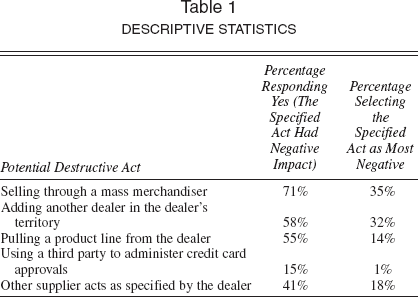
The two actions most frequently cited by dealers for the “Other” category were recent changes in the supplier's longstanding freight and pricing policies. To ensure that we captured destructive supplier actions, we examined the mean rating on the item that assessed how damaging each dealer viewed the supplier's action they selected as being the most destructive. This item, which was measured on a seven-point scale (1 = “not at all damaging,” 4 = “somewhat damaging,” 7 = “very damaging”), had a mean of 5.5, demonstrating that dealers generally viewed the action they selected as quite harmful. The dealer was then instructed to answer all remaining questions (e.g., attributions, responses to the act, pre-act relationship quality) with respect to this specific supplier act.
Measure Validation Procedures
We adapted Anderson and Gerbing's (1988) two-step approach to our data analysis. Assessing adequate measurement of constructs using confirmatory factor analysis before conducting tests of hypotheses is also a common practice in channels research (e.g., Heide and John 1990, 1992). We estimated the following four measurement models to assess the quality of the measures collected from the dealers and the supplier's representatives:
Measurement Model 1: antecedents of disengagement, constructive discussion, passive acceptance, and venting. Intensity of the DA, the three types of attributions, dealer's dependence, and supplier's dependence. With the exception of the intensity of the DA and supplier's dependence, the constructs were measured by three items each. As suggested by Anderson and Gerbing (1988), to estimate the model we set the error variance at .10 for the single-item intensity measure.
Measurement Model 2: pre-act and post-act relationship quality. Relationship quality is typically viewed as being manifest in several distinct, though related, constructs (e.g., Dwyer and Oh 1987; Kumar, Scheer, and Steenkamp 1995a). Because trust and commitment are the constructs frequently used to reflect relationship quality in channels research, our constructs of pre-act and post-act relationship quality were specified as second-order constructs, and trust and commitment were the first-order constructs. Pre-act trust, pre-act commitment, post-act trust, and post-act commitment were measured by three items each.
Measurement Model 3: dealer performance. The supplier's sales representatives completed Kumar, Stern, and Achrol's (1992) 21-item performance scale. Because each supplier informant completed between three and five questionnaires, LISREL's independence of measurement assumption was violated, and the results must be interpreted with caution.
Measurement Model 4: disengagement, constructive discussion, passive acceptance, and venting responses. Five first-order constructs measured threatened withdrawal, constructive discussion, passive acceptance, neglect, and venting using three items each. The model operationalized disengagement as a second-order construct, and threatened withdrawal and neglect were its first-order constructs. 2 Constructive discussion, passive acceptance, and venting remained as first-order constructs.
An exploratory factor analysis confirmed that threatened withdrawal and neglect represented one factor and constructive discussion, passive acceptance, and venting represented additional factors.
The results, summarized in Table 2, indicate that all four measurement models provided an acceptable fit. Although the chi-squares were significant, this is not unexpected given the large sample size (Anderson and Gerbing 1988). More important, the comparative fit index (CFI) for each model, which is not sensitive to sample size, was above the recommended .90 level.
MEASUREMENT MODELS

LISREL composite reliability cannot be computed for a single item.
The measures demonstrated adequate reliability, convergent validity, and discriminant validity. All measures had a composite reliability greater than the minimum recommended level of .60 and in most cases exceeded the preferred level of .70 (Churchill 1979; Nunnally 1978). 3 All items demonstrated adequate convergent validity: Their loading on the hypothesized construct was significant at p < .01, and the parameter estimates were 10 to 20 times as large as the standard errors (Anderson and Gerbing 1988). Discriminant validity among all constructs was also observed from the phi matrices, as the latent correlation between any two constructs plus/minus twice the standard error did not include 1.0 (Anderson and Gerbing 1988).
Although the single-item archival measure cannot be tested for reliability, we examined its convergence with the 21-item performance scale. Because archival and survey data are different methods of measuring performance, such comparisons can provide a test of convergent validity. As Table 3 indicates, the correlation between supplier-rated performance and archival performance was r = .18. We also examined the correlation between archival performance and the three-item growth facet of the performance scale. This correlation was r = .23. Both of these correlations are significant (p < .001), thereby demonstrating convergent validity.
Hypothesis Testing
Because of the large number of constructs and hypothesized relationships to be evaluated, path analysis was the most appropriate analytic approach. Path analysis, using structural equation modeling methodology, enabled us to simultaneously test all the hypothesized relationships and examine the potential mediating effects of our focal constructs: dealers' disengagement, constructive discussion, passive acceptance, and venting responses. 4
We thank one of the anonymous reviewers for emphasizing the potential for additional insights into our data that could accrue from a simultaneous test of all proposed hypotheses.
We combined the items measuring each construct into a single indicator measure to avoid identification problems. The error for each construct was set at one minus its reliability (Kenny 1979; Williams and Podsakoff 1989). The error for the single item intensity of the DA was set at .10, as is recommended by Anderson and Gerbing (1988). The scores on pre-act trust and pre-act commitment were averaged to obtain pre-act relationship quality. Similar procedures were employed for post-act relationship quality. The supplier and dealer dependence items were averaged and subsequently used to compute total and relative dependence. The construct-level correlation matrix used for the path analysis model is presented in Table 3.
MEANS, STANDARD DEVIATIONS, AND CORRELATIONS

Total and relative dependence correlations with other variables are based on 429 observations. Correlations of total and relative dependence with performance (supplier-rated) are based on 428 observations. Correlations of total and relative dependence with performance (archival) are based on 420 observations. Correlation between relative dependence and performance (archival) is significant at p < .08, two-tailed.
Performance (archival) correlations are based on 671 observations. Performance (supplier-rated) correlations are based on 628 observations. Performance (archival) and performance (rated) correlation is based on 605 observations.
Denotes confidential data. Measures are standardized at the request of focal manufacturer.
Notes: All correlations are based on 699 observations except those denoted a or b. Correlations ≥.07, <.10 are significant at p < .05, two-tailed. Correlations ≥.10 are significant at p < .01, two-tailed.
Although Figure 1 provides an overview of the relationships between each major group of variables we examine, we delineate more precisely the 42 paths that were simultaneously estimated in our path model:
Paths from each of the four cognition-related constructs (DA intensity, self attribution, supplier attribution, and external attribution) to each of the four potential dealers' reactions (disengagement, constructive discussion, passive acceptance, and venting), resulting in 16 paths.
Paths from each of the three relationship-related constructs (pre-act relationship quality, total dependence, and relative dependence) to each of the four potential dealers' reactions (disengagement, constructive discussion, passive acceptance, and venting), resulting in 12 paths.
Paths from each of the four potential dealers' reactions (disengagement, constructive discussion, passive acceptance, and venting) to each of the two consequence variables (post-act relationship quality and dealer performance from the supplier's perspective), resulting in 8 paths.
Paths from each of the three relationship-related constructs (pre-act relationship quality, total dependence, and relative dependence) to each of the two consequence variables (post-act relationship quality and dealer performance from the supplier's perspective), resulting in 6 paths.
Results
The path model demonstrated an acceptable fit (χ2(21) = 227.12, goodness-of-fit index [GFI] = .96, CFI = .91, root mean square residual [RMSR] = .035), especially for a model with such a large number of constructs. 5 The R2 coefficients, shown in Table 4, indicate that the path model accounted for an average of 38% of the variance across all of our focal constructs. We now outline the findings for each of our hypotheses.
Because we measured performance using two different methods (supplier-rated and archival), we estimated the path model twice, once for each type of performance method. Except for the paths that were directly linked to performance, all the other paths in the model remained unchanged irrespective of the performance measure used. All results reported in the article come from the path model using supplier-rated performance, except for the results specified as archival performance.
PATH ANALYSIS RESULTS

p < .001.
p < .01.
p < .05.
Notes: All p-values are one-sided.
Results Related to Effects of Cognitions on Dealers' Responses
H1
As predicted, as a dealer's perception of the intensity of the supplier's DA increases, the dealer is less likely to respond with passive acceptance (γ = −.21) and more likely to respond with disengagement (γ = .10) and venting (γ = .22). No significant relationship from intensity to constructive discussion (γ = .07) was found.
H2
As predicted, as a dealer's attributions to the supplier for a supplier's DA increase, the dealer is less likely to respond with passive acceptance (γ = −.29) and more likely to respond with disengagement (γ = .43) and venting (γ = .54). Contrary to our hypothesis, the dealer is more likely to respond with constructive discussion (γ = .22).
H3
As predicted, as a dealer's attributions to itself for a supplier's DA increase, the dealer is more likely to respond with constructive discussion (γ = .14) and less likely to respond with venting (γ = −.14). Contrary to our hypothesis, as a dealer's self attributions increase, the dealer is more likely to respond with disengagement (γ = .23). No significant relationship from self attribution to passive acceptance (γ = .06) was found.
H4
As predicted, as a dealer's attributions to external circumstances for a supplier's DA increase, the dealer is more likely to respond with passive acceptance (γ = .29) and less likely to respond with disengagement (γ = −.12), constructive discussion (γ = −.26), or venting (γ = −.13).
Results Related to Effects of Relationship Characteristics on Dealers' Responses
H5
As predicted, as a dealer's perception of the pre-act relationship quality with its supplier increases, the dealer is more likely to respond with constructive discussion (γ = .21) and passive acceptance (γ = .08) and less likely to respond with disengagement (γ = −.07). No significant relationship between pre-act relationship quality and venting (γ = .04) was found.
H6
As predicted, as the level of total dependence in the relationship increases, the dealer is more likely to respond with constructive discussion (γ = .10) and venting (γ = .11) and less likely to respond with disengagement (γ = −.24) and passive acceptance (γ = −.14).
H7
As predicted, as a dealer's relative dependence increases, the dealer is more likely to respond with passive acceptance (γ = .14) and less likely to respond with disengagement (γ = −.25). No significant relationships between relative dependence and constructive discussion (γ = −.03) or venting (γ = .02) were found.
Results Related to Effects of Dealers' Responses on Relational Consequences
H8
As predicted, as a dealer's use of passive acceptance increases, the dealer's performance as rated by the supplier increases (β = .07). No significant relationship from passive acceptance to archival performance (β = −.07) was found. Contrary to our hypothesis, as a dealer's use of constructive discussion increases, the dealer's performance from the supplier's perspective, both rated (β = −.08) and archival (β = −.14), decreases.
H9
As predicted, as a dealer's use of disengagement increases, the dealer's performance from the supplier's perspective, both rated (β = −.22) and archival (β = −.16), decreases. As predicted, as a dealer's use of venting increases, the dealer's archival performance decreases (β = −.13). No significant relationship from venting to performance, as rated by the supplier (β = .04), was found.
H10
As predicted, as a dealer's use of passive acceptance increases, the post-act relationship quality increases (β = .17). No significant relationship from constructive discussion to post-act relationship quality (β = −.03) was found.
H11
As predicted, as a dealer's use of disengagement (β = −.32) and venting (β = −.17) increases, post-act relationship quality declines.
Results Related to Effects of Relationship Characteristics on Relational Consequences
H12
As predicted, pre-act relationship quality has positive effects on post-act relationship quality (γ = .25) as well as dealer performance from the supplier's perspective, both rated (γ = .09) and archival (γ = .09).
H13
As predicted, total dependence has positive effects on post-act relationship quality (γ = .29) and dealer performance as rated by the supplier (γ = .40). No significant relationship from total dependence to dealer archival performance was found (γ = .07).
H14
As predicted, a dealer's relative dependence has negative effects on dealer performance from the supplier's perspective, both rated (γ = −.40) and archival (γ = −.09). Contrary to our hypothesis, a dealer's relative dependence increases post-act relationship quality (γ = .15).
Assessing Mediating Effects
Our conceptual model implicitly argues that disengagement, constructive discussion, passive acceptance, and venting play an important mediating role, irrespective of any direct effects of the antecedents on the consequences. This mediating role indicates that the effects of the antecedents on the relational consequences work through the four response constructs. However, our hypothesis testing did not assess the extent of these mediating effects compared with the direct effects of the antecedent variables on the relational consequences.
We computed the relative magnitude of each antecedent's indirect effect through disengagement, constructive discussion, passive acceptance, and venting compared with its direct effect on each consequence, using the following formula provided by Alwin and Hauser (1975): 6

Alwin and Hauser (1975) used absolute values of effects in the formula, because direct and indirect effects can sometimes differ in sign. Detailed results are available from the first author.
Together, disengagement, constructive discussion, passive acceptance, and venting mediate 46% of the effects of the antecedents (intensity of the DA, attributions, pre-act relationship quality, and interdependence constructs) on post-act relationship quality and dealer performance.
Geyskens, Steenkamp, and Kumar's (1998) study is the only reported channels research of which we are aware that has tested for indirect effects using Alwin and Hauser's (1975) formula, observing that 49% of their model's effects were mediated through trust. 7 Thus, we concluded that the mediating role of dealers' responses to a supplier's DA, at 46%, is substantial. 8
To the best of our knowledge, there is no test to assess the significance of the indirect effects when there are multiple mediating variables. In addition, in evaluating the mediating effects of a variable or variables, researchers generally use a rule of thumb: If approximately 50% of the effects are indirect, then there is strong support for the mediating effects.
Two additional sets of analyses were performed. A test for two-way interactions between the independent variables indicated that only one interaction (between intensity of DA and supplier attribution for venting) was significant. Multivariate analysis of covariance and analysis of covariance tests to examine whether the type of DA selected affected the dealer's responses were not significant. Details of these tests are available from the first author.
Discussion
The major intents of this study were to (1) develop a conceptual model of channel members' responses to a DA by another channel member and (2) test several antecedents and consequences that may be related to a member's responses. Taken as a whole, the results provide valuable insights into these two areas and indicate that dealers' responses to a supplier's DAs can affect not only the dealers' perceptions of the relationship but also the dealers' performance. Our hypothesized model appears effective in its application to marketing channels settings, as each of the four dealer response categories was significantly associated with many of the key antecedent and consequence variables (and accounted for an average of 38% of the variance). In addition, the role of the four dealer responses to a supplier's DA is substantial, as they mediate 46% of the effects of the antecedents (intensity of the DA, attributions, pre-act relationship quality, and interdependence constructs) on post-act relationship quality and dealer performance.
A more detailed breakdown shows that of the 42 hypotheses, 32 were supported, 6 were not significant, and 4 were significant but in a direction opposite of the hypothesized one. Because the expected results are reviewed previously, we examine the results that were contrary to our hypotheses with the hope that through further probing we may shed additional insights and provide directions for future work. We then consider some limitations in our research, followed by its theoretical contributions and managerial implications.
The first unexpected result indicated that as a dealer's attributions to the supplier increased, the dealer was more likely to respond with constructive discussion. To understand this result, we examine the pattern of results among the three types of attributions and constructive discussion. Apparently, dealers attempt to initiate constructive discussion with the supplier when they attribute the DA to either the supplier or themselves. Under such circumstances, constructive discussion may help avoid such an event from happening again or, at a minimum, lead to a better understanding for each party of the other's motives. In contrast, when the attribution is to external causes, constructive discussion is not particularly effective, because neither party perceives it has control over the underlying cause for the act.
The second unexpected result was that a dealer's use of constructive discussion had a negative impact on performance (both supplier-rated and archival). Perhaps independent dealers' efforts to engage the supplier in constructive discussion did not receive a sympathetic ear. As a result, dealers felt rebuffed or frustrated, possibly lost confidence in the supplier, and thereby lowered their efforts on the supplier's behalf. Thus, although the supplier observed the dealers' attempts for constructive discussion, these dealers showed subsequent performance declines.
A third contrary finding indicated that when dealers blame themselves or feel compelled to share the blame, they become more likely to disengage. Upon reflection, the notion of “throwing up one's hands” makes sense when dealers attribute the DA to themselves. Perhaps when dealers perceive that they contributed to the supplier's DA, they tend to believe that the relationship has deteriorated to such a point that it is unlikely to improve, and thus disengagement is the most viable and logical option.
The final contrary finding showed that as a dealer's relative dependence increased, it perceived relationship quality more favorably. Given that one component of the relationship quality construct is trust, this finding is not completely unexpected, particularly when viewed in light of the results of a recent meta-analysis that involved trust in marketing channel relationships (Geyskens, Steenkamp, and Kumar 1998). These authors note that the variation in correlation coefficients for (own) dependence and trust in previous studies is considerable: Pairwise relationships exhibited a wide range (r = −.460 to r = .167). Similar to our finding here, their meta-analysis results show that a channel member's own dependence is a positively related antecedent to trust.
Limitations
Several potential limitations of our study must be noted. First, we relied on retrospective reports from informants to collect some of our measures, including how members reacted to a past DA. Because it is unclear how the passage of time effects the quality of informants' responses, we attempted to control for this partly by having members report on a DA that was perceived as both major and relatively recent. However, retrospective informant reports in organizational research continue to be advocated as a viable methodology if the measure used to generate the reports is adequately reliable and valid (Golden 1997; Miller, Cardinal, and Glick 1997).
Second, our study examined a single marketing channel and the relationship between one focal supplier and its independent dealers. Although this setting allowed for some control over extraneous factors, it also limits the generalizability of the study. Finally, although the correlation (r = .36, p < .01) between pre-act and post-act relationship quality suggests that dealers could distinguish between them, as with many cross-sectional studies, a longitudinal investigation would be preferred.
Theoretical Contributions
In a recent review on organizing and managing channels of distribution, Frazier (1999) highlights Rosenberg and Stern's (1971, p. 442) declaration that “tracing a crisis through the stages of conflict interaction … would be central to understanding the development and impact of conflict.” Even though this declaration and the research on conflict in marketing channels dates back almost three decades, Frazier (1999, p. 230) encourages researchers to heed this call and “probe more deeply into the essence of the conflict process,” to “help us better understand its functional and dysfunctional effects.” We have attempted to provide one empirical reply to this call.
However, rather than examine overall levels of conflict in a relationship, as has usually been done in past channel research, we focus on a specific DA in an effort to probe more deeply into the process. We show that such acts are likely to be trigger points in igniting spirals of conflict. We map specific dealer responses to a supplier's DA and in doing so extend previous typologies used in exchange relationships (Ping 1993, 1995; Rusbult et al. 1988; Rusbult and Zembrodt 1983).
Although trust and commitment continue to emerge as important constructs, most empirical research has concentrated on their interrelationship or their antecedents rather than explored their consequences (for important exceptions, see Anderson, Lodish, and Weitz 1987; Dahlstrom and Nygaard 1995; Morgan and Hunt 1994). We find that a channel member that expends resources to build and nurture a close working relationship based on trust and commitment can expect to increase the likelihood of constructive responses in the face of a DA. Furthermore, as the behavior of dealers within a channel is often shaped by the attributions they make (Anand and Stern 1985; Frazier 1983; Kaufmann and Stern 1988), the strong relationships we found among attributions and response behaviors advocate that more consistent inclusion, development, and application of attributional scales can yield additional insights into member behavior.
Our focus on the consequences of conflict responses, rather than the typologies themselves as the end product, enables a more thorough understanding of the connection between specific responses and a member's future performance in that particular channel relationship. Unfortunately, performance is often overlooked in channels research (Cannon and Perreault 1999; Gaski and Nevin 1985; Jap 1999; Kumar, Stern, and Achrol 1992; Noordewier, John, and Nevin 1990 are some exceptions). Furthermore, one specific finding demonstrated that both pre-act and post-act relationship quality had a positive relationship with performance (rated and archival). Given that there is no shared method variance because data were collected from different parties in the dyad, we believe that this is the first article to demonstrate empirically that trust and commitment have a positive impact on performance.
Although previous research on exit, voice, and loyalty has implicitly viewed constructive discussion as positively correlated with passive acceptance and negatively correlated with threatened withdrawal and neglect (e.g., Ping 1993; Rusbult and Zembrodt 1983), we observe that constructive discussion has a positive correlation with disengagement (r = .19, p < .01). However, this positive correlation is not completely unexpected (Rusbult et al. 1988). Hirschman (1970) suggests that aggrieved parties do not need to make a choice between threatened withdrawal and constructive discussion but rather a decision on each response. Thus, dealers that believe that their relationships with the supplier are severely damaged may respond with constructive discussion in trying to keep the current relationship viable, while simultaneously formulating withdrawal strategies.
Finally, we find discriminant validity between constructive discussion and venting, as they differ in terms of both antecedents and consequences. In addition, there has been no marketing channels research reported that links constructive discussion and venting to relational consequences. To the best of our knowledge, we are the first to make this distinction and the relational link.
Managerial Implications
As suppliers seek to meet changing end-user purchasing patterns and outlet preferences by modifying and reconfiguring their distribution channels, the potential for other channel members to perceive some of these changes as destructive appears to be almost a certainty. The finding in our study that the supplier's efforts at channel expansion were selected by a majority of the dealers as the most damaging DA suggests several implications for both dealers and suppliers.
Dealer's perspective
Our results suggest that in the face of a supplier's DA, passive acceptance is the only relationship-enhancing (i.e., having a positive impact on post-act relationship quality and performance) response that is available to a dealer. Contrary to the hypotheses, trying to work things out through constructive discussion has negative consequences. From a dealer's perspective, these findings may seem discouraging, because only if they accept a DA—that is, “take their lumps”—will there be a positive impact on the relationship. 9 This begs two questions: When is it rational behavior for a dealer to forgive a supplier in the face of a DA? And why does the use of constructive discussion not have positive effects for the relationship?
We thank one of the anonymous reviewers who highlighted this dealer's perspective outcome.
Axelrod's (1984) seminal work on cooperation using iterated games may provide some insights into the first question. He found that a “tit-for-two-tats” strategy (defect when the opponent has defected in both the previous moves) beat a tit-for-tat strategy (defect when opponent has defected in the previous move) under certain conditions. Axelrod (p. 120) observes that “the moral of the story is that the precise level of forgiveness that is optimal depends upon the environment.” He further argues that “if the main danger [of a strategy] is unending mutual recriminations, then a generous level of forgiveness is appropriate. But, if the main danger is from strategies that are good at exploiting easygoing rules, then an excess of forgiveness is costly.” Thus, if the environment is one of trust between dealer and supplier, the dealer may see the main danger of a negative response (to a single DA) as unending supplier recriminations rather than the supplier exploiting forgiveness by the dealer. Therefore, the dealer responds with passive acceptance. However, in the face of repeated DAs (defections in Axelrod's terminology) by the supplier, passive acceptance on the part of the dealer would be an unreasonable response choice.
Drawing comparisons from findings on constructive discussion in romantic relationships (where it demonstrated positive effects) and our research (where it showed negative effects) may shed insight into the second question. In a romantic relationship, a partner can directly engage in a substantive discussion with the initiator of the DA. Furthermore, this discussion may often lead the initiator of the DA to make adjustments in future behavior. Therefore, considerable potential exists to improve the situation through the use of constructive discussion. In contrast, in business-to-business relationships, frequently the interactions consist of one-to-many—in our study, a focal supplier and its 1200 active dealers. Not only would it be nearly impossible for the supplier (either through headquarters personnel or local field representatives) to engage in constructive discussion with all 1200 dealers, but it is unlikely that each of the supplier's representatives involved in the discussions with dealers would have authority to make changes. No wonder the use of constructive discussion appears to pose a major dilemma in marketing channel management.
Supplier's perspective
First, efforts at nurturing trust and commitment with dealers builds a reservoir of goodwill on which the supplier can draw in the face of perceived destructive events. In addition, even in the face of a DA, dealers with prior positive relationship quality perceptions will remain the supplier's better performers and continue to view the relationship in a positive light. On the basis of our findings, we would advocate that suppliers should systematically categorize their dealer base using several key criteria or variables similar to those employed in this study—for example, performance, perceptions of relationship quality, dependence, and attributional tendencies. This segmentation of the dealer base would enable a supplier to anticipate which dealers might be more likely to react in a negative manner to potential DAs. Furthermore, the construction and profiling of dealers into particular groups would enable a supplier to make more informed decisions related to its dealer network—for example, dealer resource allocation decisions and selection of dealers for advisory councils.
Second, managing a dealer's perceptions about the intensity of the act and especially attributional interpretations seems crucial. If a supplier recognizes that an action has the potential to damage a dealer or dealers, the supplier should proactively launch damage control efforts to mitigate its effects. Damage control should take place on several fronts. For example, articulating a superordinate goal that is based on a perceived or actual outside threat to the well-being of existing channels or brands may enhance dealers' attributions to external factors. Perceived threats from foreign competition is one example that has been used to coalesce domestic channels, even in the face of radical changes (margin adjustments, territorial shifts, product withdrawals, and so forth).
Although much of the business and trade press describes how more powerful parties in channel relationships (e.g., Wal-Mart versus its suppliers) are able to extract “premiums” from less powerful parties, we reason that maintaining an asymmetry in relationship dependence hinders the more powerful party from achieving performance gains from the less powerful party. Furthermore, we argue that efforts by the more powerful party to move the relationship from one of relative advantage to a more mutually dependent state pays off in terms of performance. Also, dealers in a mutually dependent relationship with the supplier continue to view the relationship more positively after a DA.
Suppliers must estimate likely consequences to existing channels before enacting new policies, using their predictions to forewarn, justify, or compensate existing channels for potential losses. In regard to forewarning, we found that suppliers must honestly communicate the message to dealers (no matter how painful) about a potential DA as early as possible. Otherwise, dealers are apt to tune out subsequent supplier messages related to an act. To justify a DA, a supplier should consider sharing important data (e.g., market trends, changing end-user purchasing patterns) with key dealers or dealer groups in an effort to illustrate why the supplier's potential action is necessary. This finding is buttressed by research on layoffs, which indicates that when management exhibits sensitivity—providing adequate explanations, expressing remorse, showing consideration, offering help to cope—this enhances perceived fairness and mitigates negative reactions (Folger and Skarlicki 1998).
Finally, with respect to compensating channel members for potential losses, a supplier should consider channel policies or changes that may enable the existing channels to compete on a more level playing field. For example, in the case of a supplier adding a new channel, differentiating the products sold through existing channels and the new channel—even relatively small or cosmetic changes—may allow existing channels more selling latitude. In addition, as a supplier launches new products, allowing existing channels an exclusive time window for distributing these products could help reward them.
Footnotes
Measures of Constructs

| Data From Dealers |
|
|---|---|
| Eliciting the DA | (New Scale) |
| We are interested if any of the actions listed below affected the way you run your dealership. Please read the following statements and keep in mind that we would like you to select the action that has had the most negative effect on your dealership. | |
| Check YES if you agree the action had a negative impact on your dealership. | |
| Check NO if the action |
|
|
|
|
|
[The supplier's] decision to sell through [the name of the mass merchandiser]. Within the past two years, [the supplier] added another retailer (other than the mass merchandiser) or dealer to your territory. Within the past two years, [the supplier] has pulled a product from your line. [The supplier's] decision to use an outside firm to handle [the supplier's] credit card. |
|
| [Dealers were also given the opportunity to write in some other supplier action that had a negative effect on them. Subsequently, dealers were asked to identify the supplier' action that had the most negative effect on their dealership. Then they were instructed, “Now we would like you to answer several questions regarding the SPECIFIC negative act you have just identified.”] | |
| Intensity of Act | (New Scale) |
| When you first learned of it, how |
|
| Attributions | (Adapted from Bradbury and Fincham 1990) |
| Again, keeping in mind the SPECIFIC NEGATIVE ACTION that you previously identified, answer the following set of questions. Please reflect on the extent to which you believe |
|
|
Self Our firm We bear most of the blame for [the supplier's] action, since our past behavior toward them contributed to it. We were to blame for [the supplier's] decision to do what they did. |
|
|
External Competitive conditions forced [the supplier] to take this action. [The supplier's] behavior was understandable given the market conditions in our area. The current environment in the industry was responsible for [the supplier's] action. |
|
|
Partner [The supplier's] act was taken because they tend to look out for their own interests, not ours. [The supplier] is self-centered, and this accounts for their action. [The supplier's] act was intended to benefit them, not us. |
|
| Disengagement, Constructive Discussion, Passive Acceptance, and Venting | (Adapted from Ping 1993; Rusbult et al. 1988) |
| We would now like to ask you how your firm reacted to the act by [the supplier]. | |
|
Disengagement Threatened Withdrawal We gave great consideration to telling [the supplier] that we intended to leave the relationship. We threatened to stop being [the supplier's] dealer. We started to make plans to add another [product category] supplier. |
|
|
Neglect The act strongly reduced our enthusiasm to push [the supplier's] line. We became less vigorous in the promotion of [the supplier's] products. Although we didn't voice our displeasure, our motivation to support [the supplier's] product line significantly decreased. |
|
|
Constructive Discussion We tried to solve the problem by suggesting mutually acceptable changes in the way we carried [the supplier's] products. We talked constructively to [the supplier] about how we felt about the action in order to improve the situation. We discussed the problem in a positive manner with [the supplier] to identify ways to alleviate the negative impact on our firm. |
|
|
Passive Acceptance We gave [the supplier] the benefit of the doubt and didn't say anything to [the supplier] about it. We said nothing about the act and remained loyal to [the supplier]. We patiently waited for the problem to work itself out without complaining to [the supplier]. |
|
|
Venting We complained to [the supplier], but took no overt action about the matter. We expressed to [the supplier] our outrage and displeasure about the act. We expressed our unhappiness to [the supplier] and other dealers regarding [the supplier's] most recent action. |
|
| Relationship Quality | (Adapted from Dwyer and Oh 1987; Anderson and Narus 1990) |
|
Prior Relationship Quality Prior Trust Please circle the number that you feel best represents your We could rely on [the supplier] to keep promises they made to us. We could count on [the supplier] to be sincere in their dealings with our firm. [The supplier] was a company that stood by its word. |
|
|
Pre-act Affective Commitment we were attracted to the things [the supplier] stood for as a company. we genuinely enjoyed our relationship with [the supplier]. |
|
|
Post-act Relationship Quality [The same six items for prior relationship quality were also used to assess the dealer's perceptions of current relationship quality (after the dealer-identified DA). These post-act relationship quality questions appeared in the survey before any questions or references to DAs.] |
|
| Total and Relative Dependence * | (Adapted from Kumar, Scheer, and Steenkamp 1995b) |
|
Dealer's Dependence Compared to other parts of our business, (such as [several lines listed]), our relationship with [the supplier] is central to the financial well-being of our firm. Having [the supplier] as a supplier is critical to achieving our organizational goals. Our firm would survive very well without [the supplier]. (R) |
|
|
Supplier's Dependence [measured from supplier's side] Our relationship with this dealer is critical to [our firm] meeting their unit goals in this area. Our district would suffer a significant drop in revenue if the relationship with this dealer dissolved. |
|
| Data from Supplier | |
| Performance (Supplier-Rated) | (Adapted from Kumar, Stern, and Achrol 1992) |
|
Contribution to sales Over the past year, the dealer has been successful in generating high sales volume for [the supplier], given the level of competition and economic growth in their market area. Compared to competing dealers in their area, this dealer has achieved a high level of market penetration for [the supplier]. Over the past year, the units that this dealer generated for the supplier were higher than those generated by other [the supplier's] dealers within the same area. |
|
|
Contribution to profits The amount of time spent servicing this dealer is reasonable, given the amount of business which this dealer generates for [the supplier]. [The supplier] made inadequate profits from this dealer over the past several years because of the amount of time, effort, and energy which [the supplier] had to devote to assisting them. (R) This dealer's demands for such things as special price discounts and/or special advertising support have resulted in inadequate profits for [the supplier]. (R) |
|
|
Dealer competence This dealer has the required business skills necessary to run a successful [industry-specific] business. This dealer demonstrates a great deal of knowledge about the features and attributes of [the supplier's] products and services. This dealer and their personnel have poor knowledge of competitors' products and services. (R) |
|
|
Dealer compliance In the past, [the supplier] has often had trouble getting this dealer to participate in [the supplier's] programs [examples listed]. (R) This dealer almost always conforms to [the supplier's] accepted procedures. This dealer has frequently violated the terms and conditions contained in their contract with [supplier]. (R) |
|
|
Dealer adaptation This dealer senses long-term trends in their market area and frequently adjusts their selling practices. This dealer is very innovative in their marketing of [the supplier's] products and services in their area. This dealer makes an effort to meet competitive changes in their area. |
|
|
Contribution to growth This dealer will either continue to be or will soon become a major source of revenue for [the supplier]. Over the next year, [the supplier] expects units generated from this dealer to grow faster than that from any other [of the supplier] dealers within the same area. In the past two years, [the supplier's] business with this dealer has grown steadily. |
|
|
Customer satisfaction [The supplier] has frequently received complaints from customers regarding this dealer. (R) This dealer goes out of their way to make their customers happy. This dealer provides customers with good assistance in solving problems involving [the supplier's] products and services. |
|
| Performance (Archival Sales Growth) | (Kumar, Stern, and Achrol 1992) |
| [Supplier unit sales to each dealer were extracted from the supplier's records, and a percentage change was calculated. The change was calculated from archival sales for the year before the DAs up to the year following the DAs.] | |
Dealer's and supplier's dependence items were used to construct total and relative dependence.
Notes: All items were measured using seven-point Likert-type scales unless otherwise noted. (R) denotes items that were reverse coded. [the supplier] is used to disguise the name of the supplier/manufacturer.