







Abstract
In the face of marketplace polls that attest to the increasing influence of corporate social responsibility (CSR) on consumers' purchase behavior, this article examines when, how, and for whom specific CSR initiatives work. The findings implicate both company-specific factors, such as the CSR issues a company chooses to focus on and the quality of its products, and individual-specific factors, such as consumers' personal support for the CSR issues and their general beliefs about CSR, as key moderators of consumers' responses to CSR. The results also highlight the mediating role of consumers' perceptions of congruence between their own characters and that of the company in their reactions to its CSR initiatives. More specifically, the authors find that CSR initiatives can, under certain conditions, decrease consumers' intentions to buy a company's products.
A growing number of marketplace polls attests to the positive effects of corporate social responsibility (CSR) on consumer behavior (Business in the Community 1997; Cone Inc. 1999; Davids 1990). Spurred at least in part by such evidence, more companies than ever before are backing CSR initiatives such as corporate philanthropy, cause-related marketing, minority support programs, and socially responsible employment and manufacturing practices with real financial muscle (Drumright 1994; Smith 1994; Varadarajan and Menon 1988). The Web sites of more than 80% of the Fortune-500 companies address CSR issues (Esrock and Leichty 1998). Not surprisingly, this trend is also reflected in the pervasive belief among business leaders that CSR is an economic imperative in today's national as well as global marketplace (Beh 1994; Murray and Vogel 1997; The World Economic Forum 1999).
Despite this increasing emphasis on CSR in the marketplace, little is known about the effects of CSR actions on consumers. Recent research suggests that there is a positive relationship between a company's CSR actions and consumers' attitudes toward that company and its products (Brown and Dacin 1997; Creyer and Ross 1997; Ellen, Mohr, and Webb 2000). However, it is not known when, how, and for whom specific CSR initiatives work. Marketers' need for an understanding of the precise focus, causes, and company- and consumer-specific moderators of such CSR effects is underscored by the equivocal link between a company's CSR actions and aggregate measures of its financial performance (Pava and Krause 1996). In other words, given the potential diversity in consumers' responses to the myriad CSR initiatives examined in prior research, it is crucial for marketers hoping to reap strategic benefits from CSR (McGee 1998) to understand how and why their various customer segments are likely to respond to specific CSR actions.
In this research, we try to understand when, how, and why consumers react to CSR by focusing on both some key moderators of consumers' CSR responses and the mechanisms underlying these responses. In two studies, we examine how and why the issue defining a company's CSR actions (i.e., the CSR domain) interacts with both consumers' personal position on that issue and their general beliefs about the trade-offs companies make in supporting CSR initiatives to affect consumers' evaluations of the company and its products. Our results implicate both company-specific (i.e., the CSR domain, product quality) and individual-specific (i.e., CSR support, CSR-related beliefs) factors as key moderators of consumers' responses to CSR initiatives and highlight the mediating role played by consumers' perceptions of congruence between their own characters and that of the company. More specifically, we show that contrary to extant belief, CSR initiatives can, under certain conditions, decrease consumers' intentions to buy a company's products.
Next, we review prior research on CSR to develop a conceptual framework that articulates its contingent relationship to consumer behavior. We then present two experiments that test the predicted pathways in this framework. We end with a discussion of our findings' implications for theory and practice.
CSR
Corporate social responsibility, also referred to as pro-social corporate endeavors (Murray and Vogel 1997) or corporate social performance (Turban and Greening 1997), has traditionally been conceptualized rather broadly as “the managerial obligation to take action to protect and improve both the welfare of society as a whole and the interest of organizations” (Davis and Blomstrom 1975, p. 6). Alternative perspectives on the role and place of companies in the broader social environment have engendered multiple conceptualizations of CSR, 1 ranging from a purely economic one (i.e., CSR as maximizing returns to shareholders; Friedman 1970; Zenisek 1979) to, more recently, a comprehensive “proactive social responsiveness view” that articulates a company's long-term role in a dynamic social system (McGee 1998, p. 379). We adhere to the larger, societal view of CSR adopted by Brown and Dacin (1997, p. 68) as the company's “status and activities with respect to [i.e.,responsiveness to] its perceived societal obligations.”
Although CSR is inextricably linked to corporate ethics, it is a more inclusive conceptualization of companies' responsibility to society at large that encompasses their more specific ethical responsibilities to abide by a set of moral principles or values in conducting business (Carroll 1991; Hopkins 1999). In other words, ethical behavior by individuals or groups within a corporation is socially responsible, but CSR extends beyond good business ethics in representing that corporation's moral obligation to maximize its positive impact and minimize its negative impact on society (Pride and Ferrell 1997).
Given the broad conceptualization of CSR, it is not surprising that the domains of socially responsible behavior are many and diverse. A comprehensive summarization of the different CSR actions is contained in Socrates: The Corporate Social Ratings Monitor (Kinder, Lydenberg, Domini & Co. Inc. 1999), a database that describes and rates more than 600 companies in terms of their CSR records. This database reduces the CSR initiatives undertaken by these companies into six broad domains: (1) community support (e.g., support of arts and health programs, educational and housing initiatives for the economically disadvantaged, generous/innovative giving), (2) diversity (e.g., sex-, race-, family-, sexual orientation–, and disability-based diversity record and initiatives, or lack thereof, within and outside the firm), (3) employee support (e.g., concern for safety, job security, profit sharing, union relations, employee involvement), (4) environment (e.g., environment-friendly products, hazardous-waste management, use of ozone-depleting chemicals, animal testing, pollution control, recycling), (5) non-U.S. operations (e.g., overseas labor practices [including sweatshops], operations in countries with human rights violations), and (6) product (e.g., product safety, research and development/innovation, marketing/contracting controversies, antitrust disputes).
Consequences of CSR
The effects of CSR on financial performance appear to be equivocal (for a recent review, see Stanwick and Stanwick 1998). 2 Pava and Krausz (1996) review 21 studies conducted between 1972 and 1992 to conclude that 12 demonstrate a positive association between CSR and financial performance, 1 demonstrates a negative association, and 8 demonstrate no association. However, some of the positive association (e.g., McGuire, Sundgren, and Schneeweis 1988) and no association (e.g., Freedman and Jaggi 1982) studies actually report mixed results, as do Pava and Krausz's own, more controlled study and others not included in their review (e.g., Aupperle and Van Pham 1989; Coffey and Fryxell 1991). In summary, several methodological shortcomings notwithstanding, CSR appears to have at best a weak, positive relationship with financial performance (for a discussion, see Stanwick and Stanwick 1998).
The measures of financial performance examined by prior research include market-based measures (e.g., market return, price/earnings ratio, and market value to book value), accounting-based measures (e.g., return on assets, return on equity, and earnings per share), market-based measures of risk (e.g., current ratio, debt to equity ratio, interest coverage, Altman's Z-score, and market beta), or combinations thereof.
More recently, research has begun to focus on the effects of CSR on the reactions of specific stakeholder groups such as employees and customers (Brown and Dacin 1997; Creyer and Ross 1997; Ellen, Mohr, and Webb 2000; Murray and Vogel 1997; Owen and Scherer 1993; Turban and Greening 1997). Of these, only four recent studies, to the best of our knowledge, have focused explicitly on consumers' reactions to CSR. Murray and Vogel (1997) show that managers are more willing to consume from a company after exposure to information about its CSR efforts. In a more detailed study, Ellen, Mohr, and Webb (2000) show that consumers' reactions to a retailer's cause-related marketing efforts not only vary with the type of cause and the retailer's precise role in it but also are reflected in consumers' attributions regarding their own motivations and that of the retailer. Creyer and Ross (1997) focus more specifically on company ethics to show a positive relationship between consumers' preference for a company's products and the extent to which their perceptions of that company's ethicality exceed their expectations. It is Brown and Dacin's (1997) research, however, that focuses most directly and explicitly on the effect of a company's CSR record on consumers' evaluations of that company and its products. The authors argue that a company's CSR record, instead of providing information about the attributes or overall quality of its products, creates a general context for consumers' evaluation. Using both hypothetical and real companies, Brown and Dacin show that CSR's effect on consumers' preference for a new product occurs through consumers' overall evaluation of the company itself.
In summary, prior research suggests that “negative CSR associations can have a detrimental effect on overall product evaluations, whereas positive CSR associations can enhance product evaluations” (Brown and Dacin 1997, p. 80). Although this aggregate positive relationship between a company's CSR record and consumers' willingness to patronize the company represents an important beginning in the understanding of CSR, it masks potentially important company- and consumer-specific differences. Next, we draw on prior research regarding people's interactions with organizations and products to develop a conceptual framework that captures the contingent nature of consumers' reactions to CSR.
Conceptual Framework
The conceptual framework shown in Figure 1 articulates the relationships between a company's CSR actions and consumers' evaluations of both the company and its specific product offerings. We test these hypothesized relationships in two studies. Study 1 focuses on the CSR–company evaluation relationship (Paths 1 and 2), including its mediation by consumers' perceived congruence between their own characters and that of the company (i.e., C–C congruence) and its moderation by consumers' support of the CSR domain (i.e., CSR support). This study also examines CSR's indirect effect on consumers' product purchase intentions (Path 3) through its contribution to the evaluative context for such product judgments. Study 2 focuses on CSR's direct influence on consumers' product evaluations (Path 4) and its dependence on three key moderators: the domain of the company's CSR actions (i.e., CSR domain), consumers' beliefs about the relationship between CSR and a company's ability to make quality products (i.e., CSR–CA beliefs), and their support of the CSR domain (i.e., CSR support). We also examine the four pathways simultaneously to provide an overall test of our conceptual framework. Next, we elaborate on the different linkages in the conceptual framework to derive predictions regarding consumers' contingent reactions to CSR.
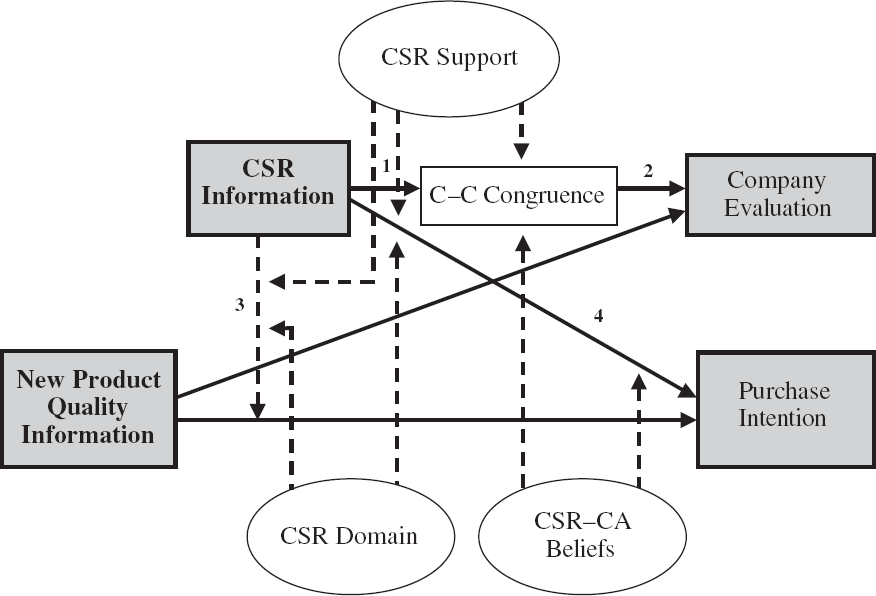
CONCEPTUAL FRAMEWORK
CSR as Company Character
Much like consumers' knowledge structures about people, their knowledge about a company, conceptualized alternately as corporate associations (Brown and Dacin 1997), corporate image (Barich and Kotler 1991), and corporate reputation (Fombrun and Shanley 1990), exists most likely as an interrelated set of company characteristics (e.g., culture, climate, skills, values, competitive position, product offerings) or a company schema (Bergami and Bagozzi 2000). Brown and Dacin (1997) decompose this schema into two key components: corporate ability (CA) associations and CSR associations. Although CA associations, related to the company's expertise in producing and delivering its products/services, are critical to a company's image or reputation, research suggests that it is the CSR information that provides consumers with insight into the company's “value system” (Turban and Greening 1997), “soul” (Chappell 1993), or “character” (Brown and Dacin 1997; Keller and Aaker 1992; Sabir 1995; Stone 1992). 3
Although these terms have been used interchangeably in prior research, for the purpose of consistency we use the term “character” to denote the CSR-related dimension of a company's identity.
C–C congruence
We propose that consumers' reactions to CSR are contingent on the amount of congruence or overlap they perceive between the company's character, as revealed by its CSR efforts, and their own. Support for this assertion comes from two related streams of research on people's relationships with their employer organizations (Ashforth and Mael 1989; Bergami and Bagozzi 2000; Dutton, Dukerich, and Harquail 1994; Kristof 1996; O'Reilly, Chatman, and Caldwell 1991). The first focuses on the central role of person–organization (P–O) fit, conceptualized as the fit between individual and organizational values, in driving an employee's preference for and commitment to his or her employer organization (for a recent review, see Kristof 1996). It is conceivable that as people learn more about the organizations they consume from (i.e., companies), their reactions to these organizations may be similarly based on their perceptions of P–O fit. Moreover, in the face of decreasing CA-based variation in the marketplace, CSR information is likely to constitute a particularly meaningful basis for such P–O fit evaluations, enabling consumers to distinguish high-fit companies from low-fit ones.
Second, research on organizational identification (for a recent review, see Bergami and Bagozzi 2000) suggests that people often identify with organizations they belong to (e.g., employees with employer organizations), incorporating favorable aspects of the organizational identity into their own for self-consistency and self-enhancement purposes (Dutton, Dukerich, and Harquail 1994). Conceptualized as the degree to which organizational members perceive themselves and the organization as sharing the same defining attributes (Dutton, Dukerich, and Harquail 1994) or a common prototype (Bergami and Bagozzi 2000), identification has been examined primarily in the context of formal organizational membership. However, as consumers learn more about and develop relationships with not just products but also the producing organizations, they may identify with some such organizations even in the absence of formal membership.
Again, such identification is more likely to stem from a company's CSR actions than its CA ones. Organizational identification research draws on social identity theory (Tajfel and Turner 1985) to suggest that people are more likely to identify with an organization when they perceive its identity to be enduring, distinctive, and capable of enhancing their self-esteem. A company's character as revealed by its CSR actions is not only fundamental and relatively enduring but also often more distinctive by virtue of its disparate and idiosyncratic bases (e.g., egalitarian employment policies, sponsorship of social causes, environmentalism) than other CA-based (e.g., manufacturing expertise) facets of the company schema, particularly among successful competitors. Moreover, identification with an organization engaged in do-good CSR actions can contribute to consumers' self-esteem. In summary, we expect a company's CSR actions to affect consumers' perceptions of C–C congruence (Path 1 in Figure 1).
The role of CSR support
Such perceptions of C–C congruence are likely to vary with consumers' personal support of the domain of the company's CSR actions (CSR support). Consumers whose self-concept includes support of the company's CSR domain (i.e., high CSR support) will perceive greater congruence between themselves and that company, either in terms of common attributes or a shared prototype, than will those whose support of that domain is low (i.e., low CSR support). 4 This moderating effect of CSR support is implicit in prior research into the role of “cause affinity among key constituents” (Drumwright 1996), “importance of issue to self” (Haley 1996), and “personal relevance” (Creyer and Ross 1997) in consumers' reactions to CSR. More generally, because organizational identification is motivated at least in part by people's need to maintain a consistent, positive self-image (Dutton, Dukerich, and Harquail 1994), consumers are more likely to identify with a company when the domain of its CSR efforts is one that they themselves support. In summary,
Given the consensual support of most CSR domains, we expect most consumers not to be actively opposed to most CSR actions. Therefore, we conceptualize low CSR support as literally weaker support of a CSR domain rather than negative support (i.e., opposition) and accompanying displeasure, per se.
A company's CSR initiatives will increase consumers' perceptions of C–C congruence.
The relationship between a company's CSR initiatives and consumers' C–C congruence perceptions will be moderated by the consumers' support of the CSR domain. The CSR-induced changes in C–C congruence perceptions will be greater for consumers who are more supportive of the CSR domain.
Effect of CSR on Company Evaluations
Much research attests to the positive effects of people's P–O congruence perceptions on their organization-related beliefs and actions. For example, Kristof (1996) presents evidence from a range of organizational settings and among different organizational stakeholders of the positive effects of P–O congruence on organizational preferences (e.g., job choice decisions), job satisfaction, organizational commitment, and turnover intentions. The consequences of organizational identification are similarly positive. Stronger identification with an organization not only strengthens people's desire to seek contact with and support that organization (i.e., organizational commitment) but also enhances organization-relevant citizenship behaviors (Bergami and Bagozzi 2000; Dutton, Dukerich, and Harquail 1994; Mael and Ashforth 1992).
In the consumption context, we can expect CSR-induced C–C congruence to have a similarly positive effect on consumers' evaluations of a company (Brown and Dacin 1997) because of consumers' greater commitment to it and the self-enhancing effects of identification. In other words, the effect of CSR on consumers' company evaluations is likely to be mediated by consumers' C–C congruence perceptions. Moreover, this mediation is likely to be moderated by consumers' CSR support. That is, given the moderating effect of CSR support on C–C congruence perceptions, the CSR-induced changes in the company evaluations of high–CSR support consumers are not only likely to be more acute than evaluations of low–CSR support consumers but also more likely to be based on the greater C–C congruence–based psychological affinity that these high–CSR support consumers feel for the company.
A company's CSR initiatives will enhance consumers' evaluations of that company.
The relationship between a company's CSR initiatives and consumers' evaluations of that company will be moderated by the consumers' support of the CSR domain. The CSR-induced changes in company evaluations will be greater for consumers who are more supportive of the CSR domain.
The effect of CSR on consumers' company evaluations will be mediated by their C–C congruence perceptions for the high–CSR support consumers but not the low–CSR support ones. In other words, the mediational role of C–C congruence perceptions in the CSR-company evaluation relationship will be moderated by consumers' support for the CSR domain.
Effect of CSR on Product Evaluations
Prior research (Brown and Dacin 1997) suggests that, in general, the effect of CSR on consumers' product evaluations is likely to parallel its positive effect on their company evaluations. Because the relationship between people and organizations in the marketplace (i.e., companies) is defined primarily by the act of consumption, an increased affinity for the tangible, acquirable aspects of a company—its products—is likely to be a key outcome of greater perceived C–C congruence, particularly when consumption is guided at least in part by self-expression or self-enhancement motives (Belk 1988; Kleine, Kleine, and Allen 1995). More specifically, however, the effect of CSR on consumers' preference for a specific product is likely to depend on their support of the CSR domain. We discuss this next.
The moderating effect of CSR support
Consumers' evaluative judgments of products are often articulated relative to the judgmental standards or reference points implicit in the context in which such judgments are made (Helson 1964). Moreover, much research (Sherif and Hovland 1961; for a recent review, see Lynch, Chakravarti, and Mitra 1991) attests to the distorting effect of this context on consumers' product judgments. For example, when the evaluative implications of the relevant product characteristics are discrepant from the evaluative context, the product evaluation is distorted away from the context (i.e., a contrast effect). Such distortions are perceptual in nature and result from context-induced changes in consumers' subjective mental representations of product information and/or the response scale anchors they use in communicating their product judgments (Lynch, Chakravarti, and Mitra 1991).
In understanding the effects of corporate associations on product judgments, Brown and Dacin (1997) suggest that consumers' corporate-level associations form an evaluative context for their more specific product evaluations, which makes the latter susceptible to contrast effects when the evaluative implications of the product information are sufficiently discrepant from the corporate associations–based context. In particular, Brown and Dacin demonstrate that when consumers evaluate a high-quality product in the context of unfavorable corporate associations, their product evaluations are contrasted away from this context and there-fore are higher than their evaluations of the same product in the context of favorable corporate associations.
More important, Brown and Dacin (1997) draw on research that implicates the relevance of a product's judgmental context as a prerequisite for its distorting influence on product judgments (Herr 1989; Stapel, Koomen, and Velthuijsen 1998; Wyer and Srull 1980) to argue that a company's product-irrelevant CSR actions are unlikely to induce contrast effects in consumers' product evaluations. Relevance, however, lies ultimately in the eyes of the beholder, and consumers who feel strongly about the domain of a company's CSR actions (i.e., high–CSR support consumers) may perceive the evaluative implications of such actions to be relevant to their product judgments. Consequently, we expect the product evaluations of such high–CSR support consumers to be susceptible to CSR-based contrast effects when the evaluative implications of the product's characteristics are sufficiently discrepant from that of its producing company's CSR record. Specifically, when CSR-based corporate associations form the evaluative context for the more specific product evaluations of high–CSR support consumers, these consumers are likely to evaluate a low- (high-) quality product less (more) favorably when they are happy (unhappy) with the company's CSR actions than when they are not. In summary, we expect consumers' CSR support to moderate the manner in which their evaluations of a company's products are affected by the evaluative context created by the company's CSR record (Path 3 in Figure 1).
The effect of a company's CSR initiatives on consumers' evaluations of its products will be moderated by the consumers' CSR support. The effect of CSR on the product evaluations of low–CSR support consumers will parallel its effect on their company evaluations. However, a company's CSR initiatives will lower high–CSR support consumers' evaluations of that company's products.
Next, we describe an experiment that is designed to test these predictions (i.e., Paths 1, 2, and 3 in Figure 1).
Study 1
Method
Design
We examined the effects of a real company's CSR and new product information on subjects' C–C congruence perceptions and their evaluations of this company and its products using a 3 (CSR Record) × 2 (New Product Quality) between-subjects design. The CSR Record factor had three levels (1 = positive CSR, 2 = negative CSR, and 3 = control [no CSR information]), and the New Product Quality factor had two levels (1 = low quality, 2 = high quality). We measured subjects' support of the CSR domain (CSR Support) and categorized subjects into two groups around the median response (1 = low support, 2 = high support).
Dependent variables
This study had three dependent variables: (1) C–C congruence, (2) company evaluation, and (3) product purchase intention. The first C–C congruence measure, C–C Distance, was drawn from P–O fit research (Kristof 1996) and was measured as the Euclidean distance between subjects' perceived personality profile of the company and of themselves. Based on prototype-matching research (e.g., Neidenthal, Cantor, and Kihlstrom 1985), the personality profiles consisted of subjects' ratings of the extent to which they believed each of a set of personality trait adjectives described both them and the company (1 = “not at all,” 7 = “very much”). The 20 adjectives (see the Appendix) were selected through a pretest (n = 26) on the basis of their applicability to both individuals and organizations and, in line with the research objectives, focused primarily but not solely on the character component of personality. 5
Although consumers' familiarity with a company's products (e.g., their positioning), its customer segments, and even its competitors may influence their C–C congruence perceptions, we focus (because of our interest in CSR effects) primarily on the component of C–C congruence that is affected by its CSR actions. Sometimes the product itself may be positioned in terms of CSR (e.g., Body Shop). However, given the relatively low prevalence of such positioning strategies, we do not focus on such cases.
The second C–C congruence measure, Identity Overlap, was drawn from organizational identification research. This measure assessed subjects' identification with the company using Bergami and Bagozzi's (2000) visual scale. Subjects circled the number corresponding to the pair in a series of differentially overlapping pairs of circles (1 = “no overlap,” 8 = “complete overlap”) that they believed best reflected the degree of overlap they perceived between their own identity (one of the circles) and that of the company (the other circle).
Subjects' evaluation of the company (Company Evaluation) was measured as their overall impression ratings of the company (1 = “very unfavorable,” 7 = “very favorable”). We obtained these company evaluations both before and after subjects' exposure to the CSR Record and New Product Quality manipulations so that we could control for variations due to subjects' extant opinions of the company. The final variable, subjects' reactions to a new product produced by the company, was measured through their product purchase intention (Purchase Intention) rating (1 = “not at all likely to buy,” 7 = “very likely to buy”).
Stimuli
To enhance external validity, subjects were exposed to CSR and new product information pertaining to a real company. We picked diversity issues as our CSR domain for four reasons: (1) diversity is not only one of the primary domains of CSR activity among companies today (Hopkins 1999) but also one of the most active ones (Kinder, Lydenberg, Domini & Co. Inc. 1999); 6 (2) consumers' support for this domain is likely to be varied, particularly compared with other domains, which enabled us to operationalize the CSR support construct meaningfully; (3) in line with Brown and Dacin (1997), this domain's irrelevance to the company's ability to produce quality products enabled us to minimize any confounding of CSR with CA associations; and (4) subjects' familiarity with the focal company's actions in the diversity domain is likely to be low compared with other, better publicized CSR domains (e.g., support of social causes), which enabled us to minimize the confounding effects of prior knowledge in subjects' reactions to CSR information.
In the Socrates database, more companies were cited for CSR strengths or concerns in the domain of diversity than in any other domain.
We obtained information about the company's diversity-related CSR record from its actual profile in Socrates and provided it in the form of a BusinessWeek article excerpt (see the Appendix). Because this company has a positive diversity record, we created a fictitious negative CSR scenario to mirror the positive one. To maintain task realism, the negative scenario highlighted the company's lack of support of diversity issues (contrasted with overall industry support) rather than its active opposition of such issues. New product information pertained to actual models of personal ink-jet printers (a product category of much relevance to the MBA student subject population) that were recently introduced by the company. Product information in terms of four key attributes (photo quality, text quality, overall speed, and versatility) was based on reviews of this company's new inkjet printers in recent issues of PC Magazine 7 and was provided as review-style summaries comprising a brief verbal description and an overall evaluation of each attribute (see the Appendix).
We substituted the real names of these printers with hypothetical ones to control for any confounding effects of actual ownership of these printers among our subjects.
Procedure
A total of 277 MBA students completed the study as an in-class, paper-and-pencil exercise. Subjects were told that we were interested in their opinions about a large, well-known technology company. Subjects first provided their initial Company Evaluation rating and indicated whether they had ever owned a printer produced by this company. Next, subjects in the positive and negative CSR Record conditions were exposed to the company's CSR information. After that, all subjects indicated their Identity Overlap and rated the company on the 20 trait adjectives used to assess C–C Distance. Subjects were then told that this company had recently introduced a new ink-jet printer, were shown its description, and were asked to provide a Purchase Intention rating assuming that they were interested in buying a new printer.
Next, subjects provided their second Company Evaluation rating. They then rated the company (1 = “very unfavorable,” 7 = “very favorable”) more specifically on a five-item CA dimension (manufacturing ability, technological innovativeness, product quality, customer service, and range of products; Cronbach's α = .87) and a six-item CSR dimension (corporate giving, community involvement, position on women's issues, position on ethnic minority issues, position on gay and lesbian issues, and position on disabled minority issues; Cronbach's α = .98). Subjects in the positive and negative CSR Record conditions indicated the extent to which the information about the company's diversity-related CSR activities (or lack thereof) was something they (1) were aware of, (2) expected of the company, and (3) were surprised by.
In addition, subjects provided their attributions (Weiner 1986) regarding the controllability (1 = “not controllable by anyone,” 7 = “controllable by someone”), locus of control (1 = “inside the company,” 7 = “outside the company”), and stability (1 = “temporary,” 7 = “permanent”) of the factors underlying the company's diversity-related activities. They then indicated their beliefs about the importance of each of six specific factors (genuine concern for women and minorities, desire to make a good impression, desire to make a profit, support of similar issues by competitors, desire to please consumers who care about diversity, and market forces) in driving the company's diversity-related activities.
Next, subjects rated the BusinessWeek excerpt on believability and credibility (correlation = .89) and completed a ten-item CSR Support scale (Cronbach's α = .88) by indicating their support (1 = “do not support at all,” 7 = “strongly support”) of the following issues: equal opportunity employment practices, special employment support for women, special employment support for gays and lesbians, special employment support for ethnic minorities, special employment support for disabled people, special educational opportunities for women, special educational opportunities for ethnic minorities, special educational opportunities for disabled people, abortion rights, and affirmative action. Finally, subjects rated themselves on the 20 personality trait adjectives used to assess C–C Distance. Subjects were explicitly debriefed about the study (in particular, the fictitious negative CSR scenario) after all of them had completed the study.
Results
In the analyses of variance (ANOVAs) used to analyze subjects' reactions to a company's CSR and new product quality information, each subject constituted a unit of analysis. Nineteen subjects were dropped because of their incomplete responses, to yield a total of 258 observations.
Manipulation checks
We analyzed subjects' evaluations of the company on the specific CA and CSR dimensions using ANOVAs with CSR Record, New Product Quality, CSR Support, and their interactions as factors. The CSR manipulation was successful (F(2,257) = 221.1, p < .05): Compared with those in the control condition (3.55), subjects' CSR perceptions were more favorable in the positive CSR condition (5.80; F(1,169) = 178.3, p < .05) and less favorable in the negative one (2.30; F(1,170) = 55.5, p < .05). The success of the New Product Quality manipulation was reflected in its significant effect on subjects' CA perceptions (low quality = 4.73, high quality = 5.46; F(1,257) = 34.5, p < .01). More important, these CA perceptions were not affected by the CSR Record manipulation (F(2,257) = .07, n.s.), which indicated that, as intended, subjects did not make inferences about the company's CA on the basis of its diversity CSR record.
Controls
Consistent with our intentions, subjects did not appear to be aware of the company's diversity-related CSR activities (1.56). 8 Moreover, they were relatively surprised (5.03) by the CSR information, because they did not expect this company to engage in such activities (2.73). Notably, these ratings did not differ significantly in the two CSR Record conditions, which disqualified these familiarity-based variables as confounds in our CSR Record manipulation. Perhaps more important, subjects found the CSR Record information to be somewhat credible (5). However, given the company's reputation, it is not surprising that they found the positive CSR Record scenario to be significantly more credible (average of believability and credibility rating = 5.32) than the negative one (4.64; F(1,170) = 11, p < .05). Our concern about the potentially confounding effect of credibility on our CSR Record manipulation prompted us to include it as a covariate in our analyses of the company and product-related responses of subjects in the positive and negative CSR Record conditions. Notably, the perceived credibility of the CSR information was not a significant covariate in the analyses of C–C congruence, company evaluation, or product purchase intention.
These ANOVAs involved the responses of only the negative and positive CSR Record condition subjects.
Attributions about CSR
Subjects' importance ratings of the different factors driving the company's CSR activities showed that they attributed the company's positive CSR record more to its desire to make a good impression (importance rating = 5.60) than to any other factor (average importance rating = 4.62), including the company's genuine concern for women and minorities (importance rating = 4.82; F(1,169) = 11.44, p < .05). The company's negative CSR record, however, was attributed more to the company's desire to make a profit (importance rating = 4.96) than to any other factor (average importance rating = 3.83). More generally, subjects attributed the company's CSR actions to factors that were relatively controllable (5.64) and internal to the company (2.76). Also, subjects attributed a negative CSR record to factors that were more temporary (negative CSR = 3.84, positive CSR = 4.82; F(1,170) = 15.9, p < .05), controllable (negative CSR = 5.93, positive CSR = 5.36; F(1,170) = 8.1, p < .05), and internal to the company (negative CSR = 2.31, positive CSR = 3.20; F(1,170) = 16.3, p < .05) than were factors underlying a positive CSR record. Most important, however, the nonsignificance of these attributional measures when they were included as covariates in relevant analyses revealed that these CSR-based attributional differences did not explain the CSR Record– and CSR Support–based changes in subjects' C–C congruence perceptions, company evaluations, and product purchase intentions.
CSR effects on C–C Congruence
We tested our Path 1 predictions (i.e., H1 and H2) through ANOVAs of C–C Distance, which ranged from a minimum distance of 0 (perfect fit) to a maximum of 27 (no fit), and Identity Overlap with CSR Record, CSR Support, and their interaction as factors. 9 CSR Record had a significant effect on both variables (C–C Distance: F(2,257) = 38.5, p < .05; Identity Overlap: F(2,257) = 21.2, p < .05). In line with H1, C–C congruence perceptions were greater in the positive CSR Record condition than in the negative CSR Record one (C–C Distance: negative CSR = 10.59, positive CSR = 7.15; F(1,170) = 70.9, p < .05; Identity Overlap: negative CSR = 2.78, positive CSR = 4.52; F(1,170) = 41.8, p < .05).
The correlation between the C–C Distance and Identity Overlap measures was .4, suggesting that they may be tapping, not surprisingly, into different facets of C–C congruence.
In addition, the C–C congruence perceptions of high-support subjects were more sensitive to CSR than those of low-support ones, which supports H2. Specifically (Figure 2), the CSR Record–induced changes in C–C Distance (negative CSR = 12.78, positive CSR = 6.99) and Identity Overlap (negative CSR = 1.81, positive CSR = 4.65) of the high-support subjects were significantly greater (C–C Distance: F(1,168) = 34.8, p < .05; Identity Overlap: F(1,168) = 17.3, p < .05) than those of the low-support ones (C–C Distance: negative CSR = 8.36, positive CSR = 7.33; Identity Overlap: negative CSR = 3.76, positive CSR = 4.40).

STUDY 1: EFFECT OF CSR RECORD ON C–C CONGRUENCE AND COMPANY EVALUATION
CSR effects on Company Evaluation
To control for the idiosyncratic influence of subjects' premanipulation impressions of the company on their postmanipulation Company Evaluations, we included their initial Company Evaluation rating as a covariate in an analysis of covariance (ANCOVA) with CSR Record, New Product Quality, and CSR Support as factors. Subjects' Company Evaluations not only were tied to their initial impressions of the company (F(1,257) = 20.33, p < .05) and New Product Quality information (F(1,257) = 58.24, p < .05) but also, in line with H3, were significantly affected by the company's CSR Record (control = 4.86, negative CSR = 3.98, positive CSR = 5.20; F(2,257) = 22.03, p < .05). Also, the effect of CSR Record (Figure 2) was greater (F(1,170) = 12.3, p < .05) for high-support subjects (negative CSR = 3.38, positive CSR = 5.27) than for low-support ones (negative CSR = 4.56, positive CSR = 5.13), which supports H4.
More generally, we examined the contribution of a company's CSR information to subjects' Company Evaluations by comparing these evaluations in the positive and negative CSR Record conditions with the control one, which contained no CSR information (dashed lines in Figure 2). The Company Evaluations of both low- and high-support subjects were significantly lower when subjects were exposed to negative CSR information than in the control condition (low-support = 5.07; F(1,87) = 3.7, p < .06; high-support = 4.65; F(1,83) = 21.3, p < .05). In contrast, the Company Evaluations of only the high-support subjects were significantly higher after exposure to positive CSR information than that in the control condition (F(1,83) = 5.2, p < .05). No such difference existed for the low-support subjects.
Mediating effect of C–C Congruence
To test H5, we ran separate tests of mediation (for details, see Baron and Kenny 1986; Hastak and Olson 1989) for the high- and low-support groups. In line with H5, the C–C Distance and Identity Overlap of the high-support subjects were substantial though not complete mediators of the CSR Record–Company Evaluation relationship: (1) In an ANCOVA with CSR Record, New Product Quality, and Initial Company Evaluation (covariate) as factors, CSR Record was a significant predictor of Company Evaluation (F(2,126) = 20.46, p < .05); (2) both Identity Overlap (β = .39, t = 6.2, p < .05) and C–C Distance (β = -.24, t = −7.2, p < .05) were significant predictors of Company Evaluation in separate regressions; and (3) when each of these C–C congruence measures was added, separately, to the Company Evaluation ANCOVA, the predictive ability of CSR Record decreased substantially (Identity Overlap: F(2,126) = 3.94, p < .05; %Δω2 = −85.7; C–C Distance: F(2,126) = 2.7, p < .08; %Δω2 = −87.6).
The C–C congruence of low-support subjects, conversely, did not mediate the CSR Record–Company Evaluation relationship, which supports H5. Although CSR Record (F(2,130) = 3.5, p < .05) was a significant predictor of Company Evaluation in the ANCOVA and both Identity Overlap (β = .14, t = 2.2, p < .05) and C–C Distance (β = -.1, t = −2.1, p < .05) were significant predictors of Company Evaluation in separate regressions, the predictive ability of CSR Record did not change when the two C–C congruence measures were added, separately, to the Company Evaluation ANCOVA (Identity Overlap: F(2,131) = 3.33, p < .05; %Δω2 = −6.9; C–C Distance: F(2,131) = 2.9, p < .06; %Δω2 = −13.7). Notably, Identity Overlap was a nonsignificant predictor in this ANCOVA (F(1,130) = 2.1, p < .15).
CSR effects on Purchase Intention
We tested H6 through an ANOVA with CSR Record, New Product Quality, and CSR Support as factors. 10 Whereas we expect the low-support subjects' Purchase Intentions to parallel the CSR-induced changes in their Company Evaluations, we expect the high-support subjects' Purchase Intentions to be lower, because of a contrast effect, in the positive CSR Record condition than in the negative one. Contrary to expectations, CSR did not have a positive effect on the low-support subjects' Purchase Intentions. When New Product Quality was high (Figure 3), this group's Purchase Intentions did not vary across the different CSR Record conditions (control = 5.04, negative CSR = 5.42, positive CSR = 5.50). However, when New Product Quality was low, this group's Purchase Intentions were lower after positive CSR (2.50) than after negative CSR (3.37; F(1,44) = 3.52, p < .07).
Subjects' prior ownership of this company's personal printers did not predict their product purchase intentions and therefore was not included as a covariate.

EFFECT OF CSR RECORD ON NEW PRODUCT PURCHASE INTENTION
The effect of CSR Record on the high-support subjects' Purchase Intentions appeared to depend similarly on the new product's quality (Figure 3), which provides partial support for H6. When New Product Quality was low, consumers' Purchase Intentions did not vary significantly with CSR Record (negative CSR = 2.50, positive CSR = 3.14; F(1,41) = 1.74, p = .18). However, when New Product Quality was high, we obtained the predicted contrast effect; subjects' Purchase Intentions were lower after the positive CSR Record (4.54) than after the negative CSR Record (5.60; F(1,40) = 4.68, p < .05) manipulation. As a result of these within-group effects, a positive CSR record resulted overall in a nonsignificant decrease in subjects' Purchase Intentions (negative CSR = 4.22, positive CSR = 3.92) rather than an increase.
Study 1 highlights the central roles of consumers' support of specific CSR domains and their perceptions of congruence between themselves and a company in their company-level reactions to its CSR efforts. However, a company's CSR efforts did not increase, and under some conditions decreased, the appeal of its new products. Compared with a negative CSR record, a positive one made high- and low-support subjects significantly less likely to purchase a new product of high and low quality, respectively. The perceptual contrast effect mentioned previously constitutes one explanation. However, because we expect such perceptual effects to be confined primarily to the more involved high-support subjects, it is conceivable that an alternative mechanism may underlie the effect of CSR Record on the low-support subjects' purchase intentions. More generally, in the face of marketplace polls linking CSR to higher sales, these purchase intention results raise a crucial question: When are CSR efforts likely to increase product purchase intentions?
Aside from replicating Study 1's results, the next study focuses on identifying conditions under which a company's positive CSR actions result in higher product purchase intentions. Specifically, we examine two moderators of the CSR–purchase intention relationship (Path 4 in Figure 1): the CSR domain and the extent to which consumers believe that CSR is at odds with CA (CSR–CA beliefs).
CSR domain
Consumer research on CSR has often assumed that a company's CSR efforts “offer consumers little information that is directly associated with the products … it produces” (Brown and Dacin 1997, p. 70). The CSR domain in Study 1 (diversity) is one such example. However, it is possible that certain CSR domains have direct implications for a company's CA. The notion of strategic CSR that runs through much of the broader CSR literature (Drumwright 1996; McGee 1998) implies that when a company focuses on a strategic, product-relevant CSR domain, such efforts not only render its character in a favorable light but also enhance consumers' CA perceptions (e.g., manufacturing expertise, employee efficiency, innovativeness) of the company. Consequently, a company's CSR efforts in any such CA-relevant domain (as opposed to the CA-irrelevant one in Study 1) may be linked positively to CA perceptions and, more specifically, to product quality in consumers' minds, enhancing their product purchase intentions. In such CA-relevant domains, then, we can expect a company's CSR efforts to influence consumers' product purchase intentions directly and positively (Path 4).
The effect of CSR on consumers' product purchase intentions will be moderated by the CSR domain. Corporate social responsibility initiatives in a CA-relevant domain (but not in a CA-irrelevant one) will increase consumers' purchase intentions regardless of their CSR support or of product quality.
CSR–CA beliefs
Consumers' reactions to a company's CSR efforts are also likely to depend on the extent to which they believe that such CSR efforts, in general, detract (in terms of available resources) from (i.e., McGee's [1998] trade-off situation) rather than reinforce (i.e., McGee's [1998] win–win situation) its CA development. Consumers who believe that companies trade off CA for CSR will react less positively, in terms of both company evaluations and product purchase intentions, to a company's CSR efforts than those who do not. More specifically, consumers' product purchase intentions are likely to be more sensitive to their CSR–CA beliefs when consumers are less supportive of the company's CSR domain (i.e., low support), when this domain does not appear to contribute to the company's CA (i.e., CA-irrelevant domain), and when the new product quality is low (i.e., low new product quality). In other words, if the low-support subjects' CSR-based CA inferences underlie the negative relationship obtained in Study 1 between CSR and their purchase intentions of a low-quality new product, then these subjects' CSR–CA beliefs should moderate this relationship.
The effect of CSR on consumers' company evaluations and product purchase intentions will be moderated by their CSR–CA beliefs. Consumers with trade-off CSR–CA beliefs will react less positively to a company's CSR initiatives than will those with win–win CSR–CA beliefs.
The moderating effect of CSR–CA beliefs on the CSR–product purchase intention relationship will be greater when the product quality is low, the CSR domain is CA-irrelevant, and consumers' support for this domain is low.
Study 2
Method
Design
In line with its objectives, this experiment had an additional factor: CSR Domain at two levels (1 = CA-irrelevant, 2 = CA-relevant). To simplify the design, the control condition was dropped from the CSR Record factor, resulting in a 2 (CSR Domain) × 2 (CSR Record) × 2 (New Product Quality) between-subject design. Aside from measuring subjects' CSR support, we also measured their CSR–CA beliefs using a nine-item scale (Cronbach's α = .87; see the Appendix). 11
The content and reliability of the scale was determined through a 29-subject pretest.
Stimuli
The stimuli differed from those in Study 1 in two key ways. First, half the subjects in this study were exposed to positive or negative CSR information in a CA-relevant CSR domain, which was determined through two pretests. In Pretest 1, 30 subjects indicated the extent to which they perceived a company's efforts in each of five different CSR domains: 12 (1) community involvement, (2) diversity, (3) the environment, (4) social causes (e.g., literacy), and (5) non-U.S. operations (i.e., overseas labor practices, including sweatshops) to improve (1 = “will not improve at all,” 7 = “definitely improve”) its CA (i.e., productivity, manufacturing expertise, technological innovativeness, and ability to provide high-quality products). We chose the domain with the highest overall rating, 13 labor practices in non-U.S. operations (sweatshop), as the CA-relevant CSR domain and created the positive and negative CSR Record scenarios to be as comparable in valence and specificity as possible to those in the diversity domain (see the Appendix). 14
We made some minor changes to the Socrates domain labels to make the domains more mutually exclusive.
Significantly (p < .05) higher CA ratings than those for each of the four other domains.
This process, along with our desire to make the CSR scenarios in the diversity domain as CA-unrelated as possible, resulted in some changes in the Study 1 diversity scenarios.
In Pretest 2, 88 subjects rated the four CSR scenarios on several cognitive (extent to which the information was interesting, stimulating, involving, vivid, and memorable), affective (extent to which they felt displeased/pleased, sad/happy, and agitated/calm), and attitudinal (extent to which the company's actions were positive/negative and extreme/not extreme, as well as subjects' overall company evaluations) measures. As expected, subjects exposed to the negative scenarios rated the information as more negative, displeasing, sad, and agitating and evaluated the company less favorably than those exposed to the positive scenarios. More important, no domain-specific differences were obtained on any of the cognitive, affective, or attitudinal measures.
Second, because business undergraduates constituted the subject population for this study, the focal company's new product information pertained to business calculators, which we believed would be more relevant and meaningful to this population. Calculator information, in terms of four key attributes (financial capabilities, graphical capabilities, statistical capabilities, and display), was provided as a product review–type summary comprising a brief verbal description and an overall evaluation of each attribute (see the Appendix).
Dependent variables
The dependent variables were the same as in Study 1. Additional dimensions reflecting the sweatshop CSR domain were added to both the set of dimensions on which subjects evaluated the company (labor practices, position on employee compensation, position on employee benefits, position on employment of underage children, and working conditions in overseas facilities) and the set of issues on which they indicated their own position (comparable compensation for U.S. and overseas labor, comparable working conditions for U.S. and overseas labor [i.e.,no sweatshops], health benefits for overseas labor, retirement benefits for overseas labor, and educational benefits for overseas labor). 15
Procedure
As an in-class exercise, 345 students completed the study in exchange for $2 each. The procedure was identical to that in Study 1 with the following exceptions: First, each subject saw a positive or a negative CSR scenario, either in the minority or sweatshop domain. Second, subjects completed the CSR–CA Beliefs scale after rating the company on the various CA and CSR dimensions but before providing information on their support of the different CSR domains and their own trait adjective ratings. Twenty-five subjects were dropped because of incomplete responses, to yield a total of 320 observations.
The corresponding measures for the diversity CSR domain were also adjusted to reflect the changes in the CSR scenarios in this domain.
Results
Overview
We tested the key pathways that constitute our conceptual framework using a system of three regression equations: (1) C–C Distance 16 predicted by CSR Record, CSR Domain, 17 CSR Support, and CSR–CA Beliefs; 18 (2) Company Evaluation 19 predicted by CSR Record, CSR Domain, CSR Support, CSR–CA Beliefs, New Product Quality, and C–C Distance; and (3) Purchase Intention 20 predicted by CSR Record, CSR Domain, CSR Support, CSR–CA Beliefs, and New Product Quality. Because of the recursive nature of this system and the possibility of correlated errors, we estimated the three equations simultaneously using three-stage least squares regression (Hanssens, Parson, and Schultz 1990). Each model in this system included the relevant interactions of interest (i.e., H1–H9) as well as, in line with accepted guidelines for examining interactions (Aiken and West 1991), all lower-order interactions and main effects. We effects-coded the categorical variables, mean-centered the continuous variables to guard against multicollinearity (Cronbach 1987), and investigated interactions involving these with slope analysis procedures (Aiken and West 1991). In Table 1, we present the model estimation results. The overall model explains a large part of the variance in the endogenous variables (system-weighted R2 = .56) and provides overall support for our conceptual framework. We focus next on tests of our assumptions and hypotheses. The results of our hypothesis tests replicate the basic findings of Study 1 and are summarized in Table 2.
For the sake of parsimony, we only focused on the C–C Distance measure of C–C Congruence.
A manipulation check revealed that a company's efforts in the sweatshop CSR domain significantly and positively influenced subjects' evaluations of its manufacturing ability, whereas no such differences were obtained when CSR efforts were restricted to the diversity domain. In other words, the CSR Domain manipulation was successful.
A nonsignificant CSR Domain x CSR Record x New Product Quality interaction in a regression of the CSR–CA belief measure indicated that subjects' beliefs regarding the relationship between CSR and CA were not affected by the experimental manipulations.
Subjects' prior (i.e., premanipulation) company evaluation was included as a covariate.
Subjects' prior ownership of a calculator made by this company was included as a covariate.
STUDY 2: UNSTANDARDIZED REGRESSION COEFFICENTS FROM THREE-STAGE LEAST SQUARES REGRESSION

p < .10 (two-tailed tests).
p < .05 (two-tailed tests).
p < .01 (two-tailed tests).
Coefficients from the Company Evaluation regression when C–C Distance (i.e., the mediator) and its interactions are not included as predictors.
SUMMARY OF HYPOTHESIS TEST RESULTS
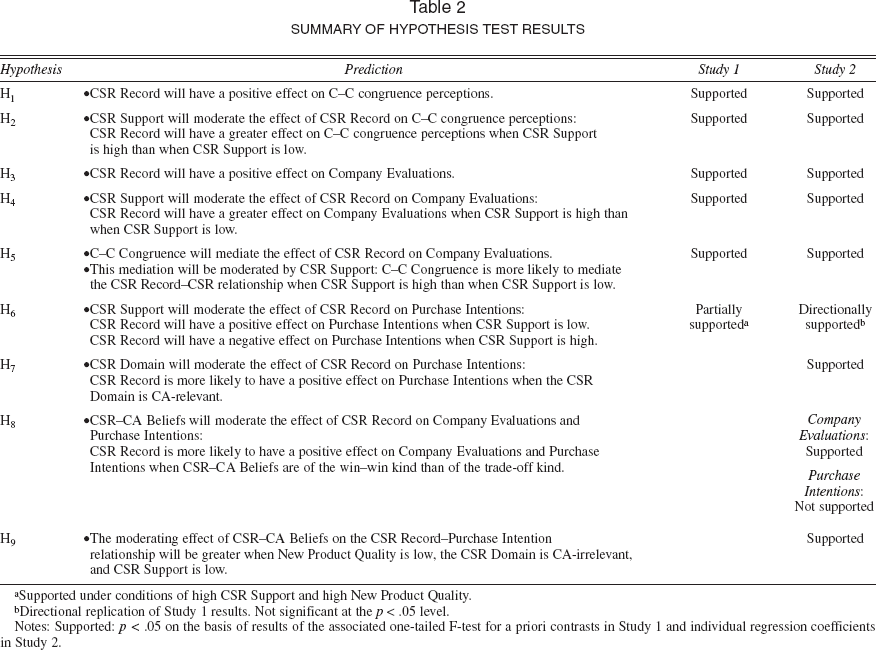
Supported under conditions of high CSR Support and high New Product Quality.
Directional replication of Study 1 results. Not significant at the p < .05 level.
Notes: Supported: p < .05 on the basis of results of the associated one-tailed F-test for a priori contrasts in Study 1 and individual regression coefficients in Study 2.
Tests of framework assumptions
The most basic assumption underlying our conceptual framework is that consumers' reactions to a company's CSR and product information are contingent on three key moderators: their CSR support, their CSR–CA beliefs, and the CSR domain. To test this, we compared each equation in our complete model with its equivalent in a reduced model in which the independent variables were restricted to CSR Record, New Product Quality, and the appropriate covariates. 21 Nested model global F-tests (Aiken and West 1991) revealed that the three moderators contributed significantly in explaining variations in subjects' reactions, in terms of all three dependent variables (C–C Distance: F(5,313) = 10.9, p < .05; Company Evaluation: F(15,297) = 9.0, p < .05; Purchase Intention: F(27,287) = 3.3, p < .05), to CSR and product quality information, supporting our basic assumption of contingency.
In the reduced model, C–C Distance was regressed on CSR Record, and both Company Evaluation and Purchase Intention were regressed on CSR Record, New Product Quality, and CSR Record x New Product Quality. Prior company evaluation and prior product ownership were included as covariates in the Company Evaluation and Purchase Intention regressions, respectively.
A more specific assumption is that the effect of CSR on Company Evaluation (Paths 1 and 2) is domain independent. This was tested with a nested model global F-test in which the full C–C Distance and Company Evaluation regression models (Table 1) were compared with reduced models that did not include CSR Domain and its interactions. The results indicate that CSR Domain contributed significantly to the explanatory power of the C–C Distance model but not the Company Evaluation one. In particular, in the C–C Distance model (see Table 1), subjects' C–C Distance perceptions were not only lower, on average, in the sweatshop domain than in the diversity domain (β = -.50, p < .01) but also more sensitive to CSR information in the former domain than the latter one (β = .52, p < .01). Another assumption is that the effect of New Product Quality on Company Evaluation is not moderated by any of the other factors in the framework. A nonsignificant global F-test comparing the full Company Evaluation model to a reduced version that included only the New Product Quality main effect (i.e., no interactions) supported this assumption.
A final assumption is that consumers' CSR–CA beliefs moderate their company evaluations and product purchase intentions but not their C–C congruence perceptions. We tested this by contrasting the full C–C Distance regression model with a reduced version that did not include CSR–CA Beliefs and its interactions as predictors. Not only are the CSR–CA Beliefs main effect (β = .35, p < .06) and the CSR Record x CSR–CA Beliefs interaction (β = -.81, p < .05) significant predictors in the full model (see Table 1), but also the nested model global F-test is significant (F(4,309) = 11.8, p < .05), which indicates that contrary to our assumption, consumers' CSR–CA beliefs affect their C–C congruence perceptions.
CSR effects on C–C Congruence
Table 1 shows that our basic expectations about the effect of CSR on C–C congruence are supported. Not only does CSR Record have a significant effect (β = −1.76, p < .01 22 ) on C–C Distance (H1), but also this effect increases (β = -.62, p < .01) with increasing CSR Support (H2).
The p-values for the hypothesis tests are one-tailed.
CSR effects on Company Evaluation
H3 and H4 were tested through a Company Evaluation regression with CSR Record, CSR Domain, CSR Support, CSR–CA Beliefs, and New Product Quality as predictors. A significant CSR Record main effect (β = .88, p < .01) and positive CSR Record x CSR Support (β = .18, p < 0.01) interaction (Table 1) supported H3 and H4. More specifically, we tested our prediction of moderated mediation by C–C Distance of the CSR–Company Evaluation relationship (H5) through a set of four, more specific regressions (Baron and Kenny 1986): (1) Company Evaluation on CSR Record, CSR Support, and CSR Record x CSR Support; (2) C–C Distance on CSR Record, CSR Support, and CSR Record x CSR Support; (3) Company Evaluation on CSR Record, CSR Support, CSR Record x CSR Support, as well as C–C Distance; and (4) Company Evaluation on CSR Record, CSR Support, CSR Record x CSR Support, as well as C–C Distance and C–C Distance x CSR Support. For C–C Distance to be a moderated mediator (see Baron and Kenny 1986), the CSR Record main effect and CSR Record x CSR Support interaction must be significant in both Regressions 1 and 2. Also, the C–C Distance main effect must be significant and the CSR Record main effect weaker (ideally nonsignificant) in Regression 3. Finally, the C–C Distance x CSR Support interaction must be significant, and the CSR Record x CSR Support interaction weaker (ideally nonsignificant) in Regression 4.
The mediation analysis supports H5. Both CSR Record (Regression 1: β = .89, p < .001; Regression 2: β = −1.82, p < .001) and CSR Record x CSR Support (Regression 1: β = .27, p < .001; Regression 2: β = -.75, p < .002) are significant predictors in Regressions 1 and 2. Moreover, C–C Distance is a significant predictor (β = -.13, p < .001) in Regression 3, though the main effect of CSR Record remains significant (β = .64, p < .001) albeit reduced (%Δω2 = −60). Finally, C–C Distance x CSR Support (β = -.05, p < .001) is a significant predictor in Regression 4, whereas the CSR Record x CSR Support interaction is no longer significant at the .05 level (β = .12, p < .10).
The moderating effect of CSR–CA Beliefs
Finally, we expect the CSR–Company Evaluation relationship to be positively moderated by subjects' CSR–CA Beliefs (H8). A positive CSR Record x CSR–CA Beliefs interaction (β = .23, p < .01) supports H8: The more subjects perceive a win–win relationship between CSR and CA, the more sensitive their Company Evaluations are to CSR.
CSR effects on Purchase Intentions
In line with H7, the CSR Record x CSR Domain interaction was a significant, positive predictor of Purchase Intentions (β = .14, p < .05). Tests of simple slopes (Aiken and West 1991) of the Purchase Intentions regression in the two different CSR domains revealed that, as expected, CSR was a significant positive predictor (t297 = 3.2) of Purchase Intentions in the sweatshop domain (across the different CSR Support and New Product Quality levels) but not in the diversity one. More specifically, separate tests of simple slopes within the diversity domain involving low and high levels of both New Product Quality and CSR Support (set as one standard deviation below and above the mean CSR Support level, respectively) revealed that the effects of CSR and New Product Quality on Purchase Intention in this domain paralleled those in Study 1 (H6). Compared with the negative CSR condition, the positive CSR condition decreased the low-support subjects' purchase intentions of a low-quality new product (β = -.40) and the high-support subjects' purchase intentions of a high-quality new product (β = -.20). However, unlike in the Study 1 ANOVA tests, these negative effects of CSR on product purchase intentions were not significant when estimated within the multiple-equation system.
The moderating effect of CSR–CA Beliefs
The nonsignificant CSR Record x CSR–CA Beliefs interaction in the Purchase Intentions regression (β = .11) indicated that CSR–CA Beliefs is not an overall moderator of the CSR–Purchase Intentions relationship. Thus H8 is not supported for Purchase Intentions. However, the significant, negative CSR Record x CSR Support x CSR–CA Beliefs (β = -.21, p < .01) and CSR Record x CSR–CA Beliefs x New Product Quality (β = -.17, p < .05) interactions indicate that, as predicted (H9), CSR–CA Beliefs' moderating effect on the CSR–Purchase Intention relationship depends on subjects' CSR Support level and the New Product Quality to which they are exposed. In contrast, CSR–CA Beliefs' moderating effect was not contingent on the CSR Domain (β = -.05).
We conducted a more specific test of H9 by contrasting the simple slope of the regression of Purchase Intentions on CSR Record x CSR–CA Beliefs when New Product Quality is low, the CSR Domain is CA-irrelevant (i.e., diversity), and CSR Support is low (i.e., one standard deviation below the mean) to that when New Product Quality is high, the CSR Domain is CA-relevant (i.e., sweatshop), and the CSR Support is high (i.e., one standard deviation above the mean). In line with H9, we find that CSR–CA Beliefs are a positive moderator of CSR's effect on Purchase Intentions (β = .74, t287 = 4.11) when the CSR domain is CA-irrelevant and both product quality and subjects' CSR support are low, but not (β = .01) when the CSR domain is CA-relevant and both product quality and subjects' CSR support are high. Under the former set of conditions, the product purchase intentions of subjects with win–win CSR–CA Beliefs increase with positive CSR actions (β = .69), whereas the purchase intentions of those with trade-off CSR–CA Beliefs decrease (β = -.81).
Discussion
In the face of burgeoning anecdotal evidence that consumers react positively to CSR, in this research we try to understand when, to what extent, and why CSR initiatives influence consumer behavior. Our tests of an individual-level conceptual framework linking CSR to consumers' company evaluations and product purchase intentions reveal both company- and consumer-based heterogeneity in consumers' reactions to CSR. This complexity in consumers' responses to CSR initiatives, particularly in terms of the purchase likelihood of specific products, constitutes one explanation for why aggregate firm-level models of CSR effectiveness have yielded an equivocal relationship between CSR and financial performance. More generally, our findings underscore marketers' need to adopt a strategic perspective in making CSR decisions, aligning their CSR initiatives with not only the company's overall strategic thrust but also its competitive positioning (e.g., CSR versus CA) and the positions of its key stakeholder groups on alternative CSR issues.
Summary of Findings
The effect of CSR on company evaluations
Using real CSR and product information about a company (Study 1), we show that the positive effect of CSR initiatives on consumers' company evaluations is mediated by their perceptions of self–company congruence and moderated by their support of the CSR domain. By implicating C–C congruence perceptions as a key mediator of the CSR–company evaluation relationship, this research complements research on consumer–brand congruity (Aaker 1997; Fournier 1998). We find that akin to consumers' perceptions of congruity with brands on self-relevant dimensions, their perceptions of congruence between their own characters and those of relevant companies (as conveyed by their CSR actions) can also be a source of self-definition. In the marketplace, the bond consumers form with a company may also be affected by their relationships with its brands. However, a key theoretical contribution of this research lies in establishing the role of a company's nonproduct dimensions, such as its CSR actions, in creating the C–C bond. Given this, it is imperative that future CSR research establish the contribution of CSR, relative to other constituents of company image, to consumers' C–C congruence perceptions, particularly under varying company, category, and brand knowledge conditions.
Not surprisingly, we also find valence-based asymmetries in the effect of CSR information on company evaluations: Consumers' company evaluations are more sensitive to negative CSR information than positive CSR information, even when (as in our CSR scenarios) negativity is borne of omission rather than commission. More specifically, all consumers react negatively to negative CSR information, whereas only those most supportive of the CSR issues react positively to positive CSR information. Therefore, managers need to be particularly cognizant about the hazards of being perceived as socially irresponsible. More generally, consumers' personal support of a CSR domain appears to be a key determinant of their sensitivity to a company's CSR efforts. Therefore, if a company's choice of CSR domains is dictated at all by market considerations rather than just by ideology, managers may want to research a variety of CSR initiatives and select those that enjoy the highest and most widespread support among the company's key consumer segments.
The effect of CSR on product purchase intentions
This research suggests that CSR's influence on consumers' product purchase intentions is more complex than its straightforward positive effect on their company evaluations. Specifically, our results suggest that a company's CSR efforts can affect consumers' intentions to purchase its products both indirectly (Path 3) and directly (Path 4). Moreover, the indirect effect was, under certain conditions, negative. In particular, we find that high–CSR support consumers' purchase intentions are distorted away from their CSR-based evaluative context by a perceptual contrast effect, which results in a CSR-induced reduction in such consumers' intentions to purchase a high-quality product. Aside from adding to the vast literature on contrast effects, this finding extends the work of Brown and Dacin (1997) by showing that in certain customer segments, the corporate context–based contrast effects documented by these researchers can affect purchase intentions even when this context is CSR-based.
An interesting empirical question pertains to the prevalence of such contrast effects in the real world. Such perceptual distortions are most likely to occur when consumers' product evaluations are made in the context of company knowledge, as was the case in both our studies and those of Brown and Dacin (1997). Such situations are likely when consumers are generally knowledgeable about a company or learn about a company before they learn about its products. Given that most company Web sites provide corporate information before specific product information, the real-world prevalence of such a learning sequence is likely to increase with greater shopping on the Internet. Thus, companies might want to consider the possibility of CSR-based and, more generally, corporate associations–based contrast effects in designing patterns of information flow on their Web sites as well as other, nonelectronic forums of communication.
Prior CSR research in marketing (Brown and Dacin 1997) suggests that CSR initiatives affect consumers' purchase intentions only indirectly, by creating a corporate context for such purchase intentions. Our findings add to this growing body of research by suggesting that a company's CSR actions in certain CSR domains (e.g., labor relations, employee working conditions) and for consumers with certain CSR-related beliefs can also have a direct effect on the attractiveness of the company's products (Path 4). Conversely, the positive effects of CSR actions on product purchase intentions in such CA-relevant domains seem to be more immune to consumer- and product quality–specific variations than in domains that are not perceived to be directly relevant to CA.
The role of CSR–CA beliefs
We also extend prior CSR research by demonstrating that consumers' beliefs about the trade-offs, if any, that a company makes between its CSR and CA efforts (i.e., CSR–CA beliefs) can play a key role in their reactions to CSR, in terms of not only their evaluations of the company and its products but also, unexpectedly, their C–C congruence perceptions. In particular, our results suggest that if a substantial proportion of a company's potential customers believe that CSR initiatives are typically realized at the expense of CA, then the company's CSR efforts may hurt it. Such adverse effects are particularly likely to hurt sales when these consumers do not believe that the company's CSR efforts enhance its CA (i.e., CSR domain is CA-irrelevant) and that its products are of high quality. Consequently, a company in such a situation would benefit from informing customers that its CSR actions do not detract from its ability to produce quality products (if that is indeed the case) and/or improving its product offerings. More important, this adverse effect of trade-off CSR–CA beliefs appears to be more prevalent among the low–CSR support consumer segment and is conceptually distinct from that borne of the perceptual context–based distortions exhibited by high–CSR support consumers.
Limitations and Future Research Directions
Several future research directions stem from the limitations inherent in this research. Subjects saw a company's CSR record and new product quality information in a specific sequence and in quick succession. However, in the marketplace they are likely to encounter such information in diverse order and over different, perhaps multiple, time periods. Also, consumers sometimes may be exposed simultaneously to differentially valenced CSR information in different domains about the same company. Thus, research investigating such sequence, time-interval, and multiple-exposure effects in consumers' responses to a company's CSR and product information would add to the validity and generalizability of our findings.
Although we endeavored to make our studies as externally valid as possible within the constraints of a laboratory experiment, field experiments or consumer surveys exploring the effects of actual CSR initiatives implemented by companies would be particularly valuable in establishing the external validity of our findings. One possibility is a Behaviorscan (Lodish and Riskey 1997) type field experiment in which different (but matched) households are exposed to different types (in terms of both valence and domains) of CSR information through either television or print, and the impact of such CSR information on their purchases of the company's products is unobtrusively observed through scanner panel records. Field surveys conducted through interviews, the mail, or the Internet can be used to assess consumers' reactions to actual CSR initiatives launched by companies, both in terms of company evaluations and purchase intentions. Although researchers may lose the ability to vary simultaneously the CSR domain, CSR valence, and product quality within the context of a single company, extensive pretesting and stratified sampling procedures would allow for assessing and perhaps balancing CSR support, C–C congruence, and consumers' product quality perceptions across different companies. Such research would also help establish the precise locus (i.e., mental representation versus response mode) of the perceptual contrast effects evidenced in this article.
Notably, subjects' support for CSR issues were, in general, somewhat high, and their CSR–CA beliefs were skewed toward win–win rather than trade-off. Although more balanced responses on such scales may be both unrealistic (given the relatively wide appeal of most CSR domains) and unobtainable (given social desirability biases), future researchers may want to focus on elucidating CSR domain–specific differences in both CSR support and CSR–CA beliefs. Similarly, subjects' CSR-based identification with the company was, on average, relatively weak. Although this is not surprising given the short time frames in our experiments and the lack of formal membership defining the C–C relationship, future researchers may want to investigate the conditions under which consumers strongly identify with organizations in the marketplace.