







Abstract
Despite the importance of decisions regarding international brand names, research on brand naming has focused primarily on English name creation. The authors conceptualize the local brand-name creation process in a multilingual international market. The authors present a framework that incorporates (1) a linguistic analysis of three translation methods—phonetic (i.e., by sound), semantic (i.e., by meaning), and phonosemantic (i.e., by sound plus meaning)—and (2) a cognitive analysis focusing on the impact of primes and expectations on consumer name evaluations. Using dual English-and-Chinese brand names, the authors show that the effectiveness of the translation depends on the emphasis of the original English name (versus the Chinese name) and the method of translation used previously for brand names within the same category.
Whenever a company introduces a product into a foreign market, one of its critical market entry decisions is the choice of a local brand name. From the classic “Nova” blunder meaning “no go” in Spanish to Clairol's “Mist Stick” suggesting “manure” in German to the rumored original name for Coca-Cola meaning “bite the wax tadpole” in Chinese, several prior cases of naming blunders have shown how cautious marketing managers must be in approaching naming decisions. Yet there are also many examples of brand names that have acquired positive nuances in foreign markets. For example, the Chinese characters now used to represent the name Coca-Cola mean “tastes good and makes you happy,” and those used for Colgate toothpaste mean “highly clear and clean.” In the global marketplace, local names can add to—or destroy—established brand equity (Aaker 1991, p. 263; Keller 1998, p. 550; Kohli and LaBahn 1997; Schmitt and Simonson, 1997, Ch. 10).
As a result, companies invest substantial resources in brand-name creation in an international context. For example, companies often engage multiple parties—including marketing managers, naming agencies, corporate-identity firms, advertising firms, customers, and distributors—in the name-selection process (Javed 1993; Shipley, Hooley, and Wallace 1988) in an effort to safeguard themselves against failures in foreign markets.
However, no prior research has developed a framework for the brand-name decision process in an international context and, in particular, in multilingual markets where consumers can read and understand two or more languages to a sufficient degree. In this research, we present such a framework, addressing linguistic translation options with an emphasis on how consumers process and evaluate brand names. We focus on the case in which the original brand name is in English and must be represented in Chinese. We first review previous research on naming and present the details of our conceptual framework. We then derive several hypotheses and test them in a series of three experiments. Using an English name as the original name and Chinese as the local language, we show that the effectiveness of the type of translation depends on two key contextual factors: (1) the degree of emphasis of the original English name as compared with the Chinese name and (2) the type of prior translation method for brand names within the product category.
Prior Research and the Current Framework
Prior research on naming has primarily focused on characteristics and functions of English names. For example, Peterson and Ross (1972) find that it is important to select names that build on familiar words, because consumers may already have positive notions about such words. More recently, research has shown that brand name associations depend on how common the related words are (Meyers-Levy 1989). Other research has demonstrated that the favor-ability of a brand name is used as a heuristic cue when consumers make product judgments (Maheswaran, Mackie, and Chaiken 1992) and that brand names that communicate benefits will later facilitate advertisement recall (Keller, Heckler, and Houston 1998). Such research has uncovered important name-selection criteria and provided key insights into the naming-decision process.
However, because English has specific phonological and morphological characteristics and is represented by a specific writing system, the generalizability of this research is limited. Prior research has thus made little progress toward a conceptual understanding of brand-name translation from a foreign language into a local language and has not generated insights regarding how to create effective local names.
We propose a framework of the brand-name creation process in multilingual, international markets. We view selecting a name in a local language not just as a word-byword or symbol-by-symbol translation process. Rather, the local brand-name creation process must consist of a linguistic analysis of the types of translations and a cognitive analysis of the key determinants of consumers' brand-name evaluations. As we show, the translation and cognitive analyses are interrelated: Certain types of translations (phonetic, or by sound; semantic, or by meaning; phonosemantic, or by sound plus meaning) work best for certain contexts (name emphasis, prior naming approach) because these contexts trigger specific cognitive processes. Similarly, certain contexts call for a certain type of translation approach.
The translation and cognitive analyses correspond to two different managerial decision tasks. One task is to decide in what contexts different types of translations will perform most effectively. For example, when faced with constraints on the available types of name translations, managers need to know how they can best communicate the names by selecting the right emphasis or by positioning their brand against a certain competitor. The other task is to decide what types of translations are most effective given contextual constraints. For example, a joint venture partner in China might insist that the local name be used more prominently on packaging than the simultaneously displayed original English name.
Analysis of Brand Name Translations
Names not only are a part of speech but also, similar to most linguistically communicated concepts, are represented in writing. Brand-name translations therefore require a consideration of the writing systems of the languages involved. There are two major types of writing systems that have been distinguished: phonographic writing systems (such as English), which represent the sound components of the spoken language (either as letters or syllabic symbols), and logo-graphic writing systems (such as Chinese), which represent words and concepts in the form of certain sign symbols (Akmajian et al. 1992, p. 467). In phonographic systems, there is a close correspondence between speech and writing. Conversely, in logographic systems, the correspondence between speech and writing is largely conventional, which results in the need for many symbols. A new name is typically represented by a combination of existing symbols.
The most complex—and most general—case of name translation occurs in the case of a translation from a phonographic system into a logographic system. In theory and practice, phonographic-to-logographic translations may be accomplished in three ways: translating by sound (phonetic translation), translating by meaning (semantic translation), or translating by sound plus meaning (phonosemantic translation).
As shown in Figure 1, all three translation techniques are used in the Chinese market, where brands are usually represented by two names: an original English name written in the Latin alphabet and a Chinese local name written in characters. Some companies highlight the original English brand name, and some companies highlight the Chinese local name. As shown in Figure 1, firms emphasize one name by positioning it above the other (e.g., Nabisco), displaying one name in a larger typeface than the other (e.g., Colgate), or placing one name on the front of the product and the other name on the back (e.g., Lipton). Companies typically highlight one of the names in these ways, not just in packaging but also in advertising, in outdoor displays, and on Web sites. Most important, each of the three translation techniques—phonetic, semantic, and phonosemantic—is quite different (for general translation theories between languages, see Chan 1990; Lou 1992; Nida 1975; Nida and Tabert 1969).

EXAMPLES OF PHONETIC, PHONOSEMANTIC, AND SEMANTIC BRAND NAMES
Phonetic
The phonetic translation technique aims to select the linguistic symbols in the foreign language that, when pronounced, correspond as much as possible to the phonetic structure of the original name. In the case of a phonetic translation, the Chinese language faces the challenge of matching the phonemes and syllables of the foreign name with the Chinese phonemes and characters. Because these characters are logographic symbols, they also carry meaning. However, when certain characters are combined in a sequence, the meanings of the individual component characters are no longer retained (Hu 1979; Liu, Pan, and Gu 1983). As a result, these characters and such sequences function as purely phonetic symbols, similar to the meaningless syllables made up of letters used in alphabetic systems. Therefore, brand names made up of these characters provide no clues about brand and meaning associations. For example, the Chinese brand names for Motorola (Mou-tuo-luo-la), Swatch (Si-wo-qi), Dove (De-fu) and Exxon (Ai-ke-sen) sound like “Motorola,” “Swatch,” “Dove,” and “Exxon” but have no specific meaning whatsoever. The same is true for the brand names shown under the heading “Phonetic” in Figure 1: Nabisco and Lipton.
Semantic
Semantic translations are less frequent than phonetic translations and the phonosemantic translations discussed subsequently, because global marketing and naming strategies strive for phonetic consistency across markets (Aaker and Joachimsthaler 2000). “Pure” semantic translation results in a local name that represents the actual meaning of the original brand name irrespective of its sound. For example, Northwest Airlines uses in Chinese the name “Xi-bei,” which means “northwest,” and United Airlines uses “Lian,” meaning “put together.” A pure semantic translation is possible only if the original brand name happens to be a lexicalized item in the dictionary (e.g., Apple computers) and not an artificially coined term such as a proper name (e.g., McDonald's) or a morphologically possible term that is not lexicalized in the dictionary (e.g., Revlon). Another example of pure semantic translation is the Chinese name for Microsoft, “Wei-ruan,” meaning “micro/tiny soft,” as shown in Figure 1.
However, because many original English brand names are not lexicalized dictionary items, to create a semantic translation, a less stringent, “nonpure” approach is used at times. This approach employs common associations of the product category. For example, the Chinese name for Sprite is “Xuebi,” meaning “snow and green,” a name associated with the characteristics of the product—cool, clear, and bottled in green. Similar translations might include “cleans well” for a detergent, “drives fast” for a sports car, or “full of orange taste” for an orange juice.
Phonosemantic
The phonosemantic translation aims to select linguistic symbols that are both phonetically and semantically related to the original brand name. The objective is to select Chinese characters (if any) that carry a certain sound and represent a meaning that is associated with the brand or the brand's product category. As in the case of semantic translations, the semantic component in phonosemantic names is typically nonpure. Johnson & Johnson's name in Chinese, “Qiang-sheng,” sounds like the English name and means “strengthen the life,” which is a meaning that relates to the product categories of most Johnson & Johnson products. Coca-Cola's Chinese name, “Ke-kou-ke-le,” sounds like Coca-Cola and means “tastes good and makes you happy.” The brands shown under the heading “Phonosemantic” in Figure 1 are additional examples of such translations (Colgate, which means “highly clear and clean,” and Safeguard, which means “soothing the skin the best”).
All three types of translations are possible approaches in local name creation. However, the empirical question arises as to which translation type is most effective: sound, meaning, or sound plus meaning? Which types of brand names do Chinese consumers evaluate most positively: phonetically, semantically, or phonosemantically translated brand names?
Cognitive Analysis
The common view is that the phonosemantic approach is superior to sound alone and meaning alone, because the local brand name resulting from such an approach, within certain constraints, both sounds like the foreign name and enables the marketer to communicate essential brand or product-category characteristics. According to this view, this translation technique combines the advantages of the phonetic and semantic approaches. It is believed to simultaneously guarantee phonetic consistency across markets and express a specific brand positioning or product benefit semantically.
This view, however, fails to take into account how consumers represent language and brand names in their minds. It also fails to account for how consumers process brand names that are presented to them simultaneously in two distinct writing systems. Moreover, the view does not recognize how the presence of other foreign brand names in the market might affect consumer perceptions and evaluations of new brand names.
It is therefore critical to move beyond a linguistic and translation analysis. To understand what effects phonetic, semantic, and phonosemantic translations may have on consumer perceptions and evaluations, it is necessary to consider how language is represented in consumers' minds. Specifically, we analyze how consumers perceive the biscripted presentation of the logographic brand names shown in Figure 1, which are the outcome of a phonetic, semantic, or phonosemantic translations, in conjunction with phonographic brand names—a situation henceforth referred to as “dual writing” brand names.
In the three experiments we report, we elaborate on the cognitive analysis of consumers' language representations by considering two key factors: (1) the degree of emphasis placed on the English name compared with that placed on the Chinese name in the dual writing situation and (2) the presence of prior types of brand-name translations (e.g., phonetic and phonosemantic) for products in the same product category. Each experiment has a set of hypotheses that is tested empirically.
Experiment 1: Name Emphasis
In Experiment 1, we examine how the degree of emphasis placed on the English and Chinese brand names in the dual writing situation influences consumer evaluations of the three translation approaches. We begin this examination with a brief review of research on mental coding and priming.
Prior research in both psychology (Nguy, Allard, and Bryden 1980; Perfetti and Zhang 1991) and consumer behavior (Schmitt, Pan, and Tavassoli 1994) has shown that in phonographic or alphabetic languages, the primary mental code for verbal information such as brand names is phonological, also known as phonemic coding. In contrast, in logographic languages, phonemic coding is used much less (Hung and Tzeng 1981; Schmitt, Pan, and Tavassoli 1994). In these languages, written information such as characters is encoded visually and, as a unit, directly mapped onto semantic meanings. The reason for the higher degree of visual/semantic processing, as well as contextual processing, can be derived from various characteristics of the Chinese language: the presence of thousands of meaningful characters, the loose orthographic–phonemic correspondence, and the lack of word boundaries that necessitate a contextual semantic analysis (Tavassoli 1999). As we show in Figure 1, U.S. brand names in the Chinese market usually consist of both an alphabetic (e.g., English) and logographic (e.g., Chinese) name. This dual writing gives rise to the question of which mental code will be used primarily for mental processing and how this processing will ultimately affect name evaluations. To address these questions, it is necessary to understand how contexts affect mental representations and, in particular, the phenomenon of “priming.”
Priming describes the effects of prior context on the interpretation of new information (Fiske and Taylor 1991, p. 257). For example, in Meyer and Schvaneveldt's (1971) classic priming experiment, subjects were faster in responding in a lexical decision task (e.g., “Are dogs animals?”) after being primed by a related concept (e.g., “cat”). Priming effects have been observed in psycholinguistic research and subsequently in the areas of social cognition and consumer behavior. Linguistic priming is an empirically robust phenomenon, which has been explained by a variety of theories that range from spreading activation models (Collins and Loftus 1975) to propositional models (Anderson 1990) and connectivist theories (McClelland and Rumelhart 1981; for comparative theory testing, see McNamara 1992; McNamara and Diwadkar 1996). In the psycholinguistic literature, priming effects have been shown at both the structural (e.g., in the form of “syntactic priming”) and the meaning (e.g., in the form of “semantic priming”) levels of a language. Such linguistic priming typically occurs automatically and at the nonconscious level (Bargh 1989; Kemp-Wheeler and Hill 1992; Thompson-Schill, Kurtz, and Gabrieli 1998).
In experiments, the time interval between the presentation of the prime and the target stimulus differs from experiment to experiment depending on research goals. In most syntactic and semantic priming studies, it is a matter of microseconds, but in some research it can be up to minutes. In social-psychological experiments, the interval can be hours and even days (Fiske and Taylor 1991). Conceptually, however, the time interval is limited only by the requirement that the prime precedes the stimulus. Any primes that occur before the target stimulus can provide the “prior context” and thus can affect the interpretation of new information. That is, as long as in a dual writing situation one stimulus is more prominently displayed than the other and therefore likely to attract attention and be processed first, this stimulus will act as a prime.
In addition, prior research suggests that priming effects influence the type of encoding and processing of verbal information, though this concept has not been tested directly. As Pan and Schmitt (1996) show, when a stimulus is presented simultaneously in auditory form and in written form, the English language can prime the sensitivity to the phonological features of a brand name (e.g., the speaker's voice), whereas the Chinese language can prime the sensitivity to a visual/semantic element (e.g., the writing style). Thus, we propose that when the English alphabetic name is emphasized (e.g., by presenting the English name above the Chinese name or in a larger font), the alphabetic writing of the English letters will act as a prime and increase the sensitivity to the phonemic encoding aspects of the entire dual writing brand name. Conversely, an emphasis of the Chinese characters will result in priming the visual/semantic encoding aspect of the dual writing brand name. As a result, in an evaluation of the original English name and its Chinese translation, the encoding type (phonemic versus visual/ semantic) is likely to set up an expectation for a phonetic or semantic translation, depending on whether the English or Chinese name is displayed more prominently.
Regarding the outcome of this priming process for the phonetic, semantic, and phonosemantic translations, we make several predictions. First, we predict that the phonetic translation will be liked better when English is emphasized than when Chinese is emphasized, because the phonetic translation matches the expectation set up by the emphasized English component but does not match the visual/semantic encoding triggered by the emphasized Chinese component. Second, the semantic translation will be evaluated more positively when Chinese rather than English is emphasized, because the semantic translation matches the expectation resulting from the visual coding triggered by the emphasized Chinese component but does not match the expectation resulting from the emphasized English component. Finally, phonosemantic translations will be evaluated equally in the English and Chinese emphasis conditions. In the case of the English emphasis, the triggered phonetic coding and expectation for a phonetic translation will allow for the processing of the phonetic aspect of the translation. And in the case of the Chinese emphasis, the triggered visual/semantic coding and semantic expectation will allow for the processing of the semantic aspect of the translation. Therefore, we predict the following interaction effect:
Phonetic translations will be evaluated more positively when the English component in the brand name is emphasized rather than the Chinese component.
Semantic translations will be evaluated more positively when the Chinese component in the brand name is emphasized rather than the English component.
Phonosemantic translations will be evaluated equally under both English and Chinese emphasis conditions.
Pretests
To select the English and Chinese names of the experiment, we conducted a focus group and quantitative pretests. In the focus group, five English native speakers generated fictitious English brand names for a variety of consumer products ranging from lotion to clothing to automobiles. Fictitious names were used to minimize any familiarity and prior knowledge factors. On the basis of linguistic criteria (e.g., syllabic structure, vowel and consonant combinations), word formation (e.g., Aronoff 1976; Selkirk 1982), and native speakers' intuitions about the appropriateness of names for things (Lehrer 1992), several names for each product were selected. These names had either two or three syllables, and the consonants and vowels making up these syllables were representative of the English language. They were judged as appropriate names for the products.
Next, 20 native English speakers participated in the pretest by providing responses to the names. Even though all names were fictitious, there may nonetheless be perceptual differences in familiarity. Therefore, participants were asked to rate on seven-point scales how familiar each name sounded to them (1 = “not at all familiar,” 7 = “very familiar”). In addition, they were asked to what degree they thought each name was a likely brand name for the product (1 = “not at all likely,” 7 = “very likely”).
Subsequently, Chinese phonetic, semantic, and phonosemantic names were created on the basis of the English names by a group of four bilingual speakers in the field of language translation, and differences were resolved through discussions (pairwise interrater agreement > .92). These three types of names were then tested with 22 Chinese native speakers in Shanghai on familiarity and brand-name likelihood. As in the actual studies, test materials for the subjects were in Chinese. English names were presented in alphabetic script, and Chinese names were presented in logographic Chinese script. The final stimuli selected for the main studies are shown in Table 1.
STIMULUS BRAND NAMES AND PRETEST RESULTS
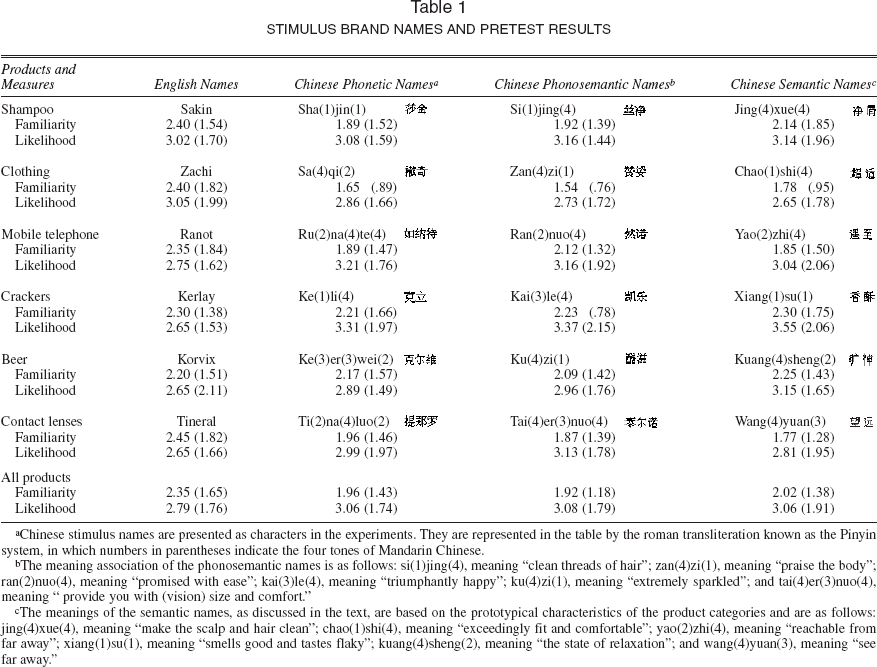
Chinese names that were phonetically translated sounded similar in Chinese to the English names. Those that were semantically translated employed Chinese characters that had meanings related to the product category—the nonpure type discussed previously. This type of semantic translation is the only one that can be used in an experimental situation that uses fictitious brand names and therefore avoids confounds with actual product knowledge and familiarity. Finally, phonosemantic translations employed both sound similarities to the English name and meaning associations of the product category. Overall, as Table 1 shows, all the names had been given similar ratings in terms of perceived familiarity and brand-name likelihood. Most important, there were no significant differences in familiarity or likelihood rowwise between the three different Chinese translation conditions on any of the names (for all, p > .30).
In addition, we provided a test to ensure that the stimuli of the three translation methods were evaluated similarly when presented without different language emphases. Sixty native Chinese students in Shanghai participated in the test. They were randomly assigned to each of the three conditions (phonetic, semantic, and phonosemantic). Subjects were asked to provide their evaluations of each name on three seven-point scales (“bad”/“good,” “not at all satisfactory”/“very satisfactory,” and “dislike”/“like”; Cronbach's alpha = .90). The names were shown to the subjects in two different orders, and no order effect was observed. There were no significant differences between the evaluations of the names in each condition (
Method
The dual writing fictitious brands (consisting of an English name paired with a phonetic, semantic, or phonosemantic Chinese name) were presented to native Chinese consumers in Shanghai. Respondents provided evaluations of the local brands on attitude scales. In this study, including pretests, and in subsequent studies, all the participants were native speakers of Chinese (Mandarin) who had some knowledge of the English language. They had studied English for three to five years and were familiar with the alphabetic writing system. Their knowledge of English was highly representative of the level of English found in the core market segment of young customers that is targeted by many multinational companies. They could read and understand basic English and judge whether a translation was purely phonetic, semantic, or phonosemantic.
Subjects and Design
A total of 183 college students participated in the experiment. They were randomly assigned to experimental conditions, according to a 3 (naming method: phonetic versus semantic versus phonosemantic) x 2 (name emphasis: English versus Chinese) between-subjects design. Name or language emphasis was manipulated through verbal instruction (i.e., subjects were told that the Chinese or that the English name was the target of emphasis), the position of the name (English above versus English below the Chinese name), and the presentation of the emphasized name (English or Chinese) in larger and bold typeface.
Procedure
Each participant received a booklet questionnaire in Chinese and was told that the study involved brand naming. Participants were told that they would be given several brand names. These names might be used for actual products in the future and would appear on product packaging and promotional materials. Participants were asked to provide their evaluations of each dual name on three seven-point scales: (1) “bad”/“good,” (2) “not at all satisfactory”/“very satisfactory,” and (3) “dislike”/“like.” A total of six names for the corresponding product categories (shampoo, clothing, mobile phone, crackers, beer, and contact lenses) were shown to participants in three different orders. Statistical analyses revealed no significant order effect.
Results
An overall index of brand-name evaluation was formed by averaging the three evaluation items (Cronbach's alpha = .87). A 3 × 2 analysis of variance (ANOVA) showed a significant two-way interaction of naming method with name emphasis (F(2, 177) = 3.44, p < .05). An examination of the means revealed that H1 and H3 were confirmed.
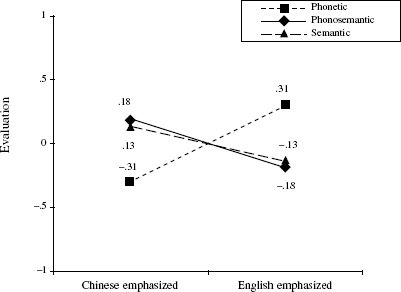
As shown in Figure 2, using rowwise comparisons, when the phonetic naming method was used, brand-name evaluations were more favorable for names that emphasized the English word than for those that emphasized the Chinese word (

BRAND NAME EVALUATION AS A FUNCTION OF NAMING METHODS AND NAME EMPHASIS
Examining the means columnwise, brand names received similar evaluations regardless of the naming method when the English word was emphasized (
The examination of columnwise means involves comparing directly across stimulus naming methods, and the means therefore may be difficult to interpret. Although the names presented in different naming conditions did not show significant differences in overall evaluations in the pretest, the brand names in one type of name translation may nonetheless have been more likable than another for this specific participant sample. As a result, we used the residual means describing the interaction to interpret the results further, as shown in Figure 3. The residual means are the values that remain after the name emphasis and naming method main effects and grand mean are removed (Rosnow and Rosenthal 1991; Ross and Creyer 1993). The residual means demonstrate that phonetic name translations and English name emphasis together produce relatively better brand-name evaluations, whereas semantic and phonosemantic translations and Chinese name emphasis together produce relatively better brand-name evaluations.
RESIDUAL MEANS
Discussion
The results of Experiment 1 indicate that no particular naming method was generally evaluated most positively. Rather, the effect depended, as hypothesized, on whether phonetic or semantic encoding was primed by an emphasis on the English or Chinese name.
Using the framework described previously and starting with the translation analysis, we investigated which presentation style (English or Chinese emphasis) of the cognitive analysis is evaluated most positively for which translation type. As expected, when Chinese consumers are exposed to a sound translation, they prefer the English name rather than the Chinese name to be emphasized. In other words, the English emphasis seems to set up an expectation for a phonetic name, which in turn is confirmed and results in positive evaluations. For the phonosemantic naming method, however, as expected, there was no difference for the two emphasis conditions, because according to our hypothesis this naming condition can deliver on the expectations set up by both the English and Chinese emphasis conditions.
We had further predicted that the semantic translation would be evaluated more positively in the Chinese emphasis condition than the English emphasis condition. Contrary to our prediction, there was no significant difference. In addition, participants in the semantic translation conditions provided similar evaluations as did participants in the phonosemantic conditions. One reason for the nonsignificant effect of semantic translations across emphasis conditions may be the lack of familiarity with this type of nonpure semantic translation. We mentioned previously that this type of translation is rare. It is therefore likely that participants did not have a well-developed expectation regarding the emphasis for which this translation would work best. Another, more conceptual explanation in line with our framework may be that Chinese native speakers, habitually attuned to the Chinese language and its visual/semantic encoding preference, prefer a meaningful semantic translation no matter whether the Chinese name or English name is emphasized. Yet when they are shown a name without a meaningful component—namely, a phonetic name—as we have shown, the preferred emphasis is English. If this conceptual explanation is correct, the nonsignificant effect for the phonosemantic condition must also be due to the meaningful semantic component only and not, as we had hypothesized, to the processing of the phonosemantic name with respect to its semantic or phonetic component depending on the emphasis condition.
We can also apply our framework differently, starting with cognitive analysis (the presentation style), and ask which type of translation would work best. As the columnwise residual-means analysis indicated, there was a crossover interaction between the phonetic and semantic translation conditions for English and Chinese name emphasis. This pattern suggests that the English emphasis condition primes phonetic encoding and the corresponding expectations of a phonetic translation, whereas the Chinese emphasis primes visual/semantic encoding and triggers the corresponding semantic expectations. Again, semantic translations behaved similarly to semantic translations across emphasis conditions, which suggests that both translations are processed by Chinese native speakers primarily with respect to the meaningful semantic component.
One alternative explanation may apply to the entire pattern of observed results. Respondents' evaluations could reflect memory rather than priming and expectation effects. For example, either differential ease of processing or depth of processing of the names, triggered by emphasis rather than priming of certain types of processing, may have occurred in Experiment 1. If ease of processing or depth of processing produced the effects, there should be an effect on memory (e.g., Lynch and Srull 1982) that causes consumers to display higher recognition and/or unaided recall of the phonetic names in the English emphasis condition than in the Chinese emphasis condition. To examine these alternative explanations, we included measures of recognition and recall in Experiment 2.
Finally, Experiment 1 was limited in terms of its marketing relevance, because new brand names were presented in isolation from other existing brand names. In the actual marketplace, brand names do not appear in isolation from other names and often are not evaluated on a stand-alone basis. Consumers are typically aware of other brands offered in the same category, and this may affect their evaluations of new names. In Experiment 2, we explore the effects of new brand names in the context of existing brand names in a given category.
Experiment 1 provided identical results for the semantic and phonosemantic conditions, regarding both rowwise and columnwise comparisons, which suggests that phonosemantic translations are processed similarly. Therefore, we included the phonosemantic condition only and compared it with the phonetic translation condition in the following experiments.
Experiment 2: Prior Naming Method
In Experiment 2 we propose that existing brand names, which are part of a consumer's long-term memory, may act as additional primes that trigger certain processing and certain expectations and affect consumer responses. As mentioned previously, priming effects not only have been reported in the form of immediate contextual and linguistic primes with relatively short duration effects but also have been reported involving long-term memory, in particular in the social psychology literature. An initial prime can affect evaluations as much as a week later (Higgins and King 1981; Sinclair, Mark, and Shotland 1987) and may even result in a chronic source of accessibility (Bargh 1989; Fiske and Taylor 1991).
What aspects of existing names in the market are most likely to serve as primes that may affect evaluations of current target names? Because we focus on the evaluations of brand names rather than products as a whole, the most likely relevant aspects of prior brands are the types of translations used for them rather than physical and tangible product characteristics. Furthermore, brand names within a category are more likely to exert influence on one another than brands from different categories, because brands that belong to the same product category are known to be linked in long-term memory (e.g., Keller 1987; Nedungadi, Mitchell, and Berger 1993). Therefore, when we inform consumers that prior brands within the same category use either a phonetic or phonosemantic translation approach, we expect the information to exert a priming influence and set up an expectation for the evaluation of the new brand name.
As we argue and have shown in Experiment 1, the presentation of the English language primes phonetic coding and sets up the expectation of a phonetic translation, whereas the presentation of the Chinese language primes visual/semantic coding and sets up the expectation of a semantic translation. Similarly, informing people that prior names use phonetic translations is likely to prime phonetic processing of the new name, whereas informing people that prior names use phonosemantic translations is likely to prime semantic processing. This is particularly likely to occur in the frequent situation when consumers have generic knowledge of a category and its prototypical translation approach without necessarily recalling the specific brand-name exemplars. In that case, when presented with prior phonetic translations, consumers will think of nonmeaningful, purely sound-based phonetic names, which thus triggers phonetic coding of the new names and expectations of phonetic translations. Conversely, when presented with prior phonosemantic translations, consumers will think of the typical, meaningful Chinese logographs, which thus triggers semantic encoding and expectations for semantic components in the translation.
As a result, when the phonetic code is primed through the presentation of an existing phonetic name, as in the prior approach, respondents will prefer the phonetic name significantly more in the English than the Chinese emphasis condition. Thus, we expect to replicate the effects of the phonetic translation of Experiment 1 (perhaps with a steeper gradient) but leave the nonsignificant effect of the phonosemantic translation between the two emphasis conditions unaltered. In contrast, when the semantic code is primed with the prior phonosemantic method, subjects should prefer the phonosemantic names more in the Chinese than the English condition, thus changing the nonsignificant phonosemantic effect of Experiment 1 into a significant difference between the two emphasis conditions. At the same time, the significant phonetic translation effect of Experiment 1 should become nonsignificant.
When presented with the phonetic translation method as the prior naming method, people will evaluate the phonetic name significantly more positively in the English than the Chinese emphasis condition. However, there will be no significant difference in the phonosemantic conditions.
When presented with the phonosemantic translation method as the prior naming method, people will evaluate the phonosemantic name significantly more positively in the Chinese than the English emphasis condition. However, there will be no significant differences in the phonetic conditions.
Method
Subjects and Design
A total of 120 Chinese college students in Shanghai participated in this study. They were randomly assigned to four different experimental conditions and received a booklet to complete the respective questionnaire in Chinese. The design took the form of a 2 (prior naming method: phonosemantic versus phonetic) x 2 (language emphasis: Chinese versus English) x 2 (current naming method: phonosemantic versus phonetic) mixed design. The first two variables were between-subjects factors, and the third variable was a within-subjects factor. The brand name stimuli and product categories were the same as those used in Experiment 1.
Procedure
Participants were told that the study focused on how to introduce new products into the market, and their opinions were needed to help managers to decide which Chinese names (presented in dual name format) to use for the products. Half the participants were told that prior successful products in the same product categories used the phonetic method (i.e., used Chinese names that sounded like the original English names); the other half were told that the categories used the phonosemantic method (i.e., used Chinese names that both sounded like and had meaning associations with the original English names). Half the participants were shown products that emphasized the Chinese name, and the other half were shown products that emphasized the English name. Participants provided ratings on four name-evaluation dependent measures relevant to market entry: (1) To what extent do you think this brand name will facilitate the success of the product in the market place? (1 = “not at all” and 7 = “large extent”), (2) How likely do you think you would be to select this brand name in order for the product to be successful in the market place? (1 = “not at all likely” and 7 = “very likely”), (3) How likely is it that the brand name will be judged favorably in the market place? (1 = “not at all likely” and 7 = “very likely”), and (4) How much do you think consumers will be satisfied with this brand name? (1 = “not at all” and 7 = “very much”). Participants were then asked to perform a distraction task to clear their short-term memory. Afterwards, they were asked to recall as many Chinese names as possible by writing them down on a sheet of paper. Finally, participants were given a recognition test. Two versions of the recognition test materials were developed; each had six original names (three phonetic, three phonosemantic) and their six corresponding distracters. Thus, participants were presented with 12 names and were asked to circle the names they had seen before.
Results
We formed an index of brand-name evaluation by averaging the four items (Cronbach's alpha = .95). A 2 × 2 × 2 ANOVA revealed a main effect of current names (F(1, 113) = 16.57, p < .0001). Phonosemantic names were rated more favorably than phonetic names (
Most important, the analysis yielded a significant three-way interaction of prior naming method, name emphasis, and current naming method (F(1,113) = 4.25, p < .05). The means are shown graphically in Figure 4. We conducted subsequent columnwise and rowwise contrasts to examine the nature of the interaction effect.
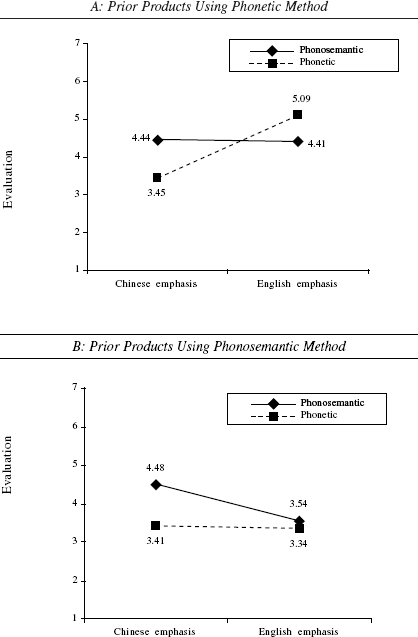
BRAND NAME EVALUATIONS AS A FUNCTION OF PRIOR NAMING METHODS, NAME EMPHASIS, AND CURRENT NAMING METHODS
As expected, when prior product names used the phonetic method, no difference in evaluations was observed for current phonosemantic name translations between the Chinese and English emphasis conditions (
Conversely, when prior names used the phonosemantic naming method, subjects provided higher evaluations for the current phonosemantic translations when the names emphasized Chinese rather than English (
As in Experiment 1, the data presented in Figure 4 may be explored columnwise. As Figure 4, Panel A shows, in the prior phonetic naming condition, for Chinese emphasis, we replicated the significant difference between phonosemantic versus phonetic naming: The current names using phonosemantic method received more favorable evaluations than the current names using phonetic method (
As Figure 4, Panel B shows, when the prior method was phonosemantic and the brand names emphasized Chinese, current brand names using the phonosemantic method received more favorable evaluations than brand names using the phonetic method (
Finally, we used the memory data to examine whether ease of processing or depth of processing accounts for the results. For the memory measure, respondents recalled roughly half the items, on average, but no significant differences were observed between the different experimental conditions. The means were close, ranging from a low of 2.63 (phonetic names with Chinese emphasis in the condition in which the prior product used phonetic naming method) to 3.00 (phonosemantic names with English emphasis in the condition in which the prior product used the phonetic naming method) (t < 1). Similarly, on unaided recall, the 2 × 2 × 2 ANOVA revealed only a significant main effect of current names (F(1,116) = 98.58, p < .0001) but no significant interactions. Phonosemantic names were recalled better than phonetic names (
Discussion
Experiment 2 strongly supported our overall hypothesis that name translation standards in a product category can serve as primes and set up expectations for current brand-name evaluations. Moreover, the results supported our specific hypotheses that prior phonetic translations prime phonemic processing and set up expectations for phonetic translations, whereas prior phonosemantic translations prime semantic processing and set up expectations for semantic translations. These primes and expectations changed the pattern of results observed in Experiment 1, in line with our predictions.
In prior priming research, both facilitating and inhibiting priming effects have been reported (Fiske and Taylor 1991). However, recent rigorous theory tests by McNamara (1992) and McNamara and Diwadkar (1996) have reported facilitating effects only. Consistent with these findings, in the present research we observed facilitating effects only. Phonetic priming resulted in positive effects on the current phonetic names only but did not affect the current phonosemantic naming adversely. Also, phonosemantic priming resulted in effects on the current phonosemantic names only but did not affect the current phonetic naming techniques. This lack of inhibition effects in the phonetic priming conditions replicated the difference between phonosemantic names and phonetic names under Chinese emphasis, which we also observed in Experiment 1. Moreover, the lack of an inhibition effect in the phonosemantic priming conditions replicated the nonsignificant difference between phonosemantic and phonetic names in the English emphasis conditions.
The results in Experiment 2 not only provide support for our hypotheses but also rule out the ease-of-processing and depth-of-processing explanations. Therefore, the differential brand-name evaluations were attributed to priming and expectation effects. As we have demonstrated, linguistic factors can significantly influence brand-name evaluations in local name creations. However, in addition to language-based considerations, social and cultural factors may have influenced respondents' judgments of new brand names. For example, prior research has suggested that people may draw inferences from the context, such as socially or culturally determined perceptions of a brand (e.g., Gurhan-Canli and Maheswaran 2000; Klein, Ettenson, and Morris 1998). For example, in a survey assessing how Chinese consumers think about local versus foreign products, it was found that Chinese consumers have positive attitudes toward Western products compared with local ones (The Gallup Organization 1999). As a result, Chinese consumers may react differently to an import product made in a Western country with a certain type of name than to a locally manufactured product. Thus, it is possible that social effects, rather than language-driven cognitive effects, were present in both Experiments 1 and 2. For example, Chinese consumers may have preferred the phonetic name under the English emphasis condition in Experiments 1 and 2 because they like a positive foreign image. To test whether foreign image inferences were a significant factor that may have confounded results in Experiments 1 and 2, we conducted Experiment 3.
Experiment 3: The Role of Foreign Image
Method
Experiment 3 took the form of a 2 (image source: domestic versus foreign) × 2 (naming method: phonetic versus phonosemantic) × 2 (name emphasis: Chinese versus English) factorial design. The manipulations of the latter two factors and the name stimuli were identical to those used in Experiments 1 and 2. If cultural and social meanings (e.g., how Chinese would perceive foreign products versus domestic products) interact with the linguistic translation and language emphasis factors examined thus far, a three-way interaction or two-way interactions involving image source should be found.
In Shanghai, 240 Chinese native speakers participated in the study by filling out questionnaire booklet. To make the use of dual writing brand names a realistic situation, we included both domestic and foreign markets as the target markets in our manipulation. Because we were not interested in differences in specific country-of-origin images of Western countries (e.g., the United Kingdom versus the United States versus Canada) but rather, as in the Gallup Survey (The Gallup Organization 1999), in a general assessment of domestic versus foreign in the context of a Chinese–English name, we manipulated image source generically as domestic versus foreign. In Chinese, idiomatic phrases such as “foreign brand” (guowai pai) or “foreign products” (guowai chanping) are used in marketing campaigns to refer to the products from foreign (mostly developed) countries. Moreover, brands with an English name from the United States, Canada, and England are all highly regarded. Therefore, this generic manipulation of foreign image seemed appropriate.
Half the participants were told that the product was made by a Chinese manufacturer located in China and was targeted at both the Chinese domestic market and foreign markets. The other half were told that the new product was made by a foreign manufacturer located outside China and was targeted at both the Chinese domestic market and foreign markets. Participants rated the product on three seven-point evaluation scales: (1) “bad”/“good,” (2) “not at all satisfactory”/“very satisfactory,” and (3) “dislike”/“like” (Cronbach's alpha = .91).
Results and Discussion
A 2 × 2 × 2 ANOVA revealed a significant main effect of image source (F(1,232) = 5.46, p < .05), a significant main effect of naming method (F(1,232) = 9.50, p < .001), and a significant two-way interaction between naming method and name emphasis (F(1,232) = 4.72, p < .05). However, neither of the two-way interactions involving image source was significant (p > .18 and p > .20), and there was no significant three-way interaction (p > .54).
The main effect of image source indicated that name evaluations were higher when the product was presented as made in a foreign country than when it was presented as made domestically, confirming that Chinese consumers have a positive image of foreign goods (
The main effect of naming method was due to phonosemantic translation's being evaluated better than phonetic translations (

BRAND NAME EVALUATIONS AS A FUNCTION OF NAMING METHODS, NAME EMPHASIS, AND COUNTRY ASSOCIATION
Similarly, columnwise comparisons indicated that phonosemantic translations were evaluated more positively than phonetic translations when Chinese was emphasized (
The absence of a three-way interaction and two-way interactions involving image source indicate that the previous effects we observed cannot be attributed to foreign image effects. Although the study may not rule out all possible social and cultural factors (e.g., accommodation effects; Koslow, Shamdasani, and Touchstone 1994), it seems to indicate that one of the most frequently demonstrated social and cultural effects—that is, effects of foreign image—does not offer a viable alternative interpretation. This strengthens our belief that the effects are due primarily to the linguistic translation and cognitive factors that are part of our framework.
General Discussion
We presented a conceptual framework for managing brand name creation in an international, multilingual market such as China. As we discussed, translations from a phonographic system into a logographic system pose the challenge of a selection among phonetic translations that preserve the sound of the original name, semantic translations that either preserve the lexical meaning of the original name or create product-category and brand associations, and phonosemantic translations that preserve the sound of the original name and create product-category and brand associations. Our empirical results indicate that the choice of translation should be guided by considerations of contextual factors. These considerations are (1) which brand name (the English or Chinese name) will be emphasized and (2) which translation approach (phonetic or phonosemantic) for similar products is considered the standard in the marketplace. The results from three experiments provide support for our framework.
Our research suggests that though brand-name translation requires a consideration of linguistic factors, it is not a purely mechanical symbol-to-symbol matching process. Rather, brand-name translations also require an analysis of how consumers mentally represent and process different types of brand names. Evaluation of names is influenced by the contextual factors, which can act as primes and benchmarks that set up expectations and affect the processing of brand names. When contextual factors prime semantic processing, it is critical to pay close attention to desirable meanings and name associations as key assets of name equity (Keller 1998). However, when phonetic processing occurs, the appropriate sound translation becomes most critical, and desirable meanings add little value.
The present research is in line with the emerging stream of research on the influence of cognitive and linguistic factors on consumer behavior. Specifically, our results provide further evidence for qualitative differences in the information processing of phonographically versus logographically presented verbal information. When processing Chinese words, people appear to rely more on visual and/or semantic cues. The opposite is true for English, which is more likely to be processed phonologically. As shown in prior research, these qualitative processes of different writing systems can significantly affect brand recall (Schmitt, Pan, and Tavassoli 1994), temporal memory (Tavassoli 1999), and brand attitudes (Pan and Schmitt 1996). In the present research, these qualitative differences in writing systems are shown to affect evaluations of name translations. In conjunction with other recent cross-cultural research on structural language issues and consumer behavior (e.g., Schmitt and Zhang 1998; Zhang and Schmitt 1998), the present study provides further evidence for the revised Whorfian hypothesis conceptualized by Hunt and Agnoli (1991). The reconceptualization states that language structures can affect thought, representation, and information-processing styles. Our results from the investigation of writing systems to the examination of dual writing brand-name representation suggest that language-triggered priming and expectations about types of translation affect the processing and evaluation of brand names.
Our research and findings also suggest possible opportunities for further research. In the present study, we focused on Chinese–English names in the multilingual market of China. Further research should examine whether our results can be replicated with other languages and in other markets. Moreover, within China, additional research could investigate translation issues for different Chinese dialects. For example, participants in Shanghai may be asked to process the local Chinese name in standard Mandarin or in Shanghai dialect, and local names may be selected in such a way that the names are of one type (e.g., phonological) when processed in Mandarin but of another type (e.g., semantic) when processed in Shanghai dialect. If such a procedure replicates the effects reported in this article, it would be possible to generalize the present findings beyond the usage of standard Mandarin. In addition, we also encourage researchers to move beyond the broad concepts of phonetic, semantic, and phonosemantic translations and examine specific types of sound translations (e.g., high versus low tones, rhymes versus no rhymes) and types of meanings and associations (e.g., metaphorical versus literal, idiomatic versus formal). As these specific types of sounds and meanings are more closely related to social and cultural meanings than the broad structural approach taken in the current study, possible interactions can be expected between linguistic factors and cultural variables that determine different interpretations of the linguistic meanings.
Finally, it would be worthwhile for further research to examine how the local name-creation methods examined in the current study might interact with nonlinguistic visual elements, such as logos and symbols. Such further research is critical from a theoretical perspective because it would provide a broader picture of how verbal and visual elements are processed and integrated (Tavassoli 1999). From a managerial perspective, such research would also address the important issue of how companies can most effectively use visuals in conjunction with local names to build memorable and positively valued brand experiences (Schmitt 1999).