







Abstract
Increased access to individual customers and their purchase histories has led to a growth in targeted promotions, including the practice of offering different pricing policies to prospective, as opposed to current, customers. Prior research on targeted promotions has adopted a tenet of the standard economic theory of choice, whereby what a consumer chooses depends exclusively on the prices available to that consumer. In this article, the authors propose that consumer preference for firms is affected not just by prices the consumers themselves are offered but also by prices available to others. This departure from the conventional strong-rationality approach to targeted promotion results in a decidedly different optimal policy. Through a laboratory experiment, calibration of a stochastic model, and game-theoretic analysis, the authors demonstrate that ignoring behaviorist effects exaggerates the importance of targeting switchers as opposed to loyals. This occurs, though with intriguing differences, even when only part of the market is aware of firms’ differing promotional policies. The authors show that both the deal percentage and the proportion of aware consumers affect the optimal strategy of the firm. Furthermore, the authors find that offering lower prices to switchers may not be a sustainable practice in the long run, as information spreads and the proportion of aware consumers grows. The model cautions practitioners against overpromoting and/or promoting to the wrong segment and suggests avenues for improving the effectiveness of targeted promotional policies.
Few things stir up a consumer revolt quicker than the notion that someone else is getting a better deal. That's a lesson Amazon.com has just learned. Amazon, the largest and most potent force in e-commerce, was recently revealed to be selling the same DVD movies for different prices to different customers.
The Internet was supposed to empower consumers, letting them compare deals with the click of a mouse. But it is also supplying retailers with information about their customers that they never had before, along with the technology to use all this accumulated data. While prices have always varied by geography, local competition and whim, retailers were never able to effectively target individuals until the Web.
“Dynamic pricing is the new reality, and it's going to be used by more and more retailers,” said Vernon Keenan, a San Francisco Internet consultant. “In the future, what you pay will be determined by where you live and who you are. It's unfair, but that doesn't mean it's not going to happen.”
With its detailed records on the buying habits of 23 million consumers, Amazon is perfectly situated to employ dynamic pricing on a massive scale. But its trial ran into a snag early this month when the regulars discussing DVDs at the Web site DVDTalk.com noticed something odd.
One man recounted how he ordered the DVD of Julie Taymor's “Titus,” paying $24.49. The next week he went back to Amazon and saw that the price had jumped to $26.24. As an experiment, he stripped his computer of the electronic tags that identified him to Amazon as a regular customer. Then the price fell to $22.74. “Amazon was trying to figure out how much their loyal customers would pay,” said Barrett Ladd, a retail analyst with Gomez Advisors. “And the customers found out.”
A number of DVDTalk.com visitors were particularly distressed to find that prices seemed to be higher for regular customers. “They must figure that with repeat Amazon customers they have ‘won’ them over and they can charge them slightly higher prices since they are loyal and ‘don't mind and/or don't notice’ that they are being charged three to five percent more for some items,” wrote a user whose online handle is Deep Sleep. Amazon says the pricing variations stopped as soon as the complaints began coming in from DVDTalk members….
“Any retailer would love to do dynamic pricing if they could,” said analyst Ladd. “If you could make the optimum amount of money from a consumer who's willing to pay more, that's a beautiful thing.”
—The Washington Post, September 27, 2000, p. A1
Targeted promotions—the practice of offering different prices to prospective and present customers—are common in the marketplace. Amazon.com, counting on habitual consumers to pay more than others might, is hardly alone in adopting such a practice. Examples of similar policies abound: the Wildlife Conservation Society in New York offers free t-shirts to entice new members but does not offer them to current members who choose to renew, many magazines offer calendars and other premia only to new members, telephone companies are notorious for offering lucrative bonuses to potential switchers, and health clubs frequently advertise to new members by offering a special discounted rate.
In contrast, many catalog companies now send their promotional catalog only to selected customers who have ordered from them before (Bult and Wansbeek 1995). Similarly, it is standard practice among symphony subscription series to first offer tickets for the next season to customers who subscribed in the previous season. Also, some car companies, such as General Motors, offer current owners (only) rebates of $500 for new car purchases. 1 Such firms apparently believe that it is better to reward their existing customer base rather than entice customers with whom they have not previously done business.
We thank a reviewer for this example.
These examples speak to the present popularity of targeted promotions. Indeed, now that access to individual customers and their purchase histories is facilitated by the Internet, it is likely that the practice will proliferate. Prior research on targeted promotions has typically adopted a tenet of the standard economic theory of “rational” consumer choice: What a consumer chooses depends exclusively on the prices offered to that consumer, not on prices available to others.
However, as the Amazon example suggests, a consumer may be aware of prices that are available to others for the identical product, knowledge that may influence his or her purchase decision. In this article, we show how the optimal promotion strategy would be different if it assumes that consumers are aware of and affected by prices to other segments (henceforth called “aware” consumers), compared with one that assumes that they are not (henceforth “unaware” consumers). 2 Again, Amazon is hardly alone in altering its targeted promotion strategy because of the presence of aware consumers. For example, a direct mail firm in New England enacts a strict prohibition against consumers on the same street and block receiving different offers. 3 Even bricks-and-mortar retailers find it difficult to conceal their patterns of preferential promotional deals: CVS pharmacies, in response to requests by different marketing companies, offer targeted promotions based on different criteria, such as to more loyal consumers of one brand or to less loyal consumers of another. The company receives many telephone calls from aware consumers who would like to take advantage of a better price deal that they have heard about; CVS's policy is to extend to the consumers the deals about which they inquire.
“Aw are” consumers not only are aware of deals to others but also are concerned about this practice. “Unaware” consumers, in contrast, comprise both those who are unaware of deals to others and those who are aware of deals to others but are not concerned about them.
We thank Scott Neslin for this example.
The perspective we develop in this article is especially important in guiding practitioners in today's information-intensive promotional environment. In the pre-Internet days, firms could reasonably assume that there would be few consumers in the market who were aware of prices to others. However, as Amazon learned, for a product sold over the Internet, the spread of information is rapid and, with the proliferation of online chat rooms, consumers can quickly learn about firms’ preferential pricing policies.
Consistent with the preceding examples and firm policies, we propose a targeted-promotion model for aware consumers. From a purely economic perspective, a rational consumer's choice should not be affected by the prices offered to other consumers; that it is affected indicates that these consumers do not behave in a manner consistent with “strong” rationality. Our model of the aware consumer is essentially a behaviorist model, as opposed to a strongly rational one. 4 The departure (in consumer response) from the conventional strong-rationality approach to targeted promotions results in a decidedly different optimal policy. We demonstrate that under strong rationality, the importance of targeting switchers is exaggerated and the impact of targeting loyal customers is slighted. Therefore, a firm may be systematically misled in its promotional policy implementation, choosing to target switchers when it ought to target loyals or offer no promotions at all.
A recent New York Times (2001) article illustrates the difference well, stressing the need for economic theory that recognizes that people may not act with rational, unemotional self-interest and that human beings have another, feistier, side to them. In contrast to the so-called behaviorist approach, the strong-rationality approach models unaware consumers, who are assumed to care only about prices of which they can avail.
Even with sales over the Internet, not all consumers may be aware. Many consumers may not be aware of prices to others, and still other consumers may be aware of prices to others but not concerned about them. They may believe, for example, that lower prices to potential switchers are warranted because of their higher switching costs. We also consider the case in which only a proportion of the market consists of aware consumers (consistent with the behaviorist view) and the rest consists of unaware consumers (consistent with strong rationality). We show that in such a market, the optimal strategy to follow may be neither strong rationality nor behaviorism for all consumers. Furthermore, the existence of even a small proportion of aware consumers in the market can change the optimal strategy from that consistent with a strong-rationality approach.
The model also suggests that offering lower prices to switchers may not be a sustainable practice, as more and more consumers learn of prices to other segments and the proportion of aware consumers increases. This is consistent with AT&T's recent announcement that the company has renounced its targeted pricing practice and will now offer equal rates to all customers (Scheisel 1999). Our model thus introduces a cautionary note, suggesting that managers would do well to consider the damage that their targeted promotional practices may do in the long run.
To empirically test the model, we first estimate its parameters in the context of a laboratory experiment. This also enables us to test whether the behaviorist hypothesis is supported among the laboratory subjects; we find (unequivocally) that it is. On the basis of the parameter values estimated on the experimental data, we derive the market shares and profits for the two firms in a competitive context.
We employ multiple methodologies, in a “synergistic” manner, to focus on the problem of interest: We use a first-order Markov formulation to represent how the targeted promotional policies of two competitive firms will affect their relative purchase probabilities; we then estimate the model's parameters in a laboratory experiment and use the parameter values thus estimated to derive the market shares and profits for the two firms in a game-theoretic context. The joint use of laboratory experiments and tools from stochastic models, econometrics, and game theory enables us to explore the issue of targeted promotions in greater depth than would any one of these methodologies on its own.
The remainder of the article is organized as follows: In the next section, we review literature in social psychology, marketing, and economics relevant to hypothesis development. Following this, we present a first-order Markov model of consumer response to various targeted promotional policies. We then derive the equilibrium prices for the two firms, based on the long-term Markovian choice probabilities. The optimal promotional policy provides several concrete suggestions for managers considering targeted promotion, as well as rationales for currently employed targeted promotional practices. The derivation of the optimal promotional policies makes use of parameter values estimated in a laboratory experiment, which we discuss next. The estimation of these parameters also allows a test of the hypotheses developed at the outset. We conclude with the limitations of the present research and potential extensions.
Prior Literature
Prior research in social psychology, marketing, and economics offers insights for our study of targeted promotion. A social welfare–based perspective on targeted promotions is suggested by a considerable body of literature from social psychology on relative deprivation (Stark and Taylor 1989), perceived fairness (Greenberg 1986), and equity (Adams 1965). Literature on equity theory (Adams 1965) and perceived fairness (Greenberg 1986) suggests that workers’ perceptions of fairness (in performance appraisal systems) take into account the ratio of a worker's outcome to input relative to a standard comparison value. This “distributive justice” perspective embodies the concept of perceived fair treatment between workers. Thus, if Mary contributes X to the firm and receives Y in return, whereas John contributes less than X and also gets Y, Mary would perceive herself to have been badly treated. If John contributed less than X and got more than Y, Mary would perceive even greater unfairness in the system.
A similar sense of unfairness may be perceived by a loyal consumer of Firm A if it offers a lower price to current consumers of Firm B than to its own (i.e., loyal) customers; this sense may even predispose the customer to switch to Firm B, despite a lower intrinsic preference for it. Such behavior is broadly consistent with Stark and Taylor's (1989) empirical findings on determinants of emigration, in which relative deprivation within a reference group plays a significant role in international migration patterns; that is, a person's propensity to feel mistreated is as much a function of how others “nearby” are treated as it is of objective levels of deprivation.
Research in marketing and psychology has also focused on consumers’ feelings of fairness; it has been shown that perceived price unfairness can exert a decisive influence on consumers’ reactions to price, such that they are often unwilling to pay a price perceived as unfair (Campbell 1999; Kahneman, Knetsch, and Thaler 1986a, b; Martins and Monroe 1994; Urbany, Madden, and Dickson 1989). Campbell (1999) notes that there is not yet a complete understanding of factors that influence perceived unfairness and identifies several antecedents and consequences of price unfairness, specifically, inferred motives and inferred relative profits of firms. For example, “if participants inferred that the firm had a negative motive for a price increase, the increase was perceived as significantly less fair than the same increase when participants inferred that the firm had a positive motive” (Campbell 1999, p. 187). Campbell further shows that perceived unfairness leads to diminished shopping intentions. Our article identifies additional antecedents and consequences of price unfairness, namely, those arising from a firm's use of targeted promotions.
Economics-based studies of targeted promotions have explored the competitive or welfare implications of individualized pricing—whether price competition increases or decreases because of targeted promotions and whether customer switching induced by target promotion is socially optimal (Shaffer and Zhang 1995; Thisse and Vives 1988). These implications are especially important for markets with high consumer switching costs. A firm in these markets is typically torn between charging a high price to everyone (harvesting profits from the existing stock of locked-in customers) and charging a low price to everyone, thereby attracting new customers who may subsequently become valuable repeated customers (Klemperer 1987, 1995). Targeted promotions enable a firm to avoid or minimize such a trade-off by charging different prices to these two segments of consumers. Chen (1997) and Taylor (1998) show that when targeting is feasible, a firm should always target switchers, the customers of rival firms. Shaffer and Zhang (2000) further suggest that the targeting of switchers by all competing firms need not be optimal, but under no circumstance can the targeting of loyal customers emerge as an optimal strategy for all competing firms.
The strategic prescriptions from these studies depend on the assumption that a consumer's preference is independent of prices available to other consumers in the market. This assumption, however, cannot be justified on the basis of certain psychological theories (e.g., Kahneman, Knetsch, and Thaler 1986a, b). Lettau and Uhlig (1999) and Rubinstein (1998) argue for an alternative paradigm of bounded rationality, one that both is consistent with observed behavior and is broadly supported by psychological theorizing. This suggests that to develop more applicable strategic prescriptions, an alternative model is needed.
Hypothesis Development
We first present strong-rationality hypotheses and then those consistent with the behaviorist view. So that terminology is unambiguous, phrases such as “offers a lower price” mean that a firm offers a lower price compared with its rival, not compared with a base or reference price for that same firm; similarly “more likely to purchase” compares likelihoods for buying from a specific firm when a condition holds versus when it does not. Therefore, “consumers are more likely to buy from their favored firm if it offers a lower price to them” means that consumers’ probability of buying from their favored firm is higher when the firm offers a lower price than its rival than when it does not.
Strong-Rationality Hypotheses
Two hypotheses are consistent with the traditional demand function and act as “reality checks” for any reasonable theory of targeted promotion. As such, the following hypotheses are expected to hold in all choice scenarios:
H1 (loyalty effect): Consumers will be more likely to buy from their favored firm if it offers a lower price to them.
H2 (switching effect): Consumers will be less likely to buy from their favored firm if another firm offers them a lower price.
Behaviorist Hypotheses
We note at the outset that the behaviorist model developed here builds on the strong-rationality model, so that H1 and H2 are an integral part of both.
Social Deprivation from Actions of the Favored Firm: Betrayal Effect
On the basis of the literature in social psychology discussed previously (e.g., Stark and Taylor 1989), if loyal consumers find out that they have been paying a higher price than others are, they may suffer feelings of deprivation or mistreatment, predisposing them to switch brands. Campbell's (1999) work on the consequences of price unfairness suggests that even though the loyal segments of consumers cannot take advantage of this offer, they may nonetheless be predisposed to switch to Firm B. This is put forth in the following hypothesis:
H3 (betrayal effect): Consumers’ preference for their favored firm will decrease if it offers a special price to switchers (the other firm's present customers) and not to loyals (their own firm's present customers).
Social Deprivation from Actions of the other Firm: Jealousy Effect
Although Stark and Taylor's (1989) framework suggests that dissatisfaction will occur when equal rewards accrue to those who make unequal contributions, it can be phrased equally well in terms of unequal rewards that accrue to those who make equal contributions. Thus, consumers may be jealous of the special treatment offered to others when they consider themselves equally deserving. Specifically,
H4 (jealousy effect): Consumers’ preference for their favored firm will decrease if another firm offers a special price to its own loyals.
Although relative deprivation plays a role in the contexts of both H3 and H4, we perceive them as differing in a basic manner. Whereas relative deprivation in the first context (H3) may result in anger toward the consumer's own firm for something it has done, in the second case (H4), it may result in jealousy for something the firm has failed to do. The difference is one of commission versus omission on the part of the consumer's own firm, and we examine which will exert greater influence, if either does at all. We henceforth refer to these two effects as “betrayal” (H3) and “jealousy” (H4). We note in closing that the strong-rationality model comprises H1 and H2 only, whereas the behaviorist model comprises all four hypotheses.
Model
In line with many prior studies in marketing, we analyze a market consisting of two brands, A and B (i.e., marketed by Firms A and B, respectively). 5 We identify two market segments for each firm, “loyals” and “switchers.” In a first-order Markovian framework, these segment labels are operationalized on the basis of the most recent purchase: Loyals are those who purchased from one firm in the last period, whereas switchers purchased from the other firm in the last period. This differs from the concept of “switcher” used in other marketing models (e.g., Lal 1990), in which a segment of consumers always buys from Firm A (loyal to A), another always buys from Firm B (loyal to B), and a third segment switches between the two firms on the basis of price (switchers). In our model, there is no “absolute” loyalty-all consumers are potential switchers. For expositional purposes, however, consumers are termed “loyals” for Firm A (Firm B) and “switchers” for Firm B (Firm A) if they purchased from Firm A (Firm B) in the last period. These terms thus act as labels for the immediately prior purchase and do not refer to an intrinsic propensity to switch.
Qualitative insights from the two-brand analysis were found to generalize broadly to one of n brands, so we explicitly present only the former.
Each firm (A or B) has a choice of three options in terms of offering a price special in the current period: only to switchers, only to loyals, or none at all. Therefore, across the two firms, there are nine possible promotional scenarios. Because we study price-special-induced switching patterns, it is not necessary to address the scenario in which a firm offers identical price deals to both segments: This would not qualify as offering a special to either segment but would constitute an across-the-board price reduction and thus would not be considered targeted pricing. Similar frameworks have been used, in one form or another, in many prior studies (e.g., Raju, Dhar, and Morrison 1994; Zhang, Krishna, and Dhar 2000).
To simplify references to the nine possible pairwise promotion scenarios, we use the symbols S, L, and N to stand for possible actions by each of the firms, so that {S,N}, for example, means that Firm A offers a promotion to switchers (i.e., Firm B's customers) and Firm B offers no promotions at all.
Consumer Choice in the Absence of Promotions
We start by considering an intrinsically first-order market in which consumers can exhibit either inertial (Jeuland 1979) or variety-seeking (Givon 1984) tendencies. In Table 1, we represent brand purchase probabilities over two consecutive purchase occasions, Period (t − 1) and Period t. The intrinsic “preference” for Brand A (B)—namely, a (β)—is taken to be its repurchase probability, 0 ≤ α,β ≤ 1, and we further take α,β to be stationary (Fader and Lattin 1993); note that in a zero-order market, β = 1 – α. Further note that α,β take into account consumers’ switching costs: When the brands are compared (irrespective of any promotional inducements), reluctance to change from one to the other will be reflected, ceteris paribus, in higher values of α and β. 6
The elements α and β may vary across the population of consumers, which may cause the long-term probabilities we obtained by examining the switching behavior at the aggregate level not to equal the true long-term probability by separately accounting for heterogeneity. However, if we can group consumers into k homogeneous segments each with its own α and β, Morrison, Massy, and Silverman (1971) show that when all k segments are (not) in equilibrium, the long-term probabilities obtained by using the aggregate switching matrix for the entire market are equal (close) to the true long-term probabilities.
Neither Firm Promotes, {N,N}

To account for promotion-induced shifts away from these baseline preference levels, we introduce four parameterized quantities, one each for switching (s), loyalty (l), betrayal (b), and jealousy (j), as discussed previously. 7 The first two are well known. The other two effects are introduced here and have meanings analogous to their everyday usage: Betrayal occurs when a firm treats its own customers worse than it treats some other group (similar to Amazon), and jealousy occurs when customers perceive that they would be treated better by a firm other than their own. Thus, a consumer can feel betrayed by the actions of his or her favored firm but jealous of the actions of another firm.
The model can easily be extended to asymmetric effects across the brands, so that bA ≠ bB, sA ≠ sB, lA ≠ lB, and jA ≠ jB. This increases the number of parameters by four but has negligible effects on fit in the forthcoming choice experiment.
We stress that the values of these parameters are not fixed across all promotional situations but are a function of several environmental and idiosyncratic variables. Two of these deserve special emphasis: First, each parameter depends on the degree of difference between the promotional offers of the two firms: When one firm offers a far stronger inducement than the other, promotional effects are exacerbated. Second, the parameters intrinsically account for switching cost effects over and above baseline levels (α and β): If consumers have higher switching costs, the same promotion will have a smaller effect on choice. Thus, a higher switching cost would decrease any parameters that enhance switching—for example, s. We do not develop specific hypotheses regarding how the models’ parameters depend on switching costs, but we direct the reader to prior work done in a similar context (e.g., the effect of coupon face value on switching probabilities; Dhar, Morrison, and Raju 1996; Raju, Dhar, and Morrison 1994; Zhang, Krishna, and Dhar 2000). Switching costs would differ by product category, necessitating different promotion amounts across categories to affect consumer-level switching patterns.
Single Brand Promoting
We first develop the model for the case in which only Firm A offers promotions, with the understanding that matrix specifications for Firm B's promotional offers are analogous.
Modeling the Effects of a Targeted Promotion to Potential Switchers, Case {S,N}
In this scenario, Firm A targets its promotions to potential switchers only (i.e., consumers who purchased from Brand B in the previous period). We model this effect by presuming that the repurchase probability for B, P(B|B), 8 will differ from its no-promotion value (β) because of promotional activity by Firm A. There are two possible effects: The first, anticipated under both the strong-rationality and behaviorist scenarios, is that of switching (H2): If Firm A offers a promotion to Firm B's (loyal) customers, these customers’ likelihood of repurchasing Brand B decreases. The multiplicative factor decreasing the baseline repurchase probability is captured linearly in the relevant parameters (e.g., Kahn and Raju 1991), as P(B|B) = β(1 – s), where 0 ≤ s ≤ 1; note that the likelihood of customers repurchasing Brand B decreases as s, the effect of Firm A's promotion to Firm B's customers, increases (see Table 2).
P(X|Y) denotes the probability of purchasing Brand X given that Brand Y was purchased on the previous occasion.
Firm a Promotes to Switchers, {S,N}

The second effect of Firm A's offering a deal to Firm B's customers is predicted only in the behaviorist model and involves A's own (loyal) customers, who will, as discussed previously, be subject to a betrayal effect (H3). The repeat purchase probability for Brand A would therefore be expected to decrease and is modeled as P(A|A) = α(1 – b). Note that setting the two “effects” parameters (b and s) to zero reduces the model to the baseline first-order repeat-purchase model, whereas doing so only for the parameter associated with the betrayal (H3) effect (b = 0) is consistent with the strong-rationality perspective, so that P(A|A) = α and P(B|B) = β(1 – s).
Modeling the Effects of a Deal to Loyals, Case {L,N}
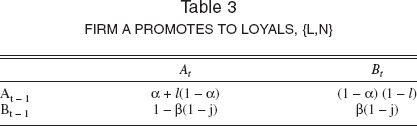
In this scenario, Firm A targets its promotions to be available to potential loyals only (i.e., consumers who purchased Brand A in the previous period). This loyalty effect is expected to decrease the likelihood of customers switching to Firm B, so we specify P(B|A) = (1 – α) (1 – l). 9 Similarly, when Firm A offers a deal to its loyals, the jealousy effect (H4) dictates that it is the repurchase probability for Brand B that decreases, so that P(B|B) = β(1 – j). These two effects can be put forth as in Table 3.
Throughout the model development, for simplicity of exposition, we attempt to express key probabilities as products of factors in the unit interval. This not only allows a compact description of the various effects but also ensures logical consistency, in Naert and Bultez's (1973) sense.
Firm a Promotes to Loyals, {L,N}
Both Brands Promoting
There are essentially three distinct scenarios that must be considered: Both firms promote to switchers, {S,S}; both firms promote to loyals, {L,L}; and both firms promote to different segments, {S,L} and {L,S}. As discussed previously, although a single firm offering an across-the-board price reduction (i.e., deals to both switchers and loyals) need not be considered, there are two scenarios in which the same group of consumers is offered deals by both firms: {S,L} and {L,S}. In these two cases, the effects of both brands promoting do not “wash out,” and repurchase probabilities therefore are not (necessarily) the same as their baseline levels, α and β: The model allows for this possibility without imposing it.
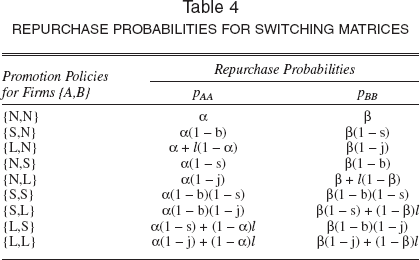
The relevant transition matrices are fully specified by the repeat purchase probabilities for Brands A and B, which appear, for all nine promotional scenarios, in Table 4. When we set the appropriate parameters to zero in Table 4, we obtain the expressions of Tables 1–3, so that the first five rows are straightforward parametric restrictions of the last four. The strong-rationality model suggests that two such parametric restrictions should hold, specifically, betrayal (H3: b = 0) and jealousy (H4: j = 0). Estimating the parameters of the Markov model can test whether these restrictions indeed hold, indicating whether the behaviorist view or the strong-rationality view is the more compelling explanation of promotional effect patterns. Subsequently, we present the results of a choice experiment for which the model's parameters can be estimated using standard methods. Next, we discuss competitive targeting implications deriving from the model.
Repurchase Probabilities for Switching Matrices
Competitive Targeting Implications
In this section, we examine the competitive targeting implications of the betrayal and jealousy effects. We first derive share and profit expressions, for a two-firm market, as functions of a firm's overall promotional strategy and that of its rival. Aided by these expressions, we can place a firm's promotional decision in a game-theoretic context and compare the equilibria that arise when betrayal and jealousy effects are accounted for with those when they are excluded. Then, we explore how the fraction of consumers who are aware of and care about different promotional offers and thus are susceptible to the influence of these two effects may alter competitive interactions. Finally, we explore in more general terms how these two effects might influence competitive targeting strategies in an industry at large.
The Impact of Betrayal and Jealousy Effects on a Firm's Sales and Profits
Let Πihk be firm i's steady-state payoffs given that firm i chooses promotion strategy h and the rival firm chooses strategy k, where h,k = {N,S,L}. To derive Πihk, we note that the transition matrices specified in Table 4 can be used to compute the long-term probabilities of purchasing a brand, and therefore its long-term sales, in a given promotional environment. Analyzing steady-state shares is appropriate and attractive for several reasons and has been used in a variety of prior studies in the sales promotion and stochastic modeling literature (e.g., Feinberg, Kahn, and McAlister 1992; Kahn and Raju 1991; Raju, Dhar, and Morrison 1994). Chief among these is the ability to decouple transient effects—those that come about in firms’ efforts to increase short-term profits—from the long-term profit implications of a promotional policy. Furthermore, considering alternative criteria would necessarily entail a finite horizon (perhaps with discounting), dynamic optimization, and/or the use of fixed, cyclical properties, all of which entail additional parameters and rather pronounced complexities. For these reasons and for consistency with prior studies, we analyze steady-state sales and profit and the most reasonable univariate measures of promotional effectiveness (see, e.g., Dhar, Morrison, and Raju 1996; Krishna and Zhang 1999; Zhang, Krishna, and Dhar 2000).
For illustration, we derive each firm's steady-state payoffs (profits) when Firm A targets switchers while Firm B does not promote. For brevity, we omit detailed derivations for the other cases, which are analogous. We define SalesASN and SalesBSN as Brand A's and Brand B's sales, respectively, when Firm A offers deals to switchers and Firm B does not promote. From Table 2, by normalizing the “size” of the market to equal 1, we obtain

Because Firm A's promotions are targeted at switchers, a fraction of its sales is made on deal. In steady state, sales on promotion are given by

In other words, Firm A's promotional sales are equal to the fraction of Brand B's buyers who switch to A because of its promotional incentives. Firm B's promotional sales, PromSalesBSN, are zero in this case, because it offers no promotion.
Let M be the normal margin for a brand and K the unit cost of redemption, inclusive of any costs of targeting a consumer, handling, and administration. In general, a firm's payoff (profit) can be written as

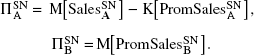
Note that Equation 3 represents steady-state sales in each period and is composed of both promotional and nonpromotional sales.
Figure 1, Panel A, illustrates how sales and profits for Firm A change as a function of the betrayal effect for case {S,N} (i.e., when Firm A targets switchers and Firm B does not promote). Figure 1, Panel B, depicts how sales and profits change because of the jealousy effect for case {L,N} (i.e., when Firm A offers deals to loyals and Firm B does not promote).
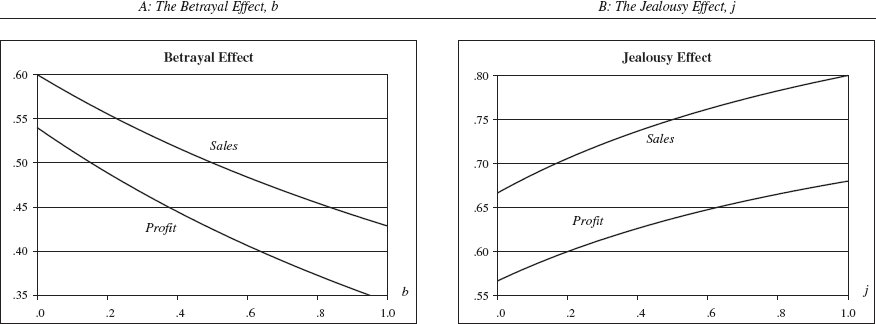
Sales and Profit for Firm a as Functions of the Betrayal and Jealousy Effects
As might be expected, Firm A's sales and profits decrease with the degree of betrayal, which alienates its own loyal customers, and increase with the degree of jealousy, which helps the firm generate incremental sales.
Competitive Equilibria: Strong Rationality versus Behaviorist
A straightforward way to use steady-state analysis in a game-theoretic setting is to construct an infinitely repeated game, in which each of the competing firms chooses its promotional strategy, that is, which segment to target: switchers (S), loyals (L), or neither (N). For the purposes of formal analysis, the firms’ payoffs can be taken to be their steady-state profit values, Πihk, assuming that all consumers in the market are susceptible to the influence of both betrayal and jealousy effects. 10 In this game, in the words of Fudenberg and Tirole (1991, p. 149), because each player “playing its Nash strategy of the stage game from now on” constitutes a subgame perfect equilibrium, we can limit our analysis to the (Nash) equilibria of the stage game, the payoffs of which are given by Equation 3. As a prelude to our more general analysis, we use the parameter estimates arising from the experiment we report subsequently to illustrate competitive equilibria for this model. We first consider a market in which consumers are aware or unaware. Next, we vary the proportion of aware consumers in the market.
Technically, this presumes either that consumers respond quickly to changes in promotional strategy or that firms have a relatively low discount rate for future payoffs.
Competitive Equilibria for Firms in the Experiment
Consider now two firms as in the forthcoming experiment. We compare the results of a Markov model that accounts for switching and loyalty effects only (strong rationality) with one that also accounts for jealousy and betrayal (behaviorism). Recourse to its own payoff matrix (Table 4) enables each firm to assess the impact of its targeting policy choice on the resulting equilibria. The strategy pair (h,k) is in equilibrium if ΠAhk ≥ ΠAik for all i ≠ h and ΠBhk ≥ ΠBhi for all i ≠ k, where i = L,S,N. When multiple equilibria arise, we defer to those for which both firms’ payoffs are strictly greater than what they can obtain in some other equilibrium. Figure 2, Panel A, illustrates the equilibrium strategies for both firms in the behaviorist scenario. So as not to confound the effect of promotion strategies with the effect of relative promotion amount, we take each firm's promotion percentage (K/M) to be the same.

Competitive Equilibria: Strong-Rationality Versus Behaviorist
Figure 2, Panel A, suggests that when promotional percentage (K/M) is high, neither firm promotes in equilibrium. This is consistent with intuition. However, when K/M is low, both firms will choose to target their own loyal consumers. Targeting switchers is not an optimal strategy for either firm in our experimental market. This is because targeting loyal customers generates two favorable effects for a firm: loyalty (retention) and jealousy effects, both of which are sizable. In contrast, targeting switchers in this market alienates loyal customers and results in a large betrayal effect. Thus, when all four effects are accounted for and both firms make use of targeted promotions in this market, the firms would be better off targeting their own (loyal) customers instead of switchers.
We are led to question whether the prescriptions arising from such a behaviorist perspective differ in any significant way from those of strong rationality: If neither firm accounts for jealousy or betrayal effects, are the resulting equilibria the same or different? To address this, we use parameter estimates from our experiment, in which we reestimate the model subject to the joint constraint b = j = 0. These new estimates ({s,l} = {.23,.203}) are then used to derive the competitive equilibria. Figure 2, Panel B, depicts the equilibrium strategies when both firms account only for switching and loyalty effects, not those of betrayal and jealousy. Comparing Panels A and B of Figure 2, we find that in this particular market, ignoring the effects of jealousy and betrayal would lead each firm to target less or even disregard its own loyal customers, becoming overly reliant on promoting only to switchers, and to promote less than it should. 11 This is reflected in the fact that under the “true” behaviorist model, both firms in this market are more likely to choose promotion over no promotion and, when promoting, aim only at loyal customers. Thus, the strong-rationality assumption may lead to errors not only of degree (how much to promote overall) but also of kind (to whom the firm should promote).
For simplicity, targeting a particular segment less refers to the range of promotional percentage, K/M, capable of supporting the equilibrium in question.
The reason for this difference in equilibria is intuitive, if construed correctly. First, failing to take account of betrayal leads a firm to exaggerate the importance of targeting switchers. In such a case, the firm is led to believe that, when offering promotional incentives to switchers only, it will simply benefit from the switching effect and will not suffer from any side effects of alienating its own loyal customers. Second, by ignoring the jealousy effect, the firm fails to appreciate the important side benefit of targeting its own loyal customers: rival firms’ customers becoming disgruntled with their relatively shabby treatment.
Specifically, in the promotional percentage (K/M) range up to 10%, the optimal promotion strategy for both firms in this market is to target their own (loyal) customers, as is shown in Figure 2, Panel A. However, if they ignore betrayal and jealousy effects, both firms perceive, incorrectly, that they can benefit more from targeting the rival's customers (i.e., switchers). This misperception causes both firms to employ the suboptimal strategy of targeting switchers in this market. We can quantify the degree of suboptimality of each firm's mistargeting by calculating its proportional loss in profit as, due to symmetry, (ΠALL – ΠASS)/ΠALL. We find this proportional profit differential to lie between 0 and 1.3% for K/M values in the 0%-10% range. 12 In the higher discount range 10%-19%, one of the firms will mistakenly target switchers, causing a decrease in its profit by 9.5%-10.2%. Therefore, the competing firms ignore the betrayal and jealousy effects at their own peril. Even worse, in the latter case, the other firm benefits from its rival's error, because its best response to the rival's strategy of targeting switchers happens to be the same as its optimal strategy under the true model—targeting its own loyal customers. For example, when Firm B wrongly targets switchers rather than loyals, Firm A's profits increase by 9.4%-10.1% in the same discount range compared with its payoffs when both firms target loyals. 13 Thus, ignorance of betrayal and jealousy effects can also confer competitive advantages to the rival firm.
When Only a Portion of the Market is Aware of Promotions to Others
Thus far, the development has presumed that all consumers are aware of promotions to others and are concerned about them; that is, all consumers experience betrayal and jealousy effects, consistent with the behaviorist model. In reality, only a proportion of consumers may be both aware of deals to others and concerned about such deals (i.e., aware consumers), whereas the rest may know about or care about only deals that they themselves receive (i.e., unaware consumers), consistent with the strong-rationality model.
Let γ represent the fraction of consumers in the market who know or care only about the promotions they themselves receive; these are the consumers who fit the strong-rationality model. The remainder (1 – γ proportion) represent the “aware-and-care” segment: They are aware of and care about promotional deals to themselves and to others and are thus susceptible to betrayal and jealousy effects. For illustration, we consider a specific promotional percentage (K/M), 5%. For this promotional percentage, the equilibrium under strong rationality is (S,S) and that under the behaviorist model is (L,L) (see Figure 2). Figure 3 shows how the competitive equilibrium in this market changes from targeting switchers to targeting loyal customers as more and more consumers become susceptible to the betrayal and jealousy effects (a smaller γ). If the competing firms overestimate γ, say, taking γ to be 85% while its true value lies in the range of 0%-83%, the firm that mistakenly targets switchers can sacrifice profit by up to 9.1%, while the rival firm gains up to 9%.

Competitive Equilibria: Proportion of Customers Who are Aware and Care about Deals to Others
The point to note here is that with a mix of aware-and-care (behaviorist) and unaware/uncaring (strong-rationality) consumers, the equilibrium may be neither the one obtained by assuming that all consumers are strongly rational (S,S) nor the one obtained by assuming that all consumers are behaviorist (L,L); it may be a different equilibrium altogether ([L,S] or [S,L]). Another point of special importance is that the optimal strategy may be very different from the one that assumes all consumers are strongly rational if even a small proportion of consumers are from the aware-and-care segment; in Figure 3, the equilibrium is (S,S) when γ = 100% but is (L,S) and (S,L) for γ < 94%. Thus, the promotional percentage (K/M) and the proportion of aware-and-care consumers both directly influence the optimal strategy of the firm.
If Aware-and-Care Consumers Experience Betrayal, but Not Jealousy
It may be that consumers are aware of deals offered by their favored firm and deals they receive from the rival firm but not of deals offered by the rival firm to its own favored consumers. In this case, the betrayal effect would be expected to hold, but the jealousy effect would not. As a result, we would expect the incentives for a firm to target its own loyal customers to weaken. This is largely because the jealousy effect enhances the sales impact of targeting a firm's own loyal customers by attracting disgruntled customers from the rival firm.
Impact of Betrayal and Jealousy on Competitive Targeting Strategies
We can isolate the impact of betrayal and jealousy on competitive targeting strategies in more general terms to gain a clearer understanding of each effect. To do so analytically, we take as a “benchmark” the case in which betrayal and jealousy are absent: Specifically, we set α = β = 1/2 and j = b = 0. We first derive the conditions necessary for a specific type of equilibrium to exist (in the discount space of Figure 2) and then examine whether a small increase in either the betrayal (b) or jealousy (j) effects will increase or decrease the range of discount rates (K/M) that supports that equilibrium. We conduct this perturbation analysis (Basar 1999) for each of the three symmetric equilibria—(S,S), (L,L), and (N,N).
Such a perturbation analysis (see the Appendix for details) suggests that ignoring behaviorist effects—betrayal and jealousy—can lead to
An excessive or inadequate degree of promotional activity: firms promoting when they should not or not promoting when they should;
A bias toward targeting switchers: targeting switchers rather than not promoting at all;
A tendency to undertarget loyals: not promoting at all rather than targeting loyals; and
Mistargeting: switchers being targeted when loyals should be.
Experiment: Effect of Targeted Promotional Policies on Consumer Preferences
We designed a laboratory experiment that would allow estimation of the parameters for the Markov model specified in Table 4 and that allows tests of H1—H4. 14 Although anecdotal examples (e.g., Amazon) indicate that betrayal effects exist, the relative magnitudes of jealousy and betrayal effects (as well as loyalty and switching effects) are difficult to measure in the field because of many confounding factors. Laboratory experiments offer an appealing way to sidestep many of these factors, even though the usual external validity issues hold.
We also did a second laboratory experiment, involving choice of grounds care services, which yielded similar results; these are summarized in Note 19.
Consistent with our model, we examine a market composed of two relevant firms, identifying two market segments for each—loyals (those who purchased from a particular firm in the last period) and potential switchers (those who purchased from its rival); we elaborate on this subsequently. Each firm had a choice of promoting only to switchers (S), only to loyals (L), or not at all (N).
Design and Subjects
The design was 3 (favored firm: {N,S,L}) × 3 (rival firm: {N,S,L}) between-subjects. At a large Midwestern university, 310 business students completed the experimental task as part of a course requirement. Subjects were presented with descriptions of two competing music downloading services to choose between. The description of services for the two firms was designed to be balanced, so that subjects would not be strongly predisposed to pick a specific firm over its rival, irrespective of price. 15 Otherwise, price specials would fail to “budge” them and would necessitate a prohibitively large sample size.
This was borne out in the choice data: The proportion choosing either firm did not differ significantly from 1/2.
We stress that a laboratory experiment offers less external motivation for subjects and renders them less emotionally involved in the situation than they might otherwise be. Therefore, we anticipate that reactions of jealousy and betrayal would be considerably weaker than for a real-world product or service about which subjects had strong personal feelings and had formed an attachment over time.
For the purposes of arriving at a choice between the two firms, subjects were asked to consider the recent proliferation of online audio distribution services, such as Napster (subsequent debriefing indicated overwhelming levels of familiarity with methods for obtaining digital audio content). They were reminded that, in this new market, competitors would be launching similar services soon and that, as researchers, we were interested in subjects’ preferences for this emerging market. Both firms seemed equally reputable, though some of the particulars of what they offered were slightly different.
Subjects were then given a description of the services provided by the two firms (Table 5) and were asked to choose the firm they preferred overall and to split 100 points between the firms to reflect relative preference. The service descriptions themselves were culled from various Web sites and from online chats with Napster users conducted by one of the authors. Attributes were chosen to be important to users of music download services, and attribute levels were chosen to be generous or nonrestrictive, so that neither service would have an undue advantage (i.e., a feature or feature level some participants could not do without). The descriptions were balanced in the sense that each of the services was superior on the same number of attribute dimensions, and all deviations from one to the other were 20% (as was the eventual pricing manipulation). Finally, pricing policy was chosen to be in line with actual practice—at the time of writing, Napster had teamed with Bertelsmann and was considering a $10/month fee, which we adopted. We considered these multiple safeguards and reality checks important not only to align with respondent expectations but also to ensure that promotional policy was unlikely to be the sole determinant of firm choice.
Comparison of Digital Audio Content Provider Services

Following this task, subjects were told to imagine that several years had gone by and that during the entire intervening period they had engaged the firm they preferred, either A (AudioNet) or B (DigiSonic). They were told that they were generally pleased with this firm and those who chose the other firm claimed that they were also pleased with their choice (so as to maintain balance in positive feedback between the two firms and mitigate potential regret; e.g., Inman, Dyer, and Jin 1997; Tsiros and Mittal 2000). Subjects were then informed that they needed to make a choice for just one additional year; this was done to ensure that the buying situation did not conjure up undue long-term price expectations for either firm, so that subjects’ choices reflected only the promotional scenario for the two periods presented to them. Some new information pertinent to their choice of digital music services was then provided—basically, that prices for the coming (i.e., final) season would be changing, according to the condition the subject was in. After considering an e-mail—which was presented as a Netscape Mail screen shot—from their firm, the other firm, or both firms, announcing the new prices, subjects were again asked for the same choice and preference information (i.e., to choose one firm and split 100 points between the two firms).
We performed manipulation checks to test whether subjects understood which firms offered promotions and to whom in each of the nine conditions. For this, we conducted a pretest, involving 90 subjects, 10 per condition. These indicated that subjects understood the promotions being offered, the general nature of the choice task, and the particulars of the setting. 16 The amount of information presented was similar in all conditions, and the order in which information was presented by the two firms was counterbalanced (order was not significant).
Specifically, after taking the study, subjects were asked a variety of “yes”/“no” questions; among them were the following: whether their favorite firm offered them a deal, whether the other firm offered them a deal, whether their favorite firm offered a deal to another group, whether the other firm offered a deal to another group, and whether they would be able to take advantage of any deals in the future. All but two subjects correctly identified the deals offered (if any) by their own firm and its rival, and none anticipated being asked to make future choices.
Model Estimation
As stated previously, the data consist of prior and posterior choices and preference allocations for each subject. 17 Subjects’ choices were consistent with their preference allocations in all cases; that is, the chosen firm was allocated a higher number of preference points. We estimate the model parameters conditional on the sample (n = 310) as follows: Each of the expressions in Table 4 relates the “posterior” repurchase probability (i.e., preference allocation after seeing the promotional offers, if any) for the favorite brand in terms of the “prior” probability (α or β) and the model parameters. These four parameters {b,s,l,j} are then estimated (along with α and β) to minimize the weighted least squares error between the stated posterior preference allocations and those predicted by the model.
Analysis based on choice data alone proved misleading, as the following scenario illustrates: If two subjects with prior preference for Brand A of 60% and 80% had posterior preference 70%, they would both be counted in the switching matrix as repeat purchasers for Brand A. Thus, accounting for choice alone fails to take note of something so basic as whether the promotional offer causes preference to increase or decrease. Analysis of pure choice data (using standard discrete modeling techniques) produced results consistent in order with those presented here, but all parameter estimates were inflated in magnitude.
Minimization was accomplished through a Newton–Raphson type algorithm; although the dependent variable (the stated posterior probability) is bounded on the unit interval, using a log-odds transform failed to produce appreciably different results. It is further possible to perform this optimization by restricting any set of effects parameters {b,s,l,j} to zero and then to compare results for nested models through Chow tests. Doing so for these data yields the following estimates and tests: where all four parameters are estimated (behaviorist), where each parameter is set separately to zero, where only {b,j} are set to zero (strong rationality), and where all parameters taken together are set to zero (none):
Several conclusions can be drawn from Table 6. The last row tests the remaining six models against the model with all four effects parameters set to zero (none); in all cases, these models yield a far better fit. Noting that the “none” model is a simple first-order repurchase specification, these tests indicate that the subjects did take overall note of the promotional offers available in their environment.
Parameter Estimates and Effects Tests

As these do not nest the strong-rationality model, they are not directly comparable.
p < .001.
The third-to-last row of Table 6 compares each of the remaining models to the behaviorist model, which takes all four effects into account. There is decisive support for the effects predicted under both the strong-rationality and behaviorist models: switching (s = .234, p < .0001) and loyalty (l = .204, p < .0001) significantly increased fit. Subjects were favorably disposed to receiving offers targeted at themselves: Whether the offer was from their favored firm or its competitor, there were strong effects for the offers of which subjects could avail themselves. Because both these effects are expected in a standard economic context, it is not surprising to find confirmation for them here.
However, in contrast with what we have termed strong rationality, subjects were also swayed by offers of which they could not take advantage. We find compelling evidence for an effect that is not predicted under strong rationality, that for betrayal (b = .124, p < .001). Holding aside questions of statistical significance, it is important to bear in mind what this parameter means: In conditions in which betrayal can take place, purchase probabilities were over 12% less than otherwise; in the standard interpretation as a market share reduction, this is a large quantity by any standards. In designing the experimental protocols used here, we took a great deal of care to ensure that subjects understood that they could not, even in principle, gain from switching to the other firm. That they did so is suggestive of something approaching an act of spite toward their own firm, ostensibly for treating others better than themselves. This is consistent with the feelings Amazon's loyal customers expressed in the example provided at the beginning of the article. Moreover, the other effect predicted by the behaviorist model, jealousy, was also significant (j = .119, p < .001), suggesting a sizable decline in purchase probability on this account alone.
Of all the tests, however, we consider the most important to be ones comparing the strong-rationality model with those that nest it (appearing in the second-to-last row of Table 6). These allow an assessment of the additional explanatory power, if any, provided by betrayal and jealousy. Specifically, then, we wish to know whether adding either or both of the excluded effects (b, j, and {b,j}) significantly strengthens the model. In all three cases, the answer is yes: The model that includes only jealousy and not betrayal (the no-betrayal model), the model that includes only betrayal and not jealousy (the no-jealousy model), and the model that includes both (the behaviorist model) fit significantly better (all p < .0001) than does the strong-rationality model. Given the modest experimental sample sizes, we believe that these effects represent compelling evidence in favor of both betrayal and jealousy effects. 18
The other experiment, with 287 participants, yielded remarkably similar results, though the product type was considerably different. Estimated values were s = .272, l = .195, b = .078, and j = .061, which are identical in effect rank order and similar in magnitude. Moreover, all relevant model comparisons were significant at the p < .05 level or better. Additional details are available from the authors.
Summary
The pattern of experimental results strongly suggests that consumer preferences for a firm are affected by the overall set of prices it offers—not only to the consumers themselves but also to other groups of potential purchasers. Specifically, we find evidence of a betrayal effect: Consumers prefer their favored firm less if it offers a promotion to switchers. We also find evidence for a jealousy effect, by which consumers prefer their favored firm less if another firm offers a price decrease to its own loyal customers. These findings are difficult to reconcile with the classic Hicksian view of demand (e.g., Irvine and Sims 1998), unless we explicitly incorporate a disutility for perceptions of being treated unfairly.
Note, however, that in the experiment, we made subjects aware of deals that the other firm (the firm they did not buy from) gave its loyals. In real life, although consumers may become aware of deals from their favored firm to switchers, they may not be aware of deals by other firms to their loyals. In this case, we would expect jealousy effects to be weaker and would predict competitive implications as discussed previously. Also, if firms give deals to switchers but inform their loyals that the additional consumers will yield economies of scale and other externalities or that high switching costs necessitate this deal, betrayal effects may also be weaker. However, as mentioned previously, betrayal effects may also be stronger in the real world versus the experiment, because consumers will be emotionally attached to firms and products.
Conclusions and Potential Extensions
The advent of information technology has hastened the demise of an undifferentiated approach to marketing. New information-intensive approaches, reflected in such catch-phrases as “mass customization,” “segments of size one,” and “micromarketing,” treat each consumer as a market unto himself or herself, in which promotions, advertising messages, and even products are tailored to individual tastes. In adopting the standard economic theory of consumer choice, prior research on targeted promotions has tacitly assumed that the choice of products or firms is dependent only on the prices consumers can avail of and so may neglect to account for perceptions of unfairness. The objective of the present article is to systematically account for the possibility of the type of backlash that targeted promotional strategies may generate.
We propose and find experimental confirmation for effects that are consistent with the strong-rationality economic paradigm, switching and loyalty, as well as for two that are not, jealousy and betrayal, which support a behaviorist viewpoint. We show that a firm's strategy will be different when it fails (consistent with the strong-rationality paradigm) to account for consumers comparing prices offered to them with prices offered to other segments (behaviorist paradigm). Thus, if consumers specifically account for prices offered to other segments but managers presume otherwise, the managers’ targeting strategy can be markedly suboptimal. We demonstrate that under strong rationality, the importance of targeting switchers is exaggerated and the impact of targeting loyal customers is slighted. For example, in scenarios in which the strong-rationality approach would suggest deals to switchers, a behaviorist approach may advocate deals to loyals or no promotions at all. Our model has implications for a game-theory research at large, in suggesting that in many situations, managers need to consider not just absolute payoffs but also relative ones. This argument is also consistent with empirical tests of ultimatum games, in which relative payoffs have been found to matter (Camerer and Thaler 1995).
Although the Internet has greatly increased the likelihood of consumers finding out about deals offered to others, it has not increased it to a certainty: Many consumers may remain unaware of competitive promotions or do not care much about them. As such, we considered the important case in which only a fraction of the market consists of aware consumers and the rest remain unaware (and so cannot avail of information on competitive promotions, consistent with strong rationality). In this market, we find that the optimal strategy can differ from the ones advocated when all consumers are presumed strongly rational or are behaviorist. Thus, we show that both the discount percentage and the proportion of aware consumers affect the optimal strategy of the firm. Also, we find that the existence of even a small proportion of aware consumers in the market can change the optimal strategy from one consistent with a strong-rationality approach. We believe this finding to be especially intriguing, suggesting as it does that the nature of equilibria and optimal policies can hinge on a small set of consumers and the deals they happen to have found out about.
The model also suggests that offering lower prices to switchers may not be a sustainable practice in the long run, because with the passage of time, a larger and larger proportion of consumers may become aware of prices to other segments. This may be why AT&T recently decided to renounce its targeted pricing practice of offering lower prices to switchers and now offers equal rates to all customers (Scheisel 1999). The present model therefore suggests that managers should consider the long-term effects of their targeted promotional strategy alongside its short-term effects.
However, our results also suggest that a practice of offering lower prices to switchers may be sustainable in certain industries: where information flow tends to be slow, where there are barriers to the free exchange of information (e.g., stricter Internet-based privacy laws), where consumers believe it is not in their interest to actively take note (e.g., they consider this a sensible switching cost or want to increase market size for network externalities or economies of scale that will lower prices for all), or where firms can explain price differences for motives other than profit gain (e.g., Campbell 1999).
Some firms attempt to sustain a targeted pricing practice by “hiding” the fact that price offers differ. This is consistent with the strategy of the direct marketing firm mentioned in the introduction, which tries to ensure that people on the same street and block receive only similar offers. Note that whereas switchers may be tolerant of loyals paying a lower price (perhaps accepting that loyalty should be rewarded), loyals may be less tolerant of switchers paying a lower price. 19 Switchers paying a lower price is, simply put, akin to loyalty being penalized. Therefore, it seems that extending better offers to switchers may best be kept quiet, whereas there may be less need to hide better offers to loyals; indeed, our model suggests that if jealousy effects are strong, a firm may even wish to publicize its promotion strategy.
In our experiment, repurchase probability of loyals decreased to a larger extent when a deal was given by the favored firm to switchers (betrayal effect) than switching probability for switchers decreased when the other firm gave a deal to loyals. Indeed, the latter increases, not decreases, because of the jealousy effect. We thank a reviewer for bringing this to our attention.
One policy implication of our analysis is that in environments where the aware-and-care segment is likely to be large, manufacturers may not want to practice targeted pricing. As we discuss previously, this is more true when deals are given to switchers than to loyals. Switchers do not typically get upset when loyals receive deals, because this represents loyalty being rewarded, which seems fair. However, loyals feel betrayed when they do not receive deals and switchers do. If firms offer deals to switchers in markets where the aware-and-care segment is large, they may instead want to offer the promotion to everyone with the hope that only switchers will avail themselves of it; that is, the price discrimination should occur by self-selection on the part of consumers. Self-selection of switchers is more difficult than self-selection of loyals (commonly practiced, for example, through in-pack coupons and loyalty programs). One way to target switchers, which may be less blatant than an open deal to them only, is by issuing coupons or mail-order rebates to consumers who buy other brands, without stating that these coupons are only for switchers. This is akin to what firms do at many checkout counters using Catalina Marketing software or by mail using loyalty card data, as CVS currently does.
Our research echoes Lettau and Uhlig's (1999) concern that there is a need for an alternative paradigm, one that is consistent with both observed behavior and psychological theory in the large. This concern, which forms the core of our hypotheses, has been foreshadowed by research in several disciplines, notably the social psychology of relative deprivation, perceived fairness, and equity. Recently, Kaufman (1999) has suggested that the behaviorist view can arise not only from cognitive constraints but also from emotional reactions in a variety of contexts. We believe that the effects documented here—effects generated by promotional offers of which consumers could not take advantage even in principle—are precisely of the type Kaufman addresses.
This melding of research traditions from social psychology, economics, and marketing is made possible through recourse to a variety of approaches: Although the stochastic model is based on current theorizing in social psychology and economics, the data from a choice experiment allow estimation of the model's effects and therefore tests of our focal hypotheses. Finally, a game-theoretic analysis enables us to delineate what might be termed the pronouncements of the model—which managerial practices seem prudent in light of behaviorist effects. We believe that the richness of the results presented here would have been difficult to achieve without such a multifaceted methodological approach.
There are several limitations to the present study. We have used steady-state payoffs to derive the competitive strategy implications. This assumes either that consumers respond quickly to changes in promotional strategy or that firms have a relatively low discount rate for future payoffs. Determining equilibria when these assumptions are relaxed would necessitate a differential games framework that would be intractable.
We have also assumed a first-order model, so that consumers’ switching and repurchase probabilities are dependent only on what they did in the prior period. However, the longer consumers stay with a brand, the less likely they may be to switch (encountering higher switching costs or not paying attention to deals from other firms, which diminishes jealousy effects), which would necessitate a higher-order model and multiple consumer segments (not merely loyals and switchers). In such a scenario, firms may wish to offer better prices to consumers with moderate loyalty, rather than to those with high loyalty. 20 In addition, the magnitude of betrayal effects for loyals may be different depending on how often the switchers have purchased their favored brand in the past. A higher-order Markov model could readily account for such differences.
We thank a reviewer for bringing this to our attention.
The model and experiment presume that loyalty, switching, betrayal, and jealousy effects are symmetric. The model can easily be extended to incorporate asymmetric effects across the brands, entailing four additional parameters. Estimating such a model on our experimental data yielded negligible effects on fit over the symmetric model; this was likely because the actual effects for the two firms were rather similar. However, even had they not been, the qualitative implications of the model would not be expected to change, though the actual equilibria for a specific set of parameter values might well do so.
To identify the main actors and forces at work, we have resorted to a two-firm, two-segment (loyal, switcher) market, in which firms can promote to loyals, promote to switchers, or not promote. Although a rich set of phenomena arises from a game-theoretic treatment of even such a simple model, it must be admitted that in real-world markets, there are typically more than two relevant firms and more than two segments of consumers, which makes promotional planning a far more complex affair. Firms must contend with multiple consumer segments and competitors, each with its idiosyncrasies, and promotions themselves come in many forms. Firms could, for example, give promotions to more than one segment but vary the amount of the promotion. Any of these dimensions provides a clear direction for extending the present model.
Even given the limitations of the model used here, the type of concerns raised for targeted promotions has no precedent in the extant literature. We believe that this provides a compelling first step toward modeling managerial decision making of a behaviorist type, in which consumers make predictably suboptimal decisions from the strong-rationality perspective.
Footnotes
Appendix
We conduct a perturbation analysis (Basar 1999) for each of the three symmetric equilibria, (S,S), (L,L) and (N,N).