







Abstract
Electronic agents have the capacity to help consumers discover new products and generate demand for unfamiliar products. This article explores how consumers respond to recommendations of unfamiliar products made by electronic agents. Two studies using simulated music shopping agents show that (1) additional recommendations of familiar products serve as a context in which unfamiliar recommendations are evaluated; (2) when the presentation of the recommendations makes unfamiliar and familiar products appear similar, evaluative assimilation results; and (3) when additional information about unfamiliar products is given, consumers discriminate them from the familiar products, which produces evaluative contrast. These results establish that information that leads to higher evaluations when context is absent can lead to contrast and lower evaluations in the presence of attractive contextual recommendations.
The Internet offers consumers access to many alternatives with relatively low search costs. Authors have suggested that as the information available on the Internet increases, consumers increasingly will turn to particular sites and technologies that can filter and summarize the alternatives (Alba et al. 1997; Maes 1999; West et al. 1999). Electronic agents are software programs that are designed to help consumers sort through available products on the Internet. They perform a variety of tasks, including defining needs, forming consideration sets, making recommendations, and negotiating purchases (West et al. 1999). We focus on agents that review products and present recommendations based on the preferences of the user. We examine how recommendation set composition and information about the recommended products affect consumer preferences for unfamiliar products and suggest how agent recommendation sets should be constructed to increase consumer demand for new products.
Many existing Web sites offer consumers recommendations. Increasingly, electronic retailers are incorporating agents to provide personalized recommendations to their customers. These agents use the customer's individual preferences to provide a more attractive set of recommendations. Thus, unlike traditional electronic retail sites, which function primarily as catalogs, these electronic agents, similar to competent salespeople, adapt to the needs of their customers (Sujan, Sujan, and Bettman 1988; Weitz 1978). We explore how consumers react to unfamiliar recommendations made by electronic agents.
We focus on recommendations of unfamiliar products for several reasons. First, unfamiliar recommendations represent an important source of business. Second, behavioral research suggests that consumers view unfamiliar recommendations negatively (e.g., Park and Lessig 1981). If unfamiliar products are more difficult to sell, selling them may have negative consequences for the retailer, which must be avoided. Third, because consumers do not possess strong preexisting beliefs about unfamiliar alternatives, these alternatives are likely to show the greatest response to managerial strategies that attempt to position the products.
The Role of Recommendation Context: Assimilation and Contrast
Imagine a consumer is shopping for rock compact discs (CDs) at a site that uses an electronic agent. The site has a profile of that person's listening preferences based on his or her past purchases, search behavior, and answers to overt questions that indicate that he or she is a fan of both rock and jazz. The agent recommends Spirits in the Field by the Arthur Blythe Trio. The consumer is unfamiliar with both the CD and the artist. If no other information is provided, he or she is unable to evaluate the CD and is unlikely to buy it.
If the agent recommends the unfamiliar CD with other more familiar titles, the consumer will be better able to make an evaluation. If the familiar CDs are ones that the consumer owns and listens to, he or she may infer that the unfamiliar CD is of similar quality (and may be similar on more tangible dimensions). Although it is unlikely that the consumer will purchase familiar CDs if he or she already owns them, the CDs may serve as a context relative to which the consumer evaluates the unfamiliar CD.
Context has been shown to affect preference for familiar stimuli (e.g., Cooke and Mellers 1998; Simonson and Tversky 1992) and help consumers interpret unfamiliar stimuli (e.g., Sen 1998; Wright and Rip 1980). Researchers have noted that the Internet affords an ideal medium in which to exploit the effects of context (Peterson, Balasubramanian, and Bronnenberg 1997). Unlike interactions with human agents, for which cues relating to process and motivation exist, the algorithms by which electronic agents make their recommendations are not obvious to the consumer. Consequently, consumers may evaluate electronic agents primarily on salient contextual cues—the recommended alternatives. If these CDs are familiar and well liked, they may convey to the user that the agent understands his or her preferences.
How might recommendation context affect the evaluation of unfamiliar recommendations? If consumers adjust their evaluation of the unfamiliar recommendation in the direction of the familiar recommendations, they engage in assimilation. Assimilation is likely when consumers process all recommendations as a group, fail to distinguish among the recommendations, or believe that all recommendations result from a single algorithm. If consumers adjust their evaluation of the unfamiliar recommendation in the direction opposite that of the familiar recommendations, they engage in contrast. Contrast is likely when consumers perceive differences among recommendations, consider recommendations as competing purchase alternatives, or otherwise compare recommendations. Comparisons tend to focus on the differences that exist between alternatives and magnify any existing differences (Tversky 1977; Tversky and Gati 1978).
Much work has investigated the conditions in which assimilation and contrast are observed. This literature shows that it is possible to alter the processing of contextual information such that the same context produces assimilation in one situation and contrast in another (e.g., Biernat, Manis, and Kobrynowicz 1997). A variety of factors have been found to affect processing, including the timing of information (Jordan and English 1989), the descriptive information provided (Fiske 1998), the availability of a salient referent (Abele and Petzold 1998; Biernat, Manis, and Kobrynowicz 1997; Stapel and Koomen 1998), and the cognitive resources available to the consumer (Meyers-Levy and Tybout 1997). In general, factors that tend to emphasize the similarity between the target and the context or cause people to consider target and context items as a unit result in assimilation, whereas factors that emphasize the differences between target and context or cause people to compare context with target result in contrast (Bless and Waenke 2000; Stapel and Koomen 1998; Stapel, Koomen, and Velthuijsen 1998; Stapel and Winkielman 1998). Previous research has examined information that is descriptively discriminating but evaluatively neutral (Fiske 1998). We extend this research to show that information per se can be individuating and that positive individuating information can either raise or lower evaluations of unfamiliar products through assimilation or contrast.
The Role of Item-Specific Information
Another technique that electronic agents use to increase the attractiveness of unfamiliar recommendations is to provide users with additional information about the new product (Alba et al. 1997). In some cases, this information is based on other consumers or critics. For example, a book retailer might provide average ratings of the book submitted by readers or reader testimonials. In other cases, the Web site may allow the consumer to experience particular characteristics of the product more directly. Book retailers often provide excerpts from the book and pictures of the book jacket. Recent advances in computer software and hardware have enabled retailers to provide consumers with experiential information about their products, including audio and video samples.
There is reason to believe that providing consumers with additional information about recommended products will benefit the recommending site. To the extent that a retail site offers more information than other retail sites, that retailer should be preferred. But what is the impact of this additional information on the consumer's evaluation of unfamiliar recommendations? On the one hand, providing additional information may make unfamiliar recommendations more attractive because it highlights positive qualities of the product. On the other hand, the information provided, though positive, may serve to distinguish the unfamiliar recommendation from more familiar recommendations, resulting in contrast (e.g., Stapel, Koomen, and Velthuijsen 1998; Stapel and Winkielman 1998). We predict that when information distinguishes the unfamiliar recommendations from the familiar recommendations and comparison is easy, contrast will occur, thereby resulting in lower evaluations of the unfamiliar recommendations. However, if positive individuating information is omitted or the information provided makes unfamiliar and familiar recommendations appear similar, assimilation will occur, thereby resulting in higher evaluations of the unfamiliar recommendations.
When electronic agents provide a context of familiar, attractive recommendations and present the unfamiliar recommendations without item-specific information, assimilation will occur and result in higher evaluations of the unfamiliar recommendation.
When electronic agents provide a context of familiar, attractive recommendations and present item-specific information, consumers will contrast unfamiliar and familiar recommendations, which will result in lower evaluations of the unfamiliar recommendation.
To summarize, we argue that the evaluation of unfamiliar recommendations depends on recommendation context and individuating information. These hypotheses jointly imply that providing a context of well-liked recommendations and positive individuating information about the new items decreases their perceived attractiveness.
Context and Informational Influences on Agent Evaluations
How might consumers evaluate electronic agents? Unfamiliar recommendations are unknown to the user and therefore possess little diagnostic value for assessing the agent. In contrast, familiar recommendations are well known to the user and can be used to judge the accuracy of the agent. An agent that recommends many CDs that are liked by the user should be judged accurate by that user.
Agent evaluations will be higher when they provide a set of familiar, attractive contextual recommendations than when they do not.
Will item-specific information affect agent evaluations? It is likely that consumers prefer agents that provide them with additional information. However, this result may depend on the salience and quality of contextual recommendations. H3 suggests that familiar, well-liked CDs may exert a disproportionate influence on agent evaluations. If so, we may find that providing information about unfamiliar CDs is only valuable when the agent does not provide a salient context. When contextual cues are available, additional information about the unfamiliar CDs is deemed unnecessary.
Agent evaluations will be higher when they provide positive item-specific information only in the absence of a context of well-liked, familiar recommendations.
In this article, we report the results of two studies that are designed to investigate the effects of two agent design variables: recommendation context and item-specific information. We examine the effects of these variables on the attractiveness of unfamiliar recommendations and the electronic agent. We use agent interfaces of our own construction that parallel existing electronic agents. Our research extends the theoretical work on assimilation and contrast, especially by examining the role of positive information in the process of evaluative contrast. It extends the work on source effects by exploring processes by which a recommending source and its recommendations may be evaluated differently.
In Study 1, we present unfamiliar recommendations in isolation or combined with familiar, well-liked recommendations. We also decrease the salience of contextual items by presenting the contextual and unfamiliar items on different screens. Finally, we provide positive individuating information about unfamiliar recommendations. We find that unfamiliar recommendations result in assimilation to a salient recommendation context in the absence of individuating information and contrast in its presence. Agent evaluations are consistently more favorable in the presence of familiar, well-liked recommendations.
In Study 2, we directly test the role of item-specific information in contextual processing. Consistent with our theory, we show that unfamiliar recommendations are judged less similar to familiar recommendations in the presence of item-specific information and that the effects of information on similarity mediate the relationship between information and evaluations of unfamiliar recommendations. These studies provide insight into the role of context and item-specific information in the evaluation of unfamiliar recommendations and underscore the relevance of using principles of information processing to understand consumers' reactions to electronic commerce innovations.
General Method
In both studies, we used similar methods. Each involved two sessions. In the first session, subjects completed a pencil-and-paper questionnaire purporting to study preferences for music. Subjects reviewed a list of 100 popular CDs spanning many musical genres. Subjects were first asked to identify 10 CDs that they liked very much. They were then asked to rate their familiarity with and liking of these CDs. Unbeknownst to the subjects, these data were used to construct the recommendations they were shown in the second session.
In the second session, subjects were asked to interact with an electronic agent. A computer program first asked them a variety of questions about their music preferences. They were asked what musical genres they liked and to compare different artists. They were also asked their age, sex, and the zip code in which they grew up. Then they saw a status bar indicating that the agent was building a preference profile for them. These steps were taken to increase subjects' beliefs that they were interacting with an actual electronic agent.
After these steps were complete, subjects were given a set of recommended CDs. In all conditions, two unfamiliar CDs were recommended. In some conditions, familiar CDs selected from subjects' responses to the first session survey were included. Because music preferences are idiosyncratic, each subject received six familiar CDs that he or she rated as most attractive. Thus, though the identity of the familiar CDs varied from subject to subject, the degree to which each subject liked the familiar recommendations was controlled. Some subjects were also presented with information about the unfamiliar CDs, though different information was presented in each study.
Subjects then evaluated each of the unfamiliar CDs and the agent's accuracy. Subjects also rated the similarity between familiar and unfamiliar items in Study 2. All subjects were asked to describe how they thought the agent had developed their recommendations.
Study 1: Item-Specific Information and Recommendation Context
Study 1 examined how music samples for unfamiliar CDs affected evaluations of the CDs and the agent. H1 predicts that in the absence of item-specific information, consumers will assimilate unfamiliar CDs in the direction of familiar CDs. H2 predicts that when item-specific information is provided, it will lead consumers to contrast the unfamiliar and familiar CDs, even though the information provided is viewed favorably in and of itself. We also examined a man-agerially relevant boundary condition, the grouping of recommendations, that we predicted would affect the salience of contextual comparisons.
Designers of electronic agents have considerable flexibility in how they present recommendations and information about those recommendations, and some formats may be better than others. In particular, it is possible to present information in ways that either emphasize or deemphasize contextual comparisons. For example, an electronic agent could present all recommendations simultaneously on the same page. This organization makes the contextual recommendations especially salient and increases the ease with which recommendations can be compared. Alternatively, an electronic agent could present recommendations sequentially, with different recommendations appearing on different screens, which would make it harder to compare the items.
How might the temporal organization of the recommendations affect the use of context? Some research suggests that context has impact only when it is salient (cf. Taylor 1979). This research implies that because contextual comparisons are more salient when the context and target recommendations are presented simultaneously, the effects of context should be amplified. When context and target recommendations are presented on the same screen and individuating information is absent (present), assimilation (contrast) should result. Assimilation and contrast should be less when context and target recommendations are presented on separate screens. This does not necessarily imply that assimilation and contrast will not occur with sequential presentation, only that the assimilation and contrast obtained should produce smaller effects than with simultaneous presentation.
Perceptual research, in contrast, suggests a different result of presentation format. Studies of perceived line length (Jordan and English 1989) and face perception (Wedell, Parducci, and Geiselman 1987) have shown that the simultaneous presentation of context and target tends to result in assimilation of the target toward the context, whereas sequential presentation of context and target tends to produce contrast. This work predicts that unfamiliar recommendations will be judged as more attractive in the simultaneous format but less attractive in the sequential format. Because this work has not examined the effects of individuating information, our research also addresses the boundary conditions of presentation format and its interaction with item-specific information.
In summary, we predict that for evaluations of unfamiliar items, the effect of context will be such that when item-specific information is absent, assimilation occurs (H1), and when item-specific information is present, contrast occurs (H2). Furthermore, we predict that presenting familiar and unfamiliar recommendations sequentially decreases the effects of context compared with the simultaneous conditions. The design of Study 1 enables us to examine both hypotheses relating to agent evaluations. Specifically, we predict a disassociation between item and agent evaluations such that agent evaluations are primarily influenced by the presence of a familiar context rather than by information about unfamiliar alternatives or their presentation (H3) and that item-specific information plays a role in agent evaluations only in the absence of context (H4).
Method
Study 1 used a 3 (context) × 2 (information) between-subjects factorial design. In the familiar recommendations absent condition, subjects saw only the two unfamiliar recommendations. In the sequential condition, subjects first saw six high-preference CDs on one screen. They clicked a “Continue” button and then saw two unfamiliar recommendations on a different screen. In the simultaneous condition, subjects saw six high-preference familiar CDs and two unfamiliar CDs on the same screen. In the information present condition, subjects heard a short music clip (approximately ten seconds in duration) prior to evaluating each of the unfamiliar CDs. Clips were not provided in the information absent condition.
Two music clips were selected on the basis of pretesting. We pretested a set of instrumental clips to select those that were considered attractive (mean ratings of 6.1 and 6.4 on seven-point scales, where 7 was “like very much”) but unfamiliar (mean ratings of 1.9 and 2.0 on seven-point scales, where 7 was “very familiar”). These clips (from a Dutch Web site) were randomly assigned to each of the unfamiliar CD titles. All subjects in the information present conditions heard the same clips.
A total of 118 subjects from a large northeastern university participated in Session 2. Of these, 83 had also completed the first session survey. A total of 13, 12, and 14 subjects participated in the simultaneous, sequential, and context absent conditions without music, respectively, and 16, 14, and 15 participated in the corresponding conditions with music.
Results
As was anticipated, providing music clips had a statistically significant effect on subjects' ratings of the unfamiliar recommendations (F1,78 = 21.0, p < .001, ω2 = .178). There was no statistically significant main effect of context (F2,79 < 1, n.s. [not significant], ω2 = .000), but there was a statistically significant interaction between context and information (F2,79 = 6.00, p < .01, ω2 = .062). We explore the nature of this interaction by examining simple effects of context for each level of information.
Context effects in the absence of item-specific information
H1 predicts that when no item-specific information is provided, consumers tend to assimilate unfamiliar recommendations in the direction of the contextual recommendations and judge them more positively. However, we also predict that this effect will be stronger when context is more salient (simultaneous condition) and decline as context becomes less salient (sequential condition) or absent. Mean ratings of the unfamiliar CDs are shown in Figure 1. Error bars represent one standard error of the mean.
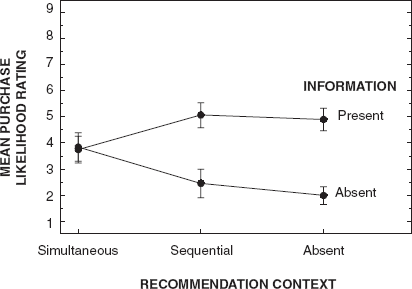
MEAN PURCHASE LIKELIHOOD RATINGS FOR UNFAMILIAR CDs AS A FUNCTION OF CONTEXT AND ITEM-SPECIFIC INFORMATION
Across unfamiliar CDs in the information absent condition, mean ratings were 3.84, 2.46, and 2.00 in the simultaneous, sequential, and context absent conditions, respectively. The difference between the simultaneous and absent conditions was statistically significant (t25 = 2.25, p < .05, ω2 = .215). When context was present and salient, subjects assimilated the unfamiliar recommendations in the direction of the attractive contextual recommendations, consistent with H1. The difference between the simultaneous and sequential conditions was statistically significant (t23 = 1.80, p < .05, ω2 = .082), whereas the difference between the sequential and context absent conditions was not (t24 = .74, n.s., ω2 = .000). Thus, assimilation was observed when all CDs were presented simultaneously but not when CDs were presented sequentially.

MEAN AGENT RATINGS AS A FUNCTION OF CONTEXT AND ITEM-SPECIFIC INFORMATION
Context effects in the presence of item–specific information
H2 predicts that when item-specific information about alternatives is provided, consumers will tend to contrast unfamiliar and familiar recommendations, which will result in lower ratings for the unfamiliar recommendations. Furthermore, we expect that this effect will be stronger when context is more salient. Thus, we predict that unfamiliar recommendations will be judged more positively when positive item-specific information is available and the context is weak (sequential condition) or absent than when the recommendation context is present and salient (simultaneous condition).
Across unfamiliar CDs in the information present condition, mean ratings were 3.75, 5.07, and 4.90 in the simultaneous, sequential, and context absent conditions, respectively. The differences between the simultaneous condition and the other two conditions were statistically significant (t28 = 1.86, p < .05, ω2 = .076 for simultaneous versus sequential, and t29 = 1.70, p < .05, ω2 = .057 for simultaneous versus absent). The difference between the sequential and absent conditions was not statistically significant (t27 = .26, n.s., ω2 = .000). The evidence is consistent with H2; when music clips are available, providing a positive and salient recommendation context results in lower ratings of the unfamiliar recommendations, a contrast effect. However, this effect appears labile; simply separating the familiar and unfamiliar recommendations onto separate pages causes the contrast effect to disappear.
Context versus item-specific experience
Another way to view these data is to consider whether recommendation context overshadows the effects of item-specific information. Subjects tended to view unfamiliar CDs as more attractive when they had additional information about them, even when that information consisted of only a short music sample. The main effect of information was statistically significant (F1,78 = 21.0, p < .001, ω2 = .178). When recommendation context was absent or less salient (sequential condition), the effects of information were pronounced (t24 = 3.6 in the sequential condition and t27 = 5.2 in the absent condition, both ps < .001, ω2 = .315 and ω2 = .473, respectively). When recommendation context was available and salient (simultaneous condition), however, item-specific experience was not statistically significant (t27 = .13, n.s., ω2 = .000). This result suggests that though recommendation context may be beneficial in particular situations, it may also serve to overshadow any positive experiential information provided. The size of this effect is expected to depend on the evaluative strength of the information provided.
How do context and information affect agent evaluations?
The preceding results suggest that well-liked contextual recommendations can make unfamiliar recommendations appear more or less attractive, depending on whether item-specific experience is provided. Do context and item-specific experience also affect agent evaluations? Mean agent evaluations are shown in Figure 2. We find statistically significant main effects of context (F2,78 = 44.2, p < .001, ω2 = .448) and information (F1,78 = 6.5, p < .01, ω2 = .029), as well as a statistically significant context × information interaction (F2,78 = 10.67, p < .001, ω2 = .085). When no item-specific information was provided, the mean agent ratings were 7.9, 7.2, and 1.7 in the simultaneous, sequential, and context absent conditions, respectively. The differences between the context absent condition and the other two conditions were statistically significant (t25 = 16.5, p < .001, ω2 = .910 for simultaneous versus absent, and t24 = 8.06, p < .001, ω2 = .711 for sequential versus absent), whereas the difference between the simultaneous and sequential conditions was not (t23 = .86, n.s., ω2 = .000).
When music clips were provided, mean agent evaluations followed an identical pattern and were 7.5, 7.1, and 5.3 in the simultaneous, sequential and context absent conditions, respectively. Again, the differences between the agent ratings in the context absent and the other conditions were statistically significant (t29 = 2.92, p < .01, ω2 = .195 for simultaneous and t27 = 1.99, p < .05, ω2 = .093 for sequential), but the simultaneous versus sequential difference was not (t28 = .68, n.s., ω2 = .000). Finally, agent evaluations were higher when information was provided in the context absent condition. The difference in agent evaluations was statistically significant in the absent condition (t27 = 4.65, p < .001, ω2 = .416) but not in the other two contexts (t27 = 1.09 for simultaneous and t24 = .1 for sequential, both ps > .1, ω2 = .006 and ω2 = .000, respectively).
These results indicate that subjects prefer agents that provide attractive recommendations, consistent with H3. They also show that providing additional information has no impact on attitudes toward the agent when attractive contextual recommendations are available, consistent with H4.
Discussion
One approach to increasing the attractiveness of unfamiliar items it to provide consumers with positive experiential information that relates specifically to the product. As technology improves and diffuses, it is becoming increasingly easy to provide consumers with this sort of information through their Web browser (at least for particular product categories). But how do item-specific information and recommendation context interact to determine the attractiveness of an unfamiliar suggestion?
Study 1 shows that the same context of familiar recommendations can affect the evaluation of an unfamiliar recommendation in different ways depending on the information provided. When item-specific information is absent, consumers tend to assimilate unfamiliar recommendations in the direction of a salient recommendation context. When item-specific information is provided, consumers tend to contrast familiar and unfamiliar recommendations, which results in lower item evaluations. These contextual effects appear quite sensitive to temporal factors; presenting familiar and unfamiliar recommendations on different screens eliminated both assimilation and contrast. Our findings of assimilation and contrast do not extend to ratings of agent competence, which are driven by the presence or absence of high-quality recommendations. Positive experiential information affects agent evaluations only when context is absent.
In summary, Study 1 shows that providing item-specific information can alter how consumers process contextual recommendations and reverse the effects of context on unfamiliar recommendations. However, it does not provide direct evidence of the underlying mechanism that results in assimilation or contrast. In Study 2, we show that providing item-specific information about unfamiliar recommendations causes consumers to view them as less similar to familiar recommendations and that this effect mediates the effect of item-specific information on product evaluations.
Study 2: Recommendation Similarity and Contextual Effects
Study 1 indicates that familiar recommendations can provide a context relative to which unfamiliar recommendations are evaluated and that either assimilation or contrast can result. Prior research has shown that assimilation occurs when consumers view the familiar and unfamiliar recommendations as similar or of the same type, whereas contrast is invoked when consumers view familiar and unfamiliar recommendations as different sets (Biernat, Manis, and Kobrynowicz 1997; Stapel and Koomen 1998; Stapel and Winkielman 1998). We propose that providing item-specific information causes consumers to classify familiar and unfamiliar CDs differently, thereby increasing the salience of any differences that exist between the items. Although Study 1 shows contrast when item-specific information is presented and assimilation when it is absent, it does not provide direct evidence of the mediating effect of similarity. It is important to demonstrate the role of similarity for two reasons. First, such a demonstration would serve to validate the theory on which our predictions are based. Second, there are many other factors under managerial control that may affect similarity and are therefore potentially dependent on the presence of contextual stimuli.
Note that the predicted effect of similarity is counterintuitive. The information provided was perceived to be generally positive, as were the contextual recommendations. Thus, it is natural to believe that providing this information will make the alternatives appear more similar. Research in contextual effects argues that item-specific information, because it is necessarily unique, will decrease rather than increase the perceived similarity of the recommendations.
Method
In Study 2, we assess subjects' perceptions of the similarity between familiar and unfamiliar CDs. In addition, we ask subjects to estimate their reservation price for each of the unfamiliar CDs so that we can examine the managerial significance of these effects. We use the simultaneous and context absent conditions from Study 1. 1 These two levels of context were crossed with two levels of information about the unfamiliar CDs. In the information absent condition, only the names of the artist and the titles of the CDs were provided. In the information present condition, subjects were also given a short biography of the band, a picture of the band or CD cover art, and a 30-second clip of music from the CD. Thus, the information present condition in this study closely resembles the information that is typically available when purchasing CDs from online retailers.
We also manipulated the salience of contextual recommendations by including a condition that explained that recommendations were formed by a collaborative filtering algorithm. Because this manipulation produced no statistically significant differences, we collapse the cells in which contextual recommendations are presented in our analysis.
Subjects answered the same preliminary music preference questions as in Study 1. Following this, they were shown a set of recommendations on a single page. Subjects in the information present condition were told to click on each unfamiliar CD to receive additional information about the artist. Subjects were not permitted to continue to the dependent measures until the information had been accessed for both unfamiliar CDs. Subjects then rated their likelihood of purchasing each of the unfamiliar CDs and reported the maximum value they would pay to buy that CD. Subjects in the related and unrelated conditions rated the similarity of the first unfamiliar CD to each of the first three familiar CDs and of the second unfamiliar CD to each of the second three familiar CDs in random order. No differences existed among pairwise similarity ratings, so the six measures were averaged to produce a single similarity index. Subjects then rated the agent and were debriefed.
A total of 101 undergraduate students at a large northeastern university participated in return for class credit. Of these, 65 had previously completed our pencil-and-paper music questionnaire. One subject who mentioned the preliminary task was excluded. Of the remaining 64 subjects, 21 were assigned to the information absent/simultaneous context condition, 11 were assigned to the information absent/context absent condition, 22 were assigned to the information present/simultaneous condition, and 10 were assigned to the information present/context absent condition.
Results
Context effects in the absence of item-specific information
H1 predicts that in the absence of item-specific information, subjects will assimilate unfamiliar recommendations toward the familiar recommendations. Mean purchase likelihood ratings and mean reservation prices of the unfamiliar CDs are shown in Figure 3. As was predicted, the mean likelihood rating for the information absent/simultaneous condition is greater than for the information absent/context absent condition, indicating assimilation (t30 = 4.20, p < .001, ω2 = .342).

MEAN PURCHASE LIKELIHOOD RATINGS AND RESERVATION PRICES FOR UNFAMILIAR CDs AS A FUNCTION OF CONTEXT AND ITEM-SPECIFIC INFORMATION
The assimilation effects were even more pronounced for reservation prices. Subjects were willing to pay a mean of $8.83 for the unfamiliar CDs in the simultaneous condition but only a mean of $4.18 for the same unfamiliar CDs in the context absent condition. Thus, subjects were willing to pay more than double the amount for the same unfamiliar CDs when contextual recommendations indicated that the agent understood their personal preferences. The difference in reservation prices for the information absent/simultaneous and information absent/context absent conditions was statistically significant (t30 = 3.23, p < .01, ω2 = .228).
Context effects in the presence of item-specific information
H2 predicts that item-specific information about the unfamiliar recommendations will cause subjects to contrast them with the familiar recommendations, which will result in lower evaluations in the related and unrelated conditions. As was predicted, unfamiliar CD evaluations in the information present/simultaneous condition were lower than those in the information present/context absent condition. These differences were not statistically significant for the purchase likelihood measure (t30 = .70) but were statistically significant for the reservation price measure (t30 = 2.38, p < .05, ω2 = .127). Again, the effects of context on reservation prices are striking. Subjects were willing to pay a mean of $7.48 for the unfamiliar CDs when information about the CD but no other contextual recommendations was given. However, subjects were only willing to pay $4.61 for the same CDs in the simultaneous condition. This result indicates that though providing item-specific information can cause consumers to perceive unfamiliar products as more attractive in the absence of a recommendation context, providing both item-specific information and well-liked contextual recommendations can invoke a different evaluative process that causes consumers to perceive the unfamiliar products as less attractive.
Item-specific information and similarity
We predict that item-specific information leads to contrast because the information, which is necessarily unique, leads people to perceive recommendations as less similar than they otherwise would in the absence of such information. To test this relationship, we effect-coded the information conditions (–1 = information present, +1 = information absent). We then performed a linear regression in which we predicted mean purchase likelihood ratings for the two unfamiliar CDs from the information condition. The model accounted for 17.5% of the variance in purchase likelihood (F1,41 = 8.72, p < .05). We found a statistically significant, positive effect of information (β = .419, t1 = 2.95, p < .01). Next, we predicted the mean purchase likelihood from the average similarity rating between familiar and unfamiliar CDs. This model explained 34.9% of the variance in purchase likelihood (F1,41 = 21.9, p < .001). The effect of similarity on purchase likelihood was positive and statistically significant (β = .59, t1 = 4.68, p < .001). This implies that the perceived similarity of the recommendations was higher in the information absent condition than in the information present condition, consistent with our contextual account. Finally, we estimated a regression in which we predicted mean purchase likelihood from the information condition and the mean similarity rating. This model explained 37.6% of the variance in purchase likelihood (F2,40 = 12.0, p < .001). We found that the coefficient for similarity was positive and statistically significant (β = .50, t1 = 3.59, p < .001), whereas the coefficient for information was no longer statistically significant (β = .18, t1 = 1.33, p = .20). Thus, our results indicate that the similarity of familiar and unfamiliar recommendations mediates the relationship between item-specific information and purchase likelihood, consistent with our thesis.
Although the preceding results suggest that recommendation similarity mediates the relationship between the provided information and purchase likelihood, subjects may judge similarity on the basis of preference, in effect, reversing the relationship. We therefore repeated the analysis using similarity as the dependent measure. In the first model, similarity was predicted from the information condition. This model explained 21.2% of the variance in similarity (F1,41 = 11.0, p < .01). In this model, the parameter for information was positive and statistically significant (β = .46, t1 = 3.32, p < .01). We then predicted similarity from purchase likelihood. This model explained 34.9% of the variance (F1,41 = 21.9, p < .001) and produced a positive and statistically significant estimate for the purchase likelihood coefficient (β = .59, t1 = 4.68, p < .001). Finally, we predicted similarity from information and purchase likelihood. This model explained 40.4% of the variance (F2,40 = 13.5, p < .001) and produced statistically significant estimates for purchase likelihood (β = .48, t1 = 3.59, p < .001) and information (β = .26, t1 = 1.92, p < .05). Because the effect of information on similarity remained statistically significant even in the presence of purchase likelihood, we can conclude that purchase likelihood does not mediate the relationship between item information and similarity (Baron and Kenny 1986). Our results are consistent with the hypothesis that similarity mediates the relationship between item information and purchase likelihood, but they are inconsistent with the hypothesis that purchase likelihood mediates the relationship between information and similarity. The evidence indicates that providing item-specific information decreases the similarity between recommendations, which in turn leads to evaluative contrast.
Context, information, and agent evaluations
The results of Study 1 indicate that contextual recommendations affect the evaluations of unfamiliar recommendations and the recommendation agent in different ways. Figure 4 shows mean ratings of the agent as a function of context and item-specific information. We again find that agent evaluations depend primarily on the presence or absence of well-liked recommendations. The effect of context on agent evaluations was statistically significant with information present (t30 = 3.55, p < .01, ω2 = .266) and information absent (t30 = 14.7, p < .001, ω2 = .870), in support of H3. However, in this study, CD information did not affect agent evaluations when contextual recommendations were absent, contrary to H4 (t19 = .84, n.s.).

MEAN AGENT RATINGS AS A FUNCTION OF CONTEXT AND ITEM-SPECIFIC INFORMATION
General Discussion
Theoretical Contributions
Through two studies that increasingly paralleled the design of online retailers, we explored the role of familiarity, context, and item-specific information in electronic agent recommendations. Consumers tend to react negatively toward unfamiliar recommendations, yet electronic agents must provide consumers with information about these alternatives to sell new products. How are agents to overcome consumers' negative reactions to unfamiliar recommendations?
One solution might be to embed unfamiliar recommendations among a set of recommendations that the consumer is known to like. Although consumers may be unlikely to purchase these contextual alternatives (perhaps because they already own these products), the presence of familiar alternatives may increase the attractiveness of the unfamiliar alternatives. We show that judgments of unfamiliar recommendations are sensitive to recommendation context, consistent with this notion.
However, it is unwise to provide users with contextual recommendations without carefully considering how they are likely to be processed. Our research demonstrates that even when the contextual recommendations are all positive, negative effects of context can occur. Both our studies show that that distinguishing information about new options, when combined with attractive, familiar contextual recommendations, leads consumers to contrast familiar and unfamiliar alternatives and evaluate the new options less favorably. This occurs even when the distinguishing information is evaluated positively. Existing research on context effects has primarily focused on descriptive matches between context and stimulus and the role of evaluatively neutral information in producing this match or mismatch (Fiske 1998). By examining the effects of positive distinguishing information, we extend research in this domain in a meaningful way.
Study 2 also examines the mechanism that underlies the effects of context and item-specific information. We measure subjects' perceptions of the similarity between contextual and target recommendations when information is present or absent. We find that the same stimuli are perceived as less similar when item-specific information is provided. Furthermore, we find that the effect of information on similarity mediates the effects of information on stimulus evaluation. Results are consistent with the theory that providing individualized information, which by itself may be viewed positively, may cause unfamiliar recommendations to be evaluated less favorably because it highlights differences among the stimuli and thereby creates contrast.
Our research also examines the effects of recommendation context and item information on consumers' evaluations of the agent. The same factors can have dramatically different implications for evaluations of agents and unfamiliar items. The impact of context on the evaluation of unfamiliar recommendations depends on the information provided about the unfamiliar recommendations. However, item-specific information appears to have relatively little impact on how context affects the evaluation of the agent. Both studies demonstrate that agent evaluations are most sensitive to the presence of attractive recommendations.
Why might this dissociation occur? We suspect that the explanation lies in the different nature of the two tasks. When assessing the value of an unfamiliar alternative, both information about the recommendation and the agent's ability to provide other high-quality recommendations are paramount. Furthermore, when engaging in a process of comparing familiar and unfamiliar items, consumers consider not only the evaluative implications of this information but also the descriptive implications that relate familiar and unfamiliar items. When evaluating the agent, however, the consumer's focus is on those recommendations that are diagnostic of the abilities of the agent. Unfamiliar recommendations are, by definition, less diagnostic than familiar ones and are correspondingly given less weight in evaluating the agent. In contrast, the dominant research on person perception assumes that, inevitably, evaluations of a source mediate the evaluation of its recommendations (for a review, see Gilbert 1998). The dissociation between agent and item evaluation in our research raises questions about conditions in which source evaluations do not mediate item evaluations. Therefore, our research provides some important first steps in developing a theory of contextual factors in item and agent evaluations. Our results further suggest that agent designers may be able to offset negative attitudes toward unfamiliar alternatives with the careful design of item-specific information and, at the same time, run little risk of damaging consumers' attitudes toward the agent or retail site. These implications are detailed next.
Agent Design Implications
Our research has a variety of implications for the design of electronic agents. Foremost is that context matters; the attractiveness of an unfamiliar recommendation and the recommending agent depend on the recommendation set. However, our research also demonstrates that positive contextual recommendations do not always produce positive effects for the judgments of new products. It is important that designers of electronic agents create contexts judiciously. We offer the following tentative guidelines for designers of electronic agents:
Providing contextual recommendations may be beneficial when
The contextual recommendations are known to be attractive to the consumer. This condition is most easily met when the agent has access to individual consumers' purchase histories or postsales satisfaction data;
The contextual recommendations are likely to be perceived as similar to the target item. Because the agent is presenting the information, the agent has control over what information is presented and thus can present information only when it tends to be similar across recommendations;
The context can be provided in a manner that makes it salient when consumers first encounter the unfamiliar recommendations. Small spatial or temporal distinctions may render context ineffective (as in the sequential conditions of Study 1); and
Little additional information, especially distinguishing experiential information, is available about the target recommendation.
Conversely, new recommendations should be presented in isolation when
Little is known about the shopper, and therefore it is not possible to construct a set of highly attractive contextual recommendations;
The familiar recommendations are likely to be perceived as different from the unfamiliar recommendations. This may depend on both the information available about the alternatives and the manner in which the information is presented;
Distinguishing information about the target item is made available; and
Strongly positive information about the target item is made available.
Directions for Further Research
The study of consumer reactions to electronic agents' recommendations is interesting, in part, because consumers typically have little insight into the processes by which agents make recommendations. In this article, we examined how the results of these processes (the recommended items and information about them) determine reactions to specific recommendations and the agent. How do consumers react to visible differences in the level of effort agents invest in the recommendation process? Conventional wisdom on Internet agents holds that electronic agents should assess consumer preferences as surreptitiously as possible. However, research in salesforce effectiveness has shown that salesperson evaluations increase with the perceived effort expended to learn about the consumer (Weitz, Sujan, and Sujan 1986). This work suggests that, rather than obscuring the details of preference assessment, as is typically done, agents may be viewed as more capable if they assess preferences in an overt fashion by asking several targeted questions.
This research focuses on consumer reactions to unknown electronic agents. Because of the large number of Web sites and electronic agents available, consumers interact with unknown agents frequently. However, as use of the Internet for commerce increases, consumers will likely visit specific agents multiple times and begin to form stable evaluations of agent performance. Therefore, another interesting direction for research is to examine the impact and recommendation set context and agent evaluation in a dynamic setting. It is possible that consumers are especially sensitive to recommendation context at an early stage of the relationship, but as experience with the agent grows, so does the level of trust that the consumer places in the agent's recommendations. That is, the dissociation between agent and item evaluations disappears with repeated visits to a site.
Another line of inquiry relates to the way consumers categorize products. Our research indicates that perceived similarity determines whether consumers tend to assimilate or contrast unfamiliar products with salient contextual recommendations. There are many factors that influence similarity. Sharing product features (e.g., recording label), process characteristics (e.g., source of review), or even perceptual characteristics (e.g., the typeface in which the review is presented) may affect item similarity and thus contextual processing. Because many of these factors are under managerial control, additional research should explore which factors lead to context-dependent processing.
A final issue relates to product category. Our research suggests several ways in which unfamiliar products in a product category can be made more attractive. Do these factors also affect cross-category recommendations? When agents recommend a diverse set of products (e.g., both books and CDs), can knowledge of the consumer's preference for one category be employed to increase purchases in other categories? Collaborative filtering algorithms base their recommendations on what consumers with similar preferences have bought. Because they do not explicitly represent product categories, they are easily applied to cross-category selling. However, the effectiveness of cross-category recommendations remains unexplored.
In conclusion, this article uses and extends theories of assimilation and contrast to demonstrate that context plays an important role in consumers' and retailers' use of electronic agents. In addition to developing more sophisticated agent technology, firms need to develop a better understanding of how consumers respond to different forms of agent recommendations. As our studies show, different types of information available through electronic agents—new product information, experiential information (e.g., product samples), and contextual information that is made more or less salient—can combine in ways that should be carefully assessed and managed. As the use of electronic agents increases, we may find that the greatest impediment to progress lies not in technological hurdles but in our limited understanding of the determinants of consumer preferences.