







Abstract
Can pleasant ambient scents enhance consumer memory for branded products? If so, why? The authors examine the effects of ambient scent on recall and recognition of brands in two studies. In the first (i.e., encoding) phase of each study, subjects are asked to evaluate familiar and unfamiliar brands while viewing digital photographs of products on a computer screen; stimulus viewing times are measured covertly on the computer. Ambient scent is manipulated in the experiment room through a diffuser. In the second (i.e., retrieval) phase, conducted 24-hours later, brand recall and recognition accuracy are assessed. In both studies, ambient scent improves both recall and recognition of familiar and unfamiliar brands. This pattern emerges whether or not the scent is congruent with the product category (Study 1), and the enhancement in brand memory is due to the presence of ambient scent during encoding rather than retrieval (Study 2). Although ambient scent apparently did not alter subjects' self-assessed mood or arousal levels, it increased their attention in terms of longer stimulus viewing times. Mediation analyses suggest that the attention mechanism most likely explains why ambient scent improves brand memory.
What is the association between scent and vivid memories of particular persons, products, or events from one's past? Anecdotal evidence has long hinted at a unique relationship between scent and human memory (Dichter 1998). Most famously, the French author Proust (1919), upon smelling a madeleine, was flooded with a series of childhood memories that became the basis for his classic novel Remembrance of Things Past. Scientific research generally supports the notion that humans can retain information about scents for long periods of time, perhaps all the way from childhood to late adulthood (Goldman and Seamon 1992; Laird 1935). Researchers are now beginning to understand why this is so (Holloway 1999). Still, at this point we know little about the influence of ambient scent on the processing of information and subsequent memory. This subject has generally received scant attention even in the basic disciplines such as cognitive psychology (Richardson and Zucco 1989).
Despite the paucity of scientific research and theorizing, the practice of environmental fragrancing has grown into a major industry in recent years. Ambient scent is currently found in such diverse locations as retail stores (Helmsley 1997), supermarkets (Bainbridge 1998), restaurants (Petran 1998), office buildings (Marsh 1998), gambling casinos (Chase 1998), and even subway stations (Global Cosmetic Industry 1999). At least one company is currently testing in grocery stores the use of kiosks with touch-screen menus that are connected to scent-emitting devices (Schick 1999). Touching the key for a particular product results in the release of that product's scent into the atmosphere. Another firm is in the process of “scent-enabling the Internet” by selling computer hardware devices that attach to personal computers and emit scents according to specific software instructions (Wilder 1999). Such practices in the marketplace implicitly suggest that scents in the environment have the capacity to affect many aspects of consumer behavior.
Perhaps as a consequence, interest in the topic of ambient scent is finally growing among consumer researchers, and some key articles have appeared on this issue in recent years (Bone and Ellen 1999; Gulas and Bloch 1995; Knasko 1995; Mitchell, Kahn, and Knasko 1995; Spangenberg, Crowley, and Henderson 1996). For example, Spangenberg, Crowley, and Henderson (1996) examined the effects of ambient scent on in-store consumer evaluations of products in a simulated retail environment. They generally find that product evaluations are more positive among subjects in scented environments. Furthermore, although subjects in the scented conditions did not actually spend significantly less or more time in the store than subjects in the unscented condition, they perceived themselves as having spent less time there.
Mitchell, Kahn, and Knasko (1995) took a different tack in that they examined the impact of ambient scent on consumer decision-making processes. Their results indicate that the presence of a congruent ambient scent (e.g., a floral scent while choosing floral arrangements), versus an incongruent scent (e.g., a chocolate scent in the same context), may increase the amount of time consumers spend making purchase decisions and the extent of variety-seeking behavior. Mitchell, Kahn, and Knasko also found that subjects in the congruent scent conditions produce more self-references and self-generated insertions (information about the product class not included in the stimuli) than subjects in the incongruent conditions.
These nascent findings suggest that ambient scent indeed affects a wide range of consumer behaviors. Notwithstanding, thus far relatively little attention has been devoted to the impact of scent on brand memory. This is quite unfortunate, because establishing a strong foothold in memory is an important strategic objective for most marketers of branded products (see, e.g., Aaker 1996; Keller 1993, 1998; Morrin 1999). The sheer accessibility of a brand name from memory has been shown to have a major impact on consumer choice (Hoyer and Brown 1990). Nedungadi (1990) demonstrates that increasing a brand's accessibility from memory by incidental priming substantially increases a brand's choice probability, even for familiar brands such as McDonald's. Furthermore, recent research suggests that for repeatedly purchased packaged goods, brand salience in memory may be the primary decision factor driving market share differences—outweighing even factors such as brand image or brand differentiation (Ehrenberg, Barnard, and Scriven 1997; Miller and Berry 1998).
Recognizing that there could be a link between ambient scent and brand memory, Morrin and Ratneshwar (2000) conducted a preliminary study in which they investigated the effects of scent on recall and recognition of real and fictitious brand names. They found that though a pleasant ambient scent increased the attention subjects paid to fictitious brand names, it had a weak and statistically nonsignificant effect on brand recall and no effect on brand recognition. It may be that Morrin and Ratneshwar's research suffered from a methodological shortcoming that undermined their findings. Specifically, in that study there was only a five-minute delay between the time of brand exposure and the time of brand retrieval. Therefore, it is possible that the effects of ambient scent on brand memory were not evident because subjects in general faced a relatively easy memory task. Conceivably, the beneficial effects of scent on stimulus attention would have manifested in brand memory if subjects had faced a more demanding task.
Therefore, the findings of Morrin and Ratneshwar (2000) are intriguing but equivocal in regard to the central question whether ambient scent can help create better memory for branded products. Their study also did not explore several related issues. For example, does it matter whether the ambient scent is congruent with the brand's product class? Does the scent need to be present at both encoding and retrieval of information to exert an effect on brand memory? Moreover, even if ambient scents influence brand memory, what type of mechanism might account for this phenomenon? These are the critical questions that motivate the research reported here.
This article is organized as follows: We first present the conceptual background for the research and distinguish between various psychological processes that might account for any relationship between ambient scent and brand memory. We then report two experiments in which we examine this relationship empirically. We conduct these experiments in the context of an incidental learning task in which subjects are exposed to brand information through digital photographs of actual products on a computer screen. We manipulate ambient scent and include attention (stimulus viewing time), brand recall, brand recognition, and measures of mood and arousal as dependent variables. In accord with prior research, we assume that unpleasant scents have little practical relevance in marketing efforts and, therefore, examine only the impact of pleasant ambient scents.
Conceptual Background
Mood and Arousal Mechanisms
Some researchers have suggested that ambient scent influences human behaviors such as work performance and productivity through mood mechanisms (see, e.g., Baron and Bronfen 1994; Baron and Thomley 1994). Still, although scents have been found in some studies to improve subjects' moods (e.g., Lawless 1991), the results have been decidedly mixed (e.g., Ellen and Bone 1998; Spangenberg, Crowley, and Henderson 1996). If ambient scents alter consumers' mood states, it is possible for ambient scent to have an impact on stimulus recall through state-dependent memory mechanisms. State-dependent memory refers to the finding that when a person's internal state (e.g., mood) at the time of encoding is reinstated at the point of retrieval, memory for the stimulus tends to be enhanced. Thus, studies have shown that when subjects learn and later attempt to retrieve information in the same physiological state (e.g., happy, sad, intoxicated), they are better able to remember such information than if they are in a different internal state (Bower 1981; Eich 1980). An extension of these findings is that similar results might be observed for brand memory if the presence of a pleasant ambient scent puts people in a happy mood. That is, if scent alters consumers' moods and state-dependent memory processes are at work, we should expect to find their memories improved, with a concomitant change in mood valence.
Another possibility is that the presence of an ambient scent increases consumers' physiological arousal levels and, consequently, brand memory. Indeed, some prior studies have shown that scents in the environment tend to increase physiological arousal levels (e.g., Donovan and Rossiter 1982; Lorig and Schwartz 1988). If the presence of ambient scent increases subjects' arousal levels, this should create higher levels of alertness, which in turn may result in better performance in cognitive tasks involving memory. Some indirect support for this line of reasoning is available in previous research. For example, Baron and Bronfen (1994) found that subjects completed more word construction and decoding tasks when air fresheners were added to the room's atmosphere, presumably because of increased physiological arousal. Furthermore, Keller and Block (1996) have shown that increased physiological arousal results in greater cognitive elaboration. Taking both of these findings into consideration, we might expect to find that consumers' memories improve in the presence of ambient scent, with an accompanying change in physiological arousal levels.
Attention Mechanism
Another possibility is that ambient scents enhance performance in memory tasks on account of an attention rather than (or in addition to) mood and arousal mechanisms. Specifically, the presence of ambient scent may affect the encoding of information by facilitating “approach behaviors” and thus increasing the amount of attention consumers give to brand stimuli (Knasko 1995; Mehrabian and Russell 1974; Mitchell, Kahn, and Knasko 1995; Morrin and Ratneshwar 2000). Why might this occur? The sense of smell is believed by many researchers to act as a perceptual “gatekeeper” that helps an organism determine which environmental stimuli contribute to (or detract from) the overarching goal of survival (Goldstein 1996). Thus, people learn through experience that individual scents act as cues for either pleasant and approachable stimuli, such as food, or unpleasant stimuli that are better avoided, such as smoke and leaking gas (Goldstein 1996). As a result, pleasant ambient scents may increase consumers' approach behaviors, which should be evidenced by their inclination to linger in such scented environments.
Some evidence is available in prior research to support the notion that the presence of a pleasant ambient scent increases approach behavior among consumers. Knasko (1995) asked subjects to examine pictorial slides at their own pace. She found that the presence of a pleasant ambient scent resulted in longer viewing times. Furthermore, as discussed previously, Morrin and Ratneshwar (2000) found a similar effect with respect to fictitious brand names. Finally, even though Spangenberg, Crowley, and Henderson (1996) did not find that ambient scents increased the time spent by shoppers in a simulated store environment, they did find that it increased their approach behavior in terms of their intentions to visit the store in the future.
If a pleasant ambient scent induces approach behavior in that people take more time to view branded products in a scented environment, it is likely that such additional attention also causes the stimuli to be processed more thoroughly (see Fiske 1980; Huffman and Houston 1993; Pechmann and Stewart 1990). A robust set of findings in the memory literature suggests that the amount and depth of stimulus processing are highly correlated with the strength of memory traces and thus with the ease and accuracy of stimulus retrieval (e.g., Baddeley 1990; Craik and Tulving 1975). Therefore, additional attention at the point of stimulus processing should tend to create stronger, deeper memory traces, which later, at the time of attempted retrieval, should be evident in more accurate memory for stimulus brands. Note that prior researchers who examined the effects of ambient scent on attention either did not measure stimulus memory at all (e.g., Knasko 1995) or obtained mixed findings because of methodological limitations (e.g., Morrin and Ratneshwar 2000).
Summary: Alternative Process Mechanisms
Ambient scent in the atmosphere may result in superior memory for stimulus brands on account of three different process mechanisms. First, a mood mechanism may be at work; if so, subjects in scented (versus control) conditions should display better memory and a more positive mood. Second, scent in the environment may enhance memory by elevating arousal and alertness. If this happens, subjects in scented (versus control) conditions should display better memory and higher arousal. Third, if scent enhances memory performance primarily through the route of increased attention, we should expect to find improved memory and longer stimulus viewing times among subjects in scented (versus control) conditions, without differences in measures such as mood and arousal. If more than one type of mechanism is responsible for the effect of ambient scent on memory, we would expect to observe a combination of these patterns.
The Role of Scent Congruity
Does the impact of ambient scent on brand memory depend on the extent of congruity between a particular scent and the product class of the stimulus brand? For example, are brands that are normally associated with floral scents better remembered if they are in an environment containing a floral scent rather than a food scent (see Mitchell, Kahn, and Knasko 1995)? This is one of the key issues we examine in this research. As mentioned previously, prior studies in this area have found some support for the notion that scent congruity is a relevant factor for certain consumer behaviors. However, those studies focused on issues and dependent variables quite different from the ones we employ in this research (see Ellen and Bone 1998, Mitchell, Kahn, and Knasko 1995). For example, Bone and Jantrania (1992) found that product-based odors that “fit” a product category, such as a cleaning solution with a lemon scent, improve product evaluations.
The basic premise underlying the expectation of a scent congruity effect on brand memory is one of semantic matching. Stronger links may be formed in memory when a brand is meaningfully related to an ambient scent. The associative network model of memory (Anderson 1983) implies that nodes in memory that share meaning (i.e., nodes that are highly semantically related) result in greater associative strength. Consequently, semantic matching between an ambient cue, such as scent, and brands encountered in that environment may lead to stronger associative bonds in memory. This idea is also consistent with the recent work of White and Treisman (1997) on serial position effects of odors, in which they find that scent-based memory may operate by people assigning specific verbal meanings to scent stimuli. With these possibilities in mind, we examine whether an ambient scent that is a better semantic match with brands encountered in the environment (i.e., a congruent scent) has a more beneficial impact on brand memory than one that is not (i.e., an incongruent scent).
Scent Pretests
In selecting specific scents for Study 1, we sought to balance two important goals. First, we wanted to choose two scents that were quite disparate in regard to congruity with the focal product category of toiletry and household cleaning products that we planned to use in our main studies. Second, because prior research suggests that the most important dimension in human judgments of scents is hedonic preference (Ehrlichman and Halpern 1988), we needed to select two scents that were more or less equally preferred so as to avoid a potential alternative explanation (i.e., confound) if any effects were to be observed on brand memory for the manipulation of scent congruity. Scent pretesting took place in two stages.
First Scent Pretest
We conducted the first scent pretest (n = 27) among undergraduates at a large northeastern university to determine which of four floral and woodsy scents was most preferred. We included three floral scents—rosemary, lavender, and geranium—that are generally rated favorably by humans (Moncrief 1970), along with a tree-based scent, eucalyptus. We believed that these scents could potentially serve as congruent scents for the category of toiletry and household cleaning products, and several of them have been used in prior research (e.g., Ludvigson and Rottman 1989; Morrin and Ratneshwar 2000; Spangenberg, Crowley, and Henderson 1996). The scents were identified by randomly assigned numbers, presented in small glass bottles containing a cotton ball with three to four drops of essential oil, and sniffed by pretest subjects in random order approximately six inches from the nose (we adapted this method from Spangenberg, Crowley, and Henderson's [1996] study). We then evaluated the scents on several nine-point semantic differential scales including measures of pleasantness (1 = “very unpleasant” to 9 = “very pleasant”), liking (1 = “do not like at all” to 9 = “like a lot”), and familiarity (1 = “not at all familiar” to 9 = “very familiar”). We averaged the pleasantness and liking scales to obtain a scent preference measure (α = .95).
Figure 1 depicts descriptive statistics for the pretest data. A repeated-measures analysis of variance (ANOVA) confirmed that some scents were preferred more than others (F(3, 78) = 4.58, p < .01, η2 = 15%). Follow-up paired comparisons showed that geranium (

First Scent Pretest: 95% Confidence Intervals for Main Dependent Variables
Second Scent Pretest
We conducted a second scent pretest (n = 21) to choose an ambient scent that would be as well liked as geranium but would be perceived as much less appropriate for toiletry and household cleaning products. Subjects provided their opinions about six different, unlabeled scents in a manner similar to that described in the first pretest. The six scents were geranium (i.e., the intended congruent scent), nutmeg, spearmint, cloves, tangerine, and cinnamon (all of the latter are food-based scents). We placed several drops of essential oil for each of these scents on cotton balls in glass jars. Subjects opened and sniffed the contents of the jars, in random order, and answered questions about each scent. We first asked the subjects whether they could identify the scent. They then rated their preference for each scent through ratings of liking and pleasantness on nine-point semantic differential scales, as in the first pretest (
Figure 2 depicts the data from this pretest. Geranium was perceived as fairly appropriate for toiletry and household cleaning products. Indeed, of the six scents in this pretest, only tangerine exhibited a slightly higher mean appropriateness rating, but the difference between_geranium and tangerine was not statistically significant (
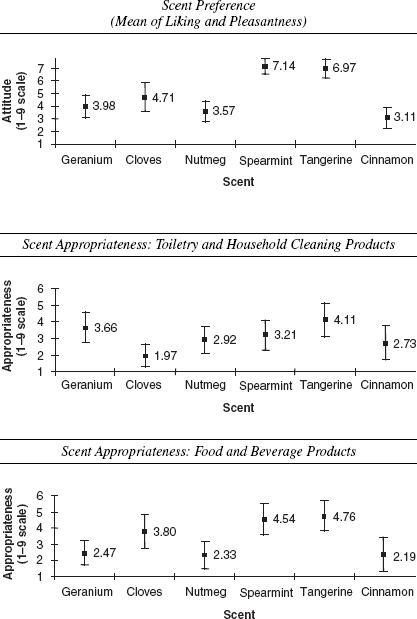
Second Scent Pretest: 95% Confidence Intervals For Main Dependent Variables
The preference ratings for geranium were in the midrange of the six scents and, most important, were consistent with our second goal: Subjects did not differ significantly in their preferences for the cloves scent versus the geranium scent (
Study 1
The main objectives of Study 1 were as follows: First, we wanted to investigate whether ambient scent would have any beneficial effects on brand memory. We included both unfamiliar and familiar brands in the study so as to assess the generalizability of the findings. Second, if ambient scent has an effect on brand memory, we wanted to gain insights into the mechanisms that might be involved. Third, we wanted to explore whether scent congruity had any role in the relationship between ambient scent and brand memory.
Method
Design and Subjects
The study consisted of a 3 (ambient scent) × 2 (brand familiarity) mixed-model experiment. Ambient scent was a between-subjects factor, and 90 subjects were randomly assigned to one of three scent conditions: congruent scent, incongruent scent, or no scent. We exposed subjects assigned to a particular cell to the same ambient scent in the encoding and retrieval phases of the experiment. We manipulated brand familiarity as a within-subjects factor; all subjects were exposed to a set of unfamiliar and a set of familiar brand names. Students of an introductory business course at two large northeastern universities participated in the experiment in exchange for extra course credit. We included only native English speakers to exclude extraneous factors such as poor language fluency and varying levels of brand familiarity. Subjects signed up for two sessions of experiments, and the sessions were spaced 24 hours apart. In reality, these two sessions were the encoding and retrieval phases of this study.
Brand Stimuli
We chose our stimuli from the personal care, toiletry, and household cleaning product categories (e.g., deodorants, skin lotions, laundry detergents) because brands in these categories typically possess pleasant floral-based scents. These categories also have several brands with which we expected subjects to be familiar. A professional photographer took full-color digital photographs of all the stimulus products in their original packaging. These digital images served as our stimuli (for examples, see Figure 3).

Examples of Familiar and Unfamiliar Brand Stimuli
We employed a total of 68 brands as stimuli in the experiment (for the full list, see the Appendix). We exposed subjects to half of these brands (i.e., the 34 target brands) during the encoding phase of the experiment. Half of the target brands (i.e., 17) were familiar brands for the subject population (e.g., Tide detergent, Ivory soap), and the other 17 brands were unfamiliar to the subjects (e.g., Margo soap, Happy Toes foot lotion). The unfamiliar brands were products sold in ethnic stores, small regional markets, or in parts of English-speaking Canada. In the recognition phase of the experiment, we exposed subjects to the target brands as well as to an equal number of foils (i.e., 17 familiar and 17 unfamiliar brands). Whenever possible, the foils were matched with the target brands in regard to product categories.
Procedure
In the scented conditions, the ambient scents were emitted into the room atmosphere by an electric diffuser into which several drops of the appropriate essential oil (i.e., geranium or cloves) had been placed. The diffuser emitted the scent into the atmosphere continuously during both the encoding and retrieval phases of the experiment. In the unscented condition, no scent was emitted. When running, the diffuser was placed behind a cardboard partition in a corner of the room so as to be quite inconspicuous. Although it was not possible to control the exact intensity of the scent emitted into the atmosphere, the same amount of essential oil was used in each session and the same amount of diffusion time was allowed to elapse before the commencement of the subject sessions for that day.
Subjects participated individually in the experiment. In the first (i.e., encoding) phase of the experiment, the subject entered either an unscented or a scented room (geranium or cloves) and completed a detailed screening questionnaire that assessed hunger, thirst, smoking habits, and allergies to scents (Engen 1982). Subjects with allergies or asthma would have been excused from participation; however, none of our subjects reported such problems. On account of the time involved in filling out the screening questionnaire, the subject experienced the scent (if present in the room) for several minutes before moving on to other tasks (see Cann and Ross 1989). Our goal was to allow enough time for the scent to potentially affect the subject, but not enough time for subjects to completely adapt to the scent (Dalton and Wysocki 1996). The subject then completed the standard Pleasure–Arousal–Dominance (PAD) scale so that we could assess his or her current mood and level of arousal (for more details, see Mehrabian and Russell [1974] and the “Dependent Measures” section).
After the subjects completed the PAD scale, we explained to them that the purpose of the experiment was to obtain their opinions about several brands, some of which would be familiar and some of which would be unfamiliar. We provided subjects with an evaluative orientation for the task, and subjects were not aware that their memory for brand information would be tested later; thus, all of the learning was incidental rather than intentional (see Ratneshwar et al. 1997). Each subject was then seated in front of a computer and provided with detailed instructions on the screen. We informed the subject that pictures of several product brands would appear on the monitor and that the task was to evaluate each brand in a self-paced manner. We told the subject to take as much or as little time as needed to evaluate each product. After several practice trials involving stimuli unrelated to the study, the subject was exposed to the 34 target brands, one by one, and in a random order. The digital image of the product package corresponding to each brand appeared and stayed on the screen until the subject provided an evaluation of the brand by hitting one of the numbered keys (1–9) at the top of the keyboard. A one-second delay was built in between the subject's key press for a particular trial and the onset of the next stimulus. The computer program captured both the brand rating and the time subjects took to view each stimulus untill the point of key press. The subject was then excused for the day. Subjects left the laboratory with the belief that that particular experiment was over.
Twenty-four hours later (cf. Morrin and Ratneshwar 2000), the subject returned to the same room for the retrieval phase of the experiment. The scent condition in the retrieval phase for each subject was the same as in the encoding phase. In the retrieval phase, we administered a surprise free recall task to the subjects; each subject was given three minutes to list as many of the brands seen in the first (encoding) phase of the experiment as possible. Next, we gave the subject a computer-based brand recognition task. The task involved exposure to the digital photographs that corresponded to the same 34 target brands as in the encoding phase and, in addition, the photographs for all of the 34 foils. The photographs of the 68 brands appeared on the screen one by one and in a random order. The subject's task was to determine, as quickly but as accurately as possible, whether each brand was one of the brands seen in the first part of the experiment. The subject responded on each trial by hitting either the lower right “?/” key marked “yes” or the lower left “Z” key marked “no.” We instructed subjects to keep their left and right index fingers poised over the respective keys before beginning the task. After each response, the subject was provided with feedback—when the subject responded correctly, a high-pitched beep sounded, and when the response was wrong, a low-pitched beep was heard. Providing such feedback is a fairly common method to encourage subjects in memory experiments to balance accuracy with speed in stimulus recognition tasks (Cameron and Frieske 1994).
After the brand recall and recognition tasks, the subject filled out a questionnaire. The first item was a manipulation check for brand familiarity. The remaining items assessed the subject's awareness of ambient scent in the room. We used a funneling technique for this purpose. The first question was open-ended: “While taking part in the experiment today, did you notice anything special about the room's atmosphere?” The subject was then asked to respond more specifically (i.e., “yes,” “no,” or “not sure”) to the question: “Did you detect any odor or scent in the room?” Subjects then assessed the pleasantness of the room odor and indicated whether they believed the room odor, if any, affected them in any way during the experiment. We also included a check for hypothesis guessing. Subjects were then debriefed and thanked for their participation.
Dependent Measures
We measured attention through stimulus viewing time—specifically, the number of milliseconds a subject spent viewing a brand on the screen in the encoding phase before recording an evaluation on the computer. The attention data, which exhibited a typical long right tail in raw scores, were log transformed to create a more normal-shaped distribution before ANOVA (Howell 1992).
We assessed brand recall accuracy by the number of familiar and unfamiliar brands correctly recalled by a subject in the test phase (17 targets in each case). These recall data, which exhibited several extremely small numbers, were subjected to a square-root transformation before ANOVA to create a more normal-shaped distribution (Howell 1992). Note that such a transformation attenuates differences in raw scores between experimental conditions and thus implies a conservative data analysis strategy.
We assessed brand recognition accuracy for both familiar and unfamiliar brands by counting the number of hits (i.e., targets correctly recognized) minus the number of false alarms (i.e., foils wrongly recognized). Therefore, recognition accuracy scores were corrected for subject guessing as per conventional practice (see Baddeley 1990). A maximum score of 17 (i.e., 100%) for brand recognition implies that a subject correctly recognized all 17 target brands and there were no false alarms.
As previously noted, we measured subjects' mood and arousal states with the PAD scale (Mehrabian and Russell 1974). The PAD scale measures mood valence (i.e., “pleasure”) and arousal with six semantic differential items for each construct, and it has been used often in prior ambient scent research (e.g., Ellen and Bone 1998, Knasko, Gilbert, and Sabini 1990; Spangenberg, Crowley, and Henderson 1996). Machleit and Eroglu (2000, p. 102) note that the PAD scale is the premier measure in the area of environmental psychology for assessing the impact of the environment on people. Furthermore, the PAD scale appears to be particularly well-suited for measuring mood and arousal as state variables in consumer behavior (e.g., Hui and Bateson 1991). After completing the PAD scale, subjects completed scales for brand evaluation (1 = “not at all favorable” to 9 = “extremely favorable”), brand familiarity (1 = “not at all familiar” to 9 = “extremely familiar”), and room odor pleasantness (1 = “not at all pleasant” to 9 = “extremely pleasant”).
Results
We analyzed the main dependent measures with mixed-model ANOVAs. We conducted follow-up contrasts (two-tailed tests) when appropriate. The between-subjects independent variable, ambient scent, had three conditions (congruent scent, incongruent scent, or unscented control condition). Brand familiarity was a within-subjects variable and had two levels (unfamiliar and familiar brands). Table 1 shows means for all dependent measures for both the untransformed and the transformed data. However, to facilitate interpretation in the subsequent discussion and in Figure 4, we report means for the untransformed data.

Study 1: 95% Confidence Intervals For Main Dependent Variables
Study 1: The Effects of Ambient Scent on Brand Attention and Memory
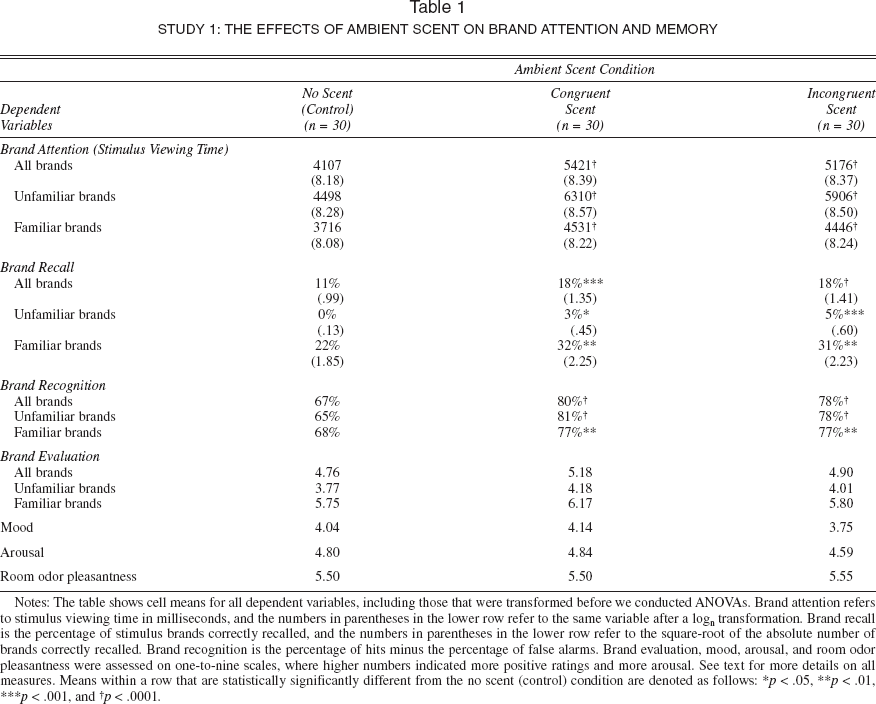
Notes: The table shows cell means for all dependent variables, including those that were transformed before we conducted ANOVAs. Brand attention refers to stimulus viewing time in milliseconds, and the numbers in parentheses in the lower row refer to the same variable after a logn transformation. Brand recall is the percentage of stimulus brands correctly recalled, and the numbers in parentheses in the lower row refer to the square-root of the absolute number of brands correctly recalled. Brand recognition is the percentage of hits minus the percentage of false alarms. Brand evaluation, mood, arousal, and room odor pleasantness were assessed on one-to-nine scales, where higher numbers indicated more positive ratings and more arousal. See text for more details on all measures. Means within a row that are statistically significantly different from the no scent (control) condition are denoted as follows:
p < .05
p < .01
p < .001
and p < .0001.
Manipulation check for brand familiarity
As expected, familiar brands were rated as more familiar than unfamiliar brands (
Brand attention
On the basis of our theoretical discussion, we anticipated that the presence of a pleasant ambient scent would increase approach behavior and therefore increase brand attention. We also wanted to explore whether scent congruency would enhance this effect. The ANOVA on the attention data confirmed a main effect for ambient scent condition (F(2, 87) = 3.29, p < .05, η2 = 2.7%). Follow-up comparisons showed that subjects in the congruent scent condition gave the brand stimuli more attention than their counterparts in the unscented control condition (
The attention data also yielded a main effect for brand familiarity (F(1, 2967) = 280.4, p < .0001, η2 = 5.3%). Subjects attended more to unfamiliar than familiar brands (
Brand recall
We expected that the presence of a pleasant ambient scent would improve brand recall accuracy, and we were curious to know whether this effect would be especially evident when the scent was congruent with the product category. Confirming our expectations, the ANOVA showed a main effect for ambient scent condition (F(2, 87) = 7.87, p < .001, η2 = 3.1%). Follow-up comparisons revealed that subjects in the congruent scent (versus unscented) condition recalled more brands (
Brand recognition
Paralleling our expectations for brand recall, we anticipated that the presence of an ambient scent would improve brand recognition accuracy. The ANOVA indeed yielded a main effect for ambient scent condition (F(2, 87) = 8.93, p < .0005, η2 = 12.2%). Comparisons revealed that brand recognition accuracy was reliably higher in the congruent scent (versus unscented) condition (
Mediation analyses
The foregoing results show that the presence of an ambient scent increased attention (a potential mediator) as well as brand recall and recognition accuracy (final outcome variables). If attention either partially or fully mediates the observed effects of scent on recall and recognition of brand stimuli, the inclusion of attention as an additional independent variable in the analyses of the two memory measures should result in a reduction of the main effect of ambient scent (Baron and Kenny 1986). Therefore, we performed additional analyses to verify whether this was the case. When the attention measure (stimulus viewing time) was added to the analysis for brand recall, the parameter for this independent variable did not achieve significance (F < 1). Thus, in the case of brand recall, we did not find much support for a mediating role for stimulus attention. Notwithstanding, when the attention variable was added to the model for brand recognition, it emerged as statistically significant (F(1, 86) = 10.75, p < .005, η2 = 9.6%). Furthermore, its inclusion in the model substantially reduced the effect size of ambient scent in regard to brand recognition (η2 = 12.2% without the mediator versus 7.9% with the mediator). Taken as a whole, these results partially support the explanation that the influence of ambient scent on brand memory may involve attention as a key mediator.
Other Dependent Measures
We obtained brand evaluations in the encoding phase of the study. Although we had no a priori predictions, we conducted a mixed-model ANOVA on the brand ratings. Only the main effect of brand familiarity was statistically significant (F(1, 2967) = 677.1, p < .0001, η2 = 15.8%). As might be expected, subjects rated familiar brands more favorably than unfamiliar brands (
A one-way ANOVA of subjects' self-assessed mood ratings showed no effect for ambient scent condition (F < 1). A similar ANOVA revealed that the ambient scent condition had no impact on arousal ratings (F < 1). As can be seen from the means in Table 1, both mood and arousal ratings are uniformly in the midrange of the scales and do not vary much between scent conditions. These results suggest that the observed effects of ambient scent on attention and memory do not involve affective mechanisms such as mood or arousal. We return to this issue subsequently. Approximately half of the subjects in the scented conditions noticed “something special” about the room's atmosphere. (Note that at this point, they were still in the laboratory room with the scent diffuser running.) Most of the subjects who noticed something affirmed that it was the scent. But only one subject believed he was affected by the odor. Finally, an ANOVA on subjects' ratings of room odor pleasantness failed to show an effect for ambient scent condition (F < 1).
Discussion
The results of Study 1 provide important insights into whether and how ambient scent can influence brand memory. First, the presence of a pleasant ambient scent, whether congruent or incongruent with the product category, substantially increased subjects' attention to brand stimuli. Mean viewing times for the stimuli in the two scented conditions (versus the unscented control condition) increased by nearly 30%. Ambient scent also improved consumer memory for both familiar and unfamiliar brands, as assessed by recall and recognition measures. For example, accuracy in brand recall improved by 7% from 11% to 18%, (i.e., more than 60% over baseline performance), and brand recognition accuracy on average increased by about 12% in the scented conditions when compared with the unscented control condition.
Second, the incongruent ambient scent (i.e., cloves) and the congruent ambient scent (i.e., geranium) had about the same degree of impact on brand recall and recognition. We did not find any support for the idea that scent congruity has an important role in enhancing brand memory. Thus, it appears that the facilitating effects of ambient scent do not depend on a semantic matching process. Rather, the results for the attention measure and the partial support we obtained for the mediating role of attention suggest that pleasant ambient scents mainly induce people to remain longer in a given environment, thereby causing them to process brand stimuli in greater depth. We also note that our scent manipulations had no effect on subjects' self-ratings of mood and arousal, which implies that the impact of ambient scent on memory probably does not operate through these two routes, at least as measured by the PAD scale we used in this research.
Although Study 1 results represent noteworthy findings in regard to relationships among ambient scent, attention, and brand memory, the design of this experiment does not permit unambiguous answers to some important questions. Does ambient scent need to be present at both brand exposure and retrieval for improvement in brand memory? Or is it sufficient that ambient scent be present only during brand encoding? If increased attention at brand encoding alone accounts for all of the memory improvement, presumably the presence or absence of ambient scent at brand retrieval would be immaterial. However, as we point out in the next section, there are theoretical reasons to suggest the possibility that ambient scent may need to be present at both the retrieval and the encoding stages for beneficial effects on brand memory.
Study 2
The presence of ambient scent during both the encoding and retrieval phases may be critical on account of two different factors. We discuss each of these factors next to provide a conceptual backdrop for the design of Study 2.
The Role of Environmental Reinstatement
The well-known Encoding Specificity principle suggests that memory is improved if the contexts at encoding and retrieval are well matched (Tulving 1983). In terms of our research, such matching between the encoding and retrieval contexts may occur because of environmental reinstatement (Smith 1994). Environmental reinstatement involves the recreation of the learning environment at the time of test. In a classic study in this area, Godden and Baddeley (1975) manipulated the physical location—underwater or on land—where subjects learned information. They subsequently tested subjects' memory in either the same or the other environment. They find that recall is higher when the external environment is the same as that at the point of encoding.
Is it the case then that environmental reinstatement is critical for ambient scent to improve memory? A study by Schab (1990) is relevant to the present discussion. Schab (1990, Experiment 1) exposed subjects to 40 common adjectives with or without the presence of chocolate aroma in the room. Subjects were asked to generate antonyms for each of the adjectives on a self-paced basis. They were also told to think about and imagine the smell of chocolate at both learning and test. After a 24-hour delay, a free recall task was administered. Post hoc comparisons showed that recall was indeed highest when subjects were exposed to scent at both learning and test. Schab (1990) explains his results in accord with the Encoding Specificity principle.
Schab's (1990) stimuli and experimental procedures were quite different from those we employed in Study 1. Notwithstanding, if ambient scent has an environmental reinstatement effect, it is plausible that the results obtained in Study 1 are not solely attributable to increased attention at the point of encoding. It could be argued, on the basis of the Encoding Specificity principle, that the presence of ambient scent at both encoding and retrieval played a vital part in improving brand memory in Study 1. In Study 2, by manipulating the presence versus absence of ambient scent at both the encoding and retrieval stages in a factorial design (as did Schab 1990), we shed light on this critical issue.
The Role of State Dependency
Although there was no evidence for a mood mechanism in Study 1's results, we believed it would be worth examining this issue again in Study 2. As discussed previously, researchers have found that information is better remembered if subjects learn and retrieve materials while in the same mood state. If state dependency is part of the explanation for the facilitating effects of ambient scent on memory, (1) recall and recognition levels should be highest when ambient scent is present at encoding and retrieval and (2) mood should be altered by ambient scent. Therefore, mood measures should enable us to distinguish state-dependency effects from the effects of encoding specificity and environmental reinstatement.
Method
This study consisted of a 2 (ambient scent present or absent at encoding) × 2 (ambient scent present or absent at retrieval) × 2 (brand familiarity) mixed-model experiment. We manipulated the ambient scent conditions between-subjects, and we randomly assigned subjects to one of the four experiment conditions. We manipulated brand familiarity as a within-subjects factor, as in Study 1. Sixty students of an introductory business course at a large northeastern university participated in this experiment in exchange for extra course credit. We included only native English speakers.
As in Study 1, subjects participated in two sessions (i.e., the encoding and retrieval phases) that were spaced 24 hours apart. The brand stimuli, procedure, and dependent measures employed were nearly identical to those of Study 1. Other than the manipulation of ambient scent in both the encoding and retrieval phases, the only other major difference in the Study 2 method was that scent congruency was not manipulated. Instead, only the congruent scent (i.e., geranium) of Study 1 was used in the scented conditions of Study 2. In addition, we probed scent awareness at the end of the experiment in a room other than the one in which the experiment took place, so that subjects' awareness levels would be based on their perceptions during the experiment.
Results
As in Study 1, we analyzed the main dependent measures using mixed-model ANOVAs. We conducted follow-up contrasts when appropriate. We transformed the attention (stimulus viewing time) and brand recall measures before the ANOVAs, as in Study 1. Table 2 reports means for all dependent variables (transformed and untransformed), but as in Study 1, in the subsequent discussion and in Figure 5, we focus on the means for the untransformed data.

Study 2: 95% Confidence Intervals For Main Dependent Variables
Study 2: The Effects of Manipulating Ambient Scent at Brand Encoding Versus Retrieval

Notes: The table shows cell means for all dependent variables, including those that were transformed before we conducted ANOVAs. Brand attention refers to stimulus viewing time in milliseconds, and the numbers in parentheses in the lower row refer to the same variable after a logn transformation. Brand recall is the percentage of stimulus brands correctly recalled, and the numbers in parentheses in the lower row refer to the square-root of the absolute number of brands correctly recalled. Brand recognition is the percentage of hits minus the percentage of false alarms. Brand evaluation, mood, arousal, and room odor pleasantness were assessed on one-to-nine scales, where higher numbers indicated more positive ratings and more arousal. See text for more details on all measures. Margin means within a row that are statistically significantly different between the scent present at encoding and scent absent at encoding conditions are denoted as follows:
p < .05
p < .01
p < .001, and
p < .0001.
Manipulation check for brand familiarity
As expected, subjects rated familiar brands as more familiar than unfamiliar brands (
Brand attention
We conducted a mixed-model ANOVA with attention as a function of the ambient scent condition at encoding, brand familiarity, and their interaction. (We did not include ambient scent at retrieval as an independent variable in this analysis because attention is relevant only in the encoding phase.) The main effect of ambient scent condition at encoding was statistically significant (F(1, 58) = 8.62, p < .005, η2 = 5.3%). As in Study 1, the presence (versus absence) of ambient scent at encoding enhanced attention; subjects in the scented condition, on average, took almost one second longer to view each brand (
Brand recall
We conducted a mixed-model ANOVA on brand recall as a function of the ambient scent condition at encoding, scent condition at retrieval, brand familiarity, and all possible interactions. The main effect of scent condition at encoding was statistically significant (F(1, 56) = 4.54, p < .05, η2 = 1.4%). As in Study 1, and consistent with the foregoing findings on attention, subjects recalled more brands when an ambient scent was present (versus absent) at the point of encoding (
Brand recognition
We conducted a mixed-model ANOVA that was similar to the one on brand recall. Again, the results displayed a main effect for the ambient scent condition at encoding (F(1, 56) = 5.57, p < .05, η2 = 7%). Subjects' recognition accuracy was higher when brand encoding took place in an environment in which ambient scent was present rather than absent (
Mediation analyses
Similar to the findings of Study 1, the presence of ambient scent at encoding had a positive effect on attention (a potential mediator) and the two memory measures. Therefore, we performed mediation tests again to examine whether ambient scent at encoding improves recall and recognition through the route of attention. We added the attention mediator as another independent variable to the mixed model analyses of the memory measures. In the case of brand recall, the attention variable was not statistically significant (F < 1). However, in the case of brand recognition, the attention parameter was statistically significant (F(1, 55) = 8.14, p < .01, η2 = 12.3%). Furthermore, the addition of attention to the model caused the effect size for ambient scent to drop substantially (
Other Dependent Measures
As in Study 1, we examined the brand evaluation data even though we had no a priori expectations. As in Study 1, the main effect of brand familiarity was statistically significant; subjects rated familiar brands more positively than unfamiliar brands (
We conducted ANOVAs to examine the effect of ambient scent condition at encoding on the mood and arousal measures. As in Study 1, we found that these two variables were not affected by ambient scent condition (both F's < 1), and subjects were uniformly in the midrange of the mood and arousal scales. We conducted a 2 (scent condition at encoding) × 2 (scent condition at retrieval) ANOVA on room odor ratings assessed at the end of the second phase of the study, but this analysis was not statistically significant (p > .35). Furthermore, relatively few of the subjects (17%) reported being aware of “anything special” about the room's atmosphere when queried at the end of the experiment.
Discussion
The findings from Study 2 provide corroboration for the results of Study 1 regarding the facilitating effects of ambient scent on brand recall and recognition. More important, the design of this experiment enabled us to evaluate more definitively whether attention at the point of brand exposure was the key factor driving the memory results or whether factors such as environmental reinstatement and state-dependency were implicated. The Study 2 data showed that brand memory was affected only by the presence (versus absence) of ambient scent at the brand encoding stage. Neither recall nor recognition was influenced by ambient scent at the brand retrieval stage. Furthermore, there was no evidence on either memory measure of an interaction between scent at encoding and scent at retrieval; this interaction should have been statistically significant if environmental reinstatement or state dependency contributed to the memory results. Finally, as we anticipated, ambient scent at encoding substantially increased attention (stimulus viewing time), and the addition of attention as an additional independent variable to the analysis of brand recognition diminished the independent effect of ambient scent on that memory measure. Therefore, as in Study 1, the results support the idea that ambient scent influences memory through the route of enhanced attention during brand encounters.
Summary and General Discussion
Environmental fragrancing is now becoming a common practice in retailing, restaurants, and other service-oriented businesses. The impact of ambient scent on consumer behavior has also recently emerged as an important theoretical and empirical issue and has begun to attract the attention of scholarly researchers (e.g., Bone and Ellen 1999; Gulas and Bloch 1995; Mitchell, Kahn, and Knasko 1995; Morrin and Ratneshwar 2000; Spangenberg, Crowley, and Henderson 1996). Recent studies have investigated issues such as the effects of ambient scent on in-store product evaluations and consumer decision-making processes (e.g., Mitchell, Kahn, and Knasko 1995; Spangenberg, Crowley, and Henderson 1996).
Notwithstanding these developments, little is known about whether and why scents in the environment might influence consumer retrieval of brand information. This is an important gap in marketing knowledge in view of the well-established role of brand recall and recognition in consumer decision making (see, e.g., Hoyer and Brown 1990; Hutchinson, Raman, and Mantrala 1994; Keller 1993; Nedungadi 1990). We addressed this issue by examining the impact of pleasant ambient scents on brand memory in two experiments. We manipulated scent in the environment in the context of an incidental learning task wherein subjects viewed and evaluated branded products that were displayed sequentially on a computer screen. We measured stimuli viewing times covertly on the computer as a measure of attention, and we also obtained subjects' self-assessments of mood and arousal. Twenty-four hours later, we first assessed brand-free recall and then brand recognition in a discrimination task.
Across the two studies, we found a consistent pattern of results. When there was a pleasant ambient scent (versus no scent) during the brand exposure phase, subjects spent more time examining the stimuli. Concomitantly, in both studies, the presence of ambient scent improved subjects' recall and recognition of brand names. Additional analyses revealed that attention (i.e., stimulus viewing time) played a mediating role in enhancing brand memory.
Theoretical and Methodological Implications
Pleasant ambient scents appear to encourage approach behavior in that they induce consumers to spend more time in a particular environment. 1 Our finding of a positive relationship between a pleasant ambient scent and the time people spend in a given environment is consistent with several prior studies (Knasko 1995; Morrin and Ratneshwar 2000). However, Spangenberg, Crowley, and Henderson (1996) found virtually no effect for ambient scent on the time people spent in a simulated store environment, even though they hypothesized such an effect. Spangenberg, Crowley, and Henderson suggest that time spent in an environment is just one measure of approach behavior. Approach behavior can also be assessed in other ways, such as by a person's intention to spend more time in a given environment in the future. Spangenberg, Crowley, and Henderson found a positive effect for ambient scent on this latter measure of approach behavior. A possible explanation for the difference between our findings and their results may lie in the precision with which time is measured in the context of a research problem. Our research focuses on brand memory and measures stimulus viewing time through a computer in milliseconds; in contrast, Spangenberg, Crowley, and Henderson were primarily interested in product and store evaluations and measured time spent in a simulated store in seconds with a stopwatch.
In addition, an ambient scent that is congruent with a brand's product category did not result in differentially more attention or a greater improvement in brand memory than an incongruent scent (Study 1; see also Knasko 1995). This suggests that pleasant ambient scents in general tend to improve memory performance and that scents that share semantic connotations with the products to be remembered do not necessarily result in deeper memory traces. The principal factor seems to be whether an ambient scent makes people stay longer in the environment such that they end up paying more attention to brand stimuli.
We speculate that this may be a nonconscious process, in that most of the subjects in our studies were unaware of the presence of the ambient scent; those who were aware of the scent claimed to be unaffected by it.
The results of Study 2 provide additional insights with respect to the mechanism responsible for improvement in brand memory. Specifically, the presence or absence of ambient scent at the point of brand retrieval had no discernable impact on memory performance; only the presence (versus absence) of ambient scent during brand encoding affected memory. Thus, our results do not support the theoretical possibility that ambient scent might improve memory by a process of environmental reinstatement (cf. Godden and Baddeley 1975; Schab 1990). Instead, the Study 2 data offer further evidence that ambient scent influences brand memory because it results in longer attention spans at the time of stimulus viewing, thereby creating deeper memory traces that are more easily retrieved, regardless of whether the scent is present again during brand retrieval. However, different results have been obtained in previous studies in which subjects expected a memory test and were made aware explicitly of the presence of an ambient scent during information encoding and retrieval (see, e.g., Schab 1990). We speculate that such procedures likely sensitize and alter subjects' information-processing strategies (see, e.g., Knasko, Gilbert, and Sabini 1990). However, with incidental learning tasks such as the one we created in our studies, the impact of ambient scent on memory probably operates through its effect on stimulus attention at the encoding phase, not through contextual cueing effects.
Ambient scent did not have an impact on subject's self-reports of mood and arousal in either study (for similar null results, see Spangenberg, Crowley, and Henderson 1996). Therefore, we did not find any evidence to suggest that these two variables are implicated in the results we observed for brand memory. To examine further the reliability of our null findings regarding mood and arousal, we conducted power analyses (Cohen 1988). When we collapsed the analyses across the two studies (which used identical procedures during the encoding phase of the experiment when mood and arousal were measured), assuming a two-tailed alpha of .05, we had an 85% probability of detecting a medium effect size for both mood and arousal. Therefore, we have a fair degree of confidence that the null results for these variables are not due to insufficient power. 2
In contrast to our theorizing and findings, prior consumer researchers have often assumed an affective or emotional link between scent and behavior. For example, Ellen and Bone (1998, p. 29) suggest that “Odors stimulate the limbic system, the part of the brain responsible for emotional responses.” We recommend that future researchers at least entertain the possibility that any observed effects of ambient scent on consumer behavior are the result of cognitive mechanisms such as attention and that they employ experimental methods that are capable of assessing this notion further. In this regard, there are two noteworthy aspects to the present research methodology: (1) We employed digital photographs of actual branded products as stimuli, and (2) we measured consumer attention unobtrusively in an incidental learning task. Given the critical role of attention in our brand memory findings, it is nontrivial that we presented ecologically valid stimuli to our subjects rather than mere brand names (cf. Morrin and Ratneshwar 2000). The generalizability of our findings to real-world settings would have been questionable if we had limited our research to sterile verbal stimuli (Klink and Smith 2001). Furthermore, although previous researchers have used reaction-time measures to assess the strength of brand associations in memory (e.g., Herr, Farquhar, and Fazio 1996), we employed computer measures of brand viewing time during an incidental exposure task. Our methodology may be useful for other consumer researchers interested in using unobtrusive but precise measures of attention (see also Pechmann and Stewart 1990).
A few other theoretical aspects of our memory results are worthy of comment. In both studies, subjects were much more accurate in brand recognition than in brand recall. This finding replicates previous research in memory that has shown that the difference in accuracy between recognition and free recall is usually quite high in incidental learning tasks (see Eagle and Leiter 1964). Furthermore, although not the focus of our research, we note that subjects (1) attended much longer to unfamiliar brands (presumably on account of stimulus novelty), (2) nevertheless recalled familiar brands far better than unfamiliar brands, but (3) recognized familiar and unfamiliar brands about equally well. That brand familiarity facilitates brand recall but not brand recognition has a parallel in the well-known word frequency × memory task interaction in the memory literature (e.g., Kinsbourne and George 1974). Previous researchers in the field of cognitive psychology have found this pattern in tasks in which subjects are given a fixed amount of time to process both familiar and unfamiliar stimuli and in intentional learning situations in which subjects anticipate a memory test. Our results extend this research by showing that this interaction also occurs in an incidental learning task and that it occurs notwithstanding that subjects pay more attention to unfamiliar stimuli.
Limitations
The research presented here has some of the same limitations as most theory-testing experimental investigations in that we conducted the studies in a controlled laboratory setting and with a convenience sample of student subjects. The scents and brand stimuli we employed were also somewhat limited in nature. Scents other than the ones we used (i.e., geranium and cloves) may operate differently in their ability to enhance attention and memory or in their impact on mood and arousal. Further research could examine the generalizability of the present findings to other kinds of scents (e.g., food smells). We also confined our brand stimuli to the types of products that typically contain scent as an ingredient. Therefore, we do not know whether our findings would apply to product categories that are usually not scented (e.g., clothing, consumer durables). However, given that congruity between ambient scent and the product category failed to emerge as an important factor in Study 1, we speculate that our findings may well carry over to nonscented products.
If we remove the 30 subjects from Study 1 who were exposed to the cloves scent, thus including only control subjects and those who were exposed to the geranium scent at encoding, the power to detect a medium effect size is reduced only marginally from .85 to .78.
Regarding the processes by which ambient scent might influence brand memory, as noted previously, we did not find any evidence to suggest that mechanisms such as mood or arousal are at work. However, it could be argued that this null finding might simply be due to the self-report measuring instrument we employed. Perhaps the PAD scale is not sensitive enough to detect the small alterations in mood and/or arousal that are brought about by ambient scent (for discussions of alternative measures of consumer mood and emotions, see Machleit and Eroglu 2000; Richins 1997). However, as we discussed in the methodology section, there is considerable precedent for using the PAD scale for measuring mood and arousal as state variables. It is left for further research to ascertain whether the present findings hold even when other procedures are used for measuring these variables (i.e., other mood and arousal measures or physiological indicators instead of paper-and-pencil self-reports).
Also, our research did not examine the role of individual differences (Knasko 1992). Some prior research suggests that people who are extremely shy exhibit lower olfactory thresholds; that is, they are better able to detect the presence of ambient scent (Herbener, Kagan, and Cohen 1989). Therefore, it is possible that individual differences not captured in the present research moderate the effects of ambient scent on attention and brand memory. Future studies may want to explore potential moderating variables such as olfactory thresholds, individual preferences for scent, optimal stimulation level, gender, and a variety of personality variables. Further research may also reveal that groups of consumers can be segmented according to scent preferences or styles.
Another issue not explored in the present research is whether informing consumers of the presence of scent alters its impact on attention and memory processes. Research in the person perception area suggests that attribute priming effects are seriously diminished when subjects become conscious of obtrusive priming manipulations (see Higgins, Bargh, and Lombardi 1985). If further research shows that a similar result occurs for ambient scent interventions, it could raise public policy issues regarding the need to notify consumers in retail and other environments in which ambient scent is used.
Managerial Implications
As noted previously, marketers and retailers employ environmental fragrancing in a wide variety of circumstances, from in-store use to in conjunction with the Internet. In this regard, our research supports previous findings in the literature that pleasant ambient scents can induce consumer approach behavior (Knasko 1995; Spangenberg, Crowley, and Henderson 1996). But our research substantially extends prior research by clearly demonstrating that consumers are likely to devote more attention to stimuli encountered in pleasantly scented environments. Therefore, we opine that ambient scents can be used in a variety of venues such as retail stores, automobile showrooms, trade shows, and product demonstrations to increase not only the amount of time spent in a given environment but also the amount of mental attention devoted to relevant stimuli (e.g., products, brand names) encountered in that environment.
Even more important, perhaps, is our finding that the causal chain between ambient scent and enhanced brand attention also extends to improved brand memory. Moreover, congruency of the ambient scent with the product category does not seem to be a relevant factor in memory improvement. If a marketer's goal is to induce consumers to pay more attention to and remember better the products and brands they see in a particular setting, the use of virtually any pleasant ambient scent should achieve this objective. Thus, a firm selling beauty products and toiletries does not necessarily need to choose floral scents; a bakery need not limit itself to only vanilla, cinnamon, or other scents and spices typically used in baked goods.
Our findings should be highly relevant to brand marketers who set up and pay for product displays and promotions in retail stores and other venues. For example, adding scent-emitting devices to in-store displays and “shelf-talkers” could substantially enhance subsequent brand awareness and brand recall. If we extrapolate these results even further, it is possible that if devices such as scent strips are added to print advertisements or to free-standing coupon inserts in newspapers, consumers may bestow more attention to the advertised brand and thereby recall the advertised brand better at the point of purchase. Nevertheless, given that the effect sizes we obtained were somewhat small in some cases (especially in regard to brand recall), the cost–benefit aspects of such tactics will need to be thoroughly evaluated before they are implemented. It also remains to be seen whether ambient scent can be a cost-efficient device for enhancing brand memory when compared with traditional marketing tactics such as repetition in media advertising, product placement in movies, sponsorship of televised sports events, and so forth.
Conclusion
Taken as a whole, this research suggests a yes to the question posed in the title of this article—it does make sense to use scents to enhance brand memory. More generally, our work adds to the small but growing body of knowledge on whether, how, and when scents in the environment are likely to affect different facets of consumer behavior such as memory, judgments, decisions, and consumption behaviors. Our research also demonstrates that for studying the effects of ambient scent in marketing and consumer research settings, theory and methodological tools from cognitive psychology can be successfully adapted and applied to brand and product stimuli that have considerable ecological validity. Further research on ambient scent that builds on these beginnings should advance theorizing regarding the role of contextual factors in consumer behavior and also offer an even wider range of managerial suggestions.
Footnotes
Brand Stimuli used in Studies 1 and 2

| Target Brands | Foil Brands | |
|---|---|---|
| Familiar brands | Tide detergent | Purex detergent |
| Edge shave cream | Barbasol shave cream | |
| Snuggle fabric softener | Bounce fabric softener | |
| Camay soap | Caress soap | |
| Crest toothpaste | Colgate toothpaste | |
| Close-Up toothpaste | Johnson & Johnson dental floss | |
| Gillette aftershave | Rise shave cream | |
| Sure deodorant | Degree deodorant | |
| Wizard air freshener | Glade air freshener | |
| Pine Sol cleanser | Lysol cleanser | |
| Neutrogena sunblock | Intensive Care sunblock | |
| Joy dish detergent | Sunlight dish detergent | |
| Dawn dish detergent | Palmolive dish detergent | |
| Ivory soap | Jergens soap | |
| Suave shampoo/conditioner | Swiss Formula deodorant | |
| VO5 shampoo | Pantene shampoo | |
| Finesse conditioner | Vidal Sassoon conditioning rinse | |
| Unfamiliar brands | Pears skin lotion | Herbal Mint skin lotion |
| Dessert Essence skin lotion | Aloe Vera skin lotion | |
| Magical Mane conditioner | European Mystique shampoo | |
| Liril talc | Happy Toes foot cream | |
| Argo laundry starch | Fels-Naptha laundry soap | |
| Germ-X soap | Germ Buster soap | |
| Green Mark dishwashing detergent | Sun and Earth cleaner | |
| Wright's silver polish | Gonzo stain remover | |
| Clearly Natural soap | Emlin soap | |
| Orchard Blend skin lotion | Healthy Salon skin lotion | |
| Herbissismo shower gel | Healing Garden shower gel | |
| California Scents air freshener | Country Treasures air freshener | |
| Margo soap | Forest Pure soap | |
| Nantucket Gold sunblock | Native Tan sunblock | |
| Smells Be Gone deodorizing spray | Mango Madness body spray | |
| Citrus Magic hand soap | Zud cleanser | |
| Thicker Fuller Hair styling gel | Fruit of the Earth skin lotion |