







Abstract
Several individual, social-setting, and choice-set factors have been shown to be related to satisfaction. This article argues that these factors operate through a set of choice goals. Using panel data on purchasers of consumer electronics, the authors examine how five goals (justifiability, confidence, anticipated regret, evaluation costs, and final negative affect) drive decision and consumption satisfaction, which in turn determine loyalty, product recommendations, and the amount and valence of word of mouth.
Recent research has emphasized the importance of decision satisfaction and how it differs from consumption satisfaction (Fitzsimons, Greenleaf, and Lehmann 1997). Analogous to the distinction between procedural and distributive justice (Homans 1974; Sheppard, Lewicki, and Minton 1992), this work separates the process of making a choice from the experience with the choice outcome. However, relatively little is known about how these two forms of satisfaction are related to each other or what their antecedents and consequences are. Using data from a two-part study, this article examines how choice-set factors, individual characteristics, and social factors affect choice goals, which then lead to satisfaction.
Theory and Proposed Model
For more than 30 years, consumer satisfaction has been a central concept in marketing (Cardozo 1965; Czepiel and Rosenberg 1977; Fournier and Mick 1999; Oliver 1989; Swan and Combs 1976), and there are several summaries of the body of knowledge (e.g., Anderson and Fornell 1994; Oliver 1997; Yi 1991). Therefore, we concentrate on a selective overview of prior research related to how experiences in decision making are linked to satisfaction.
Traditionally, satisfaction has been conceptualized as a product-related judgment that follows a purchase act or a series of consumption experiences (Yi 1991). Most satisfaction research concentrates on what Fitzsimons, Greenleaf, and Lehmann (1997) term “consumption satisfaction.” The most popular view is that confirmation and/or disconfirmation of a preconsumption standard is responsible for satisfaction and dissatisfaction (Oliver 1989). Several additional determinants of satisfaction, such as perceived equity (Joshi 1990; Oliver and Swan 1989a, b), product quality (Fornell 1992), postdecision regret (Tsiros and Mittal 2000), consumption-related emotion (Mano and Oliver 1993; Oliver 1993), and need fulfillment (Spreng, MacKenzie, and Olshavsky 1996; Westbrook and Reilly 1983), have also been linked to satisfaction. This stream of research assumes that outcome-related cognitive and affective processes explain the variance in satisfaction judgments.
According to Czepiel and Rosenberg (1977, p. 406), “[satisfaction] is determined by every aspect of the purchasing-consumption process.” They, and others (West-brook and Newman 1978; Westbrook, Newman, and Taylor 1978), propose that consumers experience satisfaction and dissatisfaction not only with the selected product but also with the purchase decision process itself. Fitzsimons (2000) and Zhang and Fitzsimons (1999) show that decision satisfaction depends on the characteristics of a choice set, such as the availability of options and the alignability of an assortment. Furthermore, Fitzsimons, Greenleaf, and Lehmann (1997) find a positive correlation between decision and consumption satisfaction.
With the exception of such findings, behavioral decision research and research on consumer satisfaction have developed in relative isolation. Research on judgment and decision making has identified several cognitive and affective processes that consumers employ during product selection. It is known that “human beings have unstable, inconsistent, incompletely evoked, and imprecise goals at least in part because human abilities limit preference orderliness” (March 1978, p. 598). Nonetheless, decision making requires a structure to select an alternative (McFadden 1999). Thus, for most purchase decisions, consumers are faced with the task of constructing a preference structure (Bettman, Luce, and Payne 1998). The strategies consumers apply depend on the selection of products offered, the internal capabilities and motivations of the decision maker, and the social environment (Payne, Bettman, and Johnson 1993). For example, consumers who have little product category knowledge and are confronted with a large number of alternatives are likely to find it difficult to identify a satisfactory and satisfying decision strategy.
This article proposes an expanded view of the antecedents and consequences of decision and consumption satisfaction and discusses how they are related. It assumes that external factors influence the attainment of basic goals, which in turn determine satisfaction. The inclusion of goals is an important component of this research. Rather than assuming that the effects of external factors are direct, we demonstrate that their effects operate through (are mediated by) the attainment of choice goals. We represent the specific hypotheses in Figure 1. The following discussion provides justification for this model.
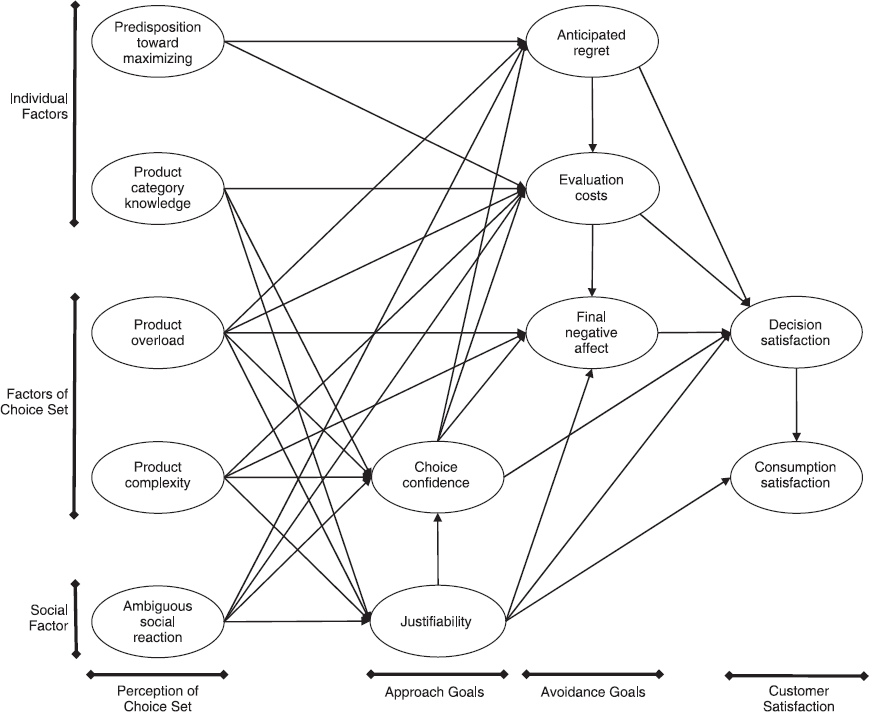
Hypothesized Satisfaction Model
Goal-Based Determinants of Decision Satisfaction
To explain decision satisfaction, we focus on five decision-making goals. Two are approach goals—justifying decisions and increasing confidence—and three are avoidance goals—anticipated regret, evaluation costs, and negative affect. It is widely accepted that need fulfillment is a major determinant of consumption satisfaction (e.g., Czepiel and Rosenberg 1977; Spreng, MacKenzie, and Olshavsky 1996; Westbrook and Reilly 1983). Bettman (1979) proposes that consumers possess a hierarchy of goals that they try to attain during product selection. We expect that the attainment of these choice goals determines satisfaction with the decision-making process.
Bettman, Luce, and Payne (1998, p. 192) suggest that four choice goals are the “most important motivational aspects relevant to decision making”: maximizing the accuracy of a decision, minimizing its evaluative costs, minimizing the experience of negative affect, and maximizing the ease with which a decision can be justified. According to the authors, these goals apply to most choice contexts and capture central insights of decision-making research. First, the choice goals framework considers rational choice theory, which assumes that consumers are motivated by a single goal: making accurate (i.e., utility-maximizing) choices. Second, Simon (1955) and March (1978) note that humans are limited in their processing capabilities; that is, people try to conserve their limited resources and save effort. Third, as social beings, people often feel evaluated by others or themselves (e.g., Shafir, Simonson, and Tversky 1993; Tetlock 1992). Thus, a satisfying decision process will be one in which consumers can identify reasons to justify product selection. Fourth, deliberation can lead to negative emotions (e.g., Luce, Bettman, and Payne 1997; Luce, Payne, and Bettman 1999). Accordingly, consumers aim to reduce negative emotions induced by trade-offs between options. At the end of the decision-making process, a final negative affect is experienced that depends on the initial level of negative emotions and the success of coping strategies.
In this article, we differentiate between two types of negative emotions. First, Luce, Bettman, and Payne (1997, 2001) focus predominantly on negative emotions experienced during the decision-making process, such as those resulting from trade-off difficulty. Second, final affective reactions are different from emotions that people anticipate experiencing after a decision has been made (Anderson 2003; Loewenstein et al. 2001). It has been suggested that the anticipation of regret is one of the major motivating forces that drives product selection (e.g., Bell 1982; Loomes and Sugden 1982; Zeelenberg 1999) and is an antecedent to emotional reactions experienced during decision making (Loewenstein et al. 2001). Therefore, we consider minimizing anticipated regret a fifth choice goal.
Goal-Based Determinants of Consumption Satisfaction
The organizational literature suggests that “should a person decide that a procedure … is unfair, it is quite difficult to change that view as applied to any outcome” (Sheppard, Lewicki, and Minton 1992, p. 30). In other words, people believe that just procedures generate just outcomes (Tyler 1984). Higgins and colleagues (2003) show that people attribute more value to an outcome if they experienced a fit between ideal and available approaches for choosing the outcome. Thus, we expect that decision satisfaction increases outcome satisfaction.
The ability to justify a decision also has a direct impact on consumption satisfaction. Possessing compelling reasons for the selection of a specific alternative (Shafir, Simonson, and Tversky 2000; Simonson 1989) affects the postpurchase consumption period. Dissatisfaction is often magnified because of cognitive dissonance and regret after a purchase decision (Festinger 1964; Oliver 1997). Choices based on convincing reasons lead to lower postdecisional dissonance and improve the decision maker's abilities for dissonance reduction.
Relationships among Goal-Based Determinants of Satisfaction
(Final) negative affect is the result of the degree to which three other choice goals are attained. Uncertain consumers are inclined to postpone purchase decisions (Greenleaf and Lehmann 1995; Hogarth, Michaud, and Mery 1980). As a consequence, uncertainty results in a conflict between consumption and choice goals, which in turn increases negative affect.
A further source of discomfort is the evaluative costs of decision making. People try to conserve energy and invest minimal effort when considering alternatives (Anderson 2003). Complex decision problems increase evaluative costs, which gives rise to stress and frustration. Consequently, “negative affect can be generated by expending cognitive effort” (Garbarino and Edell 1997, p. 156).
Finally, negative affect depends on people's ability to identify reasons for a decision. Identifying reasons for choosing one option over another is a problem-focused coping strategy (Bettman, Luce, and Payne 1998, p. 198). Thus, “a subjectively better choice (i.e., one that is more justifiable) should generate a more positive overall emotional reaction” (Luce, Bettman, and Payne 2001, p. 33).
Evaluation costs depend on choice confidence and anticipated regret. People who are uncertain believe that there are more advantages in extensive choice processing (Anderson 2003; Urbany, Dickson, and Wilkie 1989). Similarly, consumers who anticipate regret are motivated to work harder to reduce the chances of postdecision negative affect (Zeelenberg 1999).
In turn, the anticipation of regret is often the result of uncertainty. Even after a decision has been made, people who were uncertain about which alternative best matched their preferences often ask themselves whether investing more effort would have led to a superior choice. Thus, uncertain decision makers will be more likely to experience postdecision regret. Previous research shows that regret-based models of decision making can explain the behavior of uncertain consumers better than that of consumers with high levels of confidence (Crawford et al. 2002).
The composition of the available options can either decrease or increase the ability to justify decisions. According to Bettman, Luce, and Payne (1998), confidence in decision making arises from the application of more complete or compensatory decision strategies and from the degree of justifiability. Therefore, the attainment of justification will lead to higher levels of choice confidence.
Individual Influences on Goal-Based Determinants of Satisfaction
Individual-level determinants of consumption and decision satisfaction include the decision maker's motivation to identify the best possible alternative and capacity to consider large amounts of information. People differ in their willingness to apply simplifying heuristics (e.g., Schwartz et al. 2002; Wieczorkowska and Burnstein 1999). So-called maximizers (Schwartz et al. 2002) are reluctant to reduce the portion of information processed, even when they are faced with complicated tasks, whereas so-called satisficers (Schwartz et al. 2002) are comfortable selecting a satisfactory but not necessarily optimal alternative. Therefore, when selecting the best possible option is difficult, people with a stronger predisposition toward maximizing tend to experience more regret and higher evaluation costs.
Capacity for decision making depends on product category knowledge (Alba and Hutchinson 1987). Product knowledge enables consumers to process new information more efficiently (Johnson and Russo 1984) and to make use of compensatory decision strategies (Bettman and Park 1980), and this leads to greater confidence in identifying a preferred option (Park and Lessig 1981; Srinivasan and Ratchford 1991).
When products are complex, consumers are faced with the task of identifying relevant attributes (Hoch and Deighton 1989; Holbrook 1981). Experts can better distinguish relevant from irrelevant information than novices (Larkin et al. 1980) and identify attributes against which available alternatives can be discriminated (Brucks 1985), thus reducing the cognitive effort required for decision making (Bettman 1979). In addition, expert consumers have an easier time determining the attributes that resulted in need fulfillment during previous consumption experiences and can identify reasons for choosing one option over another more easily.
Choice-Set Influences on Goal-Based Determinants of Satisfaction
Two key choice-set factors influence decision making: the number of alternatives and the number of attributes (Malhotra, Jain, and Lagakos 1982). The degree to which consumers feel overloaded with the number of alternatives affects all five choice goals. Reasons for decision making are frequently based on perceptual characteristics of choice sets (Bettman, Luce, and Payne 1998); that is, reason-based choice is evidenced whenever the number of alternatives is small (Shafir, Simonson, and Tversky 2000). Characteristics of choice sets that provide compelling reasons for choosing one option over another, such as asymmetric dominance (Simonson 1989), are more difficult to identify when people feel overloaded by the choice task, which results in a feeling of low justifiability.
If the number of alternatives is large, consumers tend to shift decision making toward elimination strategies (Timmermans 1993) and use less information (Iyengar and Lepper 2000). Because decision makers may continually assess the accuracy of a choice process (Payne, Bettman, and Johnson 1993), feelings of increased uncertainty and low choice confidence are likely whenever consumers feel overloaded. Furthermore, as the number of alternatives increases, the apparent differences between alternatives decrease, and counterfactual thinking increases (Anderson 2003). A larger choice set also requires decision makers to turn down more options, which in turn increases anticipated regret (Schwartz et al. 2002; Wathieu et al. 2002).
Decision making requires more effort when the number of options is large (Payne, Bettman, and Johnson 1992) because consumers are motivated to increase clarity (Glazer, Kahn, and Moore 1991; Kahn 1998). The price of increased freedom in decision making is the possibility of choosing a poor alternative, which gives rise to negative emotions (Schwartz 2000). Luce, Bettman, and Payne (2001, p. 29) point out that if it is “difficult to understand a decision situation, the decision maker may feel less able to cope with that situation by implementing a normatively accurate problem-focused decision strategy.” Experiences of cognitive limitations increase the negative affect of decision making (Folkman and Lazarus 1988; Lazarus 1991; Luce, Bettman, and Payne 1997).
The number of attributes per alternative has consequences similar to those of the number of alternatives. Products with many attributes are more complex, more difficult to understand, and more difficult to process; therefore, they decrease confidence. Complex products also have operations and advantages that are not easily explained (Holak and Lehmann 1990), which results in low justifiability. Furthermore, in general, complex products are more difficult to evaluate and lead to higher cognitive costs (Burn-ham, Frels, and Mahajan 2003). In addition, complex products may generate incongruencies between mental conceptions of the products offered and the information available and thus generate negative affective reactions (Mandler 1982).
Social Influences on Goal-Based Determinants of Satisfaction
Purchase decisions and choice processing also depend on the social environment (Moschis 1987). Information about preferences of important reference groups is often not directly accessibly to the decision maker (Miller and Prentice 1996) and is difficult to aggregate across reference groups. Therefore, other people's product evaluations are often ambiguous to consumers. Ambiguous reactions lead to difficulty in generating a clear preference structure and to higher evaluation costs as well as fear of postdecisional regret and low justifiability.
In summary, five choice goals motivate consumers' purchase decisions, and the attainment of these goals depends on five primary exogenous determinants. In addition, the attainment of choice goals is interrelated. We summarize our discussion with the following four hypotheses:
H1: The approach goals of justifiability and choice confidence are a negative function of the ambiguity of social reactions, product complexity, and product overload and are a positive function of product category knowledge. Choice confidence is also a positive function of justifiability.
H2: Anticipated regret is a positive function of the predisposition toward maximizing, the ambiguity of social reactions, and product overload and is a negative function of choice confidence.
H3: Evaluation costs are a positive function of the predisposition toward maximizing, the ambiguity of social reactions, product complexity, product overload, and anticipated regret and are a negative function of product category knowledge and choice confidence.
H4: Final negative affect is a positive function of product complexity, product overload, and evaluation costs and is decreased by justifiability and choice confidence.
Consequences of Satisfaction
We expect that satisfaction positively affects loyalty, willingness to recommend, and both the amount and the tone of word of mouth. There is considerable evidence that satisfaction affects future choice. For example, Fornell and Wernerfelt (1987, 1988) demonstrate that satisfaction leads to improved customer retention (loyalty). Boulding and colleagues (1993) and Rust, Zahorik, and Keiningham (1994, 1995) find that service quality satisfaction leads to higher repurchase intent, as well as willingness to recommend and willingness to talk positively about a product.
Empirical Analysis
Method
Sample and procedure
We use data from a two-part probability sample of actual buyers in the consumer electronics market. Constructs such as negative affect and anticipated regret are experienced differently when people are faced with decisions that have actual consequences rather than with hypothetical decisions in a lab setting (Luce, Bettman, and Payne 2001). By gathering data at two points in time, we are able to test the stability of constructs and construct relationships.
Initial study
Respondents were members of a panel operated by a German university. Only consumers who had purchased an electronics product costing more than €50 within the past three months were selected. Data were collected with a self-administered online survey.
Respondents were compensated with the chance to win one of three €75 prizes. Of the 1480 respondents contacted, 661 provided usable answers (45%). Respondents' ages ranged from 18 to 59 years, and 45% were female (mean age = 33.1 years). Participants reported purchases of a wide selection of items, including audio and video devices, computers, and laptops, as well as accessories, handheld devices, and gaming systems. The most frequently reported products were digital cameras and DVD and MP3 players. Prices paid ranged from €50 to €3,000.
Measures
When possible, we used existing measures for the model constructs. When we could not identify an appropriate scale (as in the case of justifiability) or when it was necessary to adapt existing scales (as in the cases of overload, ambiguous social reactions, and anticipated regret), we applied the following procedure: We generated verbal protocols (Bettman and Park 1980; Biehal and Chakravarti 1982) with a convenience sample of 12 prospective buyers. We asked participants to make a purchase decision for a digital camera using a major online shopping system. On the basis of the verbal protocols, we compiled statements that corresponded to each construct. We assessed these for face validity with the aid of 15 faculty members and graduate students of a Swiss university. We measured the resulting items on nine-point scales. Measures and sources for the constructs appear in the Appendix.
As in other surveys on purchase decisions and search behavior, we rely on the recall of prior experiences (e.g., Beatty and Smith 1987; Fitzsimons, Greenleaf, and Lehmann 1997; Greenleaf and Lehmann 1995; Punj and Brookes 2001; Punj and Staelin 1983; Ratchford, Lee, and Talukdar 2003; Srinivasan and Ratchford 1991). Following the work of Srinivasan and Ratchford (1991), we tested whether “forgetting” had a significant impact on the data by splitting the sample into three groups: those who reported purchasing a product within the month, between one and two months before participation, and between two and three months before participation. Only two of the items showed significant differences across the three groups (α = .05); this is what would be expected due to chance. Therefore, we did not find any evidence of forgetting over the postpurchase time span.
Second study
We conducted a second survey 4.5 months after the first. In addition to the measures of decision and consumption satisfaction used in the initial study, we measured four possible consequences: loyalty or repeat-purchase intent, word-of-mouth valence and intensity (Harrison-Walker 2001), and willingness to recommend to a friend (Reicheld 2003). We measured the constructs on nine-point scales, which appear in the Appendix. Each respondent was recontacted through the Web panel and given the chance to win one of three €50 prizes for participation. A total of 419 responses were collected, for a response rate of 63.4% of the 661 initial-study respondents.
Basic Results: Initial Study
We conducted most of the data analysis using LISREL 8.72. Before the estimation of the structural model, we employed confirmatory factor analysis to test for internal consistency of the scales. In the case of negative affect, the indicators with low reliabilities were those that had no apparent relationship to decision making. Emotions such as shame and guilt are logically only weakly related to the task of deciding which alternative to buy. Therefore, we eliminated them from further analysis. In the case of decision satisfaction, Fitzsimons's (2000) original scale includes three items each on the perception of the assortment and on the experience of deliberation. The sets of items share little variance. When we included all six items in the measurement model, we obtained indicator reliabilities of .06 (Indicator 2), .21 (Indicator 3), and .18 (Indicator 4) for the three items that measured assortment perceptions. However, a measurement model consisting of only the three items related to the experience of decision making resulted in reliabilities of .67 (Indicator 1), .57 (Indicator 5), and .38 (Indicator 6). Therefore, for both empirical and substantive reasons, we focused on the more narrow deliberation aspect of decision satisfaction. Similarly, we reduced the overload scale to the three items that focused on the number of options available. On the basis of empirical evidence and substantive considerations, we also shortened the scales that measured maximization, complexity, anticipated regret, and consumption satisfaction.
The revised measurement model has high levels of internal consistency, convergent validity, and discriminant validity for each construct (see Bagozzi 1980). Globally, the final measurement model with 56 indicators achieves an excellent fit. Coefficient alpha for the 12 constructs ranged from .70 to .87, and average variance extracted ranged from .54 to .64. We compared the average variance extracted with the variance shared between all construct pairs to investigate discriminant validity (Fornell and Larcker 1981). Internal consistency exceeds external consistency for each construct (the average difference between the variance extracted and the shared variance was .30). Details of the revised measurement model appear in Table 1, and correlations among the constructs appear in Table 2.
Initial-Study Measurement Model

ρη,ξ is Fornell and Larcker's (1981) average variance extracted, a measure of convergent validity.
Notes: All factor loadings are statistically significant at p < .01.
Initial-Study Correlations

Using the revised constructs, we estimated the model in Figure 1 and some alternatives (Table 3). The baseline model fits the data well, though eight structural parameters are not significant. Because removing these eight paths from the model has a nonsignificant impact on fit (Δχ2 = 10.90, Δd.f. = 8), we deleted them.
Models of the Determinants of Satisfaction

Denotes a confirmatory factor analysis model that includes the multi-item measures selected after scale purification.
Notes: RMSEA = root mean square error of approximation, SRMR = standardized root mean square residual, NNFI = nonnormed fit index (or Tucker–Lewis index), CFI = comparative fit index, and ECVI = expected cross-validation index.
Assuming that consumption satisfaction precedes decision satisfaction leads to a worse fit, as does assuming that avoidance goals precede approach goals and dropping causal paths between choice goals. Similarly, assuming that satisfaction leads to the attainment of choice goals, which in turn leads to the perception of choice set (reversing the model flow), produces a worse fit. We also included all paths between individual, choice-set, and social factors and choice goals. As a group, the improvement was significant. Testing the relationships one at a time, we found only one to be significant: the product category knowledge → anticipated regret path (γ = .08, t = 2.06). Because the reason more knowledgeable consumers would anticipate more regret than novices was not clear theoretically and because the effect is small, we left this link out of the model.
We also individually (one at a time) added direct links from the choice goals to consumption satisfaction. Of these, two were significant: choice confidence and evaluation costs (see Table 4), consistent with previous findings. For example, Cardozo (1965) finds a relationship between product satisfaction and effort expended in making a choice. Similarly, uncertainty or feelings of low competence and effective problem-solving skills have been found to be negatively related to satisfaction (Robinson and Shaver 1969). Therefore, we added these links to the model and reestimated it. As we expected, this had small impacts on the other model parameters, which suggests that the model results are robust. Notably, neither the negative affect-consumption satisfaction link (β = .08, t = 1.41) nor the anticipated regret-consumption satisfaction link (β = .02, t = .39) was significant, suggesting that their impact is indirect through decision satisfaction.
BEST-FITTING MODEL OF SATISFACTION
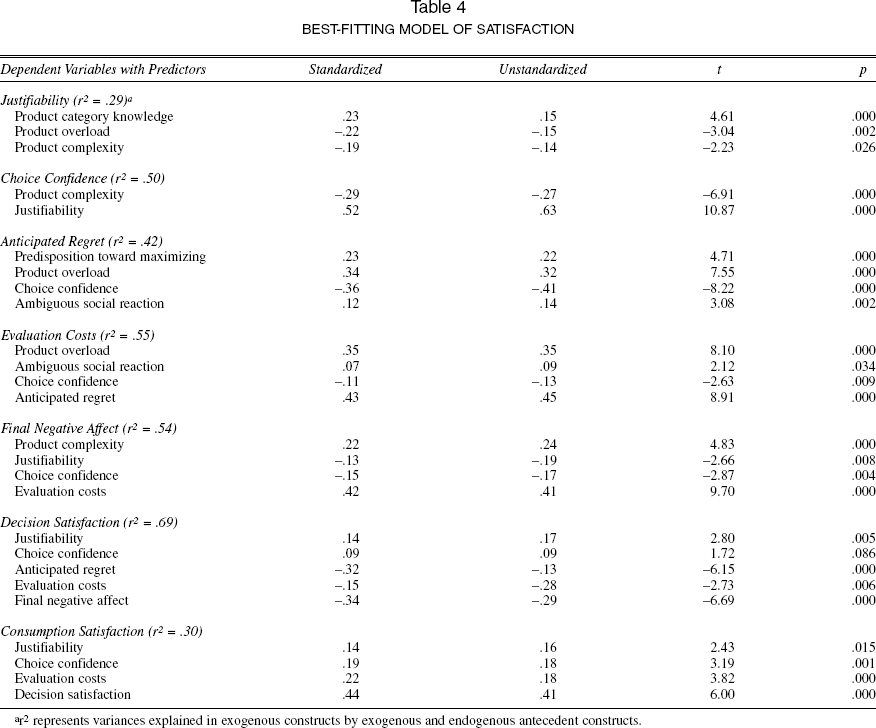
r2 represents variances explained in exogenous constructs by exogenous and endogenous antecedent constructs.
In general, different choice goals drive decision and consumption satisfaction. More specifically, decision satisfaction is primarily driven by emotional goals (anticipated regret, final negative affect), whereas consumption satisfaction depends primarily on choice confidence, evaluation cost, and decision satisfaction. Moreover, considerably more variation is explainable for decision (r2 = .69) than for consumption (r2 = .30) satisfaction. In terms of the choice goals, all depend significantly on exogenous factors; product overload was significant for three of the five goals.
Do choice goals mediate the impact of exogenous factors? To test this, we first allowed the exogenous factors to affect decision and consumption satisfaction directly. Consistent with previous research, all paths were significant. We then allowed both the exogenous factors and the choice goals to affect satisfaction. Although many of the choice goals were significant, except for product overload (p < .10), none of the exogenous factors were, and their coefficients decreased substantially in magnitude. Because (1) the exogenous factors affect goals and the goals affect satisfaction, (2) the exogenous factors affect impact satisfaction when goals are not allowed to affect satisfaction, and (3) this impact is reduced to the point that only product overload has a significant effect at a 10% level when choice goals are allowed to affect satisfaction, we suggest that as hypothesized, choice goals mediate the effect of the exogenous factors (see Baron and Kenny 1986).
Results: Second Study
The consequences constructs are reliable (Table 5). The five-item loyalty scale has an average variance extracted of .50, and all standardized loadings are above .60. Similarly, the three-item scale for intensity of word of mouth has an average variance extracted of .58, and all standardized loadings are above .70. Furthermore, the four consequences, though correlated, again extract a higher average variance in their indicators than they share with any other construct, indicating discriminant validity. Therefore, we examine the impacts on them separately.
Second-Study Measurement Model
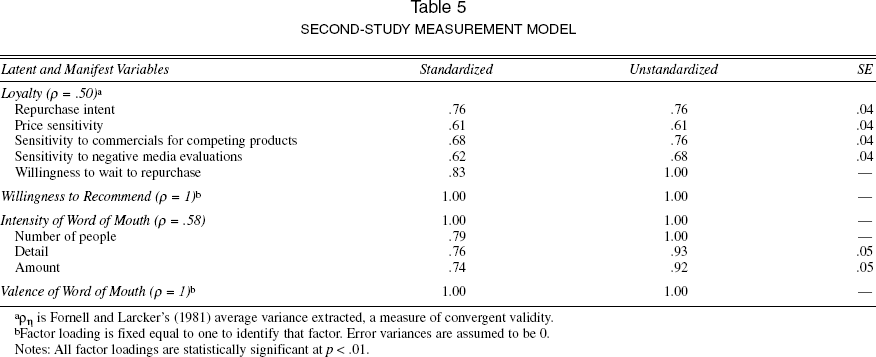
ρη is Fornell and Larcker's (1981) average variance extracted, a measure of convergent validity.
Factor loading is fixed equal to one to identify that factor. Error variances are assumed to be 0.
Notes: All factor loadings are statistically significant at p < .01.
We first tested whether the satisfaction constructs had the same structure in the two periods. For consumption satisfaction, eight of ten factor loadings were equal according to nested tests using LISREL with separate equality constraints for each individual measure. Two indicators—“I am not happy that I bought this product,” and “I feel bad about my decision to buy this product”—had significantly different loadings, though they are similar numerically. Still, we dropped them from the analysis of the second study. This had no real impact, because the correlation between consumption satisfaction in the second study with all ten indicators and with the remaining eight indicators is .99. For decision satisfaction, two of the three indicators had stable coefficients and one (Measure 5: “I found the decision-making process interesting”) differed. Given the desire for multiple indicators, we kept the same three indicators as in the initial study.
We examined the stability in the satisfaction ratings with a carryover coefficient. For decision satisfaction, the standardized stability coefficient in LISREL was .59 (t = 18.60). For consumption satisfaction, the intertemporal coefficient was .61 (t = 21.72). This means that the latent constructs are reasonably stable over time.
The next question is whether there is a mean shift over time. Encouragingly, on average, decision satisfaction is unchanged (average latent mean difference = .04 on a nine-point scale, t = .59). Notably, consumption satisfaction has a small but significant increase (average difference = .28, t = 5.40). This could be caused by acculturation to the chosen alternative and/or by learning to use the product better or represent the process of dissonance reduction.
We also conducted a multiple-group analysis of the final model with both consumption satisfaction from the initial study and consumption satisfaction from the second study. The decision satisfaction–consumption satisfaction coefficient dropped slightly from .41 (initial study) to .33 (second study), the effect of justifiability on consumption satisfaction dropped from .14 to .10, and the link between evaluation costs and consumption satisfaction dropped from .21 to .17. We observed a slight increase in the choice confidence–consumption satisfaction coefficient from .20 to .21. Imposing equality constraints across groups one variable at a time reduces fit by an nonsignificant amount (for the decision satisfaction–consumption satisfaction link, Δχ2 = 1.33, p = .25; for the justifiability–consumption satisfaction link, Δχ2 = .33, p = .57; for the choice confidence–consumption satisfaction link, Δχ2 = .01, p = .92; and for the evaluation cost–consumption satisfaction link, Δχ2 = .56, p = .45). Thus, the results are robust with respect to when consumption satisfaction is measured, which suggests they are not due to the common method bias that arises within a survey.
Finally, we examined whether there was any evidence of attrition bias by rerunning the antecedents model on the initial-study data for only the 419 respondents who participated in the second study. Except for a slight decrease in statistical significance (which is to be expected with a smaller sample size), the results were essentially equal. Therefore, we chose to use all the available observations in each of the analyses.
We related decision and consumption satisfaction to the various consequences through simple correlations and LISREL (Figure 2). The LISREL results allow for a test (with the modification indexes) of whether adding the consequences to the model requires model revision in the previous stages. Fortunately, as we expected, the rest of the model was not significantly affected.

Revised Model of Satisfaction and Its Consequences
The correlations between decision and consumption satisfaction and the four consequences appear in Table 6. In general, all correlations are significant, and consumption satisfaction is more highly linked to consequences than is decision satisfaction. This is not surprising, given the previous finding that decision satisfaction leads to consumption satisfaction.
Correlations Between Satisfaction and Its Consequences
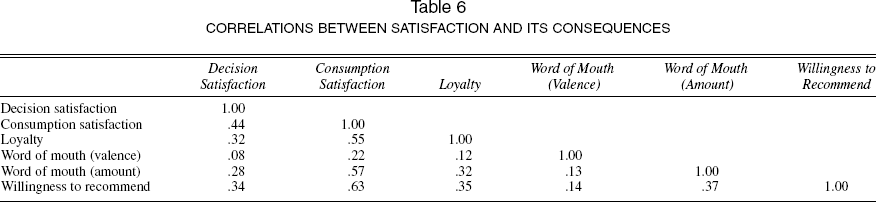
Because additional determinants may affect the four consequences, we allow for residual correlations among the consequences constructs when we added these to the LISREL model from the initial study. The results are significant from consumption satisfaction to all four variables and from decision satisfaction to two variables (loyalty and willingness to recommend). When we do not allow for residual correlations, the results are similar; all coefficients are slightly larger, and the decision satisfaction– willingness-to-recommend link is significant at p < .05. We obtain similar results when we treat the indicators of the consequences as formative and use an index (average) of them in the analysis. Because the impact of decision satisfaction on the valence and intensity of word of mouth was not significant (Δχ2 = 1.30, n.s.), we dropped these links from the model and reestimated it. Apparently, decision satisfaction has no incremental impact (over consumption satisfaction) on word of mouth.
The coefficients from the revised model that links satisfaction to consequences appear in Table 7. The overall fit was good (root mean square error of approximation = .05, nonnormed fit index = .96, and comparative fit index = .97). In terms of both magnitude and statistical significance, consumption satisfaction has a greater impact, even when we consider the indirect impact of decision satisfaction. Moreover, decision and consumption satisfaction explain a substantial fraction of the variance in loyalty, willingness to recommend, and the valence of word of mouth (r2 = .27 to .37). In contrast, the impact of consumption satisfaction on the amount of word of mouth, though statistically significant, is quite small (r2 = .03), and decision satisfaction has no significant impact on word of mouth. This suggests that the tendency to talk about a product is largely a function of individual differences (e.g., opinion leadership), whereas what is said and done about a product is driven substantially by satisfaction. We ruled out an alternative explanation— that the effect on the amount of word of mouth is nonlinear (i.e., high for very low or very high levels of satisfaction)— on the basis of a graphic examination of the relationship between the two constructs.
Revised Model of the Consequences of Satisfaction

r2 represents variances explained in exogenous constructs by endogenous antecedent constructs.
We also reran the antecedents analyses using consumption satisfaction from the second study. This results in a stronger effect for consumption (consistent with a response-style effect) and a weaker effect for decision satisfaction. Thus, the impact of decision satisfaction may fade in memory and influence, whereas that of consumption satisfaction may be reenforced by use and thus increase over time.
Discussion
This article makes several contributions. First, it provides additional evidence for the existence of decision and consumption satisfaction as separate constructs. It also provides evidence that decision satisfaction leads to consumption satisfaction. Second, it shows that the achievement of five choice goals (justification, confidence, evaluation costs, anticipated regret, and final negative affect) leads to decision and consumption satisfaction. In turn, these goals are driven by factors related to the choice set, individual differences, and social influences. In terms of consequences, there is a clear impact of satisfaction on loyalty/repeat purchase, willingness to recommend to a friend, and general valence of word of mouth, with consumption satisfaction providing the bulk of the impact. Notably, only consumption satisfaction affects the amount of word of mouth, and this is only to a limited degree.
Considering choice goals, we note that evaluation costs affect decision and consumption satisfaction in opposite directions. With regard to consumption satisfaction, our results replicate Cardozo's (1965) counterintuitive finding that evaluation costs increase satisfaction. However, evaluation costs negatively affect decision satisfaction. Because decision and consumption satisfaction are positively related, there is a direct, positive effect and an indirect, negative effect of evaluation costs. However, the total effect remains positive (β = .15). Thus, a strategy of increasing convenience by a reduction in effort may not be optimal.
In general, manufacturers are more interested in increasing consumption satisfaction, whereas retailers may con-centrate on decision satisfaction. With regard to channel coordination, it has been noted that except for evaluation costs, all the endogenous and exogenous determinants influence decision and consumption satisfaction in the same direction. Consequently, manufacturers and retailers share common interests. This is important because many constructs, such as product knowledge or product complexity, can be managed most effectively when retailers and manufacturers cooperate.
Recent studies on assortment size have shown that excessive choice can result in a demotivation to choose and a decrease in satisfaction (e.g., Iyengar and Lepper 2000). Our results reveal a similar finding with a total effect of perceived overload on consumption satisfaction of −.13. This occurs because choice overload increases anticipated regret and the difficulty in identifying convincing consequences of reasons for choosing one option over the others.
There are also limitations to this research. A main limitation is the data. Although the data are useful and derived from “real” consumers, they use a recall method and thus are subject to hindsight bias. The data are also based on consumer electronics; the process may differ in other categories that vary in expenditure level, hedonic versus utilitarian aspects, involvement, and so forth. In addition, participants were members of a panel that raises various maturation issues, and the 45% response rate allows for a nonresponse bias. Furthermore, although all model constructs pass the threshold for being discriminant, product complexity and product overload are highly correlated. Although we did not observe inflated standard errors for the links from both constructs, multicollinearity could have affected the results. Finally, it is possible to question some of the individual items in the scales. In general, the results are robust with respect to individual items. For example, we removed POV3 from the perceived-overload scale, and the results were essentially unchanged. Nonetheless, alternative measures could produce somewhat different results.
There are several directions for further research. Different populations and products (and services) need to be studied before empirical generalizations are possible. Moreover, given the weak finding with respect to explaining the intensity of word of mouth, more work is needed to explain this phenomenon. Furthermore, the question of what drives this is worth investigating. Another research direction involves linking decision and consumption satisfaction to firm revenue and value to determine whether they have direct effects in addition to their impacts on customer purchase behavior. There is also the intriguing issue of linking the two types of satisfaction to retention and expansion of customers as well as to brand equity. We hope that this article will spur research in these and other directions.
Footnotes
Appendix
Initial Measurement Scales

| Latent Variables with Indicators | Scale Based on |
|---|---|
| Product Category Knowledge | Beatty and Talpade (1994); Flynn and Goldsmith (1999) |
| SPK1 I knew pretty much about these products. | |
| SPK2 Among my circle of friends, I was one of the “experts” on these products. | |
| SPK3 Compared to most other people, I knew less about these products. (R) | |
| SPK4 When it comes to these products, I really did not know a lot. (R) | |
| SPK5 I did not feel very knowledgeable about these products. (R) | |
| SPK6 I had a lot of experiences with these products. | |
| SPK7 I felt familiar with these products. | |
| Predisposition Toward Maximizing | Schwartz et al. (2002) |
| PTM1 When I am in the car listening to the radio, I often check other stations to see if something better is playing, even if I'm relatively satisfied with what I'm listening to. | |
| PTM2 When I watch TV, I often channel surf, scanning through the available options even while attempting to watch one program. | |
| PTM3 a No matter what I do, I have the highest standards for myself. | |
| PTM4 a I never settle for the second best. | |
| PTM5 a Whenever I'm faced with a choice, I try to imagine what all the other possibilities are, even ones that aren't present at the moment. | |
| PTM6 a I often find it difficult to shop for a gift for a friend. | |
| PTM7 a Renting videos is really difficult. I'm always struggling to pick the best one. | |
| Product Complexity | Burnham, Frels, and Mahajan (2003) |
| PCO1 The offerings in this product category were difficult to understand. | |
| PCO2 a The number of product attributes was overwhelming. | |
| PCO3 a I felt a salesperson selling this kind of product would need to know a lot to do a good job. | |
| PCO4 I felt that I would need to know a lot to take full advantage of the products offered. | |
| PCO5 I felt this kind of product was complicated in nature. | |
| Product Overload | Sproles and Kendall (1986) |
| POV1 There were so many brands to choose from that I felt confused. | |
| POV2 The more I learned about these products, the harder it seemed to choose the best. | |
| POV3 It was difficult to obtain an overview over the products offered. | |
| POV4 With that many options to choose between, I have had a hard time identifying distinguishing product characteristics. | |
| POV5 With that many options to choose between, I found it difficult to compare competing offers. | |
| Ambiguous Social Reaction | Park and Lessig (1977) |
| I found it difficult to judge … | |
| ASR1 which products friends, neighbours, relatives or work associates with reliable information would recommend me to buy. | |
| ASR2 which products an association of professionals or independent group of experts would find superior. | |
| ASR3 the product related preferences of people with whom I interact. | |
| ASR4 with which product I would satisfy the expectations others have of myself. | |
| ASR5 with which product I could show others who I am and who I would like to be. | |
| ASR6 the characteristics of typical customers of the different brands being offered. | |
| Justifiability | Qualitative prestudy |
| JUS1 I thought it would be easy to justify a purchase decision, in case someone challenges it. | |
| JUS2 I was able to see at first sight that some products were superior. | |
| JUS3 In order to decide for one product, it was not necessary to make any difficult trade-offs. | |
| Choice Confidence | Bruner, James, and Hensel (2001); Urbany et al. (1997) |
| CCO1 It was impossible to be certain which product fits my preferences best. (R) | |
| CCO2 I felt confident when identifying one product that best matches my preferences. | |
| CCO3 I was convinced to find a product that best fulfils my needs. | |
| Anticipated Regret | Oliver (1997); Schwartz et al. (2002); Tsiros and Mittal (2000) |
| ARG1 When I selected a product, I was worried to get information after the purchase on superior competing products. | |
| ARG2 When I chose a product, I was curious about what would have happened had I chosen differently. | |
| ARG3 a I worried others would expect me to deliberate more extensively and make a better choice. | |
| ARG4 Even after finding a good option, I feared that I am overlooking better products. | |
| ARG5 When I selected a product, I was curious how much I would appreciate competing offers. | |
| Evaluation Costs | Burnham, Frels, and Mahajan (2003); Cooper-Martin (1994) |
| EVC1 How much time/effort did it take to evaluate and compare the alternatives in order to feel comfortable making a choice? (“very little/a lot”) | |
| EVC2 I could not afford the time to fully evaluate relevant purchase options. | |
| EVC3 It was tough to compare the different products being offered. | |
| EVC4 It was difficult for me to make this choice. | |
| EVC5 I concentrated a lot while making this choice. | |
| Final Negative Affect | Luce, Bettman, and Payne (1997); Watson, Clark, and Tellegen (1988) |
| When I ultimately selected a product I felt … | |
| FNA1 a ashamed. | |
| FNA2 jittery. | |
| FNA3 distressed. | |
| FNA4 afraid. | |
| FNA5 upset. | |
| FNA6 a guilty. | |
| FNA7 irritable. | |
| FNA8 a hostile. | |
| FNA9 a nervous. | |
| FNA10 a scared. | |
| Decision Satisfaction | Fitzsimons (2000); Fitzsimons, Greenleaf, and Lehmann (1997); Zhang and Fitzsimons (1999) |
| DES1 I found the process of deciding which product to buy frustrating. (R) | |
| DES2 a Several good options were available for me to choose between. | |
| DES3 a I thought the choice selection was good. | |
| DES4 a I would be happy to choose from the same set of product options on my next purchase occasion. | |
| DES5 I found the process of deciding which product to buy interesting. | |
| DES6 I was satisfied with my experience of deciding which product option to choose. | |
| Consumption Satisfaction | Oliver (1997) |
| COS1 a This is one of the best products I could have bought. | |
| COS2 This product is exactly what I need. | |
| COS3 This product hasn't worked out as well as I thought it would. (R) | |
| COS4 I am satisfied with my product. | |
| COS5 Sometimes I have mixed feelings about keeping this product. (R) | |
| COS6 My choice to buy this product was a wise one. | |
| COS7 If I could do it over again, I'd buy a different product. (R) | |
| COS8 I have truly enjoyed this product. | |
| COS9 I feel bad about my decision to buy this product. (R) | |
| COS10 I am not happy that I bought this product. (R) | |
| COS11 Owning this product has been a good experience. | |
| COS12 a I am sure it was the right thing to buy this product. | |
| Loyalty | Boulding et al. (1993); Fornell et al. (1996); Zeithaml, Berry, and Parasuraman (1996) |
| LOY1 It is very likely that I would purchase this same product (or its successor) again. | |
| LOY2 I am willing to pay a price premium over competing products to be able to purchase this product (or its successor) again. | |
| LOY3 I would only consider purchasing this product again, if it would be substantially cheaper. (R) | |
| LOY4 Commercials regarding competing brands are not able to reduce my interest in buying the same product (or its successor) again. | |
| LOY5 I would purchase this product (or its successor) again, even if it receives bad evaluations by the media or other people. | |
| Willingness to Recommend | Reichheld (2003) |
| REC Would you recommend this product to a friend? (“very unlikely/very likely”) | |
| Intensity of Word of Mouth | Harrison-Walker (2001) |
| WMI1 I've told more people about this product than I usually tell people about my possessions. | |
| WMI2 I seldom missed an opportunity to talk about this product. | |
| WMI3 When I conversed about this product, I talked about it in great detail. | |
| Valence of Word of Mouth | Harrison-Walker (2001) |
| WMV When I talked about this product, I tended to talk … (“very negative/very positive”) |
Items were removed during the scale purification process.
Notes: All measures not indicated otherwise were assessed on nine-point scales, anchored by “strongly disagree” (1), “somewhat disagree” (3), “neither agree nor disagree” (5), “somewhat agree” (7), and “strongly agree” (9). R = reverse scored.