







Abstract
The mere measurement of a person's intention to behave has been shown to influence his or her likelihood of engaging in the behavior. The mere measurement effect has been attributed to an increased accessibility of the attitude toward the behavior. Another source of the mere measurement effect may be the redundancy in the cognitive processes used to generate the mere measurement response and the cognitive processes used to decide whether to engage in the behavior. Process redundancy creates a fluency that can be interpreted as supportive of the behavioral tendency. Across eight studies, the authors show that processing fluency also contributes to the mere measurement effect.
There is considerable evidence that the mere measurement of intent influences subsequent preference judgments, behavioral intent, and behavior (Morwitz and Fitzsimons 2004; Spangenberg and Greenwald 1999). The prevailing account of the mere measurement effect has been the attitude accessibility explanation (Morwitz and Fitzsimons 2004; Morwitz, Johnson, and Schmittlein 1993). Morwitz, Johnson, and Schmittlein (1993, p. 47) argue that “answering purchase intent questions might make the attitude underlying the intent more accessible.” To the extent that an attitude toward a product is positive (negative), increasing the accessibility of this attitude should increase (decrease) the likelihood that a person will engage in behaviors consistent with this attitude. Morwitz and colleagues (Chandon, Morwitz, and Reinartz 2004; Dholakia and Morwitz 2002; Fitzsimons and Morwitz 1996; Morwitz and Fitzsimons 2004) provide evidence that suggests that a response to an intent question can increase access to preexisting attitudes and subsequently influence brand loyalty and consumption behavior.
Despite the support for the attitude accessibility account of the mere measurement effect, findings imply that there are additional sources of the mere measurement effect. First, mere measurement effects can occur for novel behaviors (Chapman 2001). For example, Chapman (2001) demonstrates mere measurement effects for novel product concepts under processing conditions that discourage spontaneous attitude formation. If a person does not have an attitude toward a behavior, it is difficult to conceptualize how responding to a single intention measure will enhance the accessibility of an attitude. Second, the mere measurement effect has been shown to persist for up to six months, even for novice consumers (Morwitz, Johnson, and Schmittlein 1993). Novice consumers are more likely than experts to construct an on-the-spot response to an intention question, so they are unlikely to store an attitude as a consequence of responding to the intent question (Feldman and Lynch 1988). In the event that novices store attitudes, these attitudes should be weakly held and should decay over time (Fazio et al. 1986; Wyer and Srull 1986). Finally, measuring intentions leads to a stronger mere measurement effect than measuring attitudes (Chapman 2001; Spangenberg et al. 2003). If attitude accessibility is solely responsible for the mere measurement effect, there should not be an incremental effect of measuring intentions.
We posit that processing fluency may be an additional source of the mere measurement effect. Processing fluency refers to the ease of executing a cognitive activity, whether it is the generation of a perception (i.e., perceptual fluency), the retrieval of information from memory (i.e., retrieval fluency), or the assignment of meaning to an event (i.e., conceptual fluency). Attributions about processing fluency have been shown to influence judgments about preference, truth, and memory (Hasher, Goldstein, and Toppino 1977; Mandler, Nakamura, and Van Zandt 1987; Whittlesea, Jacoby, and Girard 1990) as well as to influence eating behavior, persuasion, and compliance with requests (Bornstein, Leone, and Galley 1987; Burger et al. 2001; Capaldi 1996). We propose that a similar bias based on the processing fluency a person experiences when planning a behavioral response can contribute to the mere measurement effect.
This article investigates the influence of responding to an initial-intent question on subsequent intentions to purchase the product. Our objective is to show that processing fluency experienced during the planning of a subsequent response, termed “response fluency,” can lead to a stronger behavioral intention. We show that response-fluency effects are independent of attitude accessibility effects and that they have defining characteristics. Experiments 1a, 1b, and 1c show that response fluency increases a subsequent purchase intention. Experiments 2a and 2b show that it is the degree of overlap in the processing activities used to answer the initial-intent question and the processing activities used to respond to the subsequent purchase intention question that create the response fluency responsible for the mere measurement effect. Experiments 3 and 4 identify a boundary condition of the response-fluency effect. Attributions about response fluency are limited to situations in which response fluency is high relative to the fluency associated with other courses of action. Experiment 5 documents that people will not rely on attributions about response fluency when more diagnostic information is available. Owing to the nature of the research questions, Experiments 1–3 and 5 investigate the influence of responding to an intent question on a subsequent judgment, and Experiment 4 investigates the influence of responding to an intent question on a purchase.
Mere Measurement
The mere measurement effect occurs when the act of responding to an initial-intent question alters respondents' subsequent evaluations and behaviors (Morwitz, Johnson, and Schmittlein 1993; Sherman 1980). Empirically similar to the self-prophecy effect, the influence of mere measurement has been documented in a wide variety of situations, including automobile and home personal computer purchases (Morwitz, Johnson, and Schmittlein 1993), shopping behavior (Chandon, Morwitz, and Reinhartz 2004), voting behavior (Greenwald et al. 1987; Simmons, Bickart, and Lynch 1993), and socially desirable behaviors (e.g., volunteering, exercising, recycling) or socially undesirable behaviors (e.g., illegal drug use, eating fatty food, cheating) (Sherman 1980; Spangenberg 1997; Spangenberg and Obermiller 1996; Spangenberg et al. 2003; Williams, Fitzsimons, and Block 2004). In each of these cases, responding to the initial-intent question biases subsequent judgments or behaviors in a proattitudinal or socially desirable direction, each factor exerting an independent and occasionally countervailing influence.
Attitude Accessibility
Gregory, Cialdini, and Carpenter (1982) were the first to claim that mere measurement increases the accessibility of information that is consistent with the attitude toward the behavior. They asked participants to imagine using a cable television subscription service. Participants who were asked to consider using cable television were more likely to subscribe than those who were not asked. Gregory, Cialdini, and Carpenter explain this phenomenon as follows: When asked to imagine a scenario, people access information related to that scenario, and later, when asked to act, they base their decision on the information that is most salient and accessible. Thus, imagining an outcome gives more weight to the information consistent with that outcome.
Morwitz, Johnson, and Schmittlein (1993) argue that responding to an initial-purchase-intent question makes the attitude toward the purchase more accessible during subsequent purchase judgments. Morwitz and Fitzsimons (2004) provide specific evidence that responding to a behavioral-intent question increases the accessibility of the attitude toward the behavior (see also Morwitz and Fitzsimons 2002). Participants were asked to form attitudes about competing Canadian candy bars, list reasons for purchasing/not purchasing a particular candy bar, and indicate whether they would purchase a Canadian candy bar (i.e., general-intent question). Participants who were asked to report their general purchase intent were more (less) likely to choose a bar if they had listed positive (negative) reasons for purchasing. Those who responded to the general-purchase-intent question were also more (less) likely to recall the more (less) accessible brand and could more quickly judge the brand as good (bad). Morwitz and Fitzsimons (2004, p. 66) contend that “simply asking a general intentions question makes attitudes toward choice options that were previously accessible even more accessible.”
Some findings in the mere measurement literature are inconsistent with the attitude accessibility account. First, mere measurement can influence behavior toward novel products (Chapman 2001; Morwitz and Fitzsimons 2004; Morwitz, Johnson, and Schmittlein 1993). It is unlikely that consumers hold attitudes toward novel products, so it is unlikely that responding to an intent question could increase attitude accessibility. Second, when consumers repeatedly respond to an intent question about a novel product, they exhibit an increase in an attitude toward the product that is not accompanied by an increase in positive thoughts about the product (Chapman 2001). Exposure-driven increases in affect for novel stimuli are most often attributed to processing fluency, not to increased attitude accessibility (Janiszewski and Meyvis 2001). Third, the mere measurement effect persists for up to six months with novice consumers (Morwitz, Johnson, and Schmittlein 1993). Novice consumers are unlikely to hold product attitudes (Feldman and Lynch 1988). If novice consumers hold attitudes, these attitudes are likely to be weak and subject to decay (Fazio et al. 1986; Wyer and Srull 1986). Fourth, measuring purchase intent leads to a stronger mere measurement effect than measuring product attitudes (Chapman 2001). Chapman (2001) shows that an intent measure led to a compliance rate of 31.9%, whereas an attitude measure led to a compliance rate of 24.4%. If it is assumed that a response to an intent question should provide access to an attitude to a lesser extent than a response to a direct attitude question, then the response to the intent question should not lead to a stronger mere measurement effect. Finally, Morwitz and Fitzsimons (2002, Experiments 1 and 4) find that mere measurement effects are not influenced by the accessibility of a behavioral intention, which indicates that an additional process may be operating.
Processing Fluency
The inability of the attitude accessibility explanation to account for all the findings in the mere measurement literature implies that there may be additional factors that contribute to the mere measurement effect. A possibility is that mere measurement effects also depend on attributions about the processing fluency experienced at the time a behavior is considered. A person may become more likely to conclude that the course of action is worthwhile and be more willing to engage in that action when it is easier to execute the cognitive processes that support the consideration of the action (i.e., response fluency). Our overview of the response-fluency hypothesis involves a discussion of the sources of processing fluency, the attributions people make about processing fluency, and the situations in which people are likely to make these attributions.
Sources of processing fluency
There are three sources of processing fluency. The first source is the increased activation associated with a stimulus representation due to prior processing of the identical stimulus (e.g., Mandler, Nakamura, and Van Zandt 1987). This type of fluency can be termed “stimulus-specific retrieval fluency” because stimuli are identical at training and at test. 1 Stimulus-specific retrieval fluency has typically been obtained for items that are novel or meaningless, leading some researchers to conclude that the processing fluency occurs as a consequence of perceptual processes (Shapiro 1999; Whittlesea 1987, 1993). Consistent with this claim, artificially increasing the activation of a stimulus at test (e.g., altering the contrast between a stimulus and its background) increases processing fluency (Reber and Schwarz 1999; Reber, Winkielman, and Schwarz 1998; Whittlesea 1993; Whittlesea, Jacoby, and Girard 1990).
Mandler, Nakamura, and Van Zandt (1987) term this type of fluency “nonspecific activation.”
The second source of processing fluency is the overlap in the procedures or processes used in both the training and the test tasks (Kolers 1973). To the extent that the component processes involved in a training and test task overlap, the training task could influence performance on the test task, independent of the stimuli used to complete each task. For example, practicing the reading of inverted text can facilitate subsequent reading of inverted text. There are even cases in which practice on one task (e.g., reading inverted text) can improve performance on a second task (e.g., reading rotated text) to a greater extent than repeated performance on the original task (e.g., reading inverted text) (Kolers and Perkins 1975).
The third source of processing fluency is the combined overlap in the stimuli and processes used in the training and test tasks, most often called “transfer-appropriate processing,” or TAP (see Franks et al. 2000; Morris, Bransford, and Franks 1977; Roediger 1990; Roediger, Gallo, and Geraci 2002). The TAP hypothesis posits that processing fluency results from “the unique interaction of a particular intentional act engaged with a particular stimulus situation” (Franks et al. 2000, p. 1140). For example, Franks and colleagues (2000) conduct 13 experiments in which two training tasks (e.g., lexical decision: “Is it a word?” animacy: “Is it alive?”) are crossed with two identical test tasks (e.g., lexical decision, animacy) for novel and repeated stimuli. Three notable findings emerge. First, the majority of the studies show that common training and test tasks do not enhance reaction times to novel items. Second, reaction times are facilitated when tasks and stimuli are repeated compared with situations when tasks are repeated and stimuli are novel (i.e., animacy–animacy is faster for old items than for new items). Third, in the cross-task conditions, the reduced reaction time to repeated stimuli occurs only when the test task is subsumed by the acquisition task. For example, the animacy training task–lexical decision test task combination results in an advantage for old items, but the lexical decision training task–animacy test task combination results in no advantage for old items. These last two findings are evidence for a TAP effect in which the influence of the shared processes at training and test is specific to the stimulus.
Attributions about processing fluency
There is general agreement that people make attributions about the meaning of processing fluency and that the attributions are usually fast and nonconscious (Bornstein and D'Agostino 1994; Klinger and Greenwald 1994; Whittlesea and LeBoe 2000). Attributions about processing fluency have been shown to influence a wide variety of judgments, including liking (Janiszewski 1993; Lee and Labroo 2004; Zajonc 1968), the truth of a statement (Begg and Armour 1991; Hasher, Goldstein, and Topinno 1977), the fame of a name (Jacoby et al. 1989), message comprehensibility (Masson 1995), memory accuracy (Whittlesea, Jacoby, and Girard 1990), and consideration set formation (Shapiro 1999). For example, if a person needs to make a judgment about liking and experience has taught the person that fluently processed stimuli are typically liked, he or she should attribute fluent stimulus processing as evidence of liking (Klinger and Greenwald 1994). For the most part, these demonstrations have depended on the consumer's willingness to use stimulus-specific retrieval fluency to make an attribution (e.g., it is liked, it is true) about the stimulus.
Processing fluency has also been shown to influence volitional behaviors. For example, repeated exposure to a specific food increases a child's willingness to consume the food, even though the taste of the food is initially disagreeable (Capaldi 1996). Repeated exposure to a political candidate's signage increases the likelihood that a person will vote for the candidate (Schaffner and Wandersman 1974; Schaffner, Wandersman, and Stang 1981). Exposure to a confederate (e.g., five minutes in the same room) increases the likelihood that a person will comply with the confederate's request, even in cases when there is no interaction within the dyad (Burger et al. 2001). In each of these cases, repeated exposure either (1) creates processing fluency, which makes the course of action more appealing than less fluently processed competing courses of action, or (2) creates processing fluency, which is interpreted positively and is used as input into the decision to engage in the behavior.
Constraints on fluency attributions
It is important to recognize that stimulus and task constraints limit the use of a processing-fluency heuristic. First, although there are hundreds of demonstrations of the use of a processing-fluency heuristic, a majority of these demonstrations involve novel stimuli (Bornstein 1989; Schwarz 2004). The large concentration of reported evidence with novel stimuli implies that a processing-fluency heuristic may be more useful when there are no other sources of information for making a decision (Bornstein and D'Agostino 1994; Fiedler 2000; Schwarz 2004). Second, consistent with most attribution processes, attributions about processing fluency are influenced by the available contextual and focal stimulus information. For example, Mandler, Nakamura, and Van Zandt (1987) show that previously viewed octagons were judged more pleasant, lighter, and darker than novel octagons but were not less pleasant than novel octagons. The implication is that the attributions about processing fluency are not limited to a single direction or a single dimension but rather are contingent on the constraints of the task. Similarly, prior exposure to positively (negatively) valenced, novel names increased the likelihood that the names were recognized as famous senators (criminals) but not as famous criminals (senators) (Klinger and Greenwald 1994). In this case, the attribution about processing fluency was contingent on the task and the information being considered to complete the task.
Documenting the Use of Processing Fluency
We contend that purchase intention judgments can be sensitive to attributions about response fluency, just as liking, truth, and memory judgments are sensitive to attributions about processing fluency. We also contend that the complexity and specificity of a purchase intention judgment suggest that the processing fluency associated with planning a response is a function of TAP. Yet claiming that processing fluency exerts a mere measurement influence beyond that of attitude accessibility requires that we identify and demonstrate effects that have been uniquely associated with processing fluency.
First, stimulus-specific processing-fluency effects are persistent. In a meta-analysis of mere exposure effects, Bornstein (1989) finds that mere exposure effects are maintained as the delay between exposure and test increases from one minute to up to two weeks. Similarly, Kolers (1976) shows that unique text presentation formats can facilitate a person's ability to reread identical sentences 13– 15 months after the initial reading. In contrast, attitudes are known to remain accessible longer than the information used to form those attitudes, but long-term increases in the accessibility of attitudes can be expected only in situations in which existing attitudes have been repeatedly generated (e.g., repeatedly responding to an intent question).
Second, processing-fluency effects exhibit correspondence (Kolers and Roediger 1984; Newell and Bright 2003; Roediger and McDermott 1993). As we discussed previously, stimulus-specific retrieval-fluency effects require that identical stimuli be presented during training and test. Franks and colleagues' (2000) TAP demonstrations suggest a more stringent criterion, arguing that both the stimulus and the type of processing must be equivalent at training and test for processing fluency to occur. This conclusion is qualified by the finding that there can be generalization from a training task that includes a large number of processes (e.g., animacy) to a test task that includes a subset of those processes (e.g., lexical decision), assuming that the subset of processes is meaningful in the training task (Moscovitch 1992; Roediger, Buckner, and McDermott 1999). The attitude accessibility literature makes no prediction about this issue.
Third, attributions about processing-fluency effects depend on relative fluency—a judgment context in which perception of the target stimulus is more fluent than expected (Whittlesea and LeBoe 2003). Expectations about processing fluency can be created by other stimuli that are being rated in the same test stimulus set or by the environment. Note that demonstrations of processing fluency invariably use procedures that include repeated and novel stimuli in the test stimulus set, regardless of the area of inquiry (i.e., judgment, memory, behavioral response).
Experiment 1A
Experiment 1a used a four-cell design to provide initial evidence that response fluency contributes to a mere measurement effect for novel products. The procedure involved asking intent questions about two unfamiliar ice cream treats (i.e., Royal Cornetto and Extreme). In the sole-intent-question condition, respondents were asked if they planned to purchase one of the two brands (i.e., half of the participants were asked, “Would you like to buy Royal Cornetto?” and half were asked, “Would you like to buy Extreme?”). In the dual-intent-question condition, all respondents were asked if they planned to purchase one brand (e.g., “Would you like to buy Royal Cornetto?”), and in a second question, they were asked if they planned to purchase the other brand (e.g., “Would you like to buy Extreme?”). In the general-intent-question condition, respondents were asked, “Would you like to buy an ice cream treat?” Control respondents were not asked an intent question. In a subsequent test phase, all respondents used a nine-point scale to indicate their purchase likelihood for each brand.
If response fluency is responsible for mere measurement effects with novel products, we should observe a mere measurement effect in the sole-intent condition but not in the dual- or general-intent conditions. At test, responding to the sole-intent question should result in increased response fluency for the measured brand compared with the unmeasured brand. Responding to the dual-intent questions or the general-intent question should not create differential response fluency toward the two brands at test. Initially soliciting intent about each brand or about a purchase in general results in equivalent response fluency at the time of the test (i.e., a judgment about one brand is not relatively more fluent than a judgment about the other brand).
If attitude accessibility is responsible for mere measurement effects with novel products, we should observe one of two patterns of results (henceforth, Attitude Accessibility 1 and 2). First, we could observe a null effect across all conditions because there are no preexisting attitudes that can be made more accessible by the intent questions (i.e., there are no preexisting attitudes associated with novel products). Second, if we were to assume that responding to an intent question creates an attitude, we could observe a significant influence of mere measurement in the sole-intent and dual-intent conditions because these conditions encourage the formation and increase the accessibility of attitudes toward the brands. 2
It could be argued that purchase intentions at test depend on the relative accessibility of an attitude and the valence of the attitude. In the dual-intent condition, attitudes toward both brands might be equally accessible and equally positive; thus, a null effect may exist. Experiment 1b addresses this interpretation of the attitude accessibility account.
Design and Procedure
The experiment was a four-cell, between-group design with three treatment groups (sole-, dual-, and general-intent questions) plus a control group. Sixty-four respondents from an undergraduate student subject pool were invited into a lab in groups of up to 20 and were seated at personal computers. Respondents read an introduction stating that a European frozen confectionary company was planning to introduce ice cream products into the U.S. market. Respondents then viewed pictures of the two European brands of ice cream treats (Royal Cornetto and Extreme). The pictures consisted of product packaging and were accompanied by a sentence describing both products (“These two products are chocolate ice cream cones and come in packs of six”). After respondents viewed the product packages for three seconds, the intent question(s) was (were) asked (e.g., “Would you like to buy_____?”), and respondents answered no or yes. After a five-minute filler task, respondents indicated their likelihood of purchasing each treat using a nine-point scale anchored by “not at all likely” and “extremely likely.” We counterbalanced the brand associated with the intent question in the sole-intent-question condition and the brand queried first in the dual-intent-question condition. Thus, we controlled for any potential brand effects.
Pretest
Forty-one respondents were asked to state their preference for each of the brands using a ten-point scale anchored by “very negative” and “very positive.” Preference did not significantly differ for the brands (MRoyal Cornetto = 5.49, MExtreme = 5.83; F(1, 40) = .59, p > .05). Thus, the brands had relatively neutral and equal ratings.
Results
We removed 13 respondents from the analysis because they indicated that they did not eat ice cream or were familiar with the brands, yielding a final sample of 51 respondents. The results appear in Figure 1.

A Purchase Intention Question About A Brand Results in A Mere Measurement Effect, But a Question About two Brands Does Not
Sole-intent question
The brand-counterbalance manipulation did not interact with the intent-question manipulation in the sole-intent-question condition (F(1, 11) = 1.09, p > .05), so we collapsed the means across brands. Respondents in the sole-intent-question condition had a significantly higher purchase likelihood for the measured brand (M = 7.38) than for the unmeasured brand (M = 5.77; t(12) = 2.39, p < .05). 3
Given the unidirectional predictions of the mere measurement hypothesis, all hypothesis tests are one-tailed.
Dual- and general-intent questions
The brand-counterbalance manipulation did not interact with the intent-question manipulation (F(2, 35) = .16, p > .05), so we analyzed the brand means as repeated measures. There was no difference in purchase likelihood between the control condition (Mbrand 1 = 5.62, Mbrand 2 = 6.44) and the dual-intent-question condition (Mbrand 1 = 5.92, Mbrand 2 = 6.50; F(1, 35) = .09, p > .05) or the general-intent-question condition (Mbrand 1 = 6.40, Mbrand 2 = 6.80; F(1, 35) = .91, p > .05).
Additional analysis
The measured brand (M = 7.38) was more likely to be purchased than the unmeasured brands in the control condition (Mcollapsed = 6.03; F(1, 27) = 3.50, p < .05).
Discussion
The results of Experiment 1a indicate that mere measurement effects for novel brands may be sensitive to the response fluency created by the initial-intent question. Consistent with results in the processing-fluency literature, we observed the mere measurement effect only when there was a difference in response fluency toward the two brands. Furthermore, we observed the mere measurement effect in the sole-intent condition, but not in the dual-intent-question and general-intent-question conditions. The results were not consistent with the patterns of results predicted by the attitude accessibility account.
Experiment 1B
In Experiment 1a, we designed the procedure to discourage the formation of attitudes toward the brands. The product package displays were shown for only three seconds, and there was no product attribute information listed in the display. Nonetheless, each product package contained a product picture that could have encouraged the formation of a positive attitude toward the brand. If the dual- and general-intent questions made each of these brand attitudes more accessible and respondents relied on relative attitude accessibility when expressing their purchase likelihood, the attitude accessibility account would have predicted null effects in the dual-intent and general-intent conditions. In effect, equally accessible, positive attitudes toward each of the brands would have been nondiagnostic. We call this explanation Attitude Accessibility 3.
Our approach to assessing whether Attitude Accessibility 3 was responsible for the results of Experiment 1a was as follows: First, we identified a key assumption associated with the Attitude Accessibility 3 hypothesis (i.e., people have brand attitudes before responding to the intent question). Second, we altered the experimental procedure to force respondents to engage in processing that was consistent with the Attitude Accessibility 3 hypothesis (i.e., respondents were forced to form attitudes toward the brands before being asked the intent questions). As a consequence, we could observe how respondents behaved when the intent questions made the attitudes more accessible. Finally, we compared the results of Experiment 1b with the results of Experiment 1a. If the results of Experiments 1b and 1a are equivalent, the results of Experiment 1a are likely to be a consequence of Attitude Accessibility 3. If the results of Experiments 1b and 1a are not equivalent, the results of Experiment 1a are likely to be a consequence of a process other than Attitude Accessibility 3. In other words, knowing that Experiment 1b produced results that were a consequence of Attitude Accessibility 3 enabled us to make an inference about the processes involved in Experiment 1a.
Procedure
The procedure was identical to Experiment 1a, except for one modification. After the three-second exposure to the product packages but before the intent questions, respondents were asked to report an attitude toward each brand. Then, they were asked to elaborate on the attitude. The remainder of the procedure was the same as Experiment 1a.
Results
We recruited 131 respondents that had favorable attitudes toward ice cream from an undergraduate student subject pool. We removed 6 respondents because they were familiar with the brands, yielding a final sample of 125 respondents. The results appear in Figure 1.
Sole-intent question
The brand-counterbalance manipulation did not interact with the intent-question manipulation in the sole-intent-question condition (F(1, 32) = 2.65, p > .05), so we collapsed the means across brands. Respondents in the sole-intent-question condition had a significantly higher purchase likelihood for the measured brand (M = 7.44) than for the unmeasured brand (M = 5.65; t(33) = 5.20, p < .05).
Dual- and general-intent questions
The brand-counterbalance manipulation did not interact with the intent-question manipulation (F(2, 88) = 1.45, p > .05), so we analyzed the brand means as repeated measures. There was a significant difference in purchase likelihood between the control condition (Mbrand 1 = 5.79, Mbrand 2 = 6.36) and the dual-intent-question condition (Mbrand 1 = 6.59, Mbrand 2 = 7.15; F(1, 88) = 6.02, p < .05) but not between the control condition and the general-intent-question condition (Mbrand 1 = 6.13, Mbrand 2 = 5.71; F(1, 88) = .25, p > .05).
Additional analysis
The measured brand (M = 7.44) was more likely to be purchased than the unmeasured brands in the control condition (Mcollapsed = 6.08; F(1, 65) = 20.41, p < .05).
Discussion
In Experiment 1b, we forced respondents to engage in a procedure that was consistent with the Attitude Accessibility 3 alternative hypothesis. The advantage of this procedure was that it could provide insight into how respondents behave when attitudes are made more accessible in each of the experimental conditions investigated in Experiment 1a. The results showed a measurement effect in the sole- and the dual-intent-question conditions. These results support two conclusions. First, and most important, Attitude Accessibility 3 cannot be responsible for the results of Experiment 1a. If respondents in Experiment 1a engaged in an Attitude Accessibility 3 process, the results of Experiment 1a should have matched the results of Experiment 1b. Thus, the results of Experiment 1a must be the consequence of a process other than Attitude Accessibility 3. We contend that this alternative process is TAP fluency. Second, equally accessible attitudes do not appear to mitigate a mere measurement effect. The implication is that Attitude Accessibility 3 is not a viable hypothesis. Instead, is seems that Attitude Accessibility 2 is a better representation of the attitude accessibility process. When a positive attitude toward a brand exists and mere measurement increases the accessibility of the attitude, purchase intention will increase for all brands queried with a mere measurement question.
There is an alternative explanation for the results of Experiment 1a. It could be argued that the results are a consequence of information accessibility rather than attitude accessibility. The sole-intent question may have made information that supported the purchase-likelihood response accessible. The major weakness of this alternative hypothesis is that information accessibility and attitude accessibility should operate in parallel (Feldman and Lynch 1988). Information supports the formation of an attitude. Thus, if attitude accessibility created mere measurement effects in the sole and dual conditions of Experiment 1b, information accessibility should have created mere measurement effects in the sole and dual conditions of Experiment 1a. In other words, if Attitude Accessibility 3 is not a viable explanation of the results of Experiment 1a, a similar modification of the information accessibility hypothesis (i.e., Information Accessibility 3) is also not a viable account of the results of Experiment 1a. We discuss the information accessibility explanation further in Experiments 2a and 2b.
If our interpretation of the data from Experiment 1a is correct, three additional pieces of evidence would be informative of how response fluency contributes to the mere measurement effect. First, we should show that the effects observed in Experiment 1 are persistent, as is the case with processing-fluency effects (Bornstein 1989) and TAP effects (Kolers 1976). Second, we should show that mere measurement effects are sensitive to correspondence. For example, consistent with findings in the TAP literature, we should be able to manipulate the level of correspondence between a mere measurement question and a subsequent dependent measure to promote or suppress the mere measurement effect. Third, we should more convincingly show that the mere measurement effect depends on relative response fluency.
Experiment 1C
To demonstrate that the mere measurement effects observed in Experiment 1a are persistent, we reran the control condition and the sole-intent-question condition with a 5-minute delay or a 30-minute delay between the initial-intent question and the purchase-likelihood measure. We created the long delay by having respondents watch two videos inserted between the initial-intent question and the dependent measure.
Respondents showed a significantly higher purchase likelihood for the measured brand in the 5-minute condition (Mmeasured = 6.78, Mnot measured = 6.17; F(1, 35) = 5.08, p < .05) and in the 30-minute condition (Mmeasured = 6.59, Mnot measured = 5.85; F(1, 33) = 4.44, p < .05). The purchase likelihood was also higher for the measured brand than the average of the brands in the control condition in the 5-minute (Mmeasured = 6.78, Mnot measured = 6.15; F(1, 61) = 2.79, p = .05) and 30-minute (Mmeasured = 6.59, Mnot measured = 6.01; F(1, 63) = 2.78, p = .10) conditions. The persistence of the mere measurement effect is consistent with the persistence typically exhibited by fluency effects.
Experiments 2A and 2B
The primary goal of Experiments 2a and 2b is to replicate conceptually the correspondence results from the TAP literature with a secondary goal of providing further evidence that is inconsistent with the information accessibility account of the results of Experiment 1a. 4 Recall that the correspondence property suggests that response fluency should occur when (1) the processes and stimuli are identical at training and test or (2) the stimuli are identical at training and test and the processes at training subsume the processes at test. Response fluency should not occur or should be much weaker when the processes at training are a subset of the processes at test, even under conditions of identical stimuli. In contrast, an information accessibility explanation predicts that making the appropriate information available at training (i.e., when asking the intent question) should influence the response at test (i.e., purchase intention) regardless of the overlap in processes.
Information accessibility has not been advanced as an explanation for the mere measurement effect. Accessible information often dissipates in minutes (Posner and Snyder 1975; Ratcliff and McKoon 1988), whereas the mere measurement effect can persist for months. Yet the information accessibility hypothesis has been discussed in the self-prophesy literature (Gregory, Cialdini, and Carpenter 1982), so we directly address the hypothesis in these experiments.
To investigate these predictions, we conducted two concurrent experiments. In the whole–part experiment (Experiment 2a), we used initial-intent questions that assessed a purchase intention (i.e., Processes A and B) or part of the information supporting a purchase intention (i.e., Process A). More specifically, we asked respondents if they planned to purchase a product (e.g., “Would you like to buy Royal Cornetto?”) or if they thought a product was appealing (e.g., “Is Royal Cornetto an appealing product?”). Subsequently, we asked respondents to report their purchase likelihood (i.e., Process A and B) or to judge the appeal of the product (i.e., Process A). Thus, we created a 2 × 2 between-subjects design with a whole or part initial-intent question and a whole or part dependent measure.
In accordance with the correspondence findings in the TAP literature, we expected that the influence of the initial-intent question would be limited to specific experimental conditions (see Figure 2). We should observe the mere measurement effect when the processes are identical at training and at test (i.e., whole–whole and part–part) or when the processes at training subsume the processes at test (i.e., whole–part) but not when the processes at training are a subset of the processes at test (i.e., part–whole). In the part–whole case, the processes supporting the response to the initial question (i.e., appeal) are a subset of the processes supporting the response to the second question (i.e., purchase likelihood); thus, the mere measurement effect should be limited.

Illustration of Conditions in Experiment 2A
The information accessibility explanation predicts that the mere measurement questions should influence subsequent judgments in all four conditions. Given that the key differentiating prediction between the response-fluency hypothesis and the information accessibility hypothesis is in the part–whole condition, we focus on the prediction of the information accessibility hypothesis in this condition. In the appeal-likelihood condition (part–whole), asking an appeal question is equivalent to accessing the information that supports an attitude. An appeal question should make positive information more accessible and enhance a purchase-likelihood response. Thus, if information accessibility is germane to our demonstrations, we should observe a mere measurement effect in the part–whole condition.
A potential limitation of Experiment 2a is the key differentiating prediction. The correspondence hypothesis predicts that people who respond to an initial-intent question will subsequently rate a product as more appealing, but people who respond to an initial appeal question will not increase their purchase likelihood. This latter prediction is especially troubling for the information accessibility explanation because information supporting a product appeal response should be relevant information for a purchase-likelihood judgment. Still, it could be argued that the information accessibility explanation could predict the same pattern of results as the response-fluency explanation if it were assumed that (1) information is most diagnostic when there is a match between the intent question and the subsequent dependent measure (e.g., whole–whole, part–part) and (2) a response to an intent question simply increases commitment (a possibility in the whole–part condition). Experiment 2b addresses this modified information accessibility explanation by showing that responding to intent questions does not uniformly enhance responses to any subsequent measure.
In the general–specific experiment (Experiment 2b), we manipulated specificity at the level of intent. The objective was to create a situation in which there was little overlap between the general-intent (i.e., Processes A and B) and the specific-intent (i.e., Processes C and D) questions. Respondents were asked whether they planned to purchase a product (e.g., “Would you like to buy Royal Cornetto?”) or whether they planned to purchase the product for a specific occasion (e.g., “Would you buy Royal Cornetto for a children's party?”). The two subsequent purchase-likelihood dependent measures corresponded to each of these questions. The correspondence prediction is that there should be a mere measurement effect in the general–general and specific–specific conditions but not in the other two conditions (see Figure 3). To be consistent with its account of the anticipated results of Experiment 2a, the modified information accessibility explanation predicts an additional mere measurement effect in the general–specific condition.
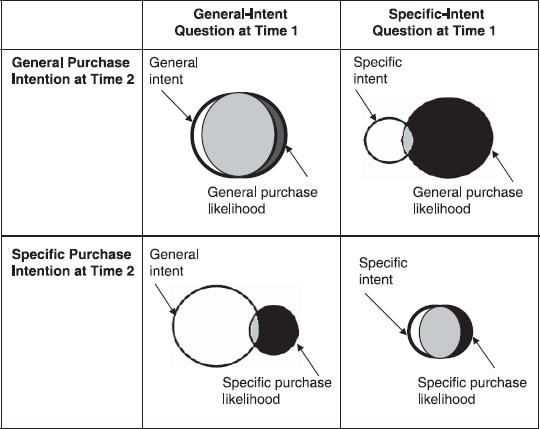
Illustration of Conditions in Experiment 2B
Similar to the sole-intent-condition procedure of Experiment 1a, the intent question was asked about only one of the two brands. We counterbalanced the brand subjected to the initial mere measurement question.
Results
One hundred thirty-two respondents who had favorable attitudes toward ice cream were recruited from an undergraduate student subject pool. Of the respondents, 66 participated in the whole–part experiment, and 66 participated in the general–specific experiment. We randomly assigned respondents across experiments and conditions. The brand counterbalance factor associated with the mere measurement question did not interact with any of the experimental manipulations, so we collapsed means across this variable. The results appear in Figure 4.
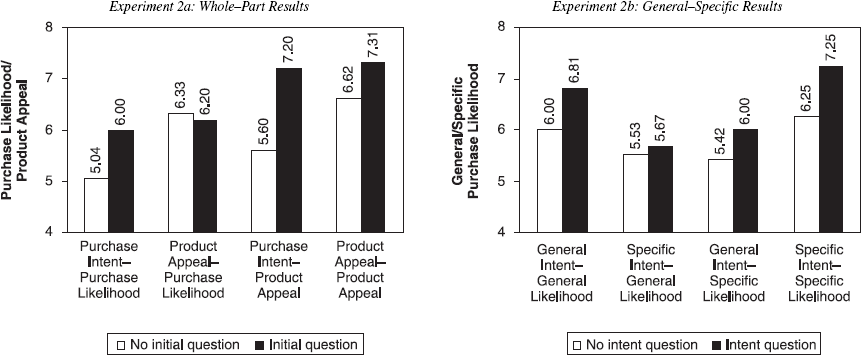
The Mere Measurement Effect Relies on Correspondence Between Cognitive Processes Supporting The Initial Intent Measure and the Subsequent Response
Whole–part Experiment 2a
As both the correspondence hypothesis and the information accessibility hypothesis predicted, there was an influence of the intent question (whole) on the purchase-likelihood (whole) dependent measure (Mnot measured = 5.04, Mmeasured intent = 6.00; t(22) = 2.33, p < .05) and the appeal question (part) on the brand appeal (part) dependent measures (Mnot measured = 6.62, Mmeasured appeal = 7.31; t(12) = 2.25, p < .05). As the correspondence hypothesis predicted, there was an influence of the intent question (whole) on the brand appeal (part) dependent measure (Mnot measured = 5.60, Mmeasured intent = 7.20; t(14) = 2.26, p < .05), but there was no influence of the appeal question (part) on the purchase-likelihood (whole) dependent measure (Mnot measured = 6.33, Mmeasured appeal = 6.20; t(14) = .34, p > .40).
General–specific Experiment 2b
There was an influence of the general-purchase-intent question on the general-purchase-likelihood dependent measure (Mnot measured = 6.00, Mmeasured intent = 6.81; t(15) = 1.98, p < .05) and an influence of the specific-purchase-intent question on the specific-purchase-likelihood dependent measure (Mnot measured = 6.25, Mmeasured intent = 7.25; t(15) = 2.28, p < .05). There was no influence of the general-purchase-intent question on the specific-purchase-likelihood dependent measure (Mnot measured = 5.42, Mmeasured intent = 6.00; t(18) = 1.22, p > .15). There was no influence of the specific-purchase-intent question on the general-purchase-likelihood dependent measure (Mnot measured = 5.53, Mmeasured intent = 5.67; t(14) = .40, p > .40).
Discussion
The purpose of Experiments 2a and 2b was to provide additional evidence that response fluency contributes to the mere measurement effect. The results of the experiments show that the correspondence between the processes performed during the response to an initial-intent question and the response to the subsequent dependent measure contributes to the mere measurement effect. These results are contingent on the constraint that the stimulus (i.e., brand) at the initial measurement and at the test is identical. 5
A reviewer pointed out that the means of the no-intent-question brand are higher in the general–general (M = 6.00) than the specific–general (M = 5.53) conditions and in the specific–specific (M = 6.25) than the general–specific (M = 5.42) conditions. This indicates that there may be a TAP effect in that the intent question need not be asked about the target brand for a mere measurement effect to occur.
The first five experiments provide evidence that response fluency can contribute to the mere measurement effect. In contrast, the entire pattern of results cannot be explained by an attitude accessibility hypothesis or an information accessibility hypothesis. The predictions of the original attitude accessibility hypotheses (Attitude Accessibility 1 and 2) are inconsistent with the results of Experiment 1a. The modified attitude accessibility hypothesis (Attitude Accessibility 3) produces the pattern of results in Experiment 1b and thus cannot be responsible for the results of Experiment 1a. The information accessibility hypothesis is only partially consistent with the results of Experiment 1a and is inconsistent with the combined results of Experiments 2a and 2b. The information accessibility hypothesis would also have a difficult time accounting for persistent mere measurement effects, as in Experiment 1c. Finally, the modified information accessibility hypothesis is inconsistent with the results of Experiment 2b.
Experiment 3
In Experiment 1a, we found that measuring a purchase intention toward one brand influenced the subsequent purchase likelihood of the brand but that measuring a purchase intention toward two brands (i.e., dual-intent-question condition) did not influence the subsequent purchase likelihood of either brand. We argued that the lack of a mere measurement effect was due to the absence of differential response fluency for either brand. The generation of a purchase-likelihood judgment was not more fluent for one brand than for the other brand, because respondents had previously stated their purchase intention for both brands. We can provide further support for the response-fluency hypothesis by showing that purchase-likelihood judgments are sensitive to the relative response fluency of brands at test. For example, if the consideration set at test consisted of five brands, two of which were subjected to prior measurement, response fluency should be higher for the measured brands than for the remaining brands. Accordingly, purchase likelihood should also be higher for these brands.
Design and Procedure
The experiment consisted of a 2 × 2 design: dual-intent questions (present or absent) and the number of brands about which respondents were asked to rate their purchase likelihood (two brands or five brands). The procedure mimicked the dual-intent condition procedure from Experiment 1a. In the dual-intent question–two brands condition, respondents were shown two brands, asked an intent question about each of the brands, and then asked to rate their purchase likelihood of the same two brands. In the dual-intent question–five brands condition, respondents were shown two brands, asked an intent question about each of the brands, and then asked to rate their purchase likelihood of the two measured brands and the three unmeasured brands (the dependent measure order was unmeasured brand, measured brand, unmeasured brand, measured brand, and unmeasured brand). We used a Latin-square design to select the two brands, from the set of five, that were subjected to the intent question. 6 The intent questions were not administered in the intent-question-absent conditions (i.e., respondents simply saw pictures of two brands). We expected that a mere measurement effect would occur only in the dual-intent question–five brands condition.
All five brands were unfamiliar frozen confectionary treats (Batonnet 8, Extreme, Picard, Pilpa, and Royal Cornetto).
Results
One hundred five undergraduate student respondents that had favorable attitudes toward ice cream received extra credit to participate in the experiment. There was no effect of intent-question order (F(1, 85) = .99, p > .05), and the brand counterbalance factor did not interact with any manipulated variable. The reported means are the arithmetic average of the two initially viewed brands.
The manipulation of the presence/absence of the intent questions interacted significantly with the manipulation of two/five brands at test (F(1, 101) = 3.95, p < .05). There was no difference in purchase likelihood between the dual-intent question and the control groups when two brands were in the consideration set (Mnot measured-2 brands = 6.03, Mmeasured intent-2 brands = 6.36; F(1, 101) = .61, p > .05). This result replicated the results of Experiment 1. However, as we predicted, there was a significant difference in purchase likelihood between the dual-intent question and the control groups when five brands were in the consideration set (Mnot measured-5 brands = 5.76, Mmeasured intent-5 brands = 7.20; F(1, 101) = 15.58, p < .05). In the dual-intent-question conditions, the intent question had a greater influence on purchase likelihood when there were five brands present (Mmeasured intent-5 brands = 7.20) than when there were two brands present (Mmeasured intent-2 brands = 6.36; F(1, 101) = 5.05, p < .05) at test.
Discussion
The results of Experiment 3 provide additional evidence that attributions about response fluency contribute to the mere measurement effect. We observed the mere measurement effect only when the previously measured brands were subsequently judged in a context in which nonfluent judgments were also made (e.g., the five-brand condition). We were able to vary the relative response fluency of the purchase-likelihood judgments by varying the context set at judgment. Thus, Experiment 3 provides further evidence for the property of relative response fluency.
Experiment 3 also provides evidence that is inconsistent with three additional competing explanations of the results. First, the lack of a mere measurement effect in the intent measure present–two brands condition is inconsistent with the hypothesis that mere measurement itself alerts respondents that they should express a greater willingness to purchase the brands. Second, the lack of a higher purchase likelihood in the intent measure absent–five brands condition rules out the possibility of a demand effect in which initial exposure to two brands alerted respondents that they should express a greater willingness to purchase the brands when considered in a larger set of brands. Third, the mere measurement effect in the intent measure present–five brands condition provides further evidence that Attitude Accessibility 3 (i.e., equally accessible and valenced attitudes) is not responsible for the lack of a mere measurement effect in the two-brand condition. The lack of diagnosticity owing to equally accessible and valenced attitudes should not be sensitive to whether there are two or five brands at test.
Thus far, our demonstrations that attributions about response fluency contribute to the mere measurement effect have relied on reported purchase likelihood rather than volitional behavior. Although there is considerable evidence that mere measurement influences both anticipated and actual behavior equivalently, claims that response fluency contributes to the mere measurement effect would be reinforced by a replication of our results using a volitional behavior. Experiment 4 provides this evidence.
Experiment 4
Experiment 4 replicated Experiment 3 with product purchase as a dependent measure. Owing to the difficulty of working with frozen confectionary treats, we changed the stimuli to candy bars. The procedure was a modification of that used in Experiment 3. Respondents were told that the experiment investigated the influence of snack consumption on movie enjoyment. First, respondents were shown pictures of 15 candy bars and were asked to indicate their preference for each bar using a scale ranging from 0 to 100. Then, respondents were given $2 to purchase candy bars. Respondents in the intent-question conditions were asked whether they planned to purchase their second-favorite candy bar followed by the same question for their third-favorite candy bar. Respondents in the no-intent-question conditions were not asked the intent questions. After a short filler task, respondents were given an electronic order form that listed their second- and third-favorite candy bars (two-brand condition) or their five favorite candy bars (five-brand condition). Respondents could spend the $2 to purchase bite-size candy bars priced at $.15 per bar. The experimenter then fulfilled the purchase order and provided change while the respondent watched a 15-minute movie clip. The respondent then evaluated the movie-watching experience.
We predicted that there would be no difference in candy purchase volume between the intent-question and no-intent-question conditions when the order form contained only the respondent's second- and third-favorite brands but that respondents answering the intent questions would purchase more of their second- and third-favorite brands when the order form contained their top five brands.
The procedure also created an opportunity to observe a mere measurement effect that depended on attitude accessibility. This procedure measured attitudes before the intent question. If an attitude accessibility–based mere measurement effect were to occur, the results should be consistent with the results of Experiment 1b and Attitude Accessibility 2 (i.e., a mere measurement effect in both the two- and the five-brand conditions).
Results
One hundred twenty-seven undergraduate student respondents that had favorable attitudes toward candy received extra credit to participate in the experiment. The reported means are the average purchase volume of the second- and third-favorite types of candy bars. There was no difference in purchase volume between the intent-question and no-intent-question conditions when two brands were on the order form (Mnot measured = 3.36, Mmeasured intent = 3.91; F(1, 61) = 1.39, p > .05). This null result was not a ceiling effect because respondents could have purchased an average of 6.5 of each type of candy bar. 7 However, as we predicted, there was a significant difference in purchase volume between the intent-question and the no-intent-question conditions when five brands were on the order form (Mnot measured = 1.95, Mmeasured intent = 2.53; F(1, 62) = 3.40, p < .05). 8 These results replicate the results of Experiment 3 with an actual purchase response.
Only three participants in each two-brand condition bought the maximum 13 candy bars.
The lower means are a function of people spending their money on the other three candy bars.
Experiment 5
The results of the seven experiments might encourage the conclusion that attributions about response fluency are the sole source of mere measurement effects. As we have argued throughout the article, this is not the case. Indeed, it is only under specific conditions that response fluency contributes to the mere measurement effect. Consistent with the literature on processing-fluency effects, response-fluency effects should occur only when there is no competing diagnostic information. For example, in the case of most of our stimuli, the brands are novel. Thus, respondents have little substantive information about the brands. We expect that when people have information about brands and they are encouraged to use this information, the influence of response fluency will be mitigated.
Design and Procedure
The experiment consisted of a 2 × 2 between-subjects design: sole-intent question (absent or present) and brand information (absent or present). The information-absent conditions were equivalent to the control and sole-intent-question conditions of Experiment 1a. The information-present conditions included two modifications of the procedure in Experiment 1a. First, product feature information was presented for a single brand. This information was provided after the three-second exposure to the product packages in the control condition and after the intent-question query in the sole-intent-question condition. The information was randomly assigned to a brand in the control condition and was assigned to the intent-question brand in the sole-intent-question condition. The information was “is made from natural ingredients,” “is some of the creamiest ice cream you will ever eat,” and “is incredibly rich and flavorful.” Second, respondents were asked to state which of the product features was more appealing and why and which of the product features was least appealing and why. After a delay of five minutes, purchase likelihood toward each brand was measured for all respondents.
Results
Ninety-eight undergraduate student respondents who had favorable attitudes toward ice cream received extra credit to participate in the experiment. The results appear in Figure 5.
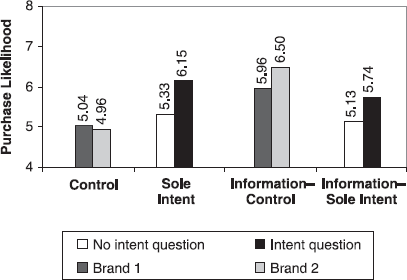
Processing-Fluency-Based Mere Measurement Effects Occur When There is no Additional Diagnostic Information
Respondents in the sole-intent-question condition had a significantly higher purchase likelihood for the brand that was measured (M = 6.15) than for the brand that was not measured (M = 5.33; t(26) = 2.41, p < .05) and for the measured brand than for the brands in the control condition (Mmeasured = 6.15, Mcollapsed = 5.00; F(1, 46) = 4.08, p < .05). This replicates the response-fluency-based mere measurement effect from Experiment 1a.
We predicted that mere measurement would not exert an influence in the information conditions. The test of this hypothesis involved a comparison of the treatment brand with the control brand across the two information conditions. This was the most appropriate test of a measurement effect because one of the two brands in the information–control condition was supported with information and one of the two brands in the information–sole-intent condition was supported with information and subjected to an intent question. Thus, an assessment of the incremental effect of the mere measurement question required a comparison of the differences scores between the no-information brand and the information brand within each condition. The advantage for the information brand (M = 5.74) relative to the no-information brand (M = 5.13) in the information–sole-intent condition as compared with the information brand (M = 6.50) relative to the no-information brand (M = 5.96) in the information–control condition was not significant (F(1, 45) = .02, p > .05).
Discussion
The results of Experiment 5 suggest that attributions about response fluency generate a mere measurement effect only when there is no diagnostic content available to inform the judgment. When there is diagnostic information, such as attribute information, people rely on the attribute information and fail to make an attribution about response fluency. Note that it may have been anticipated that the information-based explanations of the mere measurement effect would have predicted a mere measurement effect in the sole-intent question–information condition. We expect that the lack of an effect can be attributed to the fact that people were not forced to crystallize attitudes before answering the intent question, as was the case in Morwitz and Fitzsimons's (2004) study. Providing brand attribute information after the response to the intent question made the attribute information a second, independent source of information about the brand.
General Discussion
An information-processing activity consists of two events. The first event consists of the acts or procedures used to manipulate information in accordance with the demands of the task (i.e., task activity), and the second event is the output or experience generated by those task activities (i.e., information content). Traditionally, mere measurement effects have been attributed to information content (i.e., attitude accessibility). We show that mere measurement effects are also sensitive to the processing activity associated with the task and the content (i.e., response fluency). Consistent with the TAP perspective, we show that redundancy in the stimuli and tasks supporting an initial-intent response and a subsequent purchase-likelihood response can increase the purchase likelihood. A person can use response fluency as evidence that he or she is predisposed toward the behavior and, consequently, be more likely to engage in the behavior.
We used eight experiments to demonstrate how and when response fluency contributes to a mere measurement effect. Experiments 1 and 2 show that response-fluency-driven mere measurement effects occur when there is correspondence between the processes used to respond to the initial-intent question and the processes used to generate a subsequent response. These experiments suggest that it is neither solely information content nor solely the fluency of an information process (i.e., procedural fluency) that contributes to the mere measurement effect. It is also the response fluency that occurs from reprocessing material similarly on both processing occasions (i.e., TAP-based response fluency). Experiments 1, 3, and 4 also show that mere measurement effects are sensitive to the relative amount of response fluency associated with making a judgment. If the responses to all the brands available for purchase are equally fluent, people do not become more likely to purchase any of the brands. It is only when a subset of the responses to brands is fluent that mere measurement effects occur. Finally, as Experiment 5 shows, attributions about response fluency will not influence behavior if more diagnostic information content is available.
Implications
Response fluency may be able to explain some of the more anomalous findings in the mere measurement literature. For example, consider the finding that mere measurement effects are stronger for inexperienced than experienced consumers (Morwitz, Johnson, and Schmittlein 1993). If we assume that inexperienced consumers have less information about a brand and are less likely to have formed attitudes, it may be the case that they are more likely to rely on attributions about response fluency, as Experiments 1a and 1c, 2a and 2b, and 3 illustrate. Similarly, consider the finding that responding to an intent question generates a stronger mere measurement effect than responding to an attitude question (Chapman 2001). Although the mere measurement of an attitude creates a mere measurement effect, the incremental effect of measuring an intention could be a function of the response fluency that is created because of correspondence, as Experiments 2a and 2b illustrate.
Note that mere measurement effects may be related to a class of effects that show that people's behavior is sensitive to the mere consideration of information. Evidence on behavior priming (Bargh, Chen, and Burrows 1996) and mimicry (Chartrand and Bargh 1999) suggests that the mere consideration of a concept or the mere observation of behavior can alter a person's behavior. In many cases, the behaviors that result from mere consideration or mere observation allow a person to achieve social or task goals and thus could be considered volitional and deliberately chosen. In other cases, the behaviors that result from mere consideration or mere observation do not seem to have any meaningful purpose. As a consequence, it has been argued that the perception of a behavior or activation of a behavioral-based concept can directly activate the neurocognitive systems involved in performing the behavior, a type of perception–behavior link (Martin et al. 1995; Rizzolatti, Fogassi, and Gallese 2000). Response fluency is an alternative explanation for these mere consideration and observation effects. It may be the case that observing a behavior makes consideration of that behavioral response more fluent and thus increases the likelihood that the behavior will be performed (Janiszewski and Van Osselaer 2005). Thus, when a repertoire of behaviors is available, a previously observed behavior can influence the response fluency associated with one of the behaviors, and the behavior becomes a more likely candidate for execution.
Limitations
The results should not be taken as evidence that information content is not relevant to the mere measurement effect. For example, if the respondents did not like ice cream, they did not express a willingness to try the products that were advertised. For these respondents, mere measurement could not contribute to an increase in purchase likelihood. Thus, response fluency enhances attitudinally consistent behavior. In effect, response fluency is interpreted and used as evidence to support the strength of a response. The direction of the response is determined by the valence of the information content or output. This finding is consistent with claims that the mere measurement effect and self-prophecy effect are limited to attitudinally consistent behaviors (Morwitz and Fitzsimons 2004; Sherman 1980; Spangenberg et al. 2003).
The finding that processing-fluency effects are attitudinally consistent highlights the difficulty of disentangling the relative contribution of TAP fluency and attitudes in a mere measurement study. Traditional explanations of processing-fluency effects conceptualize the fluency effect as a contextually consistent attribution about processing fluency (Janiszewski and Meyvis 2001; Klinger and Greenwald 1994). Fluency is experienced during the course of a mental activity, and information content (e.g., currently accessible information, beliefs, attitudes) is used to make attributions about this fluency. We could label this “fluency as an independent mental event.” An alternative view is that attitudes are experienced (or constructed), and then fluency is used to make attributions about the strength of the attitude. This conceptualization of the attitude accessibility hypothesis assumes that people make attributions about the accessibility (i.e., fluency) of the attitude. We could label this “fluency as a contingent event.” Although each of these perspectives conceptualizes fluency as an independent construct, they disagree about the nature of the nomological network that relates processing fluency and information content. Further research could disentangle these perspectives as they relate to mere measurement and other processing-fluency effects.
Our results cannot be used to comment on the social desirability explanation of the self-prophecy effect that Spangenberg and colleagues (Spangenberg 1997; Spangenberg and Greenwald 1999; Spangenberg et al. 2003) advocate. The stimuli we used in our studies (e.g., frozen confectionary treats, candy) do not involve socially desirable acts and would not cause dissonance in the event that a person did not behave in accordance with his or her prediction. As such, attributions about response fluency should be viewed as a source of mere measurement that operates outside the domain of socially desirable behaviors.
Finally, we expect that response-fluency-driven mere measurement effects are limited to certain classes of behaviors. Intent questions should be more effective at changing behavior with respect to an act than an outcome. As with purchasing a product, an act is concrete and can be considered in the context of the intent question. An outcome such as losing weight or becoming a better person requires a series of specific behaviors that have limited TAP overlap with the intent question. In addition, as the results of Experiment 5 suggest, intent questions should be more effective for infrequent or novel acts for which there is little competing information. What is not clear is whether TAP-based response fluency can bias responses for behaviors about which a consumer is knowledgeable (cf. Experiment 4). For example, although a person may know a considerable amount about the product he or she wants to purchase, the person may not recruit detailed attribute information at the time the purchase decision is being made. Thus, we expect that people will not rely on response fluency when they are also considering attribute information (Experiment 5) but that response fluency may exert an influence when people fail to consider attribute information.