







Abstract
Consumers use metacognitive experiences to draw inferences about the state of their brand understanding but only when these metacognitive experiences are relevant for making this inference. In such situations, metacognitive difficulty can improve brand evaluations because it triggers efforts to restore brand understanding by seizing on available new information.
Maintaining the sense of meaning is a basic human motivation (Heine, Proulx, and Vohs 2006). Indeed, this motivation may apply as much to the mental representation of a brand as to other mental constructs. How does the motivation to maintain a sense of brand understanding affect consumers’ judgments? Consider a well-established brand, such as McDonald's. As reflected in the films Super Size Me and Fast Food Nation, the opinions most consumers hold about McDonald's food pertains to its unhealthfulness. Although McDonald's makes an effort to communicate its new menu of “high-quality” foods (Macarthur and Stanley 2006), consumers are slow to accept these new claims. This may be because consumers view their existing representation of the brand as sufficient for understanding the brand (e.g., “McDonald's is not suitable for a healthful diet—period”). In this respect, responses to new information may depend on consumers’ metacognitive feelings about whether they adequately understand the brand (Schwarz 2004, 2006).
We refer to consumers’ feeling that they know a brand sufficiently as “perceived understanding.” Perceived understanding is an epistemic feeling resulting from a person's metacognitive assessment of the state of his or her own knowledge about a target. We assume that well-established brand representations, such as what a person might have for McDonald's, are usually characterized by a strong sense of understanding. In other words, consumers generally believe that they have a good grasp on the brand's meaning.
We focus on how metacognitive experiences in thinking about a brand can affect a person's perception of how sufficient his or her existing understanding of the brand is. Research indicates that greater fluency or ease in thinking about a target leads to more positive judgments toward it (e.g., Lee and Labroo 2004; Reber and Schwarz 1999; Reber, Winkielman, and Schwarz 1998; for evidence to the contrary when goals are in conflict, see Labroo and Lee 2006). In general, these studies have examined attitude formation toward new or unfamiliar targets of metacognitive inferences. In contrast, we argue that the effects of metacognitive experiences may be distinct for well-established brands. The experience of ease or difficulty in processing may elicit inferences about the brand representation itself (i.e., the understanding it is perceived to provide). If a person's perceived understanding is threatened by the experience of metacognitive difficulty, he or she will be motivated to restore the sense of understanding and therefore may be more willing to consider any available information about the brand. Thus, the restored brand understanding could become either more positive or more negative, depending on the new information. In this article, we highlight a situation in which established brands could benefit from eliciting metacognitive difficulty, opening people up to more positive information about the brand.
To address these possibilities, we first demonstrate that metacognitive experiences of difficulty can lead to inferences about a person's understanding of a brand (Experiments 1 and 2). We show that this effect occurs only when the metacognitive experience is deemed to be relevant to inferring the state of understanding (Experiment 2). Finally, we show that this effect can enhance the impact of available new information about the brand (Experiments 3 and 4).
Metacognition and Perceived Understanding
Perceived understanding is consumers’ feeling that they grasp the brand's meaning. By characterizing a brand representation in these terms, we do not address the actual amount or the accuracy of brand knowledge. The key issue is whether consumers perceive their existing mental representation of a brand as giving them a good understanding of the brand. We contend that metacognitive experiences can be informative about a person's perceived state of brand understanding. The important role of metacognitive experiences in judgment formation has been demonstrated in several studies (for a review, see Schwarz 2004, 2006). These studies demonstrate that metacognitive experiences in thinking about a target are informative in their own right. For example, when people experience greater effort in calling information to mind, such as when they are asked to recall many (versus a few) examples of their own assertive behavior, they rate themselves as less assertive (Schwarz et al. 1991). Metacognitive experiences also have implications for attitude formation. For example, in an experiment by Novemsky and colleagues (2007), participants were asked to rate how easy it would be to generate either two or ten reasons for choosing one of two products. Subsequently, they were given a chance to decide between choosing a product and deferring the decision. In the two-reason condition, 49% opted for deferral, whereas 61% did so in the ten-reason condition. In other words, when participants experienced (or anticipated) difficulty in generating reasons to buy, they inferred that they might not have sufficient knowledge to make a decision and therefore deferred their choice.
Our analysis focuses on the notion that a person's brand representations can be the target of metacognitive judgments. However, consumers do not always use metacognitive experiences to infer the state of their brand representation. The nature of the brand makes a difference. For brands that are well established, such as McDonald's, consumers have frequently been exposed to their marketing claims and have experienced the brands. Therefore, regardless of whether consumers are indeed knowledgeable about the brands, they may believe that they understand the meanings of these brands well and thus expect to feel a sense of ease when thinking about them. If, instead, consumers experience a sense of difficulty in thinking about such a brand, they may infer that they do not understand the brand so well after all. As we describe subsequently, this process can have consequences for brand judgments not anticipated by prior approaches.
H1: Metacognitive experiences of difficulty (versus no difficulty) in generating brand information reduce perceived understanding for an established brand.
As Schwarz (2004) notes, people have naive theories about the meaning of their metacognitive experiences. Thus, when consumers view a metacognitive experience as being uninformative for inferring the state of their brand representations, their perceived understanding of the brand should not be affected. For example, if a brand is considered less established, consumers should be more likely to attribute the experienced difficulty to the brand (i.e., “The brand is not well known. Thus, it's not surprising that it is difficult to generate some characteristics of it.”). Similarly, if consumers attribute their metacognitive difficulty to other factors (e.g., distractions), their perceived understanding should remain intact (see Schwarz et al. 1991).
H2: Metacognitive experiences of difficulty affect perceived understanding only when a person deems the difficulty to be relevant to inferring the state of his or her brand understanding.
Consequences for Brand Evaluations
When consumers have a well-established brand representation, such as what they might have for McDonald's, how will their judgments be affected by a new cue, for example, about its “healthfulness”? Previous research has not addressed this question directly, though it indicates that the ease of retrieval or high fluency in thinking about a brand increases the favorability of brand judgments. For example, when people experienced ease (versus difficulty) in retrieval of reasons for choosing BMW over Mercedes, they evaluated BMW more (versus less) favorably and Mercedes less (versus more) favorably (Wänke, Bohner, and Jurkowitsch 1997). Lee and Labroo (2004) find that the presentation of a cue associated with high conceptual fluency (e.g., beer in a bar) leads to a more favorable attitude toward the product. According to this framework, metacognitive difficulty should lead to less favorable judgments of a brand. Moreover, exposure to a cue, such as “healthfulness,” which is not conceptually fluent for McDonald's, should not improve attitudes toward McDonald's.
However, our assumption that consumers are motivated to maintain a sense of brand understanding suggests an effect not anticipated by prior approaches. If people are motivated to maintain and, if necessary, reestablish their sense of understanding, metacognitive difficulty should trigger such motivations. Specifically, when perceived understanding is reduced, consumers will be motivated to restore the sense of understanding by seizing on any available information. Such a “seizing” process reflects a desire for “nonspecific closure” (Kruglanski and Webster 1996). Kruglanski and Webster (1996) argue that this seizing process should dispose people to be relatively open to persuasion attempts because such attempts promise to furnish closure. Thus, we propose that when perceived understanding is reduced because of metacognitive difficulty, consumers may be more influenced by new marketing claims about the brand.
Conversely, when consumers do not experience metacognitive difficulty, they should not be especially motivated to consider new information, because no motivation to restore a sense of understanding is aroused. Instead, their perceived understanding may promote a feeling that situations can be dealt with using status quo brand knowledge. This process can also be described as a “freezing” process (Kruglanski and Webster 1996), which represents a person's desire to maintain previously acquired closure (e.g., “McDonald's food is not healthful”). In this case, new cues are less likely to change consumers’ judgments about an established brand.
H3: When perceived understanding is reduced (versus intact), consumers’ judgments about the brand are more influenced by newly encountered cues.
If consumers are motivated to restore a sense of understanding when it is reduced by seizing on newly encountered cues to judge the brand, this should be particularly true for those who are more inclined to pursue epistemic closure. The need-for-closure scale (Webster and Kruglanski 1994) assesses individual differences in the extent to which a person desires any answer (nonspecific closure), compared with ambiguity, when making a judgment. Contextually, time pressure enhances the desire to seize on any answer to obtain closure (Chiu et al. 2000).
H4: When perceived understanding is reduced, consumers who are more (versus less) inclined to pursue epistemic closure are more influenced by newly encountered cues.
This prediction further illustrates the value of considering consumers’ motivation to restore their sense of brand understanding. Absent this assumption, it might be expected that people who are more inclined to pursue epistemic closure are more likely to reject new cues when evaluating a brand. However, we propose that it is not the brand judgment itself that consumers try to protect but rather the sense of understanding they expect to have for a well-established brand. When that sense is threatened, people are more likely to seize on any cues to judge the brand. In these conditions, people who are more inclined to pursue epistemic closure should be more likely to use new cues in an effort to restore a sense of understanding.
Experiment 1
Experiment 1 tested the predictions that metacognitive experiences of difficulty (versus no difficulty) in thinking about a brand would reduce perceived understanding (H1) and that this effect would occur only when a person deems the metacognitive experience to be relevant for inferring the state of his or her brand understanding (H2). A well-established method of inducing metacognitive experiences is requiring people to assume a specific facial expression (Sanna, Schwarz, and Small 2002; Stepper and Strack 1993). For example, contraction of the corrugator muscle produces tensed brows, an expression associated with a feeling of mental effort (Cacioppo, Petty, and Morris 1985), which lowers perceptions of fluency (see Stepper and Strack 1993). We expect that for an established brand, when consumers experience a sense of difficulty in listing characteristics induced by contracting the corrugator muscle, they will infer that their brand understanding is lacking. For comparison purposes, the experiment also includes a less established brand. For such a brand, consumers may be more likely to attribute their metacognitive difficulty to the nature of the target (i.e., it is not a well-known brand). Because metacognitive experiences should not be considered relevant for assessing perceived understanding for such brands, we expect that metacognitive experiences will affect perceived understanding only for established brands.
Method
Pretest
We conducted a pretest to create an inventory of established and less established brands for subsequent experiments (n = 136). We selected 14 brands that represent varying degrees of familiarity and likability from various product categories. We attempted to identify recognizable brands that differed in familiarity while controlling for product category. Of the 14 brands, we randomly assigned 2 to each participant. Participants responded to items that assess perceived brand understanding and other measures, including perceived familiarity (1 = “very unfamiliar,” “not at all informed”; 7 = “very familiar,” “very informed”). We used average familiarity ratings to classify a brand as either established or less established. We selected Hallmark as an established brand and American Greetings as a less established brand (i.e., MHM = 5.75 versus MAG = 3.11; F(1, 33) = 23.65, p < .001). In addition, we designed five seven-point items to measure perceived understanding—that is, the extent to which consumers believe that they sufficiently understand the brand's meaning (for measurement information, see the Web Appendix at http://www.marketingpower.com/jmrapril09). As we expected, consumers viewed their perceived understanding of Hallmark as being higher than that of American Greetings (MHM = 6.00 versus MAG = 4.63; F(1, 33) = 7.85, p < .01).
Participants and Design
We randomly assigned participants to one of the conditions of a facial expression (contracting instructions versus control) × brands (Hallmark versus American Greetings) between-subjects design. Ninety introductory business students participated in the main experiment. We deleted seven participants’ responses because they were completely unaware of a given brand (we dropped four from the contracting-instructions condition and three from the control condition).
Facial Expression Manipulation
In the contracting-instructions condition, to induce metacognitive difficulty, participants were given a cover story modified from prior research to contract their eyebrows (Sanna, Schwarz, and Small 2002; Stepper and Strack 1993; Strack and Neumann 2000; for the instructions, see the Web Appendix at http://www.marketingpower.com/jmrapril09). In the control condition, there was no such cover story. A separate pretest (n = 114) validated the effect of this manipulation on metacognitive experiences, in line with prior research (e.g., Sanna, Schwarz, and Small 2002). Participants were asked to list five characteristics of either Hallmark or American Greetings after either receiving or not receiving the contracting instructions. Participants then rated their feelings of difficulty in listing brand characteristics (1 = “extremely easy,” and 7 = “extremely difficult”). As we predicted, this self-rated feeling of difficulty was greater for the contracting-instructions condition than for the control condition (M = 4.96 versus 4.20; F(1, 110) = 2.97, p < .05). Listing characteristics for the less established brand was rated as somewhat more difficult than for the established brand (M = 4.99 versus 4.17; F(1, 110) = 3.40, p = .068). The interaction of facial expression × brands was not significant (F(1, 110) = 1.43, n.s.). It is not surprising that generating brand characteristics for less established brands is relatively difficult for consumers. However, our prediction is that this experienced difficulty will influence perceived understanding for an established brand.
Procedure
A maximum of 12 people participated in each session, working in cubicles so that they could not see one another's faces. In the contracting-instructions condition, participants were given relevant instructions about contracting the corrugator muscle. Then, all participants were asked to list five characteristics either of Hallmark or of American Greetings. After that, contracting-instructions participants were told that they could stop holding the facial expression. All participants then responded to the measure of perceived understanding. Next, they indicated how well they succeeded in maintaining the assigned facial expression while listing brand characteristics (0 = “not well at all,” and 9 = “very well”) and how strenuous their effort was to maintain the expression (1 = “not at all strenuous,” and 9 = “very strenuous”). Finally, all participants indicated on four seven-point scales how easy it was to list the brand characteristics (“very easy/difficult,” “not effortful/effortful,” “simple/complicated,” and “a breeze/hard work”; Tybout et al. 2005).
Results
We analyzed the data using facial expression × brands analyses of variance (ANOVAs). Throughout our analyses, we tested predicted results with one-tailed p-values. As we intended, across brands, people reported that they had succeeded equally well in maintaining the facial expression (MHM = 5.55 versus MAG = 5.10; F(1, 40) < 1) and expended the same amount of effort in maintaining the facial expression (MHM = 5.77 versus MAG = 5.85; F(1, 40) < 1). No other effects emerged.
Perceived Understanding
We averaged responses to the perceived understanding items into one index (α = .87). As we expected, ratings for the established brand were higher than for the less established brand (M = 5.79 versus 4.79; F(1, 79) = 18.76, p < .001). This was qualified by the predicted interaction between facial expression and brands (F(1, 79) = 5.39, p < .05). Specifically, as we predicted, participants rated their perceived understanding of the established brand lower when they contracted their corrugator muscles than when they did not (MContracting = 5.47 versus Mcontrol = 6.10; F(1, 79) = 3.95, p = .050). However, perceived understanding for the less established brand did not differ by facial expression condition (MContracting = 5.01 versus Mcontrol = 4.57; F(1, 79) = 1.73, n.s.). This indicates that for an established brand, when consumers experienced a sense of difficulty when thinking about the brand, they inferred that their brand representation did not provide sufficient understanding. For the less established brand, metacognitive difficulty did not reduce brand understanding (if anything, brand understanding increased, though nonsignificantly).
Content Analysis
It might be argued that contracting the corrugator muscle distracted participants from generating brand characteristics and thus lowered the actual quality of the content they generated. Although this would not account for the moderating role of established versus less established brands, we attempted to rule out this alternative explanation by content analyzing the listed brand characteristics. To assess whether the listed content was equally characteristic of the brand in question, we analyzed the listed characteristics in terms of their typicality to the brand (for analysis details, see the Web Appendix at http://www.marketingpower.com/jmrapril09). The findings indicated that facial expression did not affect the nature of the brand characteristics generated. This supports the contention that the metacognitive experience of difficulty, rather than the actual brand associations generated, affected perceived understanding. Finally, the mean number of characteristics listed was 4.59 (SD = .94), which did not differ by brand type (F(1,79) = 1.52, n.s.), facial expression (F(1, 79) = 2.46, p > .12), or their interaction (F(1, 79) = 1.81, p > .18).
Discussion
In Experiment 1, we found support for the prediction that metacognitive difficulty in thinking about a brand would reduce perceived understanding (H1) and that this effect would occur only when the experience was deemed to be relevant for inferring brand understanding (H2). That is, for the established brand, consumers assumed that they should already have a sufficient brand understanding. Thus, when they experienced difficulty as a result of contracting their corrugator muscles, they inferred that their understanding was poorer than when no metacognitive difficulty was experienced. In contrast, for the less established brand, for which metacognitive experiences presumably were not deemed to be relevant for inferring the state of brand representation, experiencing difficulty did not reduce consumers’ perceived understanding of the brand.
It might be argued that contracting the corrugator muscle induced a negative mood, which in turn may have influenced brand perceptions. That is, participants could have perceived their understanding as being lower because of their negative affect, not because of their metacognitive experience. However, this would not explain why the effect emerged for established but not less established brands. In any case, if a process driven by negative affect transfer had been induced by the tensed eyebrows, consumers would likely have become less sensitive, not more sensitive, to their metacognitive experiences (for related discussions, see Sanna, Schwarz, and Small 2002; Schwarz 2002, 2006). Previous research has shown that positive moods are likely to motivate people to rely on metacognitive experiences or cues (Mackie and Worth 1989; Ruder and Bless 2003). Negative moods, which signal that something in the environment requires monitoring, motivate people to process information more elaborately (Ruder and Bless 2003). In addition, content analyses indicated that our effects could not be accounted for by the nature of the brand associations that were listed. This supports the argument that metacognitive experiences can affect perceived understanding of an established brand independently of the content of brand associations that come to mind. Experiment 2 tested this reasoning further.
Experiment 2
When consumers are led to attribute their experienced difficulty in thinking about a brand to factors other than the state of their brand representation, their perceived brand understanding should remain intact (H2). For example, suppose that consumers hear loud noises while they tense their eyebrows and attempt to list brand characteristics. Research suggests that under such conditions, they should (mis)attribute their metacognitive difficulty to the noise (Schwarz et al. 1991). By showing that perceived understanding remains intact when there is an alternative explanation for metacognitive difficulty, we provide converging evidence that a person's inferences from metacognitive experiences affect his or her perceived understanding of a brand.
Method
One hundred ninety introductory business students participated. We excluded data from 6 participants who were completely unaware of the brand (2 from the contracting-instructions condition and 4 from the control) and from 1 who did not make the assigned facial expression, which left 183 participants. We used the same facial expression manipulation, brands, and questionnaires as in Experiment 1, along with a newly added misattribution factor. In the misattribution-cue condition, participants heard loud noises in the next room as they listed characteristics of a brand. The experimenter then told them, “Sorry about the noise. It must make it difficult for you to list brand characteristics.” In the no-cue condition, no noise occurred. Thus, the study was a facial expression (contracting instructions versus control) × brands (Hallmark or American Greetings) × mis-attribution cue (noise versus no noise) between-subjects design.
Results
We analyzed the data using facial expression × brands × misattribution cue ANOVAs. As in Experiment 1, participants’ self-rated success in maintaining the facial expression did not differ as a function of brands (MHM = 5.35 versus MAG = 5.04; F(1, 89) < 1), misattribution cue (Mnoise = 4.84 versus Mno noise = 5.56; F(1, 89) = 2.68, n.s.), or their interaction (F(1, 89) < 1, n.s.). Self-rated effort in maintaining the facial expression also did not differ as a function of brands (MHM = 5.93 versus MAG = 6.24; F(1, 89) < 1), misattribution cue (Mnoise = 6.28 versus Mno noise = 5.92; F(1, 89) < 1), or their interaction (F(1, 89) = 1.45, n.s.).
Perceived Understanding
We averaged responses to the perceived understanding items (α = .80). A significant interaction of facial expression × brands emerged (F(1, 175) = 4.46, p < .05). This was qualified by the predicted three-way interaction (F(1, 175) = 3.25, p < .05; see Figure 1). The no-noise condition replicated the pattern we observed in Experiment 1. The predicted interaction of facial expression × brands was significant (F(1, 175) = 7.88, p < .05). For the established brand, perceived understanding was lower when participants tensed their brows than when they did not (M = 5.18 versus 5.74; F(1, 175) = 4.65, p < .05). However, for the less established brand, the facial expression manipulation did not reduce perceived understanding and even nonsignificantly reversed the effect (MContracting = 4.57 versus MControl = 4.08; F(1, 175) = 3.30, p > .07). Conversely, as we predicted, in the misattribution condition in which noises were made, the facial expression manipulation had no effect on perceived understanding for either brand (Fs < 1.43). This indicates that when there was an alternative explanation for the experienced difficulty in thinking about a brand, consumers did not use this difficulty to infer the state of their brand representation.

Perceived Understanding as a Function of Misattribution-Cue Condition, Brand, and Facial Expression (Experiment 2)
Content Analysis
The mean of the number of brand characteristics generated by participants was 4.65 (SD = .91). Participants generated more characteristics in the facial expression condition than in the control condition (M = 4.78 versus 4.51; F(1, 175) = 3.97, p < .05), but no other effects were significant (Fs < 2.16, ps > .14). Using the same procedures as in the previous experiment, we conducted the content analysis (see the Web Appendix at http://www.marketingpower.com/jmrapril09). The findings indicated that facial expression did not affect the nature of the brand characteristics that were generated. Instead, they suggest that it was the metacognitive experience of difficulty, rather than the actual nature of the brand associations generated, that affected perceived understanding.
Discussion
This study provided further support for H1 and H2. As in Experiment 1, difficulty in thinking about an established brand reduced the perceived understanding of the brand. Experiment 2 further showed that people do not use their metacognitive difficulty to infer the state of their brand representation when there is an alternative explanation for their difficulty. Taken together, these results provide converging evidence that consumers draw inferences about the state of their brand representations and that their metacognitive experiences can be a basis for these inferences when they are perceived as informative. The next experiments examine what can happen when perceived understanding is threatened in this way.
Experiment 3
We have argued that consumers are motivated to maintain a sense of understanding regarding their brand representations. If that perceived understanding is threatened, consumers will be motivated to restore it. Research on epistemic closure suggests that under these conditions, consumers are likely to seize on available information in an effort to restore their sense of understanding (Kruglanski and Webster 1996). If the use of new information reflects a motivation to restore perceived understanding, as we have argued, consumers who are chronically more (versus less) inclined to seek cognitive closure (i.e., those high in need for closure) will be more likely in these conditions to seize on and use new information. Accordingly, we expect that need for closure will moderate the effect of metacognitive experiences on the use of new information in judging the brand. For example, for an established brand, such as McDonald's, consumers generally expect to have a well-established sense of the brand. Therefore, when marketers present new information about it (e.g., “McDonald's provides a wide variety of foods, such as salads and yogurt”), consumers may not be influenced. However, when their perceived understanding of McDonald's is threatened, consumers with a high need for closure should seize on and use the newly encountered information to judge McDonald's.
As in Experiment 2, we expect that when an attribution is provided for metacognitive difficulty, perceived understanding should not be affected by that metacognitive experience. Therefore, even consumers who are inclined to pursue epistemic closure should not seize on and be influenced by new information. This would provide converging evidence that the perceived understanding inferred from metacognitive experiences is a key factor in the extent to which consumers are influenced by new information about a brand.
An alternative process is also plausible. When perceived understanding is threatened, consumers may perceive their knowledge about the brand as no longer valid and therefore may be motivated to process new information more thoroughly. This experiment addresses this elaboration-based account by examining whether consumers’ chronic motivation to engage in elaborative thinking (i.e., need for cognition; Cacioppo and Petty 1982) moderates the effect of metacognitive experiences. Finally, this experiment manipulates metacognitive experiences in a different way (through print readability) to provide converging evidence for the role of this variable in perceived understanding.
Method
Pretest
We selected McDonald's as the target brand. Because McDonald's is a well-established brand, consumers are likely to share typical associations with the brand and have well-established brand representations. To identify the strongest associations with McDonald's, 20 pretest participants briefly listed characteristics they associated with McDonald's in the order in which they occurred to them. The two associations that were most frequent and appeared earliest in the list were convenience (e.g., “fast,” “easy,” “many locations”; 28.75%) and unhealthfulness (e.g., “fattening,” “greasy,” “salty”; 21.25%). Because we wanted to demonstrate that metacognitive difficulty could elicit improvements in brand evaluations under certain conditions, we chose a negative association (unhealthfulness) as the target attribute for McDonald's, and we included a claim about its healthful menu choices as the target cue.
Participants
For the main experiment, 101 business students participated. As Kruglanski (http://www.wam.umd.edu/∼hannahk) suggests, we randomly included five “lie items” to check for careless or socially desirable responding. Consistent with the guidelines, we deleted 12 participants’ responses (5 in blurry/cue absent, 2 in normal/cue present, 4 in normal/cue present, and 1 in blurry/cue absent), which left 89 participants’ data in the sample.
Design
We used a 2 (print readability: blurry print versus normal print) × 2 (attribution cue: present versus absent) × need for closure between-subjects design. We measured need for closure.
Manipulation of Metacognitive Experience
Participants worked on either blurry- or normal-print questionnaires that asked their opinions about McDonald's. Blurry or difficult-to-read print has been shown to elicit metacognitive difficulty in processing information (Novemsky et al. 2007; Reber and Schwarz 1999). Thus, we expected that processing information about a brand in blurry print would reduce perceived understanding of the brand.
Attribution-cue Condition
In the attribution-cue-absent condition, a filler question about McDonald's atmosphere appeared as the first item in the questionnaire. In the attribution-cue-present condition, a question about perceptions of the print in the survey (1 = “not at all easy to read,” and 9 = “very easy to read”) appeared in its place. This question directed participants’ attention to the clarity of the print, thus providing an explanation for their metacognitive difficulty. We predicted that in the attribution-cue-present condition, participants would not use their metacognitive difficulty as a cue for inferring the state of their brand representation.
Healthfulness Judgment
The key dependent variable was a judgment of the healthfulness of McDonald's foods. After the attribution cue (or filler question), participants were asked how suitable they thought McDonald's wide variety of foods was as part of a healthful diet (1 = “extremely unsuitable,” and 7 = “extremely suitable”). The phrase “McDonald's wide variety of foods” was designed as the claim on which participants could seize. For external validity, we modified this claim from an actual statement appearing on McDonald's Web site (“McDonald's range of high-quality foods can fit into a balanced diet”).
Procedure
Participants responded to a (blurry- or normal-print) questionnaire about how consumers perceive various brands in the hospitality industry. The first question manipulated the presence of an attribution cue. Participants then judged the healthfulness of “McDonald's wide variety of foods.” They then responded to questions measuring their perceived understanding of the brand. Note that these items appeared after the opportunity was provided to reestablish their perceived understanding by seizing on the available claim. Accordingly, we expected no differences on this measure as a function of metacognitive experience.
Next, participants responded to other items, including the print-clarity question (attribution-cue-absent condition only). We also assessed their degree of confidence in their healthfulness judgment on a −3 to +3 scale. We expected that confidence levels would not be affected by print readability (metacognitive experience), because perceived understanding was presumably restored when consumers seized on the new claim and judged the brand. Finally, participants responded to the need-for-closure scale and the 18-item version of the need-for-cognition scale (Cacioppo, Petty, and Kao 1984). Participants then responded to some other measures and were debriefed.
Results
Manipulation Checks
We conducted a print readability × attribution cue ANOVA on perceptions of the print in the survey. Participants rated the normal-print survey as much easier to read than the blurry-print survey (M = 8.36 versus 3.36; F(1, 85) = 199.18, p < .001). There was no difference as a function of the attribution-cue condition (F < 1). However, the interaction was significant (F(1, 85) = 6.03, p < .05), indicating that there was no difference in the perception of normal print between the attribution-cue-absent and the attribution-cue-present groups (M = 8.08 versus 8.63; F(1, 85) = 1.17, n.s.), but the blurry print was perceived as more difficult to read in the attribution-cue-present group than in the attribution-cue-absent group (M = 2.71 versus 3.91; F(1, 85) = 5.77, p < .05). Note that the print readability question was asked first for the attribution-cue-present group, but it was asked after other measures for the attribution-cue-absent group. Thus, the attribution-cue-absent group might have become used to the blurred font as they progressed through the questionnaire and perceived it as less difficult to read by the time they were asked to assess this.
Healthfulness Judgment
We analyzed the data using a print readability (blurry or normal print) × attribution cue (present or absent) × need for closure general linear model. We entered need for closure as a continuous independent variable after summing it into one score (α = .84) and centering it.
As we predicted, a significant three-way interaction emerged (F(1, 81) = 4.11, p < .05). No other effects were significant. Specifically, when participants were not given an attribution cue, the predicted interaction of print × need for closure appeared (F(1, 45) = 5.88, p < .05). No other effects were significant. That is, in the blurry-print condition, the healthfulness judgment and need for closure were significantly correlated (r(24) = .43, p < .05). This indicates that when perceived understanding was presumably threatened by the difficulty in processing the blurry print, the higher consumers’ need for cognitive closure was, the more they were influenced by the new claim (i.e., “McDonald's wide variety of foods”). In contrast, in the normal-print condition, in which perceived understanding was not threatened, there was no significant correlation between the healthfulness judgment and need for closure (r(25) = –.20, n.s.).
Furthermore, when participants were given an attribution cue, the effect of metacognitive difficulty was eliminated (Fs < 1). That is, they could (correctly) attribute their experienced difficulty to the blurriness of the print. Thus, perceived understanding of McDonald's was not threatened, and there was no need to seize on the available claim to judge the brand. The cell means (using a median split for need for closure, median = 3.72) appear in Figure 2.

HEALTHFULNESS JUDGMENT AS A FUNCTION OF PRINT READABILITY, ATTRIBUTION-CUE CONDITION, AND NEED FOR CLOSURE (EXPERIMENT 3)
Perceived Understanding and Confidence
Note that this measure appeared after the opportunity was provided to restore perceived understanding by seizing on the new claim. Thus, we neither expected nor found differences on this measure (α = .60) as a function of print readability (F < 1) or attribution (F(1, 81) = 2.08, p > .15; Mcue absent = 5.89 versus Mcue present = 6.08) or need for closure (F < 1). For the same reason, we neither expected nor found differences on judgmental confidence as a function of print readability (ps > .18).
Need for Cognition
Scores on the need-for-cognition scale negatively correlated with the overall need-for-closure score (r(89) = –.198, p = .063). This is consistent with previous findings showing a weak negative correlation between need for closure and need for cognition (Webster and Kruglanski 1994). We summed need-for-cognition scale items into a single score (α = .93) and analyzed this using a print readability × attribution cue × need for cognition general linear model. We entered need for cognition as a continuous variable. As we predicted, there were no significant effects (Fs < 1). In addition, neither the overall correlation between need for cognition and healthfulness judgments (r(89) = –.06, n.s.) nor correlations between the two in any condition (ps > .16) were significant. This indicates that the effects of metacognitive difficulty on the tendency to be influenced by the healthfulness claim were not driven by the motivation to elaborate information thoroughly to make an accurate judgment. Instead, the results are consistent with the notion that a threat to perceived understanding elicits the motivation to restore the sense of understanding by seizing on available information.
Discussion
The findings supported the hypothesis that when perceived understanding is threatened by the experience of metacognitive difficulty, consumers are more influenced by newly encountered information (e.g., the healthfulness of McDonald's foods). As we expected, this effect was moderated by the extent to which consumers were inclined to pursue cognitive closure by seizing on available information. Moreover, in line with the results of Experiment 2, when consumers were led to attribute their metacognitive difficulty to the blurred print of the survey, the effect was eliminated. That is, perceived understanding of the brand was not threatened, and therefore there was no need to reestablish it by seizing on available information. These findings provide converging evidence that consumers were influenced by the available claim when they were motivated to restore their sense of brand understanding.
Experiment 4
Experiment 3 showed that by triggering the motivation to restore perceived brand understanding, metacognitive difficulty can increase consumers’ acceptance of new information and thus improve brand evaluations. In Experiment 4, we extend this in managerially actionable directions, examining the effect of metacognitive experience on purchase intentions toward the brand. In addition, to examine naturalistic conditions that trigger the need for cognitive closure, we employed time pressure (Chiu et al. 2000). We expect that when perceived understanding is reduced, consumers who are time pressured (versus not) will be more likely to seize on available new information in an effort to restore their sense of understanding.
In addition, for comparison, we report results of a control condition in which no claim was provided. Even when consumers are motivated to restore a threatened sense of understanding, they may only do so when there is available information on which to seize. When there is not, we expect that metacognitive difficulty does not influence purchase intentions. We designed this no-claim comparison to test our account of how a threat to perceived understanding can enhance the effect of an available claim and, in turn, lead to more positive intentions toward an established brand.
Method
Design and Participants
We used a print readability (blurry versus normal) × claim (present versus absent) × time pressure (present versus absent) between-subjects design. We recruited 195 participants from introductory business courses. We removed data from 20 participants who were not native English speakers and who had spent less than three years in the United States, which left 175 participants in the sample. The deleted participants were distributed across the eight print readability × claim × time pressure cells.
Manipulation of Metacognitive Experience
As in Experiment 3, to manipulate metacognitive experience, participants received either blurry- or normal-print questionnaires that asked their opinions about McDonald's.
Manipulation of Need for Closure
We manipulated need for closure with time-pressure instructions, modified from the work of Chiu and colleagues (2000). A pretest determined that the average time to finish the questionnaire booklet was 8–9 minutes. Then, in the main experiment, in the time-pressure condition, participants were told, “You have 8–9 minutes to complete this booklet of questionnaires. Most people need 12–14 minutes to do it. If you work fast, you can finish in 8 minutes. I will remind you of the time, if necessary.” In the no-time-pressure condition, people were told, “You have 8–9 minutes to complete this booklet of questionnaires. Most people need 5–6 minutes to do it. Take your time. We will tell you when time is up.” A separate study (n = 41) validated the time-pressure manipulation (see the Web Appendix at http://www.marketingpower.com/jmrapril09).
Claim Condition and Purchase Intentions
The key dependent variable assessed purchase intentions toward McDonald's foods. The claim manipulation was embedded in the following measure: “If you had a choice of quick-serve restaurants at a food court, how likely would you be to order some [of the wide variety of] food [available these days] at McDonald's for your lunch?” (1 = “would definitely not order McDonald's,” and 7 = “would definitely order McDonald's”). We designed the phrases in brackets as the claim on which participants could seize. Note that the claim is purposefully subtle, merely hinting at the healthful potential of McDonald's foods. In the claim-absent condition, we omitted the phrases.
Procedure
Participants responded to a “college students’ lifestyle survey” about everyday choices to reach a healthy level of well-being. After the instructions, the first page of the survey was about dining; it was titled “What would you choose for a healthy level of well-being?” Thus, participants were prompted to evaluate dining options in terms of healthfulness. The page was printed in either a blurry or a normal font, which constituted the metacognitive experience manipulation. The first question was the filler item about McDonald's atmosphere. The next question was the key measure of purchase intention toward McDonald's foods. The subsequent pages were all in normal print. After participants completed several filler items of the lifestyle survey, they rated their current moods on the PANAS (Positive and Negative Affect Schedule; Watson, Clark, and Tellegen 1988). They then rated the perceived ease of filling out the survey (1 = “very difficult,” and 7 = “very easy”). Finally, they responded to other items, including a check of the print manipulation (1 = “very difficult to read,” and 7 = “very easy to read”). At the end, they completed demographic items and were debriefed.
Results
Manipulation Check
We conducted a print readability × claim × time pressure general linear model to analyze each measure in the study. The manipulation worked well. Participants rated the normal-print survey as much easier to read than the blurry-print survey (M = 6.41 versus 5.87; F(1, 167) = 9.19, p < .004). There were no other significant effects.
Purchase Intentions
An interaction of claim × time pressure emerged (F(1, 167) = 3.58, p = .030). This interaction was qualified by the predicted three-way interaction (F(1, 167) = 3.43, p = .033). No other effects were significant. Planned comparisons showed that when the print was blurry, purchase intentions were higher in the claim-present than the claim-absent condition under time pressure (M = 3.87 versus 2.73; F(1, 167) = 7.07, p = .009; for the cell means, see Figure 3). No other comparisons were significant. This result is consistent with our prediction that when perceived understanding of McDonald's was threatened by the metacognitive difficulty, consumers experiencing a high need for closure as a result of time pressure would seize on the available claim (i.e., “the wide variety of foods available these days at McDonald's”) and report more favorable purchase intentions toward McDonald's foods. In contrast, in the normal-print condition, in which perceived understanding was not threatened, the claim had no effect (p > .66).
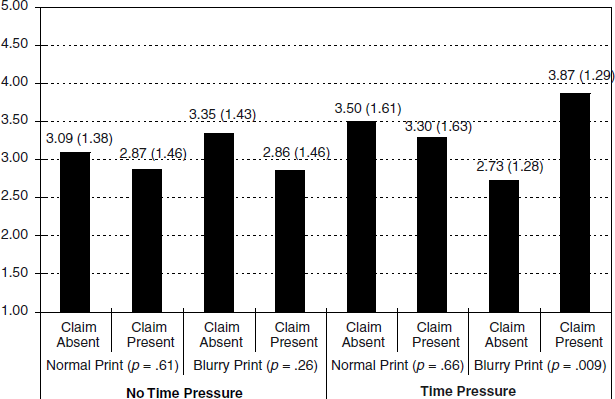
Purchase Intention as a Function of Print Readability, Claim Condition, and Time-Pressure Condition (Experiment 4)
Other Measures
Previous research has suggested that people in a sad mood tend to engage in more effortful processing of information provided to them rather than relying on their existing judgments (Schwarz 2002). Thus, if the blurry print or time-pressure instruction evoked a negative mood, it would account for why people in this condition were more affected by the available claim rather than relying on their existing judgments of McDonald's as an unhealthful restaurant. To address this possibility, we analyzed participants’ ratings on the PANAS scale. For positive moods (α = .87), there were no significant effects of the manipulations (ps > .116). For negative moods (α = .83), only the three-way interaction was significant (F(1, 167) = 4.31, p = .039). In the no-time-pressure condition, the interaction of print × claim was significant (F(1, 167) = 4.71, p = .03). Specifically, in the no-time-pressure/normal-print condition, negative moods were somewhat stronger when a claim was present than when it was absent (M = 1.68 versus 1.39; F(1, 167) = 2.91, p = .09), whereas the claim had no effect on mood in the no-time-pressure/blurry-print condition (Mclaim present = 1.50 versus Mabsent = 1.74; F(1, 167) < 1.88, n.s.). In the time-pressure condition, there were no effects of claim in any condition (Fs < 1.08). This pattern suggests that neither the time-pressure instructions nor the blurry print evoked more negative moods and that participants’ moods do not appear to account for the effect of metacognitive experience on purchase intention in this study. These findings also provide evidence converging with the prior studies that it is not enhanced elaboration driven either by people's need for cognition or by negative moods that influences the metacognitive effects reported here but rather the tendency to seize on the claim to restore perceived understanding when the need for closure is high.
Regarding the self-reported difficulty of completing the survey as a whole, only a significant three-way interaction emerged (F(1, 167) = 5.66, p = .018). The interaction of print × claim was significant in the time-pressure condition (F(1, 167) = 3.90, p = .05) but not in the no-time-pressure condition (F(1, 167) = 1.91, p = .17). In the time-pressure/blurry-print condition, the survey was rated somewhat easier when the claim was absent than when it was present (M = 6.86 versus 6.52; F(1, 167) = 2.77, p = .098). There was no effect of claim in the time-pressure/normal-print condition (F(1, 167) < 1.33, n.s.). Although these ratings reflect perceptions of the survey as a whole, they suggest that efforts to restore perceived understanding by seizing on the provided claim were not experienced as subjectively easier than when the claim was absent. This may be because in the no-claim cell, consumers could report their preexisting brand judgments without using new information to reevaluate the brand.
Discussion
This experiment extended Experiment 3 in managerially actionable directions, examining the effect of metacognitive experience on purchase intentions toward the brand. Furthermore, consumers’ need for closure was induced by imposing time pressure rather than by measuring the chronic need for closure. Finally, a comparison with a no-claim condition showed that when perceived understanding was threatened, consumers who were motivated to restore closure seized on a claim only when it was available. When perceived understanding was threatened by metacognitive difficulty and consumers felt pressed for time, the available claim connoting the healthful potential of McDonald's food (“the wide variety of food available these days”) increased intentions to purchase the food. However, as we expected, when perceived understanding was not threatened, and therefore there was no need to restore it by seizing on available information, the claim did not affect consumers’ purchase intentions. Taken together, these findings provide converging evidence that consumers were more influenced by the available claim because they were motivated to restore their sense of brand understanding.
From the practitioner's point of view, these findings suggest that metacognitive difficulty could increase consumers’ acceptance of marketing claims and thus elicit improvements in brand evaluations under certain conditions. For example, when consumers feel time pressured to make a decision (e.g., in a line with many customers waiting behind), anything that threatens their sense of brand understanding (e.g., a new menu, a redesigned logo, a change in packaging) may prompt greater openness to new information. It is noteworthy that we assessed purchase intention toward McDonald's in a context in which health-fulness was strongly emphasized. Although McDonald's foods are not typically considered healthful choices, merely completing a blurred questionnaire under time pressure increased consumers’ acceptance of a claim connoting McDonald's healthful potential, which was reflected in purchase intentions.
Comparison with the Truth Value Effect
It is instructive to compare these results with previous studies showing that fluency fosters the acceptance of new information as being true (for a review, see Schwarz et al. 2007). That is, ease of processing is experienced as a sense of familiarity (“I have heard this before”), and this familiarity implies social consensus and, therefore, validity. For example, Reber and Schwarz (1999) suggest that high perceptual fluency increases the perceived truth value of processed information. In their study, participants judged a statement as more likely to be true when it was presented in higher-contrast print. From this account, it might be expected that blurred print should have decreased the truth value of the claim about McDonald's and led consumers to be less influenced by it.
However, we argue that when the target of judgment is a familiar brand for which a person expects to have a well-established brand representation, the inference triggered by metacognitive experience may focus on that brand representation (i.e., whether it provides sufficient understanding of the brand). Prior research has also suggested that people can use their metacognitive experiences to evaluate their own mental representations (e.g., Winkielman, Schwarz, and Belli 1998). In contrast, the truth effect (Reber and Schwarz 1999) has been observed with new objects or less familiar targets, for which people's fluency-based inferences may focus on the stimulus. Similarly, there is a difference between how people process a target (e.g., brand X) and how they process information about the target (e.g., an advertisement highlighting the benefits of brand X; Lee 2004). Lee (2004) suggests that fluency associated with the target itself may bring about a favorable attitude because the experience of fluent processing is hedonically pleasing, rather than being due to other operating metacognitive theories. However, Lee notes that with respect to the processing of persuasive messages promoting the target, enhanced evaluation of the target may result from the application of metacognitive theories. Thus, when people experience blurred-printed information about a well-established brand, metacognitive theories for such brands are likely to be activated first—in this case, “My understanding of McDonald's may not be sufficient; that is why I am experiencing a sense of difficulty in processing this information.”
General Discussion
Branding is all about building a strong sense of brand understanding and helping consumers maintain that sense of understanding. This research investigated conditions under which metacognitive experiences of difficulty can threaten the perceived understanding of existing brands and what can happen when the sense of understanding is threatened in this way. In summary, this research shows that (1) metacognitive difficulty in thinking about a brand leads to a reduction in the perceived understanding of a well-established brand (Experiments 1 and 2); (2) the effects of metacognitive experience occur only when a person deems that experience to be relevant for inferring the state of his or her brand representation (Experiments 2 and 3); (3) when perceived understanding is threatened, consumers are more influenced by an available cue in judging or formulating purchase intentions for an established brand (Experiments 3 and 4); and (4) this effect is moderated by the extent to which consumers’ motivation to maintain cognitive closure by seizing on available information is either chronically high (Experiment 3) or intensified by time pressure (Experiment 4).
This research contributes in several ways to the literature on metacognitive experiences and its effects on attitude formation (Lee and Labroo 2004; Wänke, Bohner, and Jurkowitsch 1997). First, this research examines how and when metacognitive experiences affect inferences about the state of a person's brand representations rather than about the favorability of brand attributes. It shows that when the brand is well established—and, thus, consumers expect an experience of ease—metacognitive difficulty threatens perceived understanding. Second, this research suggests that metacognitive experiences link to a motivation to maintain and, if necessary, reestablish perceived brand understanding. Thus, it demonstrates processing consequences of metacognitive experiences in terms of responses to new information.
Our framework focusing on the perceived understanding of brands makes it possible to predict effects not anticipated by existing models. This research suggests that metacognitive difficulty can sometimes lead to more favorable outcomes for the brand. That is, when an existing representation involves a negative judgment of an attribute, metacognitive difficulty may increase the likelihood of considering new information (e.g., healthful potential of McDonald's foods) because it can motivate consumers to question their brand understanding, setting the stage for persuasion to occur.
It is instructive to consider differences between our findings and those of Wänke, Bohner, and Jurkowitsch (1997) because we both focus on existing, well-established brands. Wänke, Bohner, and Jurkowitsch find that when asked to name one reason versus ten reasons for choosing a BMW over a Mercedes, people evaluated BMW more (less) favorably and Mercedes less (more) favorably. That is, metacognitive experiences of ease in retrieving positive associations led to a more positive attitude toward an established brand (either BMW or Mercedes). Related to this, Schwarz (2004) suggests that which inferences people draw from their metacognitive experiences depends on the naive theory of metacognitive processes that they bring to bear on the task. In Wänke, Bohner, and Jurkowitsch's study, participants might have applied a relevant naive theory that “the more positive brand attributes that exist, the easier it is to bring some to mind” to infer the superiority of one brand over another. In our experiments, we asked participants to list brand characteristics without regard to their valence or to evaluate the brand as a whole. Thus, they were more likely to have linked their experienced difficulty to the state of their brand representation and apply a relevant naive theory that “the better the brand representation, the easier it is to bring information to mind.” These metacognitive experiences then led to inferences that affected consumers’ subsequent openness to new brand information.
Implications for Consumer Learning in the Brand Representation Literature
Our account is distinguished from existing models of brand representations in its focus on consumers’ use of their metacognitive experiences to infer the state of their brand representation and their motivation to maintain a sense of understanding. We did not focus on the content of the brand association network per se. For example, the associative network model that Keller (1993) adapts to describe brand associations primarily addresses the recall of brand information when people contemplate a particular brand. Regarding the process of learning new information, it assumes that existing node links and the processing they trigger influence what gets readily incorporated into an existing associative structure. This model has been useful in anticipating branding effectiveness—for example, explaining why the “fit” between an existing associative network and new products is critical for successful brand extensions (e.g., Boush and Loken 1991). However, the model does not view the role of consumers’ motivation as critical to the learning of new information. Our research suggests that when consumers believe that they have a good sense of understanding, they are not motivated to acquire new information. However, when their perceived understanding is threatened, they are more open to an available cue, which possibly results in a change to the existing evaluation and representation of the brand.
Managerial Implications: Repositioning Established Brands
It is noteworthy that just by showing blurred print (something that might be expected to reduce the favorability of attitudes), consumers’ acceptance of new information about that attribute and even their purchase intentions can be increased. We do not imply that managers should present brand information in blurry font or engage in other efforts to decrease the fluency of consumers’ metacognitive experiences. Rather, our broader point is that people's desire for coherent understandings extends to brands and that when those perceived understandings are questioned, this triggers inferential processes that can benefit or harm a brand's interests. Thus, brand managers’ goals could be viewed as extending beyond the management of their brand concepts to the management of consumers’ metacognitive understandings of their brands. In particular, our results suggest expectations that consumers may have for their brand representations. For established brands, people draw inferences from their metacognitive experiences because they expect an experience of ease. For less established brands, consumers do not expect to have strong brand representations that facilitate easy processing. Thus, metacognitive difficulties are more likely to be attributed to the brand itself.
Our research also suggests novel implications for information processing. Perceived understanding of established brands is a type of meaning that consumers are motivated to maintain. It is worth keeping in mind that strong brand representations do not just have value for marketers; they have epistemic value for consumers as well. At the same time, a downside for brands associated with such well-established representations is that it may be difficult to reposition them.
Limitations and Further Research
Note that in Experiments 3 and 4, we used a subtle claim that consumers could seize on when judging the brand—namely, “wide variety of foods,” which connotes the healthful potential of McDonald's foods. The results showed that when time pressure or need for closure was low, consumers were not motivated to restore perceived understanding by incorporating the claim into their representation of a well-established brand. It is possible that, had the claim been stronger, it would have been seized on to restore perceived understanding even under lower motivation to reach closure. Further research could address this possibility.
Another area for further research pertains to the effects of metacognitive ease. We argue that in the absence of metacognitive difficulty, consumers should not be especially motivated to consider new information, because no motivation to restore a sense of understanding is aroused. This account is supported by the meaning-maintenance model (Heine, Proulx, and Vohs 2006), which proposes that the human motivation to maintain the sense of meaning is obviated or attenuated when sated. However, note that in this research, we compare metacognitive difficulty with a control condition, not with metacognitive ease conditions. It is possible that metacognitive ease will arouse a different motivation to protect and reinforce the sense of understanding. Indeed, Labroo and Lee (2006) show that ease of processing reduces liking of information that conflicts with a person's brand representation. If this is the case, consumers with a high need for closure (or time pressure) may be more motivated to process information that is consistent with their existing brand representations when experiencing metacognitive ease. Further research should address this possibility to provide a comprehensive picture of the relationship between the metacognitive experiences and consumers’ motivation to maintain their perceived brand understandings.
References
Supplementary Material
Please find the following supplemental material available below.
For Open Access articles published under a Creative Commons License, all supplemental material carries the same license as the article it is associated with.
For non-Open Access articles published, all supplemental material carries a non-exclusive license, and permission requests for re-use of supplemental material or any part of supplemental material shall be sent directly to the copyright owner as specified in the copyright notice associated with the article.
