







Abstract
How do arousal-inducing contexts, such as frightening or romantic television programs, influence the effectiveness of basic persuasion heuristics? Three theoretical models make different predictions: (1) A general arousal model predicts that arousal should increase the effectiveness of heuristics, (2) an affective valence model predicts that effectiveness should depend on whether the context elicits positive or negative affect, and (3) an evolutionary model predicts that persuasiveness should depend on both the specific emotion elicited and the content of the particular heuristic. Three experiments examine how fear-inducing versus romantic contexts influence the effectiveness of two widely used heuristics—social proof (e.g., “most popular”) and scarcity (e.g., “limited edition”). The results support the predictions from an evolutionary model, showing that fear can lead scarcity appeals to be counterpersuasive and that romantic desire can lead social proof appeals to be counterpersuasive. The findings highlight how an evolutionary theoretical approach can lead to novel theoretical and practical marketing insights.
Imagine the following scenario: You are charged with the task of creating a television advertising campaign for a new product. Knowing that people typically do not process advertisements very deeply, you craft the message with widely used persuasion tactics that are known to be particularly effective when people make quick and heuristic evaluations (Cialdini 2001). After learning that your advertisement tests well in a focus group, you purchase airtime during two types of perennially top-rated television programs: a police crime drama and a romantic comedy. Exactly how will these programs influence the persuasiveness of your advertisement? Will an advertisement featuring a widely used persuasive tactic actually be countereffective when aired during one of these programs but not the other?
Several well-established theoretical models make predictions regarding how emotionally arousing contexts, such as television programs, should influence the effectiveness of persuasion heuristics. Arousal-based models predict that arousal should inhibit deep processing and increase the effectiveness of diagnostic heuristics (Pham 1996; Sonbonmatsu and Kardes 1988). Affective valence-based models differentiate between positive and negative feelings, predicting a different pattern for each of these types of affect (Schwarz and Bless 1991). According to such models, programs that elicit positive feelings (e.g., romantic comedy) should lead to shallower processing and increased effectiveness of heuristics. In contrast, programs that elicit negative feelings (e.g., the worry elicited by a police drama) should lead to more careful processing and decreased effectiveness of persuasion heuristics.
In this research, we investigate another possibility grounded in an evolutionary approach (Griskevicius et al. 2006; Saad 2007; Schaller, Park, and Kenrick 2007). This theoretical approach suggests that affectively arousing stimuli can activate specific emotions. In turn, these specific states should motivate people to think and act in ways that are consistent with the underlying fitness-enhancing functions of those emotions (Keltner, Haidt, and Shiota 2006). Unlike models of general arousal or affective valence, an evolutionary approach suggests that different emotions (1) lead people to be persuaded by some types of heuristic cues and to interpret the same persuasive appeal in different ways and (2) even cause some well-established persuasive tactics to be countereffective. In three experiments, we examine how two emotions (fear and romantic desire) influence the effectiveness of two commonly used persuasion tactics, and we identify when such tactics have a negative persuasive effect. More broadly, this research highlights a promising theoretical approach to marketing by demonstrating how an evolutionary perspective can lead to novel marketing insights.
Persuasion Heuristics
Each day people are confronted with innumerable pieces of information and hundreds of decisions. Not surprisingly, people seldom deeply process each piece of information, instead often relying on quick mental shortcuts, or general heuristic rules, to guide their attitudes and behaviors (Cialdini 2001; Kahneman, Slovic, and Tversky 1982). In line with such findings, it is no coincidence that advertising has come to use fewer lengthy logical arguments, instead infusing advertisements with simple, time-tested persuasive appeals. Such appeals capitalize on heuristic processes because these persuasive tactics are especially effective when people are not particularly motivated or capable to think deeply about a message (Petty and Wegener 1998).
One such persuasive tactic is based on the general heuristic rule that if many others are doing it, it must be good—a persuasion principle known as “social proof (Cialdini and Goldstein 2004). Appeals based on the principle of social proof tend to convey that a product is a top seller or is particularly popular. Each week, for example, there is a barrage of new advertisements indicating which movie is the top-grossing film because people are more likely to engage in a behavior if they are made aware that many others are already doing it (Bearden and Etzel 1982; Goldstein, Cialdini, and Griskevicius 2008; Nolan et al. 2008).
Another such persuasion tactic is based on the general heuristic rule that if a product or opportunity is rare, it must be good—an influence principle known as “scarcity” (Cialdini and Goldstein 2004). Appeals based on the principle of scarcity tend to emphasize features related to the distinctiveness, rarity, or unavailability of a product or an opportunity (Dhar and Sherman 1996). For example, companies purposefully market “limited-edition” products that are perceived as more distinct and less available. Similarly, each year during the holiday shopping season, there is invariably a toy (e.g., Nintendo Wii, Power Rangers, Tickle Me Elmo) that becomes a must-have item in part because it is scarce (Pratkanis and Aronson 2000).
Because heuristic cues, such as social proof and scarcity, are known to increase the effectiveness of advertisements, sales pitches, and even appeals to engage in proenvironmental behavior (e.g., Cody and Seiter 2001; Schultz et al. 2007), these strategies consistently appear on a short list of proven persuasion tactics in marketing, persuasion, and psychology (Cialdini 2001; Hoyer and MacInnis 2006; Myers 2005; Pratkanis and Aronson 2000; Solomon 2004). However, advertisements featuring these persuasive tactics are often preceded by some content, such as a television program, magazine article, or attention-grabbing image, that may influence the effectiveness of these appeals. Indeed, there are several classic theoretical models that make predictions regarding how affect-arousing contexts should influence the effectiveness of persuasion heuristics. As we discuss subsequently, however, each model offers a different set of predictions regarding how arousal and affect might influence the use of mental shortcuts.
Arousal, Affect, and Persuasion
Arousal-based explanations focus on the effects of autonomic nervous system activation on thought and behavior. In general, within the realm of persuasion, higher levels of arousal promote processing of information in a more shallow and peripheral manner, leading people to be more likely to form evaluations based on diagnostic mental shortcuts (Petty and Wegener 1998; Pham 1996). For example, viewing advertisements in an aroused state leads people to be more persuaded by the general heuristic rule that if an endorser is likable and attractive, the product must be good (Sonbonmatsu and Kardes 1988). 1 Thus, arousal-based explanations suggest that the influence of persuasive heuristics should be enhanced to the extent that various contexts, such as romantic comedies or police dramas on television, induce general arousal.
Note that not all arousal models are identical. For example, Pham (1996) argues that arousal increases the selective reliance on any type of diagnostic information (i.e., heuristic or otherwise), whereas Sanbonmatsu and Kardes (1988) argue that arousal leads to an increased reliance specifically on heuristic cues.
Unlike general arousal models, affective valence-based explanations draw a sharp distinction between the effects of positive and negative feelings (Schwarz 2002). According to these models, positive affect leads people to rely more on simplistic thinking and mental shortcuts (Batra and Stayman 1990; Schwarz and Bless 1991), whereas most negative states (e.g., fear, sadness) lead people to think in a more complex manner and to rely less on mental shortcuts (Murry and Dacin 1996). Accordingly, people in a positive affective state are more persuaded by a heuristic cue, such as source expertise, whereas people in a negative state are less likely to use this mental shortcut (Tiedens and Linton 2001). Thus, according to affective valence-based explanations, to the extent that a context elicits positive affect, advertisements featuring heuristic cues should be more effective. In contrast, to the extent that a context elicits negative affect, such heuristic cues will not necessarily enhance persuasion.
A MODERN EVOLUTIONARY APPROACH
Recent research indicates that a distinction based solely on arousal or affective valence may be insufficient to capture the rich influence of affect-arousing contexts (Lerner and Keltner 2001; Pham 2004). For example, fear, embarrassment, sadness, anger, and disgust are all negative affect states, but they do not have equivalent effects on cognition and behavior (Dahl, Manchanda, and Argo 2001; Lerner, Small, and Loewenstein 2004; Raghunathan and Pham 1999). Given that people across cultures experience similar affective responses to universal classes of stimuli, it is useful to examine the influence of affect on cognition and behavior from an evolutionary perspective (Cosmides and Tooby 2000; Keltner, Haidt, and Shiota 2006).
Two key features of modern evolutionary approaches are functionality and domain specificity (Kenrick and Shiota 2008; for a more detailed discussion, see Saad 2007; Tooby and Cosmides 1992). Functionality refers to the explicit consideration of how a recurrent pattern of behavior, affect, or cognition might have served to solve recurrent adaptive problems that all ancestral humans confronted; such fundamental adaptive problems included protecting themselves from predators, finding and attracting mates, making friends, gaining status, and avoiding disease (see Kenrick, Li, and Butner 2003). When adopting an evolutionary approach to examine how emotion might affect cognition and behavior, researchers might begin by asking the following question: Given that cues of physical danger lead people of all cultures to experience similar affective reactions (fear), what might be the adaptive function of this affective reaction? In other words, the key questions regarding emotion from an evolutionary perspective are, What adaptive problems might fear (or any other emotion) have helped solve for our ancestors? and How might that emotion have promoted solutions to these problems?
Merely to argue that an emotion or a behavior is adaptively functional does not necessarily lead to novel hypotheses. The key second insight that has made modern evolutionary approaches useful in generating novel hypotheses is the consideration of domain specificity. The concept of domain specificity follows from many cross-disciplinary findings indicating that mental mechanisms well-suited to solving one adaptive problem are often ill-suited to solving another (Barrett and Kurzban 2006). Thus, rather than viewing the brain as one big domain-general processor, an evolutionary approach views the brain as comprising multiple domain-specific mechanisms, each tasked with solving a different adaptive problem. For example, although the seemingly simple process of classical conditioning has been historically regarded as domain general, recent research shows that classical conditioning works differently for learning aversions to poisonous foods versus learning aversions to physical threats—two qualitatively different adaptive problems (Domjan 2005; Kenrick and Luce 2004). Furthermore, organisms are predisposed to condition responses more readily to specific types of stimuli that would have promoted ancestral success. For example, fear responses in humans and nonhuman animals are much more easily conditioned to snakes or spiders than to electrical outlets or automobiles—even though electrocution and automobile accidents cause many more deaths to people living in current-day environments (Öhman and Mineka 2001).
From an evolutionary perspective, emotions are conceived as activators of executive motivational subsystems that direct energy in ways designed to deal with particular kinds of adaptive problems (Cosmides and Tooby 2000; Keltner, Haidt, and Shiota 2006). When such a system is activated, it promotes a functional cascade of perceptions, cognitions, and behaviors that are conducive to the successful solution of the adaptive problem (Griskevicius et al. 2006, 2007; Maner et al. 2005). In addition, the activation of one such system can inhibit or even suppress the activation of other potentially competing systems (Brendl, Markman, and Messner 2003; Tipper 1992). For example, engaging the self-protection system can suppress attention to attractive people of the opposite sex (Neuberg et al. 2005). Thus, an evolutionary perspective generates a novel set of empirical predictions involving emotion and persuasion heuristics. It suggests that the effects of different affect-arousing contexts should depend not only on the particular type of affective state in question but also on how the particular heuristic cue facilitates or inhibits solving recurring adaptive problems.
Fear, Self-Protection, and Persuasion
Ancestral humans frequently confronted physical threats, and we are here today in part because our ancestors were successful at solving the problem of self-protection (Daly and Wilson 1988). The self-protection system is activated by fear-eliciting cues that suggest physical threat, including photos, messages, or movies depicting dangerous others (Maner et al. 2005). When activated, a self-protective state should have promoted basic strategies that helped avoid harm in ancestral environments (Öhman and Mineka 2001). A core strategy evolutionarily associated with successful self-protection is increased safety in numbers. When a social animal is threatened by a predator, for example, that animal herds closer to its group; this strategy increases survival because the animal becomes less individually salient to the predator (Alcock 2005). Consistent with such animal behavior, fear in humans also appears to produce group-cohesive processes. For example, when people in a chat room are made to feel afraid, they are more likely to conform to the opinions of others in the chat room (Griskevicius et al. 2006).
Building on this previous work, the current investigation examines how fear might influence the effectiveness—and perhaps even the countereffectiveness—of widely used advertising persuasion heuristics. Traditional persuasion research (see, e.g., Petty and Wegener 1998) often does not consider potential differences among various heuristic cues. For example, general arousal and affective valance models do not make different predictions depending on whether the heuristic cue is focused on a spokesperson's expertise, on the product's scarcity, or on social proof (e.g., “best-selling brand”), but an evolutionary approach posits that the specific content of a heuristic cue may be especially relevant, particularly when a person is in a state of fear. Considering that fear should promote the adaptive strategy to join together with others, advertisements featuring social proof appeals (e.g., “the choice of millions”) are likely to be particularly effective when people are in a fear state. In contrast, fear may actually cause advertisements featuring traditional scarcity appeals (e.g., “limited edition”) to backfire. That is, it may be especially unappealing (and non-adaptive) to stand out from the crowd when a predator might be lurking nearby. Because being distinct increases conspicuousness, advertisements with scarcity appeals may be less persuasive in fear-inducing contexts. In summary,
H1: Fear should lead social proof appeals to be more persuasive than when such appeals are not used.
H2: Fear should lead scarcity appeals to be less persuasive than when such appeals are not used.
Romantic Desire, Mate Attraction, and Persuasion
In addition to surviving, our ancestors were successful at solving the adaptive problem of attracting and reproducing with mates. The mate attraction system is activated by cues that elicit romantic desire, including photos, stories, or movies that depict attractive people of the opposite sex, who suggest the potential for reproductive success. When activated, this state should promote basic strategies associated with greater mating success in ancestral environments (Griskevicius, Cialdini, and Kenrick 2006; Van den Bergh, Dewitte, and Warlop 2008). A core strategy evolutionary associated with successful mate attraction is salient positive differentiation. For example, when various species of animals are approached by the opposite sex, they often engage in conspicuous displays that function both to attract the attention of the opposite sex and to positively differentiate the individual from same-sex rivals (Miller 2000). Consistent with such animal behavior, romantic desire in humans also appears to lead people to engage in salient public displays, such as conspicuous consumption and public charity (Griskevicius et al. 2007).
Building on this work, an evolutionary approach suggests that romantic desire can influence persuasion, especially regarding the effectiveness of basic persuasion heuristics. Considering that romantic desire should lead people to want to differentiate themselves positively, this state should lead scarcity appeals (e.g., “limited edition”) to be more persuasive. In contrast, romantic desire might cause social proof appeals (e.g., “over a million sold”) to backfire. That is, because doing what many others are doing is not an adaptive positive differentiation strategy, social proof appeals may actually become counterpersuasive when people are motivated to attract a romantic partner. In summary,
H3: Romantic desire should lead scarcity appeals to be more persuasive than when such appeals are not used.
H4: Romantic desire should lead social proof appeals to be less persuasive than when such appeals are not used.
Experiments 1A and 1B
The first two experiments test how eliciting fear and romantic desire influences the effectiveness of two basic persuasion heuristics (social proof or scarcity) compared with a control condition that uses neither heuristic. The two experiments were conceptually identical in design, but they differed in (1) the product that was rated, (2) the method of emotion elicitation, and (3) the wording of the persuasion heuristics. Specifically, in Experiment 1a, emotion was elicited through movie clips, and participants rated an advertisement for a museum that contained a social proof, a scarcity, or neither appeal; in Experiment 1b, emotion was elicited through reading short stories, and participants rated a product review for a restaurant that contained different persuasion appeals.
Method
Participants
One hundred fifty-four people (74 men and 80 women) participated in Experiment 1a, and one hundred fifty-seven people (63 men and 94 women) participated in Experiment 1b. Participants were students at a large university, and they participated in the experiments in return for course credit. Participants came to the experiments in small groups and were seated at computers that were partitioned from each other.
Design and procedure
Both experiments used a between-subjects 2 (emotion: fear, romantic desire) × 3 (persuasion heuristic: social proof, scarcity, control) design. We induced emotion in participants by having them either view a short video clip (Experiment 1a) or read a short story (Experiment 1b). Participants then viewed either an advertisement (Experiment 1a) or a product review (Experiment 1b) that contained a social proof appeal, a scarcity appeal, or neither appeal (control).
To minimize potential demand characteristics, both experiments used cover stories. In Experiment 1a, participants were told that we wanted to add realism to a “marketing and personality” study by having everyone watch a video clip before viewing an advertisement. Importantly, participants were told that everyone would see the same clip and the same advertisement because we were interested in the effects of personality. In Experiment 1b, participants were told that we were interested in “reading and memory”; the short story (i.e., the emotion manipulation) was presented as a memory task, and participants were told that they were to wait five minutes after reading the story to let their memory decay before testing. In the meantime, participants provided ratings for a product review that was ostensibly part of a different study.
Emotion manipulation
To elicit fear and romantic desire, in Experiment 1a, participants viewed an edited seven-minute film clip. In the fear condition, they saw scenes from The Shining, which depicts a madman chasing people with an ax. In the romantic desire condition, they saw scenes from Before Sunrise, which depicts an attractive man and woman falling in love as they travel through Europe. In Experiment 1b, we elicited emotions by having participants read a short 600-word story. To elicit fear, participants read about being alone in bed late at night and hearing scary noises; after hearing someone enter the house, the story ends as someone is about to enter the bedroom. To elicit romantic desire, participants read about meeting a highly desirable person of the opposite sex and spending an enjoyable afternoon with that person.
To assess whether the manipulations were effective at eliciting the intended emotions, a separate group of 96 people underwent the manipulations used in each experiment. Afterward, they indicated the extent to which they felt (1a) fear, (1b) motivation to protect themselves, (2a) romantic desire, (2b) motivation to attract a romantic partner, and (3) general arousal. We measured responses on nine-point scales with the endpoints “not at all” (1) and “very much” (9).
A two-way analysis of variance (ANOVA) with emotion and method of elicitation (movie clip versus short story) did not reveal an interaction (F(1, 94) = .24, p = .91), meaning that there was no difference regarding the type of method used to elicit the states. Table 1 reports means for every condition, though we combined the movie clip and short story conditions for the analyses to avoid repetition. As we expected, compared with the romantic desire manipulations, the fear manipulations elicited more fear (Ms = 6.51 versus 1.61; F(1, 94) = 130.18, p < .001) and a stronger motivation for self-protection (Ms = 6.50 versus 2.48; F(1, 94) = 45.37, p < .001). Conversely, compared with the fear manipulations, the romantic desire manipulations elicited more romantic desire (Ms = 6.80 versus 1.28; F(1, 94) = 170.79, p < .001) and a stronger motivation to attract a romantic partner (Ms = 7.28 versus 1.56; F(1, 94) = 198.65, p < .001). Although the romantic desire manipulations elicited more general arousal than the fear manipulations (Ms = 7.14 versus 5.68; F(1, 94) = 12.57, p < .01), both manipulations were above the midpoint, suggesting that both elicited some level of arousal. Importantly, the predicted pattern of results (i.e., the interaction of emotion with persuasion heuristic) could not be explained by the slightly higher level of general arousal in the romantic desire condition.
Emotions, Motivations, and Arousal Elicited by Manipulations Across Experiments

Notes: Higher numbers indicate a more intense state. Bold numbers denote means above the midpoint. Standard deviations are in parentheses.
Persuasion heuristics
For Experiment 1a, we created a magazine-like advertisement for a museum. Because we did not want participants to be highly motivated to scrutinize the advertisement (see Peracchio and Myers-Levy 1997), participants were told that they were among a large number of people at many universities who were participating in the study (meaning that their individual responses were merely one of a large number of responses); participants were also not given additional incentive to pay careful attention to the advertisement. The advertisement contained a photo of the museum, the museum's logo, and the line “San Francisco Museum of Art.” In the social proof condition, we added a heuristic piece of information based on common social proof appeals to the no-heuristic control advertisement: “Visited by over a Million People Each Year.” In the scarcity condition, we added a heuristic piece of information based on common scarcity appeals: “Stand Out from the Crowd.” We presented the advertisement to participants for 15 seconds.
For Experiment 1b, we created a brief, generically positive product review for a restaurant. In the social proof condition, we added three heuristic pieces of information to the control review: The title included the phrase “the most popular restaurant,” and the review mentioned that “many people gathered there” and that “if you want to know why everyone gathers here for a great dining experience, come join them at the Bergamot Café.” The scarcity condition included the phrase “a unique place off the beaten path” in the title, and the review mentioned that the restaurant was a “one-of-a-kind place that is yet to be discovered by others” and that “if you're looking for a great dining experience different from any other, look no further than the Bergamot Café.” 2
Consistent with previous findings, testing indicated that inserting a social proof appeal into the ad/product review (M = 5.59/7.30) or inserting a scarcity appeal into the ad/product review (M = 5.54/7.22) indeed led the ad/product review to be more persuasive than the no-heuristic control ad/product review (M = 4.98/6.45).
Dependent measures
After viewing the advertisement/product review, participants responded to six questions, indicating their attitudes toward the museum/restaurant and their intentions to go there, both of which were expected to produce a similar pattern of results. Specifically, they answered three nine-point questions regarding their attitudes toward the museum/restaurant (“bad/good,” “unfavorable/favorable,” and “negative/positive”). Then, they answered three nine-point behavioral intentions questions with endpoints “not at all” and “very much” regarding (1) the extent to which they were interested in finding out more about the museum/restaurant, (2) how likely they were to consider going there, and (3) how likely they were to actually go there.
Results
As we expected, the six attitude and behavioral intentions measures showed a similar pattern (Experiment 1a: α = .91; Experiment 1b: α = .93), and we combined them for the analyses. Considering that both experiments had conceptually identical designs, we first wanted to ensure that the experiments did not differ in their patterns of results. An omnibus three-way ANOVA with emotion, persuasion heuristic, and experiment did not produce an interaction (F(2, 299) = .22, p = .80). The experiment factor also did not interact with emotion (F(1, 299) = .33, p = .57) or with persuasion heuristic (F(2, 299) = .47, p = .63), indicating that emotion and persuasion heuristic had similar effects in both experiments. Thus, we combined the results from the experiments for the analyses.
At a broad level of analysis, an ANOVA indicated the predicted significant interaction between emotion and persuasion heuristic (F(2, 305) = 20.81, p < .001, d = .73; see Figure 1). Although the specific pattern of results was consistent with predictions, to examine our specific hypotheses, we next performed a series of planned comparisons.
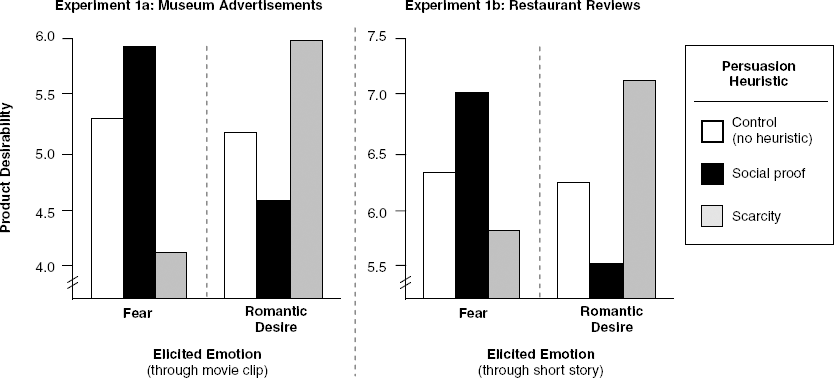
EXPERIMENTS 1A AND 1B: EFFECTIVENESS OF PERSUASION HEURISTICS AS A FUNCTION OF ELICITED EMOTION
First, we examined the predictions for fear. In line with H1, fear led social proof appeals to be more persuasive than the control (F(1, 305) = 3.84, p = .051, d = .22; Msocial proof = 6.50, Mcontrol = 5.88). In contrast, fear led scarcity appeals to be less persuasive than the control (F(1, 305) = 6.97, p = .009, d = .30; Mscarcity = 4.96, Mcontrol = 5.88). Thus, in support of H2, not only did fear have different effects on the persuasiveness of social proof and scarcity appeals, but it also led scarcity appeals to be counterpersuasive (see Figure 1).
Second, we examined the specific predictions for romantic desire. In line with H3, romantic desire led scarcity appeals to be more persuasive than the control (F(1, 305) = 5.34, p = .021, d = .25; Mscarcity = 6.53, Mcontrol = 5.79). In contrast, romantic desire led social proof appeals to be less persuasive than the control (F(1, 305) = 4.97, p = .033, d = .24; Msocial proof = 5.04, Mcontrol = 5.79). 3 Thus, in support of H4, not only did romantic desire have a different effect on the persuasiveness of social proof and scarcity appeals, but it also led social proof appeals to be counterpersuasive.
Note that researchers’ critical alpha level (e.g., .05) for two-tail t-tests for specific predictions depends on the importance researchers place on Type I errors. For example, a more conservative test in this case would use a Dunn-Sidak correction (see Kirk 1995) to adjust for using the same control condition for two tests, which would place the critical alpha level at .03.
Discussion
Contrary to the predictions of general arousal and affective valence models, fear and romantic desire influenced the effectiveness of social proof and scarcity heuristics in a way that is consistent with specific predictions from an evolutionary model. In particular, although appeals based on the principle of social proof were more effective when people were in a fear state, advertisements and messages featuring scarcity appeals actually backfired when people were in a fear state. In contrast, romantic desire produced the opposite pattern, leading scarcity appeals to be more persuasive and social proof appeals to be less persuasive.
Note that our findings are not mere demonstrations of simple persuasion-matching effects. For example, matching models might suggest that putting people in a particular affective state (e.g., positive or negative) will lead them to be more responsive to appeals that are congruent with that affective state. Persuasion-matching models might also suggest that romantic feelings will enhance responses to appeals that explicitly suggest that a particular product will make a person more desirable to the opposite sex and that fear might enhance responses to messages that explicitly suggest that a particular product will prevent physical danger. Going beyond such matching hypotheses, our model makes predictions that involve a nonobvious, subtle interplay between emotion and the effectiveness of basic and widely used persuasion principles—an interplay that flows naturally from our evolutionary model.
Experiment 2
Considering that specific emotions can cause widely used persuasion appeals to be counterpersuasive, Experiment 2 examined theoretically derived contexts in which such potentially detrimental persuasion effects might be avoided. By doing so, the experiment also aimed to illuminate the process by which fear and romantic desire can lead specific persuasive heuristics to be counterpersuasive. To explore these issues, we again drew on an evolutionary approach, which led us to parse the persuasion heuristics of social proof and scarcity into two separate and rarely distinguished components.
Two Types of Social Proof Heuristics
Our functional perspective posits that romantic desire should cause social proof appeals to backfire because this state motivates people to differentiate themselves positively by explicitly not doing what many others are doing. However, a closer examination of the wide uses of social proof appeals reveals a subtle but potentially important distinction. Social proof appeals sometimes focus on what many others are doing, but at other times, they focus on what many others desire or are talking about (e.g., “the movie that everyone is talking about”). The key difference is that the first type of appeal conveys mass behavior (many people are going to that movie), whereas the second type conveys a positive attitude toward that behavior (many people want to go to that movie) without explicitly conveying that many people are already doing it.
Social proof appeals often unwittingly conflate “behavioral” information (many others are doing it) and “attitudinal” information (many others are talking about it). For example, stating that a hotel is the “Number 1 hotel in town” can imply different information: Perhaps the hotel books the most rooms (behavioral social proof), such as a hotel with large discounts, or perhaps the hotel is the “in place” to be (attitudinal social proof), such as a small boutique hotel frequented by Hollywood's elite. According to our functional perspective, romantic desire should decrease the persuasiveness of only the behavioral social proof appeal. That is, whereas behavioral social proof appeals imply that one would be following the herd by purchasing a product, attitudinal social proof appeals do not explicitly convey mass consumption, only that people are talking excitedly about a product. Thus, romantic desire should produce a backfire effect for behavioral social proof appeals (as in Experiments 1a and 1b), but it should not produce a backfire effect for attitudinal social proof appeals, because such appeals do not convey information about ubiquitous consumption. In summary,
H5: Although behavioral social proof appeals (“everybody's doing it”) should be more persuasive under fear (H1) and less persuasive in a state of romantic desire (H4) than a neutral emotion control, the persuasiveness of attitudinal social proof appeals (“everybody's talking about it”) should not differ as a function of emotion.
Two Types of Scarcity Heuristics
Our functional approach makes a similarly textured prediction regarding how emotion-arousing contexts influence scarcity appeals. Our model posits that fear causes scarcity appeals to backfire because fear motivates people to stay with the crowd (and not be distinctive). However, a closer examination of the wide uses of scarcity appeals reveals that they do not always focus explicitly on the distinctiveness of a product. Instead, scarcity appeals can note that an opportunity to purchase a product is limited (e.g., “only three days left”).
Scarcity appeals often unwittingly conflate both distinctiveness and limited opportunity simultaneously (e.g., limited-edition product). That is, the reason limited-edition products are desirable is both because they are perceived as being less available (limited-opportunity scarcity) and because owning such products increases the odds that other people do not have the same ones (distinctiveness scarcity). Our model predicts that fear and romantic desire should have a markedly different effect on these two types of scarcity appeals. Specifically, whereas distinctiveness-based scarcity appeals convey that purchasing that product will lead a person to be unique, limited-opportunity scarcity appeals do not convey consumer uniqueness. Thus, whereas fear should cause distinctiveness-based scarcity appeals to backfire (as in Experiments 1a and 1b), limited-opportunity scarcity appeals, which are not informative about consumer uniqueness, should be effective even in threatening contexts. In summary,
H6: Although distinctiveness-based scarcity appeals (“stand out from the crowd”) should be more persuasive in a state of romantic desire (H3) and less persuasive under fear (H2) than a neutral emotion control, the persuasiveness of limited-opportunity scarcity appeals (“limited-time offer”) should not differ as a function of emotion.
Method
Participants
Four hundred sixty-eight students from a large university (239 men and 229 women) participated in the experiment in return for course credit. To minimize potential demand characteristics, we used a slightly modified version of the cover story from the first two experiments. Fourteen participants indicated that they were not fluent in English, leaving 454 participants for the analyses.
Design and procedure
The experiment used a 3 (emotion: fear, romantic desire, neutral) × 4 (persuasion heuristic: behavioral social proof, attitudinal social proof, distinctiveness scarcity, limited-opportunity scarcity) × 2 (product: museum, Las Vegas) mixed-factorial design. Emotion and product were between-subjects factors, meaning that a participant saw an advertisement for the museum or an advertisement for Las Vegas. Persuasion heuristic was a within-subjects factor, meaning that each participant saw advertisements with all four types of persuasion heuristics.
All participants initially rated a no-heuristic version of the museum or the Las Vegas advertisement. These preemotion manipulation ratings of the no-heuristic advertisement provided a measure of participant-specific biases toward the product and ad layout. As we expected, there were no differences in the initial ratings of the advertisement across the three emotion conditions (Mneutral = 5.75, Mfear = 5.73, Mromantic desire = 5.64; F(2, 451) = .23, p = .80). These preemotion ratings served as a covariate in the analyses to reduce within-subject noise in the study.
After these preratings, we elicited emotion through a movie clip. We elicited fear and romantic desire through the same movie clips as in Experiment 1a. Participants in the neutral condition viewed a clip from the film Winged Migration, which depicted nature scenes. The addition of a neutral emotion condition enabled us to ascertain the specific direction of the persuasion effects predicted for fear and romantic desire. Participants then viewed the four versions of the Las Vegas or the museum advertisement; each version contained one of the four heuristics. The four versions of the advertisement were each presented in random order for 15 seconds. We used the same dependent measures as in Experiments 1a and 1b.
Persuasion heuristic
Half the participants evaluated advertisements for a museum (see Experiment 1a). In addition to the three original versions of the advertisement (behavioral social proof: “Visited by over a Million People Each Year”; distinctiveness scarcity: “Stand Out from the Crowd”; and no heuristic), we created two versions for the two new persuasion heuristic conditions. For the attitudinal social proof advertisement, we added a line conveying that many people think the museum is an exciting place: “The museum that millions are talking about.” For the limited-opportunity scarcity condition, we added a line conveying a dwindling opportunity to visit the museum: “Last chance to visit.”
The other half of participants saw an advertisement for Las Vegas. The basic no-heuristic version of the advertisement contained a large photo and the name of the city. In the distinctiveness scarcity condition, the advertisement contained the appeal “Do something different.” In the limited-opportunity scarcity condition, the advertisement contained the appeal “Limited-time offer ends this week.” In the behavioral social proof condition, the advertisement contained the appeal “Visited more than any other city.” In the attitudinal social proof condition, the advertisement contained the appeal “See what everyone is talking about.”
Ad pretesting
To ascertain whether people clearly perceived the intended differences among the four versions of the advertisements, a separate group of 23 people viewed and rated all the advertisements. They indicated the extent to which each advertisement conveyed information that was directly related to the four persuasion heuristics in the study. Specifically, they indicated the extent to which an advertisement conveyed that there was a limited opportunity to visit the museum/Las Vegas and that this opportunity was becoming increasingly scarce (limited-opportunity scarcity); that the activity would be something distinct from what others are doing, and thus visiting these destinations would enable a person to differentiate him- or herself from others (distinctiveness scarcity); that these destinations were commonly visited and were popular (behavioral social proof); and that there was a lot of “buzz” and a lot of excitement about these destinations (attitudinal social proof). They also indicated the extent to which the appeal was informative regarding whether many or few people actually visit the museum or Las Vegas. All responses were provided on seven-point scales with the endpoints “not at all” and “very much.”
As we expected, a two-way repeated measures ANOVA with heuristic and advertisement did not indicate an interaction (F(1, 21) = .22, p = .84), so we combined the Las Vegas and the museum advertisements for the analyses. As Table 2 shows, pretesting confirmed that each of the four types of heuristic appeals conveyed the intended information. Specifically, products in the distinctiveness scarcity condition were viewed as more distinct and different rather than as limited and scarce (Ms = 6.43 versus 1.48; F(1, 22) = 517.03, p < .001). In contrast, products in the limited-opportunity scarcity condition were viewed as more limited and scarce rather than as distinct and different (Ms = 5.72 versus 2.22; F(1, 22) = 96.85, p < .001). Products in the behavioral social proof condition were viewed as being common, popular, and consumed by many rather than as having much buzz and excitement (Ms = 6.86 versus 4.96; F(1, 22) = 47.60, p < .001). In contrast, products in the attitudinal social proof condition were viewed as having more buzz and excitement rather than as being merely common and popular (Ms = 6.61 versus 5.57; F(1, 22) = 12.79, p = .002). Importantly, products in the behavioral social proof condition were perceived as having been significantly more consumed than products in the attitudinal social proof condition (Ms = 5.87 versus 3.91; F(1, 22) = 18.91, p < .001).
Experiment 2: Specific Product Information Conveyed by Each Persuasion Heuristic

Notes: Bold numbers denote the highest means within a row. Standard deviations are in parentheses.
Results
We combined the six dependent measures into a persuasion index (α = .91). A repeated measures ANOVA did not indicate an interaction with type of advertisement (Las Vegas and museum; F(6, 1341) = .77, p = .60), so we combined the two types of advertisements for the analyses. As we predicted, a repeated measures analysis of covariance (with the preemotion manipulation ratings of the no-heuristic advertisement as a covariate) revealed an interaction between emotion and persuasion heuristic (F(6, 1350) = 10.28, p < .001, d = .44). To test the specific hypotheses of the study, we performed a series of tests for main effects and a series of planned contrast with the preemotion manipulation ratings of the no-heuristic advertisement as a covariate.
Consistent with H5, the persuasiveness of the new attitudinal social proof appeals (e.g., “the museum that millions are talking about”) did not differ across the three emotion conditions (Mcontrol = 5.82, Mfear = 5.91, Mromantic desire = 5.77; p = .92). However, the persuasiveness of the behavioral social proof appeal (e.g., “visited by over a million people each year”) was significantly different across the three emotion conditions (F(2, 450) = 7.70, p = .001, d = .37). In line with H1, behavioral social proof appeals were more persuasive in the fear than in the control condition (Mfear = 5.48, Mcontrol = 5.09; F(1, 450) = 5.38, p = .021, d = .25; see Table 3). Consistent with H4, behavioral social proof appeals were less persuasive in the romantic desire than in the control condition (Mromantic desire = 4.71, Mcontrol = 5.09; F(1, 450) = 3.92, p = .048, d = .20; see Table 3). Overall, H5 was supported; fear and romantic, desire had opposite effects on behavioral versus attitudinal social proof appeals.
Experiment 2: Effectiveness of Each Persuasion Heuristic as a Function of Emotion
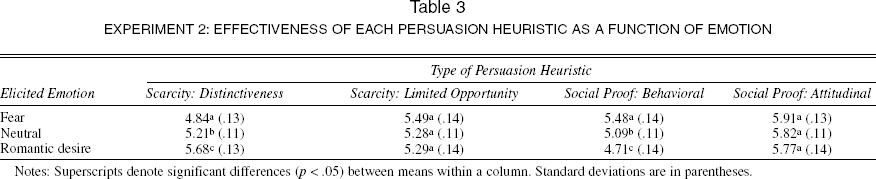
Notes: Superscripts denote significant differences (p < .05) between means within a column. Standard deviations are in parentheses.
Consistent with H6, the persuasiveness of the new limited-opportunity scarcity appeal (e.g., “limited-time offer ends soon”) did not differ across the three emotion conditions (Mfear = 5.50, Mcontrol = 5.28, Mromantic desire = 5.28; p > .32). However, the persuasiveness of the distinctiveness scarcity appeal (e.g., “stand out from the crowd”) was significantly different across the three emotion conditions (F(2, 450) = 14.56, p < .001, d = .51). In line with H3, distinctiveness scarcity appeals were more persuasive in the romantic desire than in the control condition (Mromantic desire = 5.68, Mcontrol = 5.21; F(1, 450) = 11.91, p = .001, d = .26; see Table 3). Consistent with H2, distinctiveness scarcity appeals were less persuasive in the fear than in the control condition (Mfear = 4.84, Mcontrol = 5.09; F(1, 450) = 5.89, p = .016, d = .25; see Table 3). Overall, H6 was supported; fear and romantic desire had opposite effects on distinctiveness versus limited-opportunity scarcity appeals.
Discussion
Experiment 2 examined how fear and romantic desire influenced the persuasiveness of social proof and scarcity heuristics when they varied in subtle but conceptually important ways. Consistent with predictions, romantic desire caused behavioral social proof appeals (“everyone is doing it”) to backfire, but attitudinal social proof appeals (“everyone is talking about it”) did not produce a backfire effect. To our knowledge, this is the first study to highlight the conceptual differences between the behavioral and the attitudinal components of social proof-based appeals. This pattern of results also indicates that romantic desire undermines persuasive appeals that specifically suggest that performing a particular behavior will signal that one is acting like many other members of the crowd. For scarcity heuristics, fear caused distinctiveness-based scarcity appeals (“do something different”) to backfire, but limited-opportunity scarcity appeals (“limited-time offer”) did not produce a backfire effect. Thus, fear appears to undermine persuasion appeals that suggest that a behavior will make a person conspicuously visible.
General Discussion
This research began with a straightforward question: How might different affect-arousing contexts influence responses to time-tested and widely used persuasion appeals? We focused on this question by examining how a specific positive affective state (romantic desire) and a specific negative affective state (fear) influence the effectiveness of two well-established heuristic cues: social proof and scarcity. Whereas general arousal and affective valence models caused two sets of different predictions, the results across three experiments were instead consistent with specific predictions derived from an evolutionary model. This model suggests that the elicitation of specific emotions should motivate people to think and act in ways that are consistent with the underlying fitness-enhancing function of each emotion. In line with this perspective, fear and romantic desire had vastly different effects on the persuasiveness of two persuasion appeals. In particular, fear caused normally persuasive scarcity appeals to backfire, though the same scarcity appeals were more effective following romantic content. In contrast, romantic desire caused normally effective social proof appeals to backfire, though the same social proof appeals were more effective following fear-inducing content.
Further consideration of these persuasion backfire effects led us to use an evolutionary model to identify key components of social proof and scarcity appeals that could eliminate such effects. In line with predictions, romantic desire specifically caused behavioral social proof appeals (“everyone is doing it”) to backfire, whereas attitudinal social proof appeals (“everyone is talking about it”) were not influenced by context. Similarly, fear specifically caused distinctiveness scarcity appeals (“stand out from the crowd”) to backfire, whereas limited-opportunity scarcity appeals (“limited-time offer”) were not influenced by context. This specific pattern of findings also indicates the reason social proof and scarcity appeals can backfire: Romantic desire can cause social proof appeals to backfire because people in this state are motivated not to follow others’ behavior, and fear can cause scarcity appeals to backfire because people in this state are motivated to stick together. These specific patterns of findings, derived from an evolutionary perspective, would not have been predicted a priori by any other theoretical model of which we are aware.
Evolutionary Approaches
This research is one of the first programmatic empirical studies to demonstrate the utility of an evolutionary approach in marketing by showing that adopting an evolutionary approach can produce unique and testable marketing insights. Although this theoretical approach has successfully led to large numbers of theoretical advancements in the fields of biology, anthropology, psychology, and economics, evolutionary models have thus far been almost completely absent in research on persuasion and social influence (Sundie et al. 2006) and in research on consumer behavior and marketing more generally (Briers et al. 2006; Miller 2009; Van den Bergh, Dewitte, and Warlop 2008). Note that evolutionary models do not aim to replace other theoretical approaches; rather, they can be fruitfully integrated into almost any area of marketing research as a means of complementing the existing theoretical models (see Dewitte and Verguts 2002; Saad 2007). Both evolutionary approaches (which are concerned with ultimate explanations for behavior) and traditional approaches (which are concerned with proximate explanations for behavior) are needed for a complete understanding of any consumer phenomena. Evolutionary models clearly need more extensive testing by marketing researchers, including the considerations of decision neuroscience (Shiv 2007), but an evolutionary approach provides fertile ground for a wide range of insights into marketing and consumer behavior, including the posing of novel hypotheses that enable broader theoretical integration and connect marketing research to a vast network of theory and research on human and nonhuman social behavior.
More specifically regarding emotions, a domain-specific evolutionary approach suggests that there are discrete negative and positive emotions. Indeed, recent research has begun to examine how specific negative emotions influence cognition (e.g., Lerner and Keltner 2001; Raghunathan and Pham 1999 l; Tiedens and Linton 2001). Although much of this work has implicit evolutionary components and is compatible with our approach, there is a key theoretical difference. In the aforementioned work, discrete emotions are often defined by particular cognitive appraisal patterns; that is, an emotion is defined by whether it relates to a high or low level of uncertainty, control, or other appraisal dimension. In contrast, our evolutionary approach to discrete emotions defines each emotion in an explicitly distinct manner (Keltner, Haidt, and Shiota 2006). That is, an emotion is “discrete” to the extent that it has a qualitatively unique set of elicitors and it solves a qualitatively different adaptive problem relative to another proposed emotion. A given emotion may be associated with a particular pattern of cognitive appraisals, but such appraisals neither define the emotion nor necessarily determine all consequences of the emotion.
Implications and Future Research Directions
The current findings have theoretical and practical implications for advertising practice and the strategic placement of advertisements and products. For example, although television advertisers have traditionally relied on viewer demographic information to determine where and when to purchase airtime, our model suggests that they should consider the content of the specific program during which their advertisements will air and should consider such issues in a more textured and less obvious way. For example, while touting the uniqueness of a product might be effective during a program that elicits romantic desire, the same advertisement aired during a fear-eliciting program, such as grim local news, might actually make the product unappealing. A related possibility is that advertisements themselves might be used to elicit specific emotions (rather than general positive or negative affect) in a strategic way. For example, the first 15 seconds of a television spot could be strategically crafted to elicit a specific emotion; this emotion could be used to make the persuasion appeal in the advertisement more persuasive. Considering that specific emotions are hypothesized to motivate fitness-enhancing behavior, an emotion elicited by an advertisement might influence both the effectiveness of the persuasive appeal in the advertisement and the attractiveness of the product, depending on whether the appeal and product promote the solution to the underlying adaptive problem posed by the emotion.
More broadly, the evolutionary considerations of functionality and domain specificity suggest that consumption-relevant processes, such as product search, product evaluation, and decision making, differ qualitatively depending on which adaptive mental system (i.e., which specific evolutionary domain) is being engaged. Such considerations imply that consumers might process information and make decisions in qualitatively different ways depending on, for example, whether they are trying to protect themselves from disease (Argo, Dahl, and Morales 2006), gain status (Sundie et al. 2006), or affiliate with others (Maner et al. 2007). Such potential marketing-relevant effects are unlikely to be limited to advertising; different mental mechanism can be engaged in a variety of contexts, such as when a person encounters a particular background on a Web site (Mandel and Johnson 2002; Vohs, Mead, and Goode 2006), sees a particular emotional expression (Ackerman et al. 2006), is shopping in a particular store environment (Kaltcheva and Weitz 2006), or is surrounded by particular scents or music (Bosmans 2006; Zhu and Meyers-Levy 2005). Overall, this research—and an evolutionary theoretical approach in general—reflects only the tip of a data-rich iceberg that can serve as an impetus for novel research and theory building in marketing.