







Abstract
Advertising nudges consumers along the think–feel–do hierarchy of intermediate effects of advertising to induce sales. Because intermediate effects—cognition, affect, and experience—are unobservable constructs, brand managers use a battery of mind-set metrics to assess how advertising builds brands. However, extant sales response models explain how advertising grows sales but ignore the role of intermediate effects in building brands. To link these dual contributions of advertising, the authors propose an integrated framework that augments the dynamic advertising–sales response model by integrating the hierarchy, dynamic evolution, and purchase reinforcement of intermediate effects. Methodologically, the new approach incorporates the intermediate effects as factors from mind-set metrics while filtering out measurement noise, extracts the factor loadings, estimates the dynamic evolution of the factors, and infers their sequence in any hypothesized hierarchy by embedding their impact in a dynamic advertising–sales response model. The authors apply the proposed model and associated method to a major brand to discover the brand's operating hierarchy (advertising → experience → cognition → affect ↔ sales). The results provide the first empirical evidence that intermediate effects are indeed dynamic constructs, that purchase reinforcement effects exist not only for experience but also for other intermediate effects, and that advertising simultaneously contributes to both sales growth and brand building. Thus, both researchers and managers should consider using the proposed framework to capture advertising's dual contributions of building brands and growing sales.
Keywords
Marketing managers hire advertising agencies to build brands but fire them because of failure to deliver sales growth. Agencies prefer mind-set metrics (e.g., brand recognition, liking, purchase intention) to assess the impact of advertising campaigns on building brands, but such metrics are not linked to sales outcomes. Because marketing managers are evaluated on sales performance, they rely on sales outcomes to evaluate agency performance, leaving agencies with little recourse to defend when sales decline, even though agencies may have successfully built brands. Srinivasan, Vanhuele, and Pauwels (2010) make an initial foray into linking mind-set metrics directly to sales outcomes, but metrics themselves do not generate sales; rather, they reflect the intermediate effects of advertising, which nudge consumers along the think–feel–do hierarchy in stages to induce brand purchase (see Vakratsas and Ambler 1999). Thus, the intermediate effects tend to be unaccounted for (i.e., lost along the way), which not only undermines the agency–client relationship, given the agencies charter to build brands, but, equally important, undervalues the dual contributions of advertising to growing sales and building brands.
Previous advertising research has generated two streams of literature: advertising–sales response models and intermediate effects of advertising. First, advertising–sales response models (e.g., Hanssens, Parsons, and Schultz 1990) quantify the short- and long-term sales impact of advertising, taking into account diminishing returns (see Simon and Arndt 1980) and carryover effects (see Leone 1995). The second stream of literature characterizes how advertising influences consumers’ cognition (C), affect (A), and experience (E), which make up the three intermediate effects reflected by the multiple mind-set metrics. Reviewing more than 250 studies in this latter stream, Vakratsas and Ambler (1999) hypothesize, without testing, that the three intermediate effects drive sales, which in turn may reinforce experience. However, advertising–sales response models ignore the intermediate effects that advertising initiates and precede sales. As the subsequent literature review shows, no study has explicitly incorporated this process of how advertising works in dynamic advertising–sales response models.
Figure 1 illustrates the dual contributions of advertising and bridges the two literature streams. The proposed framework facilitates the discovery of how advertising works, empowering managers to discover the operating hierarchy among the three intermediate effects for their brands using tracking data on mind-set metrics. Consequently, brand managers can understand how spending and creative decisions generate mind-set metrics and brand sales as an interconnected system. In other words, if advertising → C → A → E → sales, the creative content drives cognition (e.g., promotions, value). Instead, if E → C → A, managers may do more sampling to trigger trials and advertising to evoke brand experience that, in turn, drives cognition and emotions that connect consumers with brand sales. Thus, this framework offers feedback to creative teams based on the operating hierarchy distilled from market tracking data, and it injects diagnostic information to help resolve governance issues in the agency–client relationship that arise from the dual contributions of advertising (i.e., agencies focus on building brands, while clients evaluate sales growth).
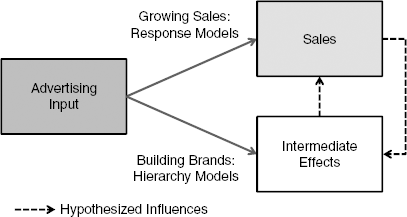
Bridging Distinct Streams Of Advertising Research
Theoretically, does advertising trigger one of the three intermediate effects to initiate the sequence (in line with the classical view), or does it ignite them simultaneously as Vakratsas and Ambler (1999) hypothesize? Do the effects exhibit dynamics? Are they reinforced by purchases? Indeed, testing these hypotheses requires a proper methodology, which we develop herein. Methodologically, how can we extract unobserved intermediate effects (or factors) from mind-set metrics while denoising them to ensure consistency? Are the factors correlated, and if so, how many factors should we retain—all three, any two, or just one? Previous studies have ignored measurement noise (e.g., Srinivasan, Vanhuele, and Pauwels 2010), dynamics (e.g., Bollen 1989; Iacobucci 2008), or both (e.g., Chandukala et al. 2011).
All these questions can be addressed within the proposed integrative framework. To operationalize it, we formulate a dynamic factor model of advertising, develop a method for parameter estimation and factor retention, conduct simulation studies to assess accuracy, calibrate the proposed model using tracking data on sales and mind-set metrics, and illustrate an application to a major soft drink brand that conducted more than 30,000 consumer interviews to collect weekly time-series data over a five-year span on 16 mind-set metrics.
More specifically, we estimate the proposed dynamic factor model using the Bayesian approach to the Kalman filter (e.g., Bass et al. 2007; Naik, Mantrala, and Sawyer 1998) and the reversible jump Markov chain Monte Carlo (RJ-MCMC; Green 1995) algorithm. We filter out measurement noise from 16 mind-set metrics, extract the three factors (C, E, A), estimate their dynamic evolution, infer their sequence from any hypothesized hierarchy, allow for their nonorthogonality, and embed their impact in a dynamic advertising–sales response models.
We preview some of the empirical insights. Advertising has a significant impact on both sales and affect simultaneously but not on cognition or experience directly. In contrast with the classical hierarchy, this finding partially supports Vakratsas and Ambler's (1999) untested hypothesis. For this brand, E → C → A → sales is the operating hierarchy. We also find the first empirical evidence that intermediate effects are dynamic constructs. Moreover, we contribute the first empirical evidence that brand purchase reinforcement effects may exist. In our application, purchases reinforce affect (sales → A) but not experience (as previously hypothesized) or cognition. Together, we learn that advertising ignites affect and sales simultaneously, affect drives sales, and purchases reinforce affect, bringing to fore the role of emotions for this brand's advertising. Andrew Robertson, worldwide chief executive officer of BBDO, shared the following insight into emotional advertising (personal communication): Cognition leads to conclusions, and emotions provoke action. Therefore, researchers and managers should incorporate the dual contributions of advertising to grow sales and build brands. Next, we review the literature to identify the gaps.
Literature Review
Growing Sales: Dynamic Advertising–Sales Response Models
A broad class of advertising–sales response models (see Hanssens, Parsons, and Schultz 1990) calibrates the impact of managers’ advertising decisions on consumers’ aggregate behavior (e.g., unit sales, market share). These models use objective macro-level (i.e., store, state, country) brand performance data and relate them to advertising investments to infer their short- and long-term effects. These models incorporate diminishing returns to current ad spending through the square root or logarithm (Simon and Arndt 1980) and carryover effect that captures the sales impact of all past ad spending (Leone 1995).
Although these models describe how advertising grows sales, they ignore the role of intermediate effects of advertising (i.e., how advertising builds brands). Each ad copy or campaign is uniquely created and spreads brand communications that consumers receive, think about, feel, and act on (Singh and Cole 1993). Consequently, advertising–sales response models without intermediate effects reduce the role of advertising to media scheduling and repetition of undifferentiated content (Vakratsas and Ambler 1999). A vast literature on the hierarchy of effects, which developed as a disconnected stream from the sales response modeling literature, has investigated the role of advertising in building brands.
Building Brands: Intermediate Effects of Advertising
Prior research on how advertising works (Barry and Howard 1990; Lavidge and Steiner 1961; Vakratsas and Ambler 1999; Vaughn 1980, 1986) suggests that advertising nudges consumers along the hierarchy of intermediate effects toward brand purchases. Vakratsas and Ambler (1999) review more than 250 studies and show that most consider the three intermediate effects: cognition (C) to describe the “thinking” dimension of consumer response, affect (A) for the “feeling” dimension, and experience (E) for behavioral actions (“do”). The classical view holds that advertising triggers one of the three effects—cognition, affect, or experience—to move consumers sequentially along the remaining two stages. In other words, a hierarchy (i.e., any one of the six permutations of E → C → A) follows advertising and precedes sales.
Foote, Cone & Belding ad agency (now Draftfcb) and later Vaughn (1980) provided the conceptual foundation for the various permutations of C, A, and E. Parameswaran and Medh (2011) describe the genesis and overview of the “FCB” grid with applications to several advertising campaigns. For example, in low-involvement situations (e.g., buying candy), the E → C → A (do–learn–feel) hierarchy influences sales when consumers have experience and need limited information. When consumers need information for high-involvement situations (e.g., buying cars), the C → A → E (learn–feel–do) hierarchy operates. Not all three effects may operate for all brands. For example, cognition-only models view consumers as rational information seekers (e.g., Tellis and Fornell 1988).
Vakratsas and Ambler (1999) claim that the hierarchy is absent and that advertising ignites all three effects simultaneously rather than triggering one a time to initiate the sequential process. They argue that advertisements may contain informational content that appeals to cognition, emotional stories that evoke affect, and product demonstration that connects with consumers’ experiences. When consumers watch advertisements, these aspects trigger all effects simultaneously. However, Vakratsas and Ambler's hypothesized model has not been tested empirically.
Purchase Reinforcement of All Intermediate Effects?
Vakratsas and Ambler's (1999) hypothesized model also conjectures the presence of a feedback loop from sales to experience. The authors argue (p. 27) that a consumer's mind “is not a blank sheet, but already contains conscious and unconscious memories of product purchasing and usage. Thus, behavior feeds back to experience.” Though logically plausible, this hypothesis has not been tested empirically.
More generally, Feldman-Lynch theory predicts that past purchases make the brand experience diagnostic and accessible to evoke not only consumers’ thinking but also their feelings. Accordingly, purchase may reinforce not only experience but also cognition and affect. Preliminary support for this possibility comes from Srinivasan, Vanhuele, and Pauwels (2010), who find that past sales influence some mind-set metrics. Thus, to advance extant literature on the hierarchy of effects, we incorporate purchase reinforcement effects on all three effects.
Dynamics of Intermediate Effects
Studies on classical hierarchy models ignore dynamics because they mostly employ laboratory experiments with between-subjects design, which by construction rules out the testing of dynamic effects. However, dynamics, through the carryover effect, are the most important variable in advertising–sales response models (Leone 1995). So it is natural to ask, Do the intermediate effects also exhibit dynamics? Consumer research suggests that “individuals are always in a stream of thinking or feeling…. Both these [intermediate effects] are continually occurring. Mental activities are dynamic, not static” (Peterson, Hoyer, and Wilson 1986, p. 158). Given the possibility of dynamics, we encounter the issue of how dynamics may unfold. In Srinivasan, Vanhuele, and Pauwels's (2010) work, past sales drive some mind-set metrics, suggesting the presence of lagged rather than concurrent effects. They argue that advertising strengthens the brand's position in consumers’ “hearts and minds” and that the resultant affect and cognitions need not immediately translate into sales (e.g., Keller and Lehmann 2006). Thus, we formulate and test both lagged and concurrent dynamics herein.
Linking Mind-Set Metrics to Intermediate Factors
Brand managers commission advertising tracking agencies to survey consumers and measure a battery of mindset metrics on a weekly (or monthly) basis. For example, they attempt to assess awareness of the brand's advertising, the liking for the brand, music or humor, and purchase intentions. However, each measure possesses several drawbacks. First, mind-set metrics lack purity—that is, they do not measure only one construct and thus may be contaminated by all three factors. Second, multiple mind-set metrics together triangulate to reflect the constructs. Finally, and most important, each mind-set metric is error prone. Measurement noise in the fallible measures, if ignored, induces inconsistency in parameter estimates (Naik and Tsai 2000). Thus, a direct inclusion of noisy regressors in the advertising–sales equation renders all the parameter estimates inconsistent (e.g., Greene 1993), which means that the true effects may not be recovered even with a large sample size.
A simple approach to denoise the mind-set metrics would be to average the multiple items, but doing so results in a loss of information and comes “at the cost of inaccuracy in substantive and theoretical conclusions” (Iacobucci 2008, p. 27). Factorization offers a statistical approach to combine the multiple mind-set metrics and relate them to the factors, thus reducing measurement noise (Iacobucci 2008). A typical intermediate factor consists of three mind-set metrics (Bagozzi and Baumgartner 1994) and is more reliable than any single metric alone.
The correlation between the metric and the factor is called “factor loading.” Distinct mind-set metrics that load only on one intermediate factor are rare because pure affective or pure cognitive responses to advertisements are difficult to disentangle. Consequently, a full factor loading matrix should be estimated in an exploratory manner. Given repeated measurements, the factor loading matrix offers diagnostic information to refine or substitute mind-set metrics periodically.
Are Intermediate Factors Distinct?
From the lack of availability of measurements over time, classical factorization imposes independence between factors by assuming orthogonality (i.e., no interfactor correlations). However, some studies argue that affect is a form of cognition, interdependence between cognition and emotion exists, and emotion may influence experience and experience drives emotions (e.g., Eder, Hommel, and De Houwer 2007). Accordingly, the three intermediate factors may be correlated. Moreover, not all three intermediate factors operate across all product categories or brands (e.g., cognition-only models; Tellis and Fornell 1988). Thus, in the proposed integrative framework, we not only estimate correlations between intermediate factors (i.e., nonorthogonal factors) but also test whether one, two, or three intermediate factors operate for a particular brand.
Growing Sales and Building Brands
To discover how advertising grows sales and builds brands, an integrative framework bridges the two distinct streams of literature on advertising–sales response modeling and the intermediate effects of advertising. Two recent studies explore this gap and offer preliminary insights. Srinivasan, Vanhuele, and Pauwels (2010) directly include mind-set metrics, such as ad awareness and consideration, into their dynamic advertising–sales model and find that the inclusion of these metrics improves model fit. They also find that these metrics evolve dynamically and are partly driven by the feedback loop from sales. Chandukala et al. (2011) propose an approach to investigate the direct and indirect effects of media exposures on purchase intention. They allow media exposures to drive brand beliefs, which in turn affect purchase intent. However, their dependent variable (purchase intent) and advertising inputs (media exposures) are self-reported metrics obtained from consumer surveys, not market transaction data such as gross rating points (GRPs) or sales. They apply their cross-sectional (i.e., static) approach to individual-level data and, similar to Srinivasan, Vanhuele, and Pauwels (2010), do not extract factors to mitigate measurement noise. Table 1 presents the relative contributions of this study.
Relative Contributions Of This Study

Implications for Model Formulation and Method Development
The top section of Table 1 summarizes the integrative framework for discovering how advertising grows sales and builds brands. It extends the extant literature by bridging the two domains and embedding the hierarchy of dynamic intermediate factors reinforced by past purchases. The bottom section of Table 1 presents the methodological aspects. Specifically, factorization restores consistency of parameter estimates despite fallible mind-set metrics, and it permits mind-set metrics to jointly reflect the intermediate factors. Extraction of nonorthogonal factors enables managers and researchers to test whether intermediate factors are independent constructs for their particular brands; if not independent, they learn the extent to which they are correlated. Furthermore, the factor retention procedure assesses whether the correlated intermediate factors are sufficiently distinct to warrant their collective inclusion. In the next two sections, we formulate the model and develop the method.
Dynamic Factor Model of Advertising
We operationalize the integrative framework as a state-space model, in which the observation equation captures the composition of the three intermediate factors reflected by mind-set metrics. The transition equation characterizes the dynamic evolution of sales and the three intermediate factors, along with alternative hierarchies and purchase reinforcement effects. The drift vector embodies how advertising triggers one or more intermediate factors and brand sales.
Growing Sales: Dynamic Advertising–Sales Response Model
Equation 1 presents the benchmark advertising–sales response model, which incorporates the current advertising effect (β4) and the carryover (γ44) from past advertising on sales (St). Following the work of Simon and Arndt (1980), we specify diminishing returns to advertising by
Dynamic advertising–sales response model (Model 1):

Building Brands: Classical Hierarchy of Intermediate Effects
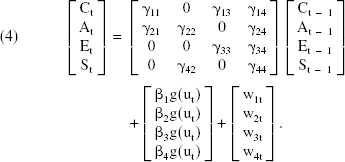
The classical hierarchy of effects suggests that advertising triggers one of the three intermediate factors to initiate the sequence, and the last factor in the sequence drives sales. In the lagged version, with the E → C → A hierarchy, for example, advertising (β3) triggers experience Et, then prior experience Et − 1 influences current cognition Ct (γ13), prior cognition Ct − 1 drives current affect At (γ21), and prior affect At − 1 induces brand sales St (γ42). The error terms (w1, w2, w3)’ represent the specification errors in factor equations. Equation 2 describes this process.
Classical hierarchical model E → C → A (Model 2):


Classical Hierarchies Of Advertising
In contrast, Vakratsas and Ambler (1999) suggest that advertising ignites all three factors simultaneously through (β1, β2, β3)'; then all factors jointly drive sales through γ41, γ42, and γ43; and brand purchases reinforce experience through γ34. Equation 3 shows the corresponding model specification.
Vakratsas–Ambler model (Model 8):

For both views, advertising does not grow sales directly (i.e., β4 = 0) but only through the intermediate factors indirectly. Thus, the classical hierarchy literature presents the “pure” brand-building view of advertising. More important, the classical hierarchies and the Vakratsas–Ambler model ignore the effects of dynamics (γii = 0).
An Integrated Framework: Growing Sales and Building Brands
We integrate the elements of the dynamic advertising–sales response model (i.e., sales dynamics through γ44 and direct sales impact of advertising through β4) with those of classical hierarchy models and the Vakratsas–Ambler model. In addition, on the basis of the literature review, we further extend this literature by incorporating the following:
Intermediate factor dynamics (γ11 ≠ 0; γ22 ≠ 0; γ33 ≠ 0). As with the sales carryover effect, the current cognition carries over into future periods with a weekly attrition rate (1-γ11). Similarly, γ22 and γ33 capture affect and cognition dynamics, respectively.
Purchase reinforcement (γ14 ≠ 0; γ24 ≠ 0; γ34 ≠ 0). For example, γ34 measures the purchase reinforcement of current experience due to the link S → E, as Vakratsas and Ambler (1999) hypothesize. In addition, we hypothesize the presence of purchase reinforcements on cognition (714) and affect (724).
Advertising grows sales and builds brands simultaneously (β1 ≠ 0; β2 ≠ 0; β3 ≠ 0; β4 ≠ 0). The parameters (β1, β2, β3, β4)’ measure the effects of advertising GRPs on all three intermediate factors and brand sales. The first three advertising effects (β1, β2, β3)’ ignite all intermediate factors to build brand values; in addition, advertising effect (β4) grows sales volume directly (as in the benchmark model). Together, brand values and sales volume create the intangible and tangible effects of advertising, respectively.
We refer to this augmented model as the “integrated hierarchy” of advertising. Equation 4 shows the transition equation for this lagged integrated E → C → A hierarchy. Different hierarchies that we aim to test empirically yield the other eight models.
Lagged integrated E → C → A model (Model 9):
To obtain the concurrent integrated hierarchy models, we transform the lagged specification as follows (for details, see the Web Appendix at www.marketingpower.com/jmr_webappendix):
Concurrent integrated E → C → A model:

We can rearrange Equation 5 to recast it in the usual state-space form for estimation (as we show subsequently). In the empirical analysis, we denote the dynamic advertising–sales response model as Model 1 (benchmark), the classical hierarchy models with six permutations as Models 2–7, and the Vakratsas–Ambler specification as Model 8. To foreshadow the results, Model 9 is the retained model shown in Equation 4. Models 10–14 (not shown for brevity) represent the other five permutations of the lagged integrated hierarchies. Figure 3 illustrates the integrated hierarchy model graphically.

Integrated Hierarchy Model for E→C→A
To obtain other sequences or subsequences with fewer intermediate factors, Equation 6 permits one-, two-, or three-factor models through the general transition equation:

Inferring Intermediate Factor Composition
To estimate the intermediate factor composition from observed mind-set metrics, let {xit}ni=1 be the vector of i = 1,…, n mind-set metrics, such as brand recognition, ad liking, and purchase intentions measured each week t = 1,…, T. Advertising tracking agencies survey consumers to collect data on various mind-set metrics, and so these survey-based items contain measurement noise, which we denote by the error term {εit}ni=1. Other than being fallible, these mind-set metrics are not exclusive indicators of a particular intermediate factor (see Bollen 1989). Indeed, as the literature review indicates, a mind-set metric may reflect the facets of more than one intermediate factor; in addition, multiple mind-set metrics make up an intermediate factor. Equation 7 permits this composition.
Denoting the factors by fjt, j = 1,…, J, we represent a general factor structure by

In advertising contexts, we have at most three intermediate factors (J = 3)—cognition (Ct), affect (At), and experience (Et)—culminating to the final stage of brand purchasing and resulting in the observed sales volume yt with the mean sales level St. Therefore, we augment the observation Equation 7 to include observed sales along with the three intermediate factors as follows:
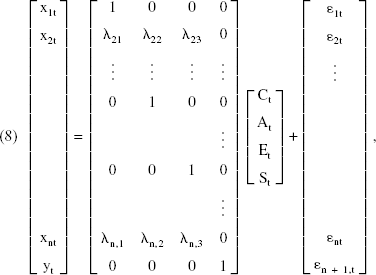

In summary, the system of Equations 6 and 9 permits the dynamic analysis of any mediation pattern, such as g(u) → (E → C → A) ↔ S. These equations filter out measurement noise in mind-set metrics and observed sales, extract each intermediate factor reflected by multiple metrics, incorporate sales and intermediate factor dynamics, allow for purchase reinforcement effects, and capture sales growth through advertising directly and brand building through the hierarchy effects indirectly. Thus, the integrative framework facilitates the discovery of how advertising works for any specific brand. In the next section, we explain how to estimate this dynamic factor model, retain the number of factors, and discover the operating hierarchy of intermediate factors.
Estimation and Inference Method
To discover how advertising works, we first set the number of factors to three so that the dimension of the state space is fixed. Equations 6 and 9 can then be estimated with maximum likelihood (ML), expectation-maximization (EM) algorithm, or Bayesian techniques. Maximum likelihood does not require the “extra” Kalman smoother (backward) recursions, which both EM and Bayes need for complete data expectation or backward sampling, respectively. Likewise, both EM and Bayes do not require “extra” quasi-Newton optimization steps, which ML needs for estimation and inference. Unlike the EM algorithm, both ML and Bayes yield inference through the information matrix or posterior densities, respectively. Asymptotically, the three methods yield equivalent results. We adopt the Bayesian approach because we subsequently relax the state-space dimensionality to facilitate the factor retention decision of whether all intermediate factors operate for a specific brand.
In the Bayesian estimation, we run the Kalman filter and smoother recursions in conjunction with MCMC to estimate the model parameters of Equations 6 and 9 and to discover the operating hierarchy that best fits the market data (observed mind-set metrics and sales; see Bass et al. 2007; Liechty, Fong, and DeSarbo 2005). Next, we compute the stable factor correlations by solving the discrete algebraic Riccati equation (Arnold and Laub 1984) to assess the degree of nonorthogonality among the factors. Finally, we determine the number of factors to retain using RJ-MCMC algorithm (Green 1995; Lopes, Salazar, and Gamerman 2008; Lopes and West 2004). We provide further details on these three steps next.
Dynamic Factor Model Estimation
When the number of factors is known, Equations 6 and 9 constitute a fixed dimensional, linear state-space model defined by {Λ, γ, β, Q, W}. We specify the priors for the model parameters and use MCMC simulation of the full posterior distribution based on the entire time series, t = 1,…, T. We denote
Factor Correlation Estimation
Because we obtain repeated measurements on mindset metrics, we can relax the assumption of orthogonal factors. The Kalman filter recursions of the state covariance matrix Φt = Var(ft) provide the time-varying correlation matrix among the factors. To obtain the time-invariant limit matrix, Φ∞ = limtÅ∞ Φt, we compute the unique stabilizing solution of the discrete-time algebraic Riccati equation (Arnold and Laub 1984). The limit matrix Φ∞ satisfies the matrix equation given by the following discrete algebraic Riccati equation:

Specifically, we supply the posterior estimates of the system matrices (Λ, γ, Q, W) as inputs to the DARE (discrete algebraic Riccati equation) function in Matlab. If the resulting Φ∞ = I, the factors are orthogonal; they are correlated if otherwise. In our case, the intermediate factors might be correlated because they do not work independently in consumers’ minds. If factor correlations were large, fewer than three factors might suffice, raising the question whether the factors are sufficiently distinct to justify retention of all of them.
Factor Retention
To decide factor retention, we apply the RJ-MCMC algorithm. In the Bayesian framework, the number of factors is just another parameter in the model, injecting additional uncertainty. For example, not all three intermediate factors (C, A, E) may be relevant, and so we consider the system dynamics in Equations 6 and 9 with two (e.g., persuasion hierarchy) or just one (e.g., affect-only or cognition-only models) intermediate factor.
To implement RJ-MCMC, we follow Lopes, Salazar, and Gamerman (2008). We denote k as the relevant set of factors, k ∈ {1,…, K}, where K = 1, 2, 3, 4 for three intermediate factors and sales. These reflect the following models: three one-factor models, three two-factor models, and one three-factor model, all with additional sales, representing all the seven combinations. Then, the system matrices in Equations 4 and 7 can be indexed as {γ(k), Λ(k), Q, Wk} for the set of factors ft(k). Let Θ(k) = {β(k), fT(k), Λ(k), γ(k), Q, W(k)} be the parameters of the integrated model with k factors. Then, the joint posterior distribution of Θ(k) is

The RJ-MCMC algorithm requires a preliminary set of parallel MCMC output for the entire set k ∈ {1, …, K} of competing dynamic factor models. These chains give a set of within-model posterior samples Θ(k) that approximates the posterior distribution p(Θk |xT, k). The posterior moments from these samples guide the choice of a proposal distribution, q(Θ(k)), from which the candidate parameters are drawn. This proposal distribution is given by

To reduce computational burden (see Lopes and West 2004), we use the inverse gamma in Equation 11 and set diagonal W and Q. Note that even though W and Q are diagonal matrices, we have a full state covariance matrix in the Kalman filter recursions because the transition and loading matrices are not diagonal. To set the tuning parameters, Lopes, Salazar, and Gamerman (2008) recommend that a
1
through a4 are less than unity and a5 = a6 = 1.5, which works well in our application. Because p(xT, k, Θ(k)) = p(xT | Θk, k)p(Θk | k)pr(k), where pr(k) = 1/K, RJ-MCMC proceeds from the initial values of (k, Θ(k)) obtained from the sample averages of the preliminary MCMC runs. In other words, it draws a candidate model k’ ∼ pr(k’ |k) and then, conditional on the model k’, draws Θ(k') from q(Θ(k”)). We accept the pair (k’, Θ(k′)) with the probability

Simulation Study
We conduct Monte Carlo simulations to test the accuracy of the proposed method in recovering parameter estimates and discriminating between correct and incorrect factor models. We relegate the details to Web Appendix A (www.marketingpower.com/jmr_webappendix) but briefly state the main settings and key results.
The true model used for data generation is the lagged integrated C → A → E hierarchy model. In the transition matrix γ, factor and sales dynamics parameters γii = .9, the three hierarchy parameters γij = .1, and the three purchase reinforcements γi4= .01. The four advertising effectiveness parameters βi = .01. The covariance matrices Q and W are set to identity. Each factor consists of three mind-set metrics. The first row of the factor loading matrix has unity and zeros for identification; the other elements are as follows:

The same pattern holds for the other two factors, with an appropriate identification row. For t = 1,…, T = 200 weeks, we generate nine mind-set metrics and one sales as the dependent variables and the weekly advertising spending from ut ∼ Uniform[0, 1000] as the independent variable. For other details, see Web Appendix A (www.marketingpower.com/jmr_webappendix).
We generate 100 simulated data sets and estimate the lagged integrated C → A → E model 100 times. In Web Appendix A, Table T1 presents the average estimated factor loadings; Table T2 displays the transition matrix and ad effectiveness estimates. Both tables show that the estimated parameters are remarkably close to their true values.
To assess the accuracy of operating hierarchy selection, we consider the following set of “incorrect” models: five permutations of (C, A, E) for integrated hierarchy, six permutations of (C, A, E) for the classical (static) hierarchy, and the Vakratsas–Ambler model. Then, we use the three metrics—P(m |y) from RJ-MCMC, log Bayes factor, and mean absolute percentage error (MAPE)—to select the best model from the 13 possible ones after each estimation run. We count the frequency of selection over 100 estimation runs. In Web Appendix A, Table T3 reveals a sharp discrimination across correct and incorrect models, with a 93% hit rate for the log Bayes factor, 79% for RJ-MCMC, 40% for MAPE. Thus, the log Bayes factor outperforms RJ-MCMC (and MAPE) when the number of factors is fixed.
To assess the accuracy of factor retention, we consider three one-factor models, three two-factor models, and one three-factor model (integrated C → A → E). Table T4 in Web Appendix A reports the results. We observe a sharp discrimination across correct and incorrect models, with an 88% hit rate for RJ-MCMC, 72% for log Bayes factor, and 55% for MAPE. As we expected, RJ-MCMC outperforms the log Bayes factor (and MAPE) when the number of factors varies. The simulation results enhance our confidence in the proposed method, and so we illustrate its application to the proprietary data from the major brand in Germany that dominates the soft-drink product category.
Empirical Analysis
Data
From 2000 to 2005, over 251 weeks, the marketing managers spent 150 million euros in advertising this soft-drink brand to generate sales of 4.98 billion liters. To assess brand-building effectiveness, they expended substantial effort to collect data on mind-set metrics. In addition to monitoring weekly sales and ad expenditures, they hired an advertising tracking agency to interview consumers on mind-set metrics such as brand recognition, liking, and purchase intent. They tracked 16 mind-set metrics each week by interviewing approximately 130 consumers per week (more than 32,800 interviews across 256 weeks). For each week, the agency reported the average scores on the mind-set metrics and provided them to the company two weeks after the interviews. Table 2 reports the descriptive statistics. The questionnaire for the mind-set metrics had been developed over many years, reflecting prevailing industry standards (see Srinivasan, Vanhuele, and Pauwels 2010). The metrics cover important brand-building aspects of advertising—for example, message clarity reflects both cognition and affect, activation pertains to cognition, liking connects with affect, and purchase intention pertains to experience.
Descriptive Statistics

Used for factor identification.
Unit roots and endogeneity
Brand building involves sustained effort over time. Accordingly, sales, GRPs, and mind-set metrics may be integrated over time. Thus, we test and reject the presence of a unit root on the basis of the augmented Dickey–Fuller test (for details, see Web Appendix B; www.marketingpower.com/jmr_webappendix). For endogeneity, conceptually, the annual budgeting process requires ad spending decisions and media booking for day/time slots several months in advance in the up-front market (see Belch and Belch 2004, p. 358; Tellis 1998, p. 351). In addition, the market research company supplies the observed metrics two weeks after the actual spending. Thus, endogeneity in weekly advertising is less likely. Nonetheless, econometrically, we account for potential endogeneity by applying the instrumental variables approach as in extant literature (e.g., Bronnenberg and Mahajan 2001). We use two lagged advertising as instruments, which yield approximately 57% correlation with current advertising. All results are based on this approach.
The Discovery Process
In Step 1, we set out to discover which hierarchy fits the data best. In Step 2, if an integrated hierarchy model prevails, which dynamics unfold, lagged or concurrent? In Step 3, we investigate whether factors are correlated and, if so, to what extent. If correlated, the two follow-up questions are as follows: (1) Do orthogonal factors fit about as well? (2) Are all factors sufficiently distinct to warrant their inclusion? In Step 4, we assess whether the factor loading restrictions are appropriate. In Step 5, we compare the resulting best model with the benchmark dynamic advertising–sales response model. We summarize the results here and relegate the details to Web Appendix C (see www.marketingpower.com/jmr_webappendix).
Step 1: Integrated hierarchies (Models 9–14) uniformly outperform all the classical hierarchies (Models 2–7) by a wide margin (see Table 3). This finding highlights the importance of including dynamic intermediate factors, purchase reinforcements, and advertising effects on both sales and intermediate factors in the model. The retained operating hierarchy is E → C → A with purchase reinforcement of affect (S → A).
Model Comparison

We evaluate the one-step-ahead predictive log-likelihood at the posterior means of the parameters; then, the log Bayes factor is the difference in the predictive log-likelihoods between competing models. A log Bayes factor equal to 2 or more furnishes strong evidence to support the model relative to the competing one (West and Harrison 1997).
The log Bayes factor base value for Model 9 is -671.2067.
Mean absolute percentage deviation (MAPE) for the out-of-sample forecasts based on 21 observations in the holdout sample and 235 observations in the estimation sample.
Step 2: The lagged integrated E → C → A hierarchy model out performs the concurrent integrated E → C → A model (see Web Appendix D at www.marketingpower.com/jmr_webappendix). This finding not only corroborates with Srinivasan, Vanhuele, and Pauwels's (2010) findings but also reveals that the accumulative effects of intermediate factors do not translate into sales immediately (e.g., Keller and Lehmann 2006).
Step 3: All intermediate factor correlations are positive and significantly nonzero. Converting correlations to angular degrees, we learn that cognition and affect dimensions display a 92.8-degree angle and affect and experience exhibit a 91.6-degree angle, revealing near orthogonality (i.e., 90°). The intermediate factors are also nearly orthogonal to sales, with angles ranging from 90.6 degrees to 93.6 degrees. However, cognition and experience exhibit a 107-degree angle, which is far from being orthogonal. Consequently, orthogonal rotation of factor space is not recommended here. Because other applications may need it, we describe how to do orthogonal rotation in Web Appendix E (see www.marketingpower.com/jmr_webappendix). Given statistically significant correlations, estimating the retained model with orthogonal restriction results in a worse fit (log Bayes factor 29.86 and MAPE 9.22 vs. 7.97), as it should. Finally, we test the retention of fewer than three intermediate factors using the RJ-MCMC algorithm and find that all three factors should be retained, indicating distinctiveness due to their small correlations.
Step 4: Because multiple factor identification constraints exist, we recommend testing such alternative factor loading specifications. Our results reveal qualitatively similar findings, but they may attain inferior scores on log Bayes factor and MAPE metrics (see Table T11 in Web Appendix C). Thus, we report the best-retained model in Tables 4 and 5.
Step 5: The lagged integrated E → C → A hierarchy model outperforms the dynamic advertising–sales model. We also tested another benchmark model with the Nerlove–Arrow goodwill formation, which also under performs on both the criteria: log Bayes factor (of marginal likelihood of sales rather than all mind-set metrics) and MAPE.
Interpreting the Operating Hierarchy
According to the estimated values of (γ13, γ21, γ42) in Table 4, the link from experience to cognition (E → C) is weaker than the other links. The more habitual the consumption, the lower are the cognitive efforts. The stronger link between cognition and affect (C → A) indicates that affect needs cognitive processing to form associated memory. The notion that affect drives sales (A → S) explains why emotional advertising is prevalent for this brand's ad campaigns. The proposed framework can be applied to investigate operating hierarchies across other brands and markets.
Parameter Estimates for the Lagged Integrated EÅCÅA Hierarchy

Notes: Bold parameters are significantly different from zero based on Bayesian inference.
Do Intermediate Factors Exhibit Dynamics?
Table 4 shows a significant dynamic sales effect (γ44 = .9329). The effect implies a 90% duration (= Ln(10)/[1-744]) of 34 weeks or eight months, which is in the expected range (Leone 1995). Intermediate factor dynamics (i.e., diagonal elements γjj) are all significant, revealing that carryover effects exist also for cognition, affect, and experience. This finding is one of the novel contributions of this study (because no previous studies have extracted dynamic intermediate factors of advertising).
Substantively, the relatively lower affect carryover γ22 = .3676 implies a 90% duration of less than four weeks. Thus, constant advertising support is needed to maintain elevated affect levels. In other words, by continual advertising, managers try to prevent affect from decreasing.
Does Advertising Ignite the Intermediate Factors?
Classical hierarchy-of-effects literature suggests that advertising triggers the initial intermediate effect of the sequence, whereas the Vakratsas–Ambler model hypothesizes that it ignites all of them simultaneously. In the proposed integrated hierarchy model, advertising builds brand values (β1, β2, β3)’ and grows sales volume (β4). Table 4 presents empirical evidence that this brands advertising builds affect and grows sales simultaneously, resulting in an advertising elasticity of .1385. This finding is another novel contribution to the extant literature; it lends empirical support to an idea—advertising ignites multiple intermediate factors simultaneously—that is contrary to the longstanding notions in the hierarchy-of-effects literature.
Do Purchases Reinforce Intermediate Factors?
The Vakratsas–Ambler model hypothesizes that purchases reinforce experience, whereas the proposed integrated hierarchy model generalizes this coverage to include cognition and affect. Table 4 presents the empirical evidence. For this particular brand, we cannot confirm any significant purchase reinforcement of experience, but we do find that the purchasing reinforces affect. This result may be due to two reasons. First, this soft drink brand is mature; consumer buying is routinized, so the experience carryover effect is large (γ33 = .9865), which leaves limited room for reinforcements of experience to emerge. Second, for this brand, purchase reinforcement of affect manifests because of enjoyment in the acts of purchasing and consuming soft drinks with family and friends. Thus, this finding supports the hypothesis of Vakratsas and Ambler (1999) that purchase reinforcement exists; it also supports our hypothesis that affect can be influenced by past purchases. This empirical validation is another novel contribution of this study.
Composition of Intermediate Factors
Table 5 reports the estimated intermediate factor loadings. We find that most mind-set metrics are not “pure” (i.e., cross-loading estimates are significant). In other words, a given mind-set metric reflects the facets of more than one factor, which comports with psychological studies (e.g., Eder, Hommel, and De Houwer 2007). For example, attention and message clarity are positively related to all intermediate factors. Next, we furnish evidence that multiple mind-set metrics constitute an intermediate factor. For example, cognition is a composite of 12 mind-set metrics; 11 and 12 mind-set metrics constitute the affect and experience factors, respectively.
Estimated Factor Loadings For The Lagged Integrated EÅCÅA Hierarchy

Restrictions.
Notes: Bold = 95% significant.
Importantly, all mind-set metrics contain significant noise (see the last column of Table 5). If we ignore the presence of measurement noise, we cannot learn whether the noise is significant or not. Only when we acknowledge that metrics can be noisy can we begin to model them as errors-in-variables, filter out the noise using the Kalman filter, and estimate the variances in measurement errors. Indeed, not filtering out the noise is not innocuous—it renders all parameter estimates inconsistent (Greene 1993, chap. 9; Naik and Tsai 2000).
The estimated loadings on the intermediate factors have expected signs. Because positive loadings are self-evident, we interpret the negative and selective insignificant loadings. Specifically, advertising uniqueness loads negatively on experience because experienced consumers are more familiar with the ad copy. Similarly, watch and music load negatively on experience because of familiarity. Esprit puts an audience in a pleasant mood, arouses feelings of surprise, and attracts attention, but it decreases with cognition because good humor should work without cognitive efforts (e.g., jokes should not need to be explained) and indiscriminate use of humor may hinder message acceptance (Tellis 2004, p.161). Negative purchase intentions decrease as affect increases (i.e., consumers intend to buy brands they like). Finally, daily usage decreases with higher cognition (i.e., consumers are less likely to buy soft drink brands if they have to think about it).
Note that affect and experience, rather than cognition, increase memorability of this brand's advertisements. This result underscores the importance of emotions in connecting consumers with commercials. Indeed, affect-driving memorability is best understood in Maya Angelou's words, “people will forget what you said, people will forget what you did, but people will never forget how you made them feel.”
Conclusion
We close by summarizing our four novel contributions. The main contribution is to bridge the two vast but disparate domains of advertising research: sales response models and hierarchy of effects. In doing so, the proposed integrative framework not only augments the advertising–sales relationship by embedding the effects of cognition, affect, and experience but also offers an approach to test the external validity of theoretical research from the latter domain.
Second, we formulate a dynamic factor model of advertising, which describes advertising's dual contributions: growing sales and building brands. Given ad agencies’ charter to build brands, they prefer to use mind-set metrics to assess advertising campaigns, but such metrics are not linked to sales outcomes. The proposed model links the mind-set metrics through intermediate factors to brand sales, thus providing a window for resolving agency–client governance issues. 1
We thank an anonymous reviewer for this suggestion.
Third, we develop a Bayesian method to estimate model parameters (through Kalman filter and smoother), to discriminate between correct and incorrect intermediate factor models of varying dimensions (through RJ-MCMC), and thus to discover the operating hierarchy. A simulation study demonstrates its accuracy. 2 Not only does the Bayesian method provide a proper framework to test any hypothesized model—for example, the Vakratsas–Ambler model versus classical hierarchy models—but it also generates empirical insights from consumers’ responses for creative teams in ad agencies to consider when making ad copy decisions. From our simulation studies, we recommend that researchers and managers select the operating hierarchy through log Bayes factor and the number of factors using P(m |y) through RJ-MCMC.
We thank an anonymous reviewer for this suggestion.
Fourth, we contribute several novel empirical results by (1) showing that the operating hierarchy matters; (2) establishing the existence of intermediate factor dynamics; (3) demonstrating the existence of purchase reinforcement of affect (rather than experience); (4) supporting the view that advertising ignites both affect and sales simultaneously, which is contrary to the long-standing belief that advertising triggers the initial intermediate factor in the sequence; and, most important, (5) illustrating how to discover the operating hierarchy for a particular brand (e.g., advertising → E → C → A ↔ sales). We hope both researchers and managers apply the proposed framework to hard and soft metrics of their own brands to discover how advertising really works.
References
Supplementary Material
Please find the following supplemental material available below.
For Open Access articles published under a Creative Commons License, all supplemental material carries the same license as the article it is associated with.
For non-Open Access articles published, all supplemental material carries a non-exclusive license, and permission requests for re-use of supplemental material or any part of supplemental material shall be sent directly to the copyright owner as specified in the copyright notice associated with the article.
