







Abstract
Do customers exhibit recurring behaviors beyond repeat purchases? If so, what are those behaviors, how are they formed, and why should marketers care? The authors apply the theory of habit to customer behavior in the context of a large customer data set of a national retailer. They find that (1) beyond repeat purchases, customers' recurring behavior with respect to returning products, purchasing on promotion, and purchasing low-margin items can be quantified along a continuum of habit strength; (2) marketing has a temporal impact on the formation of different customers' habits; and (3) customers' purchase and promotion habits positively affect firm performance (by $58 million), whereas return and low-margin purchase habits negatively affect firm performance (by $62 million). The findings underscore the need for managers to consider customer habits beyond repeat purchases, take stock of customers' habit measures before implementing policy changes, and leverage the habit measures (as compared with using only traditional behavioral measures) to strategically allocate resources at the customer level to maximize customer and firm profits.
A “habit” is defined as a person's psychological dispositions to repeat past behavior (e.g., Neal et al. 2012). As much as 45% of human behavior can be deemed habitual and prone to repetition when performed in the same contextual situation (e.g., the same physical location; Wood, Quinn, and Kashy 2002). If people repeatedly perform a particular behavior in a given situation (with a satisfactory outcome) over time, they become cognitively hardwired to repeat that behavior consistently in the same or a similar situation (Marchette, Bakker, and Shelton 2011; Muraven and Baumeister 2000).
In the context of marketing, customers' habitual behavior has been regarded as an important research area and has received considerable attention in the literature. For example, several studies have researched customers' habitual purchase behavior (Ehrenberg and Goodhardt 1968; Liu-Thompkins and Tam 2013) in terms of brand inertia (Corstjens and Lal 2000; Odin, Odin, and Valette-Florence 2001), store loyalty (Bell, Ho, and Tang 1998), and behavioral loyalty (Anand and Shachar 2004). Other scholars have proposed methodological approaches to model habitual purchase behavior (e.g., Anand and Shachar 2004; Erdem 1996; Roy, Chintagunta, and Haldar 1996; Seetharaman 2004). However, beyond repeat purchases, are there other forms of recurring customer behavior that are important for managers?
Evidence suggests the existence of different aspects of recurring customer behavior (beyond repeat purchases), with substantive implications for customer profits and firm performance. For example, consider customers who return previously purchased products. Customers return $264 billion worth of products, or almost 9% of total sales each year (Kerr 2013). Of particular concern to marketers are instances in which customers have consistently returned previously purchased products, as in the cases of national electronics retailer Best Buy (McWilliams 2004) and apparel retailer Filene's Basement (Zbar 2003).
Similarly, deal-prone customers may habitually buy only when an item is on promotion (Bawa and Shoemaker 1987), and such behavior may be difficult to alter even when the respective firm discontinues or reduces the level of promotions (e.g., Ailawadi, Lehmann, and Neslin 2001). For example, in early 2012, national retailer J.C. Penney eliminated its heavily advertised sales and discounts in lieu of “fair and square” everyday low pricing. Although the marketing policy shift seemed to make logical business sense, the firm underestimated the strength of its customers' habits of purchasing during promotions. Consequently, habitual promotion shoppers of J.C. Penney stopped buying from the company, and it incurred a steep decline in sales that contributed to $985 million in losses over a one-year period (Mattioli 2013).
A related dimension of customer behavior is purchasing loss-leader items, or items that are temporarily priced at or below retailer cost. From a retailer's standpoint, loss pricing strategy can help boost store traffic and indirectly increase overall store profit when customers buy regular-priced items in addition to the loss leaders (Walters and MacKenzie 1988). However, retailers may potentially lose out on their margins if value-conscious customers (Monroe and Petroshius 1981) only persistently buy merchandise at deep discounts (Fox and Hoch 2005; Levy and Weitz 2004; Shah et al. 2012).
In this research, we analyze aspects of recurring customer behavior beyond repeat purchases. That is, we examine customers' recurring behavior with respect to product returns, promotion purchase, and low-margin purchase (advertised to customers as markdowns or clearance). More specifically, we address the following five issues: (1) Do customers exhibit habitual behaviors other than repeat purchases? If so, what are these behaviors and how can marketers quantify them? (2) Are customers' different habitual behaviors independent of one another? (3) What is the financial impact of customers' different habitual behaviors on the firm's bottom line? (4) How does habit formation occur? How can a firm's outbound marketing influence habit formation? (5) What are the implications of this research for marketers and researchers? We address these research questions through empirical analyses of a large data set of a Fortune 500 national retailer comprising approximately 460,000 customers. The customer data set offers a wide variety of customer information, including online and offline transactions recorded over time, qualitative data, and several demographic and psychographic variables.
We summarize the overall contribution of this research as follows:
We propose and operationalize empirical measures to quantify customers' habits and validate them using self-report measures proposed in the social psychology literature. We find that, beyond repeat purchases, different aspects of customers' recurring behavior (i.e., product return, low margin purchase, and purchasing during promotion) can be reliably inferred as habitual behavior. We evaluate the economic value of different habits on firm performance. We find that customers' habits not only help explain the variance in customers' profit over time but also have a significant and differential impact on the firm's bottom line. More specifically, in our data, repeat purchase and promotion purchase habits positively affect the firm's bottom line by $53.5 million and $3.9 million, respectively, whereas product return and low-margin purchase habits negatively affect the firm's bottom line by $58.9 million and $61.6 million, respectively, over a four-year observation period. We find that habit formation occurs nonlinearly over time, with the growth trajectory varying by customer and by habit. Furthermore, firm-initiated marketing has a significant temporal impact on customers' habit formation. Previous research in marketing has mainly regarded habit as an exogenous construct (e.g., Shah et al. 2012). We discuss substantive managerial implications in terms of how managers can leverage the influence of habit to the practice of marketing.
We organize the rest of the article as follows. We begin with a review of theory related to the habit construct and its relevance to the practice of marketing. Next, we discuss the data employed in this research. Then, we report our methodology and present the results. Finally, we discuss the managerial implications of the research, including a framework that illustrates how managers can implement the habit construct to better manage their customers and firm performance. We conclude with limitations and directions for further research.
Theory
Research on habit dates back to the late nineteenth century (e.g., James 1890). To understand why people are prone to repeating a frequently performed task from the past, we refer to the social psychology and neuroscience literature.
Early research studied habit formation as an associative learning and stimulus–response mechanism (Hull 1943). Under this paradigm, habitual behavior is conceptualized as a reflex-like response governed by automaticity and requiring minimal or virtually no cognitive attention (e.g., Posner and Snyder 1975; Shiffrin and Schneider 1977). Habit formation is strongly related to the frequency of previous behavior in a stable and recurring context. In other words, if a person frequently repeats a given behavior (e.g., wearing a seat belt after sitting in a car), that person will automatically execute the behavior (e.g., wearing a seat belt) over time whenever he or she encounters the same context (e.g., sitting in a car).
In the past few years, there has been a major resurgence of habit-related research in the social psychology literature. The renewed interest is based on understanding how a person's goals, intentions, and dispositions (e.g., attitudes, personality) mediate habit formation and affect cognitive associations that trigger temporal consistency of repetitive behavior (Wood and Neal 2007). Contemporary research has focused on the need for a “goal” and supporting “conscious intentions” to initiate an action that leads to some form of a rewarding or positive outcome, which in turn serves as an incentive to perform the same behavior repeatedly in a similar context contingent on activation of the same goal. In other words, conscious intentions and a goal are essential for a behavior to be initiated. However, longitudinal field experiments by social psychologists have shown that although intentions are important in the early stages of habit formation, once a habit is formed, the impact of intentions on driving behavior is weak to nonexistent (e.g., Aarts, Verplanken, and Knippenberg 1997; Verplanken et al. 1998). Indeed, strong habits may even override intentions. For example, Ji and Wood (2007) find that a group of participants consistently repeated their habitual behavior despite reporting intentions to do otherwise.
Persistent repetition of the same behavior in the same context establishes a cognitive association of the context and the associated response. According to neuroscience studies, these associations become stronger over time with an increase in repeat behavior (Yin and Knowlton 2006). Consequently, when a person encounters the same context cue, the regulatory control mechanisms (possible through conscious intentions to act otherwise) are depleted by the strong habitual patterns etched in the mind (Marchette, Bakker, and Shelton 2011; Muraven and Baumeister 2000). For example, Assael (1987) describes a model of habitual purchase behavior in which a consumer's satisfaction with prior purchases of a brand is applied as a heuristic to simplify decision making; thus, the consumer readily applies this prior satisfaction when deciding whether to buy the same brand in the future, resulting in minimal consideration of alternative brands.
In addition to regulatory depletion, the influence of habits on behavior may be amplified by other everyday demands (e.g., time pressures, competing distractions), personal traits, and/or situations. For example, older consumers may be more prone to habitual behavior given their reduced inhibitory capacity and relatively high vulnerability to time pressure and confirmatory search processes (Yoon, Cole, and Lee 2009).
The theoretical underpinnings of the habit construct present several opportunities for research that are relevant to the practice of marketing. At a very fundamental level, any form of consumers' recurring behavior can be potentially habit forming and of interest to any firm concerned with managing customer relationships over time. Therefore, it is worthwhile to extend the “habitual behavior” paradigm to other types of recurring customer behavior beyond repeat purchases. This notion is supported by marketplace evidence (discussed previously) as well as by Shah et al.'s (2012) recent study, which investigates different habit-like traits for a segment of customers to explain unprofitable cross-buying behavior.
In addition, many current marketing decision models and practices (e.g., Ha 1998; Shimp and Kavas 1984) are based on the fundamental notion that customers' attitudes and intentions drive behavior (e.g., Fishbein and Ajzen 1975). However, longitudinal studies in social psychology literature have shown that as people form habits, the link between attitude/intention and behavior becomes increasingly weak (Ji and Wood 2007; Neal et al. 2012; Verplanken et al. 1998). In such a scenario, it would be important for marketers to evaluate whether certain recurring customer behaviors may be construed as habit forming.
In this study, we focus on the following four recurring customer behaviors: (1) making a purchase trip, (2) responding to a promotion, (3) buying marked-down items, and (4) returning previously purchased products (in the context of the retailer included in this study). Furthermore, we evaluate whether marketing plays a role in the formation of customers' habits and, if so, whether the influence of marketing on habit formation varies over time. In addition, we evaluate whether customer habits help better explain the variance in customer profits (beyond the traditional customer behavioral variables). The overarching goal is to apply the theory of habit to the practice of marketing. We operationalize the conceptual framework through a series of empirical analyses. In the next section, we describe the data used for the empirical analyses.
Data
The data come from a Fortune 500 general-purpose retailer with a major national presence in the United States. (To preserve the confidentiality agreement, we do not reveal the name of the firm.) The firm sells a wide assortment of products to consumers (related to home improvement, gardening needs, furniture, and home appliances). It operates more than 1,000 stores and stocks an average of 20,000 items per store, with prices ranging from a few cents to several hundreds of dollars to thousands of dollars. The product-level margin varies widely, ranging from −15% to 125%, with an average margin rate of 35%.
The observation period for the data set extends over four years (2006–2009), during which period transaction data for 1.3 million unique customers were archived on a daily basis across all retail stores. The transaction data contain rich customer-level information including in-store and online transaction details (e.g., time of purchase, store location, purchase amount, number of items purchased, number of product returns, response to marketing campaign), product characteristics (e.g., product margin, product category), and firm-initiated marketing efforts (e.g., direct mail, coupons, e-mail campaigns). Through a research collaboration with Acxiom, we augmented the transaction data with more than 1,000 customer characteristics (e.g., age, income, ethnicity, education level, geographic information, hobbies, home value, shopping traits, lifestyle clusters, media consumption behavior). Consequently, we have 900,000 (out of 1.3 million) customers with good coverage of transaction and customer characteristics data. Given the objective of the empirical analyses (i.e., analyzing customers' habits over time), we selected customers with at least one purchase in each of the four years and dropped the remaining customers from the analyses. Therefore, the final data set selected for the empirical analyses comprises 460,000 customers.
We test for selection bias with respect to the cohort of customers included in the study (i.e., 460,000 customers with at least one purchase transaction with the retailer in each of the four years). We summarize profile information for the firm's customers who are not included in the study (for whom the relevant information was available) on the basis of three customer characteristics—age, gender, and income—and compare this information with the profile of customers included in the study. The difference in mean age is not significantly different from zero (t-value = 1.30, p > .1). To compare gender, we apply the chi-square test and find that we cannot reject the null hypothesis, thus implying that the two cohorts of customers are homogeneous with respect to gender (χ2(1) = 2.26, p > .1). Because the income variable is an ordinal variable, we apply the Wilcoxon rank sum test. Again, we find that we cannot reject the null hypothesis and conclude that there is symmetry between the two groups with respect to income (z-statistic = −1.27, p > .1). Overall, the results indicate that the customer profiles across the two groups are not statistically different with respect to any of the key customer characteristics.
Overview of Empirical Analyses
The empirical analyses are divided into three studies. Each study addresses one or more of the key research objectives. Study 1 empirically quantifies different types of customer habits and validates them with a popular self-reported measure used in social psychology. Study 2 quantifies the economic value of customer habits in terms of its impact on firm profits. Study 3 models the habit formation process on a cohort of newly acquired customers and investigates the dynamic impact of marketing on customers' habit formation. In the next sections, we describe the methodology and the findings corresponding to the three empirical studies.
Study 1: MEASURING CUSTOMERS' HABITS
Habit strength has been most commonly measured by social psychologists through self-reported measures of behavioral frequency over time (e.g., Ouellette and Wood 1998; Triandis 1977; Verplanken and Aarts 1999). Because (habitual) behavior can be exhibited in varying contexts, a more efficient measure of habit strength can be obtained when the stability of the context (in which the repetitive behavior took place) is also taken into account (e.g., Danner, Aarts, and Vries 2008). For example, the same physical location in which the repetitive behavior of interest is performed can serve as a basis for contextual stability (Ji and Wood 2007). A relatively recent and popular measure of habit strength is the Self-Report Habit Index (SRHI) proposed by Verplanken and Orbell (2003). Unlike the pure behavioral frequency–based measures, the SRHI regards habit as a psychological construct and thus incorporates the phenomenon of automaticity that people experience as they repeat behavior. In this study, we propose an empirical approach for measuring habit strength on the basis of the observed recurring behavior of customers in longitudinal data sets.
Method
We conduct descriptive analyses of the retailers' data set to identify whether a sizeable proportion of the firms' customers exhibit temporally recurring behaviors (beyond repeat purchases) and, if so, what those behaviors are. We find several notable shopping habits, such as customers persistently using the same self-service counter in the store, buying items at approximately the same time of the day (or same day of the week), and so on. From these behavioral trends, we select four recurring consumer behaviors that have a direct financial implication for the firm: (1) purchase of low-margin items (“low-margin purchase habit”), (2) return of previously purchased items (“return habit”), (3) purchase of items on promotion (“promotion habit”), and (4) purchase from the same retail store (“purchase habit”). Note that several marketing studies have acknowledged the importance of these behavioral traits and incorporated them as behavioral measures in empirical studies (e.g., for product return behavior, see Petersen and Kumar 2009; for cherry-picking propensity, see Fox and Hoch 2005; for deal proneness, see Webster 1965; for coupon proneness, see Bawa and Shoemaker 1987). A fundamental distinction of our approach is that we also incorporate the feature of temporal consistency into the behavioral measures. Consequently, customers' recurring behavior is rationalized as stemming from underlying habit strength that increases (decreases) in magnitude as customers consistently (inconsistently) repeat the same behavior over time. More specifically, the theory of habit postulates habit strength as a continuum, with habit of relatively high strength characterized by relatively (1) high intensity of recurring behavior, (2) high automaticity, and (3) low variance of contextual stability (e.g., Danner, Aarts, and Vries 2008; Neal et al. 2012). In this study, “contextual stability” is implied by the stability of the physical location at which behaviors of the customers are observed—that is, more than 95% of customers' interactions with the firm are observed at the same retail store of the firm.
We define “promotion habit” as the general behavioral tendency of a customer to selectively purchase items that are offered to customers as “deals.” The retailer in this study employs a range of direct marketing media such as e-mails, coupons, and direct mailings to offer deal-based promotions regularly to its customers. The customer data set distinguishes a promotion item purchased by a customer through a binary flag. Therefore, we measure the intensity of a customer's promotion purchase as the number of times a customer purchases a product on promotion. To make this measure comparable across customers, we normalize it by the total number of times a customer i makes a purchase from the store. That is,

Consumers' promotion purchase behavior is analogous to the more commonly used term “deal proneness” (e.g., Bawa and Shoemaker 1987; Blattberg et al. 1978; Webster 1965), which has been described in the marketing literature as a “general proneness to respond to promotions” (Lichtenstein, Netemeyer, and Burton 1990, p. 55). Deal proneness can often entice customers to buy an item primarily because it was a “deal” (Hackleman and Duker 1980) and consequently have it lie around the house unused (Thaler 1983).
“Deal proneness” is conceptually different from “value consciousness” (Lichtenstein, Netemeyer, and Burton 1990). Whereas deal proneness represents a consumer's commitment to the deal (Henderson 1988), value consciousness represents a consumer's desire to pay low prices subject to some quality constraint (Monroe and Petroshius 1981). Consequently, value-conscious customers are likely to purchase mainly items that are offered at steep discounts (Fox and Hoch 2005; Levy and Weitz 2004; Shah et al. 2012).
We identify repeat buying of steeply discounted products of the firm as the low-margin purchase habit. Whereas the firm typically employs direct marketing media (coupons, e-mails, and direct mailings) to promote relatively high-margin items, low-margin items are mainly “markdowns” in stores communicated through newspaper inserts and occasionally print and television ads. The basic objective of the retailer for lowering the margin on certain items is to incentivize customers to visit the store with the underlying belief that customers will also purchase other, higher-margin items.
Customer purchase of low-margin items is captured by an indicator variable in the firm's customer transaction data set.
1
Therefore, the intensity of a customer's low-margin purchase can be measured as the number of times a customer purchases a low-margin item, normalized by the total number of times a customer i makes a purchase from the store. That is,

Similarly, we define “product return habit” as a customer's general tendency to return previously purchased products. We measure the intensity of product return behavior as follows:

We define “purchase habit” as a customer's general tendency to repeatedly buy from the firm. We measure the intensity of purchase behavior as follows:

where the “total number of days” refers to the observation period corresponding to each customer. Note that the denominator term in each of the four equations normalizes the measures and makes the intensity measure ranges from 0 to 1 for all customers.
We measure the intensity of the aforementioned four behaviors for every six months (i.e., semiannually) for which data are available (i.e., four years). We calculate the overall mean for the intensity measure corresponding to each behavior k (represented in Equations 1–4) by averaging the N semiannual measures. That is,

As we discussed previously, prior literature has conceptualized habit as a psychological disposition whereby habit strength is associated with recurring behavior with automaticity as an underlying psychological driver (e.g., Danner, Aarts, and Vries 2008; Neal et al. 2012). We infer “automaticity” on the basis of the level of temporal consistency of the recurring behavior over time and quantify it on the basis of the inverse of the standard deviation (σ) of the semiannual measures of behavioral intensity.
Consequently, we measure habit strength for the four aforementioned customer behaviors by dividing the mean behavioral intensity measures by the standard deviation (σ):

As evident from Equation 6, we add a 1 to the standard deviation in the denominator. It serves two purposes: (1) in the event that σ= 0 (when all semiannual measures of the behavioral intensity are the same), the customer's habit strength will be the same as the mean behavioral intensity measure during the observation period and (2) the denominator term (i.e., 1 + σik) will always be greater than 1. This ensures that the habit strength measure will lie along a continuum ranging from 0 to 1 for all customers.
Incorporating temporal stability helps make the habit measure empirically different from the pure behavioral frequency measures used in prior literature. For example, consider the example of Customer A, who makes 80%, 90%, 0%, 10%, and 70% of her purchases through coupon redemptions across five semiannual periods, versus Customer B, who makes 50% of his purchases through coupon redemptions across each of the five semiannual periods. Conventional behavioral measures quantify the level of deal proneness (or coupon proneness) as .5 for both customers (the mean level of coupon redemption across the five periods). In contrast, the proposed habit strength measure discounts the “mean” by the 1 + σik to account for the temporal consistency of the two behaviors. The standard deviation is .42 for Customer A and 0 for Customer B. Therefore, the promotion habit strength (based on the observed level of coupon redemptions) for Customer A is .35, while it is .5 for Customer B.
In summary, the proposed empirical measures quantify habit strength to be high when the customer exhibits not only a high degree of the recurring behavior over time (i.e., relatively large value of the numerator term of Equation 6) but also a high level of temporal stability (i.e., relatively small value of the standard deviation or the denominator term of Equation 6).
To establish face validity of our habit measures, we measure the habit strength corresponding to the four behaviors by adapting the SRHI survey-based approach (proposed by Verplanken and Orbell 2003) for 507 customers of the firm. We obtained the measures at the end of the observation period. Web Appendix A lists the measurement items employed in the survey.
The SRHI incorporates both performance frequency and automaticity of behavior to measure habit strength and has been widely cited in the social psychology literature. Therefore, we treat the habit strength measures obtained from the SRHI-based survey (for 507 customers of the firm) as true habit strength measures. We then compute the correlation between the SRHI measures and the proposed empirical habit strength measures (obtained by applying Equations 1– 6) on the observed customer transaction data for the same 507 customers of the firm).
Results and Discussion
We apply the habit measures to all customers of the firm and estimate habit strength during the observation window of four years. Note that unlike purchase habits, low-margin purchase, return, and promotion habits are not exhibited by all customers of the firm during the observation period. Specifically, 97,132 customers of the firm did not exhibit any incidence of return behavior and 228,448 customers did not exhibit any promotion purchase behavior during the observation period. For the remaining customers, the habit strength measures are best interpreted as the relative strength of habit (along a continuum ranging from 0 to 1) over the four-year observation period. The means (standard deviations in parentheses) of the habit strengths corresponding to the four behaviors are .03 (.03), .11 (.09), .07 (.08), and .35 (.13) for purchase, return, promotion, and low-margin purchase habits, respectively. Note that our observation data are both left- and right-censored and contain a mix of existing and new customers. Because we obtain the habit strength measures after discounting them by the 1 + σik term in the denominator (see Equation 6) to account for temporal (in)consistency, we expect the absolute magnitude of the habit measures to be relatively low. Figure 1 illustrates the overall distribution of the four habit strength measures.
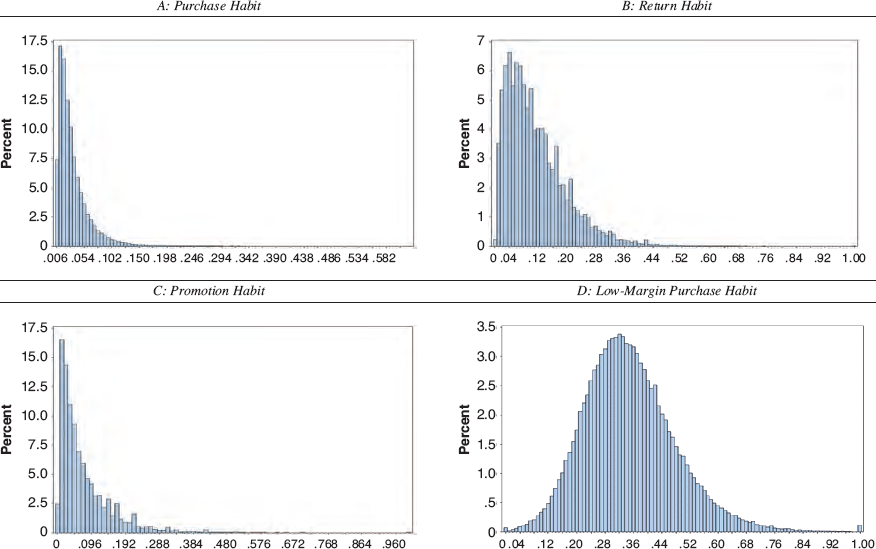
DISTRIBUTION OF HABIT STRENGTH MEASURES
It is possible that customers' recurring behavior may be an artifact of the firm's marketing cycles or naturally recurring store visits, as in the case of a gas station or grocery store. In the context of this research, we rule out the former by noting that the correlation between customers' purchase behavior and firm-initiated marketing during the observation period is very low (r = .04, p < .01). The latter explanation is not applicable in the context of a general-purpose retailer. Nevertheless, researchers and managers should validate the empirically computed habit strength measures with the SRHI measures for a large sample of the customers before interpreting them as true indicators of habit strength. In the context of this research, the proposed habit strength measures (obtained from Equation 6) correlate strongly (Pearson's correlation coefficients range from .82 to .95) with the SRHI-based measures (obtained from the survey) for a sample of 507 customers of the firm.
To evaluate the importance of incorporating both frequency and temporal consistency of behavior to quantify habit strength, we evaluate the correlation between the SRHI-based measures and frequency-based measures (the numerator of Equation 6) as well as inertia-based measures (the denominator of Equation 6). The results (see Table 1) indicate that the correlation coefficients of the SRHI measure with an inertia-based measure range from .45 to .77 for the four habitual behaviors. The correlation coefficients of the SRHI measure with a frequency-based measure range from .56 to .85 for the four habitual behaviors. In comparison, the correlation coefficients of the SRHI measure with the proposed habit measures have the highest magnitude and range from .82 to .95 for the four habitual behaviors, thereby underscoring the importance of incorporating both performance frequency and temporal consistency of recurring behavior in the habit strength measure. From a managerial standpoint, computation of habit strength using customer data serves as a cost-effective and feasible approach (compared with the survey-based approach) to determine the habit strength of virtually all customers of the firm.
COMPARISON OF THE CORRELATION OF SRHI WITH DIFFERENT MEASURES OF RECURRING BEHAVIOR

Notes: p-values are in parentheses.
Figure 2 shows the Pearson's intercorrelation coefficients of habit measures across all customers of the firm. 2 Notably, the four habit measures (on an average) are not highly intercorrelated within the same customer.

Intercorrelation of Habitual Behaviors
Regular purchase habit is negatively correlated with promotion habit (−.1) and low-margin purchase habit (−.12), implying that customers who habitually redeem coupons or purchase low-margin items are selective in their purchases and thus not likely to exhibit high purchase behavior frequency. In contrast, the intercorrelation between promotion habit and return habit is the highest (.2) among the pairwise correlations of different habits, implying that customers who return products are also likely to buy on promotion. Such customers persistently buy products offered on promotion and most likely return them later. We observe a positive correlation (.12) between promotion habit and low-margin purchase habit, indicating a segment of customers who are deal prone as well as value conscious. Overall, the intercorrelation of the four habit strength measures is relatively low (Pearson's correlation coefficients range from −.12 to .20), thereby implying that different customer habits are independent of a customer's loyalty to the retailer (as exhibited by a relatively strong purchase habit).
Study 2: IMPACT OF HABIT ON FIRM PERFORMANCE
Why should managers measure customers' different habitual behaviors beyond repeat purchases? In Study 2, we quantify the economic values of different customer habits in terms of their impact on customer profits and firm performance. In addition, we evaluate whether the habit measures can help managers improve their ability to forecast customer profits.
Method
We first specify a simple linear model to evaluate whether customers' habits significantly affect profits as specified in Equation 7:
sum of profit of customer i across the four years, the total number of different product categories purchased by customer i across the four years, total revenue (computed as the price paid multiplied by the quantity of the respective item[s] purchased) of customer i across the four years, parameters to be estimated, and random error term.
We compute the dependent variable (total profit) by subtracting the cost of product returns and marketing cost from the gross contribution margin of the customer over the four-year observation period. The inclusion of covariates such as the Total CB and Total Revenue is consistent with previous customer profit models (e.g., Kumar and Shah 2009; Venkatesan and Kumar 2004). Note that revenue does not share a perfectly linear relationship with profit. Customers typically purchase multiple products of varying margins during the observation period. As we discussed in the “Data” section, the retailer stocks approximately 20,000 items in each store, with margin rates varying widely from −15% to 125%. We also include purchase habit, return habit, promotion habit, and low-margin purchase habit (measured over the four-year observation period) as covariates in Equation 7 and estimate the model as an ordinary least square regression.
Equation 7 offers a simple regression-based descriptive model to enable managers to assess the impact of different habits on customer profit.
3
However, longitudinal analyses of customer data are warranted to account for the dynamics of customers' habit strength over time. Moreover, longitudinal analyses can enable managers to “forecast” customers' profits. Consequently, we specify a dynamic version of the customer profit model in Equation 8:
time-invariant unobserved factors, the profit for customer i at time t – 1, the number of different product categories purchased by customer i in time t, the total revenue (computed as the price paid multiplied by the quantity of the respective item[s] purchased) of customer i in time t, parameters to be estimated, and random error term.
The subscript t refers to six-month time intervals. Consequently, we model customer profit every six months (which is similar to the time interval for the habit strength measures in Study 1). Inclusion of the lag of the dependent variable (Profitit – 1) helps capture the effect of prior profit and unobserved factors in the model.
We compute the four habit measures (in Equation 8) by applying the measurement approach described in Study 1 for every time period t. Note that we need at least two observations to compute the standard deviation. Therefore, the habit measures are computed from the second time period of the observation period. The unobserved factors (ηi) include customer-level factors that are unlikely to change over time (e.g., customer's physical proximity to the store). Note that the time-invariant variable (ηi in Equation 8) can be correlated with Profitit – 1 and can lead to biased parameter estimates. To address this problem, we transform Equation 8 to a growth-growth model. That is, from each variable in Equation 8, we subtract its corresponding lagged variable (e.g., ΔProfitit = Profitit – Profitit – 1). This helps eliminate the unobserved fixed effects (ηi) from the model. Consequently, we get a growth model as specified in Equation 9:

However, the lagged dependent variable (i.e., ΔProfitit – 1) in Equation 9 is correlated with the error term (i.e., Δ∊it) because both terms have information from t – 1. To account for the endogeneity of ΔProfitit – 1, we follow a widely used method in econometrics and marketing: the Arellano–Bond (1991) difference general method of moments (GMM) estimator. The GMM takes into account the endogeneity of the lagged dependent variable, which results in unbiased and consistent estimates. The method involves two steps: First, we use lags of the endogenous variables and time dummies as instruments for their first differences. For example, Profitit– 2 and Profitit – 3 serve as instruments for ΔProfitit – 1 in Equation 9. Lagged values are valid instruments for the first differences under the assumption that error terms are not serially correlated (i.e., (E(∊it, ∊it – 1) = 0). If ∊it is not serially correlated, the second-order difference errors ∊it – ∊it – 1 and ∊it – 2 – ∊it – 3 will not be correlated. We test this assumption through the second-order autoregressive test (AR[II]), in which the null hypothesis is that the second-order differenced error terms are not correlated (Arellano and Bond 1991). We also apply the Sargan/Hansen test to ensure validity of the instruments. The null hypothesis for the Sargan/Hansen test is that the instruments are exogenous and, thus, valid (Roodman 2006). Second, we use the instruments (i.e., lagged values of the endogenous variable and time dummies) with the GMM estimator to obtain unbiased and consistent estimates for the profit growth model (Equation 9). The GMM estimator relaxes any assumptions about the distribution of the independent variables (Hansen and West 2002). This is important because the distribution of habit strength measures (especially return habit and promotion habit) contains a large number of zeros for several customers.
Results and Discussion
We report the results for Equation 7 in Table 2, Panel A. The parameter estimates indicate that the purchase habit and the promotion habit positively affect total customer profit (α3 = 4,159.55, p < .01; α5 = 175.44, p < .01), whereas the return habit and the low-margin purchase habit negatively affect total customer profit (α4 = −1,380.41, p < .01; α6 = −367.96, p < .01). Consistent with prior research, other covariates such as total cross-buying level and total revenue have a positive impact on total customer profit (α1 = 3.98, p < .01; α2 = .24, p < .01).
PARAMETER ESTIMATES

Table 2, Panel B, reports the results corresponding to Equation 9. The Sargan/Hansen test and the AR(II) test indicate that the second-order differenced error terms are not correlated and that the instruments are valid.
The parameter estimates indicate that the increase in strength of purchase habit and the promotion habit positively affect customer profit (β4 = 575.83, p < .01; β6 = 52.42, p < .01). However, the increase in strength of the return and the low-margin purchase habit negatively affect customer profit (β5 = −274.21, p < .01; β7 = −73.00, p < .01). Other control variables—increase in lagged profit, increase in cross-buying level, and increase in revenue4— have a positive impact on profit (β1 =.12, p < .01; β2 = 8.87, p < .01; β3 = .23, p < .01).
We assess the empirical utility of the habit strength measures by running two benchmark models. In Benchmark Model 1, we drop the four habit strength measures from Equation 9. In Benchmark Model 2, we replace the habit strength measures in Equation 9 with simple contemporaneous behavioral variables (i.e., customers' observed behavior without accounting for the temporal consistency). Comparing the models, we find that our proposed model (as specified in Equation 9) better explains the variance in customer profits by 22% and 15% as compared with Benchmark Models 1 and 2, respectively. For the purpose of forecasting, we treat the observation data corresponding to the first seven semiannual periods as the calibration sample and the eighth (last) semiannual period of the observation period as the holdout sample. We employ the calibration sample to estimate the parameters for the proposed model and the two benchmark models and then apply the parameters to forecast customer profit for the holdout sample. We assess the quality of the forecast by computing the mean absolute percentage error for each of the three models. The results indicate that the mean absolute percentage error increases by 32% for Benchmark Model 1 and 23% for Benchmark Model 2 as compared with the proposed model. The results underscore the importance of incorporating habit-based measures in a customer profit equation.
To quantify the impact of customers' habit strength on firm performance, we apply the coefficient estimates of the model results (in Table 3) corresponding to the four habits and aggregate its effect on profit across all 460,000 customers of the firm over the observation period of four years. The results indicate that customers' purchase habits and promotion habits positively contribute to approximately $54 million and $4 million to the firm's bottom line, respectively. In contrast, the return habit and low-margin purchase habit negatively affect the firm's bottom line by approximately $59 million and $62 million, respectively. In percentage terms, the customers' habitual behaviors affect the firm's total customer profit by 1% to as much as 12%, as we summarize in Table 3.
FINANCIAL IMPACT OF HABITUAL BEHAVIOR ON FIRM PERFORMANCE

Firms are increasingly considering managing customer relationships on the basis of the customers' lifetime value (CLV; Kumar and Shah 2009). Therefore, a related issue is whether the negative impact of customers' habits on firm's profits (as shown in Table 3) may be offset by the customer's longevity with the firm. In other words, will the results of Table 3 (based on the observed data) hold over customers' expected lifetime duration?
Customer lifetime value is defined as the net present value of future profits from a customer over the time the customer is expected to transact with the firm. To compute the lifetime value of each customer, managers need to (1) determine the time duration (in the future) over which the customer will stay active with the firm, (2) predict the contribution margin of the customer, and (3) predict the marketing cost expected to be incurred on the customer. Scholars have proposed several CLV models in prior literature. For illustrative purposes, we employ the beta geometric negative binomial distribution model to predict the probability that a customer in a noncontractual setting (such as a customer of the retailer in this study) is still actively engaged in the relationship with the firm given his or her purchase history (Fader, Hardie, and Lee 2005).5 We use the average of the contribution margin and marketing cost for a customer to obtain estimates of CLV. Further research could also employ a driver-based approach, as suggested by Kumar et al. (2008), to estimate the contribution margin and the marketing cost for each customer.
We present the results of the analyses in Figure 3. The customers' CLV scores are summarized in ten deciles (where each decile represents the mean of 10% of the customers organized in descending order of CLV scores).

DISTRIBUTION OF CLV (N = 461,395)
Drawing on the distribution of the CLV scores, we designate customers in the top two deciles (deciles 1 and 2) as high-CLV customers, the middle six deciles (deciles 3–8) as medium-CLV customers, and the bottom two deciles as low- CLV customers (deciles 9 and 10). Using this classification, we present the prevalence of the four habits for the high-CLV, medium-CLV, and low-CLV customers in Table 4.
HABIT STRENGTHS FOR THE HIGH-CLV, MEDIUM-CLV, AND LOW-CLV CUSTOMERS
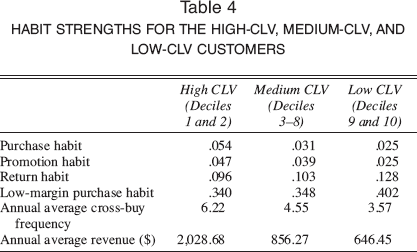
The results indicate that the high-CLV customers possess stronger positive habits on average (i.e., purchase and promotion habits) and, by virtue of their positive habits, are likely to contribute considerably to the firm over their lifetime duration. In contrast, low-CLV customers possess stronger negative habits (i.e., return and low-margin purchase habits) and are likely to contribute negatively over their lifetime duration. The results also indicate that the medium-CLV customers possess stronger positive habits (i.e., purchase and promotion) on average than low-CLV customers and possess stronger negative habits (i.e., return and low margin purchase) on average than high-CLV customers. We did not observe any significant difference in the attrition level of customers with strong positive or negative habit(s). Indeed, both customers with strong positive habits and those with strong negative habit(s) have below-average attrition rates. This finding is expected because customers with strong habits in general will continue to transact with the firm in the foreseeable future by virtue of their habitual behavior.
In summary, the results from this study underscore the substantive importance of the four habit constructs in two ways. First, there is tangible economic value associated with each customer's recurring behavior. In other words, customers' habitual behavior has a direct impact on the firm's bottom line, and we expect that impact to persist over the lifetime duration of the customer—especially for customers with relatively high habit strength. Second, inclusion of habitual behavior of customers in standard customer profit models helps improve the model fit and reduce the forecasting error.
Study 3: MODELING HABIT FORMATION
Given the economic importance of customers' habits to the firm, it is important for marketers to understand how customers form habits and whether the firm's marketing influences habit formation. Therefore, the objective of Study 3 is to evaluate how customers form habits as they transact and interact with the firm and receive the firm's marketing communications and offers.
Method
The first step in evaluating habit formation entails understanding how habit strength evolves over time. Similar to the process of learning, habits are formed gradually as people repeatedly perform a specific behavior in a stable context (Neal et al. 2011). Hull's seminal study of learning conceptualizes the relationship between repetition and habit strength to follow an asymptotic curve (Hull 1951). Lally et al. (2010) observe a similar relationship in their empirical study in the context of the formation of people's everyday habits.
The data set contains a mix of existing and new customers. Because our data are left-censored, we do not know the history of marketing to or the state of habit formation for customers the firm acquired before the observation period. Therefore, we chose a cohort of customers who initiated a relationship with the firm in the first six months of the observation period and who exhibited temporal growth in habit strength (measured every six months) over the four-year observation period. We measure habit strength by applying the computations discussed in Study 1. Note that (as we discussed previously) at least two time periods are required to compute the standard deviation. Therefore, habit strength is computed from the second time period onward. Consequently, we get seven time periods (corresponding to six-month intervals) per customer over the observation period of four years. The customer cohorts comprise 3,360, 848, 4,548, and 336 customers, which corresponds to the formation of purchase habits, return habits, low-margin purchase habits, and promotion habits, respectively. We apply the visual analytics software JMP to examine the habit formation trajectory for the respective cohorts and observe a nonlinear growth pattern (at an aggregate level), as we illustrate in Web Appendix B. The habit formation trajectories are consistent with prior literature (Hull 1951; Lally et al. 2010).
We apply JMP to get a visual representation of habit formation trajectories at the individual customer level. Customers vary significantly in terms of their initial level and/or the rate of growth of the habitual behavior strength over time, as Figure 4 shows with a representative set of six customers.
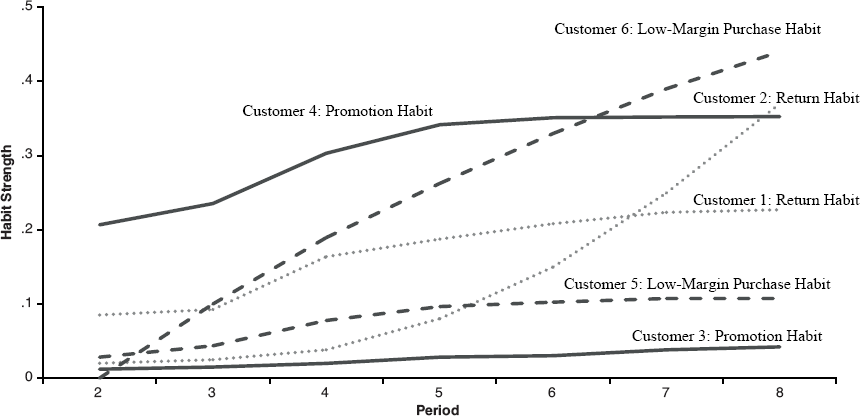
MODEL-FREE EVIDENCE OF INDIVIDUAL HABIT FORMATION TRAJECTORIES OVER TIME
The figure in Web Appendix B and Figure 4 offer model-free evidence of the habit formation dynamics, and we apply these insights to specify a flexible sigmoid curve model. That is, we specify the habit strength for a given habit k for customer i at time t as follows:

The function ∑βkiXkit in Equation 10 is
1, 2, 3, 4 (i.e., return habit, promotion habit, low-margin purchase habit, and purchase habit); 1 through 7, each representing six-month intervals; the lower asymptote of the k habit strength; the upper asymptote of the k habit strength; the parameter that determines the trajectory's intercept for customer i and habit k; a vector of coefficients that determine the rapidity with which the trajectory will approach the upper asymptote (hkmax) for customer i of habit k; time-varying covariates corresponding to customer i at time t of habit k; error term assumed to follow a normal distribution with mean 0 and variance σ2; intensity of habit measures in the previous period; indicator for the first half of the observation period (i.e., Firstt = 1 when t = 2, 3, 4; 0 otherwise); indicator for the second half of the observation period (i.e., Secondt = 1 when t = 5, 6, 7, 8; 0 otherwise); and the level of firm's outbound marketing for customer i at time t. This is operationalized (by the firm) as a weighted sum of firm's outbound e-mails, coupons, and direct mailings to the customers. The weights are assigned by the firm and reflect the unit cost of the marketing medium. The weighted sum is obtained by multiplying the unit cost–based weight with the frequency of the respective marketing medium.
Given the operationalization of the habit strength measures (discussed in Equations 1–6), hmin = 0 and hmax = 1 for all four habit measures. Because habits are formed through repetition of past behavior, the habit strength for any behavior at time t depends on the intensity of the corresponding behavior in the previous time period (i.e., time t – 1). Furthermore, marketing may have an effect on habit formation, and the influence may vary temporally with the increase in the strength of the habitual behavior over time. Therefore, the time dummies First and Second are interacted with the marketing covariate to assess the time temporal effect (if any) of firm-initiated marketing on the habit formation process in the first and the second half of the observation period. We allow the parameters of the model {αi, β1i, β2i, β3i} to vary randomly across individual customers, where the random components of the parameters have multivariate normal distribution with mean vector 0 and variance–covariance matrix ∑.
The customer-specific effects allow the shape of the habit formation trajectory to vary by customer and help account for unobserved customer heterogeneity. We estimate the model with the PROC NLMIXED routine of SAS 9.3 for each habit measure. The routine uses an iterative maximum likelihood procedure for estimating the fixed effects and the variance components of the model. We execute the routine by applying the Newton–Raphson optimization technique with line search to find the global optimum to maximize the likelihood function.
Results and Discussion
In Table 5, Panels A–D, we show the fit statistics, the maximum likelihood estimates of the parameters, and the variance of error terms. The random effects corresponding to the marketing covariate (i.e., β2ki, β3ki) are not significant for all four habits, and thus we do not report them in the model results.
HABIT FORMATION MODEL RESULTS

Consistent with the theory of habit that postulates that previous repetitive behavior contributes to habit formation, we find that the intensity of previous behavior has a significant positive effect on the formation of all four habit strengths (p-value of β1k < .001). In the model, we assume the random component of intercept and past behavior to be distributed multivariate normal with the expected value of 0. As Table 5 shows, there is significant variation across customers for all four habits (i.e., variance components in the parentheses). In addition, the within-group random effect Var(∊) is significant for all four habits (p-value of Var(∊k) < .001). For example, the lagged intensity of product returns is positively related to the return habit in the current period (t) because the fixed effect of lagged return proportion (β11 = 2.26) is positive. This effect size varies by customer given that the random component is 1.12.
Marketing affects the habit formation process for all four behaviors in a dynamic manner. For the purchase habit, marketing in the first half and second half are both positively related to habit strength (p-values of β24, β34 < .001). However, the impact of marketing on the formation of purchase habit is twice as great in the first half of the observation period as compared with the second half of the observation period (β24 = .22, β34 = .11, respectively) despite the finding that the level of outbound marketing is approximately the same in both time periods. The results suggest that marketing plays a stronger role in the initial development of purchase habits. As purchase habit gains in strength, customers begin to repeat their purchases (with relatively less need for a marketing cue to perform the desired action). Our finding is consistent with previous research showing that interventions to change intentions do not have a strong impact on behavior when strong habits are formed (Webb and Sheeran 2006). Lodish et al.'s (1995) finding that advertising elasticity is higher for new products than for established products also supports our result. Notably, for each of the other three habit measures, the influence of marketing on habit formation is stronger in the second half than in the first half of the observation period.
For the promotion habit (β22 = .03, p < .001; β32 = .63, p < .001) and the low-margin purchase habit (β23 = .16, p < .001; β33 = .40, p < .001), the impact of marketing is positive and significant in both periods. However, the relative magnitude of marketing's impact is stronger in the second half of the observation period. Here, marketing seems to be indirectly encouraging habit formation by incentivizing customers to visit the stores and buy promoted or advertised markdowns (low-margin items) repeatedly.
For the return habit, the impact of marketing in the first half of the observation period is not significant (β21 = −.05, p > .05), while it is positive and significant in the second half (β31 = .71, p < .001). There is a delayed effect of marketing in the case of product return behavior. That is, the firm's marketing will initially encourage the customer to make a purchase, which in turn will trigger product return at a later stage or in the subsequent period(s).
From a marketer's standpoint, these findings are useful because they offer an additional dimension of insight into how marketing interventions should be managed at the customer level based on the state of the customer's habit. We elaborate on the managerial implications of these findings in the next section.
Drawing on the findings of Study 2 (i.e., customers' habits have a direct impact on the firm's bottom line) and Study 3 (i.e., marketing significantly affects customers' habit formation over time), we can compute the indirect impact of marketing on customer profits that result from habit formation. We apply the parameter estimates from Table 5 to compute the growth in customers' habit strength that can be attributed to marketing. We then apply the parameter estimates of customer profit equation (from Table 2, Panel B) to assign a dollar value to the growth in habit strength that can be attributed to marketing. The results indicate that marketing positively affects the firm's profit by $.6 million and $.8 million through the formation of purchase and promotion habits, respectively. In contrast, marketing negatively affects the firm profit by $3.3 million and $2.6 million through the formation of product return and low-margin purchase habits, respectively.
Managerial Implications
Customer Habits beyond Repeat Purchases
Habitual behavior is multidimensional. Customers are likely to form a habit with respect to virtually any temporally recurring interaction with the firm in a stable context. In this research, we find that, beyond repeat purchases, customers exhibit habitual behavior with respect to returning previously purchased products, purchasing low-margin products, and purchasing products promoted through direct marketing. Notably, the different habitual behaviors are relatively independent of one another (as Figure 2 illustrates). Therefore, focusing merely on the repeat purchase behavior may ignore customers' other habitual behaviors that bear a significant impact on the firm's bottom line (as indicated in Table 3). Furthermore, customer habit strength measures can help managers better forecast customer profits compared with conventional behavioral measures.
Implementing the Theory of Habit to the Practice of Marketing
Prior literature (e.g., Ailawadi, Lehmann, and Neslin 2001) as well as marketplace evidence (e.g., Mattioli 2013) has reported the fallacy of marketing policy shifts in the context of major firms such as Procter & Gamble and J.C. Penney. In both cases, the respective firms decided to move away from their current practice of frequent promotions while grossly underestimating their customers' promotion habits. The policy shift alienated customers instead of influencing the behavioral change (i.e., continued patronage without the promotions) that both firms had hoped for. Predictably, financial performance was adversely affected before both firms eventually reversed their decisions.
In the context of the retail firm included in this study, the four habits of the firm's customers affect the firm's profits differently, as we discuss in Study 2 and report in Table 3. In general, firms should implement the methodology of Study 2 to regularly analyze the financial impact of their customers' habits. The extent to which different habits are prevalent across customers of a firm and their impact on the respective firm's performance can vary across firms and industries. For example, the product return habit is likely to be relatively more problematic for firms in a retail industry with lenient product return policies as compared with service industries, in which product returns (or refunds) are less common (or nonexistent).
Depending on the prevalence as well as the relative magnitude of customer habits, firms can make better-informed decisions about marketing policy changes. For example, a relatively high level of returns may require the introduction of a more stringent return policy if a majority of serial returners are also unprofitable for the firm. Similarly, a relatively large number of customers with a low-margin purchase habit should prompt the firm to revisit its pricing policy. However, some caution should be exercised here. Managers must keep in mind that widespread prevalence of a particular habitual behavior of a firm's customers (with a relatively high magnitude of habit strength) would imply a general resistance to a change in that behavior. In such a scenario, a unilateral marketing policy change in a competitive environment is likely to make customers switch to another firm whose marketing policies are compatible with their shopping habits (Ailawadi, Lehmann, and Neslin 2001).
At the individual customer level, knowledge of each customer's habits can enable the firm to make strategic resource reallocation decisions. The results from Studies 2 and 3 indicate that firm-initiated marketing may contribute to the formation of return habits and low-margin purchase habits, with an adverse impact on customer profit over time. Because habits (by definition) are enduring constructs, firms may strategically move marketing dollars away from customers with relatively high return and low-margin purchase habits and reinvest them in developing the purchase and/or promotion habits of other customers of the firm. Alternatively, firms may selectively alter their marketing practice for customers on an individual basis with the objective of breaking adverse habits (e.g., returns, low-margin purchasing), as discussed in Shah et al. (2012) and practiced by several firms in the context of serial returners (Kerr 2013).
In essence, knowledge of customers' habits can enable managers to make important strategic decisions. This is because unlike conventional behavioral measures, a habit measure represents the prolonged tendency of a customer to consistently repeat past behavior with financial implications for the firm.
Profiling Habitual Customers
Who are the habitual customers? To find out, we regressed the habit strength measures on the customer characteristics available in the data set (obtained from Acxiom, as discussed previously). We find that customer age is positively correlated with the four habit measures. Similarly, we find that certain customer activities (e.g., collecting exotic items, sewing/knitting/needlework, motorcycling) are negatively correlated with the four habits. We also find that some customer characteristics correlate differently with different habits. For example, whether the customer is a working woman is positively correlated with purchase habit but negatively correlated with return and promotion habits. Notably, customer characteristics that may be attributed to affluence such as “savvy senior” and “premium card holder” are positively correlated with the low-margin purchase habit and not related or negatively correlated with the purchase habit.6
In summary, managers can infer customers' habitual proneness and strategically align their marketing efforts to develop (deter) good (bad) habits that are likely to have a positive (negative) impact on the firm's profits. Inferring customers' habitual proneness on the basis of their characteristics could prove useful for managers in the context of new customers or customers with limited transaction history, for whom the proposed empirical approach may not be possible for inferring habit strength. For example, in the context of this study, the retailer could apply the insights from the profile analyses to customers with limited transaction history who were dropped from the empirical analyses to infer habitual proneness. The firm could then strategically invest in developing customer relationships (through marketing) with customers who exhibit a relatively high proneness of forming a purchase and/or promotion purchase habit while choosing not to invest in customers who exhibit a relatively high proneness of forming a return or low-margin purchase habit.
Limitations and Future Research Directions
“Habit” represents a powerful and managerially useful construct. In the context of marketing, it has been largely unexplored beyond the repeat purchase behavior of customers. This presents tremendous opportunities for further research. For example, this study analyzes customer habits in the context of a particular retail store. Further research might observe consumers' behavior across multiple shopping instances at different retail outlets (i.e., across different contexts). It would be worthwhile to record whether a customer's consumption habits at a particular retail store prevail in the context of other similar or competing retail stores. Another underresearched area is the relationship between customer characteristics and habitual proneness. Although our research reports the relationships from an empirical analyses standpoint, further research could take the consumer behavioral route and validate the statistical relationships found in this study through experiments. In addition, there is scope to develop a strong theoretical framework to support and thus generalize the empirical relationship between customer characteristics and habit strength.
Although we work with a large data set in this study, the data are both left- and right-censored and span an observation period of four years. Moreover, we do not have information on competition. Further research might consider replicating this study using data sets with longer time frames that contain information about competition. In addition, future studies might consider adding other habit dimensions (e.g., recurring service requests from customers) or different industry settings (e.g., business-to-business settings). In conclusion, given the renewed interest of habit in the social psychology literature and its economic value tied to different aspects of recurring customer behavior, research related to habit in the marketing context seems to be a valuable avenue for further research.
Footnotes
1
Note that the retailer has few product items that are chronically low margin. However, the proportion of these items (by total sales from low-margin items) is less than 10%, and removal of these items from the low-margin purchase (and habit) measures does not significantly affect the measures.
2
These results are similar to the intercorrelation of habit measures obtained from the survey-based SRHI data. For reasons of brevity, we do not report the (similar) results from the SRHI data.
3
4
5
Because our approach is based on methodologies described in prior literature (i.e., Fader, Hardie, and Lee 2005;  ), we do not reproduce the related CLV computation details.
6
These results should be accompanied by a strong theoretical support before interpreting them as general indicators of customers' habits. There is scope for further research to generalize these results.
References
Supplementary Material
Please find the following supplemental material available below.
For Open Access articles published under a Creative Commons License, all supplemental material carries the same license as the article it is associated with.
For non-Open Access articles published, all supplemental material carries a non-exclusive license, and permission requests for re-use of supplemental material or any part of supplemental material shall be sent directly to the copyright owner as specified in the copyright notice associated with the article.
