







Abstract
Using subject indexes and text mining of author abstracts, the authors track the evolution of content in Journal of Marketing Research since its inception 50 years ago. These data reveal that the journal has expanded beyond its initial emphasis on marketing research methods and advertising to increase its coverage of other substantive topics and consumer behavior. Moreover, a joint space of topics and editors reveals that editorial orientations appear largely evolutionary rather than revolutionary and that a major shift in journal coverage occurs at the time Marketing Science began publication. The authors conclude their analysis with several policy recommendations.
This special issue commemorates the 50th anniversary of Journal of Marketing Research (JMR) by assembling retrospective summaries of its content over that half century. Collectively, these essays document the evolution of the marketing field, reflecting the perspectives of the editors who ran its most inclusive premier journal (for a list of past editors in chronological order, see Table 1). This retrospective enables current scholars to place their own work in a broader historical context and illuminates future directions of inquiry for the field.
Tenure of Past Editors

Our objective is to integrate these various editor perspectives by relating the tenure of the editors with the topics of published articles. Collectively, JMR has published roughly 2,500 papers over its half century (excluding editorials and book reviews). Figure 1 depicts the article counts by year as well as the average article length. Of note, two modes of article counts are indicated in this figure, which can be attributed to two sources: in the early 1970s, the journal made extensive use of short research notes, and in 2008, JMR expanded from four volumes to six to accommodate increased submissions. Because research notes were brief, the average article page length was much shorter in the early period of the journal. It is interesting to speculate why notes, often related to practice, no longer appear in JMR given their past prevalence; they could represent a new opportunity to broaden the types of articles the journal covers.
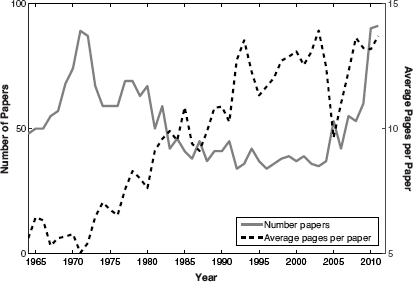
Papers Published and Page Length Per Year
In the process of linking the editors with article topics, we address several questions. First, we identify trends in topics to determine which are in ascendance and which are in decline. These trends inform the strategic direction of the journal and raise questions about whether more emphasis on certain research dimensions is warranted. Second, we explore whether, in the first 50 years of JMR, editors have led topics or topics have led editors. While we cannot answer that question definitively, we find a remarkably strong state dependence in the topics that editors publish, suggesting that individual editors are more swept along by the trends in the field than directing them.
This analysis is predicated on two sources of topical information. First, we consider the annual index published in JMR. Authors could either select topics from a predetermined subject index list sent by the American Marketing Association (AMA) or write in their own category. Index topics changed year over year because of differing topic selections and authors’ ability to enter their own categories. Second, we employed SAS's text miner to build a meaningful list of terms commonly used in JMR abstracts. Although this categorization has the advantage of being largely author generated, the resulting set of words are prone to commonly noted limitations inherent in text mining, such as large numbers of common terms (e.g., “shows,” “derives,” “implies,” “analysis,” “life”) and ambiguous words (e.g., “factor,” “weight,” “consideration”). Because of these differences, we analyzed both sets of data; however, we find that the conclusions are generally consistent.
We begin by discussing the data. Next, we detail the most common topics used and how they have changed over the past 50 years. Clear trends include the reemergence of Consumer Behavior and the ascendance of Information Processing as dominant paradigms in recent years, contrasting with a contemporaneous decline in articles pertaining to legacy issues such as Advertising, Surveys, Choice Models, and Measurement. We then consider when, and under which editors, key concepts appeared in the literature and the degree to which these concepts have persisted. In general, we find that major topics appear at a decreasing rate over time, suggesting that it is increasingly difficult to add new paradigms as the field matures. Next, a joint correspondence analysis of topics and editors identifies evolving intellectual constellations of the journal. Subsequently, we consider author productivity, finding that nearly two-thirds of authors never publish in JMR more than once, but those who manage to overcome this hurdle show higher likelihood to republish more than twice in JMR. In that analysis, we find that method-oriented research has higher author survival rates, and consumer behavior research shows the highest author loyalty in terms of topic repeat rates. The analysis further reveals an increasing tendency to coauthor. We conclude with a summary of our findings and some policy implications.
Data
The raw input reflects all reviewed articles or research notes from 49 volumes of JMR from its inception in 1964 through June 2012. For each, we have the authors, issue and date of publication, title, abstract, and indexed subjects. The indexed subject information follows the subject index compiled by the AMA and published in the last issue of each annual volume. We focus our analysis on the 2,531 reviewed articles and research notes written by 2,348 authors or coauthors.
We mapped articles into research topics using two approaches. First, we used the AMA's Subject Index, which resulted in 228 unique subject terms for the 2,531 articles. Because the definitions of subject names have changed slightly over the years, we merged highly similar subjects, such as “Bayesian inference,” “Bayesian analysis,” and “Bayesian statistics”; “channels of distribution,” “distribution channels,” and “channels research”; and “buyer behavior” and “consumer behavior.” Web Appendix A lists the substitutions. After combining, we further reduced the subject data to 166 unique categories.
Second, we extracted terms from the published abstracts for each of the articles. Starting with the index terms listed by JMR and the keywords listed in Marketing Science and Journal of Consumer Research as a technical dictionary, we applied ontology learning (Missikoff and Navigli 2002) to extract terms. These terms focused on phrases built from nouns, verbs, and adjectives, as well as the technical keyword dictionary, combining terms sharing the same roots (e.g., “Bayes” and “Bayesian”; “average,” “averages,” and “averaging”). This process led to the identification of 801 terms contained in the 2,531 article abstracts, which we further distilled into 44 topics. Next, we computed affinity measures between each article and each of the 44 topics by aggregating the affinity measures of all keywords associated with the topic and article. Web Appendix B lists the aggregations. The remainder of this article refers to the first data set (obtained from the subject index) as the “subject data” and the second data set (from text-mining the article abstracts) as the “topic data.”
Analysis and Historical Insights
Top Subjects and Topics
Tables 2 and 3 report the frequency count of the top 25 index subjects and abstract topics in JMR, respectively, over the past five decades. Table 2 also lists the interval in which the index terms were available.
25 Most Prevalent Index Subjects in JMR, 1964–2012

25 Most Prevalent Abstract Topics in JMR, 1964–2012
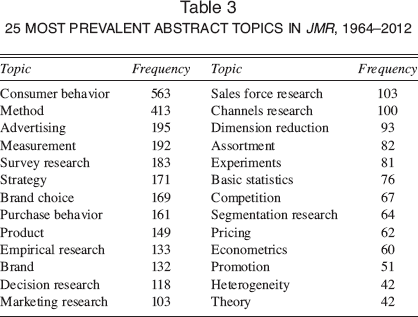
Although we obtained the two frequency counts from different sources through distinct methods, there is close agreement between the two sets, particularly among the most popular subjects/topics. In both cases, Consumer Behavior and Methods are the most common descriptors of the articles. Measurement also appears consistently among the top subjects/topics. One inconsistency between the two taxonomies is evident in Strategy, which is prominent in the abstracts (6th most common topic) but less so in the index subjects (18th most common topic). It is conceivable that JMR sometimes indexed Strategy into related classifications. Likewise, Purchase Behavior, which ranks 8th in the abstracts, does not appear at all in the index. The JMR index classifies this term elsewhere, possibly subsuming it into Brand Choice or Consumer Behavior. In any event, these two examples illustrate the importance of considering the authors’ abstracts in addition to the indexing classifications they choose. Regardless of approach, Consumer Behavior dominates as a paradigm in JMR; its frequency is substantially higher than any other term in either classification.
It is interesting to contrast the leading subjects in JMR with those in Marketing Science, as reported by Mela, Roos, and Deng (2013). Consistent with the positioning of JMR around research methods, its top ten subjects are more populated with research methods (e.g., Regression, Method, Survey, Econometric Models, Measurement), whereas words pertaining to application subjects such as the 4 Ps and 3 Cs predominate at Marketing Science.
While the subject or topic lists are informative about the long-term orientation of the journal, they obscure the changes over time in its orientation. We consider these changes next.
Life Cycles of Subjects
Figure 2 shows the trends in popularity (as a share of articles) for the most popular subjects in JMR‘s subject index. In the upper-left panel, we track Consumer Behavior, Attitude Theory, and Decision Research (typically pertaining to Behavioral Decision Theory). The figure illustrates the recent ascendance of Decision Research and Consumer Behavior in the subject index, which most recently constituted nearly one-quarter of all articles in JMR. Notably, at JMR‘s inception, Consumer Behavior was also a prominent topic in article abstracts, but its presence waned somewhat in the middle years. Also notable is how the rise in Decision Research coincides with a decline in the prevalence of Attitude Theory as a subject, perhaps due to the competition from Journal of Consumer Research at the time. In the upper-right panel, we observe a decrease in recent years in method-oriented research pertaining to Regression, Econometric Models, and Measurement. These subject/topic areas have declined approximately 50% in use, having once represented more than one-quarter of the journal's articles. The lower-left panel shows three research areas, Survey Design, Brand Choice, and Segmentation. These areas had strong initial followings but recently have experienced substantial declines. In part, this decline can be attributed to the demise of research notes; many of these notes featured topics such as survey design. Finally, the lower-right panel suggests a shift from Advertising Research toward Price and Promotion, possibly reflecting the increased availability of data in these latter domains. With the advent of new media, we expect the potential for future work in advertising to be substantial.
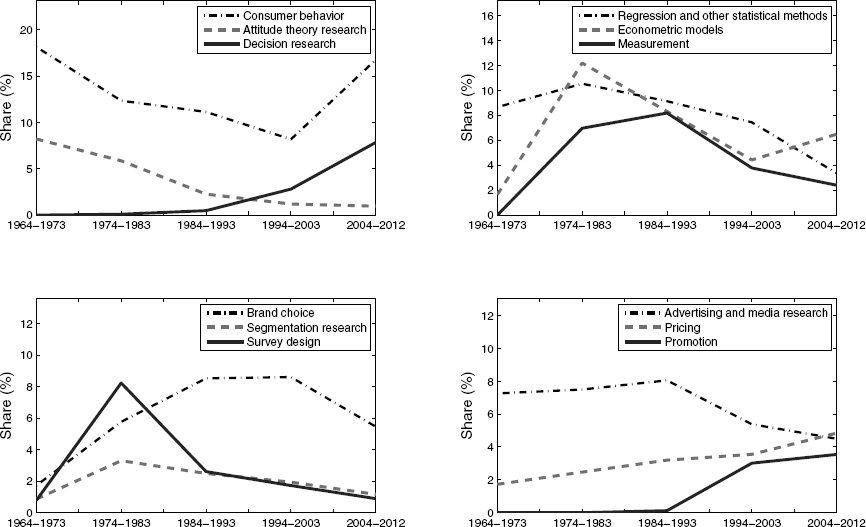
Index of Subjects’ Popularity Over Time
Paradigmatic Innovation
Figure 3 depicts scatter plots of the top seven index categories for each editor's tenure as determined by the share of subjects used during their respective terms. The vertical axis lists subjects in the order of their first appearance in the top seven list, with earlier appearing subjects listed closer to the bottom. The horizontal axis identifies the editor in place when these subjects first appeared. Each circle in the plot represents a subject featured during an editor's tenure, and the size of the circle is proportional to a subject's share for that editor's tenure. (Note that the first appearance of a subject on this plot marks the time at which it first became popular enough to enter the top list in market share, but not the first time the subject appeared in the literature.)

Emergence, Persistence, and Decline of Highly Popular Indexing Subjects
As a pattern, the upper frontier of the circles in Figure 3 is generally concave, showing that the rate of innovation pertaining to “breakthrough topics” is slowing, which reflects the maturation of the field. Periods of accelerated innovation occurred during the tenures of Ferber through Churchill and again from Weitz to Mahajan (though we caution the reader that this may be due to changes in policies pertaining to indexing). Consistent with the plots in the previous section, Consumer Behavior was the most prominent topic both early and late in the history of the journal. In contrast, Advertising and Measurement have been on the wane as defined by their share of journal space.
Figure 4 replicates Figure 3 using the topic data set extracted from article abstracts. Here, we again observe that the rate at which major new topics obtain a foothold is slowing. In addition, as in the early years, Consumer Behavior has again become a prevalent paradigm more recently. Likewise, we observe the decline of some other subject matter, such as Measurement and Advertising, as discussed in the preceding section. There is one notable difference with abstract data. Examining words in abstracts suggests that the pattern and timing of innovation is more gradual. It is possible that the discontinuous changes in Figure 4 are related to changes in indexing policy decisions from the journal, which are not reflected in the abstracting topics data.
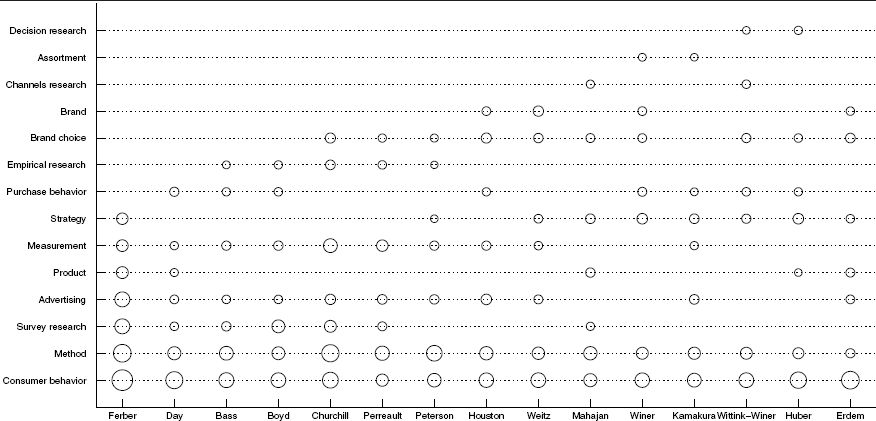
Emergence, Persistence, and Decline of Highly Popular Abstract Topics
Eras of Marketing
One key goal of this research is to understand the relationship between the content of JMR and the editors who stewarded it. To shed light on this issue, we generated positioning maps with a correspondence analysis of the aggregated abstract topic counts for each year of the journal's history (Figure 5). This two-dimensional map aligns editors and topics so that each editor is depicted at the centroid of the topics published during his or her editorship and topics are depicted at the centroid of the editors who published them.

Correspondence Analysis Showing Abstract Topics and Editors
Because this analysis allows a consideration of a wider array of topics than the preceding analyses, we focus solely on the abstract topic data. Index subjects often appear and disappear for less commonly used subjects, suggesting the correspondence analysis might be unduly influenced by limitations in the AMA's indexing categories. In contrast, the abstract topic data categorization remains relatively constant over time, as all topics were directly extracted from the authors’ own description of their work.
It is important to note that the dates of editorship were not an input to this analysis. Editors nonetheless align closely in terms of sequence of their tenures, moving in a horseshoe shape from Ferber, up to Perreault and Churchill, and moving back to Erdem, as shown in Figure 5. The reason the correspondence analysis pattern comes back on itself is because the topics in the center of the horseshoe, such as Experiment, Consumer Behavior, and Market Share, can be thought of as forming a gravitational field that draws all editors. In contrast, the abstract topics at the periphery reflect the specialized foci of editors near to them.
The first four editors (Ferber, Day, Bass, and Boyd) form a cluster associated with topics such as Demographics, Interview, Loyalty, Sampling, Survey Research, Retailing, and Diffusion, which reflect the interest of academic researchers in the earlier years of JMR. Beyond these four early editors, there are no clearly discernible clusters of editors. However, it is possible to observe a nearly linear evolution, starting with Churchill, closely followed by Perrault, and then moving to Peterson, Houston, Weitz/Mahajan, and Kamakura, with centroids that are pulled by basic descriptive methods such as Measurement, Empirical Research, Method, Basic Statistics, Loyalty, and Segmentation. This evolution is nearly chronological, showing movement away from topics favored in the first two decades and toward predictive-modeling topics such as Brand Choice, Heterogeneity, and Econometrics and substantive issues such as Service, Pricing, and Assortment. Also of note, the first set of editors (Day, Ferber, and Bass) started out with a strong emphasis on Consumer Behavior, to which recent editors (Erdem and Huber) have circled back.
It is interesting to speculate on the role of competition among journals on the evolution of topics in JMR. Specifically, Marketing Science appeared in 1982 with a distinct quantitative positioning. This introduction coincides with the tenures of Peterson and Perreault, and there was a sharp turn in the trajectory of editors at that time. It is possible that the weight of topics shifted in response to authors directing some of their research to Marketing Science. Similarly, the recent introduction of Quantitative Marketing and Economics coincides with the recent increase in the share of Consumer Behavior and Decision Making papers in JMR. Clearly, the potential for macrolevel events to affect the evolution of topics in a journal is present, and the journal should further consider how its positioning is altered by the growth of these other outlets.
This correspondence analysis also informs the extent to which editors either drive or reflect changes in the field. We speculate that the case in which editors are reflective would be consistent with high state dependence in their positions, as evidenced in our analysis. The gradual and contiguous changes shown in Figure 5 suggest that the observed changes are driven more by the evolution of the community of scholars than by individual editors.
Author Publications
Author Productivity
In addition to providing interesting insights into the evolution of the journal in terms of its content and the role of the 16 editors in shaping this content, our data also reveal insights into the productivity of JMR authors. Figure 6 plots the distribution of publications per author. These figures are conditioned on having published in JMR, a challenging task to begin with. For the majority (nearly two-thirds) of elite scholars who ever published at JMR, that article was their sole JMR publication. The proportion of authors publishing two articles at JMR falls dramatically to approximately 15% and to less than 3% for authors publishing five articles.
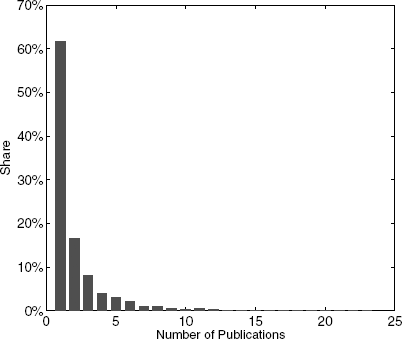
Distribution of Research Productivity
Exploring this idea in greater detail, Figure 7 depicts the author survival rate, defined as Pr(Σk + 1Knk > 0 | nk), where nk = 1 if an author publishes k papers and 0 otherwise. This figure suggests that there is substantial learning from the first to the tenth article, leaving only 20%–30% of uncertainty for highly accomplished authors. These data are consistent with the rates observed at Marketing Science (Mela, Roos, and Deng 2013).

Author Survival Rates
It is interesting to conjecture how author productivity has been affected by the tendency to coauthor. Figure 8 depicts the number of authors per article by decade. There has been a strong and pronounced shift to more authors per article. In the 1960s, only approximately 5% of published articles had three authors or more (and two-thirds of all articles had only one author). By the 2000s, nearly half had three authors or more (and only one-tenth had one author). A possibility is that technology (e.g., the Internet) has reduced the cost of coauthoring. Another possibility reflects the increasing work involved in publishing an article, as indicated by the increasing page length shown in Figure 1. We conjecture, for example, that more studies are required to publish a behavioral paper. Given that tenure standards often reflect a fixed number of papers, a rational adaptation to lower acceptance rates or increasing complexity of publishing would be to observe more authors per paper. It is our view that the field and journals should consider ideas to enable authors to publish single-author work, perhaps in the form of the research notes we alluded to previously.
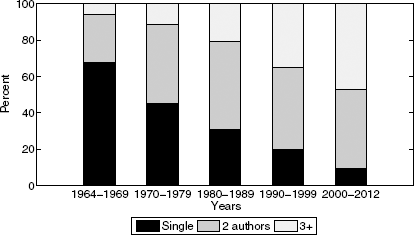
Coauthorship Over Time
Article Content and Author Survival
The historical analysis in Figure 7 shows that publishing more articles at JMR increases the probability of publishing again. We now investigate how survival within JMR relates to the subjects and topics of the authors’ articles. Following Mela, Roos, and Deng (2013), we compute the empirical probability (across author–articles) of repeating the subject, switching to a new subject, or never publishing again. Because these three states sum to one, the probability of survival after using a subject is the sum of that subject's repeat and switch probabilities. We used the same process for all author–article–topic combinations in the subject index data set. Figure 9 compares the resulting repeat, switch, and survival probabilities for the top 25 subjects and topics. For example, for authors who publish Consumer Behavior articles, 27.2% repeated the subject, 22.0% switched to another subject in later publications, and 50.8% never published again.
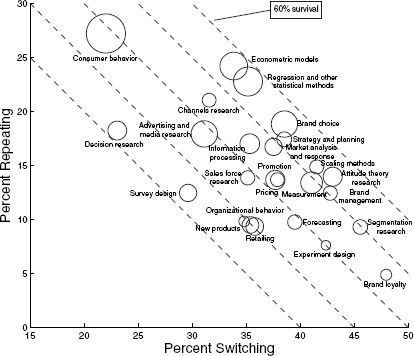
State Dependence in Subject Usage Within JMR
In contrast to other topics in JMR, authors who publish Consumer Behavior or Decision Research articles are far more likely to repeat that topic and far less likely to switch to a different topic. Put differently, Consumer Behavior and Decision Research authors tend to be topic loyal. Moreover, authors publishing methods-oriented research such as Regression, Econometrics, and Market Response articles have the highest survival rates, reflecting the greatest likelihood to republish in JMR.
Conclusions
In this study, we develop a retrospective of JMR content as defined by the topics its authors have used over the past 50 years and the editors who have led it. To develop these insights, we consider two distinct sets of data, one involving the annual subject indexes published by JMR and the other obtained from text mining its authors’ abstracts. Both lead to similar insights regarding the history of the journal.
Two overarching findings are that Consumer Behavior, which was once the most dominant topic, has again become so and that Decision Research is also ascending to prominence. In contrast, legacy issues such as Advertising, Survey Design, and Measurement have become less prominent. Given that these topics are of core interest to practitioners, we recommend that the journal consider these trends and their potential impact on the journal's readership. One possibility for increasing the prevalence of applied research is to consider reviving the practice of research notes, which were common in the journal's early years.
In addition, we find that it is becoming increasingly challenging to develop breakthrough topics as the field matures, a trend evident in other marketing journals as well. Tenure committees looking for “breakthrough papers” would be well advised to recognize this change.
A correspondence analysis of topics and editors suggests the field had moved from Consumer Behavior and basic descriptives toward Econometrics and later back to Consumer Behavior. In addition, editorial positions in this joint space tend to evidence strong temporal dependence. Were editors to shape the field, we might expect to see less contiguity in their positions; instead, it seems they are moved along by organic changes in topics of interest in the field. In addition, we find some movements in editorial positions with the advent of competing journals. A key implication of the latter finding is that consideration of the impact of these journals on submissions is warranted.
Finally, we consider author productivity and find that nearly two-thirds of authors who publish once in JMR never do so again. That said, conditioned on three or four successes, publication becomes easier—with an 80% survival rate. A topic-specific analysis indicates that Consumer Behavior authors are most likely to repeat publish with the same topic and that authors who use methods-oriented topics have higher survival rates. In addition, we observe a markedly increased tendency to publish papers with multiple authors and recommend that the journal discuss why this is the case (perhaps the work required for publishing has become far more substantial) and whether a response is warranted. Clearly, tenure committees should become aware of the changing standards.
Finally, our analysis was somewhat constrained by the annual variance in topical categorization. Authors typically categorize their articles from a list of predetermined topics, which they can supplement with their own subject categories. This lack of a formal indexing approach stands in contrast to other journals in which authors self-select words (e.g., JPL classifications). We believe the adoption of such a system would be helpful both in facilitating the review assignments and enabling authors in other fields to find relevant content.
Overall, we find that the journal has changed dramatically over the past 50 years, and we expect that it will do so again in its next 50. We hope the analyses conducted herein will prove useful to the journal as it considers policies and procedures moving forward and that authors find it useful to see how their own contributions have shaped the journal and how they can help it remain among the foremost journals in marketing.
References
Supplementary Material
Please find the following supplemental material available below.
For Open Access articles published under a Creative Commons License, all supplemental material carries the same license as the article it is associated with.
For non-Open Access articles published, all supplemental material carries a non-exclusive license, and permission requests for re-use of supplemental material or any part of supplemental material shall be sent directly to the copyright owner as specified in the copyright notice associated with the article.
