







Abstract
The present research investigates whether corporate social responsibility (CSR) reduces negative and promotes positive responses to service failures among value-aligned customers. Study 1 shows that customers are less likely to experience anger and spread negative word of mouth following a service failure when a firm engages in high (donating 15% of profits to environmental conservation) but not low (donating 2% of profits) levels of environmental CSR, but only if customers are high in environmental concern. In Study 2, the authors explore the benefits of CSR policies that target a broader range of beneficiaries versus policies that offer customers a choice over the firm's CSR allocations. Compared with a no-CSR policy, CSR with choice has a stronger effect on customers' emotions and intentions by enhancing perceived value alignment, reducing anger and regret over choosing the firm, and increasing guilt over harming the firm. These emotions subsequently reduce negative word of mouth and increase positive word of mouth and repurchase intentions. The results support the benefits of value-aligned and choice-based CSR policies in the wake of service failures.
Keywords
Logically, incentivizing CSR requires a clear understanding of how consumers respond to such initiatives. Unfortunately, as Hoeffler, Bloom, and Keller (2010, p. 78) observe, “Despite the great interest in these initiatives, there is little academic research on their potential effects to guide managerial decisions.” Indeed, there are at least two gaps in the CSR literature that might limit its more widespread adoption. First, although studies have suggested that CSR encourages positive consumer responses, little is known about the effect of CSR in the wake of negative events such as service failures. If CSR buffers firms against service failures, firms might be more willing to adopt CSR initiatives. Second, questions remain about when and why CSR benefits firms. For example, spending on CSR does not consistently predict corporate reputation (Hutton et al. 2001) or financial returns (Raghubir et al. 2010), and consumers often question firms' motives for engaging in CSR (e.g., Webb and Mohr 1998). These factors suggest that CSR's benefits might be somewhat tenuous or “contingent” (Sen and Bhattacharya 2001, p. 227) on several moderators, possibly undermining the business case for CSR. Thus, it behooves researchers, policy makers, and managers to understand when and why CSR is more or less effective and to develop CSR initiatives that maximize stakeholder returns.
The present research addresses these gaps by providing theoretical and practical insights into when and why CSR influences responses to service failures. Our central premise is that consumers who experience a service failure will be less likely to spread negative word of mouth (NWOM) and more likely to repurchase and spread positive word of mouth (PWOM) when a firm's CSR efforts match consumers' values (i.e., when firms engage in “value-aligned CSR”). We further posit that value-aligned CSR promotes more favorable responses to service failures because value-aligned consumers experience less anger, less regret over choosing the firm, and greater anticipated guilt over harming the firm. Next, we review research on CSR and service failures and offer an integrative framework explaining when and why value-aligned CSR promotes favorable responses to service failures. We then report two studies that test our hypotheses and yield theoretical and practical insights for policy makers and managers considering CSR.
Background and Hypotheses
Corporate Social Responsibility
Broadly defined, CSR encompasses a range of socially beneficial activities that extend beyond base-level legal and ethical requirements (McWilliams and Siegel 2001). In pursuit of CSR, firms might donate money to build a new children's hospital, implement onsite daycare to accommodate parents, or support an environmental campaign designed to promote safe drinking water. A common avenue for achieving these goals is the use of cause-related marketing (CRM), which typically involves donating a percentage of profits or sales to an attached nonprofit (Mullen 1997). Viewed from this perspective, corporate philanthropy becomes an exchange relationship (Murray and Vogel 1997): a firm performs philanthropic activities with the hope that consumers will reward the firm with additional sales.
Consumer Reactions to CSR
Although the link between CSR and financial performance has been difficult to establish (Raghubir et al. 2010), research at the consumer level has indicated that CSR leads to more favorable evaluations of firms (Lichtenstein, Drumwright, and Braig 2004) and brands (Sen and Bhattacharya 2001), stronger preference for a brand (Barone, Miyazaki, and Taylor 2000), enhanced satisfaction and loyalty (Salmones, Crespo, and Bosque 2005), and a stronger inclination to recommend that friends apply to work for a firm (Murray and Vogel 1997).
The preceding studies suggest that firms benefit from CSR, but most studies have focused on pretransaction behaviors (e.g., brand evaluations). Thus, little is known about the effect of CSR on posttransaction behaviors in the wake of negative events such as service failures. Establishing when and why CSR can buffer firms following service failures could incentivize firms to implement CSR. Integrating work on CSR and service failures could also advance research on service failures, which has typically focused on postfailure recovery efforts (e.g., apologies, compensation) rather than preemptive strategies such as CSR, as we review next.
Can CSR Buffer Firms against Service Failures?
Service failures occur when service falls short of expectations. Research has shown that service failures lead to dissatisfaction (Bitner, Booms, and Tetreault 1990); anger (Folkes, Koletsky, and Graham 1987); switching behavior (Keaveney 1995); and desire to exact revenge (Zourrig, Chebat, and Toffoli 2009), for example, by complaining and spreading NWOM (Curren and Folkes 1987). As a result, marketing scholars have investigated methods to reduce negative reactions to service failures, for example, through recovery efforts based on principles of interactional and distributive justice (Davidow 2003), including offering apologies and compensation (Joireman et al. 2013).
Although it has never been tested, there is reason to believe that CSR might promote more favorable responses to service failures. This reasoning follows from the notion that when firms engage in CSR, they accrue moral capital and relational wealth that act as a reservoir of goodwill and demonstrate that the firm acts positively on customers' behalf (Godfrey 2005). Indeed, CSR leads consumers to resist negative information regarding a firm (Eisingerich et al. 2010) and to form more favorable firm and brand evaluations following a product-harm crisis (Klein and Dawar 2004). Accordingly, it seems reasonable to posit that CSR can protect firms following service failures. However, given the “contingent nature of CSR,” it also seems likely that some consumers may respond favorably to a firm's CSR, whereas others may respond negatively. What might account for these varying reactions? As we outline next, one likely candidate is the degree to which a firm's CSR efforts are in alignment with a consumer's values.
Value-Aligned CSR
Although previous studies have noted an overall benefit from CSR, CSR that matches a consumer's values might yield better outcomes (Golob, Lah, and Jančič 2008; Siltaoja 2006). Sen and Bhattacharya (2001) detail a model of organizational identity to account for this effect. As consumers interact with an organization, they learn and may integrate an organization's identity and values into their own identity. Consumers who strongly support the CSR domain that a firm targets may perceive a greater degree of value alignment with the firm. To maintain a consistent self-image, consumers could then support organizations with the highest degrees of perceived value alignment. In line with this reasoning, Sen and Bhattacharya (2001) show that CSR has a larger positive impact on firm evaluation among consumers who strongly value CSR in general, and Mohr and Webb (2005) report that CSR has a larger positive impact on purchase intentions among consumers who strongly value the specific CSR domain targeted.
Value-Aligned CSR and Responses to Service Failures: An Integrative Framework
The preceding work suggests that value-aligned CSR will promote more favorable responses to service failures. Yet no study to date has tested the effectiveness of value-aligned CSR in responses to service failures, and little is known about the cognitive and emotional mechanisms that might explain the effectiveness of value-aligned CSR. To shed light on these questions, we offer an integrative framework merging insights from cognitive dissonance theory (Festinger 1957) and cognitive appraisal theory (Nyer 1997; Watson and Spence 2007).
The proposed framework contains two related processes. As the left side of Figure 1 illustrates, the model first assumes that the effects of value-aligned CSR can be viewed in terms of a set of positive or negative relations between the firm, the customer, and the type of CSR pursued by the firm. In the example shown, a customer experiences a service failure (−) at a firm that engages in a form of CSR (+) that the customer values (+). In line with cognitive dissonance theory, when faced with this set of imbalanced cognitions (i.e., when the product of the signs is negative), a customer experiences cognitive dissonance, which is likely to result in tension (i.e., it is difficult to hold negative feelings toward a company that is engaged in CSR activities that the customer values). This tension is uncomfortable, and the customer is motivated to reduce it.
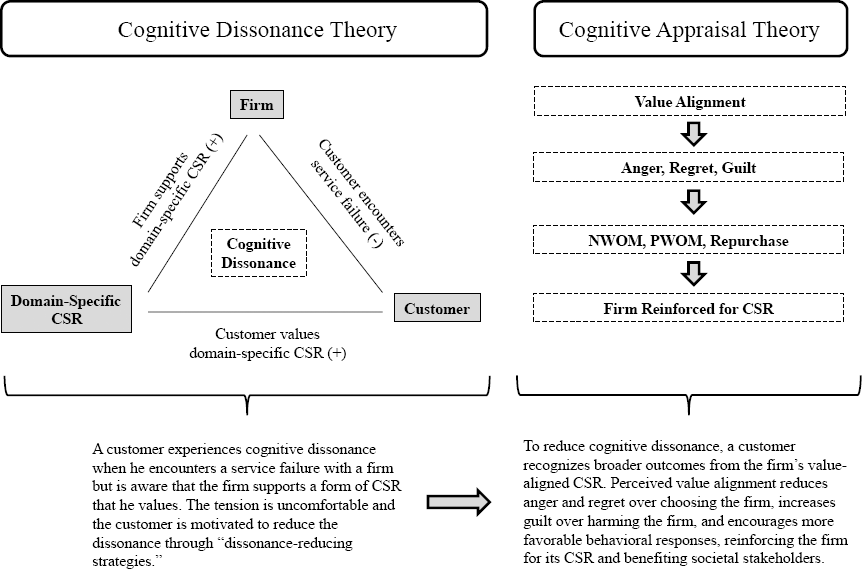
Customer Responses to Value-Aligned CSR Following Service Failures: An Integrative Framework
The right side of Figure 1 shows the resulting cognitive, emotional, and behavioral processes. The hypothesized responses are based on cognitive appraisal theory (Watson and Spence 2007). Cognitive appraisal theory stipulates that emotional and behavioral responses to a situation are activated by cognitive appraisals of the situation. The primary dimension along which situations are appraised is outcome desirability (or goal congruence). In a service failure context, outcome desirability refers to a consumer's judgment about how good or bad the outcomes are or whether outcomes are congruent with the consumer's goals. A consumer who experiences a service failure experiences unsatisfactory outcomes. According to cognitive appraisal theory, this negative outcome appraisal is likely to activate anger, which should increase the likelihood of revenge-seeking behaviors, such as NWOM (Bougie, Pieters, and Zeelenberg 2003).
Although anger and NWOM are common responses to service failures, value-aligned CSR might buffer these negative reactions. As noted previously, value-aligned customers are likely to experience dissonance over harming a firm that supports a cause they value. To cope with these concerns, value-aligned customers may reappraise the situation by altering their judgment regarding the valence of the outcomes they received. Specifically, it is possible that when value-aligned consumers consider their complete set of outcomes from their exchange with a firm, they may take into account broader outcomes beyond the immediate service, such as the extent to which the firm helped the consumer value–based goals (e.g., supporting a cause the consumer values). According to the model, this value alignment should reduce anger and regret over choosing the firm while increasing guilt over harming the firm. We predict that these emotional responses, in turn, will reduce NWOM while increasing PWOM and repurchase intentions, ultimately rewarding firms for engaging in value-aligned CSR.
For example, consider an environmentalist who receives the wrong coffee order at a café known for donating to environmental causes. In this situation, the customer is likely to face a trio of conflicting cognitions: the firm supports an environmental cause (+), the customer values environmental causes (+), but the customer experiences a service failure (−). Multiplying the signs yields a negative product and creates corresponding dissonance and tension. This tension is uncomfortable, and the customer is motivated to reduce it by changing one of the signs using tension- reducing strategies. One method for reducing tension is cognitive reappraisal of the situation. The customer, for example, may simply conclude that the service was, indeed, satisfying. Viewed in the context of value-aligned CSR, the customer may also interpret the exchange with the firm more broadly, recognizing that her purchase supported a cause she values. As a result, the customer may recommend the café to friends and family and return the next time she needs a cup of coffee, despite the service failure. For the firm, the increase in sales should then reinforce engagement in CSR, thus contributing to the well-being of society.
Preliminary Test (Study 1)
Our framework assumes that value-aligned CSR leads consumers to experience cognitive/emotional responses that facilitate more favorable responses to service failures. As a preliminary test of this process, Study 1 explores how customers who vary in environmental concern respond to a service failure at a café that either does not (0%) or does (2% or 15%) donate some of its profits to environmental causes. Although donating a percentage of profits to environmental causes is only one type of CSR, it is not uncommon. Moreover, Study 2 focuses on a wider range of beneficiaries, enhancing generalizability.
Following the provision of CSR information and the service failure, we assess two commonly studied emotional and behavioral responses to service failures, including anger and NWOM (Bougie, Pieters, and Zeelenberg 2003). Within our integrative framework, both should be reduced when a firm engages in environmental CSR (ECSR), and the reductions should be largest (1) among customers who value the ECSR domain (i.e., those high in environmental concern) and (2) when ECSR donations are high (vs. relatively low) (Folse, Niedrich, and Grau 2010). In line with this reasoning, we posit that ECSR will interact with trait environmental concern (TEC) to predict anger and NWOM, and anger will mediate the ECSR × TEC interaction on NWOM. Formally, we hypothesize the following:
H1: ECSR activities and TEC interact such that, following a service failure, ECSR activities lead to the largest reduction in (a) anger and (b) NWOM among consumers high in TEC. (c) Furthermore, the hypothesized effects are most pronounced when the firm shows a high (vs. low) commitment to ECSR. H2: Anger mediates the hypothesized ECSR × TEC interaction on NWOM.
Study 1
Method
Participants
Participants were either drawn from business courses at a large state university in the western United States (N = 142) or recruited using Amazon.com's Mechanical Turk (MTurk; N = 198, all U.S. residents), for a final sample of 340 people (45.3% male, 83.5% Caucasian, median age = 30 years). Students were entered into a lottery for one of three $10 gift cards, and MTurk participants were paid $1 for completing the survey. We collected data from two sources to maximize sample size and enhance the representativeness of our sample while balancing costs. 1 The study used a three-level between-subjects design (no CSR, low ECSR, high ECSR) with a continuous moderator (trait environmental concern [TEC]).
Service Failure Scenario and CSR Manipulation
All participants imagined a service failure at a coffee shop with an unusually long wait and incorrect drink order. Before imagining the service failure, participants were randomly assigned to one of three CSR conditions (Appendix A). In the no-CSR control condition, participants imagined the service failure and immediately completed the dependent measures. In the low-ECSR condition, participants were told that the café donates 2% of its profits to environmental causes. In the high-ECSR condition, participants were told that the café donates 15% of its profits to environmental causes.
Measures
Next, participants rated (in the following order) their perception of the café's environmental commitment, anger, and NWOM intentions and completed the New Ecological Paradigm (NEP) scale (Dunlap et al. 2000), a widely used measure of environmental concern 2 (Appendix A). Analysis supported discriminant and convergent validity (Fornell and Larcker 1981) and ruled out common method variance (Korsgaard and Roberson 1995): (1) a one-factor model fit the data poorly (χ2 (189) = 2,548.27, p < .001; comparative fit index [CFI] = .38; standardized root mean square residual [SRMR] = .21; root mean square error of approximation [RMSEA] = .20); (2) a three-factor model fit the data adequately (χ2 (186) = 601.07, p < .001; CFI = .90; SRMR = .06; RMSEA = .08), with all loadings significant (p < .001); (3) the average variance extracted (AVE) for TEC (.50), anger (.85), and NWOM (.75) reached or exceeded the recommended value of .50; (4) the AVEs exceeded the squared correlation between constructs (anger with NWOM, r = .57, p < .001; anger with TEC, r = −.15, p < .01; NWOM with TEC, r = −.27, p < .001); and (5) the composite reliabilities for TEC, anger, and NWOM were all high (>.90). Appendix B presents correlations and descriptive statistics.
Results
Manipulation Check
To check our CSR manipulation, we analyzed perception of the firm's environmental commitment using an analysis of variance (ANOVA). The results indicated a significant effect of CSR on perceptions of environmental commitment (F(2, 337) = 54.45, p < .001). Planned comparisons revealed higher perceived commitment among those in the low-ECSR condition (M = 4.83) and the high-ECSR condition (M = 5.60) relative to the no-CSR control condition (M = 3.99) (both p-values < .001), providing support for our manipulation.
Anger and NWOM as a Function of ECSR × TEC (H1a–c)
To test H1a–c, we conducted two-step regression analyses on anger and NWOM. In Step 1, we entered TEC (mean-deviated) and the two planned comparisons testing the ECSR effect (Comparison 1 = no CSR [0] vs. low ECSR [1]; Comparison 2 = no CSR [0] vs. high ECSR [1]). In Step 2, we entered the interaction terms between TEC and each ECSR comparison. Both regression analyses yielded a significant main effect of TEC (Step 1), a nonsignificant interaction between TEC and the low-ECSR comparison (no CSR vs. low ECSR), and a significant interaction between TEC and the high-ECSR comparison (no CSR vs. high ECSR) (Step 2; see Table 1).
ECSR × TEC Interactions and Mediation Through Anger (Study 1)

Notes: Low ECSR and high ECSR are dummy-coded variables (each coded as 1) compared with the no-CSR control condition (coded as 0). Trait environmental concern was mean-deviated prior to analysis. The indirect effect of high ECSR × TEC on NWOM through anger is significant at p < .05, following Hayes's (2013) bootstrapping procedure.
Figure 2 depicts the interactions. To follow up the interactions, we next conducted floodlight analyses (Spiller et al. 2013; see also Mohr, Lichtenstein, and Janiszewski 2012) to determine the value(s) of the moderator (TEC) at which the relevant ECSR comparison was significant (at p < .05). Shaded regions indicate the range of TEC values over which the ECSR comparison is significant. As Figure 2, Panel A, illustrates, low ECSR never resulted in a significant reduction in anger or NWOM relative to the no-CSR condition, even when TEC reached its maximum score. In contrast, as the left side of Panel B shows, high ECSR led to significantly lower anger than no CSR when TEC was 4.57 or higher. Similarly, the right half of Panel B shows that high ECSR led to significantly lower NWOM than no CSR when TEC reached 5.96. Notably, the results on NWOM also suggested a high ECSR backlash effect: when TEC was 3.01 or lower, results revealed significantly higher NWOM in the high-ECSR condition than in the no-CSR condition, a finding we return to in the “General Discussion” section.

ECSR × TEC Interactions and Floodlight Analyses on Anger and NWOM (Study 1)
Anger as a Mediator of the High ECSR × TEC Interaction on NWOM (H2)
We next tested the hypothesis that anger would mediate the high ECSR × TEC interaction on NWOM. First, we used procedures suggested by Muller, Judd, and Yzerbyt (2005). Specifically, to establish mediated moderation, (1) the treatment (high ECSR) and moderator (TEC) should interact on the dependent variable (NWOM) and mediator (anger), (2) the interaction on the dependent variable should become nonsignificant when the mediator and its interaction with the moderator are entered into the model, and (3) at least one of the latter terms (anger or anger × TEC) should be significant in the final model. As we show in Table 1, these conditions were met, in support of our hypothesis that anger mediates the ECSR × TEC interaction on NWOM (H2).
We next tested the indirect effect of the high ECSR × TEC interaction on NWOM through anger with bootstrapping using Hayes's (2013) Model 7 (see also Zhao, Lynch, and Chen 2010) with 5,000 bootstrapped samples. The results revealed a significant (negative) indirect effect of the interaction on NWOM through anger (−.31, p < .05), with a 95% confidence interval (CI) that did not include zero (−.55, −.07). Additional conditional indirect effects tests indicated that high ECSR had a significant (p < .05) indirect effect on NWOM when scores on TEC were one standard deviation above the mean (95% CI = [−.94, −.27]) and at the mean (95% CI = [−.53, −.07), but not when TEC scores were one standard deviation below the mean (95% CI = [−.31, .37]). 3
Discussion
Study 1 tested whether value-aligned CSR reduces anger and NWOM after a service failure. As we predicted, customers high in TEC showed a significant reduction in anger and NWOM after learning that a firm engaged in high levels of ECSR (i.e., donating 15% vs. donating nothing to environmental causes). We did not observe similar reductions when the firm engaged in low levels of ECSR (i.e., donating 2% to environmental organizations) or among customers low in TEC. Mediated moderation and indirect effects analyses further supported the hypothesis that the reduced NWOM among value-aligned customers is due to reduced levels of anger.
Although these findings are encouraging, Study 1 has several limitations. First, it focused on a single form of CSR (donating money to environmental causes). Second, ECSR is likely to influence a narrower segment of consumers than a firm might desire (i.e., only those high in environmental concern). Third, low levels of NWOM do not necessarily translate into more positive customer actions that can actively benefit the firm, such as PWOM or repurchase intentions. Fourth, anger is only one of many consumption emotions that may explain why value-aligned CSR works. Fifth, we did not measure value alignment directly. Our reasoning suggests that value alignment is the underlying process that explains why value-aligned CSR leads to more favorable responses following service failures. Thus, if we had measured value alignment in Study 1, we would have located it as a mediator between the ECSR × TEC interaction and anger. However, because we did not measure value alignment directly, we merely inferred evidence for value alignment as a mediator on the basis of the nature of the interaction between high ECSR and TEC (i.e., high ECSR is only effective among consumers high in TEC, suggesting a process of value alignment).
Conceptual Model (Study 2)
To address the limitations just noted, Study 2 explores the impact of two types of broad-based CSR policies designed to enhance value alignment and promote more favorable responses following service failures. Both CSR policies benefit a broad range of beneficiaries (environmental conservation, health initiatives, human rights campaigns, and local community organizations), but they differ in how donations are allocated across the four beneficiaries. Under the CSR–no choice policy, consumers learn that the company decides how to allocate its donations among the four beneficiaries. In contrast, under the CSR–choice policy, consumers are given a choice over how the firm allocates its CSR contributions among the same four beneficiaries.
The conceptual model (see Figure 3) articulates how the CSR–no choice and CSR–choice policies affect value alignment, a wider range of consumption emotions (anger, regret over choosing the firm, and guilt over harming the firm), and a larger number of behavioral intentions (NWOM, PWOM, and repurchase intentions). Figure 3 depicts the hypothesized relationships, which we develop subsequently.

Conceptual Model (Study 2)
To begin, relative to a no-CSR policy, each CSR policy should increase perceived value alignment because the four beneficiaries span a range of values, increasing the likelihood that consumers can relate to causes supported by the company. Moreover, offering consumers a choice over how the firm allocates its CSR donations should be especially likely to enhance the perception of consumer–firm value alignment because consumers can directly express their values through their choice of beneficiaries, further enhancing the perception that the firm values causes that consumers value. Accordingly, we advance the following hypotheses:
H3: Value alignment is lowest in the no-CSR condition, highest in the CSR–choice condition, and between these extremes in the CSR–no choice condition (CSR–choice > CSR–no choice > no CSR). H4: When each CSR policy is compared with a no-CSR policy, the CSR–choice policy results in larger benefits (e.g., reduced anger, enhanced PWOM) than a CSR–no choice policy.
Moving forward in the model, we hypothesize the following:
H5: Stronger value alignment is associated with lower (a) anger and (b) regret over choosing the firm as well as (c) greater guilt over harming the firm.
Once activated, anger should be positively related to NWOM and negatively related to PWOM and repurchase intentions, regret should be positively related to NWOM and negatively related to PWOM and repurchase intentions, and guilt over harming the firm should be negatively related to NWOM and positively related to PWOM and repurchase intentions. Formally, we hypothesize the following:
H6: Anger is (a) positively related to NWOM and negatively related to (b) PWOM and (c) repurchase intentions. H7: Regret is (a) positively related to NWOM and negatively related to (b) PWOM and (c) repurchase intentions. H8: Guilt over harming the firm is (a) negatively related to NWOM and positively related to (b) PWOM and (c) repurchase intentions.
As Study 1 shows, angry consumers seek revenge, often through NWOM. It is reasonable to assume that angry consumers are also unlikely to speak positively about a firm or to return in the future. A similar case can be made for regret over choosing the firm. Regretful consumers are likely to share their disappointment with others (a form of NWOM), not recommend the firm, and avoid the firm in the future. Finally, consumers who anticipate feeling guilty over harming the firm should be reluctant to spread NWOM about the firm and may even go out of their way to speak positively about and repurchase from the firm in an effort to avoid harming it.
To test the model's predictions, we used three techniques. First, as per Study 1, we compared each CSR policy (with and without choice) with a no-CSR policy on all model variables. Second, we tested the model's mediation paths (e.g., CSR → value alignment → anger) using regression analyses and indirect effects using bootstrapping procedures (Hayes 2013; Zhao, Lynch, and Chen 2010). Third, we tested the overall model using structural equation modeling.
Study 2
Method
Participants
U.S. respondents recruited through MTurk completed a brief survey in exchange for $1 (N = 154, 52.6% male, 76.0% Caucasian, median age = 34 years). The study used a three-level between-subjects design (no CSR, CSR–no choice, CSR–choice).
Service Failure Scenario and CSR Manipulation
As in Study 1, all participants imagined a service failure at the Coffee Bean. Before imagining the service failure, participants were randomly assigned to one of three CSR conditions (Appendix C). In the no-CSR control condition, participants imagined the service failure and immediately completed the dependent measures. In the CSR–no choice condition, participants were first told (on the credit card keypad) that the Coffee Bean donates 10% of every purchase to a combination of four causes (environmental conservation, health initiatives, human rights campaigns, and local community organizations). In the CSR–choice condition, participants were first told (on the credit card keypad) that the Coffee Bean donates 10% of every purchase to “the cause of your choice” and indicated their preference for one of the four causes mentioned in the CSR–no choice condition (we used 10% as a middle ground between the CSR values used in Study 1 [2% and 15%]).
Measures
Next, participants identified the Coffee Bean's CSR policy. The majority of participants (93.5%) passed this check; the remaining participants were not included in the analysis. Participants then completed (in this order) scales assessing (1) perceived customer–firm value alignment; (2) anger, regret over choosing the Coffee Bean, and guilt over harming the Coffee Bean through NWOM; and (3) NWOM, PWOM, and repurchase intentions (Appendix C). As in Study 1, measurement analyses supported discriminant and convergent validity (Fornell and Larcker 1981) and ruled out common method variance (Korsgaard and Roberson 1995): (1) a one-factor model fit the data poorly (χ2 (170) = 1,647.49, p < .001; CFI = .49; SRMR = .13; RMSEA = .25); (2) a seven-factor model fit the data well (χ2 (149) = 238.51, p < .001; CFI = .97; SRMR = .05; RMSEA = .07), with all loadings significant (p < .001); (3) the AVE for all constructs exceeded the recommended .50 (.60–.91); (4) the AVEs exceeded the squared correlation between any given pair of constructs (maximum R2 = .45); and (5) the composite reliabilities for all measures were high (>.82). Appendix B presents correlations and descriptive statistics.
Results
Direct Effect of CSR on Model Variables
We first conducted a one-way ANOVA on the model's dependent variables. Consistent with the approach we used in Study 1, we compared the no-CSR condition with the CSR–no choice condition (C1) and CSR–choice condition (C2), respectively. As Table 2 shows (p-values under column C1), compared with the no-CSR condition, the CSR–no choice condition led to significantly higher value alignment and PWOM and significantly lower anger and regret over choosing the firm. Column C2 shows that the results for the CSR–choice condition were stronger, in support of H4: the no-CSR condition and CSR–choice condition differed significantly on six of the seven variables and showed a marginally significant (p < .10) difference on the remaining variable (anger). In summary, compared with those in the no-CSR condition, participants in the CSR–choice condition reported significantly higher value alignment, guilt over harming the firm, PWOM, and purchase intentions and significantly lower regret over choosing the firm and NWOM. These preliminary analyses suggest that CSR policies that offer customers choice over the CSR allocations have a wide range of beneficial cognitive, emotional, and behavioral effects.
Impact of CSR on Model Variables (Study 2)
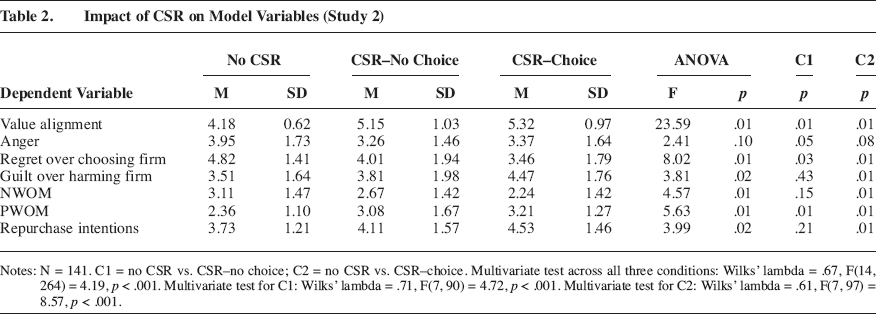
Notes: N = 141. C1 = no CSR vs. CSR–no choice; C2 = no CSR vs. CSR–choice. Multivariate test across all three conditions: Wilks' lambda = .67, F(14, 264) = 4.19, p < .001. Multivariate test for C1: Wilks' lambda = .71, F(7, 90) = 4.72, p < .001. Multivariate test for C2: Wilks' lambda = .61, F(7, 97) = 8.57, p < .001.
Mediation
Next, we conducted three-step regression analyses to test the model's mediation paths. On Step 1, we entered two dummy-coded variables to test the effect of each CSR condition against the control condition. On Step 2, we entered perceived value alignment to assess whether the CSR effects would be reduced or eliminated with value alignment in the model. Finally, on Step 3, we entered the emotions to determine whether the effect of value alignment on the behavioral intentions was mediated through emotions. Table 3 summarizes these analyses.
Impact of CSR on Behavioral Intentions Through Value Alignment and Emotions (Study 2)

Notes: N = 141. CSR–no choice and CSR–choice are dummy-coded variables (coded as 1) compared with the no-CSR control condition (coded as 0).
Step 1 shows that compared with the no-CSR condition, CSR without choice increased PWOM but had no effect on NWOM or repurchase intentions. In contrast, relative to the no-CSR condition, CSR with choice led to significantly lower NWOM and significantly higher PWOM and repurchase intentions. Step 2 shows that all of the previously significant CSR effects became nonsignificant after value alignment was entered into the model, while value alignment remained a significant predictor of each behavioral intention. Finally, Step 3 reveals that value alignment became nonsignificant after anger, regret over choosing the firm, and guilt over harming the firm were entered into the model. Step 3 also reveals that anger was positively related to NWOM, regret over choosing the firm was positively related to NWOM and negatively related to PWOM and repurchase intentions, and guilt over harming the firm was negatively associated with NWOM and positively associated with PWOM and repurchase intentions. In summary, the regression analyses provided good support for the proposed model.
Indirect Effects
Next, we performed bootstrapping using Hayes's (2013) Model 4 (see also Zhao, Lynch, and Chen 2010) to test the indirect effects implied in the model (e.g., CSR–choice → value alignment → anger, value alignment → anger → NWOM). In total, 13 of the 15 effects were in the expected direction and significant (p < .05). The two nonsignificant indirect effects (value alignment → anger → PWOM, and value alignment → anger → repurchase intentions) emerged because anger did not predict PWOM or repurchase intentions after regret and guilt had been controlled. (Additional details are available from the first author.)
Overall Model Fit
Finally, we tested the fit of the structural model using path analysis (Figure 4). 4 With two exceptions, the coefficients were significant and in the expected direction, and the model yielded excellent fit indices, supporting the model at the broadest level.

Test of Conceptual Model (Study 2)
Discussion
Study 2 evaluated the benefits of CSR policies that target a broader range of beneficiaries and offer customers choice over the firm's CSR allocations. Compared with a no-CSR policy, both CSR policies increase perceived value alignment with the firm, but CSR with choice had a stronger effect on customers' emotions and intentions. Specifically, CSR with choice reduced anger and regret over choosing the firm and increased guilt over harming the firm; these emotions, in turn, reduced NWOM and increased PWOM and repurchase intentions. The results support our model of how CSR affects responses to service failures and underscore the benefits of a CSR policy that offers consumers choice over a firm's CSR allocations.
General Discussion
The current research explored why value-aligned CSR promotes more favorable responses to service failures. As we predicted, in Study 1, consumers expressed less anger and NWOM when a firm engaged in ECSR, but only when consumers were high in environmental concern. Results also supported the prediction that value-aligned CSR reduces NWOM by reducing anger. Study 2 showed that compared with a no-CSR policy, a CSR policy offering consumers a choice over the firm's CSR allocation increased perceived value alignment, reduced anger and regret over choosing the firm, and increased guilt over harming the firm; and these emotions, in turn, reduced NWOM and increased PWOM and repurchase intentions.
Research Contributions
This article makes four contributions to the literature streams on CSR and CRM. First, the present studies refine the argument that CSR acts as a global insurance policy against failure by demonstrating that the insurance applies only to customers who perceive a high degree of alignment with the firm's values. To date, research has shown that CSR can improve consumers' perceptions of firms with “bad reputations” (e.g., tobacco; Yoon, Gürhan-Canli, and Schwarz 2006) and repurchase intentions following a service failure (Albus and Ro 2013). However, these studies have focused on the global effect of CSR, and at least one study suggests that CSR does not buffer firms against negative service quality information (Eisingerich et al. 2010). The present studies shed additional insight into this line of work by demonstrating that CSR is a more effective buffer when it matches the values of consumers.
Second, by highlighting value alignment, the present work complements and extends previous CRM research on related issues of fit and identification. For example, consumers respond more favorably to CRM campaigns when (1) they perceive a high degree of brand–cause fit (Pracejus and Olsen 2004), (2) they are high in cause involvement (Grau and Folse 2007; Koschate-Fischer, Stefan, and Hoyer 2012), (3) they identify with the cause (Vanhamme et al. 2012), and (3) the benefits to the cause match the consumer's time orientation (Tangari et al. 2010). The present studies highlight an additional form of fit and identification connecting the consumer to the firm itself: the degree to which the firm shares the values of its customers, as reflected in its CSR efforts.
Third, the present studies identify a set of consumption emotions that explain why value-aligned CSR works. Our results suggest that value-aligned consumers experience less anger and regret over choosing the firm as well as greater anticipated guilt over harming the firm through NWOM, emotions that in turn promote less negative and more positive responses to the failure. To date, research attempting to account for the effects of CSR and CRM has been highly cognitive, with its focus on perceived motives (Barone, Miyazaki, and Taylor 2000) and perceived fit and identification (as noted previously). With few exceptions (Kim and Johnson 2013), little research has directly explored corresponding emotional mechanisms that might carry these effects. The present studies thus help expand understanding of the cognitive-emotional linkages explaining customer responses to CSR and CRM.
Fourth, our work illustrates an effective method for enhancing value alignment among a variety of customers (i.e., offering customers a choice over how the firm allocates its contributions). To the best of our knowledge, only one study has addressed the issue of CRM choice. In that study, Robinson, Irmak, and Jayachandran (2012) show that choice-based CRM programs enhance perceived control and consequently generate greater consumer support. The present work complements their findings by highlighting the benefits of choice-based CRM in response to service failures and establishing value alignment as an additional mechanism that can explain the benefits of choice-based CRM. Future studies testing control and value alignment as dual mediators would further advance understanding of choice-based CRM.
The present studies also make two important contributions to the service failure literature. First, we extend the nascent literature on proactive strategies for addressing service failures. Whereas most studies have focused on reactive strategies (e.g., apologies, compensation), an increasing number of scholars are attempting to understand what firms can do before customers complain directly to the firm to promote more favorable responses to service failures. For example, employees might establish preservice rapport with their customers (Worsfold, Worsfold, and Bradley 2007), recommend structural changes to improve future service quality (De Jong and De Ruyter 2004), or monitor social media and complaint websites to identify and reach out to disgruntled customers before the customers ask for reparation (Van Noort and Willemsen 2012). Each of these approaches is promising, but they may have drawbacks as well. Establishing a strong relationship with customers before a service failure runs the risk of turning “love into hate” without appropriate postfailure interventions (Grégoire, Tripp, and Legoux 2009), and monitoring websites and engaging in postsales service can be costly and may lead to feelings of an invasion of privacy (Challagalla, Venkatesh, and Kohli 2009).
The present work highlights another type of proactive strategy for buffering against service failures: value-aligned CSR that benefits a range of social and environmental causes (Study 2). Value-aligned CSR has several characteristics that differentiate it from prior proactive approaches for dealing with service failures. To begin, the aforementioned approaches all emphasize avoiding or dealing directly with service failures. In contrast, value-aligned CSR does not address service quality. Rather, it appears to promote more favorable responses following service failures by emphasizing the broader outcomes consumers can achieve, beyond the confines of the immediate service quality. Value-aligned customers might also experience dissonance when they consider responding negatively after the firm has facilitated their ability to have a positive impact on society. Additional research testing these explanations could further illuminate how consumers respond to service failures.
As a proactive approach to service failures, value-aligned CSR is also unique in that it is the only approach that has the benefit of promoting the social good. Although apologies, compensation, and proactive approaches to service failures can yield more satisfied and less vengeful consumers, they do little to benefit a broader range of stakeholders. In contrast, value-aligned CSR (with choice) offers a true “win–win–win” solution to the inevitable service failure. Customers win; firms win; and society, as a whole, wins (i.e., the triple bottom line is maximized).
The present research also expands the range of emotions involved in responses to service failures. To date, previous work has largely focused on anger and regret as the key emotional mediators linking aspects of the service failure and recovery to downstream intentions and behaviors such as NWOM, PWOM, and repurchase intentions. Complementing this research, Study 2 highlights the finding that guilt over harming the firm explains these key outcomes beyond anger and regret. To our knowledge, little research has focused on guilt in a service failure context. It is possible that guilt has received such little attention because, in a service failure context, the service failure is often the fault of the service provider (though responsibility attribution certainly varies in degrees). Restated, it seems unlikely that customers would experience guilt over the service failure itself. However, this does not mean that guilt is irrelevant. We underscored the relevance of guilt by focusing on future (anticipated) guilt over harming the firm, as opposed to past (experienced) guilt over the service failure. From our findings, further research on the role of anticipated guilt over harming a firm appears promising.
Finally, and more broadly speaking, the current research reinforces and informs recent thinking in stakeholder management. For example, Smith, Drumwright, and Gentile (2010) argue that marketing is now experiencing a “new marketing myopia” due to an overemphasis on customer orientation to the exclusion of broader stakeholders (e.g., communities, the environment). Smith, Drumwright, and Gentile define stakeholders as “anyone who is affected by or can affect what a company does (Freeman 1984)—or, for that matter, as partners in value creation (Lusch 2007)” (pp. 5–6, emphasis added). Consistent with this perspective, the current work illustrates that customers are stakeholders who, through choice-based CSR activities, can both affect what a company does and cocreate societal value. The current research also supports Laczniak and Murphy's (2012) recent call to move beyond “soft-form” stakeholder management (focusing on the firm and customers) toward “hard-form” stakeholder management (focusing on all stakeholders, including society and the environment). According to Laczniak and Murphy (p. 289, emphasis added), within the hard form of stakeholder management, “stakeholders are accorded enhanced voice (i.e., dialogic input embodied in company policies) to question marketing actions in a manner consistent with the service-dominant logic proposition of cocreation.” Value-aligned CSR illustrates a policy that firms can adopt to offer customers “enhanced voice” and “dialogical input” into the way firms affect a wide range of stakeholders.
Managerial Implications
Beyond the contributions just noted, the current work offers several managerial implications. First, although financial return from CSR activities is not always clear (Raghubir et al. 2010), our research shows that value-aligned CSR can provide insurance against service failures. Given that the heterogeneous nature of service delivery makes failure all but inevitable (Folkes 1984), this research becomes especially pertinent for firms that want to mitigate deleterious effects of failure.
Second, our initial findings reveal an unexpected but potentially dangerous “CSR backlash” effect among value-misaligned consumers. Specifically, in Study 1, consumers who were low in environmental concern were more likely to spread NWOM if a firm engaged in high levels of ECSR (as opposed to no ECSR). Although this finding is preliminary and in need of replication, backlash against CSR among value-misaligned customers is worth anticipating and avoiding.
Finally, we evaluated the effectiveness of two CSR policies designed to appeal to a broader range of consumers. The first policy targets a wide range of beneficiaries (environment, education, health care, and local community) but does not offer consumers choice over how the firm allocated its CSR contributions. The second policy allows consumers to choose how the firm allocates its CSR contributions. Although broad-based CSR without choice had some benefits (vs. a no-CSR policy), CSR with choice resulted in a much larger set of positive downstream consequences (e.g., reduced regret over choosing the firm, increased guilt over harming the firm, enhanced PWOM). The CSR with choice policy was also the only policy that reduced NWOM and increased purchase intentions. These findings argue in favor of a choice-based CSR policy.
Limitations and Future Research Directions
Several limitations should be kept in mind when interpreting the current results. First, we focused on self-reported responses to a relatively innocuous, yet also quite common, hypothetical service failure. It is possible that value-aligned CSR is less effective when the service failure is larger. Further research testing CSR's effectiveness in real-world settings varying in service failure magnitude would thus be profitable.
Second, culture variables might alter the effects detailed in this article. For example, as Matten and Moon (2008) describe, many European firms are simply expected to engage in CSR-related activities. Thus, European consumers may not give firms as much “credit” for engaging in CSR, which is likely to diminish its effectiveness in the wake of service failures. Relatedly, if CSR spending becomes commonplace, CSR might cease to be a value-added experience, nullifying its benefits. Further research exploring the implications of consumers' evolving CSR expectations could provide additional insight into the conditions under which CSR encourages consumers to cut firms slack following a service failure and ultimately conclude, “It's all good.”
Third, although the NEP scale (Dunlap et al. 2000) used in Study 1 is a commonly used measure of environmental concern, each of its items mentions “the earth.” Environmental concern might also be based on concern with humans and animals (e.g., Schultz 2001). It would thus be beneficial for researchers interested in ECSR to keep this broader array of environmental concerns in mind when implementing future studies.
Finally, the structure and scope of the CSR donations utilized in the present studies leave several questions unanswered. To begin, the CSR donations in the present studies were structured (quantified) in terms of a percentage of profits donated to different causes. This “calculable” approach is common and popular with consumers, but a firm's donations can be quantified in several other ways (Grau, Garretson, and Pirsch 2007). For example, a firm may donate an exact amount of money to a cause for each purchase or may claim that “an (unspecified) percentage of profits” benefit a cause (an “estimable” approach) or that “all purchases benefit” a cause (an “abstract” approach). This is important because consumers are more likely to trust and positively evaluate a company when the company's donation is described in more concrete terms (exact donation > calculable donation > estimable donation > abstract donation) (Grau, Garretson, and Pirsch 2007).
The scope of beneficiaries used in the present studies also deserves mention. In both studies, CSR donations bene fited local and national causes. Thus, it is relevant to ask which set of beneficiaries evokes the most positive response following service failures. Research by Grau and Folse (2007) strongly suggests that donations to local causes would be more effective than donations to national causes, especially among consumers who are initially not heavily involved in the cause supported by the company. Further research testing this assumption would offer additional theoretical and practical insights into the effect of CSR following service failures.
The present work suggests several additional future directions. 5 The generalizability of the present findings to more serious failures (e.g., product-harm crises, environmental disasters, corporate fraud) warrants investigation. Can value-aligned CSR also shield firms from negative outcomes across these more severe failures? Echoing a previous point, it seems reasonable that as the firm's failure becomes larger, value-aligned CSR will become less effective. If this notion is true, the question becomes: Why? We suspect that the answer will revolve around three processes. First, the “broader outcomes” from value-aligned CSR will likely not offset the damage created by the firm in these more severe failures. Second, blame is likely to be high under these circumstances, and when negative outcomes are combined with high levels of blame, consumers are likely to experience extremely high levels of anger, which leads to a host of negative actions. Third, if reappraisal fails to reduce the dissonance consumers experience when a value-aligned firm engaged in CSR fails, the consumer is likely to discount the firm's commitment to the cause. This may be especially likely if the firm's failure affects the CSR domain it claims to support (e.g., ECSR in the face of an environmental crisis caused by the firm). Indeed, consumers respond more negatively when a firm fails in a domain that is closely aligned with characteristics personified by brand spokescharacters (Folse, Burton, and Netemeyer 2013). In the present context, high levels of CSR might implicitly communicate brand personality traits, such as sincerity. Thus, if a firm engaged in CSR commits a failure in a domain related to sincerity (as opposed to, say, ruggedness), customers may respond in an especially negative manner.
Another worthwhile question is how other mechanisms and traits mediate or moderate the present effects. For example, do consumers indeed experience dissonance when firms that support a value-aligned CSR domain fail, or does the reappraisal process occur at a more unconscious level? And, how might traits such as trust and/or consumer emotional intelligence moderate the present findings? First, it seems reasonable to assume that the benefits of value-aligned CSR in the wake of failures would be stronger among consumers high in dispositional trust. It is also possible that consumers high in emotional intelligence are more skilled at managing their emotions through the reappraisal process, which suggests that emotional intelligence would also moderate the benefits of value-aligned CSR following negative events. Further research testing these hypotheses could provide interesting insights into when and why value-aligned CSR promotes positive responses to a firm's failures.
Conclusion
Given the voluntary nature of CSR, governments increasingly must rely on soft-policy tools such as education, training, and dissemination of best practices to encourage socially beneficial business practices. However, this method can be hindered because the payoff from CSR is often difficult to establish (Raghubir et al. 2010). In this article, we help address that challenge by demonstrating that choice-based and value-aligned CSR can mitigate negative and promote positive consumer reactions following a firm's failure. These insights might well serve as the basis for a soft-policy approach that governments could use to encourage businesses to engage in actions that benefit a wide range of societal stakeholders.
Footnotes
Appendix A: Service Failure Scenario and Scales Used in Study 1
Appendix B. Correlations and Descriptive Statistics (Studies 1 and 2)

| A: Study 1
a
|
|||
|---|---|---|---|
| TEC | NWOM | Anger | |
| NWOM | –.27 ** | ||
| Anger | –.15 * | .57 ** | |
| M | 4.69 | 3.08 | 4.33 |
| SD | 1.01 | 1.54 | 1.31 |
| Composite reliability | .93 | .94 | .90 |
| AVE | .50 | .75 | .85 |
| B: Study 2
b
|
|||||||
|---|---|---|---|---|---|---|---|
| Value Alignment | Anger | Regret | Guilt | NWOM | PWOM | RPI | |
| Anger | –.25 * | ||||||
| Regret | –.31 ** | .60 ** | |||||
| Guilt | .24 * | –.32 ** | –.48 ** | ||||
| NWOM | –.28 * | .58 ** | .65 ** | –.45 ** | |||
| PWOM | .31 ** | –.36 ** | –.57 ** | .51 ** | –.35 ** | ||
| RPI | .35 ** | –.45 ** | –.67 ** | .53 ** | –.55 ** | .59 ** | |
| M | 4.89 | 3.54 | 4.08 | 3.94 | 2.66 | 2.88 | 4.13 |
| SD | 1.01 | 1.63 | 1.78 | 1.81 | 1.47 | 1.38 | 1.43 |
| Composite reliability | .82 | .93 | .97 | .89 | .94 | .96 | .91 |
| AVE | .60 | .82 | .91 | .74 | .84 | .89 | .84 |
p < .01.
p < .001.
N = 323 (listwise deletion).
N = 141 (listwise deletion).
Notes: RPI = repurchase intentions.
Appendix C: Service Failure Scenario and Scales Used in Study 2
1Preliminary regression analyses on NWOM and anger indicated that sample (student vs. MTurk) did not have a main effect or enter into any interactions with the study's primary predictor variables (ps > .22) (i.e., two ECSR comparisons, TEC, and their interactions). In addition, our conclusions were not altered by entering sample or its interactions into the models. Thus, we dropped sample from the model.
2Dunlap et al. (2000) suggest that the NEP scale contains five subscales (reality of limits to growth, anti-anthropocentrism, fragility of nature's balance, rejection of exemptionalism, and possibility of an eco-crisis); however,  find that the five subscales form a single higher-order factor (as do we). Although our hypotheses do not pertain to the subscales, we performed multiple regression analyses using the NEP subscales. The results support using the global NEP. In each case, the directions of the effects were identical, and with a few exceptions, the effects were significant (p < .05) or marginally significant (p < .10). The strongest findings involved the eco-crisis subscale (all effects significant, p ≤ .05). Although these analyses suggest some subtle differences between the subscales, we focused on the global NEP construct because (1) our ECSR was framed broadly, (2) we had no basis for predicting different patterns using the NEP subscales, (3) our confirmatory factor analysis supported a higher-order factor, and (4) the pattern of findings using the subscales was in line with our key findings. Additional details of these analyses can be obtained from the third author.
3In the analyses reported in the text, we used dummy codes to compare each ECSR condition with the no-CSR control condition. An alternative approach would be to use Helmert contrasts: (Contrast 1 = no CSR vs. CSR conditions combined; Contrast 2 = low ECSR vs. high ESCR). Analyses using Helmert contrasts revealed a significant Contrast 1 × TEC interaction on anger and NWOM but failed to reveal a significant Contrast 2 × TEC interaction on either variable. Viewed from this perspective, it is tempting to suggest that donating 2% and donating 15% yield the same results, and managers should thus opt for the lower donation. However, this conclusion runs counter to the primary findings reported in the text; namely, when compared with the no-CSR control condition, only high ECSR was able to reduce anger and NWOM (among those high in TEC). In contrast, low ECSR was no more effective than the no-CSR control condition. Thus, the more conservative conclusion based on this study is that the level of ECSR does matter.
4We tested the structural model rather than the combined measurement/structural model for two reasons. First, the sample size did not meet current guidelines for the ratio of cases to observed variables (i.e., ten cases per observed variable). Second, as we have noted, separate tests for convergent and discriminant validity supported the measurement model and reliability of the indexes, minimizing concerns over measurement error.
5We thank the JPPM review team for raising many of these questions.