







Abstract
While statisticians have simulated the expected rate of growth in pyramid schemes, this research examines actual data on the spread of an alleged pyramid scheme in Montana. Fortune Hi-Tech Marketing (FHTM) was a multilevel marketing firm, sued by six states and the Federal Trade Commission and permanently shut down in 2014. Data from a settlement with the State of Montana provide a population of participants in a geographic region with definable markets and offer unique insights into local contagion. The authors analyze the pattern of FHTM adoption within a diffusion-of-innovation framework. The findings confirm that nearly all adoption results from interpersonal influence (i.e., imitation) and indicate that participation is higher in counties with larger economic contractions. The authors add to existing guidance about early indicators of fraudulent activity and discuss intervention and prevention strategies that reflect the imitative nature of this diffusion process.
Little academic research contributes to the understanding of this intersection of retailing and fraud, in part due to a lack of reliable data. Gastwirth (1977) and Gastwirth and Bhattacharya (1984) use simulated data to determine the expected rate of growth in a pyramid scheme based on a theoretical model of scheme activity. Others have studied MLM from a specific perspective (e.g., global expansion, managerial control, buyer preferences), but few studies focus directly on the potential for fraud within the industry and none have had access to comprehensive micro-level data. This article is a significant shift in that it analyzes participant data from a firm accused of pyramid scheme activity to better understand the juncture between fraud and person-to-person sales.
The focus of our investigation, FHTM, was an MLM firm operating in the United States from 2001 to 2013. The firm is now defunct after a 2014 settlement agreement with the FTC. The State of Montana reached a settlement with FHTM before FTC action, and this study uses data from that settlement, analyzing the population of Montanans who joined the firm between 2006 and early 2010. While this case study approach is temporally and spatially limited, it has distinct advantages in that all join activity is captured in a state with definable markets and varied economic conditions. We argue that this local analysis is preferable to aggregate examination so that local dynamics are not obscured when regional data are combined. In addition, FHTM is important to examine because its business practices prompted six states and the FTC to investigate and take legal action, ultimately resulting in its demise and heavy losses for its founders (Federal Trade Commission et al. v. Fortune Hi-Tech Marketing, Inc. 2014b).
Furthermore, the case itself is worthwhile to advance the study of diffusion of a business model. Lynch (1996) notes that while it may be easy to identify cases in which good ideas spread widely and bad ideas die out, the interesting case is one in which a bad idea ends up spreading anyway (see also Dennett 1995). As we discuss subsequently, regulators characterize FHTM as a firm lacking in competitive products/services and compensating primarily for recruitment. Analysis, both in Montana and across the United States, shows that nearly all participants lost money and were with the company for 12 months or less. Within a diffusion-of-innovation framework, we analyze adoption of this alleged MLM/pyramid scheme to determine whether the spread over time provides insights useful for prevention and regulation. In an effort to identify early indicators of fraud, we compare the FHTM diffusion results with the growth/decline of other MLM firms. We analyze local areas for differences in diffusion based on geography and local economic conditions.
We begin with a discussion of existing literature on the intersection of MLM and pyramid scheme activity. Next, we model MLM business opportunity adoption as a diffusion process. We then apply the diffusion model to FHTM participant data in Montana and present findings from this analysis. We explore early warning signs, and we use the diffusion analysis to inform policy and consumer protection efforts. The dynamics of FHTM's growth and decline suggest that early intervention is possible and that effective response must recognize the highly interpersonal nature of imitative adoption.
Distinguishing MLM and Pyramid Schemes
Multilevel marketing organizations now dominate the direct selling industry in the United States, but this was not always the case. In 1990, MLMs were only 25% of member firms in the U.S. Direct Selling Association (DSA), but by 2011, they accounted for 96% of the trade group (Brodie, Stanworth, and Wotruba 2002; World Federation of Direct Selling Associations 2012). This rapid change has increased the potential for pyramid scheme activity, complicating the process of separating legal from illegal commerce.
During revisions of the Business Opportunity Rule, the FTC (2011) noted the potential overlap between pyramid schemes and MLMs. While ultimately deciding to exclude MLM from increased regulation, the commission stated that “although there is significant concern that some pyramid schemes may masquerade as legitimate MLMs …, assessing the incidence of such practices is difficult and indeed, determining whether an MLM is a pyramid scheme requires a fact intensive, case-by-case analysis” (FTC 2011). So how are pyramid schemes defined or identified, and how might one decipher whether a particular offering is a legitimate MLM or a fraud?
Pyramid schemes come in many forms, including chain letters, gifting tables, and business opportunities. Definitions vary by jurisdiction, but Keep and Vander Nat (2014, p. 10) define the underlying theme as “a money-transfer scheme in which the foreseen losses of the vast majority become winnings for a small minority at the top of the recruitment structure.” As an example of a jurisdictional interpretation in state statute, the State of Montana (2013) defines a “pyramid promotional scheme” as a “sales plan or operation in which a participant gives consideration for the opportunity to receive compensation derived primarily from obtaining the participation of other persons in the sales plan or operation rather than from the sale of goods or services by the participant or other persons induced to participate in the sales plan or operation by the participant.”
As is implied by Montana's statute, a pyramid scheme can pose as an MLM by offering a product or service, creating the impression of retail intent. In a 2004 FTC advisory opinion, commission staff stated that the presence of product or service sales does not, by itself, indicate legitimacy and defined a pyramid scheme as “a multi-level compensation system funded primarily by payments made for the right to participate in the venture” (Kohm 2004). The advisory noted the use of mandatory product purchases as a method by which some pyramid schemes create the illusion of retail activity and seek to disguise recruitment rewards as retail commissions.
Vander Nat and Keep (2002) review case law to identify guidelines for differentiating legitimate and illegitimate MLM firms. Finding the major determinant of legitimacy to be the level of genuine retail activity (as measured by sales made to consumers outside the distributor network rather than to and between distributors themselves), the authors then calculate the minimum percentage of retail sales needed to prevent an MLM from being identified as fraudulent. This threshold is shown to be dependent on the individual firm's operational data, namely, the proportion of wholesale price attributable to production costs and “upline rewards” (i.e., commissions paid to those above the seller in the distributor network). In his expert witness testimony for Federal Trade Commission et al. v. Fortune Hi-Tech Marketing, Inc. 2013c, Vander Nat reported that at least 88% of payments made to FHTM participants were ultimately based on recruitment and virtually no goods were purchased by consumers outside the FHTM distributor network, falling well below the minimum threshold defined in Vander Nat and Keep (2002). In a more recent case, the U.S. Court of Appeals for the Ninth Circuit affirmed this recruitment versus retail sales perspective and, in its opinion against MLM BurnLounge, quoted Vander Nat: a “pyramid scheme is an organization in which the participants obtain their monetary rewards primarily through enrolling new people into the program rather than selling goods and services to the public” (Federal Trade Commission v. BurnLounge, Inc. 2014).
Because the internal data needed for such a calculation are not available to individual consumers, and likely even most regulators, both the FTC and the SEC provide warning signs of fraudulent MLM activity, including the presence of a buy-in requirement, an emphasis on recruitment, a complex commission structure, lack of evidence of out-of-network retail sales, and promises of quick riches and long-term passive income (see https://www.sec.gov/investor/alerts/ia_pyramid.htm). With the current research, we aim to complement this advice, as well as prior research but not to provide a specific legal basis on which to differentiate legitimate MLMs from pyramid schemes (for a full discussion of case law in this area, see Keep and Vander Nat 2014; Vander Nat and Keep 2002). Instead, we examine the growth pattern of a now-defunct MLM firm, FHTM, to provide insight for those who encounter MLMs that may push the boundaries or generate accusations of pyramid scheme activity—namely, consumers, policy makers, and regulators.
A Model of MLM Adoption
The diffusion-of-innovations literature provides a context and language for understanding MLM participation over time. Modelers have used diffusion-of-innovation models for decades to explain and predict the adoption of new products and services over time. Business process innovations and ideas, such as sustainable practices and business process reengineering, diffuse in similar ways (O'Mahoney 2007; Peterson 2013). In using the diffusion-of-innovation model, we assume that participants of an MLM organization are primarily adopting the innovation of the business model rather than the products/services offered. This would be especially true in a firm at risk of pyramid scheme activity that emphasizes recruitment and mandatory purchases over retail sales.
Considering FHTM specifically, the FTC investigation determined that most of the goods and services offered through the company were widely available from other sources and that proprietary products had close market substitutes that were less expensive (Federal Trade Commission et al. v. Fortune Hi-Tech Marketing, Inc. 2013b). Furthermore, when given a choice, more than 95% of the participants chose accumulation of points (used to elevate the distributor's standing to enhance recruitment rewards) over product discounts, and most product purchases were made to qualify for recruitment rewards (Federal Trade Commission et al. v. Fortune Hi-Tech Marketing, Inc. 2013c). If true, both the product offerings and the participants' choices suggest that FHTM joiners were primarily adopting the business opportunity. This might be the case for MLM participation more broadly. A DSA website poll of more than 48,000 direct sellers indicates that 85% of respondents became a direct seller to earn full or part-time income, while only 9% entered to buy products at a discount (DSA 2014). Because the overwhelming majority of direct-selling organizations in the United States are organized as MLMs, this suggests that the primary motivation for MLM participation is to generate income, and therefore, participation is primarily an act of adopting the business opportunity.
The Classical Diffusion Model
Rogers (1976) describes the “classical model” of diffusion as one that attempts to explain the adoption of a new idea in which the adoption occurs by individuals over time, within a social system with embedded communication channels. The focus of the classical model is on the initial purchase/adoption decision rather than on duration of use or repeated purchase.
Bass (1969) describes adoption as occurring through two types of agents: “innovators,” whose adoption is independent of the choices of others, and “imitators,” whose timing of adoption is influenced by the adoption decisions of others in their social system. Whereas adoption through innovation is driven by mass-media communication, imitative adoption occurs through interpersonal communication within social networks. Given a fixed market potential, the probability of imitation is expected to rise initially with the number of cumulative adopters but eventually decline as the market becomes saturated. If MLM adoption follows these expectations, the resulting diffusion curve will have a characteristic S shape because diffusion is initially slow, rises more dramatically during peak contagion, and then increases more slowly due to market saturation. Here, we analyze monthly FHTM data to understand the relative role of innovation and imitation and to determine whether growth matches classical expectations of diffusion.
Innovation Features
The rate of adoption is expected to depend on the nature of the innovation itself and the suitability of the environment (i.e., social system) in which it is being adopted. Rogers (1962) identifies innovation features that promote individual adoption and, therefore, aggregate diffusion. An innovation is more likely to be adopted when it is consistent with the adopter's existing set of beliefs and habits (compatibility), easy to try without great risk (trialability), attractive relative to competing innovations (relative advantage), visible to others (observability), and simple to adopt (low complexity).
Multilevel marketing organizations use these features to enhance the likelihood of adoption. Compatibility is enhanced through interpersonal interaction, as the recruiter is often in the same social network and can tailor the appeal to the beliefs, habits, and desires of the individual recruit. The participation agreement is structured to have a relatively small initial investment so that the recruit can try the bundle (products/services and business model) and make additional purchases/investments to sustain participation. Recruitment pitches emphasize the freedom and flexibility that can come from earning money outside the traditional “9-to-5” workplace, stressing the disadvantages of traditional work and investment options. These schemes also promote visibility (e.g., apparel, car decals, social media activity) to be sure that adoption is apparent to the participant's social network.
Perhaps most powerfully, MLMs simplify use by offering turnkey training materials. Sales pitches repeat the “anyone can do it” mantra early and often. According to O'Mahoney (2007), cut-and-paste simplicity lowers adoption costs. Coupling simplicity with active replicators—innovation features designed for the sole purpose of supporting contagion/replication—further supports diffusion. This concept of active replication draws from epidemiological examples, such as a cold virus designed to cause sneezing. In MLMs, recruitment rewards function as an active replicator.
Diffusion does not imply benefits, and disappointment does not always lead to complaints. O'Mahoney (2007) notes that successful diffusion does not itself require that the innovation is good for the adopter, just as a cold or computer virus might spread despite harm to the host. Dennett (1995) stresses that entities replicate when they are well-designed for replication. An innovation could certainly promote adoption through increasing actual benefits conferred to the host, but this need not be the case. O'Mahoney (2007) notes the potential disconnect between the external discourse surrounding an innovation and the internal reality for adopters.
For pyramid schemes disguised as MLMs, the volume of complaints and negative word of mouth are often quite low. Of all fraud types monitored by the FTC, pyramid schemes have the lowest complaint rate (Anderson 2004). In the case of FHTM, of the more than 3,500 Montana residents who lost money in the scheme, only 75 complaints were received. Participants are often silent about their personal internal reality due to guilt (as they have often recruited friends and family into the scheme), shame (for falling prey to a get-rich-quick scheme or for feeling that they failed as an entrepreneur), obligation or loyalty (based on close ties with one's recruiter), and/or hope that continued scheme activity might increase the likelihood of a personal return on investment; in other words, silence is used as a self-concept and impression management strategy (Goffman 1952).
There can also be pressure from one's “upline” (i.e., those higher up in the distributor hierarchy) to stay with the organization, communicated through messages such as “the only way to lose is to quit” and “fake it ‘til you make it.” In addition, some MLM distributor agreements include arbitration clauses that can limit a participant's access to outside resolution through courts or regulatory bodies. From an assumption of neoclassical economic rationality, consumers might determine that the expected benefit of filing a complaint is exceeded by the anticipated cost.
Finally, complex compensation structures can obfuscate a participant's understanding of his or her internal reality and may further contribute to silence. Pratt (2000) finds that MLM distributors were often unable to state their net earnings and, furthermore, that distributors could not agree on the method by which they should calculate the returns to their labor. Conversion of gross to net earnings is complicated by many factors: joining and renewal fees; complex bonus structures; unmeasured time and travel expenses; payments for training materials, conventions, and selling aids; and incentivized internal consumption.
Innovation Environment
While content and design are critical to innovation adoption and diffusion, the environment also determines the innovation's success. O'Mahoney (2007) likens the former to a seed and the latter to the fertility of the ground in which it is planted. One key environmental factor is network density, both social and geographic. Haggith et al. (2003) finds that dense networks best support diffusion of innovations, especially when those innovations are adopted through the imitation of ideas. The adoption and diffusion of MLM are expected to increase with population density because transaction costs are reduced and the sheer number of prospects (assumed to be some function of the number of people living within a certain distance) increases, especially if imitation occurs through face-to-face interaction between a participant and potential recruits. To address both population density and the possibility of variation in diffusion timing across markets, we examine the data for the Billings metropolitan market separately from the data for the rest of Montana. We also analyzed other counties and regions for differences, but no significant variation emerged outside the Billings metropolitan area.
Local economic conditions are also expected to affect adoption. Cahn (2006, 2008) and Casanova (2011) find that participation in MLM is motivated by limited access to formal labor markets and the need to supplement household earnings. This could mean that participant interest grows during recessionary periods, when alternative opportunities for labor and capital investment are depressed. For MLM firms with significant retail sales, however, the potential recruit would need to consider the possible entry of other sellers in the same market as well as the subsequent reduction in demand for the product/service offered (unless those offerings include inferior goods). Because the focus of MLM-based pyramid schemes falls on recruitment over sales, they may not follow the trajectory of legitimate retail firms. The analysis that follows provides some preliminary evidence that recruitment is stronger in locations with weaker economic conditions and that FHTM in Montana was affected differently by the recession than many other MLM firms.
The landscape for MLM could also be affected by a country's or region's retail environment. Areas with insufficient retail infrastructure will likely be more receptive to direct selling because the availability of substitutes is limited (Biggart 1990; Schwartz 1992). This provides an opening for pyramid schemes disguised as MLM business opportunities. For fraudulent offerings, legal and financial systems also affect the climate for scheme growth. Jarvis (1999) points to Albania's weak formal financial system and legal infrastructure as preconditions for the catastrophic effects of pyramid schemes there in the 1990s. Verdery (1995) cites Romania's history of hyperinflation, plummeting real incomes, and tight credit as some of the factors encouraging massive participation in more than 100 schemes between 1990 and 1994. Given that our data set is restricted to a single U.S. state over a four-year time frame, we do not expect that any significant changes in the legal or financial infrastructure were affecting participation. Rather, we anticipate that, if anything, the Montana retail environment between 2006 and 2010 became more competitive as e-commerce offerings expanded and might have modestly reduced the appeal of FHTM.
Methodology
Given that features of both the environment and the innovation drive the degree to which adoption occurs within a social network, how can we expect an MLM to spread in a certain place and over a certain time period? The classical diffusion model addresses this question, assuming that diffusion occurs through adoption by innovators and imitators. The Bass model, as described by Mahajan, Muller, and Bass (1995), assumes that the probability of adoption in a given time period is dependent on the likelihood of innovation and imitation in the following way: If n(t) is the number of new adopters at time t, N(t) is the number of cumulative adopters as of time t (i.e., all those who adopted before time t), m is market potential, p is the coefficient of innovation (or external influence), and q is the coefficient of imitation (or internal influence), then

Rearranging Equation 1 yields the following:


This research applies Equation 2b to the population of FHTM participants in Montana. Given that the data are from an alleged MLM pyramid scheme, we expect diffusion to be driven primarily by imitation, as measured by the relative importance of q over p. There was relatively little direct contact between the company and potential recruits/adopters, and virtually all recruitment is assumed to have occurred through interpersonal communication within social networks, limiting the role of external influence on adoption. Given the importance of interpersonal influence, the spread of the network should reflect a contagion pattern conforming to the Bass model as explored in other market contexts, and the timing of diffusion might not necessarily be uniform across the state. Finally, we expect FHTM activity to respond to local economic conditions, with larger economic contractions during this recessionary time period corresponding to higher levels of adoption.
We estimate predicted monthly joins/adoptions, n(t), using ordinary least squares regression, where Equation 2b is estimated as follows:

The parabolic shape generates an estimate of m, where predicted new joins become zero due to market saturation. Using m and the regression coefficients, we derive the coefficient of innovation (p) and the coefficient of imitation (q). Statistical significance of p is determined by evaluating the statistical significance of the regression intercept term, b0, because we know m to be nonzero. If p is statistically insignificant, the statistical significance of q can be determined on the basis of the significance of b1. We present the results of this analysis after describing FHTM participant data from Montana.
Data and Results
Participant Data
FHTM, founded in 2001, operated as an MLM company in the United States, Canada, and Puerto Rico and, by early 2013, had recruited more than 500,000 people in the United States alone. Over the previous few years, the company had settled state-level lawsuits with Montana, Texas, and North Dakota. The State of Montana alleged the following in Montana v. Fortune Hi-Tech Marketing, Inc. 2010:
FHTM is not a multilevel distribution company, but rather a pyramid promotional scheme because the compensation each participant in the program receives is derived primarily from obtaining the participation of other persons in the program and not the sale of goods and services.
During its time in operation, the company recruited “independent representatives” who paid (typically $299) to join the company, with additional fees for training and yearly renewal. Representatives were to earn compensation based on recruitment of others and on commissions for products/services sold. The company website advertised approximately 20 products/services that could be purchased through FHTM, the most high profile of these being Dish Network satellite service. For most of these offerings, the company was operating as a third-party vendor, advertising access to preexisting goods and services such as TaxBot and Amusement Pack. In Federal Trade Commission et al. v. Fortune Hi-Tech Marketing, Inc. (2013a), investigators reported that FHTM could not offer a discount on any of these goods and that sales commissions were extremely small (e.g., $.80 on a Dish Network package). Although FHTM distributors could earn commissions on retail sales made by their downline recruits, they were a fraction of the original sales commission (e.g., $.08, or one-tenth of the commission, on a Dish Network package sold by a downline recruit).
While denying any wrongdoing, the company agreed to pay $1 million in a 2010 settlement with the State of Montana and up to $1.3 million in a 2011 settlement with the State of Texas, for which the money was used to fund refunds to participants. Subsequent events have closed the company. On January 28, 2013, the FTC and three state attorneys general (Kentucky, Illinois, and North Carolina) announced a shutdown of the firm, pending trial on charges of exaggerated earnings claims and pyramid scheme activity. In May 2014, a settlement order was filed. The settlement stipulates that, while admitting no wrongdoing, FHTM is permanently closed and its founders are banned from all future MLM activity of any kind (Federal Trade Commission et al. v. Fortune Hi-Tech Marketing, Inc. 2014b). The financial judgment also allows for some refunds to consumers across the country. This settlement result is typical of the FTC's approach to halting pyramid scheme activity. In a recent review of past FTC pyramid scheme cases, 12 of 14 reached a settlement before trial, and in all 12 settlements, the defendants did not admit liability (D. Brooks, personal communication, June 11, 2014). In each of these settlements, Brooks notes that defendants agreed to stipulations that “generally include injunctions against participating in prohibited marketing practices, disclosure and record keeping requirements, and financial redress.” In the FHTM case, a new deterrent was generated when the court authorized clawback litigation against highly compensated FHTM participants, in addition to the company's founders (Federal Trade Commission et al. v. Fortune Hi-Tech Marketing, Inc. 2014a).
The data for this research are the result of the company's settlement with the State of Montana, provided by Montana's Deputy Securities Commissioner. While personal information was redacted, the data set provides location, recruitment date, fees paid, and yearly commissions earned for all 3,737 FHTM independent representatives in Montana, recruited from the beginning of 2006 through March 10, 2010 (temporary cease and desist order issued in March 2010). While data showing specific recruitment lines would be useful for network analysis purposes, such data are not available; instead, our study aims to measure the rate of imitation (or contagion) within a geographic region, which can be estimated without such direct network link data. We believe that this is the first data set of its kind (i.e., individual participant data for an alleged pyramid scheme) made available for research.
We computed total net earnings over the four years for all individual distributors as sales commissions minus joining, training, and renewal fees reported by the company. Note that any additional business-related expenses or product purchase for the purpose of rewards qualification would reduce these net earnings further, but such data are not available. As an illustration of the data set, Table 1 displays information for the ten highest net earners in Montana and the ten lowest net earners. Figure 1 then displays summary net earnings information for all participants in Montana over this time period.

FHTM Distributor Net Earnings in Montana (June 2006–March 2010)
FHTM Distributor Data (June 2006-March 2010): High and Low Earners

Some similarities are evident among the representatives with high net earnings. The top four earners, who capture nearly half (48.4%) of all positive net earnings in this data set, entered the business in 2006 or 2007 and resided in the largest population centers in the state (three of the four were in Billings, the most populated city in the state). Nearly all of the 21 +$10,000 earners resided in or around the largest cities in the state. Probabilistically, it is more likely that a representative will reside in a larger population center, and the location's density might also support earnings if it brings dense social networks and reduced transaction costs.
The pyramid-like earnings structure is readily apparent in Figure 1. On average, the 94% of participants at the “bottom of the pyramid” earned $39 in commissions to slightly offset the $299 joining fee, for a net loss of $260. Only 3% of all distributors paid renewal fees, meaning that 97% of recruits left the organization within one year of joining. Table 2 demonstrates the outcomes for participants who entered in different time periods. As expected, earnings and duration of participation declined for later adopters. These results correspond with the national data on FHTM participants between 2009 and 2012. Over this time period, approximately 96% of participants earned less than $299, and the renewal rate fell from 5.8% to 2.4% (Federal Trade Commission et al. v. Fortune Hi-Tech Marketing, Inc. 2013d).
FHTM Earnings and Retention in Montana by Joining Year

Results of Diffusion Analysis
Figure 2 depicts the new adoptions each month and the diffusion measured in cumulative joins between June 2006 and February 2010 (the last full month of data available). It is evident that the MLM had not reached saturation statewide at the time the company's operations were halted in Montana, providing incomplete data for model estimation. Within the state, however, the Billings metropolitan area appears to have experienced its peak adoption period before the regulatory action, as Figure 3 depicts (adoption in Billings vs. the rest of the state). We proceed with an analysis of the Billings region, the largest population center in Montana, representing 42% of all FHTM joins. We then draw implications for the remainder of the state.

Monthly FHTM Adoption and Diffusion in Montana

FHTM Adoption in Montana by Location
Figure 4 depicts the Bass model analysis, with the tick-marked line mapping the predicted joins against actual joins for the Billings metropolitan area. The region appears to have experienced two waves or cycles of adoption, generating a functional discontinuity: cycle 1 from June 2006 through December 2008 and cycle 2 from the end of December 2008 onward. There are multiple possible triggers for the second cycle. The recession could have caused a new wave of interest in nontraditional earnings and investment options. There were also four new recruits who joined late in 2008 and ultimately earned substantial sums, all located in a small zip code in the northwest corner of the Billings metropolitan area. This cohort of new aggressive distributors, acting as meme fountains (Blackmore 2000, p. 163), might have helped launch the second cycle, inspiring higher levels of imitation. If we treat the two cycles separately (similar to two successive rounds of the flu), we can get a better sense of the adoption pattern and related parameters for each cycle, as Figures 5 and 6 show.

Billings Monthly Adoption: Actual and Bass Predicted

Billings Monthly Cycle 1 Joins: Actual and Bass Predicted

Billings Monthly Cycle 2 Joins: Actual and Bass Predicted
Because the innovation coefficient (p) is statistically insignificant in every case (H0: b0 = pm = 0 is not rejected), we can conclude that FHTM adoption occurred through interpersonal influence rather than through direct appeals from the company to individual recruits. Furthermore, the coefficient of imitation is larger for the second cycle than for the first. The q values, .276 and .475, fall in or near the expected range of .3–.5 found in the diffusion literature (Mahajan, Muller, and Bass 1995). The peak level of contagion/imitation in the first cycle comes when there are 300 existing adopters. With this level of diffusion, the model predicts 45 new adoptions in the subsequent time period; no additional joins are expected after there have been 607 adopters (m). The second cycle is shorter and more potent. Peak contagion occurs when there are 515 cumulative joins (prompting 130 adoptions in the subsequent time period), and diffusion is expected to stop at 1,050 recruits. Note that, especially in the second wave, the number of new monthly recruits falls off quickly after reaching the peak adoption period. The three estimated parameters (p, q, and m) can be used to predict the rest of the diffusion cycle, resulting in a declining curve for new joins with cumulative membership leveling off.
Turning our attention to the remainder of Montana, we use the Billings results to inform a possible diffusion scenario for the rest of the state, in the absence of court intervention. As Huang and Chen (2010) note, diffusion studies often utilize parameters (especially m) from another product or region to generate predictions for instances when peak adoption has not yet occurred. Considering Figure 3 again, the Billings and outstate experiences were somewhat alike in the first three years of FHTM activity, with Billings experiencing a stronger wave of adoption in the second year relative to the rest of the state. Their adoption patterns diverged in year four, as the Billings area joins declined while adoption accelerated in the rest of the state.
If we assume that the Billings region was approaching saturation and we examine the total diffusion in this region, adoptions represented approximately 1% of the Billings metropolitan population. For illustrative purposes, we predict adoption outside the Billings region assuming that market potential (m) is similarly 1% of the population (or 8,674 total joiners). Choosing p to reflect initial joins and selecting q to minimize mean squared error results in p = .002 and q = .16. Figure 7 displays the actual join data against Bass model predictions using these parameters. It may be that this scenario overestimates outstate diffusion given that Billings has a higher population density than the remainder of the state. However, the model clearly underestimates new adoptions in February 2010, so diffusion could have exceeded that predicted in Figure 7. In either case, it is reasonable to expect that state action limited future losses. Both the litigation activity and the settlement restrictions on future FHTM operations would be expected to lessen future participation in the company in Montana. In an extreme scenario, if state action were to have deterred all future joins, our analysis shows that an estimated 7,000 outstate residents would be prevented from joining. If we assume that 94% of recruits lose an average of $260, this translates to an avoidance of $1.7 million in consumer loss. Any reduction in participation generated by the state action would shift the diffusion curve downward. While most of the damage might have already been done in the state's largest city, the intervention almost certainly reduced loss elsewhere.
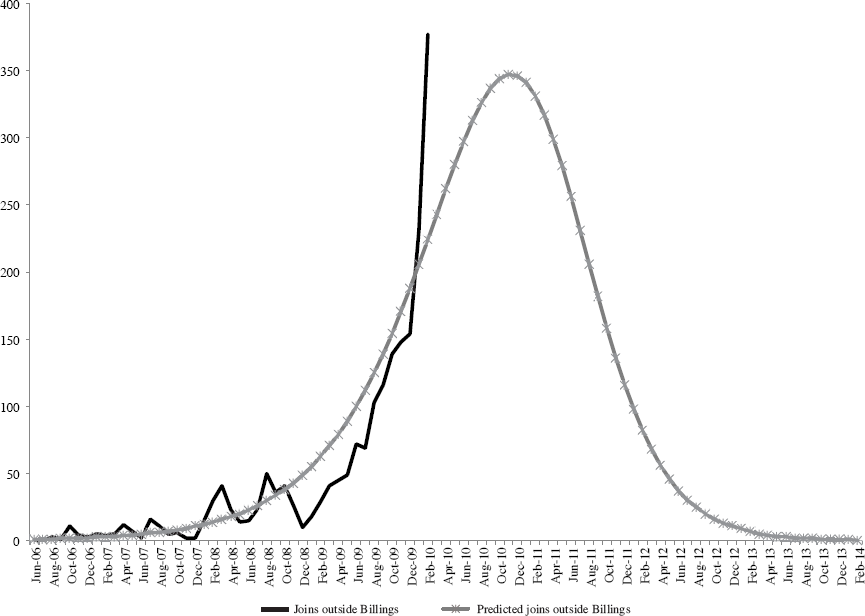
Actual and Bass-Predicted Joins Outside Billings
To explore the role of the innovation environment, we also examined adoption in outstate counties under different economic conditions. From 2006 to 2010, each county in Montana experienced an increase in its unemployment rate. The median rate increase was 2.8 percentage points, with a maximum and minimum of 9.7 and .9 percentage points, respectively. Figure 8 depicts FHTM adoption in counties below the median (i.e., experiencing less dramatic economic contractions) and in counties at or above the median unemployment rate increase. As expected, adoption was higher in counties that experienced larger economic contractions. This difference was not attributable to higher population or population density in those depressed counties, so it is reasonable to conclude that this result is related to economic conditions. This suggests that special attention should be paid to regions experiencing pronounced contractions because they may be most vulnerable to scheme contagion.

Impact of County-Level Economic Conditions on Scheme Contagion (Outside Billings)
The diffusion analysis provides useful findings on the nature of FHTM adoption and growth. First, this alleged pyramid scheme spread in a way consistent with the Bass model, as driven by imitation (i.e., internal influence). Second, the imitation coefficients estimated generally fit within the norms of the diffusion literature but vary by adoption wave and region. Third, in a fixed geographic region (Billings), adoption accelerated rapidly, peaked, and decelerated rapidly as well, similar to a fad. Furthermore, it is possible to have multiple cycles of adoption. Finally, the economic environment appears to affect adoption, and the timing of FHTM diffusion varied within the state.
Montana may be atypical in certain ways (e.g., low population density, high degree of homogeneity), but the relatively sparse population was beneficial in analyzing definable markets. It would be informative to estimate parameters for other regions or alleged schemes for comparison purposes. Following Huang and Chen (2010), examination of environmental factors such as income, education, and culture could provide even more insight for policy and consumer protection efforts. We have not provided guidance on predicting multiple waves of activity. While the policy implications are not necessarily sensitive to the number of adoption cycles, further study might help identify triggers for additional waves of adoption.
Comparison with other MLM Firms
Do these results present any aspects of diffusion that are unique to an alleged pyramid scheme? In the interest of identifying distinctions that might serve as early warning signs, we compare the growth of FHTM with other MLM firms over this same time period (2006 through quarter 1 of 2010). We obtained quarterly revenue data from SEC filings for ten publicly traded MLM firms. While most of these firms operate in multiple countries, U.S. revenue was identified in most cases, and North American revenue was reported for two firms when U.S. revenue was unavailable. For each firm, we estimate a time-series regression equation. If Yt represents company revenue in quarter t, Tt captures time trend, Rt is a dummy variable indicating a recessionary quarter, and Qt is comprised of quarter dummy variables to capture seasonal variability,

Because we do not have national or state-level FHTM revenue over this time period, we calculated revenue from join fees per quarter in Montana. Given that genuine retail sales were modest and most sales were connected to rewards qualification, we expect join fee revenue to be highly correlated with overall FHTM revenue in the state each quarter. Table 3 depicts regression output for these firms.
FHTM Versus Other MLM Firms: Results of Time-Series Regression Analyses (Quarter 1 2006-Quarter 1 2010)

p < .10.
p < .05.
p < .01.
Notes: For all ten comparator companies, quarterly revenue is represented in millions of dollars and obtained from SEC 10Q and 10K filings. For FHTM, revenue is in dollars and computed from join fees in Montana. When region is not noted, revenue is for the entire company, and revenue is dominated by U.S. sales.
Of the ten MLM firms analyzed, all had statistically significant linear time trends and five were experiencing a downward trend in sales between 2006 and early 2010. None of the firms with declining revenues over time had a statistically significant coefficient on the recession variable, indicating that the downward trajectory might be interrupted by seasonal variability but was not significantly altered by the nationwide recession (at least not as defined by the technical peak and trough for the nation). For FHTM and the five comparator firms with a positive time trend, we compared the linear model with the log-linear to check for nonlinear revenue growth and chose the best specification on the basis of Royston and Goldstein's (1993) transformed R-squared method. Focusing on the time trend, FHTM was one of four firms with nonlinear positive growth and had a per-quarter growth rate of 33%. The firm experiencing the next-fastest growth exhibited a rate of only 8% per quarter. Aside from this upward trend, two of the four firms with a positive, nonlinear time trend experienced significantly lower growth during recessionary quarters, but FHTM did not exhibit this tendency. While the recession did not generate a statistically significant boost in join fee revenue, the results indicate that the recession did not hinder FHTM growth in Montana.
Differences observed might be the result of the local versus aggregate nature of the data analyzed, as FHTM is observed in a single state whereas comparative data are captured at the national or international level. Within those large-scale data, it is possible that these MLM firms also experienced bursts of activity in certain markets contemporaneous with declines in others. However, this analysis highlights Montana's experience with FHTM and how that experience contrasts with a broader picture of other MLMs. Differences reveal a warning sign of potential fraud that is best observed at a local level: a continuous innovation with exponential growth, coupled with uninterrupted adoption during a recession. As previously mentioned, FHTM adoption was higher in counties with larger increases in unemployment. Diffusion analysis at a local level also demonstrates rapid decline in adoption, which is not observed in this aggregate MLM data.
These findings add to current warning signs promulgated by federal regulators and prior research, as we summarize in Table 4. Some findings of FHTM outcomes, specifically high turnover and losses to most participants, are consistent with FTC warnings. Furthermore, our findings with regard to diffusion characteristics add to the body of knowledge. Although FHTM adoption dynamics do not identify a bright line legal determinant, they do add to the qualitative characteristics investigators could look for when examining individual MLM activity, especially at the local level. These same findings could be useful, if properly reframed, for consumer education efforts.
Warning Signs of MLM-Based Pyramid Schemes
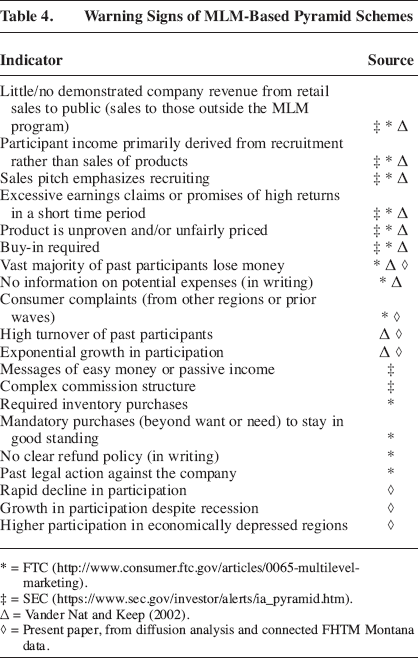
= Present paper, from diffusion analysis and connected FHTM Montana data.
Implications and Recommendations
Consumer issues are widely addressed through three basic mechanisms: regulation, consumer education, and industry self-regulation (McGregor 2012). We discuss the use of such mechanisms to address the complexities of MLM systems in this section, with an emphasis on regulation and consumer education.
Just as monitoring and inoculation systems are designed to control epidemiological outbreaks, such systems must be designed to identify and prevent pyramid scheme diffusion. An understanding of diffusion dynamics can inform policies and procedures in terms of both prevention and intervention. We use FHTM as a case study to discuss recommendations because it was alleged to be a pyramid scheme by six states and the FTC, nearly all participants lost money, and the majority of activity centered on recruitment. State action in early 2010 likely disrupted the diffusion cycle outside the Billings region, averting significant consumer losses.
By the time the FTC took action against the company in early 2013, expert witness Vander Nat conservatively estimated consumer losses to be $169 million (Federal Trade Commission et al. v. Fortune Hi-Tech Marketing Inc. 2013c). The court-appointed receiver reported that national participation in FHTM was already declining by 2012, as the number of new representatives in the United States fell from 97,323 in 2010 to 47,667 in 2012 (Federal Trade Commission et al. v. Fortune Hi-Tech Marketing Inc. 2013d). While regulatory action prevented additional harm and the potential for new waves of FHTM activity, the data suggest that adoption was slowing and that significant consumer losses could have been avoided by earlier intervention. With the understanding that resources and information are limited, how can the FHTM diffusion analysis inform future action?
Fraud Identification
The diffusion analyses in Montana indicate an early incubation period during which FHTM activity remained relatively low. Because participation was driven by imitation rather than by innovation, it took time for FHTM to gain traction in the state. Had innovative adoption played a more dominant role, there would likely have been increased activity in the early months after introduction. While this finding might confirm expectations, these data are the first to demonstrate and measure the imitative nature of diffusion of an MLM alleged to be a pyramid scheme. It suggests that an aggressive response could reap large rewards, in the form of averted consumer losses, if fraudulent activity is halted prior to the period of exponential growth. In addition, the Billings region provides an example of multiple waves of adoption in which information from a first wave could be used to prevent successive waves. As we discussed previously, pyramid scheme victims often remain silent. This knowledge of relative silence, combined with the diffusion curve characteristics, suggests that early MLM complaints should be taken extremely seriously. In an environment of competing public interests and limited enforcement resources, the FHTM analysis provides support for resource allocation in the face of just a limited number of complaints, as we outline subsequently.
When receiving a complaint, a first step might be to check for complaints filed with other agencies or in other regions. The FTC's Consumer Sentinel Network is a fraud complaint aggregator, bringing together complaints from states, the Better Business Bureau, and other sources. In 2012, the system contained only 2,922 complaints on MLMs/chain letters/pyramid schemes and only nine states contributed data to the system (FTC 2013a). If all states participated in this network, early local-level complaints could be compared against activity in other areas. Note that the imitative nature of adoption is responsible for the varying timing of diffusion across regions. If FHTM adoption had been innovative, diffusion could have occurred more uniformly across the state of Montana. In some ways, the imitative nature is a benefit (from a consumer protection point of view) in that social networks are likely to be affected at different times, again providing an opportunity for early detection and intervention.
Kentucky Attorney General Jack Conway noted the importance of looking to the experience of other regions when determining whether to investigate an MLM firm. He reported that his state's investigation of FHTM began in summer 2010, after noticing that both North Dakota and Montana had taken regulatory action against FHTM. At that time, his office had received “about a dozen complaints” against the company (FTC 2013b). Complaint aggregation would support information flow between regions, even before regulatory action is taken by a state.
After a complaint has been received, and especially if complaints appear in other regions, the company's compensation plan and other company documentation should be reviewed for warning signs. This review could also occur at the time of registration, if the state requires such a registration (as Montana now does). Both the SEC and the FTC warn consumers to watch for complicated incentive plans that reward recruitment over retail sales and to be skeptical of excessive earnings claims, especially those that promise quick returns and passive income. Despite these warnings, it is not clear that regulators at the state or national level routinely examine company information. In reviewing FHTM's compensation plan, Vander Nat reported that recruitment rewards outpaced product commissions at a rate ranging from 25/1 up to 42/1 dollars, depending on participant rank in the organization (Federal Trade Commission et al. v. Fortune Hi-Tech Marketing, Inc. 2013c). Vander Nat also noted the misleading nature of the firm's earnings disclosure statement, as it left off the majority of participants who earned no compensation. Company literature and promotions were also found to promise quick and easy wealth with long-term residual income. The 2013 FTC complaint against FHTM cites many such examples, including a distributor testimonial claiming more than $50,000 in earnings in his six months with FHTM and the presentation of a $64 million mock check awarded to the top 30 earners at a national convention.
Training could be provided by experts in fraud detection to state-level investigators to better equip local regulators to identify hallmarks of fraud. The FTC headquarters and regional offices could work more consistently with states, supporting local efforts, as individual states often lack the resources and expertise needed to pursue such investigations. After action was taken against FHTM by other states, the FTC's Midwest Region office supported Kentucky, North Carolina, and Illinois. Relatively few cases have been pursued at the state or federal level, and cooperation of this type can support additional action against suspect firms.
Tighter disclosure requirements would also support consumer protection, as FHTM-like earnings and retention outcomes would be more evident. While there might be no specific bright line between a legal earnings structure and an illegal one, it would presumably be a reasonable ingredient in determining which firms to scrutinize more closely (we discuss disclosure requirements further in the next section). If such data are available through tax filings or registration requirements, states should also look for activity that is outside the norm of traditional retail growth. The FHTM analysis suggests that “unusual activity” includes spikes in participation, growth despite a recession, and elevated growth in depressed regions.
Consumer Education
Adkins and Ozanne (2005, p. 154) note that consumer literacy “includes such knowledge as understanding consumer rights and marketing practices, having the interpersonal skills to manage service encounters and make complaints, and asserting one's voice and achieving agency in the marketplace.” McGregor (2000) includes three areas in consumer literacy: decision making, resource management, and citizenship. The choice to participate in an MLM opportunity encompasses all three of these areas, as the consumer makes a decision about this option among others, there are implications for the consumer's personal finances, and unscrupulous schemes generate the need for consumer protection. One tenet underlying consumer education is that consumers should be able to make good decisions “based on reliable information” (McGregor 2005, p. 438). The dearth of information available in some of these schemes violates this underpinning, and in the case of consumption opportunities that also serve as business investments, consumer protection suggests that the standard for literacy should be especially high.
In concert with more aggressive detection and intervention, preventive measures might help the public achieve this higher level of economic literacy, leading to better decision making, at least for decision makers at the margin. This is especially relevant when diffusion occurs through imitation, as was demonstrated for FHTM. If adoption is an act of innovation, education works at an individual level to prevent personal participation. Education that prevents a single join can thwart further adoption within that same social network, generating a higher return on the educational investment.
Enhanced financial literacy is one approach to arming consumers against fraudulent schemes. Federal Trade Commission statistics reveal that victims of income-related fraud (which includes business opportunity, work-at-home, and pyramid scheme fraud) are most likely to be aged 18–24 and have some college or have completed a college degree (Anderson 2013). This provides an opening for secondary and postsecondary institutions to offer financial literacy programming through courses or cocurricular offerings.
The call for more widespread consumer education in secondary schools is part of a growing trend in the United States. According to Walstad, Rebek, and MacDonald (2010), as of 2009, 44 states had developed educational content standards in the area of personal finance, and 13 states required completion of a course including material on personal finance for high school graduation. Their study demonstrates gains in financial knowledge among high school students based on financial literacy education, in areas including financial decisions, human capital, risk and reward, and decision making. Moving beyond short-term learning gains, Grimes, Rogers, and Smith (2010) report that educational experiences in economics/personal finance are associated with consumers' opening and maintaining a bank account, showing that the effects are behavioral as well as conceptual. In their study, the impact of a high school class was almost as large as that of learning in college. Given the much broader exposure to high school–level education, continued initiatives at that level are warranted but should be expanded to discuss pyramid scheme fraud.
In addition to exposition on the warning signs of fraud, such programming should discuss the use of social networks and sophisticated persuasion tactics to promote adoption and diffusion. In “affinity fraud,” schemes capitalize on trust built up within tightly knit social networks, such as religious, racial, or ethnic groups (Fairfax 2001; Perry and Brody 2011). Recruitment within a high-trust social network can serve to reduce skepticism and capitalize on feelings of obligation or allegiance to the group and its members (Cialdini 2001; Lynch 1996). Again, the use of affinity groups for fraud promotion is all the more potent when adoption occurs through imitation. Consumers can, however, be educated to identify the effects of these tactics and counteract them with cognitive strategies that engage more rational decision-making frameworks (Cialdini 2001).
Literacy efforts could also emphasize the characteristics of likely victims. Federal Trade Commission statistics show that victims of income-related fraud are more likely to report risky purchasing behavior (i.e., buying from an unknown or unreliable source in the past) and self-report as optimistic and risk-seeking (Anderson 2013). Knowledge of risk factors could prove useful in discussing personal vulnerability.
Information Disclosure
Beyond preventive measures to improve the financial literacy of potential victims, inoculation could also be embedded within the marketing message itself. Redmond (1996) notes that public policy can be geared to affect adoption of harmful products by altering the “product” (e.g., labeling requirements) or the person (e.g., educating the adopter or those in his or her social network). We suggest product alteration through an enhanced disclosure document, presented at the time of recruitment and again before renewal. For new MLM firms, such disclosure could be required after one year of operation.
Fischer, Schulz-Hardt, and Frey (2008) find that decision makers are more cautious and seek more diverse information when they are focused on potential losses. Gain-framing tactics that focus attention on potential gains (and minimize discussion of losses) motivate confirmatory information search and, as a result, stimulate participation. Multilevel marketing promotional materials often capitalize on this tendency, presenting a selective and biased set of past earnings information that reflects the subset of participants who reached a particular minimum threshold of participation and earnings. All MLM firms should be required to present an earnings disclosure statement that includes earnings (net of fees paid to the firm, as in Figure 1) and retention rates for all past participants, regardless of earnings level or status. Consistent with FTC and SEC warnings to consumers, the company should also be required to disclose evidence of retail sales outside the distributor network, provide a listing of existing company distributors within the recruit's home market, and present information on current and past litigation against the company. Again, in an imitative process, deterrence of one can mean averted harm for many.
While there is much research suggesting the limits of information disclosure in affecting consumer decision making, Garrison et al. (2012) set forth a process for creating a disclosure that is most likely to increase information retention. This includes careful attention to design aspects (e.g., word selection, layout, framing, context) and a consumer testing process with focus groups and other complementary methods. In the context of payday borrowing, Bertrand and Morse (2011) also find differences in altered consumer behavior based on disclosure attributes. They find that consumers respond most to disclosures that indicate the “over time” cost to use. The MLM disclosure should be informed by research and tested for consumer efficacy, potentially emphasizing the cost of long-term participation.
Cooling-Off Period
Finally, research points to the role of urgency in scam recruitment, encouraging decision making during “hot” rather than “cold” moments to limit information search and processing (Langenderfer and Shimp 2001). While it is hoped that a potential recruit would conduct necessary research before joining, many recruits will succumb to interpersonal influence and urgency and sign on but may use the current three-day “cooling-off period” to reevaluate that decision after further deliberation. The FTC is currently considering a proposal to alter the existing cooling-off period regulation (Federal Trade Commission 2012). The change would lift the exclusionary limit from $25 to $130, as the original limit was established in the early 1970s. The FTC itself notes the difficulty in differentiating fraudulent pyramid schemes from legitimate MLM firms and suggests multiple deliberative steps, including researching the company and seeking the advice of a friend or advisor. On the basis of the demonstrated importance of interpersonal influence (i.e., imitation) in scheme recruitment and the speed with which it can spread, we suggest that the FTC should maintain the existing exclusionary limit to maintain current levels of coverage. Individual states or the FTC could also require a longer cooling-off period for MLM business opportunities, as was done in Montana.
Conclusion
In analyzing FHTM participant data in Montana within a diffusion-of-innovation framework, we find that adoption was highly imitative and nonlinear. Furthermore, both the timing of the diffusion cycle and the coefficient of imitation varied across time and region, and the most populated region experienced multiple waves of adoption. The business opportunity was more readily adopted in counties with larger economic contractions and is differentiated from other MLM firms in that it experienced aggressive exponential growth and continued to grow during the national recession. We use these diffusion findings to suggest changes to monitoring and intervention systems (e.g., complaint aggregation, enhanced training for state investigators, strengthened partnerships between states and FTC regional offices) aimed at early identification of fraud based on local activity. The findings also inform new prevention efforts, including consumer education programs and enhanced disclosure requirements, intended to introduce friction in imitation. Finally, we recommend maintenance of the existing cooling-off period given the role of interpersonal influence in recruitment.
This research expands on questions of MLM legitimacy to directly analyze adoption of an alleged pyramid scheme with the goal of developing proactive interventions. We do not suggest that a diffusion curve would necessarily be useful in a court setting but rather that the FHTM diffusion pattern has helped identify a set of policies and processes that could trigger fraud inquiries in a more systematic and timely manner. Our analysis does not overstate the financial risks; indeed, our data provide a conservative estimate of losses because we do not have data on product purchases made for plan qualification or other business expenses outside of join and renewal fees. This research sheds some light on an often invisible phenomenon, and we hope that it prompts discussion and additional research on pyramid scheme activity and ways to best protect citizens from these fraudulent offerings disguised as MLM business opportunities.