







Abstract
Food waste presents a complex global problem that involves multiple actors and institutions within the aggregate food marketing system. Food waste occurs across food production and distribution, as well as at the hands of the consumer. In this research, the authors focus on waste that occurs across what is termed the “squander sequence,” which describes waste that occurs from consumer behaviors at the preacquisition, acquisition, consumption, and disposition stages. The authors set forth a behavioral theory–based agenda to explain food waste in the squander sequence with the ultimate goals of encouraging future research to uncover the psychological underpinnings of consumer-level food waste and of deriving transformative consumer solutions to this substantive issue.
Food waste is considered one of the biggest global challenges of our time because of its implications for issues such as climate change, food security, international trade, and environmental sustainability. Approximately one-third of the food produced globally for human consumption is wasted (FAO 2011). The sobering paradox is that while millions of tons of food are being wasted, hundreds of millions of people (at least 805 million total) are food insecure (FAO, IFAD, and WFP 2014). One in nine people worldwide is chronically undernourished, and, surprisingly, one in six Americans says that food runs out at least once a year (FAO, IFAD, and WFP 2014; McMillan 2014). Yet, a typical four-person American household discards roughly $1,500 worth of usable food every year (Smith 2014).
While research has been conducted at the consumer level to identify behavioral antecedents of avoidable food waste (e.g., excessive purchase, overpreparation, inappropriate conservation; Porpino, Parente, and Wansink 2015; see Porpino 2016 for a review), the specific psychological underpinnings of waste behaviors are less understood. In this research, we set forth a nuanced behavioral theory–based agenda for addressing the issue of food waste at the hands of the consumer. Interpreting waste behaviors through a theoretical lens is essential to understanding the root of the substantive problem of food waste, which can occur throughout the consumer decision-making process. As such, we identify relevant consumer-level theory at each stage of what we term the “squander sequence”—from preacquisition/point of sale through disposition—with the goal of initiating theory-based inquiries into understanding why waste occurs. This knowledge is essential to understanding consumer demand, which in turn drives food supply and prices; in other words, consumer waste affects resource allocation in our aggregate food marketing system.
The aggregate food marketing system is an adaptive technological and human institution that reflects the particularities of culture, geography, political decisions, and economic opportunities and constraints (Wilkie and Moore 1999) and thus differs by society and geographical region. This is nowhere more evident than in the context of food waste, in which substantial differences have been observed in developing versus industrialized countries. These differences manifest both in the scope of the problem as well as in the primary sources of food waste across regions. According to the World Resources Institute, the developed world (North America, Europe, Oceania, and the industrialized nations of China, Japan, and South Korea) accounts for 56% of total food waste, and the developing world accounts for 44% (Lipinski et al. 2013). In many parts of the developing world, food production, transportation infrastructure, and handling and storage problems account for a substantial majority of the losses that occur (e.g., south and southeast Asia, 87%; sub-Saharan Africa, 95%). In developed nations, on the other hand, more than half of food waste occurs at the hands of the consumer—from the point of sale through disposition (Lipinski et al. 2013). Disparities in the distribution of food waste across regions suggest that efforts to reduce waste in the early stages of food production and distribution will be more effective in developing countries, and efforts aimed at either consumers or marketers will have the greatest payoff potential in industrialized areas.
In line with these ideas—and in line with our transformative consumer research agenda—we suggest theory-based research questions that address why consumer waste occurs; this knowledge is an essential precursor to forming transformative solutions for reducing consumer food waste. In order to clearly define the scope of our inquiry to waste at the consumer level throughout stages of the consumer decision-making process, we begin by introducing the squander sequence.
Food Waste and the Squander Sequence
The problem of food waste is a complex one, involving inextricably linked actors and institutions. As represented in Figure 1, food is wasted throughout the marketing system—from the farm to the consumer's waste bin. Note that in Figure 1 and throughout the article, we adopt an overarching definition of “food waste” to include all edible materials within the food supply that are intended for human consumption but are ultimately not consumed (Parfitt, Barthel, and Macnaughton 2010). We recognize that extensive food waste occurs prior to or during harvest, storage, transportation, processing, and packaging—that is, before food researches the consumer. However, in line with our objectives to highlight the significance of waste generated by consumers in the course of their everyday lives, we focus on food that is wasted during the squander sequence, which we define as the numerous opportunities for consumers to waste food throughout the consumer decision process: in the preacquisition or acquisition stage (e.g., response to tempting displays or promotions at the retailer, search for the perfect item, faulty estimates of quantities needed), at consumption (e.g., use of ingredients in meal preparation, plate waste), and through disposition (e.g., allowing leftover foods or ingredients to spoil). This is food that could be consumed, donated, preserved, or stored but instead is discarded.

Waste in the Aggregate Food Marketing System
The sources of food waste have been extensively documented, with a series of solutions centered on changes to processes carried out by members of the supply chain and elsewhere in the aggregate marketing system (see FAO 2011; Parfitt, Barthel, and Macnaughton 2010). Figure 2 (columns 1 through 3) summarizes the major sources of food waste from agricultural production to the point of sale. To identify the sources of food waste at the consumer level, research has primarily focused on specific contextual cues (e.g., dishware type), tactical consumer behaviors (e.g., not using a shopping list), or consumer sociodemographic characteristics (e.g., single-person households waste more food per person per week than larger households; consumers aged 16–24 years waste more than twice as much food as consumers over 65 years waste; Ventour 2008). Figure 2 (columns 4 through 7) provides a more complete list of the sources of food waste in the squander sequence. While these descriptive elements lend initial insight to the sources of food waste at the hands of the consumer, generating solutions aimed at reducing food waste requires an understanding of the theoretical underpinnings of wasteful behavior. While there have been a small number of studies that have taken a theoretical approach to the study of consumer food waste, these studies assume that food waste is under volitional control (Visschers, Wickli, and Siegrist 2016). Indeed, the theory of planned behavior may adequately explain food waste when the reasons for such waste are consciously derived (e.g., because food is spoiled) and when waste behaviors align with individual's’ explicit attitudes toward food waste (Graham-Rowe, Jessop, and Sparks 2015; Stancu, Haugaard, and Lahteenmaki 2016; Visschers, Wickli, and Siegrist 2016). By contrast, we contend that much of consumer food waste occurs for reasons that consumers may not be consciously aware of and that may not necessarily align with their explicit attitudes. We suggest that it is equally important to understand the heuristics and biases that might drive consumer waste subconsciously or unintentionally. For this reason, we next draw on research in psychology and marketing to identify and discuss potential underlying psychological drivers of wasteful behaviors.
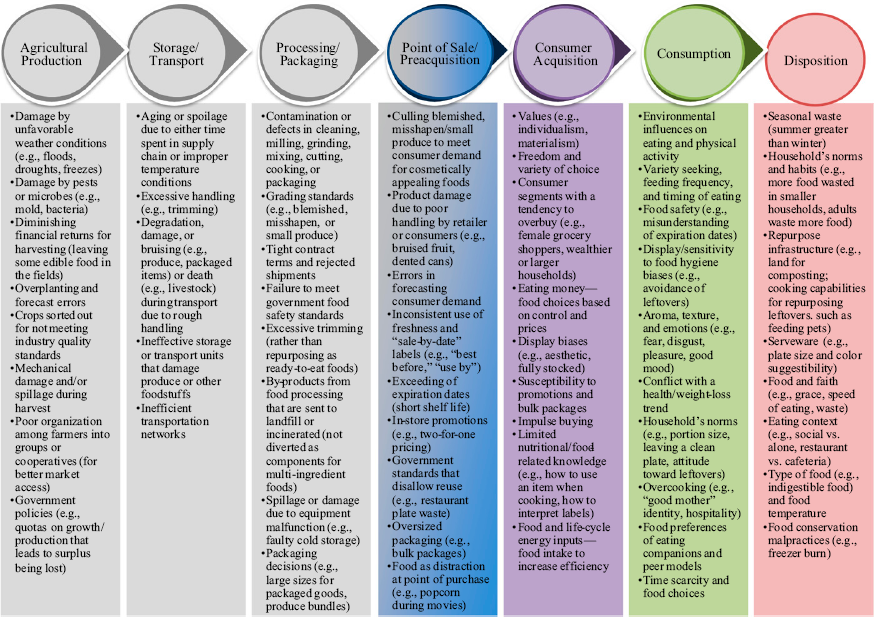
Major Sources of Food Loss: From Agricultural Production Through the Squander Sequence
Underlying Sources and Drivers of Food Waste within the Squander Sequence
We categorize the various theoretical drivers according to the squander sequence from preacquisition (point of sale) to acquisition to consumption to disposal (see Figure 1), but we do so for illustrative purposes only and recognize that these drivers may influence the decision-making process at multiple points. We recognize that our list is not exhaustive; it is our intention to spur future scholars’ creativity and interest in developing a more comprehensive theoretical overlay for empirical work related to food waste. Consequently, in our discussion of specific consumer theories and their potential impact on food waste throughout the squander sequence, we also suggest avenues for future research to articulate the specific role of these drivers of food waste, and we identify opportunities for consumer education and policy efforts aimed at attenuating food waste. Key research questions and pertinent behavioral theories are summarized in Table 1.
Theoretical Drivers and Sample Research Questions for Food Waste: From Consumer Preacquisition to Disposition

Retail Point of Sale/Consumer Preacquisition: Theories of Motivational Influence
The point-of-sale environment represents the intersection between producers and consumers, and it is here where marketing activities most directly influence consumers and initiate the squander sequence. Point-of-sale venues in the food distribution system include both retail (e.g., grocery stores, convenience stores, warehouse stores, farmers markets, vending machines, online sales) and food-service settings (e.g., restaurants, cafeterias, hospitals). Point-of-sale food waste is significant; according to the Food Marketing Institute (2014), every $1,000 generated by grocery retailers results in 10 pounds of food wasted, while restaurants have an estimated food loss of 4%–10% of food purchased for use by the restaurant in producing its products (Gunders 2012). At the point of sale, marketers are pursuing operational efficiencies to reduce food waste and thus lower their own costs, while at the same time encouraging and reinforcing consumer spending, which may contribute to food waste. At this preacquisition stage, consumers’ behaviors are often influenced by motivational biases that may be either consciously or nonconsciously activated by point-of-sale marketing; we now turn to two categories of such motivational drivers.
Evolutionary-Psychological Motivations
Visual staging cues that emphasize prototypical product aesthetics are used to bolster consumers’ perceptions of quality (and thus evaluations of price) and subsequently drive purchase (Zeithaml 1988). The aesthetics of produce, for instance, are highly censored by suppliers and retailers to ensure that consumers receive products that are unblemished and of the right color, size, and shape; for example, the culling of products based on quality or appearance grading is the major reason for postharvest losses of fresh produce (Gunders 2012). In addition to attracting consumer attention, visual food aesthetics act as critical cues in assuring consumers that a product is safe to consume. In research on minor packaging blemishes, White and colleagues reference an industry report that shows that 75% of shoppers would not buy frozen packaged foods if the product was damaged, and up to 55% of shoppers would reject the brand entirely if even one package showed signs of damage (White et al. 2016).
Consumer insistence on unblemished or perfect packaging may stem from people's evolutionary instincts to protect themselves from objects that might pose a threat to health or safety (White et al. 2016). Indeed, the danger of microbe-borne physical illness, particularly through ingestion, is thought to be the original domain and root source of the basic properties of contagion theory (Nemeroff and Rozin 2000). According to the laws of contagion, contact with a negative stimulus is often thought to be physically harmful or morally debasing. Contagion operates very powerfully in the food domain; people show strong aversions to foods that are deemed disgusting (e.g., food that has come in contact with a sterilized cockroach) or harmful (e.g., toxins even well below a harmful threshold level; see Nemeroff and Rozin 2000 for a review). Not surprisingly, then, the laws of contagion operate prolifically in the supermarket aisles and other retail point-of-sale venues. While meaningful imperfections, like a dent in a can, might reasonably be correlated with an increase in food-borne risks, even superficial imperfections, like a ripped label on a can, act as contamination cues that activate thoughts of health and safety (White et al. 2016). This deep-rooted evolutionary instinct increases food waste by reinforcing consumers’ rejection of any imperfect foods and marketers’ corresponding response to offer only “picture-perfect” fresh and packaged foods, thus creating a cycle of behavior reinforcement at the early stages of the squander sequence.
Likewise, rejection of imperfect foods might also be explained by other evolutionary psychological principles, like the belief that the beautiful is good. This “beauty mystique,” defined as “the belief that the beautiful is good, and the ugly is evil” (Synnott 1989, p. 611), can be traced back to the ancient Greeks (Homer, Plato, Aristotle; Holbrook, Block, and Fitzsimons 1998). Although it is typically applied to individuals and the societal tendency for people to judge and treat attractive individuals more positively than unattractive ones (Eagly et al. 1991), the beauty mystique is equally relevant to products and consumer goods. Trudel and Argo (2013) demonstrate that when a product is distorted (i.e., it looks more like garbage), consumers are more apt to throw it away than to recycle it. It is not difficult to extrapolate to the food domain, wherein consumers are more apt to waste food the more distorted or less prototypical it appears to the eye.
Identity-Signaling Motivations
Marketer actions both reinforce and are a response to consumer product preferences and desires for variety and abundance, creating a cyclical pattern that can promote waste in the system (Moscato and Stanton 2016). Western consumers expect that any kind of fish, fruit, or vegetable will be available at any time of year regardless of seasonality, which means that these items are shipped from greater distances and spend in more time in the supply chain, resulting in increased handling and spoilage and consequent food waste. Large assortments are appealing to consumers and drive consumer loyalty (Briesch, Chintagunta, and Fox 2009). The pressure for retailers to make fresh, prepared items available at any time of day can lead to large quantities of food being discarded (Bloom 2011), and recent estimates have suggested that this discarding represents an increasingly large share of food waste at the retail level (Gunders 2012). Indeed, the most notable drivers of food waste in restaurants are overly large menus, buffet formats, large portion sizes, and the challenges inherent in managing perishable inventory. There are 93.3 items on the average American restaurant menu (Datassential 2014); this high level of variety is a response to consumer preferences for and expectations of such diversity (Tristano 2015). Consistent with this idea, in the supermarket or packaged goods point-of-sale venues, research has also demonstrated that brands that offer more products are perceived as being of higher quality, in turn driving consumer choice (Berger, Draganska, and Simonson 2007).
Such consumer desire for abundance and variety might stem in part from the identity signaling that drives much of consumer behavior. For example, materialist consumers (i.e., consumers with higher levels of trait materialism) will acquire in order to bolster their internal sense of worth or signal their value, wealth, or power to others, even when they know that they do not actually need the good in question (Ahuvia and Wong 2002; Belk 1985; Dubois, Rucker, and Galinsky 2012). Materialism theory would thus argue that demand for an abundance or variety of food at point of sale, or the subsequent overacquisition of food, might substitute for connections to more transcendent means of self-valuation (Kilbourne, Grünhagen, and Foley 2005). Furthermore, having the means to waste food may itself be used as a signal of wealth and power, as in the notion of conspicuous waste (Veblen 2005). However, since one's food consumption may be fairly stable relative to one's acquisition, using food purchasing as a means toward materialistic ends is likely to lead to substantial quantities of wasted food.
A number of studies have linked overacquisition and overpreparation of food, as well as resulting food waste, to consumers’ (especially mothers’) desire to demonstrate that they are “good providers” (Evans 2011; Graham-Rowe, Jessop, and Sparks 2015; Porpino, Parente, and Wansink 2015; Visschers, Wickli, and Siegrist 2016). Consumers signal commitment to the well-being of the family through providing plentiful and beneficial nourishment. These intentions are manifested in the presentation of varied and healthy options, such as perishable produce, designed to cater to the idiosyncratic preferences of family members, which results in preparing and serving more food than can be eaten (Evans 2011; Graham-Rowe, Jessop, and Sparks 2015). The integration of findings from more qualitative and sociological studies may help consumer psychology researchers identify previously unconsidered influences on food waste.
Consumer Education, Marketing, and Policy Considerations that Affect Food Waste at the Preacquisition Stage
As discussed, consumers are apt to waste foods with unconventional, imperfect, or blemished appearances. To address this driver of food waste, consumer education campaigns like those initiated in Europe can teach consumers that ugly produce is still very much edible. The French grocery chain Intermarche's “Inglorious Fruits and Vegetables” television and print campaign, which uses bright graphics and photos to present malformed fruits and vegetables in a positive light, has been credited with selling 1.2 million tons of “inglorious” fruits and vegetables in its first two days and increasing store traffic by 24% (Yale Environment 360 2014). This campaign spurred similar campaigns in competitive retailers and in other countries, and it received one of London's prestigious graphic design awards for 2015 (Godoy 2014; Hohenadel 2015).
In addition to educational campaigns, making it easier for consumers to acquire ugly or imperfect foods will help reduce food waste. For instance, “Imperfect Produce” sells its namesake products through delivery services to consumers (Aubrey 2015a; see also imperfectproduce.com). Several new services that encourage consumers to acquire food that would otherwise be wasted may be unintentionally—yet successfully—disrupting the maladaptive identity-signaling drivers of food waste. In their place, consumers may adopt the new identity signals of being tech-savvy or socially conscious that are made possible through mobile technology. Consumers can download apps from services like PareUp and Gander that provide consumers with spontaneous discounts on food and drink at participating establishments that have overstocked or otherwise to-be-discarded foods.
In addition to providing discounts, a growing number of donation initiatives are rescuing food that would otherwise be discarded. In March 2016, Starbucks announced its FoodShare program, under which the company will donate 100% of its unsold food (e.g., sandwiches, salads) from its 7,600 stores to food banks (Kim 2016; see also starbucks.com). Starbucks is just one of many food retailers collaborating with the Food Donation Connection, an organization that helps food service providers with surplus food donate to relief banks; currently, Yum! Brands (KFC, Pizza Hut, Taco Bell) and Darden Restaurants (e.g., Olive Garden, LongHorn Steakhouse) are among the companies with the organization to redirect food that would otherwise be wasted (USDA 2013; see also www.foodtodonate.org). Such food rescue initiatives are not limited to retail or corporate donors. Ample Harvest, for example, is a nonprofit that enables home and community gardeners to donate excess garden produce to food pantries across America—an act known as “gleaning” (USDA 2013; see also ampleharvest.org). Likewise, the Food Recovery Network (FRN) encourages college students to form FRN chapters to rescue edible food from their campus cafeterias and deliver it to people in need (USDA 2013; see also foodrecoverynetwork.org).
The Food Waste Reduction Alliance (FWRA) has also attempted to bridge the gap between parties in the food service sector. A collaboration between retailers and food manufacturers launched in 2011 and facilitated by the Food Marketing Institute, the Grocery Manufacturers’ Association, and the National Restaurant Association, it is focused on increasing food donations and reducing the amount of food sent to landfills through recycling, composting, and recovering food (Food Waste Reduction Alliance 2015). Motivated by the cost advantages that accrue from maximizing the yield of purchased ingredients/goods, as well as the goodwill gained from maintaining more sustainable operations, the FWRA has developed waste assessment tools for firms, identified some best practices, and worked with policy makers to further the objective of food waste reduction. Impact analyses of such programs could provide insight for these and similar solutions moving forward. Building upon solutions at the preacquisition stage, we next turn to consumer acquisition to address biases in consumer planning and shopping, and to identify managerial and policy interventions to aid in waste reduction at this stage in the squander sequence.
Consumer Acquisition: Biases in Consumer Planning and Shopping
In the prior section, we considered waste that stems from marketer activities at the point of sale and the impact of these activities on consumers prior to acquisition. Next, we consider the psychological underpinnings of food waste at acquisition by identifying psychological theories that are likely to influence consumer behavior in planning and shopping.
Planning
Consumers are notoriously poor planners, with extant literature showing, for example, that individuals often misestimate inventory at home, in turn leading them to overpurchase food that they already have on hand (Chandon and Wansink 2006). More generally, consumers in many contexts fall victim to the “planning fallacy” (Kahneman and Tversky 1977), which is a tendency to underestimate how much time will be needed to complete a future task. In the context of food acquisition, this might lead consumers to underestimate the amount of time it would take to consume all the food in ‘their shopping basket, leading to the purchase of items that go unused and are thus wasted. Consumers also display a general optimism bias, such that they believe negative events are less likely to occur to them (vs. others; Lovallo and Kahneman 2003). This might lead to an overestimation of the useful life of purchased perishable items, such as meat, fish, produce, and dairy. Indeed, there may be more specific antecedents to these planning biases in the context of food acquisition, which might differ for single- versus multiple-person households.
Shopping
Biases are also likely to influence decisions made in a shopping context. For example, the present bias might lead to overacquisition, as consumers overweigh the immediate benefit or rewards of acquiring an appealing food product (e.g., taste, visual appeal) compared with the long-term outcomes of their purchases (e.g., nutrition, preparation). As previously mentioned, retailers’ deliberately appealing product aesthetics and displays may increase a consumer's desire for immediate gratification without thought of when or how a product will be prepared or consumed. Moreover, because visual cues—such as plate color and size—may encourage consumers to fill their plates in a food-service context (e.g., Van Ittersum and Wansink 2012), factors wholly unrelated to the food itself can contribute to increased food waste.
Similarly, consumers may display a naïve diversification bias (Simonson 1990) in placing a high value on variety at the moment of purchase (e.g., purchasing multiple flavors of yogurt). At consumption, however, desire may be for one most preferred item (e.g., a favorite yogurt flavor). As a result, nonpreferred items purchased for the sake of variety might be wasted. Understanding the drivers of these behaviors would lend insight into strategies for overcoming them, aiding consumers in making more prudent purchases that reduce food waste.
Value pricing and bulk packaging are also drivers of overacquisition and resultant food waste. For example, belief in a lay theory that “large is a better value” (Haws and Winterich 2013) can lead to overshopping. Furthermore, Bell and colleagues observe that unplanned purchasing is particularly strong for shoppers who patronize a single retailer due to a favorable pricing strategy (vs. multistore shoppers; Bell, Corsten, and Knox 2011). As with all drivers of increased purchase quantity, these strategies may increase food waste when consumers are faced with product spoilage or taste satiation (Inman 2001). Given the ubiquity of promotional strategies that increase the likelihood of food waste due to purchase quantity, exploring the psychological factors that drive consumer perceptions of and attraction toward these manufacturer- and retailer-based strategies would provide important insight on the issue of food waste.
Consumer Education and Policy Considerations Impacting Waste at the Acquisition Stage
A major theme in discussions of food wasted by consumers at the acquisition stage is a lack of planning and the ability to stick to a plan during shopping. Some educational programs have been enacted to aid consumers in this process. For example, the United States Department of Agriculture (USDA) created an online interactive program called Healthy Eating on a Budget (USDA 2015a), which includes interactive games, information and reminders on inventorying food in the home and planning meals for the week, tips and tools for making a shopping list, and advice for choosing the best options when shopping. These programs have primarily focused on educating lower-income consumers, with particular emphasis on the monetary costs of squandered food. In addition, as a part of its Supplemental Nutrition Assistance Program (SNAP), the U.S. Department of Agriculture (USDA) provides several mobile applications aimed at helping consumers to choose healthy meals or determine the safety of different foods. Although there are many publicly available shopping list and planning applications available for mobile devices, the USDA may want to invest in creating similar educational tools for home inventory and planning purposes.
Beyond these types of educational efforts, food waste could be further reduced if unused but wholesome food were donated by individuals, retailers, or food service providers. Unfortunately, food recovery efforts are hampered by donors’ fear of liability, particularly fear of food-borne illnesses. To relieve such concerns and to reduce the burden of having to comply with state-by-state liability regulations, in 1996 Congress passed the Bill Emerson Good Samaritan Food Donation Act. The Bill Emerson Act (BEA) absolves donors of potential criminal and civil liability for injuries that might result from donations, except in the case of gross negligence or intentional misconduct. The act “establish[es] a uniform national law to protect organizations and individuals when they donate goods in good faith.” 1 Food must be donated for the purpose of “encourag[ing] and enabl[ing] restaurants, grocers, and other donors to feed the hungry.” 2 This federal act does not preclude greater protection for donors; states are free to provide protection above that mandated by the BEA. Despite these protections, legal scholars have suggested that the BEA is an underutilized tool for food recovery, claiming that many food retailers are still not aware of the act and the protections it provides, and that some potential donors still believe it is illegal to donate food items (Haley 2013).
143 Cong. Rec. H7479 (daily ed. July 12, 1996) (statement of Rep. Danner).
143 Cong. Rec. H7478 (daily ed. July 12, 1996) (statement of Rep. Clay).
Sales taxes may also be used as a way to reduce unplanned, impulse purchases of unhealthy foods. When such goods are bought in large quantity, it may lead to waste of these as well as healthier, perishable items. A meta-analysis by Andreyeva, Long, and Brownell (2010) indicates that increases in prices on various food categories (e.g., sugary drinks, salty snacks) decreases consumption in these categories. A number of countries currently levy taxes on unhealthy foods and/or drinks, with sales tax laws in the United States beginning to appear at a more local level ( Economist 2015). Policy makers might consider greater taxes for certain types of food that, particularly when purchased in large quantities, can lead to greater long-term health problems and more wasted food. Extending our exploration of food waste at acquisition, we next explore contextual and motivational biases that influence consumers at the point of consumption.
Consumption: Contextual and Motivational Biases
Once food has been purchased, the consumer is faced with additional consumption-related decisions—for instance, which foods to eat, prepare, or serve. The psychology and consumer behavior literature highlights a variety of contextual and motivational factors that might influence these decisions and, in turn, influence food waste.
Context-Driven Choices
Relying on the availability heuristic leads consumers to make decisions on the basis of what comes to mind most easily when evaluating a decision (Tversky and Kahneman 1974). When consumers make decisions about what food to consume (e.g., what to eat for dinner), food that was purchased most recently (and therefore that is likely stored in a more visible location within the consumer's refrigerator, freezer, or pantry) is likely to be more accessible in terms of both physical proximity and memory; it is therefore more likely to be selected for consumption. This is particularly true when decisions are made from memory, relative to a more “online” decision process made with all information available (e.g., after evaluating items in the refrigerator or pantry; Hastie and Park 1986). Reliance on this heuristic is a potential driver of food waste because it reduces the likelihood of utilizing a “first in, first out” strategy for foods, which would help ensure that older items that are closer to spoilage are used before newer ones. Thus, consumer researchers could study the success of various food storage interventions at overcoming waste driven by availability. Alternately, researchers might explore ways to nudge choice beyond a set of items easily accessed from memory or even visually salient items, to a more comprehensive consideration set (e.g., items hidden in a cabinet or refrigerator).
Even if consumers are aware of their acquired food, their tendency to rely heavily on printed expiration dates might result in the wasting of usable food. The concept of anchoring and adjustment states that when people need to reach a judgment, they rely heavily on an available estimate, or anchor, and adjust this estimate as needed; however, final estimates are generally biased toward the anchor (Tversky and Kahneman 1974). Expiration dates serve as such an anchor; in fact, one study indicated that 17% of U.S. household waste was due to food products being past their labeled dates (Van Garde and Woodburn 1987). Although the adoption of expiration dates was a response to consumer concerns about product freshness, there is wide variation in the use of expiry date labeling, which creates confusion for both retailers and consumers (NRDC 2013). In fact, there are no federal regulations that govern different labeling conventions regarding expiry dates. Specific categories of labels are targeted toward business versus consumer use (although note here that these labels are not legally defined and are adopted voluntarily by marketers); for businesses, “production” date indicates when a product was manufactured, and “sell by” is the manufacturer's suggestion about when a product should no longer be offered for sale; for consumers, “best by” and “use by” are manufacturer estimates of when a food will no longer be at its highest quality (NRDC 2013). Although these dates are not directly related to food safety, 50% of consumers incorrectly believe that eating foods after their sell-by or use-by dates can put their health at risk (Ransom 2005), and foods close to or at their use-by date are perceived as less acceptable for consumption (Sen and Block 2009; Wansink and Wright 2006). Not surprisingly, food safety is indicated as a top reason why consumers waste food (Neff, Kanter, and Vandevijvere 2015). Interestingly, Sen and Block (2009) observe that consumers’ perceptions of food safety based on freshness dates were subject to an ownership bias; consumers indicated less risk and were more willing to consume food past its labeled expiration when they perceived ownership of the item (vs. when they did not)—an outcome explained by the endowment effect. Additional research on consumer perceptions of food dating is warranted in order to determine the extent to which consumers anchor on provided dates, as well as the process of adjustment, as a means of providing insight into the boundaries of a consumer's latitude of acceptance for consuming still-edible food close to or past the labeled expiration date. A reluctance by consumers to acquire food that is approaching its best-before date also has implications for well-meaning efforts by retailers to reduce waste by discounting food that will be discarded if not purchased soon; future studies might investigate whether, and the extent to which, this psychological barrier can be overcome by decreases in price.
Motivationally Driven Choices
The “how do I feel about it” heuristic (Pham 1998; Schwarz and Clore 1988; also known as the affect heuristic in Slovic et al. [2002]), which describes the mental shortcut in which an individual's current emotional state (e.g., pleasure, fear) drives decisions, is another potential factor in the decision to consume a food. For instance, consumers may rely on discrete emotions like disgust for an “expired” food rather than on more cognitive assessments, such as consuming older food items before newer ones. Disgust can also arise when consumable food becomes “contaminated” in the consumer's mind due to proximity to other items deemed disgusting (e.g., a disliked food item or a food consumed by another person; Morales and Fitzsimons 2007). While these emotional triggers that increase food waste are difficult to override with logic, future research should seek to identify emotional triggers that affect waste.
Self-regulation also plays an important motivational role in food consumption decisions. In the food domain, many consumers possess self-regulatory objectives to restrict food consumption for weight loss or other health-related goals. Unfortunately, a waste reduction goal may conflict with these pursuits; individuals attempting to control their diet may see disposal of already acquired indulgent food as a moral victory, in that it represents progress toward their goal of restricted consumption. Similarly, consumers attempting to diet may overacquire healthy foods as the aforementioned planning fallacy and optimism biases fail to take into account the likelihood of adhering to a strict eating plan; for instance, when fresh fruits and vegetables do not offer as much appeal as more tempting snacks, such healthy but perishable items are likely to go unconsumed, resulting in food waste. Thus, one direction for future research is to explore mechanisms that encourage consumers to adopt waste reduction as an additional self-regulatory objective in the food domain.
Consumer Education, Marketing, and Policy Considerations that Affect Waste at the Consumption Stage
As discussed, the dating terms that are printed on foods (e.g., “use by”) can generate confusion for retailers and consumers alike (NRDC 2013). Aside from infant formula, there are no federal regulations surrounding expiry date labeling, and state regulations vary widely (e.g., in Montana, milk is required to carry a sell-by date within 12 days of pasteurization, while New York, Wisconsin, and other states have no labeling requirements for dairy items; NRDC 2013). Although these dates are intended as markers of product quality, they are often interpreted as indicators of safety. This concern for food safety leads retailers to worry about the potential for harm (and subsequent liability), which then leads to a considerable amount of food waste when usable food is prematurely discarded.
Regulations specifying what terms can and should be used—and more specific guidance about the meaning of these labels—would provide clarity regarding what food is usable, potentially reducing food waste. Researchers and policy advocates have called for clarity and standardization for date labeling and have offered suggestions, including the following: (1) make sell-by dates invisible to the consumer (because they are intended for retailers); (2) establish a system for consumer-facing date labeling that is consistent with respect to wording and predictably located on products, and (3) provide a “freeze-by” date so that excess food can be stored for future use as opposed to being wasted (NRDC 2013). Consumer groups in other countries have been lobbying for additional labeling laws to require “open dating” in addition to the expiration dates already present on most packages; under this system, food producers would be required to list when the product was manufactured, alongside recommendations for sell-by or use-by dates (Harcar and Karakaya 2005). Such a system might allow for a more flexible consumption period and, as a result, less waste.
Meanwhile, policy makers might make efforts to educate consumers about expiration dates and what they mean for different products (e.g., milk vs. flour; Milne 2013). For instance, the United Kingdom reviewed its policies regarding expiry dating in 2011 to clarify when to use “best-before” versus “use-by” labeling (United Kingdom Department for Environment, Food & Rural Affairs 2011). The revised guidelines account for food perishability, the potential harm to humans due to spoilage, and the possibility of overcoming harm due to processing (e.g., cooking), and they aim to clarify consumer and retailer misperceptions that lead to waste (Milne 2013). Certainly such policies and policy changes must be accompanied by consumer education programs, so that consumer-facing date labels are understood. In the meantime, commercial ventures are attempting to fill this role. For example, the mobile app Green Egg Shopper provides estimates for the useful life of fresh and packaged foods; when consumers input purchased items in addition to their expiration dates, the app generates categories of food in terms of expiration dates so that consumers are aware of and can use items that are nearing expiration (e.g., “use me now” vs. “long life” categories; Gilpin 2014). In the next section, we build on our discussion of consumption to consider food waste that occurs at the final stage in the consumer decision-making process: disposition.
Disposition: Deliberate and Unintentional Biases
In the context of food waste, it is not possible to completely disentangle consumption from disposition because consumption choices ultimately affect disposition decisions. Along these lines, we acknowledge that the aforementioned heuristics and biases also influence disposition. In the next section, we discuss two categories of biases that are particularly relevant to disposition behavior: those that are deliberate and those that are unintentional. These categories acknowledge that consumers intentionally waste food in some instances, whereas other instances of disposition may not register as waste.
Deliberate Behavior
Often, what becomes household waste could have been be repurposed for other uses. One method is composting, which offers many environmental benefits; for example, the city of San Francisco enacted a mandatory composting program, resulting in significant reduction of greenhouse gas emissions (San Francisco Department of the Environment 2015). However, a 2015 survey indicated that 41% of respondents who compost said that because they compost, they are not bothered when they waste food (Neff, Spiker, and Truant 2015). This behavior is indicative of a phenomenon commonly known as the licensing effect (Khan and Dhar 2006), in which consumers’ virtuous choices and behavior (e.g., composting) may license less virtuous behaviors (e.g., wasting food). Research might consider the unintended effects of composting and other virtuous behaviors in the food domain (e.g., dieting) on food waste due to licensing.
Consumers may also exhibit biases when attributing the causes of food waste. When consumers eat out of home, for instance, food retailers (rather than consumers) typically determine portion sizes. Consistent with literature that shows that when decisions are delegated, the responsibility of the outcome is also delegated (e.g., Bartling and Fischbacher 2012), this determination of portion size might relieve the consumer of the responsibility for wasting uneaten food. Attribution bias may also hold in other settings in which consumers take or specify their own portions—such as buffets or at home—if consumers assign responsibility for food waste to the restaurant or cook, rather than themselves. Future research on attribution bias might consider whether consumers are, in fact, more likely to waste excess food when portion size is delegated and, moreover, the factors that lead consumers to attribute portion size to others versus themselves.
Unintentional Behaviors
The manner in which consumers categorize food types may affect food waste at disposition. Categorization theory suggests consumers generate internal categories for objects (like foods) based on repeated associations over time. In the present context, ad hoc categories related to food are likely to be strong determinants of a food's destiny—consumption or disposition. In one relevant study, Williamson, Block, and Keller (2016) show that more food is thrown away when a meal is eaten from a disposable (i.e., paper) versus a permanent plate. This is due to the development of categorical links between “permanent plates” and “consume” and between “disposable plates” and “waste,” in part because of the conditioned experiences of throwing away disposable plates along with the food that remains on them. Importantly, consumers do not intentionally dispose of more food simply because of the disposable nature of the plate; rather, they are unaware of this subtle nudge toward disposal. Future research both to better understand the process by which these and other implicit categorization effects manifest and to extend our knowledge to other food-related categories (e.g., meals vs. snacks; in-home vs. out-of-home dining) is important.
Finally, perhaps the most pervasive unintentional behaviors, and thus the most difficult to overcome, are those driven by habit. Habits can be thought of as heuristics in that they are simplifying strategies that reduce the effort consumers need to put into decision making (Wood and Neal 2009). Habits can lead to unnecessary disposition if, for example, consumers habitually discard food parts (e.g., the end slices of bread, the stems of vegetables). Maladaptive habitual cooking behaviors can also increase food waste. For example, many consumers buy ingredients for a particular recipe and then throw out any unused, yet still consumable, portion simply because they are not in the habit of using that ingredient in other ways. Fear of not having enough food or difficulty estimating portion sizes can lead to habitually cooking excess food; in an online survey of 1,200 consumers, 25% agreed that food waste comes primarily from overpreparing food, with 20% of respondents indicating that they prepare more than they plan to consume “just in case” (NSW Office of Environment & Heritage 2011). While some consumers cook extra in anticipation for meals in the days to come (NPD Group 2009), it has been shown that leftovers are the second-most-wasted food product, contributing significantly to food waste (NSW Office of Environment & Heritage 2011). Family habits, routines, and rituals may also contribute to food waste through the association of certain types of food with specific occasions or holidays (e.g., Wallendorf and Arnould 1991), resulting in foods being prepared (often in substantial quantities) simply due to tradition and regardless of whether they will actually be eaten. Certainly, creating disruptions to the context surrounding food decisions is essential to breaking bad habits and developing less wasteful new ones in the context of food disposition (Verplanken and Wood 2006).
Policy Considerations that Affect Waste at the Disposition Stage
Public policies to reduce food waste at the consumer level might address food disposition behaviors that are both deliberate and unintentional. With respect to the deliberate behavior of composting as an alternative to throwing food away, some U.S. cities have successfully adopted curbside composting programs through local government, while residents in other areas can pay to have compostables picked up at home (Sheppard 2012). While composting behavior reduces the environmental impact of food waste, research has suggested that it may result in increased food loss by reducing concern for food waste (Neff, Spiker, and Truant 2015). Future composting policies might take into account the successes (and failures) of citywide compositing initiatives and the resultant consumer behavior.
At the institutional level, particularly in school cafeterias, USDA National School Lunch Program policies and the Healthy, Hunger-Free Kids Act have unintentionally increased waste; research conducted with U.S. middle-school students has shown that the overwhelming majority of the vegetables now required to be on students’ trays (73%) end up as food waste—more than any other lunch component (Cohen et al. 2013). The USDA is currently tackling the side effects of such policies through aspects of its Food Waste Challenge; a countrywide initiative launched in 2013 aimed at reducing food waste, this program has specific guidelines for schools, ranging from techniques that encourage students to consume healthy foods (e.g., self-serving and self-portioning) to redirecting excess wholesome food to people in need (USDA 2013). Such coordinated efforts may work to further the goal of food waste reduction and stem the unintended waste from initiatives focused on wellness.
Experts have projected that a 15% reduction in U.S. food waste would feed 25 million Americans (USDA 2015b). Thus, reducing unnecessary disposition of edible food represents a crucial step toward overcoming the paradoxical global issues of food waste and hunger. To achieve such a large reduction of edible waste at the consumer level, federal public policies have recently addressed deliberate and unintentional food disposition on a national scale. In September 2015, the USDA and the Environmental Protection Agency announced national targets to reduce food waste and a national campaign to specifically target waste at the consumer level (USDA 2015b). Secretary of Agriculture Tom Vilsack sees the goals as an effort to “create a generation of Americans that are sensitive to food waste” and to encourage consumers to view wasting food as culturally unacceptable (Aubrey 2015b). This public campaign may serve to enhance conscientious behavior in food-service contexts in which consumers may otherwise decouple from their own responsibility for wasted food, and it may also disrupt unintentional, habitual food disposition during home preparation.
Conclusion
Clearly, understanding the psychological drivers that affect food waste throughout the squander sequence is an essential part of the effort to understand how we might collectively work toward reducing food waste. Without denying that food waste presents a major problem, we should also recognize that it offers rich opportunities for researchers. As suggested in the previous section, behavioral theory literature offers a multitude of theoretical constructs and mechanisms that map well onto various aspects of food waste. Table 1 presents some of the testable hypotheses that might be considered on the basis of this discussion. However, we anticipate that many more will be generated if food waste is analyzed through varying conceptual lenses and with the range of methodologies available to consumer researchers. Thus, we encourage the academic community to extend the work begun in this article by exploring these and other potential relationships that might be identified. Doing so would be both theoretically interesting, in that it may provide novel insights into the act of “nonconsumption” (as opposed to our standard focus on consumption), and, we believe, of obvious practical importance. The United Nations has set a goal to halve per-capita global food waste along the production chain by 2030, including specifically “food waste at the retail and consumer levels” (see United Nations 2015, p. 27, goal 12.3). This resolution, adopted at the 70th session of the United Nations General Assembly on September 25, 2015, is aptly titled “Transforming our World: the 2030 Agenda for Sustainable Development.” We call upon our transformative consumer research community to join the 193 member states in recognizing, researching, and applying transformative solutions for reducing food waste throughout the squander sequence.