







Abstract
This article provides a framework to guide the construction of transformative stories by social impact organizations (SIOs) including nonprofit organizations, public policy entities, and for-profit social benefit enterprises. This framework is built from the integration of the academic literature on narratives and narrative construction relevant to SIO story construction. This transformative story construction framework outlines how SIOs can assemble and craft authentic and effective stories that convey the organization's impact, engage audiences, and call those audiences to action as well as how SIOs can develop and manage a portfolio of such stories. The framework also provides recommendations to guide the marketplace practice of transformative story construction by SIOs. Finally, the authors pose questions to engage SIOs in collaborative research to refine the practice of constructing stories with the power to transform.
Keywords
Every day in the communities where we live and work, social impact organizations (SIOs) such as nonprofit organizations, government and public policy agencies, and for-profit social benefit enterprises work to address some of the world's most pressing social problems: poverty and health disparities, addiction and overconsumption, accessibility and food well-being, sustainability and waste, and racism and social justice. Organizations dedicated to these profound societal challenges frequently struggle both to adequately communicate the complex problems they are facing and to present solutions to these problems to their multiple audiences. In today's crowded and noisy marketplace, so many entities are trying to develop messages to capture the public's attention that it is difficult for SIOs to break through the clutter, effectively communicate their mission and impact, and move an audience to action.
For these reasons, many organizations focused on social impact identify stories as a vital marketplace tool that can provide insight into the intersectional social problems they address as well as secure audience attention, engagement, and action (Goodman 2015). Stories are character-centered narratives focused on the goals, motives, obstacles, and struggles a character faces over time (Haven 2007). In fact, 96% of nonprofits regard stories as central to their communications, and most expect the importance of stories for their organizations to increase (Dixon 2014). Such attitudes are well grounded: The Center for Social Impact Communication, for example, reports that “reading a story on social media” was the primary motivator leading donors and volunteers to offline actions such as giving and volunteering (Dixon 2013). That is because stories offer organizations seeking social impact the opportunity to build bridges between their cause or mission and their audiences in a compelling, memorable, and authentic way. Stories span worldviews and enable an SIO's constituents to see and feel the lives of the people the organization serves: a mother who struggles to feed her children, a drug-addicted teenager who lives on the streets, or a newly arrived immigrant learning to speak English.
Organizations that operate in this social impact space face challenges—and may become overwhelmed—when they try to identify and construct authentic and compelling stories that communicate the nature and impact of their work. Unfortunately, despite their intentions to relate a story, SIOs often do not craft their communications as a coherent story (Goodman 2015). An analysis of communications labeled “stories” by 150 nonprofits found that almost half were actually information summaries, profiles, and testimonials, not stories (Dixon 2013). Drawing on research on narratives and the story development practices of organizations focused on social impact, we develop an integrative framework designed to guide SIOs as they construct stories that authentically communicate the organization's impact, engage audiences, and motivate desired behavioral responses. We contribute to narrative research, which has focused on “storytelling” (how a teller communicates a story to an audience) and understanding the “story receiver” (how an audience interprets a story). This leaves “story making” ripe for consolidation and continued exploration (Visconti and Van Laer 2016); we fill that gap by offering an integrated conceptual framework to guide the process of story construction for SIOs.
Our SIO story construction framework offers a dual path to contribution by building from an approach described by Deighton et al. (2010) and a complementary approach proposed by Ozanne et al. (2016). Following Deighton et al.'s (2010, p. 2) advice for conceptual pieces, we develop an integrative framework for SIO story construction, with our contribution emerging from “organizing existing findings (about narratives and narrative construction) into a powerful yet simplified view that adds clarity and reduces complexity.” In keeping with Ozanne et al.'s relational engagement approach, which suggests a broadening of the assessment of research impact to include “the creation, awareness, and use of knowledge to (effect) societal impact” (p. 1), our multidisciplinary team of authors worked together with a wide variety of SIO stakeholders from the inception of this project to understand the challenges, needs, and requirements that SIOs face in constructing stories. Our work culminated in this research-based framework grounded in narrative knowledge designed to guide SIOs to identify and craft transformative stories.
We note that our SIO story construction framework offers guidance that is applicable to an increasingly diverse group of organizations, which is significant given that social impact is no longer the exclusive domain of the nonprofit and governmental sectors of our economy. Today, “financial success and social impact are becoming ever more linked with the lines blurring between the business and nonprofit sectors” (Arrillaga-Andreessen 2016). As an example, for-profit companies such as Warby Parker build their business model on dual foundations, selling fashionable eyewear online while also making a social impact by giving away glasses to those in need. New philanthropic ventures such as the Chan Zuckerberg Initiative are choosing not to form as a nonprofit or foundation, instead opting to invest in nonprofit, governmental, and for-profit organizations that advance social impact (Singer and Isaac 2015). Thus, to reflect the evolution in the landscape of organizations designed for social impact, we introduce the term “social impact organizations” to include nonprofit organizations, government and public policy entities, and for-profit enterprises with a social benefit mission.
Our current work begins with a definition of “story” and a presentation of the academic literature on narratives and narrative construction relevant to SIO stories. Then, we synthesize and integrate narrative research to formulate a story construction framework designed to fit the needs of SIOs. We outline how to develop and manage a portfolio of authentic and effective SIO stories. Finally, we put forth recommendations to guide the transformative story construction practices of SIOs and propose research to advance the process of SIO story construction.
Harnessing the Power of Stories
What is a Story?
Although there are many varied definitions of “story,” we rely on one used by consumer researchers and marketing practitioners that is meaningful to SIOs. Haven (2007, p. 79) defines a story as “a detailed, character-based narration of a character's struggles to overcome obstacles and reach an important goal.” This definition does not include some common interpretations of “story-based” communications employed by SIOs, such as descriptions of programs, series of facts, and information-based presentations. Furthermore, not all stories are good stories. Good stories carry emotional weight and trigger processing that results in compelling and enduring memories. Authentic portrayals are essential to good stories. Consider this story about Kids Tales, a nonprofit that offers creative writing workshops to underserved children. “Thank you for letting me have a voice. No one has ever done that for me before,” was the first full sentence out of eleven-year-old Alana's mouth during a week-long Kids Tales creative writing workshop. Alana was a shy girl and during the first few days of the Kids Tales workshop she mostly kept to herself as she worked diligently to master creative writing. But on the last day of the workshop, she called me over to her table and told me that never before in her life had she owned her own journal. Alana explained that she only ever got to write in school, and even then, only about what her teachers assigned. Outside of school, Alana was shuffled between her parents’ houses, had no space of her own, and rarely had a chance to voice her feelings. Through writing, Kids Tales gave her that voice. (Katie Eder, Founder, KidsTales.org)
Donors describe this Kids Tales story as “powerful,” “moving,” and “the reason I contributed.” It transmits information about the organization while also communicating the transformative capacity of Kids Tales. Why, though, would such a story be key to an SIO's ability to communicate complex societal problems and its impact on those problems? Next, we provide a brief review of the academic literature on the power of stories.
The Power of Story
Stories are a type of structured narrative that help an audience of consumers, readers, or listeners process and remember information (Schank 2000). In this view, people are creative story builders who record the world not by remembering disparate, isolated facts but instead by encoding and recalling stories. Thinking about the world through stories helps people organize and understand events and situations, as well as their own emotional responses to them (Bruner 1990). Stories enable people to comprehend what occurs in their lives by developing a goal-oriented account in which actions result in outcomes that provide meaning and purpose (Kerby 1991). Story-oriented thinking, known as narrative processing, comes naturally to people as they attempt to understand the world. Therefore, when an SIO tells a story, that story automatically evokes in the audience innate narrative processing (Mick 1987).
When processing a narrative—that is, when reading or listening to a story—people structure incoming information about story elements (settings, characters, and situations) into an organized framework or mental model (Zwaan, Langston, and Graesser 1995). This framework establishes relationships between the story's components and incorporates general knowledge about goal-oriented action sequences (Pennington and Hastie 1986). Because these story elements are organized through time, causal inferences about actions leading to outcomes can be made. What happens first (a single parent loses their job) causes what happens next (the parent goes to a food pantry). Research has shown that stories are encoded through a cognitive pathway that often leads to different outcomes than argument or evidence-based communications (Green and Brock 2000). This contrasts with the critical thinking characteristic of routine analytic processing, in which people discount information unless they are persuaded through favorable elaboration on strong arguments or relevant peripheral cues (Nielsen and Escalas 2010).
Narrative processing, in contrast, is likely to evoke the same kind of emotional response in people that they experience in daily life. For example, the audience members for a story can experience characters’ emotions vicariously as part of their temporary suspension of reality (Green and Brock 2000). Empathy, or understanding and experiencing the feelings of a depicted character, is one way stories transmit emotion, and it is associated with higher levels of story engagement and influence (Van Laer et al. 2014). The audience's processing and mental story construction can also facilitate emotional contagion, or an unconscious absorption of the emotion conveyed in a story (Van Laer et al. 2014). Social impact organizations operate in settings that naturally produce empathy-generating stories, making the emotional aspect of SIO stories especially powerful and persuasive. The audience's emotional response to an SIO client's story about a life challenge can catalyze positive behavioral outcomes such as volunteering, community support, or donations.
Narrative processing is also cognitively demanding, because the audience must update their mental model of the story as it moves forward (Zwaan, Langston, and Graesser 1995). One consequence of this cognitive effort is that audiences approach stories with lower initial levels of skepticism and a suspension of disbelief. When people are engaged in a story, they reserve evaluative judgments, accepting story-related information as “truth” within the story (McQueen et al. 2011). Thus, information encountered during story processing is initially accepted as true and must be effortfully “unaccepted” (Gilbert 1991). Shrum, Burroughs, and Rindfleisch (2005) suggest that people suspend disbelief to obtain pleasure from stories. Furthermore, experiencing a story is fundamentally enjoyable (Green, Brock, and Kaufman 2004), and people readily invest mental resources to process stories (Nielsen and Escalas 2010).
Authentic and honest storytelling can be a powerful tool to engage audiences and move hearts and minds. However, the power of stories comes with the risk that some people or organizations who do not value story integrity may fabricate or embellish stories for their own purposes. For example, the founder of the Central Asia Institute, an organization that built schools in Pakistan and Afghanistan, was accused of fabricating his story of origin and his organization's success in his book, Three Cups of Tea (Goldberg 2015). After this alleged fraud was revealed in 2011, the Central Asia Institute experienced steep declines in donations, forcing it to narrow its mission and eliminate school construction. Certainly, fraudulent stories can destroy an SIO, but they may also undermine legitimate SIO stories. Social impact organization organizational policies, procedures, and practices must safeguard and uphold story authenticity.
Another issue that arises is that SIOs may hesitate to share—or choose to soften—stories revealing the severe, complex, or prejudicial realities faced by the clients they serve, such as the homeless, children living in poverty, or adults reading at a third-grade level. By avoiding difficult stories or failing to report unsuccessful outcomes, SIOs may not provide their audiences with an accurate sense of the severity of a problem or the urgency of an issue. Because stories invoke empathic processing, they can be a critical tool for tackling taboo topics, stereotypes, and social stigma often associated with the people and issues SIOs serve. Social impact organizations should strive to tell difficult stories that balance the need for realism and understanding with the desire to inspire positive attitudes and support for an SIO and its social impact.
All too often SIOs set out to tell compelling stories about the pressing social issues they address but instead inadvertently produce informational reports, profiles, and testimonials. How can such reports, profiles, and testimonials—when appropriate—be transformed into stories? Next, we outline the essential components needed to craft a story.
Essential Elements of a Story
A story must contain three essential elements—characters, chronology, and causality—in which the latter two elements make up the story's plot (Escalas 2004). Stories contain characters that interact with each other and serve as agents of cause and effect by reacting to events. Chronology or time is configured in stories as episodes, each with a beginning, middle, and end. Stories organize events temporally, meaning that activity occurs over time (Bruner 1990). Finally, causality refers to the relationships among story elements that allow for inference making (i.e., the characters’ goals lead to actions that result in outcomes; Bruner 1990). When people process a story, they establish relationships among the story's elements by incorporating their knowledge about goal-oriented action sequences (Pennington and Hastie 1986).
Consider the following story crafted by Home Instruction for Parents of Preschool Youngsters (HIPPY), an SIO devoted to partnering with parents to prepare their preschool-age children for success in school. “My son, Jaquay's, love of reading and our bond as a family come from HIPPY,” said his mother, Tamara. Tamara opened the door to school success for her then three-year-old son Jaquay when a HIPPY Home Visitor arrived. Tamara met with a HIPPY Home Visitor 30 weeks each year for the next three years learning the skills she needed to prepare Jaquay for school. Jaquay entered first grade ready for school. Tamara wouldn't have dreamed that, 15 years later, Jaquay would be finishing high school and anticipating college. Nor that she, then a childcare worker with a few college credits, would be completing a master's degree, contemplating a doctorate, and working as the executive director at an early childhood education agency.
In this story, Tamara is the protagonist, or the focal character. The HIPPY home visitor and Jaquay are supporting characters who serve as the driving motivation for Tamara to overcome the challenge she faces. Tamara's intensive efforts to learn and then apply the skills needed to aid her son's educational development are the focus of the story's plot, which occurs over time, exemplifying chronology and character development: Tamara's initial state differs from her state 15 years later. The HIPPY home visitor's actions enable the change in Tamara and Jaquay. That is, Tamara and Jaquay's improved circumstances occur because of HIPPY.
SIO Story Construction Framework
An individual story about an SIO can be powerful and emotionally charged. Yet, for an SIO's stories to be most effective, they should relate to its mission and connect to relevant content about the organization. For example, SIO stories, like the HIPPY story reported in the previous section, often cast the SIO in the role of a causal agent that facilitates the change experienced by the protagonist. In this way, many such SIO stories over time reinforce how the SIO is accomplishing and living its mission. By contrast, SIOs sometimes present stories as “one-off” messages that are not connected to the organization's mission or social impact, potentially diminishing the impact of such stories for the SIO. In this section, we describe how SIOs can develop a strategic and layered framework for constructing authentic stories by crafting a metanarrative, building and preserving a story portfolio, identifying and crafting effective individual stories in the story portfolio, and appointing a master storyteller. We conclude our discussion of the story construction framework by providing advice on how to craft stories that move beyond the essential elements to become engaging, compelling, and memorable.
Crafting a Metanarrative
Social impact organizations can best leverage the power of individual and genuine stories—for example, the HIPPY story—when these stories are linked to a broader, overarching mission-focused story about the SIO and why it exists. We term this overarching story the organization's metanarrative. Stephens and McCallum (1998) define a metanarrative as a story about a story, encompassing, explaining, and uniting other “little stories” into an integrated whole. Figure 1 depicts how an SIO's metanarrative serves as an umbrella story and how each story (represented by the arrows labeled A, B, and C) the organization tells should authentically convey the SIO's mission and impact; be directed to a distinct audience; and strive to yield a specific behavioral outcome such as increased awareness, program attendance, community support for a new initiative, volunteers, or donations. A mission-focused metanarrative is itself a story—and, as such, it should possess the aforementioned structural components of stories: character, chronology, and causality.

Mission-Focused Metanarrative
Metanarrative Character
The main character, the protagonist, of the metanarrative is the organization itself. In a metanarrative, the organization is treated as a protagonist that has a history, undertakes actions, and hopes to achieve future goals. The mission-focused metanarrative is constructed to create the personality, objectives, and meaning of the organization. There may be other characters in the metanarrative—for example, employees, donors, and people served in the community. Even the community can be construed as a character in the metanarrative. All of these characters will interact with the organization—the protagonist—in the metanarrative over time, and their individual stories will be informed by the metanarrative and then told as discrete “little stories.”
Many organizations are founded by a person with the heart, passion, and drive to make an impact. Subsequently, this founder's story of why and how (s)he formed the SIO is a key story. However, the SIO also needs a mission-focused metanarrative that serves as the organizing center for every story it tells. For example, the American Red Cross features the story of its founder, Clara Barton. Yet the Red Cross is a global organization that serves at the front lines of disasters and transforms compassion into action “by mobilizing the power of volunteers and the generosity of donors” (Red Cross 2016). Thus, the Red Cross metanarrative is not the story of Clara Barton. In its metanarrative, the Red Cross is the central character.
Metanarrative Chronology
A metanarrative has chronology, conveying the organization's past, present, and future. The organization's past may encompass its history, its founder's story, and the societal issues it has addressed. Thus, the metanarrative includes the organization's “brand biography,” which is an unfolding story chronicling the brand's origins, experiences, and evolution over time (Paharia et al. 2011). The organization's present consists of the SIO's mission, values, programs, and strategic objectives: what the organization does and why. The mission-focused metanarrative should be a strategic story that articulates the organization's differential advantage, that is, the unique needs it meets relative to other organizations. Finally, the metanarrative includes both a description of what comes next for the organization in the short run as well as its long-term vision for the future. The greater focus should be on the long-term aspirations of the SIO—the road map of how the SIO hopes to achieve its organizational objectives and goals.
Metanarrative Causality
The third component of a compelling metanarrative is causality, or plot. A metanarrative should present goal-oriented characters who follow a course of action to achieve those goals, resulting in a final outcome (Stein and Albro 1997). A compelling plot focuses on conflict: the obstacles that the organization, the protagonist, must overcome to achieve its objectives. The mission-focused metanarrative should include a strategic demarcation of the goals of the organization; those goals serve as the foundation for why the organization engages in action such as offering programs or raising awareness in the community. Every SIO faces setbacks and challenges as it tackles the issues it addresses. The mission-focused metanarrative should highlight the organization's most important challenges and tell the story of a few of its critically important past failures and successes. Current challenges and actions, as well a description of what the SIO is doing today to achieve its goals, make up the “present” component of the metanarrative. The future serves as the motivating force that drives the organization into action and is the basis for evaluating whether the SIO achieves its goals (Pennington and Hastie 1986). In this sense, the SIO's metanarrative can play a role in setting the parameters used to evaluate its success.
Although an SIO's metanarrative includes the organization's “brand biography,” in the sense of its history and evolution, a metanarrative is distinct from a brand biography. A brand biography is a marketing mechanism intended to “enliven” an intangible brand's personality and enable it to connect to specific target audiences. In contrast, an SIO's metanarrative focuses on describing the aspirations and motives—the past, present, and future of an organization striving for social impact. It goes beyond the founder's story to track the progress and setbacks of the SIO's goal pursuit. In addition, an SIO's metanarrative functions primarily as an overarching story to guide the construction of authentic, individual stories. Paharia et al. (2011) call for research to explore the efficacy of brand biography as a rhetorical device for identification with a brand. In some sense, our notion of a metanarrative answers this call, as it moves the conceptual underpinnings of the power of narratives forward, into the realm of SIOs that strive to have a societal impact.
Whereas some SIOs struggle to help audiences understand the complex problems they address or the value of their programs, others make the mistake of assuming their audience already understands the problem and believes it is an important concern. Still other organizations tell interesting stories but do not do so in a way that advances their mission and objectives. A well-delineated metanarrative (1) explains the pressing social problems that motivate the organization to engage in actions, (2) includes a call to action, and (3) highlights the SIO's accomplishments and achievements to demonstrate its value to the community. Consider the Wisconsin Humane Society (WHS), a 137-year-old SIO that saves the lives of more than 24,000 animals each year (WHS 2016). In its metanarrative, the WHS is the hero/protagonist, whose story revolves around rescue, redemption, and happy endings. The WHS's metanarrative is about uniting adoptive families with rescued animals and treating all animals, and their human caregivers, with kindness and respect. The WHS metanarrative has a clear plot in which the organization plays a matchmaking role by identifying homes for animals and saving their lives. This metanarrative allows adoptive families, donors, and even families that surrender animals to become part of and visualize themselves in the WHS story.
Building and Preserving a Story Portfolio
The mission-focused metanarrative serves as the overarching story for an SIO. It becomes a tangible representation of the organization, encompassing a chronicle of its past, an accounting of its current actions, and a revelation of its future goals. After a metanarrative is developed, the SIO should build a story portfolio, a collection of individual, authentic stories that are derived from, and informed by, its mission-focused metanarrative. Each individual “little story” in the story portfolio should be directed toward a particular audience. By keeping the mission-focused metanarrative in mind during the identification and development of individual stories, each story the SIO tells can be consistent with its history, current strategy, and objectives. In this way, the metanarrative umbrella connects each individual story, linking each to the SIO's mission.
Social impact organizations need to expand their focus, moving beyond simply telling good stories to curating collections of stories that depict the breadth, expertise, and uniqueness of their organizations. The individual stories in an SIO's story portfolio should be assembled into curated categories or groupings on the basis of audience, programs, and an SIO's objectives. This portfolio of stories should be preserved in a story bank that remains available to the SIO and becomes a history of the organization in story form. Thus, the stories told by the SIO become part of the marketplace tool kit an organization uses to make progress toward achieving its mission and addressing complex social problems. In the age of social media, when the search for meaningful and engaging content is critical, curating a story portfolio provides a valuable opportunity for SIOs to widely share stories with impact.
Effective Individual Stories in the SIO Story Portfolio
Even a compelling individual story may fail to convey a clear message about the SIO to its audience. Such a story, then, would not be effective. What creates an effective story depends in part on the SIO's intention for the story—we use the term “effective” to describe a story that advances an objective set by the organization, as compared with a story consumed solely for entertainment purposes. Figure 2 demonstrates how each story identified and crafted by an SIO should be designed to reach an audience and accomplish a goal while reinforcing the SIO's mission-focused metanarrative. To this end, the process of crafting stories is iterative and includes refining stories as they are retold to a particular audience. The story refinement process does not affect what happens in the story but, rather, how the story is told. Thus, the story is authentic but is told in a manner that evokes emotion and captivates the audience. For example, when curating and refining a collection of such stories, one might ask: Does this story open residents’ eyes to the realization that hunger and homelessness exist in their own community? Does this story motivate additional financial support for a program? Do voters support public funding for a program shown to effectively reduce recidivism? Figure 2 depicts the relationship between each individual “little story,” its audience, the story objective, and the overarching metanarrative of the organization. Stories constructed using the process outlined in Figure 2 are more likely to be effective than those that are not.
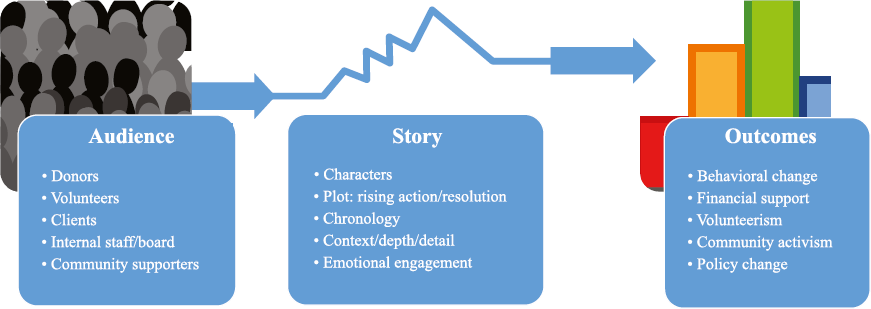
Individual Stories in the SIO Story Portfolio
Master Storyteller
To ensure that SIO stories function effectively, SIOs should appoint a “master storyteller.” The master storyteller is a member of the SIO's leadership team—frequently someone with experience in marketing, strategic planning, or public relations. Ideally, this person would have been part of the metanarrative development process, but even if this is not the case, the master storyteller should be intimately familiar with the organization's mission-focused metanarrative. It is essential the master storyteller ensures that each story the SIO tells is authentic and genuine, reflects the organization's mission-focused metanarrative, and is tailored to resonate with a specific audience (e.g., volunteers, clients, donors, the community at large). It is the responsibility of the master storyteller to build a tactical story portfolio, assembling individual stories that are derived from, informed by, and consistent with the mission-focused metanarrative. At the same time, the master storyteller should ensure that stories are carefully vetted for accuracy and validity and told in a way that engages audiences and maintains authenticity. In this sense, it is the master storyteller's responsibility to assure that the individual stories are authentic, effective, and connected to the SIO's mission-focused metanarrative, stewarding the strategic process of SIO story construction (see Figure 1).
Crafting Transformative Stories for the SIO Story Construction Framework
Stories vary in the extent to which they are engaging, compelling, and memorable; while some stories pull in viewers, others fail to “hook” the audience. Although the three essential elements necessary for story construction—characters, chronology, and causality—must be present, these alone are not enough to engage an audience and transform behavior. Certain features of stories contribute to capturing an audience's attention, engaging them in the story, and calling an audience to action. Drawing from the academic literature on narratives and narrative processing, we explore several features of stories that SIOs can leverage to enhance a story's power to transform: a narrative hook, character development, a climactic plot, a mission-motivated message, and literary craft.
A Narrative “Hook”
A narrative “hook” is a literary technique employed in the opening of a story that catches the audience's attention, ensuring that they will engage in the story (Escalas, Moore, and Britton 2004). One way to do this is to incite curiosity by using lines that require further reading or listening to understand. In such a case, the audience might ask themselves the following questions: What do the first lines mean? What's going to happen? Relatedly, starting a story at an important moment (in medias res) or presenting an unusual situation will increase the audience's desire to learn more and discover what will happen next. Another way to engage the audience with a hook involves presenting an interesting character. The promise of learning more about an intriguing character will draw the audience into the story (Haven 2014).
Character Development
Good stories feature characters the audience cares about. Social impact organizations can accomplish character development by providing details that make characters realistic and concrete. Good characterization gives the audience a strong sense of characters’ personalities and complexities; it makes characters vivid, alive, and believable. Characterization can be direct, as when a story tells readers what a character is like (e.g., “Tyrone was a smart child”), or indirect, as when a story shows what a character is like by portraying his or her actions, speech, or thoughts (e.g., “Tyrone always knew the answers to the math teacher's questions”). Descriptions of a character's appearance, behavior, interests, and mannerisms are all part of characterization. Stories written from a third-person point of view (an external perspective looking in on the world of the characters) achieve characterization in these ways. For stories written from the first-person point of view (the perspective of the narrator looking out on the world), the narrator's voice, or way of telling the story, is an additional source of characterization. A first-person point of view has been shown to make a story more compelling. Audiences make more inferences and exert a greater effort to construct an interpretation when a story has a well-developed first-person perspective (Feldman et al. 1990). Furthermore, access to a character's thoughts and feelings facilitates the audience's ability to empathize with the character, thus adding depth, engagement, and persuasiveness to the story (Escalas and Stern 2003). A first-person point of view also enables the audience to hear the voice of a person whose life has been affected by an SIO (e.g., a mother unable to feed her children, a child struggling to read). Such characterization is a critical element of stories because it offers a bridge—a human connection—between an SIO's cause or issue and its audience, who may have a different life experience from the mother living in poverty.
Engaging stories also portray characters that develop or evolve, either in the way they view their world or in the way that their world views them, usually as a result of resolving a central conflict or facing a major crisis. For example, a story that features a person who changed his or her behavior, life, or stance on an issue after an interaction with an SIO makes a story relatable. Character development not only helps the audience move into and through a story but also affects the message the audience derives from the story. For example, the story of a homeless man whose life improves as a result of obtaining job skills training through an SIO may illustrate one of the ways in which an SIO helps clients.
Climactic Plot
There are five essential components necessary to convey a story's plot: what was done (the action), when or where it was done (the scene), who did it (the actor), how the actor did it (the instrument or agency), and why (the purpose or intention) (Burke 1969). However, even with these five components, not all story plots are good plots. Stories that are expected, or consistent with everyday experience, usually evoke little interest or attention. In contrast, engaging stories feature memorable, distinctive plots. Research has shown that scripts or sequences of expected behaviors for a given situation score low on measures of story quality (Brewer and Lichtenstein 1981). However, if a story is too novel, or if it departs too far from expectations, it may be difficult for the audience to understand, resulting in confusion or inattention (Escalas and Stern 2003; Wang and Calder 2006). Thus, a story's plot should balance the commonplace with the novel.
Relatedly, a narrative imbalance in a plot, or content that is unusual or unexpected, has also been shown to improve a story's quality (Lucariello 1990). This imbalance can take the form of a breach in normative expectations about how people should behave or how stories should unfold (e.g., a hospice patient attending a cocktail party). A narrative imbalance can also provide tension between story elements, such as actions that fail to achieve goals (e.g., a homeless shelter's unsuccessful attempts to help a woman living under a bridge). Therefore, stories that follow a straight path from problem to solution may not engage the audience (Brewer and Lichtenstein 1981). Drama that arises from uncertainty about an outcome or from unexpected twists and turns as the story unfolds holds an audience's interest. Although SIOs may hesitate to incorporate story elements that show some of the most challenging dimensions of their cause, the realism of that difficulty, as depicted in a story, may be what engages the audience on an emotional level. These imbalances in the plot lead to increased elaboration as the audience attempts to explain the imbalance and understand the story (Lucariello 1990). Thus, not every SIO story has to have a happy ending to make an impact.
It is important to point out that the structural configuration of a story, or the sequence of events in its plot, can determine how well it elicits an emotional response. For example, a character making progress toward the realization or achievement of a goal elicits positive responses from the audience (Lazarus 1991). Gergen and Gergen's (1988) work suggests that a story in which the protagonist's situation rapidly improves, worsens, or alternates between the two should be especially good at generating emotional responses. Plots can be sequenced in a way that generates suspense or surprise, both of which enhance evaluation of a story (Moulard, Kroff, and Folse 2012; Tal-Or and Cohen 2010).
Mission-Motivated Message
An SIO story should clearly feature all relevant information as well as a moral or take-away message. For example, a hospice aiming to inform potential clients about its services should illustrate the use of those services in the story. Relatedly, one clear, central message woven throughout the story will be more effective than a message that makes a singular appearance or one that has to compete with many subplots. A clear moral that manifests at several points throughout the story, and in different ways, is a hallmark of both great literature and effective stories. For example, in its stories, an SIO focused on youth education should highlight the importance of that theme, perhaps by showing how the SIO's services providing access to education made an important difference in the lives of its clients. Such stories could prompt reflection from potential donors about the importance of education in their own lives. In this way, the story's message about the value of the organization is not only layered onto the audience's personal experiences about value of education but also anchored to the SIO's mission-focused metanarrative.
Finally, many SIOs want some type of positive behavioral outcome in response to a story (e.g., donate, volunteer, vote), which may require that stories contain a clear call to action. For example, SIOs seeking donations should not only demonstrate how a viewer's donation can help ensure certain beneficiary-focused outcomes but also ask for support. However, Holt (2002) articulates the difficulty that SIO storytellers face when they walk the fine line between telling engaging stories and making persuasion attempts to influence donations. If receivers sense underlying motives and view the story as “sponsored persuasion” (Holt 2002, p. 85), story engagement may be inhibited. Some stories may be used to simply raise awareness of an SIO's services among a target audience. In these cases, accurate portrayal of services will aid effectiveness. Overall, the story's goal should be determined a priori, and the plot and time sequence of how the story is told should be crafted to lead the audience naturally to the desired outcome.
Literary Craft
Story writing has long been considered an art form, and certain story qualities can enhance a story's artistic appeal. Stories that contain immersive imagery, including concrete depictions of characters or vivid descriptions of a scene (Kim et al. 2012; Zillmann 2006), are considered to be of higher quality than those that do not. If readers can picture the characters and scene of the events described, they are more likely to become engaged with the story. Furthermore, writing that is designed to encourage self-referencing within the narrative (e.g., “imagine you are” rather than “imagine a mother is”) has been shown to have a positive effect on shaping opinions and perceptions in a social marketing context (Van Laer 2014). The creation of mental imagery and audience identification through self-referencing is more likely to lead to impactful and lasting persuasion than fact-based narratives, which prompt a more analytical processing style. Ultimately, it is the details of how the stories are told that determine whether they are compelling, engaging, and memorable narratives.
Conclusion
Building on the narrative processing literature, we propose a framework for transformative story construction by SIOs, including nonprofit organizations, public policy entities, and for-profit enterprises engaged in social benefit. This framework offers a methodology to guide SIOs as they craft authentic and compelling stories with the power to transform. An SIO begins by crafting a metanarrative—a story about what the SIO is and why it exists—which becomes the overarching umbrella and point of connection for each individual SIO story. Then, the SIO, guided by its master storyteller, identifies and constructs individual stories that connect to and are consistent with its mission-focused metanarrative. All of these SIO stories are banked and preserved in a story portfolio. Each individual story crafted by the SIO, including the SIO's metanarrative, should be authentic, genuine, and cognizant of the key features of a good story, including a narrative hook, strong character development, and a climactic plot.
Implications for Marketplace Practices and Policy Makers
Our framework for constructing SIO stories offers a strategic structure for the marketplace practice of assembling transformative stories and adds to the narrative processing literature by proposing a formalized story construction process. One challenge SIOs may face in implementing this transformative story framework is deciding which stories to tell. On the surface, it may seem wise to craft and share stories that illustrate an SIO's success. However, stories that lead directly from a problem to a solution may not paint an authentic portrayal of many SIOs’ history and experiences. After all, the solutions to pressing social problems such as poverty, addiction, climate change, or racism are not straightforward or simple. Furthermore, if only success stories are told, this may undermine an SIO's ability to communicate the complexity of a social problem, portray challenges in a way that is relatable to those who struggle, or demonstrate an ongoing need for support. Although a heroic success may demonstrate what is possible and motivate audience support, that story alone may not reflect what is probable or convey the challenging and difficult road facing SIOs.
A second practical consideration in crafting stories for SIOs is selecting the appropriate length for a story. As a result of consuming information on digital platforms such as Facebook and Twitter, consumers’ appetite and attention span for longer stories seems to be waning. The American Marketing Association reports that the average attention span of a web user is eight seconds, giving SIOs an extremely narrow window in which to capture attention and draw audiences into a story (Litt 2014). By necessity, many stories crafted by an SIO will need to be relatively short. Yet crafting an engaging story may take time and space. The recent popularity of serial podcasts that explore a story as it unfolds demonstrates that although consumers’ attention spans are often limited, they still crave engaging stories. Furthermore, consumers have shown a renewed interest in the long-form drama, but on their own terms, as evidenced by viewers’ obsession with binge watching and a shift from mainstream television to streaming content online. So, in addition to the features of a story outlined in our transformative story construction framework, storytellers need to assess an audience's attention span as well as the best mechanisms and media platforms for engaging them in a story. Such assessments will become more important as social media evolves and new opportunities to share stories arise.
Our transformative story construction framework offers additional benefits to SIOs. A well-crafted metanarrative can aid in the development of brand equity, or a distinct brand identity that is clearly differentiated in the marketplace, which is increasingly important for SIOs as they compete for resources (Becker-Olsen and Hill 2006). Furthermore, a SIO's metanarrative and story portfolio can also advance authentic and genuine portrayals of itself, which helps combat skepticism among consumers. Authenticity is about an SIO practicing what it preaches and being clear about what it is and what it does best. When an SIO's storytelling rhetoric is out of sync with consumers’ actual experiences, the brand's integrity and future persuasiveness suffers. Thus, an SIO's transformative story practices must be built on organizational truths and be compelling enough to persuade the different audiences of an SIO that its actions are consistent with the SIO's objectives to be considered authentic (Grayson and Martinec 2004).
Finally, SIOs not only engage in activities that offer direct services to people and communities; they also work to promote and influence social policies that will have a positive impact on pressing intersectional social problems. Such SIO advocacy programs to influence social policy, as well as efforts by policy makers themselves to promote particular actions, would benefit from our story framework. Policy makers can utilize stories to educate citizens about important social policy and legal reforms needed in the communities in which they serve. By developing targeted stories strategically constructed to reach an audience and accomplish an objective, policy makers may use stories as a marketplace tool to change behavior, beliefs, and attitudes (Ricketts 2015). Stories that increase audience engagement and systematic effortful processing of the message may prove to be quite persuasive in changing attitudes and encouraging action required for advancing social impact (Shintaro et al. 2015). Furthermore, audiences remember stories more than other forms of communication (Schank 2000).
Directions for Further Research
This conceptual framework provides only a starting point for understanding transformative SIO stories. Further research should continue to explore the story construction practices of SIOs using a relational engagement approach (Ozanne et al. 2016). Can SIOs tell negative stories and still accomplish desired outcomes? Indeed, because stories invoke empathic processing, they may be a critical tool for tackling taboo topics, stereotypes, and social stigma often associated with the people and issues many SIOs serve. Research is needed to help SIOs understand how to tell difficult stories that balance the need for realism and understanding with their desire to inspire positive attitudes and support for their organizations and social causes. Further research should also help SIOs understand how to develop stories that successfully navigate the narrow line between advancing their cause or initiative and evoking skepticism about their authenticity and motives. More research is needed to understand the differences between the use of stories as a marketing tool and stories that are solely entertainment. While some SIOs have an innate affinity for storytelling, the story construction framework we propose may help other SIOs learn this vital practice.
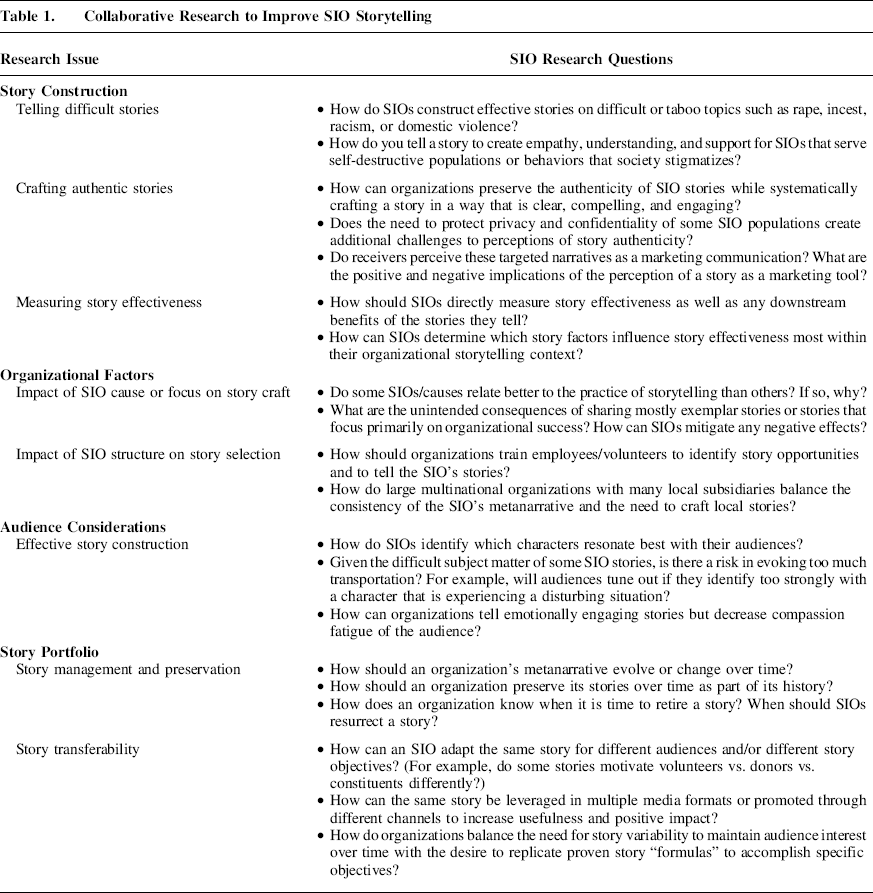
More research is also needed to help define effective story management practices. What constitutes an effective story bank, and how can organizations maintain this fluid initiative? How can an organization develop a culture to identify and cultivate stories? When should stories be retired or resurrected? What new technology tools can SIOs use to capture, store, catalog, and share stories efficiently? Are there negative consequences of telling only stories that represent the outlier as opposed to the typical situation? How can organizations prevent audiences from developing compassion fatigue? How do large multinational SIOs with many local subsidiaries effectively utilize stories? These questions are best answered by working directly with SIOs to better understand the unique and challenging situations they face when crafting compelling stories to advance their individual cause. Table 1 puts forth a series of research questions we uncovered as we met with SIOs to develop this framework. By engaging in collaborative research to refine SIO storytelling best practices, we may also develop a broader set of tools to guide SIOs as they unlock the transformative power of storytelling.
Collaborative Research to Improve SIO Storytelling
Given the potential dark side of stories by organizations with intentions to deceive, research should also investigate policies and regulations that help protect consumers from fraud or intentional deception. Misuse of a marketing tool—in this case, transformative stories—does not mean we should not work to enhance the story construction practices of SIOs. However, we need research and creative thought around procedures and remedies for promoting and preserving authentic and genuine SIO stories. Research could also help investigate how SIOs should respond through story when scandal in their cause or competitive space produces spillover effects that could have negative ramifications. We echo the call of prominent transformative consumer researchers (e.g., Andreasen 2012; Davis and Pechmann 2013; Hill and Martin 2014) for more scholarly research focused on how to tackle pressing intersectional social problems—in particular, the benefits and drawbacks of transformative stories.
In summary, our framework for SIO story construction is a response to an appeal by Stewart (2015, p. 3) “for the marketing discipline to take a broader view of its contribution. This means taking on bigger problems, with more general analyses of society's provisioning needs and how to best ensure that societal needs are met efficiently and effectively. It also means offering more creative market-based solutions to important social problems.” This transformative story framework is a marketplace solution, a tool that bridges the academic research on narrative construction to enrich SIO practice. This SIO story construction framework promotes authentic communication of pressing intersectional social problems and aims to move people to action—for example, by giving, volunteering, and engaging in desired behavioral outcomes. People enjoy stories and actively try to experience them. This story experience stands in sharp contrast with the didactic, admonishing, or tedious messages that many consumers have come to expect from SIOs. Communicating stories with impact enhances the likelihood of SIO success in engaging an audience, motivating behavior change, and transforming individuals and society.