







Abstract
The Federal Trade Commission's “do-not-call” program successfully cut the number of telemarketing calls for households that registered. Time savings and fewer interruptions are real benefits. However, telemarketing was one of the most successful marketing tools that firms used to offer lower-priced consumer telecommunications services directly, and do-not-call regulations largely eliminated this advertising method. The authors estimate that the average U.S. household will have between $19 to $39 in increased long-distance costs annually as a result of forgone lower prices because of do-not-call regulations. The Federal Trade Commission's do-not-call policy is not a free lunch. The hidden cost of higher telephone service prices that will continue into the future is a less obvious but real cost of this policy.
One year after the law came into effect, consumers had registered 62 million telephone numbers. Consumers also registered 428,000 possible violations, and 200 companies had 100 or more violations. Reports of two surveys on the FTC Web site state that 60% of surveyed consumers registered their telephone number; 87% claimed that they received fewer calls. A second survey found that 92% of registered consumers reported receiving fewer calls; 25% claimed that they received no telemarketing calls at all (FTC 2004).
Individual consumers decide to forgo many telemarketing offers by placing their telephone number on the list. Consumers can “opt out” by registering in a national database; this limits the number of (unsolicited) sales calls they receive. However, calls from charities, political campaigns, pollsters, and companies with which the consumer has an ongoing business relationship are not prohibited. The immediate benefit of enrolling is clear: fewer annoying telemarketing calls. However, most consumers may not be aware that their individual actions, coupled with the actions of millions of other consumers, may raise telecommunications prices.
Similar policies by several states before the FTC actions allow observation of the probable impact of do-not-call regulations in the telecommunications market. According to Worldcom (2002), Florida and Georgia required nominal yearly consumer fees for enrolling in their do-not-call registries and had low levels of consumer participation. Beginning in 1999, Arizona charged consumers a $5 fee, which yielded a 1% participation rate as of the summer of 2002. Oregon also charged fees ($6.50 for a new listing and $3 for renewal) and had a participation rate of approximately 3.4% of eligible lines as of the summer of 2002. 1 State and FTC actions suggest that consumers will participate in a do-not-call registry when it is free, but most are unwilling to pay even nominal fees to avoid some telemarketing.
State do-not-call regulations may have suffered from an inability to influence calls made from out of state as a result of interstate commerce issues.
The Cost of Do-Not-Call Regulations to the Telemarketing Industry
The purpose of this article is to provide a preliminary analysis of the possible consequences of the do-not-call program in an industry of substantial importance: U.S. telecommunications. Our thesis is that implementation of a successful do-not-call policy may not improve consumer welfare, even if the policy has 100% success in removing unwanted calls. This perverse result can occur because telemarketing solicitations played an important role in competition between service providers in this industry. We use standard welfare economics techniques to provide rough estimates of the welfare impact of the do-not-call policy in U.S. telecommunications; this is the first article that we know of that provides any attempt to estimate the effect of the policy empirically.
We organize this article as follows: First, we offer an overview of the telemarketing sector in the United States and the regulation limiting its operations. We then examine the connection between telemarketing and competition in the U.S. telecommunications industry. Next, we illustrate how the do-not-call policy may plausibly affect the telecommunications prices that different households pay. We then use simple welfare economics calculations to provide rough dollar estimates of the possible consumer welfare effects in telecommunications. Although speculative, our findings suggest that the do-not-call program is not an unalloyed benefit for consumers: Even modest rises in long-distance prices create substantial harm from the policy. The benefit to society of fewer annoying telephone calls may be an overall “good policy” in the eyes of many, but this benefit is not a “free lunch.” In short, fewer annoying calls may come at the cost of higher telecommunications prices.
Telemarketing is a major U.S. industry. Counting only outbound calls, in 2001, telemarketing generated $274.2 billion in sales, representing 27% of all consumer direct marketing sales and 4% of total U.S. consumer sales. It is estimated that the telemarketing industry employed 4.1 million workers in 2001 (Direct Marketing Association 2002).
The federal do-not-call registry was accompanied by additional FTC regulations called the Telephone Consumer Protection Act of 1991. Many of these rules and regulations impose either a direct tax on the telemarketing industry or regulations that increase the cost of telemarketing operations. As a whole, the Telephone Consumer Protection Act imposes considerable additional costs on the telemarketing industry, which may drive marginal operations out of business and leave their employees out of work. The direct costs of surviving firms will increase.
The FTC is charging telemarketing companies $29 per area code and a maximum annual fee of $7,250 to access the list. The FTC anticipates that it will generate $18.1 million in fees, which is four times the original estimate of the regulatory cost of the program and exceeds 10% of the FTC's total annual budget (Mainstream Marketing Sources Inc. et al. v. Federal Trade Commission 2003). Because abiding by the do-not-call list is a requirement to use telemarketing legally, this fee acts as an $18 million direct tax on the telemarketing industry.
The FTC also mandated that predictive dialers may abandon no more than 3% of calls answered by a person and must also deliver a prerecorded identification message when abandoning a call (FCC 2003, p. 44144). Predictive dialers increase productivity of telemarketing operations by computer dialing many numbers simultaneously and transferring only the calls picked up by a person to a telemarketing operator. With the mandate that a maximum of only 3% of predictive dialing calls can fail to have a human operator pick up within two seconds of the connection being made, telemarketers will be forced to employ more operators to keep the abandoned call rate within acceptable minimums, which will directly increase telemarketing operating costs. Again, increasing costs associated with this rule will force some companies out of business and will cause others to shrink operations and/or raise prices to cover the higher costs.
Most significant, the FTC regulations will place many millions of customers beyond the range of legal contact by telemarketers, substantially reducing the effectiveness of this form of advertising. The overwhelming popularity of these regulations is a testament to the real costs imposed by telemarketing operations. However, as with most policies, the telemarketing ban is not without potential problems. As a partial ban on advertising, telemarketing restrictions may have anticompetitive effects on industries in which telemarketing plays an important competitive role. We believe that long-distance telecommunications is one such industry. Before discussing this in detail, we briefly review the theories of advertising on which our argument is based.
The Effect of Advertising and Direct Marketing on Market Price
One of the most fundamental insights into the importance of advertising to consumer welfare is Stigler's (1961) observation that advertising reduces the cost to consumers of learning about market alternatives. Grady (1981, p. 222) observes that “when sellers know that consumers are more likely to find the good buys, they will be less disposed and less able to offer bad buys.” When truthful advertising is restricted, consumers become under- or misinformed, which makes it more likely that they will make poor brand choices. In turn, this misdirects economic activity and reduces consumer welfare (Beales 1991). Robert Pitofsky (1966, p. 56), a former chairman of the FTC, stated that the commission had “an understanding that unnecessary restraints on truthful advertising can be as harmful to consumers as deceptive or unfair advertising.”
The information contained in advertising can both reduce search costs and boost market efficiency (Ratchford et al. 1996). Several empirical economic studies have shown that markets that allow advertising of professional services have significantly lower prices (Benham 1972; Bond et al. 1980; Cady 1976; Schroeter, Smith, and Cox 1987). The impact on market price and competition is not limited to price advertising. Benham (1972) finds that consumer prices are lower even in markets that allow only nonprice advertising than in markets that ban advertising completely. Increases in consumer welfare from advertising have also been found for near commodities, such as gasoline (Maurizi and Kelly 1978). Higher consumer prices occur when advertising restrictions are more stringent (Benham 1972; Jacobs et al. 1984). Abernethy and Franke's (1998) meta-analysis finds that when FTC regulatory actions are most stringent, overall levels of advertising information fall.
In long-distance telecommunications, telemarketing has historically been a fundamental tool of competition. Many residential consumers learn about new competitive rates from direct calls (Worldcom 2002). Furthermore, because virtually everyone is presubscribed to some local and longdistance provider, such calls, by necessity, target rivals' customers. Finally, it appears that the offers made in these calls frequently stress price reductions and other objective, economically relevant factors, such as free minutes and cash awards.
For consumer telecommunications, telemarketing serves as a primary method of price competition, and therefore telemarketing limitations could raise prices. North American Telephone Network offers low-cost domestic and international long-distance service to 20,000 customers in the United States. The firm claims that the FTC's new rules and regulations on telemarketing would result in a dramatic loss of its customer base (North American Telephone Network 2002).
Perhaps the clearest indication of the impact of the FTC regulations on consumer telecommunications prices comes from Worldcom on behalf of its subsidiary MCI (Worldcom 2002). The final FTC regulations prohibit telecommunications companies from contacting their rivals' customers to offer lower-priced services if that customer is registered on the federal do-not-call registry. However, the regulations do not prohibit a telephone company from contacting its current customers. This is an important distinction because it presents a direct impediment for a new entrant in a consumer telecommunications market to offer a lower price to the customers of more established companies. The majority of customers who switched to MCI did so in response to telemarketing efforts (Worldcom 2002).
MCI developed an integrated package of unlimited local and long-distance service called “The Neighborhood” for a low price. MCI signed up half a million customers to The Neighborhood in only eight weeks, the majority of whom were acquired through telemarketing. Because customers of the current local telecommunications provider may not be aware of the MCI offer, it is critical that a cost-effective means of reaching those customers is available. According to MCI, most customers reached through telemarketing were unaware that they even had a choice of local telephone service providers. MCI found that local market penetration was 60% greater in states without a do-not-call list (Worldcom 2002), and MCI's market share was considerable, though Baby Bells dominated local service (see www.pacecoalition.com). Making telemarketing much more expensive (if not impossible for large market segments) is not a blanket prohibition on consumer advertising. However, telemarketing calls were self-evidently the most cost-effective method of consumer telecommunications price competition (as was evidenced by its widespread use), and FTC limits on this tool impede price competition.
According to Andrew Graves (2002), senior manager of marketing strategy and policy for MCI, state do-not-call lists had a substantial negative impact on MCI's ability to compete by raising the costs of marketing lower-priced telephone services to residential consumers. He goes on to state (p. 3), “Thus, state do-not-call lists mean that some customers might never learn that they have a choice for local phone services, killing local competition before it even takes hold.” For this reason, the national do-not-call registry, which is far larger than the combined state lists, may impose a significant increase in marketing costs to companies offering lower prices for local and long-distance consumer telecommunications services. The remainder of this article develops simple welfare economics estimates of the costs and benefits of do-not-call regulations to the U.S. economy.
The Economics of Do-Not-Call Regulations
Any competent determination of the social welfare effects of do-not-call regulations will be a complex matter. It is not our goal to provide any final resolution to this issue. However, it is possible to identify what plausibly will constitute a valid and relatively complete list of factors on which any credible evaluation must be based. Furthermore, it is possible theoretically to determine the positive or negative welfare effects that these factors will have on any evaluation.
Broadly speaking, there appear to be two primary categories of consumer welfare effects that must be associated with restrictions on telemarketing. First, unwanted telemarketing calls impose an externality on those receiving them. The costs of this irritation and inconvenience are not borne by the callers, nor may the targeted customers costlessly avoid the calls in the absence of some do-not-call-type mechanism. Although it is certainly true that many recipients buy goods or services offered by telemarketers, this alone is not evidence that telemarketing causes no substantial social burden. Second, telemarketing restrictions will probably reduce competition and raise prices in some industries. If widespread, this effect should be considered a social cost of the telemarketing restrictions to consumers, and these costs could exceed the benefits resulting from mitigation of the externalities of irritating calls.
Externalities
Households have some property right with respect to who uses their telephones to call them. However, when people buy telephone services, no guarantee is made that they will receive only calls they want to receive. Customers may buy additional services, such as caller ID, that allow them some ability to screen calls. The courts have traditionally held that peoples' homes enjoy a special and unique status with respect to privacy expectations (e.g., a person may avoid door-to-door solicitations by posting a no-solicitations sign). The right to avoid unwanted sales calls may be considered to spring from the same logic.
Following traditional economic logic, in general, too many solicitations will be made in an unregulated environment (ignoring their other effects), and the institution of a do-not-call mechanism may improve social welfare by driving the number of such calls closer to its efficient level. Presumably, on average, people who bother to register on such a list reveal that they object to such calls more than do those who do not enroll. This makes the analysis of the optimal number of such calls more complex.
An additional complexity arises here, even when the competitive consequences of the do-not-call ban are ignored: Advertising often has a “prisoner's-dilemma” character insofar as the extent of a firm's advertising reduces the benefits that other firms obtain from advertising. Thus, even if there were no other welfare effects of advertisements and no externality arose at all, the industry equilibrium advertising profile may be socially inefficient. Because our focus is on the welfare of consumers, we skirt this issue in what follows.
Telemarketing, Competition, and Prices
If bans on telemarketing result in a reduction in competition in some industries (e.g., telecommunications) and an associated increase in prices, the costs of higher prices may exceed the benefits of reduced external costs. All else being equal, increased prices due to reduced competition will likely benefit sellers and harm customers. It is not necessary to understand the actual mechanism by which such a result occurs to make a credible evaluation of the net effects.
Any ban on telemarketing will result in diminished competition, which in turn will raise prices above the price level obtainable with telemarketing. Telecommunications markets have relatively complex pricing dynamics. Most households are already presubscribed to a calling plan. Telecommunications companies often have a large percentage of customers enrolled in old calling plans with prices considerably higher than those offered by newer alternative calling plans. Thus, many telecommunications providers serve customers with similar services under a bewildering array of prices. For our purposes, it is important to distinguish between prices paid by “old” customers (i.e., buyers who have been presubscribed to a carrier for some time) and prices paid by “new” customers (i.e., buyers who switched to the carrier recently in response to an attractive offer). With so-called churn rates (i.e., rates of customer switching) in residential telecommunications estimated at 30% per year (Sevel and Xu 2003), substantial price disparities exist among customers.
Given this, we can conceptualize the telemarketing/pricing problem that firms face as follows: Assume that firms select standard prices for service to presubscribed customers and select prices to offer rivals' customers whom they try to recruit. These latter prices would depend directly on prices the targeted customers enjoy with their current provider. Therefore, firms have an incentive to moderate their standard prices to reduce the extent of customer recruitment by rivals. Thus, the occurrence of telemarketing can be expected to affect both standard prices and special-offer prices pitched by telemarketers and others.
Telemarketing is expensive. More important, as with virtually all economic activities, telemarketing undoubtedly exhibits diminishing returns: Given prices, a doubling of the number of successfully recruited customers more than doubles telemarketing costs. In addition, telemarketing efforts expand until, on the margin, they are not profitable. Therefore, the extent of telemarketing depends (at least indirectly) on the prices that rivals charge because these prices determine how great discounts must be to attract other firms' customers.
Thus, we expect that a ban on telemarketing will have three primary effects on telecommunications consumers. First, consumers will enjoy fewer interruptions (especially during dinner hours, except for those calls from their current providers, politicians, charities, other firms with which they have current dealings, and so forth). Second, consumers will be less frequently alerted to lower telecommunications prices that competitors offer. As we discussed previously, before do-not-call regulations, telemarketing was a primary tool used to inform consumers about alternative telecommunications plans with lower prices. Because firms act rationally, we believe that before the ban, telemarketing was the most effective way to gain new customers through low-price offerings. Unlike other forms of advertising, telemarketing allows consumers to act immediately to switch providers, something not possible with other means of advertising. Recipients often gain substantial savings as a result of these offers. Given the lower effectiveness of other means of persuading consumers to switch telecommunications providers, we expect that there will be fewer effective offers of lower-priced options.
Third, even if consumers intend to remain with their more costly carrier, they may experience higher prices because of the diminished incentives for carriers to “protect” their pre-subscribed customers through more attractive pricing. In brief, telemarketing is a cost-effective means of attracting new customers because by offering lower prices, it can potentially persuade customers to make an immediate decision to change providers. Eliminating the ability of competing firms to contact the customers of their rivals directly with low-price telephone offers will, in turn, give companies less incentive to offer lower prices to all current customers to discourage them from switching to rival providers. (These effects may be demonstrated in a theoretical model, which is available from the authors on request.) A related analysis is offered by Fudenberg and Tirole (2000, p. 653), who note that “firms price below static equilibrium levels when trying to poach from their competitors.”
On the basis of the market preference for telemarketing offers of low-price long-distance service before the do-not-call registry, many firms found telemarketing to be the most cost-effective means of gaining new customers. The do-not-call regulations did not ban other forms of advertising, such as direct mail or television, and if other forms of advertising are close substitutes for telemarketing, the do-not-call regulations will have a minimal impact on consumer prices (Baye and Morgan 2001; Butters 1977). However, we doubt that other forms of advertising will be close substitutes for telemarketing in offering low prices for long-distance service for the following reasons.
First, the firm making the telemarketing offer will contact the customers of rival firms because the firm making the offer has a list of its current customers. This virtually eliminates the problem of improperly and expensively sending advertising to current customers. Second, telemarketing enabled the low-price offer to be made such that the customer could decide to change providers immediately. In contrast, direct mail or other advertising requires the potential customer to receive the offer, notice the offer, and take the additional action of making a call to switch providers. Third, in general, personal selling and a human being asking for the customer's business has also been proved to be more effective in generating sales than less personal forms of communications, such as direct mail or television advertising (Belch and Belch 2004).
These considerations enable us to examine the potential welfare effects of the telemarketing ban. Combining statistics from recent FCC telecommunications trends reports with some speculation enables us to determine the broad outlines of the expected welfare effects. However, the do-not-call initiatives will affect many industries, of which telecommunications is only one. Although considerable telecommunications price competition occurred as a result of telemarketing before the do-not-call regulations, it is possible that other industries also used telemarketing to compete on the basis of lower prices. Thus, it is impossible to evaluate the economywide effects credibly, so we limit ourselves to this much more modest simulation, which actually provides far more conservative estimates of welfare losses than we would achieve if we considered all industries. Our results are probably indicative only of the magnitudes of the effects and should not be taken literally. However, to our knowledge, our estimates of potential consumer welfare losses are the only such estimates to date.
Consumer welfare change due to the ban arises from the combined effects of higher prices and fewer unwanted telemarketing calls. We can focus on possible price effects if we assume that the program reduces welfare losses from calls by telecommunications telemarketers to zero (the optimal, though unlikely, policy result). There are two potential price effects of telemarketing offers. First, consumers responding to these offers enjoy an immediate price savings or other valuable benefits. Second, increased competition from telemarketing yields lower market prices, even for those who do not switch.
We turn now to a speculative but plausible series of numerical simulations in an attempt to estimate (at least to orders of magnitude) informally the possible welfare costs of the do-not-call policy. We base our simulations on the following assumptions: First, do-not-call regulations reduce the rate of consumer switching to lower-priced plans. Second, do-not-call regulations further prevent price cuts to consumers who do not switch because competition is reduced. Finally, these welfare effects may be credibly approximated by evaluating the consumer surplus changes that such effects imply in a “representative agent” context. The validity of our calculations rests both on the correctness of these assumptions and on the input values we use to “calibrate” the welfare expressions. We pursue this speculative course because the entire issue of the competitive consequences of do-not-call regulations seems to have been largely ignored in the rush to adopt this popular regulation. It is important to at least ask, What are the possible costs of this policy?
If we suppose that the prices paid by nonmigrating consumers are ΔP higher in the absence of telemarketing-based competition and that migrating customers, recruited by telemarketers, enjoy a cost savings of d per unit, loss of these price cuts would cause economic damage, given by the surplus measure ΔS:

where D(s) represents service demand, λ represents the proportion of consumers who retain their original provider (i.e., not switching to a discount plan as a result of telemarketed solicitation), and p represents an appropriate starting price. By obtaining credible parameter values and expressions for D, P, ΔP, d, and λ, we can evaluate the integrals in Equation 1 and calculate how large the per-line irritation of telecommunications-related telemarketing calls must be for the ban to improve consumer welfare. We turn now to this issue.
To begin, we make use of official FCC telecommunications trends data for the years 1999–2001 to calculate average prices (denoted average revenue per minute, or ARPM, in the telecommunications literature). These prices represent a combination of new-plan low prices and old-plan high prices. We find that average prices for direct-dialed, interstate long-distance calls were $.11 per minute in 1999, $.095 in 2000, and $.08 in 2001. Furthermore, using the midpoint year 2000 as a basis, the U.S. monthly average among all customers was 225 minutes per month per switched access line. We use this latter figure to “calibrate” our representative demand curve.
For individual representative demand, we use an observed and reasonable price elasticity of -.7 (Phoenix Center 2004; Taylor 1994) and note that originating domestic long-distance minutes per line amounted to approximately 225 minutes per month (FCC 2002, Table 10.2). Thus, we approximate long-distance demand per line for our simulations as

The constant is selected to cause the demanded quantity to equal 225 originating minutes per month at a price of $.095. We choose this price because it is reasonable and because it is the midpoint ARPM for the years 1999–2001.
Using www.cheaplongdistance.com to examine per-minute charges for interstate long-distance services, we find that costs can be lowered substantially below observed ARPMs. State-to-state calling plans that provide rates as low as $.02–$.03 per minute with minimal fees are available. Therefore, we make the quite conservative assumption that customers who switch to discounted plans merely receive either a $.02- or a $.03-per-minute reduction in average rates. Although speculative, such an assumption appears quite reasonable.
In addition, we need to make some credible assumptions about switching/churning and about the effects of the do-not-call policy on these values. Fortunately, we can borrow the estimate of a 30% churn rate of residential users from the work of Sevel and Xu (2003), a figure somewhat lower (and, thus, more conservative) than that obtained by extrapolation from changes in ARPMs using the telecommunications trends numbers. The churn estimate of .30 is an annual figure, which is derived from surveys conducted 12 months apart. Thus, if 30% of lines are switched in a year, in an average month selected at random, one-half of these (or .15) are considered already switched. Because not all switching is due to telemarketing, we use λ = .85 and .925 and (1 –λ) = .15 and .075 in Equation 1. (Caution should be applied to churn data because of the heterogeneity of subscribers.)
Finally, we must produce an estimate of the reductions in average or standard prices that arise from competition facilitated by telemarketing sales of discount plans. As we demonstrated previously, because telemarketing has long been the major means of competition in long-distance service markets, it may be assumed that banning telemarketing will have a noticeable effect in this industry. Fortunately, we can obtain a plausible value by applying the churn rate of .30 per year to the ARPM series obtained from the FCC. In particular, suppose that we accept the (conservative) $.03-per-minute value for ARPM savings when switching to a discount plan. Given a churn of 30%, we can then calculate the change in standard prices per year that are necessary to cause observed ARPM to decline as indicated by FCC figures. For example, in 1999, ARPM was $.11. It fell to $.095 in 2000, during which time presumably 30% of accounts switched to a discounted plan $.03 per minute cheaper. Given this, the average prices paid by nonswitches would necessarily need to fall by approximately $.008 to drive ARPM to $.095. A similar calculation for the years 2000–2001 yields a ΔP = $.011. Again, not all price reductions should be attributed to telemarketing. Thus, we take the values ΔP = $.01 and ΔP = $.005 for our calculations.
We can now perform the calculations indicated by Equation 1, taking P = $.095, λ = .85 and .925, d = $.03 and $.02, ΔP = $.01 and $.005, and Q = 43.3p-.7. Table 1 presents the results of the annual long-distance simulated losses per household. Depending on the assumptions used, the annual costs range from a low of $18.84 to a high of $39.12 per household. The equation is flexible so that readers or policy makers with different assumptions about consumer longdistance price increases resulting from do-not-call regulations could easily input these assumptions into the model to estimate the household costs of the regulations.
Simulated Losses in Consumer Welfare Due to Assumed Price Changes as a Result of Do-Not-Call Regulations
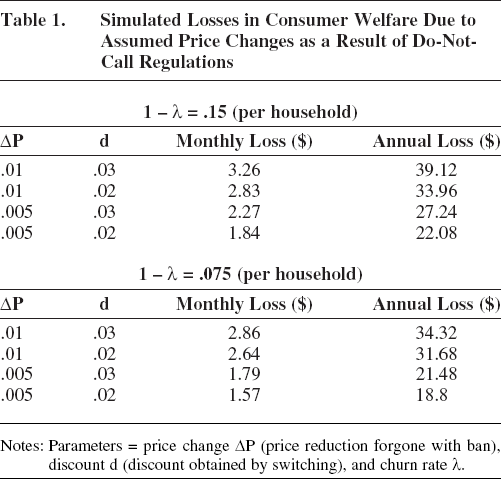
Notes: Parameters = price change ΔP (price reduction forgone with ban), discount d (discount obtained by switching), and churn rate λ.
Discussion
We can use these figures to place bounds on the benefits a telemarketing ban in telecommunications must exhibit for it to be worthwhile to consumers. We believe that the price effects assumed in our calculations could reasonably be taken as a measure of telemarketing's price-cutting impact, but even if the benefit is only a fraction of this, it is not clear that the ban will improve consumer welfare. Recall that we focused only on long-distance telecommunications services telemarketing. Is it reasonable to believe that average households would pay $18.84 to $39 annually merely to avoid calls from that subset of telemarketers that offer them discounts on long-distance telephone service? Given the current prevalence of “bundled” sales of toll service, local calling, and Internet access, actual losses may greatly exceed those shown here. We also do not consider potential price savings from telemarketing in other industries. For these reasons, it is likely that our estimate of the consumer benefit necessary to make do-not-call regulations a consumer welfare gain is conservative.
It is important to emphasize again that our calculations refer only to long-distance telecommunications. This industry is not the only one affected by the FTC list, though for reasons we discussed previously, we believe that it is both unusually dependent on telemarketing and particularly important to the economy. Suppose that the welfare losses due to the ban in telecommunications constitute X% of the losses in the entire economy. Then, selecting X to correspond to prior expectations, it is possible to determine, in a crude fashion, the minimum amount of harm unwanted calls must inflict on consumers for the ban to improve consumer welfare. For example, using the minimal figure of $18.84 for telecommunications market harm and X = 33.3, telemarketing abatement would need to be worth approximately $56.60 per U.S. residential access line per year to justify the policy. For some consumers, this may be a reasonable price to pay for fewer interruptions at home, though others may disagree. Yet this is precisely the sort of analysis that was not done before actual implementation of the do-not-call regulations.
In general, the calculations we provide herein are a rough insight into the possible unintended consequences of the telemarketing ban. For some industries, telemarketing plays a crucial role in fostering price competition. People forgo those benefits when, as a society, they ban an important form of advertising. The commonplace observation that no one enjoys unwanted sales calls is, by itself, insufficient to establish the public value of the ban. Some consideration must be given to the price and welfare impacts.
Other forms of long-distance communication, such as cellular service and Internet telephone service, could act as a restraint on long-distance prices, though recent empirical evidence finds that cross-price elasticities between cellular and wireline service are as low as .05 (Rodini, Ward, and Woroch 2003). However, do-not-call regulations will also make an advertising method that has proved to be effective as a means of offering low-price long-distance service unavailable to these telecommunications providers. The advertising restriction may affect Internet long-distance service the most because it is the newest entrant in the market, and the average consumer has the least knowledge of this service.
The FTC do-not-call policy is not a free lunch. The consumer benefit of fewer interrupting telephone calls is obvious and valuable to many. However, the hidden cost of higher telephone prices or a slowing of the rate of price decreases that will continue into the future is less obvious. The real issue is not the welcome result of fewer interruptions or whether consumers gain economic and social benefits from fewer interruptions, but whether the cost per household that arises from potentially higher consumer telephone rates is a price worth paying for this benefit.