






Abstract
The authors focus on the organ donation scene in Singapore and explore the range of marketing activities and responsibilities of the primary organ procurement agency in Singapore, the National Kidney Foundation. The authors examine Horton and Horton's (1991) model of willingness to become a potential organ donor and apply it with modifications to a sample of 368 multiracial Singapore residents. The authors find that, in addition to altruistic values and product knowledge, spiritual beliefs surrounding organ donation have an impact on a person's willingness to be a potential organ donor. The authors discuss implications for marketers and policymakers.
Social Marketing and Organ Donation
To be labeled social marketing, a program must apply commercial marketing technology, have the influence of voluntary behavior as its bottom line, and primarily seek to benefit individuals/families or the broader society (Andreasen 1994). Organ donation programs do not fall under the traditional categories devised by Andreasen (1994), because they do not benefit the target consumer or his or her family (e.g., programs designed to promote breast self-examination or the immunization of children), benefit the society at large (e.g., programs that encourage consumer recycling), or have joint beneficiaries (e.g., efforts to induce drivers to obey speed limits, which would help save the lives of drivers and their passengers). Therefore, it may be difficult to convince potential donors of any tangible benefit accrued to themselves from participation in such a program. It is therefore not surprising that the implementation of marketing techniques to the organ donation cause has met with little success (DeChesser 1986; Horton 1991). Although problems such as the intangibility of the product and the nonmonetary price of purchase may be inherent in organ donation (Prottas 1983), the general unfavorable public attitude toward organ donation may be a bigger obstacle. Several researchers have attempted to understand the factors affecting attitude toward organ donation (Belk and Austin 1986; Goodmonson and Glaudin 1971; Parisi and Katz 1986). It has been recognized that there is a pressing need to understand psychological motivations behind the decision to donate organs (Shanteau and Harris 1990) as well as provide a greater cross-national and cross-cultural perspective on issues in organ donation (Harris and Shanteau 1990).
Background on Singapore
Singapore is a small city-state with a population of 4,017,733 (Singapore Census of Population 2000a). The people are largely descendents of immigrants from China, the Malay Peninsula, and the Indian subcontinent who have gradually developed a Singaporean identity while retaining their cultural heritage (Ministry of Information and the Arts 1994). Singapore is considered a multiracial, multireligious, and multicultural society, with four distinct ethnic groups— the Chinese, the Malays, the Indians, and the Eurasians, who are often classified with minority groups under the label “others” (Lai 1995). The local ethnic composition has remained relatively stable in the past decade. In 2000, the Chinese formed 76.8% of the resident population, and the Malays and Indians constituted 13.9% and 7.9% of the resident population, respectively. The ethnic groups in Singapore share some common characteristics, but in certain respects, they also exhibit distinct differences in their views of life and values (Kau and Yang 1991). Each has its own cultural background and its own dominant religions and languages (Kuo and Tong 1991), and there is a correlation between ethnic group and religion, particularly among the Malays and the Indians. Table 1 shows the breakdown of the resident population by ethnic group and religion for the three main ethnic groups.
Resident Population Ages 15 Years and Older by Ethnic Group and Religion

Source: Singapore Census of Population 2000.
Spiritual Beliefs regarding Organ Donation
Spiritualism encompasses religious and other beliefs belonging to a paranormal belief system that is (1) inexplicable in terms of current science; (2) explicable only by major revisions in basic limiting principles of science; and (3) incompatible with normative perceptions, beliefs, and expectations about reality (Alcock 1981; Braude 1978; Clark 1977; Leshan 1966). Such beliefs could have implications for a person's personality structure and functioning (Tobacyk and Milford 1983). Bruce (1999) defines spirituality as a transcendental pursuit and a practical revenue for establishing connections with others. In Singapore, spiritual beliefs are mostly regarded as a legacy from the ancestors, handed down from generation to generation. They exist in people who believe in them but who do not have the benefit of further investigation and research (Mohtar 1979). In our study, the scope of spiritualism encompasses beliefs pertaining to religion, the paranormal, and superstitions, each of which has been closely intertwined with spiritualism. Definitions of religion have ranged from “wish fulfillment” (Malinowski 1948) to the “beliefs in spiritual beings” (Tyler 1979). Religion/spiritual belief has important defense functions in providing ways of managing tensions and anxieties (Lessa and Vogt 1972). Historically, the quest for survival has driven the belief that paranormal powers could be manipulated. Therefore, methods to overcome difficult situations were developed and practiced (Heinze 1993).
The Chinese in Singapore demonstrate a combination of logical clarity and naive trust in their approach toward spiritualism. Despite the religious shift among the Chinese, many of whom have abandoned traditional beliefs (Taoism) for Christianity, Buddhism, and atheism (see Table 1), many Chinese remain fairly spiritual, even superstitious. According to the Chinese, one of the most vital but erratic factors affecting everyday life is luck. Although luck is generally considered to be predestined, the effects of bad luck can be reduced and the benefits of good luck can be reaped with the assistance of gods and ghosts (Wee 1976b). For example, birthdays make a person lucky, because they symbolize a rejuvenation of his or her life span. All conceivable matter, colors, and numbers hold some meaning to the Chinese. When asked about their reaction to the number 4 (which denotes “death” in the Cantonese dialect), the Chinese express the greatest reservations in having the number 4 in their licenses or registration documents (Kau and Yang 1991). The Chinese hold the numbers 2 and 8 in high regard, because they represent prosperity and, more important, completeness. Similarly, most Chinese consider removing an organ from their body appalling, because it destroys the complete person. Many Chinese in Singapore are Buddhists and believe that deeds in this life influence the birth to another life (Wee 1976b). This concept of rebirth, as well as that of ancestor worship practiced by all Chinese regardless of religion, challenges the concept of organ donation. The Chinese believe in keeping their organs and bodies intact in anticipation of being reborn as human beings; otherwise, they may be reborn as imperfect beings with physical handicaps caused by the donated organs (Comber 1969). The same belief explains why most Chinese express their preference for burial (over cremation) after death (Comber 1969).
Malays, most of whom are Muslims in Singapore, have a strong attachment toward tradition (Kau and Yang 1991). The chief tenet of Islam is the belief in one god, Allah, and the creed does not allow the representation of human or animal form, lest these images be turned into idols (Chatfield 1962). Among the Malays, there exist several spiritual beliefs and taboos related to the human body. For example, a married woman (pregnant or not) should avoid dangerous activities, because such actions may arouse feelings of fear and her baby might be born with deformities or imperfections. Muslims believe that their bodies are given to them by Allah in a pure and perfect state and that they should return their bodies in the original unadulterated states when they leave this world (Nagata 1974). This explains the Islamic prohibition on alcohol and on eating or even touching pork (Chatfield 1962). The belief in the need to retain the body in its original state and be buried intact (The Straits Times 1999b) leads most Muslims to believe that they must not donate their organs. Even though the Islamic Religious Council of Singapore refutes this (The Straits Times 1999e), the Muslims in general hold a (mistaken) belief that the Islamic faith prohibits organ donation (NKF 1999).
As for the Indians, many of whom are Hindus, the important elements of Hindu traditional practice are votive pattern, rebirth, and mediumship (Babb 1974). Hindus believe in entering into contracts with deities by vowing to perform various acts when the deities grant their requests. They also believe in the functions of mediums as agents of communication between human beings and deities (Mialaret 1969). Although rituals represent an important part of Hinduism in Singapore, it is held that few Hindus know the exact procedures of worship and the majority follow the actions of others (Sinha 1993). Although there are no documented implications of spiritual beliefs on organ donation among the Hindus, the illustration of belief in the afterlife and devotion in temples hint that Hindus are likely to take social cues from their community and do not regard organ donation as an obligatory component of their religious behavior. Overall, although each religion is unique in its worship, the different ethnic groups in Singapore share several common spiritual beliefs (e.g., rebirth and need for completeness of the human body). Against the background of Singapore's rich cultural history and localized taboos and superstitions, these are likely to create barriers toward organ donation.
Background on Organ Donation in Singapore and the NKF
The NKF was founded in 1969 by Khoo Oon Teik, a nephrologist, after his brother died of kidney failure. Khoo's efforts resulted in the establishment of Singapore's first dialysis unit at the Singapore General Hospital, which has since grown to become the world's largest not-for-profit provider of dialysis care. In 1973, the Medical (Therapy, Education, and Research) Act (MTERA) of 1972 was passed. The act stipulated that people 18 years of age and older could give all or part of their bodies for donation after their death (MTERA 1972). According to this act, those who pledged their organs knew that their wishes could not be overridden by surviving relatives. That same year, the NKF conducted its first organ donation campaign, in which 750,000 organ donor cards were sent to households through utilities bills. In 1975, the NKF set up a Self-Dependency Center and a training center for Home and Self-Dependency Dialysis. Subsequently, the NKF opened its first dialysis center, launched publicity campaigns, and introduced the NKF Star Charity, an annual fundraising event broadcast live on television, which has consistently raised millions of dollars each year. There are 18 dialysis centers in Singapore today.
The NKF also became the main proponent of the Human Organ Transplant Act (HOTA; 1987), which allowed kidneys of accident victims to be used for transplants. It conducted a massive publicity campaign to generate support for HOTA, and the act was subsequently passed in 1987. The HOTA presumes that a person has pledged his or her kidneys after death, unless he or she has previously opted out in writing. The act applies to Singaporean and permanent residents between the ages of 21 and 60 years who are victims of accidental death, unless they have opted out. However, it excludes Muslims on religious grounds. As Singapore's primary organ procurement agency, the NKF established a new Multi-Organ Donation Development (MODD) unit in 1999 to organize a nationwide effort to encourage organ donation. Among the most notable initiatives of the MODD was the launch of the Multi-Organ Pledge Appeal Campaign—a five-year public education and awareness campaign. It includes the Ambassadors of Life program, which recruits volunteers to become spokespersons on the organ donation cause (NKF 1999). The MODD also conducted talks in schools as part of its public education program. Both the NKF and the MODD received support from the local media through the publication of various articles on organ donation in the local newspapers (The Straits Times 1999a, b, c, d, 2000a, b; The Sunday Times 2001a, b).
In 1999, the MODD set out to explore the facets of organ donation among Singaporeans through the Awareness Survey. Of the 931 persons surveyed, the majority (95.6%) were aware that their organs could be donated. Yet only a minority (9.7%) had signed up as donors, suggesting a high level of awareness regarding organ donation, which did not correspond to a high rate of organ donation. Many had mistakenly believed that under the HOTA (1987), they were organ pledgers by default; in reality, the HOTA (1987) applies only to the removal of kidneys of accident victims. Most were unaware of the MTERA (1972), which provided for the pledging of organs. Many respondents also highlighted beliefs dealing with issues such as rebirth as the reasons for choosing not to donate organs. This prompted us to investigate whether such beliefs have an effect on people's attitude toward organ donation.
Model and Hypotheses
Horton and Horton (1991) attempted to build a model of people's willingness to become potential organ donors. From the study on a U.S.-based sample, the authors establish that two factors, values and factual knowledge regarding organ donation, are positively correlated with a person's attitude toward donation. Of the existing research on drivers of organ donation (e.g., Frauman and Miles 1987; McIntyre et al. 1987), Horton and Horton's effort presents the most recent and comprehensive model of the organ donation decision. However, as suggested by McIntyre and colleagues (1987), there are likely to be unstated motivations and unarticulated fears about organ donation. A variable that Horton and Horton did not explore was the effect of spiritual beliefs on a subject's organ donation decisions. As suggested by the 1999 NKF survey, in the Singapore context, it may offer an additional perspective on possible barriers toward organ donation.
We adapted Horton and Horton's (1991) basic model and introduced an additional variable on spiritual beliefs to the original two variables, as shown in Figure 1. All three factors can be considered part of the overall interpretation process that consumers use to combine different types of knowledge and subsequently form overall evaluations, or attitudes, and intentions (Peter and Olson 1999). Peter and Olson use knowledge, meanings, and beliefs interchangeably to refer to various types of personal and subjective interpretations of information. In our model, two factors, values and spiritual beliefs, represent one type of knowledge, that is, personal knowledge about the self; the third factor represents another type of knowledge, that is, knowledge about the product (in this case, organ donation). We propose that these factors together influence a person's attitude toward organ donation as a mediating factor, which leads to willingness to donate.
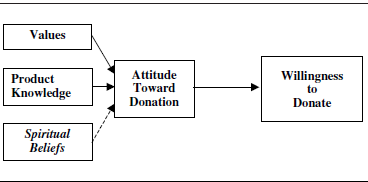
Conceptual Research Model
Values
Cleveland (1975) suggests several psychological underpinnings, including values, for the decision to become a potential organ donor. Rokeach (1968) describes values as a type of belief, centrally located within a person's total belief system, about how he or she should behave, or some end state of existence that is worth or not worth attaining. Munson (1984) proposes that personal values are only indirectly linked to behavior and that attitudes toward an act such as organ donation grow out of more basic underlying values. Horton and Horton (1991) apply Rokeach's (1973) values survey to assess 18 terminal values (desired end states) and 18 instrumental values (means for achieving these desired end states) of respondents. They identify one factor, “helpful,” that contains seven instrumental values—broad-minded, cheerful, courageous, forgiving, helpful, honest, and loving—and establish that a positive relationship exists between such personal values and attitude toward donation. It appears that many of these items are related to the generous nature of respondents. Belk and Austin (1986) find that people who are more materialistic (defined as attachment to possessions) are less willing to donate, which suggests that altruism is a likely determinant of willingness to donate organs. On a related note, Batten (1990) proposes that families will explain their decision to donate a member's organ as altruistic when they receive sufficient social support. Although the literature contains many definitions of altruism, one that has received general acceptance among psychologists is that offered by Macaulay and Berkowitz (1970, p. 3), which defines altruism as behavior that is carried out to benefit another without anticipation of rewards from external sources. In Batten's (1990) work on altruism in organ donation, altruistic motivation is defined as motivation to help others. Also, Vinson, Munson, and Nakanishi (1977) investigate the Rokeach value scales and determine that there is an underlying factor they label “compassion,” which seems similar to Horton and Horton's helpful factor. The four instrumental values contained in Vinson, Munson, and Nakanishi's compassion factor—namely, forgiving, helpful, cheerful, and loving—are four of the seven items in Horton and Horton's helpful factor. In the context of this research, we investigate whether the same type of instrumental values may be obtained from a culturally diverse population sample such as Singapore's and whether the positive relationship between altruistic values and attitude toward donation exists among the Singaporean sample. Therefore, we posit H1 as follows:
H1: The more altruistic a person's values, the more positive is his or her attitude toward organ donation.
Product Knowledge
Prior to the 1991 study, Horton and Horton (1990) conducted separate research to investigate whether knowledge of organ donation facts was related to attitude, on the assumption that organ donation decisions followed the learning hierarchy model of decision making (Horton 1984; Petty, Cacioppo, and Schumann 1983). They investigated public knowledge regarding 21 facts about organ donation. Although previous studies had shown high levels of public awareness of organ donation in the United States (Manninen and Evans 1985), it was not until this study that it was established that product knowledge regarding the facts about organ donation was positively related to attitudes toward organ donation. The 1999 NKF survey found that many Singaporeans were mistaken about their donor status or unsure about the procedures required for pledging their organs. We wanted to investigate whether an increased level of product knowledge about organ donation would positively influence the attitudes of Singaporean respondents toward organ donation. Therefore, we propose that
H2: The greater a person's knowledge about factual organ donation issues, the more positive is his or her attitude toward organ donation.
Spiritual Beliefs
The definition of spiritual beliefs has been detailed previously in this article as including religious and paranormal beliefs. Prior researchers have acknowledged the effect of such beliefs in shaping a person's attitude toward a specific attitude-object (Emme 1940; Sherif and Cantril 1945; Tobacyk and Milford 1983). It is likely that these beliefs have an effect on people's attitudes toward organ donation, particularly in a heterogeneous society such as Singapore where there is a diverse landscape of religions, ethnic groups, and cultures. The relationships between paranormal beliefs (encompassing superstitious beliefs) and personality structure and functioning have been proposed to exist (Tobacyk and Milford 1983). In the context of Asian cultures, particularly in Singapore, strong religious and cultural factors shape spiritualism and influence perceptions of life and self. As Belk (1990) notes, bodily organs may fall in the realm of sacred objects, and there is a common reluctance to mar the body's “perfect vessel,” even after death. For many, the idea of organ donation can take extreme forms, including a belief in the sanctity of the body and the need for the body to remain complete after death (Quah 1992). For example, typical Chinese funeral rites in Singapore include burning paper houses, paper cars, and even paper household appliances to ensure that these items will all join the deceased in the next life. We propose the following:
H3: The stronger a person's spiritual beliefs, the more negative is his or her attitude toward organ donation.
Attitude toward Donation
The concept of attitude has been widely researched as a variable influencing human behavior (Sherif and Cantril 1945). An attitude (Fishbein and Ajzen 1975, p. 6) is a “learned disposition to respond in a consistently favorable or unfavorable manner with respect to a given object.” This relationship between attitude and response is of interest to marketers (Judd, Owens, and Self 1988). Goodmonson and Glaudin (1971) examine the relationships between a newly formulated attitude toward human organ transplantation and patterned commitment responses. They find that given conditions in which situational factors are maintained, people who express positive or negative attitudes toward organ donation behave in a manner consistent with their attitudes when they are presented the chance to become organ donors. Horton and Horton (1991) establish a similar relation between a person's attitude toward organ donation and his or her willingness to donate. We aim to examine whether the same relation exists when the model is applied to the Singaporean sample, which leads to the next hypothesis:
H4: The more positive a person's attitude toward organ donation, the greater is his or her willingness to donate.
Research Design
We incorporated a survey pretest, a pilot test, and the final survey. We first conducted the survey pretest on a sample of 26 students from the local university, with approximately equal representation from the four main ethnic groups in Singapore. We checked that members of the various ethnic groups fully understood the contents of the questionnaire. The pretest detected ambiguous or leading questions and identified areas of difficulty faced by subjects in responding to each question. We reworded and improved several statements. For example, we replaced the occupational label “physician” with “doctor,” a term more commonly used locally. A pilot test followed and was administered with 11 subjects. We encountered no major difficulties and adopted the revised questionnaire for the final survey. Participants in both the survey pretest and the pilot test were excluded from the final survey to avoid biased responses (Aaker, Kumar, and Day 1998). For the final survey, we adopted the interviewer-assisted central location intercept method, which enables interviewers to provide on-site clarifications (Freimuth 1985). The survey was conducted in various city and suburban parts of Singapore to ensure a good representation of respondents.
The questionnaire comprised 80 questions in English, the most widely spoken language among the ethnic groups in Singapore, and was titled “Survey on Personal Values and Beliefs” to mask the original research intention. Section I covered values, Section II the knowledge of respondents with regard to organ donation, Section III respondents’ willingness to donate, Section IV respondents’ spiritual beliefs, Section V the attitude toward organ donation, and Section VI the demographic characteristics.
For the values data, we used Rokeach's (1973) value survey. We assessed the knowledge construct using the scale from Horton and Horton's (1990) Organ Donation Knowledge Survey. This comprised 21 statements related to specific knowledge about organ donation, to which respondents were instructed to indicate an answer of “true,” “false,” or “don't know.” We modified the statements to fit the local context. For example, we replaced the Uniform Anatomical Gift Act (1987) in the original survey (Horton and Horton 1990) with the MTERA (1972) and replaced the original “presumed consent” laws in a majority of U.S. states with the HOTA (1987). The score obtained for each respondent was a raw score based on the number of correct responses to the 21 statements; that is, the score could range from 0 to 21. To measure spiritual beliefs, we adapted Tobacyk and Mil-ford's (1983) paranormal scale. We believed that this was appropriate, as their scale captured many of the shared spiritual beliefs in Singapore, such as beliefs in reincarnation, lucky/unlucky numbers, and communication with the spirits (Tobacyk and Milford 1983). As far as possible, we made adjustments to ensure that the items were relevant to local context. We assessed the attitude construct with the scale developed by Goodmonson and Glaudin (1971) to measure attitude toward organ donation. The 10 statements used comprised a mix of items that measured dimensions of attitude toward organ donation. We assessed the willingness to donate construct using the original statements from Horton and Horton's (1991) study. Two statements queried respondents on their willingness to donate their own organs after death and the organs of a loved one who had died.
Profile of Respondents
We approached 500 respondents and handed them a questionnaire; 368 survey questionnaires were fully completed, indicating a 73.6% response rate. A summary of the profile of respondents is provided in Table 2. The sample comprised 177 men (48%) and 191 women (52%). The sample also reflected Singapore's high literacy rate of 93% (Singapore Census of Population 2000c).
Profile of Respondents
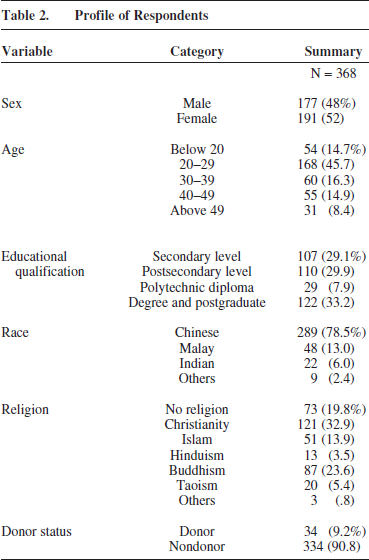
The ethnic composition of the respondent sample was fairly representative of Singapore (Singapore Census 2000a). The religious composition of the respondent sample was less representative of Singapore. For example, there was a larger than expected percentage of Christians and a lower than expected representation of Buddhists. This over-representation of Christians may be due partly to the locations where the intercept interviews were conducted. These shopping areas tend to be frequented more by Singaporeans who are more likely to be Christians compared with the general population; that is, they are younger and more likely to speak English. It is likely that this inclusion of Christians increased the power of our tests by adding variability in responses and helping avoid ceiling effects. In other words, if everyone in the sample had been highly superstitious, we might not have had adequate variability to detect a significant relationship between level of superstition and willingness to donate.
Data Analysis
We measured the reliability of the multiple-item scales using Cronbach's (1951) alpha. Reliability results revealed that each of the constructs yielded sufficiently high alphas to meet the recommended threshold value for acceptability (minimum α = .7542) (Cohen and Holliday 1982). Reliability coefficients improved further after we carried out factor analyses on each construct and reduced the number of items in each scale.
For the values construct, all 36 items in the Rokeach values scale were factor-analyzed together. We identified an altruism factor that consisted of four items: forgiving, helpful, cheerful, and loving. These values were similar to those found by Horton and Horton (1991) and Vinson, Munson, and Nakanishi (1977), thus providing both empirical and theoretical support for what we labeled altruistic values. This component explained 19.85% of the variance and had a coefficient alpha of .83.
On the knowledge construct, factor analysis did not yield an interpretable structure. Therefore, we included all 21 statements in the scale (see Table 3) as a single raw composite score, ranging from 0 to 21 for each respondent based on the total number of correct responses to all 21 statements. The knowledge construct had a coefficient alpha of .75.
Product Knowledge Statements

For the spiritual beliefs scale, we factor analyzed the 11 items based on Tobacyk and Milford's (1983) scale and found two factors: spiritualism and superstitious beliefs. The first component, spiritualism, consisted of four items dealing with soul travel, the spirit leaving the body, communicating with the dead, and reincarnation. It explained 38.87% of the variance and had a coefficient alpha of .86. The second component, superstitious beliefs, consisted of three items dealing with breaking mirrors, black cats, and the number 13. It explained 35.47% of the variance and had a coefficient alpha of .92. We separated H3 into two hypotheses, each dealing with one of the two components: H3a for spiritualism and H3b for superstitious beliefs.
We factor analyzed the 10 attitude items based on Goodmonson and Glaudin's (1971) scale and found a single dominant construct consisting of three items that dealt with whether organ donation is good, benefits humanity, and helps someone. It explained 84.2% of the variance and had a coefficient alpha of .91. The willingness to donate scale had a coefficient alpha of .83.
Results of Hypotheses Testing
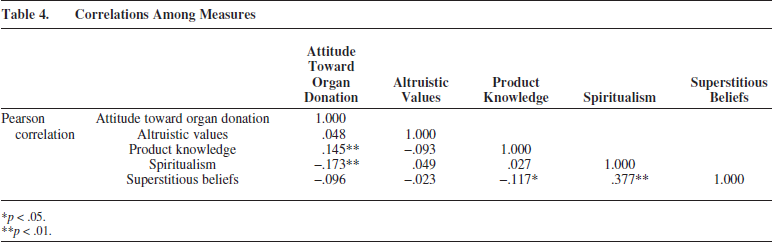
The measures for each construct were examined for low item-to-total correlations. Table 4 shows the Pearson correlation among the measures in this research. We observed no significantly high correlations among the four independent constructs—altruistic values, product knowledge, spiritualism, and superstitious beliefs.
Correlations Among Measures
p < .05.
p < .01.
We analyzed the research model in three stages, using three multiple regression submodels. In Submodel 1, we carried out multiple regression analysis to examine the effects of altruistic values, product knowledge, and spiritual beliefs (both spiritualism and superstitious beliefs) on attitude toward donation (see the predictor variables in Figure 1). In addition, we wanted to investigate the effect of ethnicity/race, which is highly correlated with religion in Singapore. Therefore, we included a categorical variable, race (Chinese, Malay, Indian, or others), in Submodel 1 to examine its effect on attitude toward donation and in the subsequent submodels.
In Submodel 2, we carried out multiple regression analysis similar to Submodel 1, but rather than use attitude toward donation as the dependent variable, we examined the effects of the predictor variables in our conceptual model on willingness to donate as the dependent variable (see Figure 1). Finally, in Submodel 3, we incorporated all the independent predictor variables and attitude toward donation, using another multiple regression analysis to examine the effects on willingness to donate. By comparing Submodel 2 and Submodel 3, we could then examine effects of attitude toward donation as a mediating variable that accounted for the relationship between the independent predictor variables in our conceptual model (Figure 1) and willingness to donate. This approach is recommended by Baron and Kenny (1986) to test for mediation.
Table 5 shows the results of all three multiple regression models. Table 5, Panel A, shows the results of the first multiple regression model. We found that all the terms in Submodel 1 are significant at the p < .l level, and the variables race, product knowledge, and spiritualism are highly significant at the p < .05 level in predicting the attitude toward donation.
Regression Coefficients Table and Test for Models 1, 2, and 3
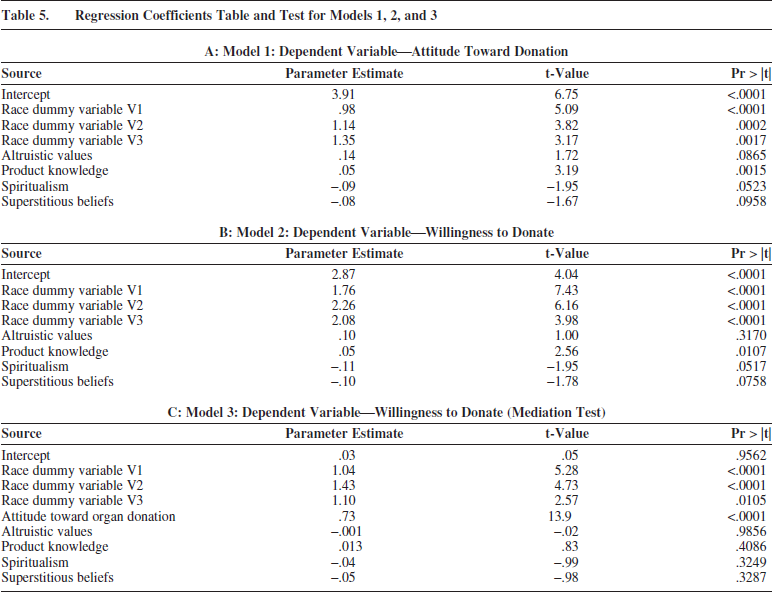
Horton and Horton's (1991) model of a willingness to become a potential organ donor found a positive correlation between values and attitude toward donation, though the coefficient was small in magnitude. In our study, H1, which states that the greater a person's values (altruistic values in our model), the more positive is his or her attitude toward organ donation, is supported at the p < .1 level.
H2 predicts that product knowledge will be positively related to attitude toward donation, as predicted by Horton and Horton (1991). The results in Table 5, Panel A, show that this relationship is significant (p < .05), in support of H2. The significance of the relationship between product knowledge and attitude toward donation implies that one of the ways to improve the general public's attitude toward donation could be to increase the public's specific product knowledge about organ donation.
H3a and H3b propose a relationship between two types of spiritual beliefs, spiritualism (H3a) and superstitious beliefs (H3b), and attitude toward donation. The research model predicted a negative relationship between both measures and attitude. The results indicate that spiritualism is significant at the p < .05 level and superstitious beliefs is significant at the p < .1 level. Therefore, both H3a and H3b, which propose that the greater a person's spiritualism and superstitious beliefs, the more negative is his or her attitude toward organ donation, are supported. The significance of these negative relationships between spiritualism and superstitious beliefs and attitude toward donation is particularly important to marketers of the organ donation cause, such as the NKF in Singapore. Although little can be done to change the values of the general public, it has been established through H2 that increasing the level of product knowledge of the general public with regard to specific facts about organ donation could improve the attitude toward organ donation. One implication of H3a and H3b is that the NKF should not only educate the public but also explore various methods of reducing the negative impact of spiritualism and superstitious beliefs on organ donation decisions of the general public.
Although we did not specify a hypothesis regarding race, it is clear from the results of Submodel 1 that attitude toward organ donation is strongly influenced by the racial/ethnic composition of our sample. In the dummy coding (V1–V3), we chose Malays as the control group because this group is significantly different from the other three groups on attitude toward donation, whereas the other three groups are not significantly different from one another. The significant difference between Malays and the other groups can be found in the multiple regression coefficients test in Table 5. The V1–V3 parameter estimates are significant and positive because, as expected, all the other groups had more positive attitudes and a higher willingness to donate than Malays/Muslims, who constituted the control group.
The results of the multiple regression analysis in Submodel 2 (Table 5, Panel B) revealed that all the predictor variables in Submodel 1, except for altruistic values, remained significant at the p < .1 level and the variables race and spiritualism are highly significant at the p < .05 level in predicting willingness to donate.
The last multiple regression model incorporated all the measures and constructs in the research model and sought to test the relationship between the dependent variable, willingness to donate, and all its predictor variables. The results of the multiple regression for Submodel 3, shown in Table 5, Panel C, revealed that the constructs altruistic values (p = .9856), product knowledge (p = .4086), spiritualism (p = .3249), and spiritual beliefs (p = .3287), which were tested to be significant in Submodel 1 and Submodel 2 (except for altruistic values) and expected to be insignificant in Submodel 3, were indeed found to be insignificant in Submodel 3. Also, the t-tests for the three dummy variables V1, V2, and V3 are significant in all three submodels, showing that Malays have the lowest mean score in terms of attitude toward donation and willingness to donate. The construct attitude toward donation (p < .000) was significant in Submodel 3.
These results support the final hypothesis, H4, that the more positive a person's attitude toward organ donation, the greater is his or her willingness to donate. This is consistent with Horton and Horton's (1991) findings and suggests that efforts to improve the attitude of the general public toward organ donation, giving consideration to the factors affecting attitude toward donation, may be rewarding in terms of increasing the willingness of the general public to donate.
A comparison of all three submodels suggests that the proposed conceptual research model represented in Figure 1 captures the relationships between the independent and dependent variables well. Altruistic values, product knowledge, and spiritual beliefs are predictor variables, and attitude toward donation is a mediating variable in explaining willingness to donate. Thus, the results of the three regression analysis submodels and a comparison of the submodels to test for mediation in line with the approach recommended by Baron and Kenny (1986) suggest that the relationships proposed in this research were well explained by the research model in Figure 1.
Findings and Implications
A summary of findings and suggestions to improve organ procurement agencies’ marketing activities based on our research findings is shown in Table 6. Although these ideas have been derived from NKF, they could be applied to any organ procurement agency outside the Singapore context. Fox (1990) notes that social marketing faces special challenges in addressing the task of encouraging organ donation and that it has not been actively applied in the United States.
Summary of Findings and Recommendations

On the basis of the first hypothesis, we found a positive relation between altruism and attitude toward organ donation. Organ procurement agencies should therefore position their product to appeal to the altruistic nature of potential donors. Understandably, organ procurement agencies have, in the past, been constrained in creating the “product” offering (Houston 1986; Houston and Homans 1977). The concept of organ donation is neither a physical entity nor a service but an abstract concept rooted in ideas about altruism, community, and social responsibility. Alternative means of defining and repositioning may be to promote organ donation as (1) enhancement of immortality, in which a person is able to “live eternally” through enabling another person to live on his or her organs or earn merit for the next life; (2) enhancement of ego, in which giving an organ is perceived to be a selfless act by the donor's immediate social groups and the recipient; and (3) an act of self-interest, in that a larger number of organs available for transplant increases probability of receiving one should the need arise. These definitions are not mutually exclusive and may not be equally relevant to target market segments in different cultures. However, they provide a premise with which organ procurers may redefine organ donation.
As suggested by the findings of H2, one of the recurring propositions has been the need to increase specific knowledge about organ donation issues. A direct way of doing this is to educate the general public by holding forums. Cooperation could also be sought from clan or religious group leaders to hold relevant talks to address specific issues. Another possibility is to leverage word of mouth through the use of spokespeople. Past organ recipients and volunteers can be trained to become spokespeople for the organ donation cause. An extension of this could be to promote organ donation within families, reference groups, and social groups through word-of-mouth communication, as this issue is not normally discussed outside the immediate family circle (Horton and Horton 1991). As families generally respect the wishes of family members to be organ donors (Manninen and Evans 1985; Prottas 1983), it is worth encouraging those who sign up as organ donors to relay the facts about organ donation to family and friends. Likewise, Web sites can serve as useful destinations for information seekers. Organ procuring organizations can use such information to further promotional causes by collaborating with sponsors and hosts of local high-traffic sites. The Web site could host an online forum and/or support group for organ failure victims and members of the public. Having an Internet representative around the clock to attend to online queries could also be an invaluable marketing tool.
There is, however, a more controversial way of achieving quick growth in the number of organ donors. This is in the form of a radical change in the legal framework, making it easier for potential donors and the public to understand legal consent. Sweden made a significant turnaround when it adopted the Surgical Transplants Act (Sangstat 1999), which switched its previous presumed nonconsent legal system to a presumed consent system. The presumed consent system is just one possibility; if passed, the system in Singapore would effectively incorporate the MTERA (1972) into the HOTA (1987) to include all of a person's organs, instead of just the kidneys. The issue, however, needs to be approached with great care so that the act will not be perceived as too coercive in nature.
For becoming a potential organ donor, Parisi and Katz (1986) and Fox (1990) suggest that many people sustain psychological costs, such as contemplating their own mortality. Our findings based on H3 suggest that people with strong spiritual beliefs fear that signing a donor card would lead to consequences that would interfere with reincarnation and afterlife arrangements. Such a psychic price can be reduced by correcting misperceptions through improving public awareness and education. This effort can be enhanced by working with and through religious groups.
When initial attention and interest are gained (e.g., from promotional activities), completing the transaction of becoming a potential donor shifts to higher-involvement media, such as direct marketing brochures explaining what organ donation is. However, possible barriers, such as the spiritually grounded fears we observed, may need to be addressed in person. Although dialysis centers can help address potential donor concerns, Davison (1987), Moran (1986), and Rothenberg (1985) suggest that churches and other places of worship are possible vehicles for distributing information about organ donation. In addition to moral authority and ability to deliver a message that might be ignored in other settings, religious institutions have the potential to reach large numbers of people. A possible channel for cross-sell could be the blood donation centers. The potential for such collaboration is enhanced by the procedures associated with collecting blood and the related base motives.
H4, which states that the more positive a person's attitude toward organ donation, the greater is his or her willingness to donate, was supported. This suggests that all organ procurement agencies should institute a strong marketing program aimed at changing attitudes. Efforts including an increase in advertising activities are recommended, but because most social marketers face budget constraints, we propose that agencies seek donation or discounts for media spaces that are available to charitable causes. The media plan needs to strive for a wide reach into the population base. The advertising should translate the value, belief, and spirituality dimensions into persuasive messages in the form of public service advertisements. An effective creative strategy could help specific target audiences gain initial awareness and acquire knowledge about organ donation. As the research findings suggest, an important task for these public service advertisements would be to address the spiritual concerns that prevent people from becoming donors. Although the monetary costs of obtaining a donor card are small (e.g., making a call or a trip to the organ procurement agency), reducing such costs may increase donor attitudes and thus sign-ups. For example, a toll-free number could be introduced.
Directions for Further Research
This research has introduced spiritual beliefs to a model that attempts to predict factors that affect a person's attitude toward organ donation. Other demographic or personality variables, yet unaccounted for, may also be influential in affecting a person's attitude toward donation, willingness to donate, and, as a possible subject for further research, the actual signing of a donor card. Recommendations to explore the applicability of results include paying special attention to other races and religions and employing far more in-depth research methods, such as personal interviews and focus group studies.
Rothschild (1979) investigates general factors that could influence the effectiveness of social marketing communications, and further research could address how marketing communications tools such as advertising can help increase organ donation. Possible areas of exploration include how creative messages can be employed to influence the potential donors and the effect of word of mouth on attitudes toward organ donation. Another potential area of research involves the public perception of organ procurement agencies and its impact on the donor sign-up decision. On a wider scale, an international study of organ procurement agencies and their activities seems warranted.
Research needs to address the impact of legal regulations on organ donation. The debate over the exclusion of Muslims from HOTA (1987) has gained considerable momentum over the past decade (The Straits Times 2000a). Relevant bodies such as Muslim Kidney Action Committee have identified the passing of an amendment in the act as a crucial factor in increasing the number of kidneys available to Muslim kidney failure victims. Although urban myths and medical thrillers may target organ donation as a fertile (and lucrative) topic, regulations can and should play a role in reducing the many disturbing misconceptions that act as deterrents to the public's willingness to donate.
In conclusion, this research has applied some of the concepts of social marketing to organ donation and the marketing efforts to increase the number of organ donors in Singapore. It is our hope that the research findings will aid in the fine-tuning of organ donation efforts and stimulate further social marketing research in the region.