







Abstract
Although public service announcements (PSAs) employing undisclosed actor portrayals (posers) in the message are in technical violation of Federal Trade Commission regulations on deception, sponsors of such PSA formats are unlikely to be pursued for such violations. However, when nonprofits use actors in lieu of real victims in their PSA messages, real financial and reputational loss to the nonprofit may occur. In this study, the authors develop and test a model of the antecedents to perceived social responsibility of and people's subsequent intent to donate to nonprofits that employ PSAs. They also investigate the efficacy of using actor portrayal labels when composites of real victims rather than actual victims are portrayed in the PSAs. The results confirm that viewers experience a stronger emotional connection when the PSA uses real victims, along with greater perceptions of the nonprofit's social responsibility and greater subsequent intent to donate to the nonprofit. The authors propose that self-regulation may help mitigate negative reactions to PSA messages that employ actors rather than real victims in the PSAs.
Keywords
According to Federal Trade Commission (FTC) policy, advertising is considered deceptive if advertising representations, omissions, or practices are likely to mislead a reasonable consumer and are likely to affect consumer choice or conduct toward the advertised product (Petty and Andrews 2008). In the MPAAT case, the FTC's regulatory acid tests for deception seem to have been met. First, there was an omission—an actor portrayal misled consumers, which led to complaints to the MPAAT. Second, reasonable people assumed that the mother in the advertisement was indeed a cancer victim, given that real cancer victims are available and willing to help nonprofits in the dissemination of cancer-related information. Third, the 5000-plus complaints viewers registered on learning that the victim was an actor suggest that this substitution was important to them and that they cared that it had been made, perhaps because they believed that their choice to donate to the MPAAT was encouraged under a false pretense.
A Problem with Current FTC Policy and PSAs
A problem with the current FTC policy arises when we consider Petty and Andrews's (2008, p. 13) observation: “[T]he FTC's statement notes that as a matter of policy, when consumers can easily evaluate the product or service and the product or service is inexpensive and frequently purchased, the FTC will carefully consider whether to bring an enforcement action.” Because most PSAs solicit voluntary action from viewers and often involve small donations, it is highly probable that though the MPAAT's PSA was perhaps technically deceptive, the FTC would take no action to curb such tactics. Yet we also believe that it is not in the public's or even advertisers’ best interest to allow outright deception in advertising because of the adverse consequences that can occur and have occurred already with groups such as the MPAAT. Thus, given these realities, the best answer to the use of deceptive practices in PSAs may be industry self-regulation, which we discuss in greater detail subsequently.
Our study attempts to understand how PSA viewers react to disclosure/nondisclosure of the use of actors in a PSA message and the subsequent impact on nonprofits that voluntarily change their messages even when official government sources do not mandate that they do so. We hope that this approach leads to a better understanding of how the public reacts to PSAs and, ultimately, PSAs that more effectively bring about prosocial change (Guion, Scammon, and Borders 2007).
Message tactics have a significant influence on people's intentions toward health-related actions (Keller and Lehmann 2008). Petty and Andrews (2008) label actors who pretend to be ordinary product users as “posers.” In PSAs, undisclosed actor portrayals are analogous to posers—a term reserved for deceptive practices. Thus, understanding the impact of actor portrayal messages on viewers can help nonprofit advertisers frame the most effective prosocial messages. We hope to influence how posers are used in PSAs by examining this practice from a self-regulatory perspective. In turn, such self-regulation would make the problem of policy maker nonaction to curb this deceptive practice a moot issue.
Understanding how consumers react to nondisclosure of actor portrayals and subsequent benefits or penalties that accrue to firms that employ them also demonstrates to PSA sponsors that self-disclosure need not result in backlash from potential target markets and donors. Rather, two more goals may result from such disclosure: (1) the mitigation of public deception and (2) stronger and more convincing PSAs that produce prosocial change.
Nonprofits and Prosocial Activities
Nonprofits, such as the MPAAT, promote prosocial activities in an attempt to initiate societal changes for the betterment of the public. Nonprofits are often supported through private donations, which are solicited through prosocial messages that are delivered to the public at large. Without such donations, prosocial change, such as the mitigation of drunk driving and cessation of smoking, may be stifled. Donors to these organizations offer time and money with little economic expectation—a condition known as generalized reciprocity (Arnould, Price, and Zinkhan 2004). As such, the public holds nonprofits to rigid standards of truthfulness and expects them to act in a socially responsible way. This means that integrity plays a central role when prospective donors evaluate nonprofits as a potential recipient of their good nature and resources (Staples 2004; Venable et al. 2005). Thus, there is a strong connection between potential donors perceiving nonprofits as acting in a socially responsible way and their willingness to donate to these nonprofits. Because of the reliance on people for donations and because there has been a proliferation of nonprofits—growing from 12,000 in 1940 to more than 1.2 million in the 1990s (Boris 1999)—nonprofits must safeguard their reputations; this is especially important because past scandals involving the United Way and the Red Cross have contributed to an undermining of public trust in nonprofit organizations (Herzlinger 1996).
When for-profit entities engage in socially irresponsible behavior, they suffer consequences, such as consumer boycotts or choice of other alternatives (Becker-Olsen, Cudmore, and Hill 2006). It is not unreasonable to assume that the same outcomes might befall a nonprofit that is also deemed to be behaving in a socially irresponsible manner. This expectation is logical because of the higher standard of truthfulness to which nonprofits are held and because of consumer expectations of nonmalfeasance—that is, firms, including nonprofits, have a moral duty to prevent or remove harm from the marketplace (Sirgy 2008). Thus, it is in the best interests of nonprofits to minimize any and all perceptions of malfeasance.
Currently, nonprofits have two options when using actors in their advertisements, both of which are less than desirable: (1) disclose the use of actors in lieu of real victims and potentially have the strength of their message diluted or (2) do not disclose the use of actor portrayals and risk viewer outrage, such as that manifested toward the MPAAT. In our study, we investigate factors that affect donor perceptions, willingness to support a nonprofit organization (using donations as a proxy), and the environment that may influence and impinge on these factors and propensities. Specifically, we explore antecedents to overall attitude toward nonprofit advertising, perceived social responsibility of the sponsor, and the subsequent effect of each on the intent to donate to the sponsor, as well as other factors that need to be considered, such as moderating effects of ad type.
We first discuss the use of actor portrayals instead of real victims and the potential need for intervention with respect to this scenario. Next, we develop a conceptual model that includes antecedents regarding social responsibility perceptions pertinent to the nonprofit sponsor and intent to donate. Then, we examine the moderating effect of ad type (real victim used versus actor portrayal of a victim with disclosure) on each of the variables to examine indirectly how intervention might influence the relationships among these constructs. Finally, we offer implications with respect to the results.
Actor Portrayal Label Disclosure
Realistically, the preferred option for safeguarding a nonprofit's reputation is to use an actual victim rather than an undisclosed actor in the advertisement because such a strategy would eliminate the type of backlash observed in Minnesota. However, if the use of a real victim is not possible, a simple solution is to disclose the use of actors through an actor portrayal designation label in the advertisement. This might include, for example, incorporating full disclosure right before delivering the advertising pitch in an effort to demonstrate truth in advertising.
However, PSAs differ in tone from for-profit product advertisements in that they are attempting to improve society (Tangari et al. 2007) rather than to convince viewers to buy goods and services. As such, viewers may expect that real victims who can speak to the issue from first-hand experience will act as spokespeople and change agents in the PSAs instead of paid endorsers. In support of this premise, Shanahan and Hopkins (2007) find that nonprofits that promote prosocial behaviors and use actor portrayal labels in advertising suffer a negative backlash from viewers. Specifically, viewers rate nonprofit PSAs that employ actors, rather than real victims, equally as negative as those that practice outright deception.
This is important because not only do scandals involving nonprofits have an immediate impact but there also seems to be a slow rate of decay in public mistrust generated by scandal. Salamon (1995, p. 15) argues that this is due to a myth of pure virtue that the public assigns to the nonprofit sector—a “romanticism about its inherent purity,” which results in a stronger sense of betrayal. In the case of the United Way, a scandal in 1992 led to the chief executive officer being indicted by a grand jury (Shepard and Miller 1994). The immediate effect was a dramatic drop in both confidence in (Spayd 1992) and contributions to the United Way (Miller 1993). Recently, the lingering effects of the United Way scandal have led 21 regional nonprofits to withdraw from the United Way umbrella, citing continuing distrust of the organization going back to the 1992 scandal (Greenwell 2009).
This case is instructive because it shows the longevity of scandals involving nonprofits and, in particular, the long-term salience of wrongdoing in the public's mind (Gibelman and Gelman 2001). In addition, small charities are especially vulnerable to backlash from scandals (Marcotty 2003). In response to several factors, including the type of advertising and resultant backlash from the public, the attorney general of Minnesota went to court to strip the MPAAT of its $202 million endowment, citing problems with its advertising and attempts to manipulate the media. Shortly thereafter, the MPAAT changed its name to Clear-Way. Nowhere on its Web site, including the “About” link, which offers information about its history, does it mention its former namesake. This suggests that the organization is cognizant of the enduring effects of its involvement in a scandal—a lesson learned from the United Way.
Another consideration for nonprofits is the magnitude and type of regulation that may be necessary in these circumstances. Because the use of disclosures in PSAs is a fairly widespread practice (Hoy and Andrews 2004), regulation could include the requirement that when actors are used to portray victims in a PSA, full disclosure is given. Specifically, this would include any main character in the PSA who is explicitly or implicitly claiming to be a victim but, in reality, is an actor (for a review of industry types for which the FTC recommends use of disclosure statements, see Hoy and Andrews 2004).
Although advertising disclosures can play an important role in reducing misleading impressions (Hoy and Andrews 2004), advertising regulation can also be a tool for enhancing the truthfulness of advertising. A predominant assumption is that firms use disclaimers because they are required to do so (Muehling and Kolbe 1997). If all PSA viewers are confident in the belief that the use of an actor portrayal label is mandated, their negative response to a nonprofit's use of actors would be mitigated somewhat (perhaps transferred to the regulatory body), thus allowing the nonprofit to use an actor without the associated viewer stigma. As Beales, Craswell, and Salop (1981) note, enhancing message credibility leads to viewer perceptions of advertising as more truthful and viewers who believe more of what they are told. Thus, the use of actor portrayal labels as disclosure statements may offer a win–win benefit for viewers because viewers are more fully informed and nonprofits may be able to avoid negative reactions to the use of actors.
The problem with this approach is that an actor may not generate the same level of empathy as a real victim. Moore (2004) finds that an actor portrayal format in an advertisement is perceived as less credible and elicits lower levels of emotional response and less positive attitude toward the ad. The alternative to using a portrayal label is to use an actor to portray a victim but not to disclose this use. Yet, and as we noted previously, the potential backlash from such a strategy is already evident from the MPAAT case, in which viewers considered this type of approach questionable at best. Shanahan and Hopkins (2007) note that viewers considered this format misleading or deceptive and had lower evaluations of the format compared with formats in which real victims were portrayed or formats that disclosed the use of an actor to portray a victim.
In summary, this discussion seems to suggest three possibilities for PSA messages that use a “victim” in the message: (1) use a real victim, (2) use an actor without any disclosure label, or (3) use an actor with a disclosure label. A variant of the third scenario is a publicity campaign to educate the public that voluntary or regulatory strictures require actor portrayal labels when nonvictims are employed. This article continues with a discussion of a conceptual model that reflects two of these three options. The public may not discover the use of an actor without disclosure until a later date, as in the MPAAT case. This has already been shown to generate a negative backlash and therefore represents an unnecessary treatment in this current study. Thus, we focus on other two options, the use of a real victim and the use of an actor portrayal label.
Conceptual Model and Hypotheses Development
Affective Response to the Advertisement
The extant literature suggests that emotional response to an advertisement affects overall attitude toward the ad (Aaker, Stayman, and Hagerty 1986; Bagozzi and Moore 1994; Edell and Burke 1987; Moore, Harris, and Chen 1995; Stayman and Aaker 1988). Thus, we hypothesize that a negative emotional response to an advertisement is positively related to the overall attitude toward the ad. In what follows, we develop this seemingly inverse relationship further.
A strong emotional response to an advertisement may influence (improve) perceptions of the social responsibility of the nonprofit sponsor. For example, attempts to garner donations for starving children often employ ad images that most people find depressing and upsetting (e.g., images that document these children's adverse living conditions). Portrayal of such images is intentional, with the expectation that the negative emotional response that arises from exposure to these scenes, while upsetting, will lead to a positive image of the sponsor, which is cast as trying to change the situation in a prosocial manner.
Shock appeals are frequently used in PSAs (Dahl, Frankenberger, and Manchanda 2003), and they are intended to deliberately startle and offend (Venkat and Abi-Hanna 1995) while also increasing attention, activating memory, and positively influencing coping behavior (e.g., preventing smoking, stopping drunk driving). Such advertisements may cause viewer discomfort, though fear appeals may be appropriate when employed for the public good (LaTour and Zahra 1989). Thus, advertisements designed to generate a negative emotional response should result in perceptions of the sponsor as being socially responsible.
Shaver and colleagues (1987) suggest that people exposed to emotion-laden advertising organize these emotions into two categories, positive and negative. Negative emotions include, for example, anger, sadness, and fear (Bagozzi and Moore 1994). Specifically, Bagozzi and Moore (1994) suggest that when confronted with images that generate negative emotions, viewers attempt to cope in some way and that this can include empathy for the victim.
Empathy is viewed as a mental process involving a person's ability to assume roles (Piaget 1965) and as a distinct socioemotional experience involving “the effort to understand the internal mental and emotional events of other human beings” (Rosenberg 1990, p. 8). As an affective state, empathy includes sympathy for, sensitivity toward, and sharing in the suffering of others. In a sense, empathy is the act of feeling another person's difficulties as if they were one's own (Cooley 1998)—for example, when feeling an emotional response to another person's distress leads to sadness, a negative emotion, but one that calls a viewer to action and results in a sense of satisfaction and/or a positive attitude. This negative-to-positive relationship seems counterintuitive, but if viewers believe that sad emotions lead to personal action targeted at positive change, these same emotional outcomes may result in others taking action as well. Thus, a positive reaction to a particularly difficult-to-watch advertisement is not only possible and plausible but also easily explained in accordance with the previously cited arguments. Keller, Lipkus, and Rimer (2002) appear to concur in that they indicate that health messages designed for safety goals are more persuasive when framed using negative emotional messages. That is, they report a direct link from negative emotions to positive attitude and prosocial change.
In our study, we conceptualize and operationalize affective response to the advertisement as a negative emotional response to the advertisement (i.e., sad responses, not happy or jovial reactions). Thus, we are conceptualizing negative emotions as defined by Shaver and colleagues (1987), not a negative attitude toward the ad. This is consistent with the operationalization of negative emotional response employed by Moore, Harris, and Chen (1995), who measure negative emotional response using the negative emotions angry, frightened, worried, and sad. They find that participants exposed to advertisements of a negative emotional nature (child abuse) expressed more favorable attitudes toward the organization charged with intervening on behalf of children.
Batson and colleagues (1986) find that negative emotional responses often accompany empathy and precede helping behavior. Thus, the term “negative emotional response,” though negative from an emotional perspective, is not negative from a practical perspective and may encourage positive outcomes. Such an opportunity to help (i.e., in our case, donating to a nonprofit) demonstrates that negative emotional response can lead to a positive attitude toward the ad. That is, “helping others is viewed as rewarding because either it is seen as a way to receive social recognition or it is intrinsically self-rewarding” (Bagozzi and Moore 1994, p. 60). Thus, if an advertisement is sufficiently powerful in its message and generates a strong emotional response, it is likely that there will be an increase in intent to donate regardless of the perception of the sponsor or attitude toward the ad. That is, a raw reaction to the advertisement is sufficient in and of itself to increase desire and intention to donate to a nonprofit based solely on the images and message in the advertisement. Thus, we hypothesize the following relationships:
H1: Negative emotional response to the advertisement is positively related to overall attitude toward the ad.
H2: Negative emotional response to the advertisement is positively related to perceived social responsibility of the nonprofit sponsor of the advertisement.
H3: Negative emotional response to the advertisement is positively related to an increased propensity to donate to the nonprofit sponsor.
Overall Attitude toward the Ad
The foundation of social marketing is trust (Hastings 2003). Because of the activities in which nonprofits engage (i.e., betterment of society), they tend to be held to a higher standard of behavior (Staples 2004; Venable et al. 2005). Therefore, if the nonprofit is perceived as breaching a trust (i.e., using advertising techniques deemed to be misleading), it is likely to be viewed as acting in a socially irresponsible manner. Conversely, if the nonprofit is perceived as acting in a prosocial manner (i.e., contributing to the betterment of society), it may be viewed as acting in a socially responsible manner. Thus, if viewers have a strong positive overall attitude toward the ad of the nonprofit, they may perceive the nonprofit as acting in a socially responsible manner.
H4: Overall attitude toward the ad is positively related to perceived social responsibility of the nonprofit sponsor of the advertisement.
In addition to perceptions of social responsibility, overall attitude toward the ad is positively related to an increased propensity to donate to the nonprofit. In their study on teenage alcohol consumption, Goldberg and colleagues (2006) find a strong connection between attitude toward the advertiser and behavioral intentions (drinking intent), which is analogous to our study in that we hypothesize attitude toward the ad to be positively related to an increase in a propensity to donate. This assumption is supported by the work of MacKenzie, Lutz, and Belch (1986), who show that attitude toward the ad directly affects nonprofit donations. Similarly, Lichtenstein, Drumwright, and Braig (2004) report a strong connection between attitude toward the ad and proclivities to donate to the sponsor. Although the latter study involves for-profit firms, the conceptual link between demonstrating prosocial advertising content and a propensity to donate is consistent with what is believed to exist for nonprofits. Thus, the extant literature suggests that a direct relationship exists between overall attitude toward the ad and intent to donate to the nonprofit sponsor.
H5: Overall attitude toward the ad is positively related to an increased intent to donate to the nonprofit sponsor.
Perceived Social Responsibility of the Sponsor
As we mentioned previously, because nonprofits are held to a rigid standard of truthfulness, they are expected to behave in a socially responsible manner and to act with veracity. Therefore, to enhance its uniqueness, a nonprofit wants to be perceived as acting (signaling) in a socially responsible manner. After all, corporate citizenship is defined as the organization's status and activities with respect to perceived social obligations (Dean 1999). Brown and Dacin (1997) add that social responsibility is the character of the company with regard to how it contributes to important societal issues. Nonprofits can demonstrate good citizenship behavior by acting in a socially responsible manner, and sponsoring prosocial advertisements can signal such social responsibility.
Signal theory suggests that nonprofits desire to delineate themselves from other nonprofits to increase the likelihood of attracting donations (Dean 1999). For example, Singhapakdi and LaTour (1991) find a strong correlation between perception of a socially responsible cause (antilittering proponents) and voting for a prosocial law promoted by the cause (antilittering). Voting for a perceived socially responsible cause is similar in nature to donating to a similarly perceived socially responsible nonprofit because both are given of free will owing to a positive perception of the nonprofit's socially responsible nature.
Similarly, in the for-profit world, an appreciation for the actions of a firm deemed to be acting in a socially responsible manner can lead to increased purchase intent based on that perception (Webb and Mohr 1998). Signal theory also suggests that nonprofits will pay a price if they are not socially responsible, especially if the nonprofit has signaled both its intent and its ability to act in such a manner. The “price” paid is loss of reputation and, consequently, lower donations. Nonprofits may strive to be conscientious, but if they deviate from acting in a socially responsible manner, stakeholders may punish them by decreasing or even stopping donations (Shanahan and Hopkins 2007). Conversely, acting in a socially responsible manner appears to have a positive effect on nonprofit donations (Brown and Stayman 1992; Goldsmith, Lafferty, and Newell 2000). Thus, we hypothesize the following relationship:
H6: Perceived social responsibility of the nonprofit sponsor of the advertisement is positively related to an increased propensity to donate to the nonprofit sponsor.
We present the conceptual model delineating the hypothesized relationships in Figure 1.

Conceptual Model
Ad Treatment as a Moderator
Fine print and disclaimers have the potential to diminish advertisers’ primary selling claims (Ellen and Bone 2008; Muehling and Kolbe 1997), including disclosure of an actor portrayal in a PSA (Moore 2004). Shanahan and Hopkins (2007) offer supporting evidence suggesting that truthful advertisements (those in which real victims are used) are better received by viewers than actor portrayal–based advertisements (those in which actors portray composites of real victims). Indeed, Shanahan and Hopkins find stronger and more positive reactions to the use of real victims in advertisements than to actor portrayals of victims.
In line with the findings of these studies, we propose that the use of an actor portrayal disclosure label versus advertisements without such a label (i.e., using real victims) should have less of an effect on PSAs sponsored by nonprofits. That is, if there is an actor portrayal label, the empathy effect should be lessened, and there should be less emotional reaction to the advertisement. Consequently, viewers could experience a disconnect, which in turn could affect their propensity to donate. With a less emotional advertisement, overall attitude toward the ad may be lower for actor portrayals than for those that use real victims. That is, viewers may form less of a connection with the victim when the victim is an actor. Therefore, the following hypotheses represent the moderating effect of using a real victim in the advertisement versus an actor portrayal (see Figure 1):
H7a: Negative emotional response to the advertisement as it relates to overall attitude toward the ad is stronger for the real victim than for the actor portrayal ad treatment.
H7b: Negative emotional response to the advertisement as it relates to perceived social responsibility of the nonprofit sponsor of the advertisement is stronger for the real victim than for the actor portrayal ad treatment.
H7c: Negative emotional response to the advertisement as it relates to an increased propensity to donate to the nonprofit sponsor is stronger for the real victim than for the actor portrayal ad treatment.
H7d: Overall attitude toward the ad as it relates to perceived social responsibility of the nonprofit sponsor of the advertisement is stronger for the real victim than for the actor portrayal ad treatment.
H7e: Overall attitude toward the ad as it relates to an increased propensity to donate to the nonprofit sponsor is stronger for the real victim than for the actor portrayal ad treatment.
H7f: Perceived social responsibility of the nonprofit sponsor of the advertisement as it relates to an increased propensity to donate to the nonprofit sponsor is stronger for the real victim than for the actor portrayal ad treatment.
Research Methodology
Given that print media has been successful in many countries in delivering antismoking and anti-drunk-driving messages (Shanahan and Hopkins 2007; Shanahan, Hopkins, and Carlson 2008), we believe that the use of print advertising is both meaningful and appropriate. In developing the actual advertisements, we used print ad content previously developed by Mothers Against Drunk Drivers (MADD) and the American Cancer Society that has been used in other empirical research (Shanahan and Hopkins 2007; Shanahan, Hopkins, and Carlson 2008). In these cases, the antismoking and anti-drunk-driving PSAs were meant to represent messages by the American Cancer Society and MADD, respectively. Two advertisements were created for each nonprofit, one depicting the real victim condition and the other representing the actor portrayal condition. The primary difference between each treatment was that the real victim advertisements contained content that stated the date of death of each person depicted within the PSA, whereas the actor portrayal advertisements stated that the victims depicted were actors who represented a composite of real victims. Inclusion of the date and death in the real victim advertisements serves as disclosure, which communicates important information to the public (Bettman, Payne, and Staelin 1986). We present a copy of each PSA in Figure 2.

Experimental Ad Exposures
Sample
We collected all data for this study in Texas. Using Texas census data, we developed a quota sample that approximated the state demographic makeup to ensure that no one group was oversampled and that participant characteristics were roughly equivalent to the state population. We selected Texas because of the increased occurrence of both cigarette smoking and alcohol-related automobile accidents in the state (Shanahan and Hopkins 2007). To reach the various demographic segments, we sampled a combination of online respondents, using a panel willing to participate in the study, and non-Internet respondents, with the help of trained data collectors. We invited the online panel members to participate in the study after they completed several screening questions to ensure that they met study requirements (i.e., unfulfilled quota space).
We provided the online respondents with an unpublished URL that took them to the online survey and told them that the survey would be available only for 48 hours. This helped mitigate the chance that someone might stumble on the survey by accident. We surveyed the non-Internet-based respondents using the mall intercept approach in several cities, at public laundry facilities, and in a bowling alley. From a total of 713 respondents, we obtained 660 usable surveys. The use of a quota sample met our objectives because our sample closely matched the population characteristics of Texas (see Table 1). We randomly assigned each respondent to one of four groups—328 respondents viewed the anti-drunk-driving PSAs, with 162 viewing the real victim advertisement and 166 viewing the actor portrayal advertisement, and 332 respondents viewed the antismoking PSAs, with 158 viewing the real victim advertisement and 174 viewing the actor portrayal advertisement. The overall sample was as follows: 44.2% were men; 62.1% were Caucasian, 22.6% were Hispanic, and 9.4% were African American; 51.5% had an income greater than $50,000; and 58% were 34 years of age or older.
Comparison of Sample and Texas Census by Percentage

Sample percentages are higher than state percentages because the study did not include minors.
Source: 2000 U.S. Census.
Instrument Design
The questionnaire consisted of four multi-item measures for (1) overall attitude toward the ad (Kamp and MacInnis 1995), (2) negative emotional response to the advertisement (Moore and Harris 1995), (3) perceived social responsibility of the sponsor (Brown and Dacin 1997; Dean 1999), and (4) willingness to donate to the sponsor (Dodds, Monroe, and Grewal 1991) (for a list of items, see the Appendix). We obtained all multi-item measures from previous studies in which their respective reliabilities and validities had been supported (Shanahan and Hopkins 2007; Shanahan, Hopkins, and Carlson 2008). We used two manipulation checks in which we asked respondents to agree or disagree with two statements: “The people in the advertisement have been killed,” and “The people in the advertisement are actors.” We included additional scales to assess demographic composition of the sample.
Results
Manipulation/Confound Checks
First, it was necessary to assess the treatment manipulation associated with the real victim versus actor portrayal PSAs. Table 2 presents the results of each manipulation check. In the real victim group, 94.5% agreed that people in the PSA had died, whereas 99.4% disagreed with the statement that people in the PSA were actors. We found similar results for actor portrayal: 97% agreed that people in the advertisement were actors, whereas 95% disagreed with the statement that people in the advertisement had died. On the basis of these results, we eliminated five responses from the sample, and thus we do not include them in the subsequent analysis.
Treatment Manipulation Check

Number retained for further analysis after deletion of respondents who did not pass the manipulation check.
A second confounding check pertained to any potential biasing effects that could possibly result from respondents viewing PSAs from each of the different sponsors. In this case, we wanted to ensure that respondents did not have significantly different thoughts/feeling about either of the sponsors in question. In this case, it would be possible to discern whether any potential bias existed relative to each organization in question. To address this issue, we performed an analysis of variance with ad treatment (real victim versus actor portrayal) and exposure to each sponsor (MADD/American Cancer Society) serving as the dichotomous independent variables and the scale score for perceived social responsibility of the sponsor serving as the dependent variable. The main effect for ad treatment was significant (F = 3.89, p = .004). Neither the sponsor main effect (F = .089, p = .776) nor the ad treatment × sponsor interaction (F = .233, p = .629) was significant, demonstrating that the sponsor in question did not impose any extraneous variation.
Measure Assessment and Hypothesis Tests
To test the conceptual model and hypothesized relationships, we undertook structural equation modeling with LISREL 8.51. As Table 3 shows, the initial model demonstrated exceptionally good fit. The results reported in the Appendix show that each scale proved both sufficiently reliable and valid. The coefficient alpha values ranged from .94 to .90, and the variance extracted measures ranged from .83 to .67. Furthermore, t-values associated with each factor loading ranged from 20.68 to 8.61 (in general, a t-value of 2.00 lends support for convergent validity; Segars 1996). We incorporated three tests to assess discriminant validity. Discriminant validity is supported if (1) all off-diagonal phi correlations among dimensions are less than one (Bagozzi 1980), (2) no confidence interval estimates around the phi correlations include the value of one (Gerbing and Anderson 1988), and (3) average variance extracted estimates are greater than the square of the correlation between two dimensions (Fornell and Larker 1981). Discriminant validity was supported according to each of these criteria.
Model Results from Structural Equation Analysis

Notes: p ≤ .05 are in bold. Completely standardized parameter coefficients are shown.
Statistical support for H1–H6 is based on the significance and directionality of each parameter coefficient associated with each structural path. All these hypotheses posited a significant, positive causal influence. As Table 3 shows, all are supported (p ≤ .05), with the exception of the path associated with the relationship between negative emotional response and overall attitude toward the ad (H1; p = 1.69).
We used multisample structural equation modeling to assess the moderating effects posited in H7a–H7f. This technique enables us to assess the significance of the proposed moderating effect and the possible differences in causal influence across structural paths caused by this effect (Bollen 1989; Jöreskog and Sörbom 1996). The method requires the testing of each possible pair of models (constrained and unconstrained) and then the assessment differences in structural parameters through chi-square difference tests with one degree of freedom. We assessed each moderated relationship individually—that is, we compared one fully constrained model with multiple additional models, each with a single unconstrained path. A significant difference between two models (Δχ2 ≥ 3.84) indicates that a moderating effect exists and that the given structural parameters differ in their collective influence on a given dependent variable. Thus, a comparison of parameter coefficients delineates the level of the moderator in which the causal effect is stronger.
Table 4 presents the results of the supported moderating effects. Of the six proposed relationships, five were supported as hypothesized. For H7a and H7b, the influence of negative emotional response to the advertisement has an effect only on perceived social responsibility, overall attitude toward the ad, and intent to donate in the real victim condition; path estimates are not significant (p ≥ .05) for the actor portrayal condition. Although the effect of overall attitude toward the ad on perceived social responsibility and intent to donate is significant under both treatment conditions, the moderating effect is significant (Δχ2 ≥ 3.84) for both relationships, though it is stronger in the real victim condition, thus lending support to H7d and H7e. The results also support H7c (Δχ2 ≥ 3.84), as the effect of negative emotional response on intent to donate is significant for the real victim advertisement (t = 3.82) but not significant for the actor portrayal condition (t = .92). The result do not support H7f (Δχ2 ≤ 3.84). Next, we discuss the practical and theoretical implications of these findings.
Moderated Relationships
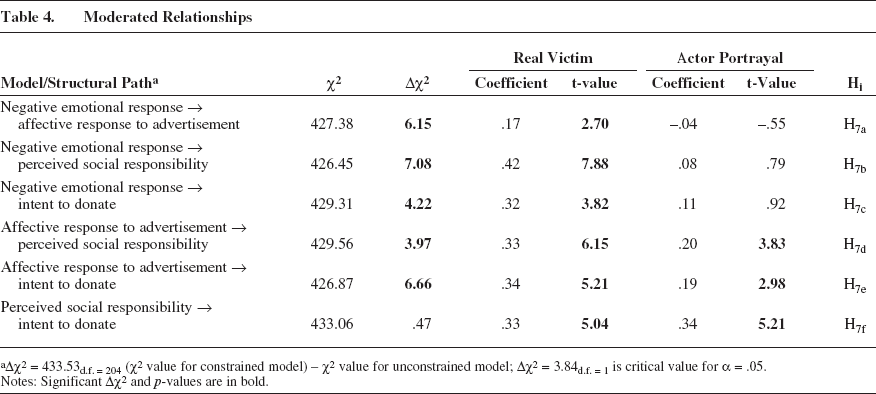
Δχ2 = 433.53d.f. = 204 (χ2 value for constrained model) – χ2 value for unconstrained model; Δχ2 = 3.84d.f. = 1 is critical value for α = .05.
Notes: Significant Δχ2 and p-values are in bold.
Discussion
The purpose of this study was to investigate factors that may impinge on donor willingness to contribute to nonprofits under two PSA formats—(1) real victims who portray the consequences of drinking and driving/who have contracted cancer from smoking versus (2) actors or “posers” who represent fictionalized or composites of people who were to assumed to have been adversely affected in each of these scenarios. Specifically, we examined several antecedents of attitude toward nonprofit advertising, perceptions of a nonprofit entity's social responsibility, and the effect of these factors on people's intention to donate to the nonprofit.
We also explored the implications of disclosing to ad viewers whether the people portrayed in two PSA messages were, in reality, actors/posers or actual victims of these circumstances. The point of this latter examination was to determine whether disclosure of an actor portrayal would mimic what might be found had a real victim been used. Similarity of findings across these treatment conditions would hold significant implications for PSA developers as well as public policy makers and regulatory agencies insofar as those who are creating PSA messages could rely on and use people who represent victims rather than actual victims in donation appeals. For example, as we noted previously, the use of actors/posers at least appears to fulfill the FTC's criteria for deception, though it is unclear whether the FTC would pursue deception of this type (i.e., within the PSA format investigated here).
Except for the relationships specified in H1 and H7f, the results support all hypothesized paths in the model depicted in Figure 1 (see also Tables 3 and 4). For example, as we expected, negative emotional response to the advertisement (PSA) directly affects perceived social responsibility of the sponsor and intention to donate. Negative emotional response also appears to indirectly affect intention to donate through perceived social responsibility of the sponsor. Thus, we believe that these results provide evidence for the intuitively intriguing but seemingly illogical inverse relationship speculated in H2 and H3—that is, that negative reactions to a PSA can result in positive outcomes of relevance for PSA developers, specifically in terms of positively affecting perceptions of the PSA sponsor's social responsibility and people's intention to donate to the PSA.
We believe that the moderated relationships (see Table 4) are also important because they indicate the overall improvement in the paths specified in the general model (see Figure 1) that may occur when viewers know that the people depicted in the PSA are real victims instead of actors. The coefficients depicted in Table 4 for all paths in the real victim condition are stronger in magnitude (and significant) than their counterparts in the actor portrayal condition with the exception of H7f (path link between perceived social responsibility and intention to donate). Moreover, the path from negative emotional response to affective response to the advertisement is significant only when a real victim is used in the PSA message.
Our results are particularly relevant and important for the direct antecedents of intention to donate. That is, the impacts of negative emotional response and attitude toward the ad on intention to donate are both significant and stronger under the real victim condition. The nonsignificant moderating effect of ad treatment exposure on the relationship between perceived social responsibility of the sponsor and intention to donate may indicate that this relationship is not affected by disclosure of whether a poser or a real victim is used in the PSA. Thus, it behooves nonprofits to enhance potential donor perceptions of how they are contributing in a positive manner to society because such views apparently are directly linked to intentions to donate.
There are several implications for nonprofit practitioners that choose to use PSAs. For example, actor portrayal disclosure may operate such that it switches negative reaction somewhat away from the nonprofit, at least in terms of comparing viewer reactions with what might have happened if the public learned that the victim depicted in the PSA was an undisclosed actor portrayal (as occurred in the MPAAT example we cited previously; see also Shanahan and Hopkins 2007). However, disclosure may still lessen negative emotional response that may be necessary to deliver heartfelt messages that influence intentions to donate to the nonprofit. Thus, nonprofits should use real victims (not actors) in PSAs whenever possible, given the observed weaker emotional response that occurs when actors appear in these types of PSAs. Ultimately, we believe that such a strategy may be better for consumers, who will not feel deceived or misled, and for nonprofits, which, through the use of real victims, will create more empathy for the victim and ultimately a more effective message in terms of appealing to target audiences.
How might such shifts in how nonprofits manage their advertising operations be accomplished? We believe that self-regulation within the industry may be a more acceptable and beneficial alternative than mandating at the federal level the type of PSA portrayal format that must be used. As we noted, although not disclosing that an actor has been used in a PSA may fulfill the FTC's criteria for determining deception, it is also unclear whether the FTC would intervene in such scenarios even if deception was identified (i.e., according to the FTC's criteria). Thus, other alternatives may be more appropriate and applicable in terms of encouraging the use of real victims in PSA messages and advertising. The advertising industry as a whole has shown that self-regulatory policies are more efficient and effective in terms of “policing” the practices of advertisers than relying on federal agencies, such as the FTC, to monitor and rectify advertisers’ (intended or unintended) missteps. In the scenario reflected in the current research, self-regulation might take the form of a nonprofit “code of ethics,” in which these agencies ascribe to tenets such as using real victims in PSA messages or, at a minimum, disclosing that actors are being used instead of real victims as well as why (e.g., difficulty in obtaining permission to portray an actual victim).
More specifically, although the FTC's “clear and conspicuous” guidelines were developed for television advertising disclosures, they have been applied in a variety of contexts (see, e.g., Hoy and Andrews 2004). At least some of these standards could also have relevance for guiding the disclosure of the use/nonuse of actual victims in televised or print nonprofit PSA messages. For example, using adequate typefaces and type sizes and avoiding distractions in the message itself (Hoy and Andrews 2004) to convey the status of the victim being portrayed are natural offshoots for presentation of this key information and flow from the FTC disclosure guidelines. Although we are not advocating legislation mandating how such disclosure should take place, information such as that which is available in the FTC's clear and conspicuous disclosure standard could form part of the basis for self-regulation principles, in addition to developing a nonprofit code of ethics applicable to the use of actual victims versus actors in PSA messages. In addition to these guidelines, other information is available that might offer insights for nonprofits that are contemplating these decisions. For example, the American Marketing Association's “Statement of Ethics” (http://www.marketingpower.com) could be used in conjunction with the FTC disclosure standards in terms of forming a nonprofit code of ethics. The association's ethical values of “honesty” and “fairness” in terms of their applicability for truthful representation of a company's “products” would seem to be particularly appropriate for contributing to an ethics code for nonprofits. However, although we recommend that self-regulation and development of a code of ethics may be the most appropriate response to incidents such as that which occurred with the MPAAT, there are those in the philanthropy industry itself who advocate more stringent policing of this sector than is available through self-regulation (Eisenberg 2007). Thus, it is worth repeating that the “best” alternative might be to use a real victim in a PSA ad appeal because this approach would appear to avoid the need to comply with the FTC's deception criteria. Yet using real victims has its own set of caveats—for example, a “staged” appeal in which a real victim is used but in a contrived setting (meaning nondisclosure of the manipulated setting) may also lead to deleterious effects that could generate unwanted scrutiny from the FTC.
Limitations and Conclusions
As is the case with most studies, there are certain limitations that may detract from the overall efficacy of these results, but these limitations may also suggest avenues for additional research. We used only two PSA formats (i.e., being the victim of drunk driving or cancer). These depictions vary on any number of comparison factors. For example, the victims (actor or not) “vary” in how long the effect of the condition afflicting them may actually take to manifest (i.e., the death of those killed by drunk drivers might be perceived as more immediate than having been diagnosed with and dying from a virulent form of cancer, which can occur over a much longer period). Further research might attempt to broaden the types of conditions depicted in these PSA message formats to obtain a more robust sense of whether the relationships we studied herein are found regardless of the victim condition depicted. Such research might also include explorations of whether the use of a real victim in a nonprofit PSA appeal is mitigated by placing the victim in a contrived scenario and how disclosure of this affects outcomes such as intention to donate, attitude toward the ad, and so forth.
We were also cognizant that respondents’ status as a smoker or drinker may have played a role in their attitude toward the ad. Thus, we tested for a main effect for smoker versus nonsmoker and drinker versus nondrinker and found that no main effect existed. This is consistent with the findings of Tangari and colleagues (2007), who also find no support for an influence of smoking status on attitude toward the ad.
Finally, the measure for the negative emotional response construct is necessarily narrow, despite a larger subset of negative feelings in the literature (Edell and Burke 1987). Although a larger set of negative emotional response has been suggested, we needed to tap into specific negative emotions or feelings directly related to the advertisement presented to the viewer. Thus, we considered previously identified negative feelings, such as skeptical, defiant, and dubious, not relevant, whereas the items we employed herein are relevant to this study and have been used previously in this context (Moore, Harris, and Chen 1995). Thus, although this could be a potential limitation, we believe that negative emotional response has been defined appropriately for this study.
In summary, this study offers insights into how nonprofits might work toward developing better and more effective PSAs and how self-regulation may mitigate the negative response to employing actor portrayal labels. In essence, although nonprofits may find the use of actors in PSAs to be an easier choice and a more attainable resource in certain circumstances, in the long run, they will benefit from capitalizing on the notion that viewers differentiate between actors and real people when processing PSA messages. Moreover, this study found that potential receivers care a lot about these differences and how they are manifested in PSA messages. Thus, a well-publicized adoption of self-regulation tenets when using actor portrayal labels may benefit nonprofits that cannot or choose not to employ real victims in PSAs.
Footnotes
List of Items
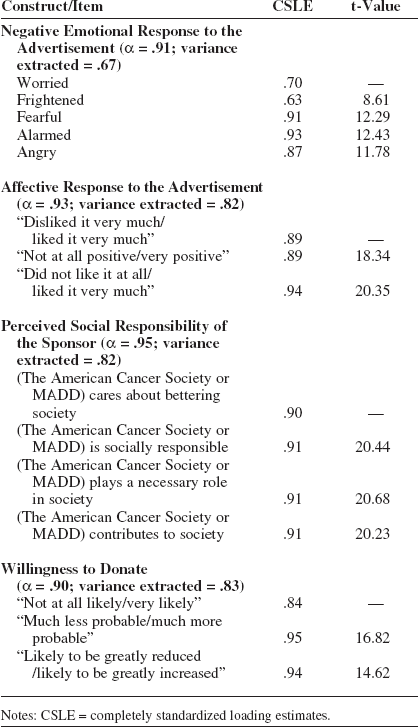
| Construct/Item | CSLE | t-Value |
|---|---|---|
|
|
||
| Worried | .70 | — |
| Frightened | .63 | 8.61 |
| Fearful | .91 | 12.29 |
| Alarmed | .93 | 12.43 |
| Angry | .87 | 11.78 |
|
|
||
| “Disliked it very much/liked it very much” | .89 | — |
| “Not at all positive/very positive” | .89 | 18.34 |
| “Did not like it at all/liked it very much” | .94 | 20.35 |
|
|
||
| (The American Cancer Society or MADD) cares about bettering society | .90 | — |
| (The American Cancer Society or MADD) is socially responsible | .91 | 20.44 |
| (The American Cancer Society or MADD) plays a necessary role in society | .91 | 20.68 |
| (The American Cancer Society or MADD) contributes to society | .91 | 20.23 |
|
|
||
| “Not at all likely/very likely” | .84 | — |
| “Much less probable/much more probable” | .95 | 16.82 |
| “Likely to be greatly reduced/likely to be greatly increased” | .94 | 14.62 |
Notes: CSLE = completely standardized loading estimates.