






Abstract
Objectives
To (1) audit dental arch relationships of all children born between 1982 and 1999 with complete unilateral cleft lip and palate (UCLP) treated at the Cleft Lip and Palate Unit, Princess Margaret Hospital for Children (PMH), Perth, Western Australia, (2) assess the distribution of GOSLON ratings from dental casts taken at 9 years, (3) compare the 9-year GOSLON ratings for “High” and “Low” caseload surgeons, and (4) compare the 9-year PMH GOSLON ratings with published ratings from other units.
Design
Retrospective audit of dental casts and medical charts.
Patients
Dental casts were retrieved for 71 children (47 boys and 24 girls) at 9 years of age.
Main Outcome Measures
GOSLON ratings.
Results
Sixty-eight percent of patients had an excellent to satisfactory dental arch relationship (GOSLON Yardstick ratings 1 to 3) at 9 years with a mean rating of 2.85. High caseload surgeons achieved statistically better mean GOSLON ratings than low caseload surgeons (2.72 and 3.33, respectively).
Conclusions
PMH Cleft Unit's dental arch relationship outcomes are comparable to published series of units using similar treatment protocols. High caseload surgeons achieved better dental arch relationships than low caseload surgeons.
Keywords
Outcome assessment and reporting by cleft lip and palate units is essential to assess the efficacy of treatment and maintain quality assurance (Asher-McDade et al., 1991; Witt and Marsh, 1997; Bearn et al., 2001; Williams et al., 2001; Shaw et al., 2005). There is a diversity of treatment protocols applied by different centers worldwide; for example, the Eurocleft study (Asher-McDade et al., 1992; Bearn et al., 2001) found 194 different treatment protocols amongst the 201 units assessed.
The timing and method of surgical repair, as well as the experience of the surgical team, have been found to influence dentofacial outcomes of patients with repaired cleft lip and palate (Ross, 1987a, 1987b; Shaw et al., 2005; Liao and Mars, 2006). However, the effect of surgical protocol on growth needs to be balanced against requirements of speech (Rohrich and Gosman, 2004) and psychosocial development (Murray et al., 2008). These aspects of cleft care have been well documented to benefit from early repair.
The objective assessment of a cleft treatment protocol should include speech, dental arch relationship, growth, and symmetry, as well as aesthetic and psychosocial factors. The cost to both the health care system and the patient also needs to be considered. To be effective, outcome measures need to be able to discriminate, be valid and reproducible, and be practicable to implement. Fulfilling all these criteria for all facets of cleft care in varied settings has not been achieved. To date, dental arch relationship and speech outcomes have been considered as the most useful benchmarks to assess the efficacy of management of children with a cleft lip and palate (Sandy et al., 2001; Sell et al., 2001).
An assessment of dental arch relationships provides information on a patient's occlusion and by inference facial growth (Mars and Houston, 1990; Hathorn et al., 1996). The GOSLON Yardstick has proven to be a valid and reliable means to assess this aspect of cleft care (Mars et al., 1987) and a better discriminator of surgical outcome than cephalometric analysis (Mars et al., 1987; Johnston et al., 2004; Stein et al., 2007). It has also been found to be valid and reproducible in many settings, hence a useful means by which to compare treatment outcomes from different units (Mars et al., 1987, 1992) and different treatment protocols (Johnston et al., 2004).
The Cleft Lip and Palate Unit at Princess Margaret Hospital for Children, in Perth (PMH) is the sole provider of cleft care in Western Australia (population 1.83 million). The purpose of this study was to evaluate and compare dental arch relationship outcomes with those of published reports from other centers as a measure of primary surgical performance of a dedicated Australian Cleft Lip and Palate Unit with a consistent treatment protocol over an extended period. The effect of surgeon case load on outcome was also reviewed.
Materials and Methods
Subjects
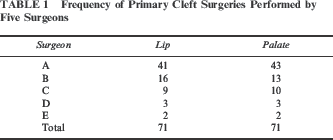
Permission to review records of participating subjects was obtained from PMH ethics committee (Activity Nos. 1919). There were 111 non-syndromic children with a complete unilateral cleft lip and palate (UCLP) that were consecutively treated between 1982 and 2000 at PMH available to the study. This cohort had received all of their treatment by the Cleft Unit at Princess Margaret Hospital and was representative of the population affinities of Perth, Western Australia, that is composed mainly of peoples of European decent. Eleven patients with a Simonart's band were excluded according to the recommendation of Nollet et al. (2005b). A further 29 patients were excluded because they had yet to reached 9 years, and therefore had insufficient records; had undergone pre-alveolar bone graft orthodontic treatment; or had been lost to follow-up. A total of 71 patients (47 boys and 24 girls) who had 9-year casts taken prior to alveolar bone graft were available for this study (mean age of 9.13 years [0.87 SD]) representing a consecutive series of treated patients. Over the course of the study, five surgeons were involved in primary repair with 57 of the operations (81%) undertaken by two high caseload surgeons (Table 1).
Frequency of Primary Cleft Surgeries Performed by Five Surgeons
Epidemiology and management data were retrieved from archived medical records. Primary lip surgery was undertaken at a mean of 3.3 months (1.86 SD). In the majority of cases a Tennison-Randall lip repair was performed (89%), and the remainder (11%) had a Millard style repair. The hard and soft palates were closed at a mean of 8.68 months (2.9 SD). Veau-Kilner-Wardill flaps were used for 68 of the palatoplasties. A Von Langenbeck procedure was performed on the remainder (three cases).
Dental study casts were scheduled to be taken at 9 years of age. The 71 children with casts available for assessment had a mean age of 9.13 years at the time the casts were obtained (SD 0.87).
Surgical Management
The primary surgical management of UCLP patients has followed a consistent protocol at PMH for the past 30 years. Surgery was mainly performed by two “high caseload” surgeons (57 UCLP patients), with the remainder (14 UCLP patients) operated on by three “low caseload” surgeons according to definitions set by Bearn et al. (2001) taking into account the frequency of all cleft-related surgeries performed over the working lives of the participating surgeon not just the dental casts of cases included in the study. Presurgical orthopedics (PSO), utilizing a plate and lip strapping, is commenced in the first week of life and continued until 3 months of age when a lip repair and a primary rhinoplasty are performed as described by McComb (1985). A Tennison-Randall or Millard type repair of the lip is performed. A Muir flap and a vomerine flap are used to repair the alveolar cleft and anterior palate. The remainder of the palate is repaired at 9 months of age with either Veau-Wardill-Kilner flaps or a von Langenbeck procedure. Since 1985 an intravelar veloplasty has also been performed. Alveolar bone grafting is carried out between 9 and 11 years of age depending upon upper permanent canine root development (or lateral incisor root development if the lateral incisor is in the minor segment).
The timing of primary surgery is based on a philosophy of providing optimal early facial aesthetics and facilitating optimal speech outcomes prior to commencing school at age 5 years. The palatal repair is combined with comprehensive speech therapy.
Comprehensive clinical records have been maintained, including archiving of dental study casts, cephalometric radiographs, clinical photographs, speech, and medical records of all patients treated for UCLP at PMH.
Data Assessment
Dental arch relationship of the 9-year casts were assessed using the GOSLON Yardstick. Dental casts of late mixed dentition UCLP children were sorted into five discreet classes by making comparisons with 10 reference casts. The yardstick sorts arch relationships according to the degree of predicted treatment difficulty. Those with good to excellent ratings (1 to 2) require only standard orthodontic treatment to resolve the malocclusion present. Patients assessed as having a poor to very poor dental arch relationship are likely to require surgical intervention to produce an acceptable occlusion (score 4 to 5). A rating of 3 is given to a patient who has a malocclusion that requires difficult orthodontic treatment to attain an acceptable occlusion. For the purposes of this study three raters, two orthodontists experienced in cleft care and a cranio-maxillo-facial specialist research scientist. All raters had completed training in the use of the GOSLON by Dr. Mars and were blinded to the subject details. The dental arch relationships were rated twice by the each rater blinded to their previous score. GOSLON Yardstick reference casts were available as a comparative guide (Mars et al., 2002).
Statistical Analysis
The mean intrarater weighted kappa score was .782 (range .752 to .826) and the interrater weighted kappa scores ranged from .691 to .791. All of the reliability scores were significant at p < .001 and the strength of agreement for 9-year model assessments was within acceptable range (Landis and Koch, 1977; Altman, 1991). The weighted kappa statistic for ordinal categorical data in this analysis was performed using SAS software package. Difference in means between low and high caseload surgeons was tested using independent t test in Excel (Excel 2002, Microsoft Corporation).
Results
PMH GOSLON Yardstick Outcomes
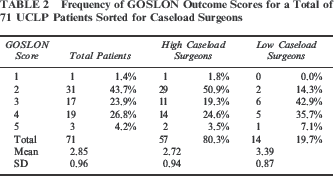
The mean GOSLON rating for 71 patients at 9 years was 2.856 (0.96 SD). Thirty-one cases (43.7%) had a “good” (rating 2) interarch relationship. Seventeen patients (23.9%) had a “fair” relationship (rating 3). Nineteen cases (26.8%) had a poor outcome (rating 4) and three (4.2%) had a very poor outcome (rating 5). Only one patient (1.4%) had an excellent (rating 1) interarch relationship.
Comparisons with High and Low Load Surgeons
The 57 patients treated by high caseload surgeons had a mean GOSLON rating of 2.72 (0.94 SD). This was significantly better (p < .05) than the mean rating for patients treated by low caseload surgeons (3.33 [0.87 SD]). The difference in means was reflected in the contrasting frequency of ratings for the individual categories (Table 2). For high caseload surgeons the highest frequency (50.9%) of ratings was in the good category (rating 2), whereas low caseload surgeons returned the highest proportion of patients (42.9%) in the fair category (rating 3). The differences between high and low caseload surgeon groups in the summed frequencies of the poor and very poor outcome categories (ratings 4 and 5) were moderate at 28.1% and 42.8%, respectively.
Frequency of GOSLON Outcome Scores for a Total of 71 UCLP Patients Sorted for Caseload Surgeons
Comparisons of PMH Dental Arch Relationship outcomes to other Published Reports
In Figure 1 the 9-year PMH GOSLON outcomes are compared with published results of Frenchay (Hathorn et al., 1996), Tokyo (Susami et al., 2006), Malay (Zreaqat et al., 2009), Clinical Standards Advisory Group (CSAG) (Williams et al., 2001), West Yorkshire (Morris et al., 2000), Old Wessex (Choudhary et al., 2003), Nijmegen (Noverraz et al., 1993; Nollet et al., 2005b), Vienna (Sinko et al., 2008), Göteborg (Lilja et al., 2006), and Oslo and Warsaw (Fudalej et al., 2009) studies. Superior mean results to the PMH mean GOSLON rating (2.85) were returned by the European centers of Göteborg (2.06) (Lilja et al., 2006), Vienna (2.31) (Sinko et al., 2008), Nijmegen (2.39) and Warsaw (2.68) (Fudalej et al., 2009), and Oslo (2.65) (Fudalej et al., 2009). This ranking between centers was also evident when comparing poor to very poor GOSLON outcomes (rankings 4 and 5): PMH, 32%; Göteborg, 2%; Vienna 7%; Nijmegen, 9%, Oslo and Warsaw, 14.4%; with the others ranging from 28% to 58.4%. At the other end of the scale, the proportion of excellent to good GOSLON outcomes (rankings 1 and 2) for PMH patients (45.1%) approached those of Warsaw (44.5%) and Oslo (50.8%), but not Nijmegen (61%), Vienna (71%), and Göteborg (85%). In contrast to this pattern were the reported results from Old Wessex (Choudhary et al., 2003) where a high proportion (52%) of excellent to good outcomes contributed to a positive bias in mean outcome despite similar frequency (28%) of poor to very poor rankings. The proportion of good to excellent result for the other centers ranged from 8.49% to 40.0%.
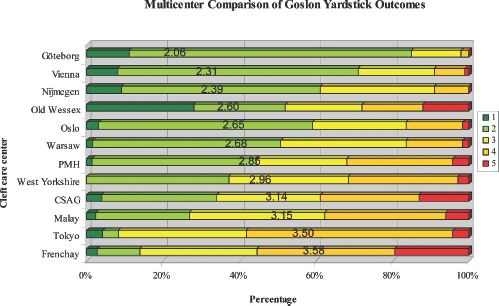
Comparisons of PMH GOSLON outcomes with published reports from other cleft centers.
Comparisons of the PMH GOSLON outcomes at 9 years with Eurocleft (Shaw et al., 1992a, 1992b) ratings 1 and 2 and ratings 4 and 5 were summed to conform to the reporting of the Eurocleft study (Fig. 2). Centers B and E only bettered PMH ratings in terms of good outcomes. In terms of satisfactory to good outcomes PMH performed most similarly with center A. The most disappointing PMH outcome was the relatively high percentage (32%) of cases being rated as poor to very poor at 9 years. This percentage was, however, less than centers C, D, and F.
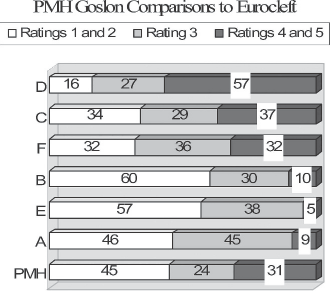
Comparisons of PMH GOSLON ratings to the Eurocleft study.
Discussion
The aim of auditing outcomes of a single cleft unit using a consistent protocol is to assess performance for the purpose of evidence-based review of practice. The comparison of dental arch relationship outcomes has become a common practice, and the GOSLON Yardstick has become the tool of choice. This study has reported the GOSLON ratings at 9 years from a unit with a consistent protocol to enable comparison with other published reports.
It is well recognized that children treated for complete UCLP may develop maxillary retrusion and malocclusion (Shaw et al., 1992a, 1992b; Morris et al., 2000). It is also recognized that the adult dental arch relationship of patients with unoperated clefts of the lip and palate may parallel normal or indeed have a greater over jet (Mars et al., 1990). This implies that a significant component of the growth restriction occurs as a consequence of surgical management (McCance et al., 1990). The 9-year arch relationships of the PMH cohort were acceptable, with 67% achieving a rating of satisfactory or better. This outcome was tempered by a relatively high proportion (32%) of patients who recorded poor to very poor outcomes (ratings 4 and 5).
The PMH outcomes were compared with those reported in the Eurocleft study (Mars et al., 1992), and these results are shown in Figure 2. Center D had the protocol most similar to PMH; however, it reported the poorest outcome. PMH contrasted to this center by being centralized, using a consistent treatment protocol, and using mainly high caseload surgeons. Centers B and E reported better GOSLON ratings than PMH. They had a similar high surgeon caseload profile to PMH; however, their protocols differed in that they did not use PSO and palate repair was carried out at 18 to 24 months.
This pattern was repeated when comparing published reports of GOSLON outcomes from other centers (Fig. 1). All of the centers with better results than PMH used high caseload surgeons. Those reporting poorer outcomes, except for the Malay population (Zreaqat et al., 2009), used low caseload surgeons (Table 3). The significant difference in outcome between low and high caseload surgeons utilizing a single protocol in this study provides some support for the centralization of cleft care to designated cleft units in order to produce experienced and skilled surgeons.
Summary Treatment Protocols of Centers With Published GOSLON Outcomes (Sorted for GOSLON Outcome)
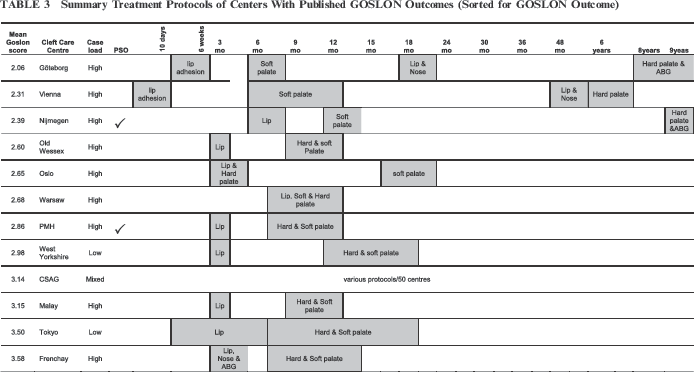
Göteborg (Lilja et al., 2006) and Vienna (Sinko et al., 2008), the two best performing centers in terms of GOSLON ratings, differed from PMH in not using PSO and delaying hard palate repair until the time of secondary alveolar bone grafting (Table 3). Göteborg (Lilja et al., 2006), Vienna (Sinko et al., 2008), and Nijmegen (Noverraz et al., 1993; Nollet et al., 2005b) had more favorable ratings than PMH at 9 to 10 years. These centers predominately use pushback procedures, which some believe result in a greater compromise to growth (Kitagawa et al., 2004); however, this may in part be offset by the delay in performing these procedures. At PMH we perform palatoplasty with hard and soft palate closure at 9 months compared to Nijmegen (Noverraz et al., 1993) at 4 years, Vienna (Sinko et al., 2008) at 6 years (soft palate at time of lip repair), and Goteborg (Lilja et al., 2006) where closure is undertaken at time of alveolar bone grafting (mean of 8.5 years). This discrepancy may be a factor in the relatively poorer PMH GOSLON outcomes.
Those centers that practice late hard palate closure all had good GOSLON outcomes supporting the notion that the timing of closure is influential in craniofacial growth (Liao et al., 2006). This is also observed in a comparison of PMH GOSLON outcomes with Eurocleft ratings (Fig. 2). Those centers practicing a later hard palate closure, E (18 months), A (9 years), and B (24 months), all report better outcomes than those centers that perform earlier closures. The other Eurocleft centers, in particular D and F, that use similar palate closure protocols to PMH report poorer GOSLON outcomes. One difference in these Eurocleft centers is the relatively large number of surgeons performing a small number of cases compared with the PMH team that use predominately high caseload surgeons.
Direct comparison of PMH GOSLON outcomes to those of the Eurocleft, CSAG, and other reports can be problematic because PMH excluded patients with Simonart's bands. In a meta analysis of published GOSLON outcomes, Nollet et al. (2005a) concluded that studies that included patients with Simonart's bands would positively influence the outcome, and recommended that these patients be removed from the analysis. This was done for the PMH study.
The use of PSO may be another source of maxillofacial growth restriction; however, these interventions have not been demonstrated to be deleterious (Ross, 1987a; Chan et al., 2003; Bongaarts et al., 2006). The Dutchcleft study (Bongaarts et al., 2006) demonstrated no statistical difference in GOSLON outcome in patients randomized for PSO. The assessment of the impact of PSO on arch relationship outcomes using the GOSLON Yardstick is inconclusive at this stage.
Focusing on GOSLON outcomes alone when reviewing a cleft treatment protocol can skew decision making to achieve dentoalveolar outcome, it may transpire to be at the expense of speech outcome. The speech outcomes of some European centers that carry out delayed hard palate closure has not been promising (Lohmander and Persson, 2008). Holland et al. (2007) reported long-term results of delayed hard palate closure in 18-year-old patients with poor speech outcomes. The PMH treatment philosophy prioritizes speech outcome over dentoalveolar outcome. This is based on the premise that growth restriction can be more successfully managed than long-term speech problems. Early palatal repair appears to be critical in good speech outcome (Rohrich et al., 2000; Chapman et al., 2008). It is interesting to note that the timing of hard palate closure in Göteborg, which has reported the best GOSLON score (2.06), has been brought forwards from 8 to 3 years due to the deleterious effects of delayed palate closure on speech (Lilja et al., 2006).
Periodic reviews of cleft protocol are important to ensure standards of outcomes and to assess whether changes are required. The use of universally accepted measures of outcome and patient inclusion criteria is critical to facilitate multicenter comparison and the sharing of acquired knowledge. For cleft care the use of the GOSLON Yardstick has been reported to be valid and reliable, as it has in this study. This validity is based on subjective assessments of a panel of experienced cleft care orthodontists. Despite these acceptable parameters it is important to subject audit tools to review of their efficacy.
Conclusions
The PMH Cleft Lip and Palate Unit's dental arch relationship outcomes are comparable with those of other units using a similar protocol. High caseload surgeons achieved superior GOSLON ratings when compared with low caseload surgeons.