







Abstract
Four newborn boxer dogs with bilateral cleft lip and palate were examined in search of further abnormalities, but no other type of congenital defect was found. These data, along with the pedigree inspection regarding the clinical phenotype, led to the conclusion that the affected dogs had a nonsyndromic monogenic autosomal recessive cleft lip and palate.
Cleft lips and palates have been reported in several species of animals, including humans and dogs (Hámori, 1983). In dogs, as in humans, nonsyndromic cleft lip with or without cleft palate is one of the most common congenital craniofacial defects, and it may be caused by environmental factors or genetic factors (Smith, 2010). In humans, genetic nonsyndromic cleft lip and palate is generally thought to be a multifactorial birth defect with a threshold of expression (Grosen et al., 2010). The same concept, derived from the practical experience of veterinary clinicians, is commonly applied to the canine species (Padgett, 1998). However, there are reports attesting that monogenic etiology can also be important in dogs (Richtsmeier et al., 1994; Kemp et al., 2009). In boxers, the prevalence of cleft lip and palate is high, but the genetic bases for this are poorly known (Foley et al., 1979).
Case Report
We examined two newborn boxer dogs, one male, the other female, with cleft lip and palate. There were also three clinically normal siblings, one male and two female. All five dogs were from the same gestation. The cleft lip and palate of both dogs had the same pathological, anatomical, and clinical features, bilaterally affecting the upper lip, hard palate, and soft palate, but not affecting most of the primary palate (Fig. 1). These abnormalities impeded suction and caused milk reflux through the nostrils. The owner did not give permission for any treatment, and the dogs died approximately 3 days after birth. Postmortem examination of both dogs showed no congenital abnormalities in other organs.
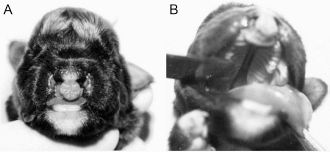
Clinical phenotype of one of the affected dogs (IV-1). A: Rostral view. B: Palatal view. All four affected dogs had essentially the same clinical phenotype.
The parents were healthy animals. They were fed a high-quality dog food and received all routine vaccines and antihelminthic drugs. The mother had a pregnancy without intercurrent diseases, and the pups were born from a normal vaginal delivery. No vaccines or medications were used close to or during the pregnancy. No substance with teratogenic potential was found in the environment where the dogs lived.
About 16 months later, the same dog couple bred again. Of the six pups in this litter, one male and one female were born with the same clinical phenotype as the probands. As in the previous situation, no treatment was attempted, and the necropsies revealed no additional congenital defects.
The family history revealed that the parents of the affected dogs were consanguineous (uncle and niece). This facilitated the identification of 14 individuals from generations before the probands, all of whom were clinically normal. There was no history of other relatives affected by any type of craniofacial defect (Fig. 2).
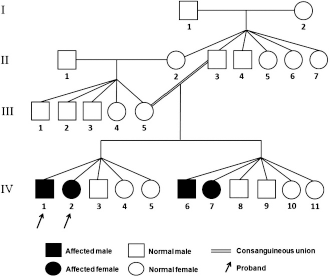
Pedigree of the affected boxer dog family.
Discussion
Although cleft lips and palates can occur in any breed of dog, they are more frequently found in brachycephalic dogs (Foley et al., 1979). Observations by breeders and veterinarians indicate that there is a high prevalence of cleft lips and palates in boxers, and Turba and Wilier (1987) estimate 0.6%, but there are no definitive numbers as yet. Turba and Wilier (1987) hypothesized that in this breed of dog the cleft lip and palate is caused by monogenic autosomal recessive inheritance, and the pedigree (Fig. 2) that we have included in this report corroborates this hypothesis. This inheritance pattern predicts that normal procreators, being heterozygotes, can produce affected descendants of both sexes with equal frequency and that there may be recurrence of the phenotype on the sibship of 25%. Furthermore, consanguineous unions increase the risk of recurrence for subsequent family generations (Harper, 2010).
In the family presented here, all of the aforementioned conditions were met. Thus, considering that an autosomal recessive allele is only expressed in homozygosity, in generation I at least one of the individuals was a heterozygote. In generation II, at least individuals 2 and 3 were heterozygotes, and in generation III at least individual 5 was a heterozygote. Male II-3 and female III-5 are normal and consanguineous (uncle and niece, respectively) and their offspring include two affected males and two affected females. The frequency rate of 36% of affected offspring (4 of 11) is a deviation from the expected value (25%) because of the small size of the sample and the family ascertainment, which only occurred because of the affected subjects. This phenomenon is well known in segregation analysis (Emery, 1976).
The clinical phenotype was essentially the same in the four affected dogs, and there were no congenital abnormalities other than the cleft lip and palate. The mother of the affected dogs remained healthy throughout both gestations and was not exposed to teratogenic agents. These facts and the data provided here all strongly suggest that the dogs in this study had a nonsyndromic cleft lip and palate with monogenic autosomal recessive inheritance pattern.
The monogenic autosomal recessive inheritance pattern has been confirmed for oral clefts in some canine breeds: Richtsmeier and colleagues (1994) described an autosomal recessive pattern of inheritance for isolated palate in Brittany spaniels, and Kemp and colleagues (1999) described it for cleft lip with or without cleft palate in Pyrenees shepherd dogs, lending further support to the conception that, at least in dogs, this inheritance pattern is a relevant factor in the etiology of cleft lip and palate, in addition to multifactorial inheritance. Bearing in mind that the genomic similarity between dogs and humans is high, and that both species share the same environment (Shearin and Ostrander, 2010), further genetic study of these abnormalities in dogs can contribute to widening our knowledge of the genetic and nongenetic aspects of these abnormalities in humans. The establishment of a boxer breeding line for research on oral clefts could serve this purpose, enabling studies to map genes and compare the genomes of the two species.