






Abstract
Objective
To identify the contribution of TGFA gene variants to the risk of nonsyndromic cleft lip with or without palate (NS-CL±P).
Design
The samples were from 142 Korean NS-CL±P families and 119 control parents having nonaffected children. Minor allele frequency, heterozygosity, and χ2 test for Hardy-Weinberg equilibrium were calculated for each of 10 selected single-nucleotide polymorphisms (SNPs). Ten SNPs were used to examine the association of case-parent trios with the transmission disequilibrium test (TDT) and conditional logistic regression models (CLRMs). Both allelic and genotypic TDTs for individual SNPs and sliding windows of haplotypes consisting of two to five SNPs were tested using family- and haplotype-based association test programs. Genotypic odd ratios (GORs) were obtained from CLRMs using STATA software. The parent-of-origin effect was evaluated for 10 SNPs, and a comparison between 218 case parents and 119 control parents was performed to investigate paternal and maternal ORs.
Results
Family-based TDT and haplotype analysis exhibited no statistical significance, but a relatively meaningful association was shown with rs3771497 (all P < .05; two SNPs, rs3771497 and rs3755377; five SNPs, rs3771497, rs3755377, rs3771485, rs11466212, and rs3771475). G/G homozygotes at rs3771497 have a significant decreased risk of NS-CL±P (GOR = 0.30, P < .01). No SNPs showed parent-of-origin effects. However, in the comparison between case parents and control parents, a single-marker analysis of maternal line showed a significant association with NS-CL±P in rs3771497 (P < .001, recessive model).
Conclusion
The association of the TGFA gene with NS-CL±P in Korean populations was not clearly found. However, the etiologic effect of the TGFA gene on NS-CL±P patients should be investigated in terms of maternal genotype influence.
Nonsyndromic oral clefts (NSCLP), which can be divided into cleft palate only and cleft lip with or without cleft palate (CL±P), have heterogeneous genetic backgrounds and developmental origins (Mossey and Little, 2002; Rullo et al., 2007; Beaty et al., 2010). Generally, surgery, orthodontic treatment, speech therapy, and psychological consultation are required for the effective improvement of the diverse problems that NSCLP patients encounter (Dixon et al., 1991; Sanford et al., 1997).
Transforming growth factor alpha (TGFA) has been mapped in chromosome 2p13, is composed of 70 to 100 kilobases of genomic DNA (gDNA), and has six exons (Brissenden et al., 1985). TGFA is known to be involved in growth regulation of the normal tissue and neoplasia. It is secreted by many types of cells, primarily of ectodermal origin, and binds to the epidermal growth factor (EGF) receptor. During the palatal fusion process, EGF is expressed at the medial edge epithelium of the palatal shelves (Dixon et al., 1991; Lamaroon et al., 1996). In murine models, EGF-null mice showed an increased incidence of orofacial clefts (Martinelli et al., 2009). TGFA interacts with the EGF receptor and can promote extracellular matrix synthesis and mesenchymal cell migration, ensuring the strength of the fused palate (Dixon and Ferguson, 1992). Miettinen et al. (1999) also found that newborn EGF receptor knock-out mice had a high incidence of cleft palate, implying that TGFA is a likely ligand for EGF receptors. They suggested that human oral clefts might have a genetic correlation with TGFA polymorphisms. On the other hand, Mann et al. (1993) and Luetteke et al. (1993) reported that the TGFA gene–null mutant mice had abnormal skin, hair, and eyes but not oral clefts.
Case-control and case-parent triad studies in humans have reported conflicting results. Although several etiological studies have insisted that NSCLP is associated with allelic variations of TGFA (Ardinger et al., 1989; Shiang et al., 1993; Beaty et al., 2006), others have not observed such an association (Stoll et al., 1992; Lidral et al., 1997; Rahman et al., 2008; Ehlers Bertoja et al., 2008; Zhu et al., 2010).
Until now, few association studies between the risk of NS-CL±P and TGFA gene polymorphisms have been conducted using a large number of samples in Korean populations. Therefore, the purpose of this study was to identify the contribution of the TGFA gene to the risk of NS-CL±P in Korean populations. We tested 10 single-nucleotide polymorphism (SNP) markers in and around the TGFA gene in Korean NS-CL±P case-parent families using the transmission disequilibrium test (TDT) and conditional logistic regression models. In addition, a comparison between 218 case parents and 119 control parents was performed to investigate paternal and maternal odds ratios.
Materials and Methods
Sample Description
The samples were taken from 142 Korean NS-CL±P families (90 boys and 52 girls; 9 cleft lip, 26 cleft lip and alveolus, and 107 cleft lip and palate; 76 trios and 66 dyads; Table 1). The control group was composed of 119 Korean parents with nonaffected children (60 males and 59 females). For this study, orthodontists examined and diagnosed NS-CL±P patients. Peripheral venous blood samples from patients and their parents were collected at either Seoul National University Dental Hospital (SNUDH), SAMSUNG Medical Center (SMC), or Hallym University Chuncheon Sacred Heart Hospital with written informed consent. This study was approved by the Institutional Review Board (IRB) at each institution (SNUDH IRB CRI-G07002, SMC IRB 2007-08-086, and Hallym University HIRB-2007-001).
Cleft Type and Gender Among 142 Korean Families With Nonsyndromic Cleft Lip With or Without Cleft Palate (CL±P) *
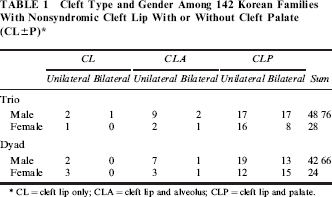
CL = cleft lip only; CLA = cleft lip and alveolus; CLP = cleft lip and palate.
SNP Selection and Genotyping
We selected SNPs located in a region from 2 kb~5′ to 2 kb~3′ of the TGFA gene using the linkage disequilibrium (LD) TAG SNP selection (TagSNP) of the SNPinfo Web server (Xu and Taylor, 2009; http://anpinfo.niehs.nih.gov/snptag.htm). A final set of 10 SNP markers was chosen to be in strong LD (r2 > .8) with published SNPs. All of the SNPs have high heterozygosity (>0.1) in reference to the HapMap data (JPT) and high design scores (>0.6) provided by Illumina Inc. (San Diego, CA).
The gDNA was extracted from each sample using a commercial DNA extraction kit (Quiagen Inc., Valencia, CA) and quantified at the Samsung Biomedical Research Center. The concentration of gDNA was verified on a spectrofluorometer (PerkinElmer, Branford, CT) using the PicoGreen dsDNA quantification kit. The SNP primers were synthesized with Oligator technology at Illumina Inc. and genotyped using the VeraCode Technology at SNP Genetics Inc. (Seoul, Korea). Genotype call rates of all SNPs and sample call rates were more than 95%.
Statistical Analysis
The minor allele frequency (MAF), heterozygosity, and a χ2 test for Hardy-Weinberg equilibrium (HWE) were calculated at each SNP between case and control groups. Pairwise LD was also computed as both D′ and r2 for all SNPs using the Haploview program (http://www.broad.mit.edu/mpg/haploview/index.php/; Ardlie et al., 2002; Barrett et al., 2005; Lee et al., 2012). The family-based association test program was used with both allelic and genotypic TDT for single SNP. In addition, sliding windows of haplotypes consisting of two to five SNPs were tested by the FBAT program (http://www.biostat.harvard.edu/fbat/default.html; Rabinowitz and Laird, 2000; Lee et al., 2012).
Genotypic odds ratios (GORs) for heterozygotes and homozygotes were calculated separately for single SNP with co-dominant and recessive models. The GORs were acquired by match sets, which consisted of the case and three pseudo-controls derived from parents and analyzed through conditional logistic regression models of the STATA software package (Lee et al., 2012).
Parent-of-origin effects were evaluated using the transmission asymmetry test (TAT), conditioning on parental genotypes (CPG) analysis, parent-of-origin likelihood ratio test (PO-LRT), and conditioning on exchangeable parental genotypes (CPEG) analysis (http://www-gene.cimr.ac.uk/staff/clayton/courses/florence11/lectures/lecture13-4up.pdf; Weinberg, 1999).
A comparison between 218 case parents and 119 control parents was performed separately by gender to investigate paternal and maternal odds ratios using the publicly available library SNPassoc in the R software (www.r-project.org). The Bonferroni correction was applied for multiple comparisons, and a P value less than .005 was considered statistically significant.
Results
MAF, Heterozygosity, HWE, and LD Analyses
The MAF for rs11466212 was the lowest (.094), while other MAFs showed values from .175 to .452. There was no significant evidence of deviation from HWE for all 10 SNPs in the parents (P > .05; Table 2). We increased the coverage by tagging SNPs based on data from the HapMap JPT samples with a threshold of D′ > .8. All SNPs were not in high LD (D′ < .8), except for a pair of SNPs, rs765871 and rs3771498 (D′ = .9; Fig. 1).
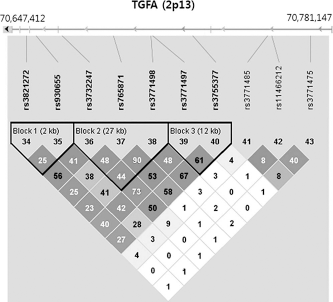
Linkage disequilibrium (LD) plot of TGFA. The level of pairwise LD is expressed by color (dark gray, D′ = 1 and logarithm of odds ratio [LOD] >2; gray, D′ < 1 and LOD ≥ 2; light gray, D′ = 1 and LOD < 2; white, D′ < 1 and LOD < 2).
Marker Information and TDT Results for 10 SNPs in the TGF-Alpha (TGFA) Gene Showing Relatively Meaningful Values of Linkage and LD in 142 CL±P Families *
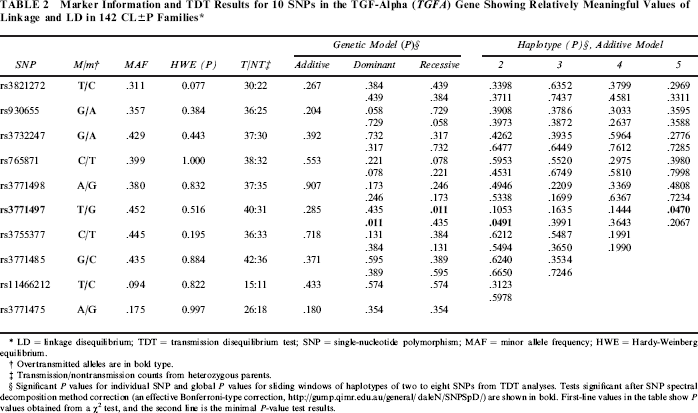
LD = linkage disequilibrium; TDT = transmission disequilibrium test; SNP = single-nucleotide polymorphism; MAF = minor allele frequency; HWE = Hardy-Weinberg equilibrium.
Overtransmitted alleles are in bold type.
Transmission/nontransmission counts from heterozygous parents.
Significant P values for individual SNP and global P values for sliding windows of haplotypes of two to eight SNPs from TDT analyses. Tests significant after SNP spectral decomposition method correction (an effective Bonferroni-type correction, http://gump.qimr.edu.au/general/daleN/SNPSpD/) are shown in bold. First-line values in the table show P values obtained from a χ2 test, and the second line is the minimal P-value test results.
TDT Analyses for Individual Markers and Haplotypes
To obtain more accurate results, two different methods were used to calculate P values; χ2 sum and minimal P-value tests (Tsui et al., 2007). Although the TDT analysis in the additive model did not show any significant association with single SNPs, rs3771497 in the dominant and recessive models appeared to have relatively meaningful P values (P = .011, in both the dominant and recessive models; Table 2).
The haplotype analysis in the additive model revealed that the association was not significant but was relatively meaningful in the haplotype including rs3771497, consisting of two and five SNPs (two SNPs, rs3771497 and rs3755377: P = .0491, minimal P value; and five SNPs, rs3771497, rs3755377, rs3771485, rs11466212, and rs3771475: P = .0470, χ2 sum).
In the strict sense, a statistically significant P value was not found by Bonferroni multiple comparison correction. All P values appeared to have a >.005 value. And the significance was not increased through haplotype analysis.
Genotypic Odds Ratios
Only the G/G homozygote at rs3771497 showed a significantly inverse association in the recessive model (GOR = 0.30, 95% confidence interval = 0.11 to 0.80, P = .0068), which suggests a trend of protection to NS-CL±P (Table 3).
GORs for Heterozygotes and Homozygotes for Individual SNPs Showing Significant Evidence of Linkage and LD in 142 CL±P Families *
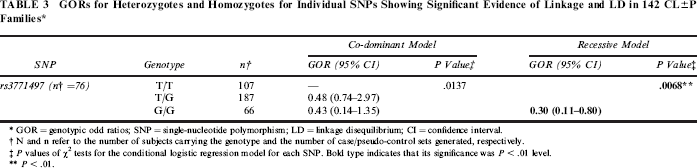
GOR = genotypic odd ratios; SNP = single-nucleotide polymorphism; LD = linkage disequilibrium; CI = confidence interval.
N and n refer to the number of subjects carrying the genotype and the number of case/pseudo-control sets generated, respectively.
P values of χ2 tests for the conditional logistic regression model for each SNP. Bold type indicates that its significance was P < .01 level.
P < .01.
Parent-of-Origin Effect (PO-LRT)
None of the 10 SNPs showed statistically significant values in TAT, CPG analysis, or PO-LRT analysis (all P > .05; Table 4). Although rs765871 appeared to have meaningful values in CPEG analysis, a significant difference was not found by Bonferroni correction (P = .0112).
Results of Parent-of-Origin Tests for 10 SNPs in the TGFA Gene†
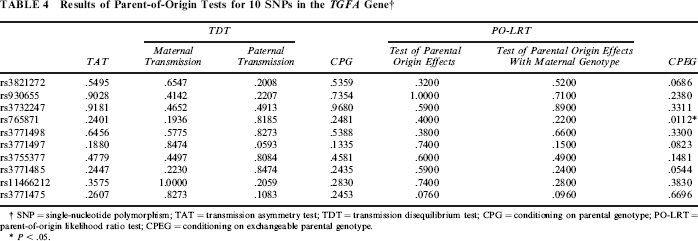
SNP = single-nucleotide polymorphism; TAT = transmission asymmetry test; TDT = transmission disequilibrium test; CPG = conditioning on parental genotype; PO-LRT = parent-of-origin likelihood ratio test; CPEG = conditioning on exchangeable parental genotype.
P < .05.
Results of Allelic Tests and Comparison Between 218 Case Parents and 119 Control Parents
Case-control group differences for mothers and fathers were estimated separately (Table 5). Single-marker analysis showed a significant association between the rs3771497 and NS-CL±P, especially in relation to the maternal line (P = .0217, log-additive model; P = .0007, recessive model; P = .0028, co-dominant model). However, the genetic risks due to the TGFA gene variants were not significant in the fathers' group.
Paternal and Maternal OR of 10 SNPs in the TGFA Gene in Comparison With 218 Case Parents and 119 Control Parents†
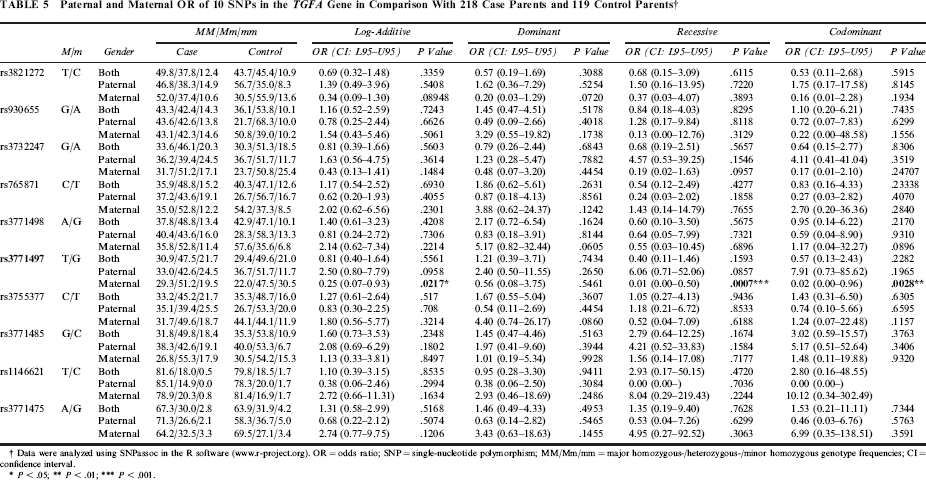
Data were analyzed using SNPassoc in the R software (www.r-project.org). OR = odds ratio; SNP = single-nucleotide polymorphism; MM/Mm/mm = major homozygous-/heterozygous-/minor homozygous genotype frequencies; CI = confidence interval.
P < .05;
P < .01;
P < .001.
Frequencies with the rarer genotype G/G of the rs3771497 were more than five individuals in all comparison groups (i.e., 7 cases/23 controls and 18 cases/24 controls in father and mother groups, respectively).
Discussion
There has been controversy regarding the association between NSCLP and TGFA allelic variation. Although several previous studies have supported a role of TGFA allelic variation in the etiology of NSCLP (Ardinger et al., 1989; Dixon et al., 1991; Holder et al., 1992; Vintiner et al., 1992; Hwang et al., 1995), Stoll et al. (1992) and Lidral et al. (1997) reported failures to observe any association of TGFA with NSCLP. Therefore, Vieira (2006) suggested that TGFA is probably a genetic modifier of clefting in humans. On the other hand, Beaty et al. (2006), in a case-parent trio study from three populations (74 from Maryland, 64 from Singapore, 95 from Taiwan), implied that ethnic background might influence the risk of cleft occurrence because TGFA showed significant etiological evidence in two of the three populations (Taiwan and Maryland).
Among the 10 SNPs used in this study, only rs3771475 was studied in other association studies between TGFA and NS-CLP. Sull et al. (2009) reported that the parent-of-origin likelihood ratio test gave significant values for maternal transmission (rs3771475: P = .027) in CLP case-parent trios regardless of ethnicity, although rs3771475 did not show statistical significance in single SNP and haplotype analyses. Their study was based on four populations (76 from Maryland, 146 from Taiwan, 35 from Singapore, 40 from Korea), and ethnicity was not reflected in this result (Sull et al., 2009). However, this study investigated only Korean NS-CL±P patients and did not find any significant association with rs3771475 in single SNP and haplotype analyses as well in the paternal and maternal case-control analyses.
The association of rs3771497 in the TGFA gene with NS-CL±P in Korean populations has not been reported in previous studies. The present study, which included 76 Korean NS-CL±P case-parent trios and 66 dyads, showed a not significant but relatively meaningful value of LD for SNPs in the TGFA gene with rs3771497 (P = .011, dominant and recessive model; Table 2). The haplotype for rs3771497 also had relatively meaningful evidence of linkage and LD with rs3771497 in the 142 Korean CL±P families (two SNPs: P = .0491, minimal P value; five SNPs: P = .0470, χ2 sum; Table 2). These results imply that statistical power might be higher as the sample size increases compared with the previous study (Sull et al., 2009).
The finding that rs3771497 showed a lower odds ratio of 0.30 in the G/G genotype (95% confidence interval = 0.11 to 0.80; P = .0068, under the assumption of recessive effect; Table 3) means that the T allele at rs3771497 was seen more frequently in NS-CL±P patients than was the G allele and that the GG genotype is associated with a decreased risk of NS-CL±P. In rs3771497, the recessive mode of inheritance was best fit to the current data.
Parent-of-origin effects was executed using STATA/SE 11.0 (StataCorp, College Station, TX) and STATA package(genassoc) by David Clayton. The TAT, TDT, CPG, PO-LRT, and CEPG analyses did not exhibit any significant maternal or paternal transmission with rs3771497. However, in comparison with case and control parents tests, single-marker analysis of maternal line showed more significant association with NS-CL±P in rs3771497 (P = .0217, log-additive model; P = .0007, recessive model; P = .0028, co-dominant model; Table 4). This case-pseudo sib control test of families should be further studied later by population studies with more sample data. In the present study, the result merely shows the possibility of an association between the maternal side of the TGFA gene and the risk of NS-CL±P.
Generally, the genetic background in the mother is known to influence the early development of offspring by selectively altering phenotypic traits (Weaver et al., 2004). Until now, this maternal association has also seemed to be related to environmental factors and gene-gene interactions. Previous epidemiologic studies have suggested that several environmental factors contribute to NS-CLP formation, including maternal smoking (Hwang et al., 1995; Shaw et al., 1996; Wyszynski et al., 1997; Zeiger et al., 2005), health status (Peteraka et al., 1994), drug intake (Shaw et al., 1996; Edison and Muenke, 2004), and alcohol intake (Khoury et al., 1989). Hwang et al. (1995) and Shaw et al. (1996) insisted that TGFA variation and maternal smoking increased the risk of orofacial clefts. Although multivitamins containing folic acid are known to reduce of the risk of oral clefts (Tolarova and Harris, 1995; Shaw et al., 1998), Hayes et al. (1996) and Munger et al. (1995) suggested that the reduced risk associated with maternal periconceptional multivitamin use may be affected by specific genes such as the infant's genotype for human muscle segment homeobox 1 (MSX1). In addition, Jugessur et al. (2003) reported that the interaction of rare variants of TGFA and MSX-1 could increase the risk of cleft palate and concluded that the gene-gene interaction may influence the etiology of NS-CLP.
Since the conflicting results in the previous studies may be partially caused by differences in the NS-CLP sample characteristics, it is necessary to investigate more detailed clinical descriptions of the NS-CLP patients, including the severity and laterality of clefts, the presence of other dental anomalies or missing teeth, and the possible interaction between TGFA and environmental factors (especially maternal exposures to smoking, alcohol intake, vitamin supplementation, etc.). Furthermore, the study should be designed to avoid any bias based on differences in family history, clinical description, genetic markers, or ethnic background.
Conclusion
Association of the TGFA gene with NS-CL±P in Korean populations was not clearly found. However, the etiologic effect of the TGFA gene on NS-CL±P patients should be investigated in terms of maternal genotype influence.
Footnotes
Acknowledgments.
This research was supported by the Basic Science Research Program through the National Research Foundation of Korea (NRF 2009–0069859) funded by the Ministry of Education, Science and Technology. The authors thank all participants who donated samples and all staff members who were involved in this research, especially Jung Sun Cho (Department of Medical Genetics, Hallym University College of Medicine, Chuncheon, Gangwon-do, Korea), Yong Ick Ji (Center for Genome Research, Samsung Biomedical Research Institute, Seoul, Korea), Eunhyun Jung (Center for Genome Research, Samsung Biomedical Research Institute, Seoul, Korea), Se Young Cho (Center for Genome Research, Samsung Biomedical Research Institute, Seoul, Korea), and Duk-Hwan Kim (Center for Genome Research, Samsung Biomedical Research Institute, Seoul, Korea, and Department of Molecular Cell Biology, School of Medicine, Sungkyunkwan University, Seoul, Korea).