






Abstract
Objective
To gain understanding of perspectives on peer relationships from children with congenital craniofacial anomalies (CFA).
Design
This was qualitative research based in a phenomenological approach, using narratives that captured children's responses to open-ended and objective questions about peer relations and life with a CFA. Interviews were audio recorded and transcribed. Transcripts were coded according to thematic categories.
Setting
Children were patients at a reconstructive plastic surgery center in an urban hospital and medical school and were recruited from a regional support organization for families of children with CFA that was associated with the hospital.
Patients, Participants
Nine children with congenital CFA aged 9 to 14 years.
Main Outcome Measures: Thematic coding categories were developed from the narratives using an open coding strategy; these categories focused on aspects of children's interactions with peers and their appraisals of the role of their CFA in their lives.
Results
Children reported satisfaction with most aspects of their peer relationships and expressed confidence in their ability to manage challenges. They acknowledged some difficulties with living with a CFA but tended to hold a balanced perspective on the impact of a CFA on their lives, and they expressed optimism about their future lives.
Conclusions
This sample of children with CFA exhibited much resilience. Although they may not be representative of all children with CFA, they provide examples that can be used to generate hypotheses for future research.
The peer relationships of children with congenital craniofacial anomalies (CFA) are frequently identified as a concern by health care professionals who serve this population, as reflected by a recent statement on standards of care for children with clefts (McCarthy et al., 2012). Research on one of the largest samples to date demonstrates that this concern is warranted; across age, gender, and diagnosis, children with CFA tend to be at increased risk for problematic adjustment within the peer group (Pope and Snyder, 2005; Snyder and Pope, 2010). Despite widespread recognition of this problem, we know very little about the specific nature of peer relationship difficulties for these children.
Appearance-related challenges seem to be a factor related to peer relationships for some children with CFA. Children's dissatisfaction with their facial appearance was found to be associated with lower social competence as rated by parents (Pope and Ward, 1997a, 1997b). However, it is unclear to what extent children's concerns about their appearance reliably reflect any objective level of facial difference or disfigurement. Studies attempting to address the question of others’ views of children with facial differences have revealed that the situation is complex, involving factors such as severity of disfigurement, background attractiveness, and cultural stereotypes (Jarvie et al., 1983; Tobiasen and Hiebert, 1993; Reed et al., 1999). Because these investigations have primarily been laboratory studies, they provide few insights about important factors that may operate in naturalistic settings, such as the presence or absence of social skills that children may employ to reduce peers’ discomfort with atypical appearance. Teasing is frequently reported as a response to facial difference (Pope, 1999; Roberts and Shute, 2010), but we are lacking studies showing whether there might be successful strategies for responding to teasing.
Several studies have evaluated the social behavior of children with CFA. Social inhibition has been reported by parents, teachers, and children themselves (Pillemer and Cook, 1989; Richman and Eliason, 1993) and has been observed in studies of social interactions (Endriga et al., 2003; Slifer et al., 2004). An observational study of young adolescents with CFA and controls, conducted in a school lunchroom, showed the CFA group as making fewer initiations and more nondirected comments, possibly an indication of poor social skills or low self-confidence (Kapp-Simon and McGuire, 1997). Similarly, playground observations of children with CFA found that they spent more time alone and less time in group play (Murray et al., 2010).
Academic challenges experienced by some children with CFA (Pope and Snyder, 2005; Snyder and Pope, 2010), potentially due to neuropsychological deficits (Richman et al., 2012), may impair peer relationships in the school setting. Research on normative samples has shown that peer disapproval of low-performing classmates can result in diminished social opportunities for academically weaker students (Hughes et al., 2001).
Medical care for this population can be intensive, involving multiple surgeries and ongoing care by a variety of specialties (Chibbaro, 1999). Not only is this stressful in its own right, but time spent in the hospital, at home recovering from surgery, or in endless visits for outpatient treatment all conspire to decrease opportunities for peer interactions. Children with CFA may have less time available for informal playtime with neighborhood friends, they may miss school, and they may also be less available to participate in organized sports or other activities that are potential sources of positive interactions and new friendships.
Clearly, numerous factors may be operating to place children with CFA at risk for impaired peer relationships. Not all factors may be present for every child, and the cumulative burden of risk factors may be higher or lower for different individuals. It is important to understand children's strengths and resources as well; observing effective coping by children and their families can potentially help us to identify successful strategies that can be taught to others.
The purpose of the current study was to learn about children's perspectives on their peer relationships and to contextualize those perspectives within an understanding of their views of living with a CFA. A structured interview was designed to capture basic elements of children's interactions with peers as well as to explore children's attitudes and feelings about their friendships and any ways they felt that having a CFA might influence their strategies or success in the peer group. Qualitative research was used because it is a methodology used to generate and evaluate detailed accounts of emotions, behaviors, and beliefs through narrative representations (Castro et al., 2010). A phenomenological approach was chosen to guide the study design and data analysis. Phenomenological research examines shared experiences across a small sample, yielding composite descriptions and broad themes that are ideal for generating new hypotheses in an area that is poorly understood (Creswell, 2013).
Methods
Participants
Participants were nine children (n = 5 girls) aged 9 to 14 years (mean age = 11 years). Children's diagnoses included cleft lip and palate (n = 4; 1 with hypertelorism and hydrocephalus), hemifacial microsomia (n = 3; 2 with microtia), Apert syndrome (n =1), and achondroplasia (short-limbed dwarfism; n = 1). Consistent with a phenomenological approach, children with a variety of CFA diagnoses were recruited because it is desirable to have some heterogeneity within the sample of individuals with common experiences (Creswell, 2013). The ethnicity of all participants was Caucasian, and all were from middle to upper-middle socioeconomic status families (socioeconomic status was informally assessed on the basis that only privately insured patients were seen in the clinic from which this sample was drawn).
Participants were recruited by sending letters to the membership of a regional support organization for individuals with CFAs and their families; recruitment yielded nine families. Use of convenience samples is common in qualitative research (Given, 2008). This study reports on a subset of data gathered as part of a larger study; reports on maternal and paternal perspectives on parenting a child with CFA have previously been published (Klein et al., 2006; Klein et al., 2010; Klein et al., 2014).
This study was approved by the Institutional Review Board of the medical center where the children were patients. Participating parents provided written informed consent, and children provided oral and written assent.
Procedure
Children were interviewed individually by a single interviewer at their homes in a private, quiet space. Interview times ranged from about 30 to 45 minutes. Children were told they were free to decline to answer any questions. Interviewers were a Ph.D. clinical psychologist and a doctoral student in clinical psychology. Neither had previously met the interview participants.
Measures
A structured interview was developed, incorporating open-ended questions to elicit personal narratives as well as objective questions (see Appendix A). Objective questions used a variety of formats, including yes-no, forced choice, and Likert-style responses. Some questions used a structured alternative format, considered to be developmentally appropriate for children, as well as an ideal approach for avoiding social desirability bias (Kendall and Braswell, 1993). Interview questions were developed by the first and second authors.
Two major content areas were addressed. Children's understanding of their CFA diagnoses was examined, including probes for their perceptions about the impact of the CFA on their sense of self and daily lives and their expectations for their future lives. The second area of focus was peer relationships; children were asked about qualities of their friendships, their experiences with peer conflicts, and adaptations they may use to minimize any impact of the CFA on their social relations.
The interview was designed to be appropriate for the cognitive level of the child participants, as well as to recognize the possibility of social-emotional sensitivity to some of the subject areas. The interview began with questions regarding the children's favorite activities; this permitted the establishment of rapport between the interviewer and the child through the use of questions that elicited uncomplicated, factual answers about areas that were expected to have a positive emotional valence. Open-ended questions typical of narrative studies were interspersed with questions that provided for a rating-scale response. This was a strategy to prevent the establishment of a response set (for example, a child repetitively saying “I don't know” or giving brief answers to the open-ended questions). Further, because children's cognitive development may limit their ability to respond to broad questions, the use of questions having a concrete response format may increase their capacity to answer, particularly to questions that may be emotionally stressful or socially embarrassing (Bierman and Schwartz, 1986).
Data Analysis
Interviews were audiotaped, and detailed notes were used to capture interview responses. Verbatim transcripts were made from audiotapes. Audiotaping failed for one interview; interviewer notes were used for this participant for coding.
Coding proceeded in stages. First, the full set of transcripts was reviewed by three independent coders, who each proposed an initial set of coding categories on the basis of particularly evocative statements from participants that led to coherent themes. This open coding strategy, characteristic of phenomenological studies, is recommended to provide a thorough understanding of participants’ experiences, free from a priori assumptions (Padgett, 1998; Moustakas, 1994; Creswell, 2013). The three coders discussed proposed categories until agreement was reached. The set of categories was compared to transcripts and refined by a fourth person (a Ph.D. clinical psychologist) to ensure that the categories adequately reflected the content of the interviews (see Table 1 for categories). The three coders then independently reviewed all interview transcripts (and notes, for the participant without a transcript) and coded passages into categories. Agreement across the three coders surpassed 90%, and differences were conferenced to agreement. As a final check on reliability, the transcripts were coded independently by a fifth person (a Ph.D. clinical psychologist) who had not previously seen either transcripts or coding categories. Agreement with previous coding was greater than 95%, and differences were conferenced to agreement.
Coding Categories
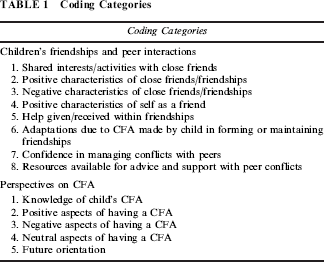
The data analytic strategy used here is consistent with a phenomenological approach, in which commonalities among individuals with similar experiences are identified through the emergence of broad themes (Creswell, 2013); this was augmented by the use of multiple independent coders to enhance scientific rigor (particularly with regard to the validity of coding categories and the reliability of coded passages).
Results
Quantitative Data
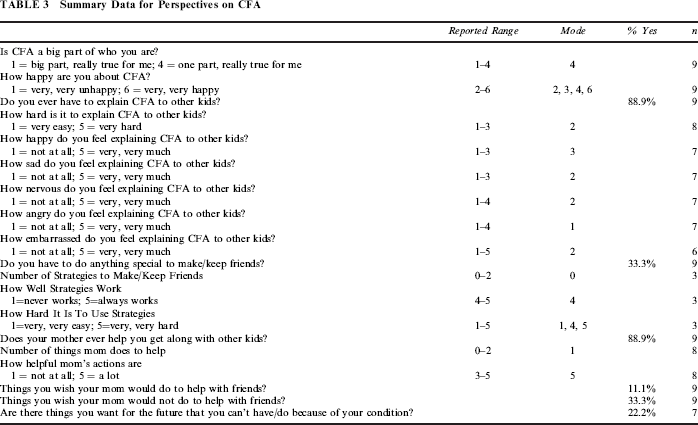
Responses to objective questions are reported using the observed range (the lowest and highest response given across the sample of children) and a value chosen to indicate a summary within the sample—the mean, the mode, or a percentage (see Tables 2 and 3). Most often, the mode is reported as the indicator of central tendency, because the mode (i.e., the most frequent response chosen) is considered best for nominal variables and may be most informative in instances in which a skewed (nonnormal) distribution would make a mean value difficult to interpret (Aron et al., 2006). Where there are multiple modes, all are reported.
Summary Data for Involvement With Activities and Friendships *
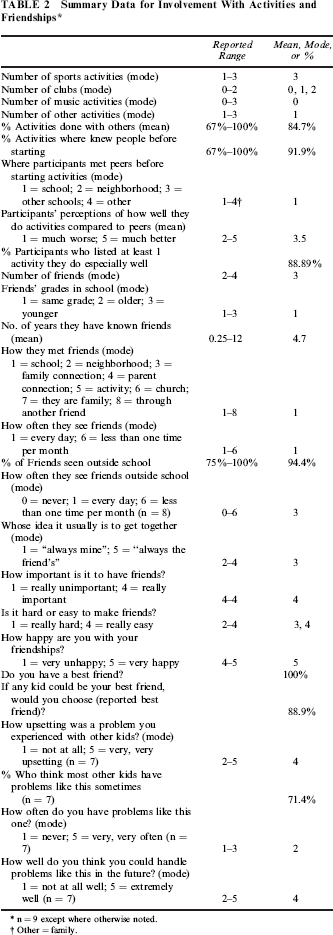
n = 9 except where otherwise noted.
Other = family.
Summary Data for Perspectives on CFA
Involvement with Activities and Friendships
Children were asked to list up to three activities in the areas of sports, clubs, art/music, and other. All children reported activities in one or more categories. All children reported at least one organized sports activity (e.g., team or individual sports such as baseball, basketball, soccer, tennis, wrestling, gymnastics), and most reported the maximum number, three. A few children were involved in clubs (e.g., school chorus) and art or music (e.g., piano lessons). “Other” activities frequently reported were playing video or computer games; some children listed reading, board games, listening to music, or watching television.
We were interested in the degree to which the reported activities provided opportunities for socialization and making new friends. For each child, the percentage of activities done with peers was calculated; the great majority of children's activities involved peers, and most often the children knew at least some of the peers (whom they most often met at school) prior to becoming involved in the activity.
Because the skill level for activities might influence peers’ appraisals, children were asked how well they do each activity compared with others. Children's mean responses across all reported activities were calculated; the mean for the sample was 3.5, a value between “just the same” and “a little better.” When asked if there was any activity they did especially well, a large majority of the sample said yes.
Children were asked to provide first names of up to four friends, and additional questions were asked for each friend. Each child reported at least two friends, with most reporting three. Most often, friends were in the same grade, and friendships tended to be of fairly lengthy duration, with the mean value at about 4½ years. Friends were most commonly met at school; not surprisingly, therefore, children frequently reported daily contact with their friends. Most children saw their friends outside school as well as in school, and the most common frequency was once or twice a week. To understand the mutuality of the friendship, we asked children who initiated get-togethers; the typical response was that both decided equally (and no children responded that it was always their own, or always their friend's role, to initiate).
Children were asked to provide evaluative judgments about their peer relationships. All children said it was “really important” for them to have friends. Most stated that it was “easy” or “really easy” to make friends, and children reported being “happy” or (most commonly) “very happy” with their friendships. All reported having a best friend, and a great majority expressed satisfaction with that best friendship.
Because the first two participants did not spontaneously mention peer conflicts, questions specifically addressing this area were added to the interview, resulting in seven participants responding. All were able to describe at least one incident in which a problem arose with one or more peers. Examples included a disagreement about which activity to choose, being teased, and a peer refusing to share. Most of the children said the incident was “a lot” upsetting. The majority believed that other children experienced similar problems, and the modal response indicated that the children encountered such conflicts “not very often.” Most of the children expressed confidence in their ability to handle similar problems in the future.
Perspectives on CFA
Children were asked about the role of the CFA in their lives. The modal response indicated that most children felt the CFA was only one part of themselves. It is notable that two children identified strongly with the statement that “some kids feel like [their CFA] is a really big part of who they are; they think about it a lot and they think that being born with [the CFA] makes the biggest difference in the way their life has turned out.” When asked how happy or unhappy they were about having a CFA, a wide range of modal responses was observed, ranging from “pretty unhappy” to “very, very happy.”
All but one child acknowledged a need to explain their CFA to peers, and most found it “kind of easy” to do. When asked to rate the intensity of a variety of feelings experienced when explaining the CFA to peers, children's modal responses were “somewhat” happy, “just a little” sad, nervous, and embarrassed, and “not at all” angry.
Children were asked if they needed to do anything special to make or keep friends, to compensate for their CFA. One third of the sample said yes; those children were asked to give examples and to rate the effectiveness of those strategies and the difficulty they experienced in using them. Children's examples included joining a sports team, initiating conversations, finding opportunities to demonstrate that they can do “normal” things, and sharing personal information. Children found these strategies to be quite effective and varied widely in how difficult they were.
To understand more about resources available to children when they encounter challenges with their peer relationships, we asked if their mothers ever provided help in these instances. All but one child said yes. Children were asked to provide examples of helpful actions taken by their mothers and to evaluate how helpful these were; most children gave at least one example, and most often these actions were perceived by children as very helpful. Examples included giving advice, comforting, encouraging the child to keep trying, enlisting help from the child's teacher, discussing ways to tell peers about the CFA, and listening. Children were asked if there were other things they wished their mothers would do to help; only one child responded affirmatively, explaining a desire for help with talking to “a problem kid.” Children were asked if there were things they wished their mothers would not do when making efforts to help with friendships; three children responded yes, citing nosiness, talking too much to other mothers, and engaging in long conversations with the child's friends about medical aspects of the child's condition.
Children were asked if there were things they would like to have as part of their life in the future that would be unavailable due to their CFA; few answered affirmatively.
Qualitative Data
Children's Friendships and Peer Interactions
This theme focused on the children's comments relating to their interactions with friends and peers, both positive and negative. Since remarks were elicited in response to specific questions regarding their friendships, every child had at least some comments in this area. Categories ranged from interests shared with close friends to adaptations made by children due to CFA with regard to friendships.
Shared Interests/Activities With Close Friends. All children discussed activities they enjoy with their friends, encompassing a broad range of typical interests. Organized and informal sports were frequently mentioned, as were playing video games and board games, watching movies, riding bikes, listening to music, and conversing.
Positive Characteristics of Close Friends/Friendships. All children described attributes they appreciated about their friends. They cited kindness, good sense of humor, and common interests. Several noted the longevity of their friendships, continuing over many years. Children spoke about ways their friends help them, for example, in teaching sports skills. One child described her friend as a positive role model: “She helps me be a better person because I see the ways she acts towards other people. She really knows how to be nice and to help others.” Another child spoke about the emotional support received from a friend: “She helps me gain my self-confidence, and helps me stick up for myself and not be so shy, because I used to let more people take advantage.”
Negative Characteristics of Close Friends/Friendships. Five children discussed things they disliked about their friends, or negative aspects of their relationships. Two children described friends’ unkind behavior toward others: “She's a very demanding, outgoing person, but uses her guts in bad ways, like to demand things from people.” Two other children talked about past arguments or unresolved conflicts that made them feel a degree of discomfort in particular friendships. One spoke about friends who are disloyal: “They'll be really jerky to me sometimes when they're around another person. But then when they're not around that other person, they can be the nicest person in the world.”
Positive Characteristics of Self as a Friend. Four children described themselves as friendly, helpful, or kind: “They always put the new kids by me. Because my teacher knew I was very nice, so she sat me with the new kids.”
Help Given/Received Within Friendships. Eight children noted the importance of friends helping each other. Children described both giving and receiving help in practical areas, such as academics and sports. Several children reported incidents in which their friends defended them during a conflict with other peers: “This girl started making fun of my face and stuff. My friend was sitting there and she said something… and somehow she got her to stop.”
Adaptations Due to CFA Made By Child in Forming or Maintaining Friendships. Three children discussed strategies they use to overcome the potential barrier of a CFA when making friends. One noted that it was helpful when peers had factual knowledge about the CFA: “It's easier to become better friends if you understand the problems, as well as what they do well.” This child offered help as a way of getting friendly with classmates: “If I see they're having trouble with something, I'll try and help them, since people often come to me since I'm smart.” Another child said involvement in sports was a strategy for making friends. Actively engaging with peers was another strategy: “If I just talk to them, and they get to know me, then they'll be my friend, but if I don't talk to them, or if I get shy, like I usually do, then people don't really talk to me.” Enlisting friends to help connect to peers was described: “We'll try to do stuff around the other kids, so that they see that I'm normal, I can do things that any normal kid can do.” One child said no special efforts were necessary: “I think of it as being myself, not like I have to do special things.”
Confidence in Managing Conflicts With Peers. Five children expressed confidence in their ability to handle distressing situations with peers. Notably, not a single child expressed doubt about his or her capacities in this area, despite a question specifically addressing this topic. One child was matter-of-fact: “I just figure it out. Like, if I don't want to be their friend, I don't want to be their friend.” Others cited the benefits of prior experience in dealing with bullies: “A lot of kids get bullied, most kids get bullied some time in their life … and it helps you know the process early or know how to prevent it.” “In the future, I'll know how to stay away from these people, and not to make friends with them.”
Resources Available For Advice and Support With Peer Conflicts. Six children described adult resources they have used when needing help to address a conflict with peers, and all six of them had parents on their list. Children described their parents as a source of comfort: “She always says I'm a beautiful little girl and that I should keep trying to do stuff, no matter what happened.” Some children said their parents provided helpful advice: “We talked about ways that I can explain to them [peers].” One child described his mother's intervention with school personnel following an experience with a bully: “She went to the counselor and she helped me tell him to make sure that kid never comes near, never talks to me, or does anything, and it helped a lot.” Two children mentioned using the school counselor to help them manage peer conflict. Another child relied on her teacher for help and added that her mother had supported this effort: “She tells the teacher to keep an eye out.”
Perspectives on CFA
This theme related specifically to children's perspectives on CFA and included topics such as their knowledge of their CFA, positive and negative aspects of having a CFA, and their future orientation. Since their remarks were elicited in response to specific questions regarding their CFA, every child participated in discussions on this topic.
Knowledge of Child's CFA. All of the children were able to describe the factual aspects of their CFA, explaining any functional and cosmetic differences, and most knew the medical terminology for their diagnoses and were knowledgeable about surgeries and other medical procedures they had experienced. In speaking about the causes, one said, “It just happened,” and another explained that other family members had the same CFA; other children said they did not know.
Positive Aspects of Having a CFA. Six children described positive aspects of having a craniofacial anomaly.
Personal attributes. One child said, simply, “I'm special.” Another spoke about resilience: “I feel like I impress myself. Like, wow, look at all I've been through my whole life.” One described compassion and gratitude developing out of the experience: “I'm one of the nicest people. I've always noticed that people who had like a deformity or something have always been a lot nicer towards other people … I guess they feel like really thankful for the things they have … so I guess maybe that helped me understand to be a better person and understand that I was lucky and it was correctable.”
Social benefits. Three children talked about having opportunities to meet people through their medical care or through support groups. “I got to meet some really nice doctors and some really nice people.” “I wouldn't have known them if I hadn't had those different activities that are specifically for people who have it.”
Perks. Two children mentioned being able to escape responsibilities: “I can get away with stuff. Like if I'm lazy, my surgery is an excuse.” Another child talked about receiving gifts in the hospital: “I had over 200 Beanie Babies right after my surgery, because everybody kept on bringing them in.”
Negative Aspects of Having a CFA. Six children described negative consequences of having a craniofacial anomaly.
Social challenges. Two children reported being teased, and several noted that the CFA was a social barrier: “Sometimes it takes a little longer [to make friends], because people don't see through how I look.” One child described a teacher's misunderstanding: “I was discriminated against when I was in kindergarten. The teacher didn't think I was smart enough, because of the way I look.”
Limitations in activities. One child spoke of physical limitations interfering with participation in organized sports: “I can't play soccer and sometimes I really want to, so I'm kind of envious.” One spoke of being unable to eat certain foods: “Like when I'm going to movies, people automatically say, oh do you want popcorn? Uh, no, I can't eat it.”
Medical. One child described the stress of surgeries: “It's kind of hectic at times, like with surgeries and after surgeries and preparing for them. I have a hard time believing that some kids are excited about surgeries.” Another regretted the financial and time costs experienced by parents: “If I didn't have cleft lip and palate, it would save my parents a lot of money … and it would probably be a lot easier on my parents and for me not to have all this extra dental work.”
“Why me?” Two children wondered why they were born with a CFA: “Sometimes I get a little upset, like why did I have to have cleft lip and palate? Why did it have to happen to me? I didn't deserve this. I guess it's really the luck of the draw, but if I could go back, I wouldn't want to have cleft lip and palate.”
Neutral Aspects of Having a CFA. Three children emphasized that their CFA did not make them different in any important ways. “It's not that hard to deal with a cleft palate. It's no different from a normal person, and you shouldn't get too tied up about it.” “It doesn't always affect my life as much as people might think it would. It doesn't make people a better person or worse person because they have it.” “The kids with the condition know that they're different, but you always have to think positive and think like they're a normal kid.”
Future Orientation. When asked to envision their lives as adults (with specific prompts for work, marriage, family, friends, and interests), children were largely optimistic. Eight described their career plans and expected to have friends. Five planned to marry and have children. Seven discussed future interests or activities.
In response to a question regarding possible limitations from their CFA on their adult lives, six said they did not anticipate any limitations. The two who expected limitations referred to physical inabilities to participate in sports and difficulty with making friends. One child declined to answer this set of questions.
Discussion
A sample of nine children with a range of CFAs was interviewed using a combination of open-ended and objective questions, with the goal of understanding their adjustment within the peer group. In addition to learning about the nature of their friendships and their activities with peers, we tried to elicit information about successful management of any challenges they may experience in their peer relationships due to the presence of a CFA.
The children in this sample were all engaged in numerous age-appropriate activities, including participating in organized sports and clubs, as well as informal activities such as riding bicycles and playing computer games. Through both formal and informal activities, all of the children reported regular interactions with peers. Although they reported frequent surgeries and other medical interventions, these did not appear to interfere with children's availability for involvement in typical childhood activities. Children described themselves as performing these activities as well as their peers, and all felt they were particularly good at one or more activities; therefore, despite some physical limitations, children were engaged in activities in which they could function as well as typical peers. Involvement in organized activities appears to be an effective avenue for increasing peer interactions, and one child listed this as a deliberate strategy for making friends. Interestingly, most children already knew some peers before joining a new activity, suggesting that these preexisting relationships might serve as a bridge to making friends with new peers. These findings are consistent with research on normative samples showing that team sports support children's psychological and social adjustment (Eime et al., 2013) and involvement in extracurricular activities promotes positive socioemotional behavior (Metsäpelto and Pulkkinen, 2012).
All children had two or more friends, and all reported a best friend. The longevity of their friendships was striking, with most friendships having lasted many years; perhaps loyalty is especially valued by children who may not always be readily befriended by unfamiliar peers. The quality of children's friendships appeared to be excellent. Children stated high levels of satisfaction with their friendships and provided examples of positive qualities of their friends and of themselves as friends. A few negative characteristics of friends were reported, but these were far outweighed by positives.
Friends were most often met at school, although children also met friends in their neighborhoods or through family or other friends. Although school settings have the potential to be risky environments for children with CFA—one child described a Kindergarten teacher who underestimated the child's academic ability, and some children reported incidents of teasing or ostracism at school—children also described teachers, counselors, and principals as valuable resources in managing peer conflicts. School personnel should be considered as part of the support network for children with ongoing health concerns (Kaffenberger, 2006).
Children uniformly felt friendships were extremely important to them, and for the most part, they felt making friends was fairly easy. A minority reported feeling the need for special efforts to overcome any barriers presented by a CFA. Strategies they reported included providing factual information about their CFA, offering to help a peer, enlisting a friend to help make connections with peers, and making deliberate efforts to overcome shyness and engage peers in conversation. Children felt some strategies were easy and others were difficult but tended to feel they were effective. Most of the children in this sample, however, firmly stated that they felt no need to do anything to make friends, beyond being themselves and being friendly. Similarly, despite having experiences with peer conflict, the children tended to express confidence in their ability to manage these.
Mothers were seen as good sources of instrumental and emotional support for children as they negotiated the world of peers, consistent with research on normative samples (McDowell and Parke, 2009). Children reported that their mothers gave good advice, provided comfort and encouragement, and enlisted the help of teachers and school counselors. They uniformly felt that their mothers’ efforts to help were effective. Interestingly, none of the children appeared to rely heavily on mothers’ help, noting that they sought support for occasional and difficult situations. It should be noted that the interview focused specifically on mothers; therefore, children's responses should not be interpreted as indicating lack of support from fathers. Previous research on father-child relationships has yielded useful perspectives on parenting a child with a CFA, suggesting the importance of this area for future research (Klein et al., 2010; Stock and Rumsey, 2015).
Children were knowledgeable about the factual aspects of their CFA and generally seemed to have adopted a balanced perspective on the role of the CFA in their lives. They recognized both positive and negative effects and also noted areas where the CFA had no effects at all. Notably, few children made much mention of appearance differences; this finding is consistent with results from another qualitative study of children's experiences of life with CFA, in which authors suggested the importance of distinguishing between the constructs of attractiveness versus impairment or disability when understanding social reactions to facial disfigurement (Roberts and Shute, 2010). Children were mostly matter-of-fact about the reasons why they might have been born with their conditions; however, two children described unhappiness over the unfairness of having a congenital condition. Almost all children had experienced the need to explain their CFA to peers, but they generally reported this was not terribly distressing. Children anticipated that their future lives as adults would be minimally influenced by their CFA and were largely optimistic about having full and rewarding lives.
Findings from this study are likely not generalizable to the larger population of children with CFA. Because this small sample was composed of volunteers from a support group for families of children with CFA, all of whom were privately insured, these families are likely to have more internal and external resources than some others; future research should examine the impact of social inequality and disparities in access to health care on the social adjustment of children with CFA.
The goal of this study was to identify broad descriptive themes that could inform future research on the social adjustment of children with CFA. The group of children who participated in this study generally appeared to be happy with their peer relationships and had a balanced and optimistic framework for understanding the role of a CFA in their lives. Areas ripe for more focused research will include the factors that may support positive social adjustment:
How do parents find appropriate activities for their children with CFA, despite the difficult logistics of managing time-consuming medical care? How do they identify their children's interests and competencies and match these with opportunities for peer socialization?
Athletic competence has been identified as an important predictor of general well-being and social competence in CFA samples (Kapp-Simon et al., 1992; Pope and Ward, 1997b). Does participation in organized sports, clubs, and other activities contribute to self-confidence in children with CFA, and does this improve peer relationships by demonstrating to peers that children with CFA are more like than unlike other children?
Examinations of success in peer relationships must include the quality (and not just the presence or absence) of friendships, in keeping with the realization that while some friendships are beneficial, others may be destructive, as described vividly by one adolescent with a CFA: “I started making some friends—some were mean, some acquaintances, and some just pals… . I had friends that taunted me, friends that wanted something from me, and friends that talked behind my back and friends that only said ‘hi’” (Snyder and Pope, 2003). In the current study, some children had friends who loyally defended them when they were teased, who coached them to be more confident, and who actively strategized to find ways to show others that the child with CFA would be an appealing friend. What types of social skills could children with CFA use to initiate and maintain high-quality friendships?
The school setting may be a great resource for friendships for children with CFA but may also expose them to negative peer interactions. Similarly, teachers and counselors may be a strong source of support or may underestimate the competence of children with CFA, undermining both academic and social potential (Richman, 1978). What types of school-based interventions can improve the climate for children with CFA?
What family or individual processes are involved in developing a self-concept that incorporates a CFA into a realistic yet optimistic perspective? How can harmful beliefs about CFA seen in some cultures (Mednick et al., 2013) be countered? Can individuals with CFA adopt cognitive strategies that minimize the harmful impact of negative social judgments on their self-worth (Snyder and Pope, 2003)? As eloquently expressed by 10-year-old Augie, a fictional character with CFA, “Here's what I think: the only reason I'm not ordinary is that no one else sees me that way” (Palacio, 2012).
Recent research showing social deficits among adults with CFA (Berk et al., 2001; Marcusson et al., 2001; Roberts and Mathias, 2012) increases the urgency of enhancing social competence in childhood to develop a firm foundation for enduring quality of life.
Footnotes
Acknowledgments
We gratefully acknowledge Forward Face for their assistance in recruiting participants for this study.