






Abstract
Objective
To describe the technique and results of structural fat grafting in cleft lip revision, including patient satisfaction and aesthetic outcome.
Design
Retrospective case series
Setting
Multidisciplinary cleft care center.
Patients
All patients who underwent structural fat grafting between June 2006 and September 2012 for cleft lip revision, with appropriate photographic follow-up included. Twenty-two cases were reviewed; 18 had sufficient data to be included.
Interventions
Patients underwent structural fat grafting for cleft lip revision, most commonly injecting fat under deficient philtral columns, the nostril base, and upper lip.
Main Outcome Measures
Blinded observers rated outcomes using the Asher-McDade nasolabial appearance rating scale. Patients completed questionnaires assessing their satisfaction. A paired Student's t-test was used to test outcomes for significance (alpha = 0.05).
Results
Patients were an average of 16 years old (range 6-43); average length of follow up was 11.7 months. Overall symmetry and aesthetics were improved based on the nasal form (P = 0.006) and vermillion border (P - 0.04) when rated using the Asher-McDade scale. No complications were recorded. Patients were significantly happier with their appearance after fat grafting (P < 0.001) and were uniformly positive when questioned about the ease of the surgery and rate of recovery.
Conclusions
Structural fat grafting is a safe and effective way to improve symmetry and enhance facial proportions in patients with cleft lip. Given the high degree of patient satisfaction, few complications, and durable results, fat grafting offers many advantages in cleft lip revision.
Patients with cleft lip typically undergo many reconstructive procedures yet are still left with stigmata of residual defects. Frequently, the tissue deficit of the upper lip leads to indistinct philtral columns, a flat upper lip, and a deficiency of vermillion or whistle deformity (Namba et al., 1980; Stal and Hollier, 2001; Duskova and Kristen, 2004). These problems are worsened by the postoperative labial scarring (Duskova and Kristen, 2004). Many secondary procedures-including V-Y advancement, Z-plasty, and Abbé flaps-have been used in attempts to correct such deformities. However, these procedures rely on tissue from already deficient areas, and they involve the risk of additional morbidity. Exploration into the use of less invasive reconstructive techniques has suggested that safer yet durable treatments are available for cleft lip.
Recently, there has been a growing interest in using injectable fillers in lieu of mobilizing local tissues. Initial case reports of using structural fat grafts in cleft lip patients have offered promising results. Improved fullness and shape of Cupid's bow were noted 1 year after injections beneath the scars of the upper lip and perioral area (Clauser et al., 2008). In another report, fat injected into the middle third of the upper lip and base of the columella provided improved cosmesis for an average of 7 months. Due to the temporary nature of results, a reported 80% of patients required repeat procedures (Duskova and Kristen, 2004).
A wealth of literature describes the cosmetic uses of structural fat grafting, but little data exists on the results of the technique in cleft lip revision, including aesthetic outcome and patient satisfaction. Use of the technique in cleft lip has been reported in only a handful of patients (Duskova and Kristen, 2004; Clauser et al., 2008; Mojallal et al., 2009). This study evaluated the outcome of structural fat grafting in a sample of patients with previously repaired cleft lip.
Methods
After obtaining Institutional Review Board approval, all patients who received fat injections between June 2006 and September 2012 for cleft lip revision were selected for inclusion in this retrospective case series. Operative details-including volume of fat injected, method of purification, concomitant procedures, and complications-were recorded.
At the Penn State Hershey Children's Hospital, fat grafting is typically done using a modified Coleman technique. Briefly, a small stab incision is made in the infraumbilical region, and tumescent solution is infiltrated with a blunt-tipped injection/grafting needle attached to a syringe. Fat is aspirated using a 3-mm blunt-tipped catheter on a 60-mL syringe; gentle suction is applied by propping the plunger open with the plunger of a 10-mL syringe. The fat is decanted onto a Telfa pad, then gently rolled back and forth to allow the oil to be absorbed. The purified fat is reloaded into a 1-mL syringe and injected with a 1.5-mm blunt-tipped injection/grafting needle. Small aliquots of fat are injected in multiple fan-shaped passes in multiple planes. In areas of severe scarring, a sharper-tip or pickle fork cannula is attached to the syringe for the final passes under the scar. The sharp tip is used to gently disrupt the scar tissue tethering the contour of the lip, and fat is then injected into the area.
Standardized pre- and postoperative photographs were examined by two raters, an attending and a resident plastic surgeon. The judges were blinded to preoperative versus postoperative status. Photographs were cropped to show the nose and lip, and profile photos (with the patient facing right) were inverted as necessary to show the cleft side towards the camera. Photographs were evaluated using a validated visual rating scale described by Asher-McDade (Asher-McDade et al., 1991). The Asher-McDade scale ranges from 1 to 5, where 1 indicates a very good appearance, 2 = good, 3 = fair, 4 = poor, and 5 = poor.
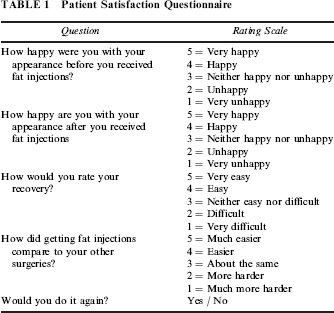
The other arm of the study consisted of a patient satisfaction questionnaire that patients completed anonymously (Table 1).
Patient Satisfaction Questionnaire
Results
Twenty-two consecutive patients were selected for the study; 4 were later excluded from photographic analysis because of incomplete records. Of the 18 patients who were included, 8 had bilateral cleft lip and 10 had unilateral clefts. These included13 females and five males. The mean age at the time of procedure was 16.1 years (median 15, range 643). All operations were done as outpatient procedures, and patients were discharged home the same day. Patient results were followed photographically for an average of 11.7 postoperative months. Only one patient underwent multiple episodes of fat grafting.
Patients most commonly presented with inadequate volume of the upper lip, nostril base, vermillion, and the philtral column bordering the repaired cleft. Other patient complaints included lip asymmetry and prominent postoperative scarring. Sixty-one percent of patients underwent fat grafting as part of a formal cleft lip revision. Half the patients underwent revision rhinoplasty at the time of fat grafting (Fig. 1). No complications were recorded.
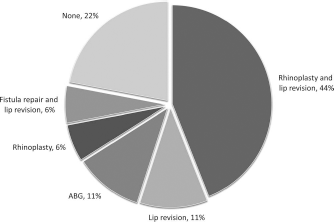
Concomitant procedures.
After fat grafting, patients were rated as having a better appearance on all four aspects rated on the Asher-McDade scale (Table 2). Statistically significant improvements were noted for vermillion border and nasal form (Figs. 2 and 3).
Results of Blinded Assessment of Preoperative and Postoperative Photographs Using the Asher-McDade Scale
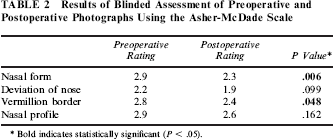
Bold indicates statistically significant (P < .05).
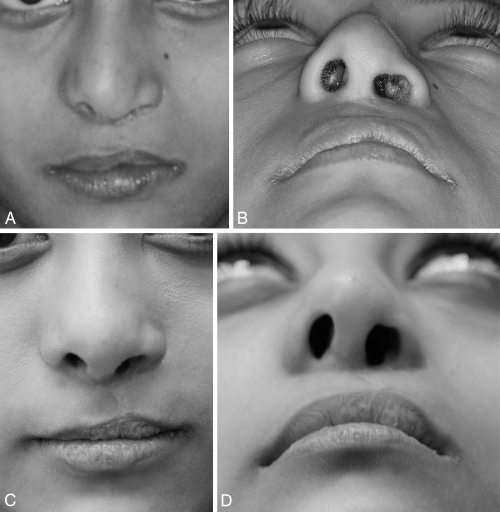
A 15-year-old female with unilateral cleft lip and palate who underwent autologous fat grafting. A and B: Preoperative. C and D: Twenty-one months postoperative.
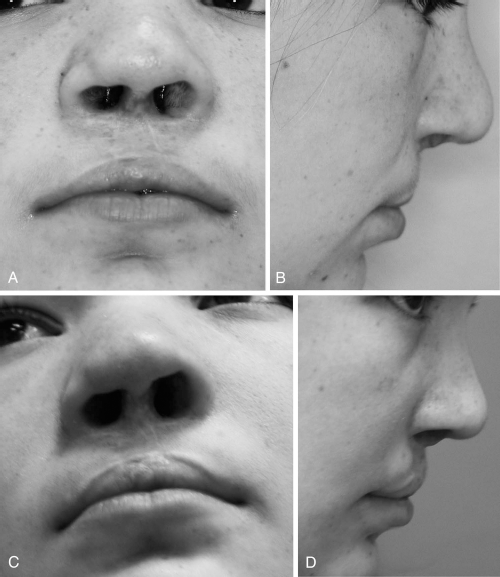
A 15-year-old female with bilateral cleft lip and palate who underwent fat grafting to the upper lip and vermillion. A and B: Preoperative. C and D: 30 months postoperative.
Eleven patients completed the satisfaction questionnaire. Patients were uniformly positive about their experience, rating it as easier than other operations they had undergone. A statistically significant improvement in patients’ satisfaction with their appearance was observed (P < .001). All patients reported they would choose this operation again (Table 3).
Patient Satisfaction Results
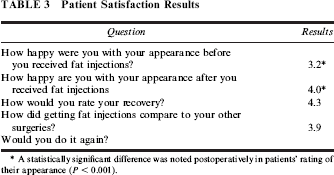
A statistically significant difference was noted postoperatively in patients’ rating of their appearance (P < 0.001).
Discussion
The mainstay of revision in secondary cleft lip deformities remains recreation of the defect and meticulous closure. Contour irregularities and deficiencies can be corrected by local means, such as Z-plasty or V-Y closure, or by designing flaps from nearby tissue, as in Abbe flaps and cross-lip vermillion flaps. However, less invasive techniques have been gaining popularity in fine-tuning results or correcting mild deformities. These include alloplastic fillers, dermal fat grafts, and autologous fat injections.
Injections of hyaluronic acid have been used to improve areas of dimpling and retraction in patients with previously repaired cleft lip. In a case report by Schweiger et al. (2008), deficient volume and asymmetry of the vermillion were corrected with injection of hyaluronic acid. While fillers avoid the potential inconvenience of surgery and risks of anesthesia, results are temporary. Patients are subjected to an indefinite future of repeat procedures, making fillers a less cost-effective option. Other known complications include hypersensitivity and foreign body reactions (Friedman et al., 2002; Kanchwala et al., 2005).
Restoration of volume with dermal fat grafts has been described in several case series (Patel and Hall, 2004; Staebel and Verheyden, 2009; Lee et al., 2012; Wang et al., 2014). Dermal fat grafts appear to yield durable results, particularly when the defect is overcorrected to account for a degree of graft resorption. However, the dermal fat graft requires creation of incisions of variable length at both the donor and recipient sites. Potential drawbacks also include the formation of keratin cysts from the dermal element (Clodius, 1972) or the development of palpable areas of fat necrosis (Staebel and Verheyden, 2009).
Autologous fat grafts offer a balance of a minimally invasive technique, similar to fillers, with the potential durability of autogenous tissue. Their benefit was first described in a limited number of patients by Duskova and Kristen (2004). Similar to the previously reported benefits, the current study demonstrated improvement in appearance after fat grafting and a high degree of patient satisfaction.
In addition to the previously reported benefits, this study showed a statistically significant improvement in patient appearance using an objective, validated rating scale. Results were more durable than previously reported: Duskova and Kristen (2004) found that fat injections lasted for an average of 7 months, while in our patients, with a slight overcorrection, results appear be long-lasting. Only one patient required a repeat procedure. As has been demonstrated in the literature for a variety of other applications, we found that keys to achieving consistent results with fat grafting seem to be gentle handling, minimal processing, injecting small aliquots with fine cannulas in multiple passes, and a small degree of overcorrection.
Fat grafting has been shown to improve the appearance of scars (Sardesai and Moore, 2007; Villani et al., 2010; Coleman, 2013). Although investigating the quality of scars was outside the scope of this retrospective study, we have anecdotally noticed that scars seem softer and less prominent after fat grafting. Future prospective studies may seek to objectify this observation.
In this study, the follow-up period was relatively short. Particularly with younger children, the potential for hypertrophy of grafted fat with later weight gain is not known. This theoretical risk could cause later contour deformities, although this was not appreciated in our study. Long-term follow-up is needed to evaluate this phenomenon in future studies.
The ease of fat grafting is a significant benefit, particularly for a population of patients who have undergone many surgeries during childhood. This is the first study to confirm, through patient satisfaction surveys, that fat grafting is indeed preferable and easier for patients compared to other cleft operations.
Conclusion
Structural fat grafting is a safe and effective way to improve symmetry and enhance facial proportions in patients with cleft lip. Given the high degree of patient satisfaction, few complications, and acceptable durability, fat grafting offers many advantages for its use in cleft lip revision.