






Abstract
Objective
To determine if all cleft surgeons uniformly and adequately evaluate patients with cleft for obstructive sleep apnea (OSA) and consider OSA in treatment of velopharyngeal dysfunction (VPD).
Design
A 22-question survey was administered via e-mail to 1117 surgeons who were members of the American Cleft Palate-Craniofacial Association. Logistic regression was used to determine if management was affected by years in practice, clinical volume, field of training, and region of practice.
Main Outcome Measures
We sought to determine if years in practice, clinical volume, region of practice, and surgical specialty affected surgeons’ evaluation of OSA and their approaches to VPD.
Results
A total of 231 surgeons responded (21% response rate), and 67% stated that they had trained in plastic surgery. With increasing years of practice, surgeons were less likely to refer patients for preoperative and postoperative sleep studies (P = .00 and P = .001, respectively), screen patients for sleep apnea (P = .008), or change their management based on a sleep study (P = .001). There were no significant differences in screening or testing for OSA based upon clinical volume. Among those surveyed, otolaryngologists were more likely to refer patients for postoperative sleep studies (P = .028). Surgeons in the Southeast were more likely to change their management based upon a sleep study (P = .038).
Conclusions
Statistically significant trends in screening and testing for OSA in the setting of VPD were identified by this survey. Notably, older surgeons were less likely to investigate OSA in their patients, and not all specialties equally refer for postoperative sleep studies.
Velopharyngeal dysfunction (VPD) results in hypernasal speech due to an inability to close the velopharyngeal sphincter (Fisher and Sommerlad, 2011), and it is well-known that a high incidence of sleep-disordered breathing exists among patients with VPD (Silvestre et al., 2014). As many as one in seven patients with a history of cleft palate screened positively for obstructive sleep apnea (OSA) in one study (Silvestre et al., 2014), and associations between VPD and OSA have been repeatedly reported in the literature (Rose et al., 2003; Muntz et al., 2008; Robison and Otteson, 2011; MacLean et al., 2012). This reality requires cleft surgeons to strike a delicate balance between attaining intelligible speech and avoiding the exacerbation of existing sleep-disordered breathing as well as the possible development of sleep apnea as a postsurgical morbidity. Sleep apnea is known to cause behavioral and cognitive decline in children, so a high level of vigilance is an absolute necessity when considering operations for the treatment of VPD (Schwengel et al., 2014).
Given that the prevalence of OSA in this particular patient group is a more recently understood phenomenon, we sought to determine if cleft surgeons across the country are addressing and treating OSA in a uniform and adequate fashion, which at the very least involves screening patients for VPD. This was one aspect of a longer survey addressing multiple aspects of VPD treatment. Additionally, we provide a review of the literature regarding treatment for VPD that is thought to minimize obstructive airway issues.
Methods
Approved by the university's institutional review board, a 22-question survey was created for cleft surgeons, regardless of specialty, and administered to more than 1100 surgeons across the country via e-mail. These questions addressed several facets of VPD care, including surgeons’ preferred operations, timing of intervention, and use of prosthetics, among others. Two additional reminder emails were sent. The survey was closed 5 weeks later. The questions that addressed sleep apnea included the following: (1) What percentage of patients are screened for OSA during history taking? (2) What percentage of patients are referred for preoperative sleep studies? (3) What percentage of the time does a preoperative sleep study change your management? and (4) What percentage of patients are referred for postoperative sleep studies? These questions were not limited to any particular time frame but were instead used to ascertain surgeons’ general practice preferences. Raw means were calculated to compare groups, and standard regression was subsequently performed to determine significant differences between groups to ascertain which predictive variables affected the diagnosis and management of OSA. Predictive variables studied included years in practice, field of training, geographic region of practice, and the number of cleft operations performed per year.
Results
The study was completed by 231 surgeons (21% response rate). Of the respondents, 42% had been in practice for less than 15 years, 43% had been in practice between 15 and 30 years, and 15% had been in practice more than 30 years. Of the respondents, 67% had trained in plastic surgery, 24% in otolaryngology, and 18% in oral surgery. There was a relatively even geographic distribution. Fifty-two percent of respondents stated they perform fewer than 50 cleft operations per year, while only 17% claimed to perform more than 100 per year.
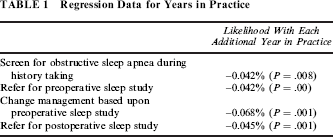
On average, a consistent trend was observed with regard to years in practice. Surgeons in practice less than 30 years screened 86% of patients for OSA during history taking, while surgeons in practice longer than 30 years screened only 62% of patients. Surgeons in practice less than 15 years referred 26% of patients for preoperative sleep studies, while surgeons in practice between 15 and 30 years referred 21% and surgeons in practice longer than 30 years referred only 14%. Surgeons in practice for 15 years, between 15 and 30 years, and greater than 30 years changed their management based upon a preoperative sleep study 32%, 26%, and 18% of the time, respectively. Those who had been in practice greater than 30 years referred 9% of patients for a postoperative sleep study, while surgeons in practice less than 15 years referred 19% (Fig. 1). After regression analysis, it was found that with each additional year in practice, surgeons were 0.042% less likely to refer for a preoperative sleep study (P = .00), 0.045% less likely to refer for a postoperative sleep study (P = .001), 0.042% less likely to screen for OSA (P = .008), and 0.068% less likely to change management based upon a preoperative sleep study (P = .001) (Table 1).
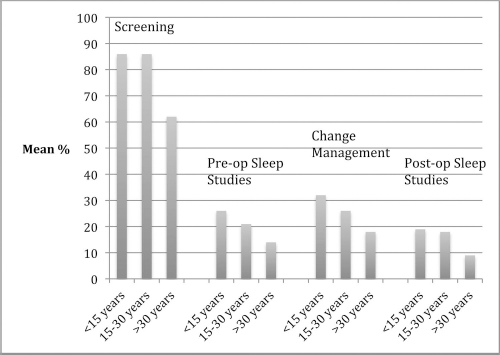
Effect of years in practice on percentage of patients screened, percentage of patients referred for preoperative sleep studies, percentage of the time management is changed, and percentage of patients referred for postoperative sleep studies. Number of years in practice is plotted on the X-axis, while the mean percentage prior to regression is plotted on the Y-axis.
Regression Data for Years in Practice
Otolaryngology-trained surgeons were more likely to screen for OSA (94% of patients screened, as opposed to 78% of patients screened for plastic surgeons and 66% of patients screened for oral surgeons), refer for preoperative sleep studies (24% of patients referred, as opposed to both plastic surgeons and oral surgeons, who referred 21%), and change their management based upon preoperative sleep studies (29.4% of the time, as opposed to 26% of the time for plastic surgeons and 28.8% of the time for oral surgeons) (Fig. 2). However, surgeons trained in oral surgery referred 23% of patients for postoperative sleep studies, while plastic surgeons referred only 15% and otolaryngologists referred 19%, based on the raw means. Following regression analysis, otolaryngology-trained surgeons demonstrated a significantly greater propensity to refer patients for postoperative sleep studies (14.6%, P = .028) compared with surgeons who had not trained in otolaryngology (Table 2).
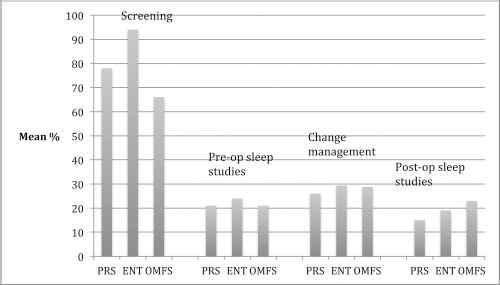
Effect of training background on percentage of patients screened, percentage of patients referred for preoperative sleep studies, percentage of the time management is changed, and percentage of patients referred for postoperative sleep studies. Training background is plotted on the X-axis (PRS = plastic and reconstructive surgery, ENT = otolaryngology, oMFS = oral and maxillofacial surgery), while the mean percentage prior to regression is plotted on the Y-axis.
Regression Data for Field of Training

Based on the raw means, there were no readily available trends observed based upon region of practice, although it did appear that surgeons from the Midwest and Southeast were more likely to change management based upon a preoperative sleep study (44% and 41% of the time, respectively) (Fig. 3). After regression analysis, it was found that surgeons from the Southeast were about 4% more likely than surgeons who practice outside of the Southeast to change their management based on a preoperative sleep study (P = .045).
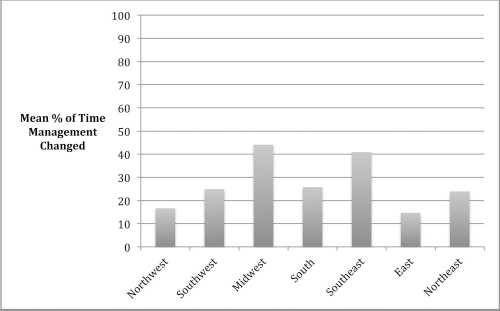
Effect of geographic location on the percentage of time management is changed based upon a preoperative sleep study. Geographic regions are plotted on the X-axis, while the mean percentage prior to regression is plotted on the Y-axis.
With regard to clinical volume, surgeons who perform more than 100 cleft operations per year screened 77% of patients for OSA, whereas surgeons who perform fewer than 100 cleft operations screened 82% of patients. Surgeons who perform less than 50 cleft operations per year referred 24% of their patients for preoperative sleep studies, compared with surgeons who are busier (surgeons doing more than 50 cleft operations per year referred 19% to 20% of patients for preoperative sleep studies). Surgeons performing greater than 50 operations per year changed their management 22% to 23% of the time based on a preoperative sleep study, while surgeons performing less than 50 operations per year changed management 32% of the time. Clinically busier surgeons also referred fewer patients for postoperative sleep studies-surgeons who perform more than 50 operations per year referred 16% and surgeons who perform fewer than 50 operations per year referred 19% (Fig. 4). No statistically significant trends were found upon regression analysis.
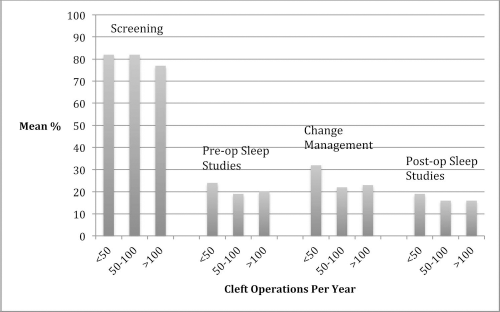
Effect of clinical volume (number of cleft operations per year) on percentage of patients screened, percentage of patients referred for preoperative sleep studies, percentage of the time management is changed, and percentage of patients referred for postoperative sleep studies. Number of operations per year is plotted on the X-axis, while the mean percentage prior to regression is plotted on the Y-axis.
Discussion
While speech is often the primary focus in patients with VPD, the preoperative presence or postoperative complication of sleep apnea secondary to VPD treatment cannot be ignored, given its harmful physiologic sequelae. First, OSA impairs both growth and development in children (Zhang et al., 2015). It has also been shown that blood pressure improves with surgical treatment of sleep apnea, indicating that a relationship exists between OSA and hypertension in children (Kuo et al., 2015). Pediatric patients with OSA also have greater insulin resistance than control groups with similar characteristics (Shamsuzzaman et al., 2014).
Although counterintuitive, sleep apnea is a common comorbidity in patients with craniofacial anomalies. As many as one in seven patients with a history of cleft lip and/or palate screen positively for OSA using a validated questionnaire (Silvestre et al., 2014). In another study, 87% of symptomatic children were later diagnosed with OSA by polysomnogram (Moraleda-Cibrian et al., 2015), further underscoring the importance of screening when taking the preoperative history. Narrowing the pharyngeal space via operative treatment can lead to the development of OSA and occasional airway obstruction (Abramson et al., 1997; Ettinger et al., 2012; Crockett et al., 2014). Syndromic children are at greater risk for OSA, as are those who have secondary management of VPD with a posterior pharyngeal flap (PPF) or a dynamic sphincter pharyngoplasty (DSP) (Muntz, 2012).
The discussion regarding which operations best avoid sleep apnea is ongoing. It is well known that PPFs tend to cause sleep apnea in more patients than do other operations. While one study showed a mere 2.5% incidence of sleep apnea after PPF (Ysunza et al., 1993), another showed an incidence of 93% and greater severity of OSA in children in comparison to adults postoperatively (Liao et al., 2002). However, it has been shown that staged adenotonsillectomy prior to PPF significantly reduces the incidence of postoperative sleep apnea (Chegar et al., 2007). Sleep apnea occurs after DSP as well, but may not occur as frequently or severely (Sloan, 2000). Despite this advantage of DSP, a sagittal pattern of velopharyngeal closure may preclude its use if intelligible speech is to be obtained (Gart and Gosain, 2014). Some assert that redo palatoplasty is the correct operation for treating VPD and avoiding sleep apnea (Madrid et al., 2011), but this remains an option only if the pharyngeal gap is small (Gart and Gosain, 2014). Fat grafting for mild to moderate VPD successfully avoids sleep apnea but may require multiple operative sessions to achieve adequate palatal contact (Cantarella et al., 2012). Additionally, results with regard to speech improvement are often varied based upon the final assessment tool and the anatomic location in which the fat was injected (Bishop et al., 2014). Despite the abundance of findings in the literature, choice of operation remains a complex decision that must be made with sleep apnea in mind.
Despite the serious consequences of sleep apnea, our study indicates that cleft surgeons do not equally emphasize its importance during the evaluation and management of patients with VPD. An adequate assessment of OSA, in our estimation, includes screening during history taking and both preoperative and postoperative sleep studies if surgical intervention is planned. Not surprisingly, more seasoned surgeons are less likely to adequately address OSA, as OSA in this patient population is a more recently understood phenomenon. Surgeons tend to practice the way they were trained, and it is probable that balancing speech outcomes with the avoidance of sleep apnea was not discussed two or three decades ago during plastic surgery residency. Otolaryngologists, compared with surgeons trained in other fields, consistently answered the survey questions in a manner that reflected a higher awareness of OSA in this population and a greater willingness to take the time to appropriately address it. This also is not unexpected, as otolaryngologists are “doctors of the airway.” They routinely perform operations to treat sleep apnea, rendering OSA an entity unlikely to be overlooked by this group of surgeons.
While surgeons from the Southeast changed management due to preoperative sleep studies slightly more often, it is uncertain why this would be the case. Most of the respondents from the Southeast were otolaryngologists, but this was controlled for in the regression analysis. Surgeons do not always practice near their training institution, which could serve as an explanation, but local patterns of practice and regional meetings may result in observable geographic trends in the treatment of VPD.
Finally, while no statistically significant trends were identified with regard to clinical volume, the raw means demonstrated an increasing trend to recognize the gravity and prevalence of sleep apnea by surgeons who perform these operations less frequently. While initially surprising, this trend may result from experienced surgeons feeling confident and comfortable with these operations, finding the investigation of sleep apnea less necessary. Surgeons who reported a higher number of cleft cases may also have been in practice longer and have established referral patterns. This would lead us to conclude that years in practice may actually be a confounder when examining trends in clinical volume. Surgeons with high clinical volume also presumably practice at a high-volume institution with easily accessible resources, such as a sleep lab, which make our results counterintuitive. However, the institution size and presence of a sleep lab were not addressed in the survey.
Regardless of experience, clinical volume, or training background, the diagnosis of and appropriate referrals for OSA have become tenets of VPD treatment. Residents of any training program involved in these patients’ care must be educated on the prevalence of OSA in this population and the operations most likely to contribute to postoperative sleep-disordered breathing. Surgeons with all levels of experience must adhere to these principles, as a surgeon's comfort or proficiency with these operations does not alter the patients’ abnormal preoperative anatomy or the known complications.
This study has several limitations, consistent with a survey investigation. Only 21% of surgeons responded, although this was likely an even sampling of cleft surgeons based upon surgeon demographics. Our results may also have been affected by survey error and incomplete responses. Upon further review, the question addressing change in management may have been phrased differently in order to clarify if surgeons truly change what they do if a patient actually has sleep apnea. Repeating the study with a more focused survey on sleep apnea with fewer questions may serve to clarify and reinforce the trends we observed.
Conclusion
Sleep apnea, while widely known to be a common comorbidity and surgical complication in patients with VPD, is not uniformly addressed by all cleft surgeons. Clear trends asserted themselves upon review of our survey's results, revealing that not all cleft surgeons adjust their approach to VPD with sleep apnea in mind, whether screening, referring for appropriate studies, or changing the surgical plan. Given the ongoing prevalence of this diagnosis among patients with cleft palate and its serious consequences, sound caution must be utilized when formulating a treatment plan, regardless of extensive surgical experience, training background, or high clinical volume.