







Abstract

The Carol A. Ghiloni Oncology Fellowship Program (OFP), developed in 2001, provides an opportunity for student nurses between their junior and senior years in a baccalaureate program to learn about the role that nurses play in providing care to patients with cancer. To explore whether former fellows felt prepared for employment in oncology nursing after their fellowship experience, a focus group discussion with former student nurse oncology fellows was conducted. The discussion was audiotaped and transcribed. Content analysis of the transcripts revealed four key findings: OFP provides an opportunity to make informed career choices; OFP provides confidence-building experience; OFP provides an experience of preceptor role modeling; and OFP provides an opportunity to build relationships with staff, patients, and patients’ families.
The Carol A. Ghiloni Oncology Fellowship Program (OFP) at Massachusetts General Hospital (MGH) began in 2001 with the goal of providing an educational opportunity for student nurses between their junior and senior years in a baccalaureate nursing program. Carol Ghiloni, RN, MSN, then nursing director of the inpatient oncology and bone marrow transplant unit at MGH, recognized that almost all of the new graduate job applicants she interviewed told her that they had had only one or two lectures on oncology in their medical-surgical nursing curriculum and that they were not encouraged to pursue oncology as a career option as new graduates, because it is a specialty. Given the impending nursing shortage, coupled with the lack of new graduate nurses applying to work within oncology for their first job, Ghiloni and her associate chief nurse, Jacqueline Somerville RN, PhD candidate, recognized a need to develop a program that educated and excited student nurses about oncology nursing practice.
They brought together a team of experts to develop the Oncology Fellowship Program. Since 2001, 14 student nurses between their junior and senior years have participated in a 10-week paid precepted educational experience learning about the nursing care of patients with cancer. In 2004, when Carol Ghiloni retired after 41 years in oncology nursing and assumed a part-time position at MGH, the fellowship was named for her.
Design of the Oncology Fellowship Program
Each year, two students from an impressive group of applicants are selected to be oncology fellows. They spend 10 weeks rotating through inpatient oncology units: the outpatient infusion unit, radiation oncology, the oncology practice centers, and the proton beam therapy center. They also spend time in the operating room and in interventional radiology and with palliative care experts to provide them with a comprehensive perspective on the role nurses play in providing care to patients with cancer.
Expanding the Program to Include Faculty
In 2004, a faculty fellowship component was added to the program. While the student fellowship program was successful at recruiting former fellows to seek employment at the hospital within oncology nursing, and information about the success of the program had spread, bringing in multiple candidates for the program each year, fellowship administrators believed that expanding the program to include a nursing faculty member from a local university each year would make the experience even more beneficial. Faculty members who teach baccalaureate students and can influence curriculum development are invited to apply for the faculty fellowship experience.
Each year, two students from an impressive group of applicants are selected to be oncology fellows.
Four faculty fellows have spent 10 weeks (400 hours) learning about oncology nursing. Two of the faculty fellows were newly hired faculty and had been assigned to teach oncology with very little work experience in this specialty. They found the faculty fellowship experience extremely valuable, as they were able to learn basic concepts of oncology nursing and experience firsthand the most current treatments being used to care for patients. The other two faculty fellows had extensive experience in oncology and used the fellowship experience as an opportunity to learn about specific areas of oncology in greater depth. Figure 1 shows the 2008 Ghiloni Fellowship team.
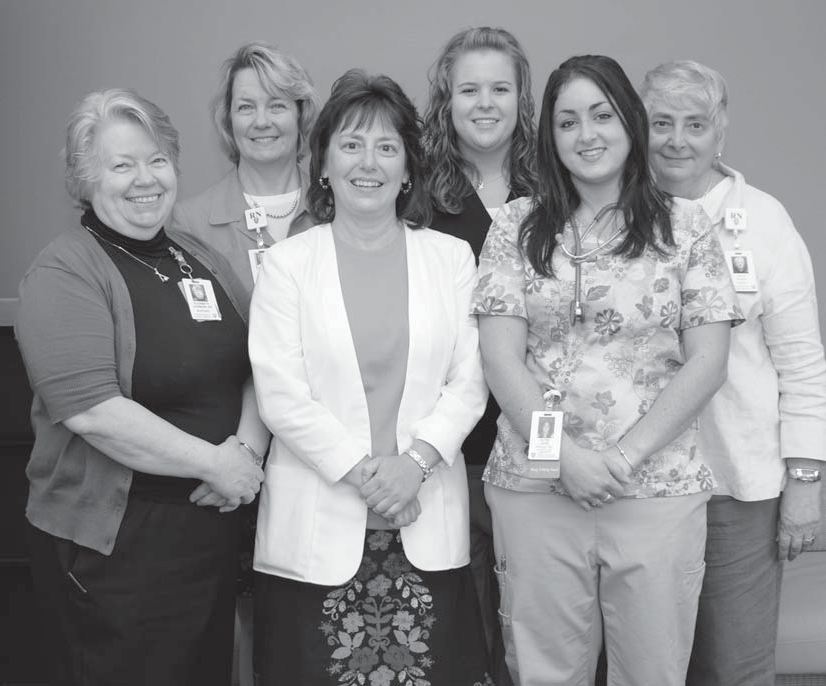
The 2004 Ghiloni Fellowship Team: Elizabeth Johnsons, RN, MSN, clinical nurse specialist; Amanda Coakley, RN, PhD; Susan Desanto-Maydea, RN, DNSc, faculty fellow; Megan O'Maley, student nurse fellow; Elyse Lavin, student nurse fellow; Carol Ghiloni, RN, MSN.
Faculty members who teach baccalaureate students and can influence curriculum development are invited to apply for the faculty fellowship experience.
Evaluating the Program
At the end of each fellowship year, the faculty and student fellows are asked to complete an evaluation tool to provide feedback on the program and make recommendations to improve the program for future years. To learn more about the fellowship experience and explore whether former fellows felt prepared for employment in oncology nursing after the fellowship experience, a focus group discussion with former student nurse oncology fellows was conducted.
Specific Aims of the Evaluation
The specific aims of the evaluation were as follows:
Explore the impact of participation in the ONF program between junior and senior years in a baccalaureate program as preparation for employment on a busy inpatient oncology unit.
Identify which aspects of the structured educational program were most beneficial in preparation for employment
Learn how the student nurses who participated in the structured educational program perceived their experience
Method
Study Design
The study was approved by the appropriate Institutional Review Board. This research used a qualitative descriptive approach. All staff currently employed at the MGH who had been Carol A. Ghiloni Student Nurse Oncology fellows were invited to attend a focus group dinner. Three former fellows attended the dinner/focus group; one former fellow who was unable to attend answered the questions in written format. The focus group discussion was audiotaped and then transcribed. The transcripts and the written responses of the nurse who was unable to attend were analyzed using content analysis. Two nurses who are involved in the fellowship program and a graduate student who is not associated with the fellowship program conducted the analysis of the data.
Sandelowski (2000) identifies qualitative content analysis as the basic strategy for qualitative descriptive research and an important approach to understanding experiences or events. The goal of qualitative descriptive research is to comprehensively summarize informational content in everyday language while also offering the researchers an iterative process with the opportunity to reflect, return to the data, and revise understandings throughout the analysis (Sandelowski, 2000). Because content analysis is considered to be reflexive and interactive (Sandelowski, 2000), it was the approach of choice.
The strategies for analysis were those described by Downe-Wamboldt (1993). The unit of analysis was identified as phrases or sentences contained within the transcripts. Categories were initially defined, pretested, and revised. The revised categories were retested and revised, and key findings were synthesized and described. Finally, the key findings were assessed for validity.
During the first phase of the analysis, the three researchers conducting the analysis independently read all of the transcripts, line by line, to identify initial categories. They came together and considered the categories they had developed independently, revised aspects of the definitions of categories, returned to the data together, and further refined the categories. They agreed upon refined definitions for the categories and then returned to the data to confirm general agreement about the definitions and findings.
The member check phase of the analysis involved presenting the categories and data to the focus group participants for their review, consideration. and validation. The participants felt that the analysis accurately captured the meaning and experiences of the research, and they agreed with the findings.
Research Questions
Did participation in the Oncology Fellowship Program prepare you for employment on an inpatient oncology unit?
How do you feel it prepared you differently from nurses who did not participate in an educational program like the fellowship?
What part of the fellowship experience had the biggest effect on you in terms of preparation for employment?
What was the experience of the fellowship like for you?
What recommendations about the fellowship do you have for us as we develop the plan for future years?
Findings
Four key findings emerged from the analysis of the data that described fellows’ experiences.
Key Finding 1: The Fellowship Program Provides an Opportunity to Make an Informed Career Choice
The fellows described the fellowship program as a vehicle providing opportunities to observe patients across the care continuum within oncology nursing and to witness firsthand the many roles within nursing. They also felt that one of the strengths of the program was that it allowed them the ability to compare and contrast the different patient care units to see which unit best suited their unique strengths and learning needs. “I like that my unit is a small unit. I knew that a small unit would suit my personality. Some people would rather have more variety, but not me.” Being able to observe the multiple roles of nurses across settings was beneficial to the students. “It is a great way to decide if oncology is the thing for you. You get to see all facets of oncology nursing and you can see if one really works for you. It is a great exposure to what your future career can be.” Another benefit of this program is learning about what nursing really is. “It is important to learn about how physical the job really is.” “It has helped me pursue a career at MGH in oncology nursing and it was one of the best decisions I have ever made!”
The fellows described the fellowship program as a vehicle providing opportunities to observe patients across the care continuum.
Key Finding 2: The Fellowship Program Provides an Opportunity for Confidence Building
The former students all reported that they felt that the 10 weeks provided them with experiences that led them to have a high degree of confidence with regard to the hospital, about patient/family interactions, and about the unit where they ultimately chose to work. “It was helpful to see all these areas. It was also helpful to get to know the hospital. I had no idea what I was talking about in regards to chemo until I saw it.” Spending time with patients and families helped the fellows feel more prepared for and comfortable with employment in oncology. “You are so much more at ease with patients who have cancer.” “It is so much less scary after you spend the time.” “You see what [patients] need. You know so much more about what [patients] are going through.” The nurses described how it felt to know some of the nurses from the previous summer and how that helped them feel prepared for their jobs as new graduate nurses on an oncology unit.
Key Finding 3: The Fellowship Program Provides Experience of Preceptor Role Modeling
Each fellow had one primary preceptor during the fellowship experience. The former fellows talked about the key role their preceptors and the staff on the units played in helping them to choose oncology nursing as a career choice. “I found the familiar faces to be really helpful.” The fellows all identified the powerful role the preceptors played in influencing them about oncology nursing. “[My preceptor]—I thought she was the most wonderful and caring person and I wanted to be just like her. She has such a wonderful way about her. I just knew I wanted to be there on [the unit with my preceptor]. Spending time with her really made my mind up that I wanted to work on that unit.”
The fellows all identified the powerful role the preceptors played in influencing them about oncology nursing.
Key Finding 4: The Fellowship Program Provides Relationship Building with Staff, Patients, and Patients’ Families
All of the former fellows talked about the importance of relationships in deciding on oncology as a career option. After spending time in many oncology settings, the fellows were able to decide which settings were more suited to them. One of the fellows said, “I really enjoyed the pediatric hematology–oncology clinic. I had more time to teach people and get to talk to them more about what is going on with them.” “I remember having a 2-year-old child and being there with her family during the experience. It was very powerful to be there in the clinic with this family.” Relationships with staff were equally important to the fellows. They talked about how good it felt to start their careers on an inpatient unit and already know some of the staff members. “I even knew some of the nurses from the summer before. I found the familiar faces to be really helpful.” They all talked about how welcome they felt during the fellowship experience and how that influenced their decision to come back to MGH for employment, often on a specific unit. One nurse chose not to work in oncology. The fellowship experience gave her an opportunity to see the complexities of oncology nursing, and she realized that she was not ready to work on an oncology unit right after graduation. She plans to transfer to an oncology unit after gaining some more experience and confidence.
Discussion
When asked what recommendations the fellows had for the coordinators of the program, many of the fellows reported that more inpatient experience and 1 day per week of observation in the outpatient areas seemed like a better model. The earlier fellows had blocks of concentrated time in the inpatient/outpatient areas. Every year, fellows recommended additional inpatient experience, so in 2007, the model was changed to an inpatient experience with 1 day per week of observation in outpatient areas such as radiation oncology, the infusion unit, the operating room, radiology, and the oncology outpatient practices. One fellow talked about the need to “gain those patient care associate skills”; all her other classmates were working as patient care associates and learning those skills, and she felt that was the one area in which she did not gain as much as she would have wanted during the fellowship. The former fellows talked about how spending more time on the inpatient units with a preceptor helped them gain the physical skills—that, unlike nursing school, the fellowship was more like real nursing practice, with 8- or 12-hour shifts instead of the 4 or 6 hours in clinicals during the school year. Finally, the relationships the fellows made were very important to them on many levels, but especially in terms of deciding on oncology as a career, working at MGH, and choosing which unit they wanted for their first job.
The Oncology Fellowship Program at MGH has proven to be a valuable educational and recruitment tool. Ten of the 14 oncology fellows were hired to work as new graduates at MGH, and all but one chose to work on an oncology unit. Additionally, the program is a rich learning model that provides an opportunity for student nurses to spend a concentrated period of time learning about a nursing specialty that has characteristically been excluded from their education. These nurses were able to articulate how the fellowship experience increased their confidence and comfort level with the specialty of oncology, with hospital routines, and with patients and families. It provided them with the opportunity to spend time with the nursing staff on various oncology units and see which unit best matched their personality, learning needs, and comfort zone. Some of the nurses who had participated in the fellowship experience felt very comfortable starting employment on a 36-bed inpatient acute medical oncology unit, while others gravitated toward a much smaller 17-bed gynecology surgical oncology unit. Spending time with the staff and patients helped these new nurses to know what interested them most and where they felt most comfortable.
The program is a rich learning model that provides an opportunity for student nurses to spend a concentrated period of time learning about a nursing specialty that has characteristically been excluded from their education.
The OFP model can be replicated at other facilities that provide oncology care or within other nursing specialties, to allow nursing students an in-depth opportunity to learn about a nursing specialty and gain confidence and comfort with a hospital and with nursing practices. With an impending nursing shortage, it is critical that nurses feel comfortable with and well suited for the units where they begin their careers. Nurses who are not well matched to the units where they are first employed will often leave the job within 2 years; some leave nursing altogether, believing that nursing is not what they thought it would be. The fellowship program assists nursing students in making truly informed career choices.
The OFP also serves as a valuable link between the hospital and the universities where the fellows are enrolled. Each year the fellows prepare a presentation about an aspect of oncology nursing that interests them. They present this information to the OFP faculty at the hospital and also at their university with one of the OFP faculty present. These presentations provide an opportunity for junior students to ask about the OFP, oncology nursing, and MGH as a place to seek employment upon graduation.
With an impending nursing shortage, it is critical that nurses feel comfortable with and well suited for the units where they begin their careers.
Footnotes
Amanda Bulette Coakley, RN, PhD, is a staff specialist and a nurse scientist at Massachusetts General Hospital.
Carol A. Ghiloni, RN, MSN, is a staff specialist at Massachusetts General Hospital. The Carol A. Ghiloni Oncology Fellowship Program has been partially funded by the Hahnemann Hospital Foundation and the Johnson and Johnson Campaign for Nursing's Future.