







Abstract

Healing and place are inseparable. (Wilbert Gesler, 2003, p. 1)
Florence Nightingale stands out as the first nursing leader to understand the impact of place on the healing process. In her writings she laid the groundwork for a holistic approach to patient care. “Volumes are now written and spoken upon the effect of the mind upon the body. Much of it is true. But I wish a little more was thought of the effect of the body on the mind” (Nightingale, 1860). She also is credited with being one of the first to record this impact in her statistical representation of public health issues. She understood that the element of place (nature, site location, and building design) needs to be integrated with elements of people (spirituality) and with processes (care delivery) to create an Optimal Healing Environment (OHE). Nightingale practiced nursing more than 150 years ago, but her insight into the creation of OHE leaves a legacy for us all. She proposed no formulaic response to the role of place in optimal healing but documented her experiences and observations with her patients as well as the larger community. Our challenge is to discover frameworks to help us identify elements that create optimal healing environments within our own communities.
The American Holistic Nurses’ Association's Standards of Holistic Nursing Practice (1998) include therapeutic environments as part of their core values. The standards state that “each person's environment includes everything that surrounds the individual, both the external and internal (physical, mental, emotional, and spiritual), as well as patterns not yet understood.” This article will introduce systems thinking as a framework for identifying and studying the elements of OHE. Application of this framework also allows subtle patterns, including the interactions between elements, to be made explicit.
With billions of dollars of spending anticipated in healthcare construction both nationally and internationally before 2020, it is imperative that means to improve the healthcare environment be explored to ensure optimal work, healing, business and cultural outcomes. (Stickler, 2007, p. 11)
Definitions of Terms
Optimal Healing Environments
The word “healing” comes from the Anglo-Saxon word haelen, which means “to make whole.” Healing environments are designed to promote harmony or balance of mind, body, and spirit; to reduce anxiety and stress; and to be restorative (Kreitzer & Zborowsky 2009). The OHE are created when people, place, and care processes converge at a particular time and within a particular culture. Some of these elements are universal while others may be unique to each community.
Systems Thinking
Systems theory was developed in the 1940s by biologist Ludwig von Bertalanffy as a reaction against reductionism and the attempt to revive the unity of science (Heylighen & Joslyn, 1992). Von Bertalanffy emphasized that real systems are open to and interact with their environments, and that they can acquire qualitatively new properties through emergence resulting in continual evolution. Rather than reducing an entity to the properties of its parts or elements, systems theory focuses on the arrangement of and relations between the parts that connect them into a whole. Systems theory is applied to many disciplines such as physics, biology and sociology to provide a holistic framework to areas of study (Heylighen & Joslyn, 1992).
Ohe and Systems Thinking
Applying systems thinking to the creation of OHE allows a holistic perspective into their creation. Figure 1 illustrates the relationship between the major elements of OHE. Systems thinking allows a broader, more integrated view of this concept. Rather than focusing on the individual parts, systems thinking allows a perspective of how the parts relate to each other. The elements can be better understood when examined in relation to each other and to the synergy that exists between them.
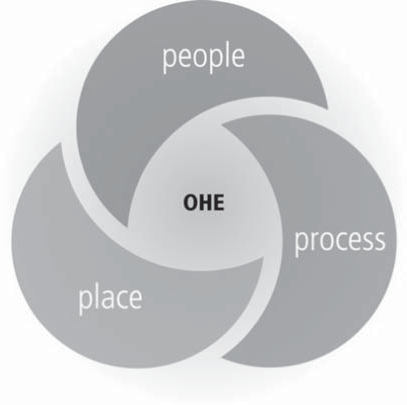
Elements of optimal healing environments (OHE).
Place includes both the designed environment (exterior architecture, designed landscape, interior space planning and interior design) and the natural environment (site topography, orientation and the natural landscape).
People, including health care providers, leaders, and ancillary staff are the most vital element in creating an OHE. It is critical that all members of the health care team embody knowledge, skills, and attitudes that enable them to provide care and service consistent with principles and practices of OHE. For example, technical skills must be accompanied by interpersonal skills of compassion and empathy. Care processes consistent with OHE include both conventional care and complementary therapies or integrative practices. Finally, place—the element of focus of this article—includes both the designed environment (exterior architecture, designed landscape, interior space planning, and interior design) and the natural environment (site topography, orientation, and the natural landscape).
The creation of an OHE should be thought of as a dynamic process seeking equilibrium rather than a linear process. Understanding the relationships and interactions between the elements is as important as understanding the elements themselves.
Other important components of the OHE model are the areas of interaction identified in Figure 2. Interaction A represents the interaction between people and place. An example is the design of same-handed standardized operating rooms that optimizes staff's ability to perform surgery in an environment that minimizes distractions and provides a sense of continuity. Interaction B represents the interaction of people with care processes. An example is standardization of surgical processes that optimizes care delivery and minimizes unforeseen incidents. Interaction C represents the interaction between place and care processes. An example is the deliberate location of medical equipment and supply cabinets to support the care processes of surgery.
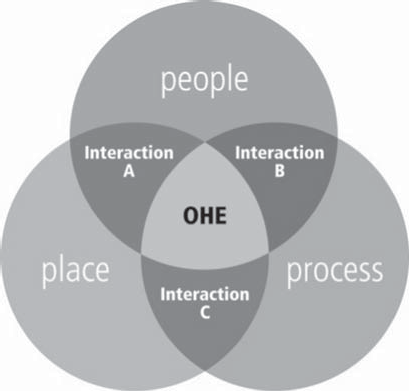
Interactions between elements of optimal healing environments.
While the model in Figure 1 may appear static, keep in mind that the creation of an OHE is about the process of creation as much as it is about identifying the elements. Similar to other systems that seek equilibrium, the creation of an OHE should be thought of as a dynamic, process-seeking equilibrium rather than a linear process. Understanding the relationships and interactions between the elements is as important as understanding the elements themselves.
Understanding the Role of Place in the Ohe Model: A Case Study
Applying the OHE model to a design problem faced during the construction of a new inpatient unit allows us to examine the relationship between elements of place and other OHE elements. From this examination we can identify the data and assumptions involved in solving the problem.
This case study involved identifying the design elements needed to create a patient-safe environment, a key component of OHE. The OHE model identifies the elements of place that impact this goal as well as important interactions to consider. In this model, Place includes:
The inpatient room layout;
The unit layout, including decentralized nursing stations outside the patient room with a view window;
Architectural items such as handrails, ceiling-mounted lift systems, and standardized medical gas and electrical outlets; and
The location of the head of the bed in relation to the toilet.
Interior design items include flooring material and lighting. Selection of such items is supported by research in the fields of environmental psychology, sociology, architecture, interior design, and human factors research, among others.
The model assumes that these design elements or interventions alone are not enough to reach the goal of an OHE. Other elements of the model must be identified as well. These include people—trained staff who use the equipment and architectural amenities in the room as well as family members who may assist the staff in providing a patient-safe environment for their loved one. Care processes include patient safety tools used to assess patients’ fall potential as well as evidence-based procedures to keep patients safe. Identifying these potential interactions helps us understand how the individual elements, interacting together, help optimize a patient-safe environment.
These interactions or relationships can be tested to provide further data to support the creation of an OHE by establishing those elements that must come together to provide a patient-safe environment: design, expectations for staff performance, and care processes. Examining how these elements come together can provide this information and also help inform more global decisions. Which of the relationships that optimize patient safety are unique to this culture? Which relationships have global application? The answers to these questions will help move evidence-based design and evidence-based practice forward.
“Surprising and innovative ideas can emerge from unpredictable corners of complex systems that foster diverse relationships among the parties within the system” (Plsek, 2003, p. 3).
Conclusion
Systems thinking is a valuable tool to help identify elements essential to creating an OHE as well as the interaction between the elements and the synergy among them. Creating an OHE is a unique endeavor, not a formulaic process. Systems thinking reveals the dynamic nature of these relationships. Research is available to aid in this discovery process in the fields of evidence-based practice and evidence-based design. This model also helps identify future research needed to validate what relationships must exist between these elements to aid in the creation of OHE.
Nurses have a unique role in the OHE model when we address the importance of Place in the care delivery process. Like Florence Nightingale we observe and, along with our patients, experience the relationships between the elements of OHE. We can validate the important interactions needed for the creation of Optimal Healing Environments and the expansion of the body of knowledge to support them.
Additional Resources about the Role of Place in the Creation of Ohe
Health Environments Research & Design Journal: Peer-reviewed journal whose mission is to enhance knowledge and practice of evidence-based health care design by disseminating research findings, discussing issues and trends, and translating research into practice. www.HERDJOURNAL.com
Nursing Institute for Healthcare Design (NIHD): Education, consulting, and advocacy company with the mission of improving nurses’ work environments. Online resource and community for nurses involved in health care design; collaborates with design community and clinical community to improve communication. www.nursingihd.com
The Center for Health Design: Mission is to transform health care environments for a healthier, safer world through design research, education, and advocacy. www.healthdesign.org
Footnotes
Terri Zborowsky, PhD, is a nurse who is currently Director of Healthcare Education & Research at Ellerbe Becket, Inc., an architectural firm in Minneapolis, Minnesota.