







Abstract
This article describes an innovative international collaboration between a children's hospital in the United Kingdom and a university school of nursing in the United States that created opportunities for networking among nurses in similar specialties. Nurses from two countries joined in an educational partnership to share dialogue and clinical experience in the United Kingdom.
In the current economic climate, pediatric staff nurses across the globe are rarely able to travel and learn from one another. Staff nurses at the bedside are often unable to attend continuing education or academic offerings to broaden their perspectives of care delivery. The expense of travel and the challenge of coordinating logistics often make the chance to meet pediatric nurses abroad only a dream.
To make this dream a reality a partnership was created. The goal of this partnership was to create an international course for nurses who would not otherwise have the opportunity to travel. The vision was a 2-day exchange that would allow a group of RN-to-BSN students from Western Carolina University and a group of staff nurses from an urban hospital in the United Kingdom to compare the challenges of rural and urban pediatric care. The visiting American nurses were paired with English staff nurses working in similar specialty areas: inpatient clinics, outpatient clinics, home care, and a school for developmentally challenged pediatric patients.
Review of Literature
International exposure for nurses is encouraged by Sigma Theta Tau International Honor Society of Nursing and the American Nurses Association (American Nurses Association, 2003; Sullivan, 2008). Sigma Theta Tau offers many programs that promote international nursing collaborations. International educational collaborations allow linking of leadership opportunities, learning advocacy roles, and ethical accountability (Leppa & Terry, 2004). Educational collaborations have shown that international exposure increases global nursing care perspectives as well as cultural sensitivity (Bennett & Holtz, 2008; Gerrish, 2004). The importance of transcultural nursing has been recognized since the formative work of Leininger (1999).
Broadening nurses ‘global perspectives facilitates leadership development and preparation (Schim, Doorenbois, & Borse, 2005). A multitude of volunteer organizations promote cultural exchange and awareness, including UNICEF, People to People International, and Project Hope. A variety of programs offer hands-on clinical care and diversity through team methods (Kuehn et al., 2005; Lindahl, Dagborn, & Nilsson, 2008). San Francisco State University's school of nursing has initiated travel programs to Italy, Peru, Thailand, Ghana, and the United Kingdom, with a goal of exposing students to differences and similarities in family-centered care (Perry & Mander, 2005).
Educational collaborations have shown that international exposure increases global nursing care perspectives as well as cultural sensitivity.
Johns Hopkins University formed a partnership with Haiti Medical Mission, which provides health services to the poor of Leon, Haiti (Sloand & Groves, 2005). The purpose was for Haitian practitioners to demonstrate culturally sensitive care, showing the U.S. nurses the differences in illnesses. Some nursing collaborations focus on leadership development on a global level (Girot & Enders, 2004; Leh, Waldspurger, & Albin, 2004). Nurses become knowledgeable about disparities in care among the world's most at-risk populations (Chinn, 2005).
Conceptual Framework
The conceptual framework for the educational collaboration was based on a view of nursing practice as encouraging patient advocacy, seeking accountability for patients, and becoming a nursing activist for pediatric clients and families (Garner, Metcalfe, & Hallyburton, 2009). For the university course, this framework was adapted to encompass the emerging model of Engaging Tomorrow's International Nursing Leaders to experience leadership development (Garner et al., 2009) (Figure 1). Utilizing the three components of the model (advocacy, accountability, and activism) for sharing ideas about pediatric nursing care delivery with their peers in the United Kingdom, the U.S. nurses grew as nursing leaders within their own clinical settings.
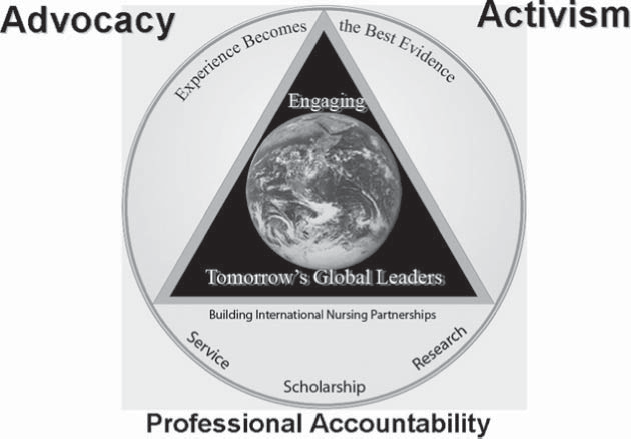
Conceptual framework for engaging tomorrow's international nursing leaders.
Process
Planning for the partnership began a year before the 2-day exchange; the U.S. nursing instructors traveled to the United Kingdom to develop rapport with the nursing administration of the children's hospital there. The initial meeting was conducted by the lead professor and the senior nursing administration of the children's hospital. Opportunities for broadening the global perspective of caring for children and their families were immediately recognized.
Few of the U.K. nurses had traveled outside their own country and had not shared dialogue with nurses from the United States. None of the nurses from the United States had traveled to the specific region of the United Kingdom where the exchange would take place. The proposed educational event would be a novel learning experience for everyone.
The conceptual framework for the educational collaboration was based on a view of nursing practice as encouraging patient advocacy, seeking accountability for patients, and becoming a nursing activist for pediatric clients and families.
The first day of the exchange would consist of nursing care presentations by both groups of nurses and introductions to the paired nurses for the clinical site visits. The staff nurses from the U.K. hospital would present emerging care issues of children and their families from the large metropolitan region. The staff nurses from the United States would present pediatric behavioral and physical care issues prevalent in the rural southeastern United States. On the second day each visiting U.S. nurse would be paired with a U.K. nurse with a similar practice background. The goal of the clinical day of sharing was to give the paired staff nurses time to discuss caring for similar populations of children from different continents.
After the initial meeting between the two faculties, planning to coordinate the visit began. Permission was obtained from families, educational institutions, and clinics to enable the visiting nurses to accompany the U.K. staff nurses in their clinical areas. Response from each of the proposed visit sites (clinics, schools, homes, and hospitals) was overwhelmingly positive. Administrations from the various clinical sites recognized the inherent value of this unique exchange. The conceptual framework for the collaboration was shared with the senior nursing administration of the U.K. children's hospital; the administrators concurred that their staff nurses had limited opportunities to engage in a new theoretical framework for approaching nursing care at the bedside. All the staff nurses welcomed the new model.
Structure of the University Course
Eleven BSN-completion students were enrolled in an international nursing course with a focus on sharing information about nursing care of pediatric patients with nurses in the United Kingdom. Online classes provided the structure for learning in preparation for the study trip, which occurred during spring break. The students were encouraged to participate in three ways:
Learning from the conceptual framework for the course
Pretravel communication with their designated peer
Preparing a presentation on a topic important to their pediatric specialty, to be given during the visit to the United Kingdom.
Collaboration Efforts and Day of Exchange
When the time for the trip arrived, the 11 RN students enrolled in the course, and two nursing professors traveled to the United Kingdom for a week. All the RNs worked full time, and each was allowed 5 days ‘leave.
The first 2 days included a guided tour of an historic hospital in London. The group also visited health-related historical museums, including the Florence Nightingale museum. The students were enthralled with the scope of the Nightingale museum; the docent was a former nursing student of the now-closed Florence Nightingale School of Nursing. Visiting the actual site where professional nursing began was profound.
The group then traveled by train to Edinburgh, Scotland. On arrival, a reception welcomed the designated peers. The presentations were successful; staff nurses raised questions about cultural differences in care delivery. Despite living on different continents, both groups of nurses shared pediatric nursing, and one nurse said, “Nursing is nursing everywhere, no matter where one comes from!”
Both groups of staff nurses were amazed at the cultural variables that entered into the care of the different types of pediatric patients. Examples of differences noted included having children living in wards in the United Kingdom and the increased need for intervention with children with profound obesity in the United States. Staff nurses from the United States were impressed with the holistic nursing care in both the inpatient and the outpatient settings in the United Kingdom. Staff nurses were engaged with their peers ‘presentation highlighting birth control information for secondary education students. The U.S. nurses presented information about cultural variables for African Americans and Native Americans. The U.K. nurses were eager to learn about care delivery methods for these populations.
Both groups of staff nurses were amazed at the cultural variables that entered into the care of the different types of pediatric patients.
The participants were asked to state the most valuable lesson they learned from the presentations. Both groups reported that despite the differences between the health care systems (a capitalistic system of private insurance companies in the United States and the National Health Service in the United Kingdom), nursing care does not change and remains the core value. Nurses were impressed that the delivery of nursing care is universal and is not dependent on nation or nationality. Many of the nurses remarked that they had never had an opportunity to discuss their practice with people of other nationalities.
At the beginning of the following day, each visiting nurse met his or her counterpart and traveled to that nurse's workplace. A visiting nurse who worked in a pediatric emergency room in the United States was paired with a nurse who worked in an accident and emergency facility. Visiting school nurses were paired with peers in schools for developmentally challenged students. American nurses with a family-centered care background were paired with nurses from a neonatal intensive care unit. Community and mental health nurses were placed with peers in public health and neurology. A U.S. nurse who provides burn and wound care in home settings was paired with a nurse who worked in a division of the Tissue Viability Sector. This visiting nurse was interested to learn that in the United Kingdom, children are routinely sedated for suture and staple removal. At the end of the day, both groups reported an overwhelming success and the desire for more days of sharing in the future.
Success of the Course
The success of the educational collaboration can be seen in the connections that were formed during the nursing care exchange. It was apparent that both groups of nurses enjoyed the chance for global networking, felt mutual respect, and gained knowledge that they could not have gleaned otherwise.
Each nursing student kept a journal comprising each component of the course. It was evident from the journal entries that each nurse had become a patient advocate, had assumed professional accountability for his or her patients, and was emerging as a global nursing activist.
The success of the international educational partnership was apparent. Mutual sharing of pediatric nursing principles and nursing care challenges was evident throughout the 2-day collaboration. It is hoped that the course can be continued with future groups of staff nurses from both the United States and the United Kingdom.
Footnotes
Sharon Elizabeth Metcalfe, EdD, RN, is assistant professor of nursing at Western Carolina University in Cullowhee, North Carolina.