







Abstract
Today, integrative medicine encompasses many healing arts therapies, including music. The universal language of music is simple, yet often forgotten, and communicates unspoken messages. The healing power of music in the health care setting creates a healing environment, distracts from pain, relaxes and de-stresses, and helps with sleep.
This touching handwritten note arrived in my mailbox:
For me, harp music is like breathing. With your music, I quieted down and watched my breathing—I was transported to another time and place. Even though you were only here for a short time out of my whole chemotherapy treatment program, you gave me a deep, much-needed reminder to focus on my breath and life, not on my illness. I will think about this through the coming weeks and even though you will not be here, the memory of your music will help me remember. Thank you.
Music speaks to our hearts—often without words. We seldom analyze music critically—it is absorbed automatically and directly. As a result, music penetrates deeply at a subconscious level. It communicates simultaneously in all four areas of well-being: emotional, physical, mental, and spiritual. Music's “messages” can be powerful and unspoken—music is a unique and potent healing modality.
As a therapeutic harpist playing in several hospitals in the Minneapolis/St. Paul and Rochester, Minnesota, areas, I see how the harp touches patients and their families to answer the need for comfort during the heightened stress of illness and crisis. Music's unspoken messages can create a healing space or environment, distract from physical or emotional pain, relax and de-stress, and help with sleep.
Music Creates An Environment—An Intimate Space—For Patients, Families, and Staff
Melissa was 28 years old and was dying from brain cancer. The cancer had spread so much that the doctors could no longer operate. As the chaplain and I walked onto the intensive care unit, we were met by Melissa's parents. I felt an immediate connection with and fondness for them. Her dad informed us that the medical staff were going to withdraw her ventilator support later that afternoon. I was touched by his openness, candor, and sincerity.
I set up my instrument and began playing softly. Melissa's parents and aunt took turns speaking to her while gently stroking her face. Something beautiful was happening in the room. There was an incredible feeling of love—love coming from every person, spreading into every part of the room. Instinctively, those present knew to support, care for, and attend to each other as well as to Melissa as they said their good-byes.
Melissa looked relaxed, calm, peaceful, and content. She was filled with love and radiated, “All is well with me.” Everything (medicine, prayers, speaking, and touching) that could be done had been done. Music was the final gift, perhaps touching her where nothing else could and giving her family comfort seeing her in such peace and love during her last minutes. The music softened the environment. It was an important part of the family's closing ritual where love, in its most beautiful earthly form, was present.
Music Can be Used as a Pain Distractor
I often play my harp in a private or semiprivate hospital room. On one occasion, I played in the entryway of a nursing unit with a circular design that allowed the music to carry throughout the entire space. Patients who are recuperating and feel strong enough often take short walks around the unit, sometimes circling round and round and round.
On this particular cold, wintry day, a woman named Carol, dressed in a beautiful pink plush robe, emerged from her room. She did not walk very long. She sat down beside me and started talking. It was obvious that she was in a great deal of pain. She explained that she had undergone surgery three days earlier, and today, the staples closing her incision were pulling and causing her discomfort.
I suggested she focus on the music. My goal was to distract her from her pain and give her something to focus on instead of her condition. As she listened intently, I encouraged her to breathe as deeply as possible and envelop her body with healing, similar to the feeling of being surrounded by her warm, pink robe.
She stayed with me for about 30 minutes, until she heard her phone ring. She stood up gingerly but with greater ease than when she first left her room. After she finished her phone call, she came back to tell me how much the music had helped distract her from her pain. She felt more hope for a quick recovery and return home. Many times, music allows us to focus on something hopeful and beautiful, distracting us from our pain and suffering.
Music Can Have a Calming Effect, Promoting Relaxation, And, Ultimately, Sleep
We live in a busy, fast-paced world, and this frenetic, stressful pace can take a toll on our bodies. Relaxing music can play a role in reducing stress, creating a calming effect, and aiding the healing process. The harp is a perfect instrument for relaxation—it naturally soothes and comforts and moves people to their peaceful core. This is a sacred moment when healing happens.
One of the music principles I use to help people relax is called entrainment. Entrainment is when our bodies synchronize with the music's rhythm. For example, if you want to relax, then it is appropriate to select music with a slow beat. As you entrain with it, you slow down, relax, and ultimately sleep (Hoffman, 1995, p. 3–5).
Music speaks to our hearts—often without words. We seldom analyze music critically—it is absorbed automatically and directly. As a result, music penetrates deeply at a subconscious level.
Therapeutic music is a simple, effective, and inexpensive way to create healing environments for you and those you serve.
The following story demonstrates the entrainment principle: After playing my harp on the surgical intensive care unit, I was preparing to leave when a nurse asked whether I had time to play for one more patient. The nurse said, “LeRoy has had brain cancer and is recovering from surgery. He is so agitated and restless. Nothing is helping him, not even medications. Perhaps your harp music will help to settle him down.”
When I entered the room, I could see that LeRoy was very fidgety. Even though he was restrained, he was writhing on his bed in constant motion. His mild- mannered wife was doing what she could to support him, trying to provide some comfort by talking softly to him and gently holding his hand. His nurse was doing everything medically possible, but she was definitely frustrated.
I started playing a song that was a bit agitated. The next song was slower. After the first couple of songs, it became apparent that the music was distracting him enough to be less fidgety. Each musical selection thereafter was slower and s-l-o-w-e-r, until the music barely pulsed. He was getting sleepy and within 20 minutes, he was peacefully asleep. After he fell asleep, his nurse said, “We have struggled with him all day. Thank you!”
LeRoy moved through the following four stages of entrainment, as depicted in Figure 1.
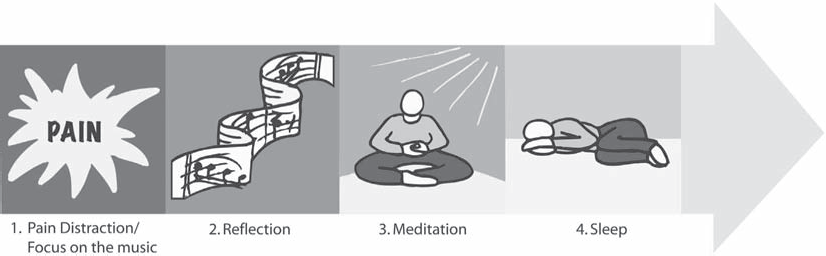
Four stages of entrainment.
After observing the powerful yet subtle nature of this principle with many hospital and hospice patients, I created a solo harp CD called Calm as the Night, which incorporates the entrainment principle. It contains five 10-minute songs, with each song starting slowly and progressively becoming slower and s-l-o-w-e-r. This recording is appropriate for children and adults who want to relax deeply and those who have difficulty relaxing and/or sleeping. It is an effective, nonpharmacological approach to rest and sleep.
In conclusion, harp music is comforting, soothing, and beautiful. As if that weren't enough, it is also healing, distracting us from pain, and helping us relax and even sleep. Therapeutic music is a simple, effective, and inexpensive way to create healing environments for you and those you serve. May you experience many of music's unspoken messages as you incorporate healing, relaxing music in your nursing practice and daily life.
Footnotes
Tami Briggs, MBA, a therapeutic harpist certified by the International Harp Therapy Program, founded Minneapolis-based Musical Reflections in 1999 to provide products and services to enhance and support the healing journey. She has released 13 CDs for relaxation, comfort, and stress reduction and has written two books: Grace Notes: Reflections on the Harp and Healing and Women as Healers: Voices of Vibrancy. Her websites are http://www.Musical Reflections.com and  AsHealers.com