







Abstract
Contemporary authors on nursing issues discuss the importance of expanding knowledge at all levels of nursing education to empower future nurses to respond in caring situations for the benefit of their patients. This article reviews several studies in which paintings, complemented by a pedagogical structure, allowed students to observe situations relevant to nursing. Results suggest that the use of visual art in nursing education can add a new dimension to students ‘experiences.
The studies described in this review focus on the use of paintings as a pedagogical tool developed from previous research about the use of art as a communication and healing tool with patients. Art has helped hospitalized children mirror their thoughts in words and/or in art objects (Wikström, 2005). Patients with irritable colon syndrome have been helped to cope with their symptoms (Cristina Grape, Theorell, Wikström, & Ekman, 2009).
Health professionals have used works of art to communicate with older patients (Wikström, 2003a). For older individuals, aesthetic forms of expression meant discovering and preserving possibilities for a meaningful life (Wikström, 2004). Dialogues generated by paintings had a positive impact on older individuals ‘perceptions of their life situation and social interaction, compared with a control group in which dialogues were about events of the day and the older individuals ‘hobbies and interests (Wikström, 2002b; Wikström, 2005). A survey of the living conditions of a random sample of Swedes aged 16–74 years showed that attending cultural events such as museum visits, art exhibitions, plays or concerts, reading books, and singing in a choir had a positive influence on survival rates (Bygren, Konlaan, & Johansson, 1996; Konlaan et al., 2000).
Nursing education must continually be examined and expanded in view of the fact that student nurses must be prepared for nursing practice that continually changes. Previous research in various aesthetic forms of expression suggests that these could be used to develop nursing skills (Breslin, 1996; Koithan, 1994; Wikström, 2002a). The present review aims to show by what means visual art could be used to complement teaching/learning programs.
The understanding of anguish, guilt, and choice are central to the discipline of nursing. These concepts are best understood with methods that involve more than detached observation or dispassionate description.
Review of Literature on Aesthetics in Nursing Education
The use of literature, film, and music as teaching tools in nursing education was discussed by Mohr (1995) and by Chinn (1994) in their classical analysis of patterns of knowing that includes aesthetics in the art of nursing. The understanding of anguish, guilt, and choice are central to the discipline of nursing. These concepts are best understood with methods that involve more than detached observation or dispassionate description. Educational elements from the humanities, including reading selected literature, observing assigned films, and listening to particular musical pieces are useful pedagogical tools. Darbyshire (1994) discusses an educational approach to promoting aesthetics in nurse education, enabling nurses to gain a deeper understanding of the lived experience of suffering and chronic pain through engaging with the art of the Mexican painter Frida Kahlo. Blomqvist, Pitkälä, and Routasalo (2007) indicate various reasons and ways to use art as an interpreter of emotions. Simons and Hicks (2006) argue that the use of different art forms in teaching facilitates trust and expression of emotion.
According to Koithan (1996), incorporating aesthetic knowing into nursing education fosters caring and fluidity in practice. Bardes, Gillers, and Herman (2001) suggest visits to art museums as a way to build clinical skills in observation, description, and interpretation of visual information. Weir (2010) reports on a workshop at the Tate Gallery in London that explored the subject of violence. Participants reported that
… something happens. It may be that there is a transformation of attitude, even impacting on practice, or an appreciation that an art gallery offers a space that allows different kinds of thinking, or restores a sense of connecting with creative aspects of the self; and the creative side of the human brain. (p. 107)
Literature, film, and music have been used as teaching tools in psychiatric nursing to enhance students ‘sensitivity to mental illness and the personal experiences of psychiatric patients (Wall & Rossen, 2004).
Purpose of the Review
This article addresses the question: “By what means have the use of works of art as teaching methods contributed to increasing subjects ‘empathy, observational skills, interpersonal relations, nonverbal communication, and intuitive knowing?” Eight studies about this strategy in nurse education that is complementary to theoretical knowledge will be reviewed.
Visual Art and Nonverbal Sensitivity: A Teaching-Learning Programme in Nurse Education
A cohort of 436 randomly chosen students from three university colleges of health sciences were asked to interpret depictions of people's body language and evaluate their experience of the process. The students were challenged to observe and reflect on postures, gestures, and eye contact and then formulate individually written reports.
The students ‘written evaluations showed that more than 80% expressed that they became aware of new knowledge, and that studying the pictures was a good way to improve clinical practice (Wikström, 2001a).
Facial Expressions in Paintings as Perceived by the Student Nurse
A group of paintings were pretested with the frame of mind formula (Hjortsjö, 1969) describing different facial expressions. The paintings were used in a two-step process. First, students were shown paintings of individuals to be regarded as hypothetical patients and were encouraged to discuss with a fellow student how to recognize facial expressions and relate these to a patient's feelings. They had to look for and compare subtle variations in the depicted person's faces, especially around the eyes and mouth, and use theoretical knowledge. In the second step, the students reported individually in written form.
Of the 106 students in this study, 95% gained a deeper understanding of the nonverbal language described by Hjortsjö. Seventy-five percent of the students were able to build hypothetical situations around the depicted person's facial expressions. They observed and described a great many details about whether the hypothetical patient had been given positive or negative information regarding his or her state of health (Wikström & Svidén, 2005).
Works of Art Dialogues: An Educational Technique by Which Students Discover Personal Knowledge of Empathy
Over a 4-year period, 428 students participated in a visual art program based on a modified form of Van Manen's (1990) pedagogical model of problem solving and reflection combined with observations and interpretations of paintings. In the 45-minute, problem-solving phase, the students observed a picture closely and interpreted it in a free and independent form, individually stating their impressions about empathy expressed between the depicted persons. In the reflection phase, the students participated in 45-minute, small-group discussions about the pros and cons of using pictures as a tool to discover personal knowledge of empathy (Wikström, 2001c).
The Development of Observational Competence through Identification of Nursing Care Patterns in the Sickbed, a Work of Art by Lena Cronqvist
The pedagogical structure of this study was based on Gibbs's (1981) teaching-learning model. From among six pictures tested by the researchers, The Sickbed by Lena Cronqvist was chosen as one in which students could find acts of caring (see Figure 1). A cohort of 203 student nurses at three university colleges of health sciences were shown this painting and asked to describe how the depicted persons feel, as well as what feelings the painting evoked in them. Students discussed the painting in pairs for 30 minutes, then in groups of four for 60 minutes, and finally produced written reports. The students were given questions to help them get close to the picture:
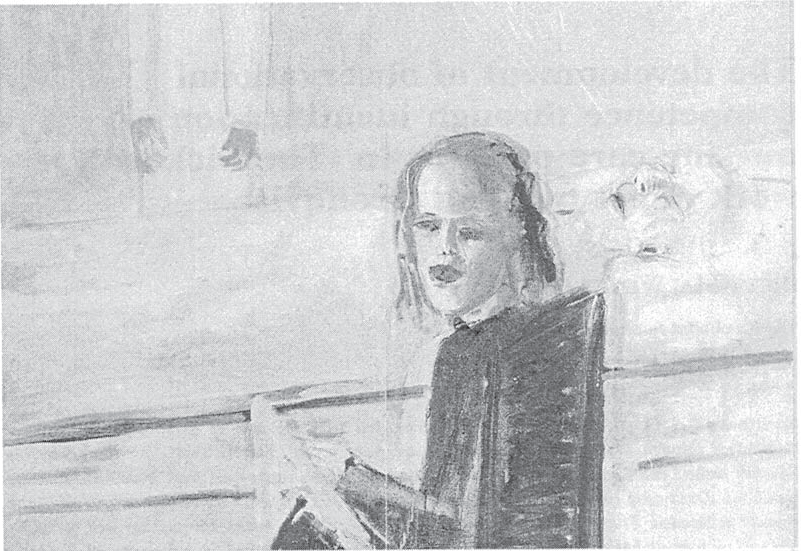
The Sickbed, by Lena Cronqvist. © 2011 Artists Rights Society (ARS), New York / BUS, Stockholm.
What kind of nursing situation does the painting depict?
From a nursing care perspective, how do the characters feel?
The students described the situation as a dying patient being watched by a girl, a close relative; the girl looked away because the situation was unbearable. A person in the background was part of the health team; he looked bewildered and did not know what to do. His contact with the relative was minimal; still he supported the relative but did not have the situation under control.
Darbyshire (1994) discusses an educational approach to promoting aesthetics in nurse education, enabling nurses to gain a deeper understanding of the lived experience of suffering and chronic pain through engaging with the art of the Mexican painter Frida Kahlo.
By what means have the use of works of art as teaching methods contributed to increasing subjects ‘empathy, observational skills, interpersonal relations, nonverbal communication, and intuitive knowing?
The researchers concluded that the students developed their observational abilities both subjectively and by means of noticing a great many details in the painting when the scenarios around the painting were constructed. The authors concluded that the picture helped the students to express personal knowledge of empathy, and that pictures should be used in other domains of education (Wikström, 2000b).
Aging Perceived through Visual Art Observations
A painting of an old woman in a sickbed was shown to 366 students from two university colleges of health sciences as an example of a situation that, with some effort and imagination, the students could interpret as a caring view of aging at a hospital. The students worked in pairs, then in groups of four for 45 minutes, then generated individual written responses. The students were given questions to help them bring forward their own meaning:
What caring issues do you think of?
How does the woman feel?
What feelings does the painting evoke in you?
The students thought that the person's face showed sadness, suffering, and anguish. Studying the picture stimulated a discussion on aging; the students became aware of their own feelings and felt that this could be regarded as a valuable learning experience (Wikström, 2000a).
Nursing Education at an Art Gallery
Students in their final study year at a university college of health sciences studied interpersonal relations at an art gallery. Students were encouraged to enjoy several works of art before choosing one to interpret; some were expressly designed and highly complex works of art. Working in 44 groups of four to seven, students chose different themes such as human needs and common social and professional roles. The students accepted others ‘suggestions and reactions as well as defending their own.
Some works evoked emotions of sadness, others of distress. Some stirred negative emotions but were regarded as interesting to discuss. Recognizing those feelings enabled the students to think beyond their immediate experiences. Students ‘evaluations showed that more than 80% appreciated this learning model, stating that it gave them opportunities to learn from experience (Wikström, 2000c).
A Picture of Works of Art as an Empathy Teaching Strategy in Nurse Education Complementary to Theoretical Knowledge
Students in an intervention group (n = 72) participated in visual art dialogues and then were requested to describe, in their own words, what was most typical of empathy in nursing care. A matched control group (n = 72) were given the same assignment but without participating in the visual art dialogues. Total record scores were subject to a two-factor repeated measures analysis of variance. The results show that visual art dialogues had positive effects on students ‘engagement in learning about the concept of empathy (Wikström, 2003b).
Works of Art: A Complement to Theoretical Knowledge When Teaching Nursing Care
This study was undertaken at two university colleges of health sciences in Sweden with similar teaching material. Eight groups of students were randomized into four intervention groups (n = 121) and four control groups (n = 146). The intervention groups observed two paintings and then participated in small group discussions about what characterizes good nursing. The control groups discussed the same topic in small groups but without viewing the paintings.
The results show that the visual art program had an impact on students ‘ways of expressing what was most typical of good nursing care. The intervention group was significantly more structured when they expressed what they regarded as most typical of good nursing care and demonstrated significantly more emotional investment (Wikström, 2001b).
Choosing Works of Art
The visual images are intended to provide students with a scene for a mental walk. The students ‘knowledge, fantasy, and experiences are decisive for this venture, together with the specific area to be studied, empathy, observation, and interpersonal relations. The role of the teacher is to support and encourage the students to get closer to the visual art object and combine earlier memories and experiences with new impressions. The students ‘own resources are the focus.
It is important that the information content and the uncertainty in the painting are neither too low nor too high and are in balance with the students ‘ability to discuss the painting.
Beautiful flower arrangements do not necessarily encourage us to look beyond the obvious. When using visual art as a pedagogical tool, aesthetically pleasurable pictures are not excluded; rather, the focus of their subject matter should express empathy, communication, and/or interpersonal relationship.
Paintings were chosen for the programs based on the premise that patterns are judged interesting when they contain information that cannot be absorbed immediately but seem likely to be absorbed relatively quickly through perceptual and intellectual efforts. Complexity, ambiguity, and variability are associated with a high degree of uncertainty, novelty, and surprise with high information content (Berlyne, 1971; Sandström, 1977). It is important that the information content and the uncertainty in the painting are neither too low nor too high and are in balance with the students ‘ability to discuss the painting. Elements such as novelty and surprise were also balanced (Wikström, Ekvall, & Sandström, 1994). The degree of realism and the lack of sharply outlined forms varied. The selection of visual art objects was made with care in collaboration with the students.
Discussion
The paintings used in the analyzed studies were a learning catalyst. Students ‘analytic skills were cultivated, along with introspection, self-reflection, critical thinking skills, and sensitivity to the personal experiences.
Some students question the purpose of visual art in education, seeing it as just a nice idea and a mildly interesting time. However, others realized that it was a challenge to their thinking and revealed things to them that had been hidden.
Student participation in the analyzed studies was voluntary, which should be regarded as a weakness in the methods because there might be an overrepresentation of students who had a special interest in visual art. This was partly controlled for by students ‘previous art knowledge and art interest. However, the students could have underestimated their art knowledge. Therefore, further research should include a presession interview to get a deeper understanding of students ‘attitudes toward and experience of visual art.
A question to put forward is why viewing and discussing a specific nursing topic in the light of visual art has been successful. It could be speculated that art presents something more than reality; this is expressed by the students in words such as “It is a presentation of an event, almost as if the spectator is present.” Visual art involves a process by an artist, a sometimes complex representation of meanings that are not obvious at first viewing. Visual art compels us to see our reality in different ways (Sandström, 1977).
Beautiful flower arrangements do not necessarily encourage us to look beyond the obvious. When using visual art as a pedagogical tool, aesthetically pleasurable pictures are not excluded; rather, the focus of their subject matter should express empathy, communication, and/or interpersonal relationships. The intended learning was built on meaning and insight between theoretical thinking, topics, and practice.
Conclusion
Focusing on multiple ways in which student nurses gain access to knowledge should include visual art as a way to enhance students ‘sensitivity to the personal experiences of patients by broadening their understanding of concepts such as empathy, communication, interpersonal relations, and observational competence. The analyzed studies provide a first step toward research-based nursing education through visual art. Hopefully, teachers will add works of art as a pedagogical tool in student nurse education, challenging the learning models they use and how these approaches shape their teaching practice.
Footnotes
Britt-Maj Wikström, PhD, is a professor in the Department of Health, Nutrition and Management at Oslo and Akershus University College of Applied Sciences in Oslo, Norway.