






Abstract
The concepts of entrepreneurship and intrapreneurship have been intermittently popular because various authors explored their relevance to and use for enhancing nursing and health care practice and delivery. This article by Wilson, Whitaker, and Whitford provides an expansive global and updated view of entrepreneurship and intrapreneurship among nurses through examination of several important nursing initiatives that are having a positive influence on health care delivery within the context of health care reform.
To introduce the topic, the authors state two initial key assumptions. First, health care reform is happening worldwide in response to expanding needs driven by aging of the population, increases in chronic diseases, and rising costs of health care. Second, the health care workforce must comprise the correct number and quality of roles, must have the appropriate skill mix, and must provide for full utilization of all roles to meet evolving health needs. Because nurses usually represent the largest proportion of professionals within the health care workforce, the role of nursing will be pivotal in designing and implementing innovations to enhance care, quality, and cost-effectiveness. Despite their pivotal role, nurses are often not full partners in the assessment and design of better approaches to health care services.
These authors posit that the “human factors” component of health care innovation, as distinct from technology-driven innovation, will be achieved through nurses creating and fulfilling roles and functions that bridge gaps in health care across settings. The skill sets that will advance these innovations have their foundation in entrepreneurial and intrapreneurial values and expertise.
Nurse entrepreneurs are defined as self-employed proprietors who are directly accountable to the clients who receive and pay for their services. To be successful, whether in providing direct care, consultation, or other activities, nurse entrepreneurs must creatively conceptualize and then offer services and/or products that are judged valuable. Nurse intrapreneurs are paid employees of health care organizations, who embrace and practice innovations skills, often to address identified needs in the patients and populations they serve. Arriving at a precise number of nurse entrepreneurs and intrapreneurs is impossible, but it is clear that they are present, their numbers are probably increasing, and they are playing crucial roles in improving health care.
Arriving at a precise number of nurse entrepreneurs and intrapreneurs is impossible, but it is clear that they are present, their numbers are probably increasing, and they are playing crucial roles in improving health care.
The authors laud the efforts of the Robert Wood Johnson Foundation (2010), along with the Institute of Medicine panel that authored the report on the Future of Nursing, noting in particular the ability of nurses to be full partners in enhancing health care quality and access to achieve desired goals. The authors introduce the concept of social entrepreneurship, the aim of which is to promote innovation and improvement to achieve social and environmental goals, and support it as a key to advancing nurses’ collective contributions to improved health care services.
The authors then highlight specific examples of nurses in various roles, including nurse practitioners, midwives, and others in advanced practice roles who have spearheaded important health care innovations. These examples span primary, secondary, and tertiary care settings, and illustrate the powerful contributions nurses can make in environments in which structures, values, and opportunities are conducive to their efforts.
The authors conclude with strategies to promote entrepreneurship and intrapreneurship in nursing, including assuring that entrepreneurship concepts are incorporated into nursing education; promoting interdisciplinary education to position nurses as full partners with allied health and medical professionals; and creating greater opportunities for interdisciplinary collaboration in research, education, and practice to foster cohesion and knowledge of the practice of various disciplines.
This article is a wonderful summary of past and present efforts along with future opportunities for nurses to claim their rightful place in assuring that health care needs are met with quality, compassionate, cost-effective care services.
Footnotes
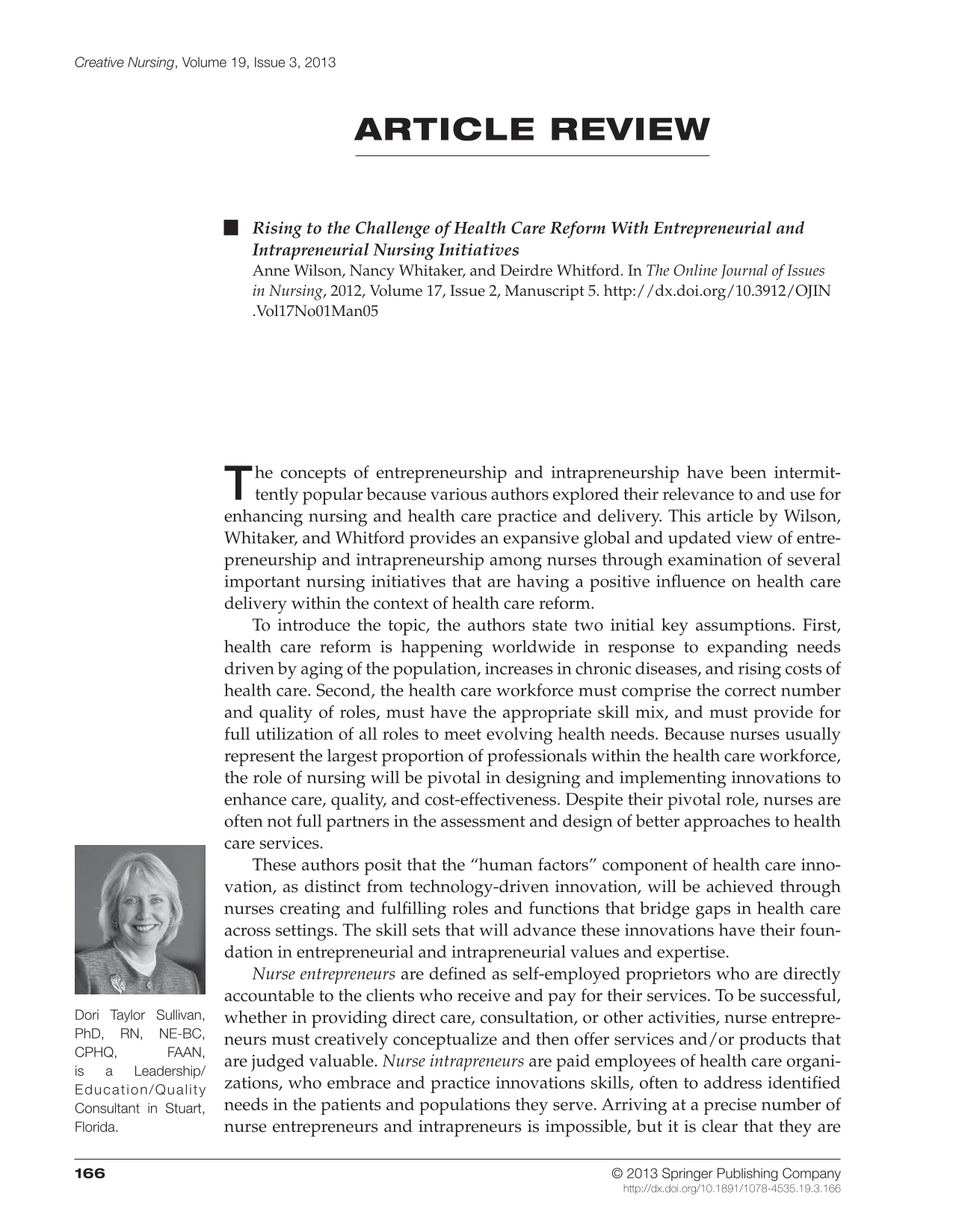
Dori Taylor Sullivan, PhD, RN, NE-BC, CPHQ, FAAN, is a Leadership/ Education/Quality Consultant in Stuart, Florida.