







Abstract
One of the essential practice skills for registered nurses (RNs) is the delegation of tasks. However, few experiences in RN educational programs directly address the development of delegation skills. Many RNs report not feeling confident in their ability to delegate appropriately upon completing their educational programs. Nurse educators must respond to the need to address delegation in undergraduate nursing curricula. This article describes research evaluating levels of knowledge of and confidence in the delegation process among newly graduated RNs, and explores options for teachable moments about delegation.
In their professional role, registered nurses (RNs) serve as clinicians but also use management skills in their work. However, during their professional education, RNs receive training primarily for clinical tasks. Although undergraduate nursing curricula include content about leadership skills, many RNs report completing their educational programs not feeling confident in their ability to delegate appropriately (Saccomano, 2008). Although the mandate to delegate is as much a part of the RN's duties as clinical tasks, there are few, if any, educational experiences at the undergraduate level that directly address the development of leadership and delegation skills. Students ‘clinical experiences rarely offer opportunities to practice delegation skills because students are not considered employees of the institution. Yet, once employed, RNs must be ready to delegate (Feldman & Greenberg, 2005; Saccomano & Pinto Zipp, 2011).
Delegation is not a new concept to nursing practice. The need to delegate patient care tasks to others is cited by Florence Nightingale (1969). State boards of nursing identify delegation as an entry-level skill, and knowledge of delegation concepts is currently included on the national licensure exam for RNs (National Council of State Boards of Nursing [NCSBN], 1997). In fact, the American Nurses Association (ANA, 1992) consistently urges nursing programs to add supervision, delegation, and legal content to existing educational curricula. However, newly graduated RNs report a lack of preparation for and familiarity with delegation and leadership activities (Kleinman & Saccomano, 2006; White, Gutierrez, Davis, Olson, & McLaughlin, 2011) despite the profession's acknowledgment of its importance. This disparity demonstrates the need to educate RNs in delegation as well as in clinical competency.
Background
Current literature and individual state regulations support the need for nurses to delegate activities related to patient care; however, little has been published about the effective delegation skills needed or how these skills may be learned. Educators, both academic and clinical, must find ways to incorporate delegation content into curricula. Development of delegation and supervisory skills is increasingly important when working with unlicensed assistive personnel (UAP) with varying competencies (Saccomano & Pinto Zipp, 2011).
It is important for educators to employ varied instructional strategies. The focus of educational programs requires that knowledge of delegation and supervision be embedded in the behavioral, social, and management sciences, with both classroom and clinical experiences. Whether education takes place in an academic setting or student clinical experience, curriculum content should include principles of change, conflict, leadership, management, and communication as well as instruction on professional and regulatory guidelines (Saccomano & Pinto Zipp, 2011).
The NCSBN (1997) identifies six steps nurses should use in the process of making decisions about delegation:
Assess the situation.
Plan for the specific tasks to be delegated.
Assure appropriate accountability.
Supervise performance of the task.
Evaluate the entire delegation process.
Reassess and adjust the overall plan of care as needed.
These six steps may be used to provide the foundation for content development for curricula designed to acquire delegation expertise.
To date, little has been written about the manner in which the roles and responsibilities associated with delegation are being transmitted in nursing curricula. To ensure that RNs are prepared and knowledgeable about delegation practices, exploring their current knowledge of and confidence in delegation is important and can provide support for the need to include delegation practices to a greater extent in educational programs. A study was conducted to explore RNs ‘knowledge of and confidence in delegation as it relates to their educational preparation.
Methodology
The primary exploratory study examined RNs ‘levels of confidence in delegating UAPs. Using data extrapolated from the primary study, a retrospective research design was then used to investigate RNs ‘perceptions regarding delegation and the need to incorporate delegation practices into nursing curricula (Saccomano, 2008).
Sample
A convenience sample of 158 RNs was selected from the previous study, which examined the relationship between RNs ‘leadership style and their confidence in their skills in delegating to UAPs (Saccomano, 2008). The RNs were employed at a 587-bed acute care suburban community hospital in the Northeastern United States. Participants included 14 (8.9%) males and 144 (91.1%) females, with an average age of 43.58 years (standard deviation [SD] = 10.40). Most (68%) nurse participants were White, 10.0% were Native American, 10.0% were African American, 10.0% were Hispanic, and 2.0% were from other ethnic groups. Participants had an average of 15.64 years of total nursing experience (SD = 11.18), with approximately 11.86 (SD = 9.18) years spent at this hospital and an average of 8.13 (SD = 7.72) years spent on a specific unit. Sixty-six participants (41.8%) held a bachelor's degree in nursing; 22 (13.9%) held a diploma; 60 (38.0%) held an associate of arts (AA) degree, and 12 (6.3%) held either a non-nursing bachelor's or master's degree.
Knowledge about legal responsibilities did not depend on type of educational preparation, suggesting deficiencies in curricula at both baccalaureate-and associate-degree levels.
Procedure
Following institutional review board approval from Seton Hall University and the participating hospital, the authors conducted a retrospective analysis of the previous study data to examine the RNs ‘knowledge of and confidence in their delegation skills as it relates to their educational preparation.
Results
Delegation Decision Making
Of the 158 nurses surveyed, 134 (84.8%) reported that they were likely to use delegation decision-making skills based on what they learned in their educational preparation, 21 (13.3%) were not likely to use delegation decision-making skills, and 3 (1.9%) conveyed that they were not exposed to the concept of delegation during their nursing preparation, χ2(2, N = 158) = 7.8, p < .05.
Subgroup Analyses
Subgroup analysis of demographic variables (age, years of nursing experience, years worked in a hospital, and years worked on a specific unit) yielded no other statistically significant differences between the groups. The 134 participants who indicated that they knew their legal responsibilities regarding delegation were compared on several questions to the 21 nurses who reported that they did not know their delegation responsibilities. Using only those participants who acknowledged knowing their legal responsibilities regarding delegation, the 134 nurses who said yes were significantly more confident in their delegation skills (M = 8.07, SD = 1.75) than the 21 nurses who said no (M = 5.67, SD = 2.03, t[153>] = 5.72, p < .05).
Given that the only significant difference was confidence in delegation, additional comparisons were made between these two groups of nurses and their educational preparation. A chi-square test of independence revealed no significant association between level of educational preparation (AA-prepared RNs vs. baccalaureate-prepared RNs) and knowledge of legal responsibilities in delegating nursing duties, χ2(1, N = 155) = 0.86, p > .05. Thus, knowledge about legal responsibilities did not depend on type of educational preparation, suggesting deficiencies in curricula regarding delegation at both the baccalaureate- and associate-degree levels.
Despite the lack of association between knowledge of legal responsibilities in delegating and educational preparation, the 76 baccalaureate-prepared nurses reported significantly more confidence in delegating to UAPs (M = 8.05, SD = 1.99) than the 82 nurses who were AA-prepared (M = 7.45, SD = 1.89), t(156) = 1.95, p = .05. Based on these findings, we further explored whether educational preparation played a role in the use of delegation and the intent to delegate (likeliness to delegate). When comparing nurses from AA and baccalaureate programs, the chi-square test of independence did not reveal a relationship between educational preparation and intent to delegate, χ2(1, N = 155) = .86, p > .05, supporting the contention that these concerns reside throughout the nursing curriculum and are not specific to either AA or baccalaureate programs.
When looking for potential differences in reported confidence in delegating between AA- and baccalaureate-prepared nurses, the 82 nurses with AA or diploma preparation reported significantly less confidence in delegating to UAPs (M = 7.45, SD = 1.89) than the 76 nurses with a bachelor's or master's degree (M = 8.05, SD = 1.99), t(156) = -1.95, p = .05.
When asked about the proportion of their nursing education course content that was devoted to delegation, three groups emerged: those who reported less than 30% (n = 87), those who reported between 30% and 69% (n = 40), and those who reported 70% or more (n = 21). Three participants reported not being exposed to delegation as students, and seven did not identify a percentage of delegation exposure during their education. When comparing these three groups of nurses on several delegation questions, the only significant differences were confidence in and likelihood of using delegation in clinical nursing practice. The nurses who reported that 70% or more of their nursing course content incorporated delegation were significantly more confident in their skills than those who reported hearing about delegation for less time, F(2, 145) = 3.05, p = .05. Likewise, the nurses who reported that 70% or more of their nursing curriculum addressed delegation indicated that they were significantly more likely to use delegation in their clinical nursing practice than nurses who reported that less than 30% of their nursing curriculum addressed delegation, F(2, 145) = 3.85, p = .02.
Although delegation practice may be included in nursing educational programs, there appear to be no designated courses or competencies associated with it.
Discussion
Based on the data extrapolated from our initial survey on RN leadership style, confidence level, and delegation practices (Saccomano, 2008), the authors further examined the data to specifically explore RNs ‘knowledge of and confidence in delegation as it relates to their educational preparation. Focusing on the relationship between educational preparation and delegation suggested that although nursing programs are providing information on delegation, there are no significant differences in students ‘learning between levels of academic programs. Furthermore, although delegation practice may be included in nursing educational programs, there appear to be no designated courses or competencies associated with it, thus leading us as academicians to explore ways to create teachable moments about delegation for our students as they prepare for their professional role.
Creating Teachable Moments on Delegation in Professional Curricula
Creating an environment that engages students in the learning journey is not always easy. Finding teachable moments in professional curricula to develop students as critical thinkers who will be effective in meeting the demands of today's health care continues to be a challenge for many, especially when exploring the topic of delegation of services.
Finding teachable moments in professional curricula to develop students as critical thinkers who will be effective in meeting the demands of today's health care continues to be a challenge for many, especially when exploring the topic of delegation of services.
So the question for academicians remains, how can we effectively and efficiently use teaching strategies that promote successful delegation as an essential professional skill? Historically, nursing educators have embraced many unique teaching and learning strategies to help students acquire the abundant information required to effectively practice their profession. These strategies include journaling, the development of clinical practice guidelines or patterns of care, problem-based learning, case studies, simulations, group learning projects, mentored clinical practice, and hypothesis-oriented algorithms for clinicians (Shepard & Jensen, 2002). Strategies that are not yet widely used include video-based case studies, class-supported clinical visitations, incorporating delegation into care plans, focused communication skills, mind mapping, and peer-professor reflective group projects. These less used learning strategies are further explored in this article as additional opportunities for teachable moments to support students ‘content knowledge, clinical understanding, comfort levels, and overall ability to delegate.
Video-Based Case Studies
Pinto Zipp and Maher (2009b) describe the use of visually unfolding video cases as providing students a unique opportunity to experience real patient scenarios in their classroom environment. When developing and using a video-based case strategy to promote learning, the educator plays an important role in helping the student create links between previously acquired knowledge and new knowledge. These links can be facilitated through what are pointed questions that the students must respond to, comparing and contrasting what they observe with what they have read in the course texts, and independent student reflections or group reflections on pertinent patient issues. Students can use information obtained from video observations to enhance their abilities to organize and prioritize patient care information and to design effective plans of care. Ensuring that the video-based case studies require students to explore potential delegation options based on the care environment and personnel available will create meaningful teachable moments for addressing delegation. In addition, the active learning required to process the video-based case studies would support development of students ‘critical thinking skills. Effective use of video-based case studies to meet curricular goals requires evaluating the case studies for depth and richness, planning effective exercises to structure the learning experience, and exploring ways to interpret the video for students based on their needs and skill levels.
Class-Supported Clinical Visitation
Class-supported clinical visitation (Pinto Zipp & Maher, 2010a) is a learning strategy in which the entire class, along with the course instructors who act as mentors, observe treatment sessions unfolding in a natural environment. The course instructors support learning by ensuring that the students are appropriately observing and interpreting the interactions occurring in the environment. Students respond to directed questions in the form of reflective essays based on the on-site clinical observations. Faculty members using clinical visitations have found them to be a unique opportunity to experience real patient and health care professional interactions within the actual care setting (Pinto Zipp & Maher, 2010a), including the art of delegation and its impact on patient care. Although these authors acknowledge that arranging clinical visitations can be time-consuming for faculty members and labor-intensive for the hosting clinical site, the experience is rewarding.
To facilitate the acquisition of delegation skills, nursing students can be paired with RNs to observe the process of delegation. Because delegation usually takes place as a verbal direction, students should witness delegation decision in action, accompanying the RN to the bedside to observe him or her giving direction to the UAP. The student should listen and watch for directions given, critical elements, cautions, and findings that need to be reported to the RN. The RN may ask the student for a return demonstration of delegation to the UAP.
Since delegation usually takes place as a verbal direction, students should witness delegation decision in action, accompanying the RN to the bedside and listening and watching for directions given, critical elements, cautions, and findings that need to be reported to the RN.
Planning Care
Another strategy for teaching delegation is to focus on care planning. The standard nursing care plan format—with columns for intervention, rationale, and evaluation—can be modified to add a column for students to identify which interventions can be safely delegated and why.
Communication Skills
Educators must ensure that health science students, in addition to possessing the content knowledge required for delegating and feeling comfortable with the process, can also communicate effectively and collaborate with colleagues—essential skills associated with successful delegation. Educators frequently use group projects within didactic coursework to develop students ‘content knowledge, communication skills, and ability to work in a team (Pinto Zipp & Maher, 2010b). Group projects can be developed to support the communication skill set needed for effective delegation and the appreciation of a collaborative work environment essential for successful delegation management.
Although these teaching and learning strategies may be similar to many currently in use in nursing education, the key difference is that as educators we must ensure that delegation is an essential component of all strategies.
Mind Mapping
One teaching and learning strategy that has emerged in recent years is mind mapping, which uses a nonlinear approach to learning that forces the learner to think and explore concepts using visuospatial relationships flowing from a central theme to peripheral branches which can be interrelated (D'Antoni, Pinto Zipp, & Olson, 2009; D'Antoni, Pinto Zipp, Olson, & Cahill, 2010). The medium for drawing the mind map is usually colored pens or pencils on a large piece of paper. In the center of the paper, the student draws an image or a word that reflects the central theme, thus allowing for 360 degrees of freedom in developing the mind map. From the central theme, the student draws main branches with key words or images. The branches represent different categories that the student perceives as key concepts associated with the theme. From these main branches, subbranches are created if appropriate. One key tenet of mind mapping is that each branch and subbranch should contain a visual image to aid in information recall. Finally, subbranches can be linked together to integrate different parts of the mind map.
Many online versions of mind mapping have recently emerged that offer numerous options for mind map development. Pinto Zipp and Maher (2009a) described a class assignment using mind mapping to promote classroom engagement and content knowledge. In this assignment, all students were required to submit mind maps for all classes as a way to ensure that they read and acknowledged the key concepts contained in the readings; students built out their mind maps further with concepts and information acquired during the class lectures, discussion, small group activities, and laboratory experiences. The authors found that requiring students to generate mind maps on reading material prepared them to engage more in class activities, thus enabling the instructors to spend more time on hands-on clinical application of the course material. One of the main branches of any mind map of a topic on health care management should include delegation of work. Subbranches must further address to whom, for what, and when the delegation of services should occur.
Case studies have historically been used in the health sciences as a way to bring realistic encounters with patients and with other health care colleagues into the classroom environment.
Incorporating mind mapping as a teaching and learning strategy and ensuring that the mind maps include information on delegation will provide meaningful teachable moments on the key issues, which must be assessed, reflected upon, and integrated for successful delegation of skills. The mind map in Figure 1 is a schematic overview of the reflection and decision-making processes to consider when engaging in delegation as part of the patient care team. A mind map can be a tool to facilitate the decision making associated with delegation practices when processing clinical scenarios, video-based case studies, simulations, and clinical internships.
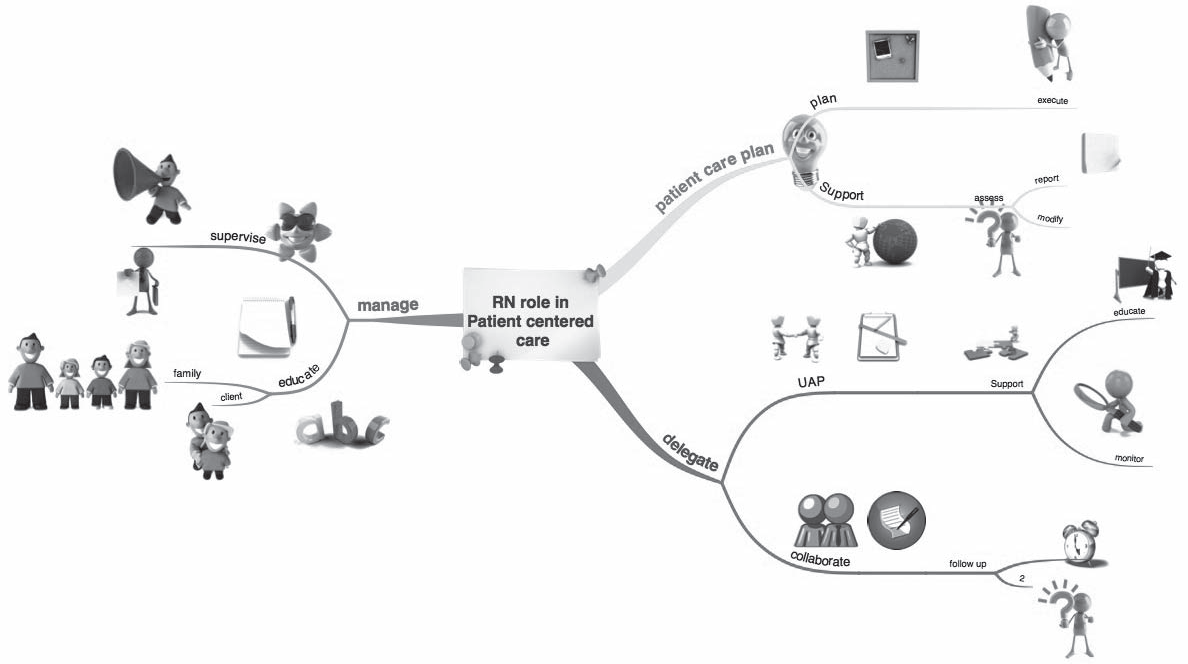
Mind map of the delegation process. UAP = unlicensed assistive personnel.
Case Studies
Case studies have historically been used in the health sciences as a way to bring realistic encounters with patients and with other health care colleagues into the classroom environment. The nursing literature has documented the use of case-based learning activities and has given educators detailed resources that cover various diagnostic and clinical issues via case study presentations (Day, 2011; Pearson, 2006). We suggest that the role and impact of delegation can also be addressed via the case-based presentation model of teaching and learning by adapting existing case studies used in a curriculum to encompass key questions about delegation.
For example: As the RN begins the day shift, the UAP reports that Mr. Jones is reporting pain at a level of 8 on a scale of 1–10. He is scheduled for discharge in 2 days and needs to ambulate. Dr. Fredericks is calling about lab results for Mrs. Smith. Mrs. Davis and Mr. Marks require blood glucose testing before breakfast. Radiology is calling for Mr. Peters who is scheduled for an a.m. chest X-ray. How does the RN decide what he or she needs to do and what can be delegated?
To ensure that the role of delegator is part of the clinical decision process associated with the case study, these questions can be added to this or any case study.
Are there services that can be delegated?
Will the use of delegation support or hinder the plan of care?
What will be the impact of delegation of services on the patient's plan of care?
To whom can services be delegated?
Going beyond just understanding and acknowledging the role of delegation to reflecting on delegation in light of a case scenario and appraising the potential use of delegation further supports students ‘abilities to form evidence-based clinical decisions.
What are the skill sets of the person to whom services will be delegated?
Is the person being delegated to receptive to the tasks being delegated?
Is there opportunity to monitor the performance of the tasks delegated?
Who will monitor the performance of the tasks delegated?
Is there an opportunity for initial training of those to whom the tasks will be delegated?
Is there an opportunity for ongoing training and for reassessment of the tasks being delegated?
If the delegator is able to gather data to answer these questions, he or she will have evidence from which to critically appraise whether any service can be delegated and, if so, which ones.
For students, using these questions when working on case studies affords them the opportunity to explore the issue of delegation as it relates to clinical practice. Going beyond just understanding and acknowledging the role of delegation to reflecting on delegation in light of a case scenario and appraising the potential use of delegation further supports their abilities to form evidence-based clinical decisions.
Conclusion
Nursing educators must respond to the need to address delegation in nursing curricula because delegation knowledge is an essential practice skill for all RNs. Finding meaningful teachable moments and creating rich learning environments that actively engage students and prepare them to practice effectively as professional nurses is a primary role of nursing educators. The strategies discussed in this article offer nursing faculty diverse yet realistic approaches for incorporating teaching and learning about delegation into today's nursing curricula.
Footnotes
Scott Saccomano, PhD, GNP-BC, RN, is an assistant professor in the Department of Nursing at Herbert H. Lehman College in Bronx, New York.
Genevieve Pinto Zipp, PT, EdD, is a professor in the Department of Graduate Programs in Health Sciences at Seton Hall University.