







Abstract
Recognizing human enlightenment is a common theme from the ancient discipline of philosophy. The budding philosophy of nursing continues to find meaning and value in advanced education. This article offers a lesson from the philosopher Plato about not knowing what we don't know. Plato's allegory of the cave offers a unique insight for nurses hesitant to return to school for advanced degrees. Those who believe that the endeavor offers little in return may find enlightenment in this two-thousand-year-old allegory. Plato's cave both encourages the reader to consider the unseen benefits of an educational journey and provides hope about the value of the unknown.
“The life which is unexamined is not worth living.”
—Socrates (Plato, n.d.)
“Education and admonition commence in the first years of childhood, and last to the very end of life.”
(Plato, n.d.)
The challenges of returning to school for baccalaureate and higher degree education stand between many seasoned nurses and their ideal leadership positions. The journey to achieving any higher nursing degree often elicits some mental resistance. The resistance may be a perception that nurses with extensive experience know everything they need to know. What is not known is not considered. Can the academic world, which offers theories, conceptual blueprints, and philosophical underpinnings, really improve care for their patients? The following is a look back to one ancient teacher and his lesson for us. Plato, the father of Western philosophy, faced a midlife career change. He offers a philosophical perspective to the developing philosophy of nursing. The lesson is as true today as it was in 349 B.C.E. In this simple story about a cave with a prisoner, Plato provides a powerful lesson about the things we truly don't know that we don't know, and the joy to be found in exploring what is not known when it becomes known to us. Lifelong education is a valuable vehicle for knowing.
Nurses may find relevance to their own practice as they attempt to guide patients through caves of their own.
Plato the Philosopher
Plato, an Athenian philosopher (429-347 B.C.E.), provided extensive lessons about human enlightenment. The origin of the word philosopher is the Greek word  or philosophe, defined as lover of wisdom (philos [“loving”] + sophos [“wise, a sage”]). This love of knowledge was taught to Plato by his mentor, Socrates, whose consummate love for knowledge was so strong that he chose execution by his own hand rather than forego his teaching of philosophy to the citizens of Greece (Kraut, 2013).
Some of Plato's teachings take the form of allegories. An allegory (n.d.) is a representation of an abstract or spiritual meaning through concrete or material forms—figurative treatment of one subject under the guise of another. In the usual Platonic style, these stories were meant to guide the listeners to their own conclusions. Because each person is ultimately unique in his or her own experiences, so self-exploration, higher learning, and new philosophical insights must be unique as well. One well-known allegory comes from Plato's most famous writing, The Republic (Kraut, 2013).
Plato'S Allegory of the Cave
Plato asks the individual to imagine a two-level cave containing imprisoned slaves chained by the neck on the lower level facing a dark wall (see Figure 1). Behind the slaves, on the upper level, their captors frequently walk by, carrying variously shaped relics on tall sticks. A constantly lit fire casts shadows of the relics on the cave wall. Imagine, Plato said, that the slaves have noticed that these shadows have normal and familiar patterns. The familiar shadows are their comforting daily truth.
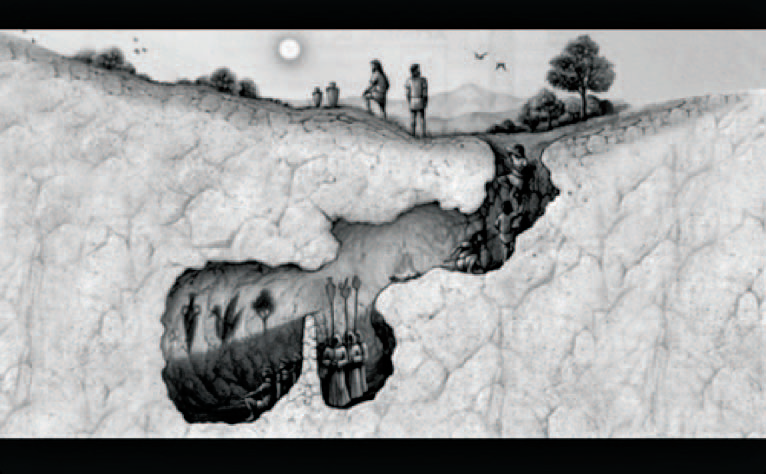
Plato's cave.
One day, after a lifetime of captivity, one of the slaves is released. He is afraid to move from the position he has known for his whole existence. He is led by the hand to turn around. Seeing the fire and the relics on sticks passing the fire is confusing to him. Which is real, the shadows on the wall or what his eyes see now? The frightened slave is led up to the door of the cave; a blinding light stops him. He has never experienced natural light. Despite his discomfort, he is led out of the cave. His eyes have difficulty focusing; he hears and smells many new things. Water, grass, and sunlight release an onslaught of new visual stimuli for his brain. He sees new shadows caused by the light above. It is overwhelming.
He tries to return to the cave, but his guide patiently holds him still. After his eyes adjust, he sees the world and its beautiful scenery. He is enthralled, and is now at peace with the new experience. He comes to appreciate the uncertainties of life. He requests to return to the cave and tell his fellow captives of his enlightening experience. When he returns, they stare straight ahead, refusing to listen, telling him to stop the madness he is speaking of. They are content with their own knowledge.
Educational Insight
In The Republic, Plato depicts the cave as an individual's journey of knowledge (for this article, the journey is nursing education). First achieving what is sensed, and then what is perceived as new, is disconcerting. As part of the basic liberal arts program, a grounding in philosophy would be helpful. Central to the introduction of a philosophy course would be the allegory of Plato's cave. The person's relationship to the world becomes part of the framework, always keeping in mind that there is a bigger world ready to be explored. After hearing his story, students of nursing may posit that the allegory of the cave is not about caves at all. For each level of our own education, whether a new student nurse or a doctoral candidate, the awareness of our own caves exists. The only certainty Plato might teach us is the persistence of questions. What else do we not know? Nurses may find relevance to their own practice as they attempt to guide patients through caves of their own.
Plato suggests it is useful that we move through these levels of enlightenment because there is always a potential world outside the cave to be explored. Coming out of the cave, the experience is a different way of knowing. A person comes from a limited shadow cast on the wall of the cave to the opening of the cave, faced with potential experiences: a choice of realities and all of their possibilities. At first, it is unsettling to believe that one's personal journey is a universal experience with so many gaps and caves to be traveled through. Plato reminds us that embarking on journeys of knowledge may also be met with conflict, just as the slave fought being led from a cave. The advantage of being acquainted with Plato's Cave offers a particular model of the world. Each human being brings a unique view and personal meaning to the allegory of the cave.
Looking outside of Plato's cave provides a lifetime of exploration. As for the development of nursing education and philosophy of nursing, the timeless rewards have yet to be seen. The acquisition of knowledge is a mainstay of any discipline, with its choices, options, and countless opportunities. Advancing nurses’ depth of education may seem a mere option, but it is a vital prerequisite to the unseen benefits for the nursing profession, laying a strong foundation as a philosophy of science (Dahnke & Dreher, 2011).
Plato provides a powerful lesson about the things we truly don't know that we don't know, and the joy to be found in exploring what is not known when it becomes known to us.
Footnotes
Brenda L. Snow, MSN, RN, CMSRN, is a clinical nurse educator at Southern Ocean Medical Center in Manahawkin, New Jersey and a PhD candidate at Kean University in Toms River, New Jersey.
Virginia Fitzsimons, EdD, FAAN, is the PhD program coordinator at Kean University in Toms River, New Jersey.