







Abstract
Many Americans need both health care and legal interventions to maximize their opportunities for health. Medical-legal partnerships (MLPs), also known as health care legal partnerships (HLPs), bring the power of law to health care to reduce barriers and negative social determinants of health. The two terms—HLP and MLP—are used interchangeably in this article. Growing research shows that these partnerships can improve care, improve health, enhance interprofessional collaboration, and improve the financial status of patients and providers. HLPs take many forms, depending on their settings and resources. A health care legal partnership learning collaborative that brings leaders of diverse HLPs together to share experiences and best practices can help expand this effective model and enhance its potential for collective impact in improving population health.
Keywords
One in six low-income Americans has at least one unmet legal need that negatively affects his or her health (Legal Services Corporation [LSC], 2009). Consider the following scenario:
A six-year-old boy suffered from uncontrolled asthma, despite receiving daily oral doses of corticosteroids, and was often absent from school, threatening his mother's ability to keep her job. During a home visit, the visiting nurse discovered mold, which was attributable to a leaky water pipe, and wall-to-wall carpeting, which harbored dust mites. The patient's mother, the nurse, and the physician all repeatedly asked the landlord to fix the pipe, clean up the mold, and remove the carpeting, with no response. (Zuckerman, Sandel, Smith, & Lawton, 2004, p. 224)
Health conditions impaired by environmental and social conditions like these cannot be improved by traditional medical interventions alone. The social determinants that diminish health, such as food insecurity, substandard housing, unjustified denial of public benefits, and personal safety concerns, often have legal solutions, but less than one in five legal needs of low-income individuals are addressed with an attorney's help (LSC, 2009). To address this need, health care legal partnerships (HLPs) between lawyers and health care providers have been forming throughout the country. Nursing, the largest and most widely encountered profession in health care, plays a large and growing role in the movement to integrate law and health care to improve the well-being of individuals, families, and populations. That role includes bringing various HLP leaders together to form a learning collaborative that shares experiences and best practices that can help new HLPs form, sustain themselves, and improve population health through collective impact.
The social determinants that diminish health, such as food insecurity, substandard housing, unjustifiable denial of public benefits, and personal safety concerns, often have legal solutions, but less than one in five legal needs of low-income individuals are addressed with an attorney's help.
History
Lawyers have worked with health care providers to address the civil legal needs of their clients since the 1960s. More formal medical-legal partnerships (MLPs), alternatively known as HLPs, began in 1993. These included one at Boston Medical Center (BMC) and one at the Community University Health Care Center (CUHCC) in Minneapolis, affiliated with the University of Minnesota (Lawton, 2014; National Center, 2015b).
The Boston partnership was begun by Dr. Barry Zuckerman, chief of pediatrics at BMC, and Greater Boston Legal Services, a publicly funded legal aid organization providing free civil (noncriminal) legal services to low-income people. Zuckerman and his colleagues were frustrated by their experiences with children failing to make clinical progress despite medical interventions because of food insecurity, substandard housing, and other social determinants of health (SDH; Medical-Legal Partnership Boston, 2015).
CUHCC, the largest urban primary care training site in Minnesota, partnered with the private Minneapolis law firm of Leonard, Street and Deinard (now Stinson Leonard Street) to reduce barriers to legal assistance for low-income individuals and as a response to the American Bar Association's call for large law firms to increase their pro bono efforts (Deinard, Martin, Lindemann, & Haynes, 1997). A unique feature of this partnership is that Amos S. Deinard, Sr., one of the founding members of the law firm, is the father of Amos Deinard, Jr., a University of Minnesota pediatrician and medical champion of the alliance between the clinic and the law firm.
Impact
The impact of HLP legal interventions on patient health and well-being (e.g., for children with asthma) cannot be overstated. According to the 2012 National Health Interview Survey (CDC, 2013), 6.8 million children in the United States live with asthma, with children of poor and minority families diagnosed at higher rates than their peers. Studies show that legal actions against nonperforming landlords can reduce household environmental asthma triggers after attempts by the family and health care team have failed (Beck, Klein, Schaffzin, Tallent, Gillam, & Kahn, 2012, as cited in Beeson, McAllister, & Regenstein, 2013; Klein, Beck, Henize, Parrish, Fink, & Kahn, 2013, as cited in Beeson et al., 2013; Pettignano, Bliss, Caley, & McLaren, 2013, as cited in Beeson et al., 2013). Figure 1 shows an example of mold infestation documented by the U.S. Environmental Protection Agency.
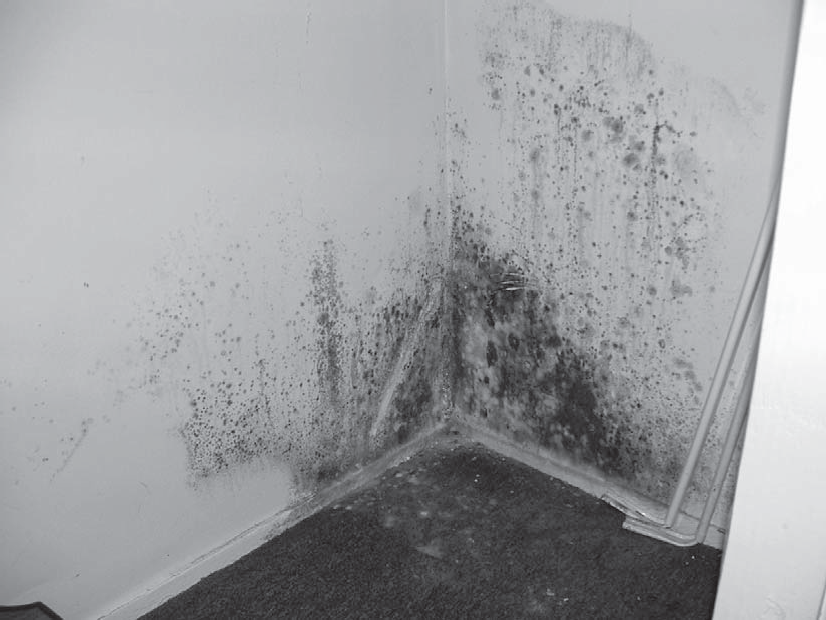
Example of mold infestation.
Attorney action can also improve asthma control in adults, reducing emergency room visits, and rehospitalizations (O'Sullivan et al., 2012, as cited in Beeson et al., 2013). Other positive impacts include better maternal–child outcomes, reduced incidence of child abuse, fewer missed clinic appointments, improved cancer treatment adherence, and the encouragement of patients to become better advocates for their care (Beeson et al., 2013; Zuckerman, 2004).
Snowflakes
HLP models vary. As Illinois legal aid attorney Andrew Weaver describes them, “MLPs are like snowflakes. No two are alike” (oral presentation, Medical-Legal Partnership Summit, April 10, 2015). Health care providers can contract with legal aid attorneys to have a regular office in a clinic, or they may refer patients to a legal aid office whose staff try to contact the patient to more fully assess the perceived need. Private law firms ‘pro bono attorneys and paralegals can partner with health care providers who refer patients to them; the firm's pro bono director may then assess the potential client to determine if an actionable legal problem exists. Although structure and populations vary, HLP goals focus on three core functions: providing legal assistance to clients, transforming health and legal institutions, and achieving policy change (Beeson et al., 2013). Legal assistance combats the health-impacting social determinants of income, housing, education/employment, legal status (immigration), and personal/family stability and safety, or “I-HELP” (Kenyon, Sandel, Silverstein, Shakir, & Zuckerman, 2007). Between 2010 and 2013, the Health Justice Project (HJP) at Loyola University in Chicago obtained more than $800,000 in debt forgiveness and disability benefits for their HLP patients and more than $550,000 in Medicaid reimbursements for their health care partner, while training more than 200 health professionals in the identification of legal and social determinants of health (HJP, 2015).
Nursing, the largest and most widely encountered profession in health care, plays a large and growing role in the movement to integrate law and health care to improve the well-being of individuals, families, and populations.
Nearly 300 partnerships currently work in 36 states to bridge the justice gap for low-income Americans (National Center, 2015a). Across the United States, HLPs involve 135 hospitals; 127 health centers; 35 medical, nursing, social work, and public health schools; 127 legal aid agencies; 46 law schools; and 70 pro bono partners. Partnerships may involve individual client representation by lawyers or supervised law students. Academic partnerships can focus on interprofessional education (IPE) to enhance understanding and collaboration among health care and legal disciplines in solving health challenges. Health care and legal professionals and students may develop and advocate for policies to improve population health by reducing negative SDH (National Center, 2015a).
Funding is similarly varied, cobbled together from foundations, health care providers, private law firms, and publicly funded legal aid. The case for health care providers to fund HLPs grows as benefit denial appeals by attorneys turn uncompensated care into compensated care. Examples include $1 million recovered in previously denied claims for cancer treatment; a 319% return on investment over 3 years for a provider-funded HLP in Illinois; and $4 million recovered for individuals by the same Illinois MLP to pay medical debts, with an additional $2 million recovered for people denied their full Social Security benefits (Beeson et al., 2013). New incentives for hospitals to invest in keeping people healthy in their communities were created by the 2010 Patient Protection and Affordable Care Act's financial penalties on hospitals with preventable rehospitalizations and its mandate that tax-exempt nonprofit hospitals regularly assess community needs and invest in meeting them (George Washington University's Maureen Byrnes, National MLP Summit, April 9, 2015).
Legal actions against nonperforming landlords can reduce household environmental asthma triggers after attempts by the family and health care team have failed.
Interprofessional Growth
The interprofessional collaboration and education that occurs through health care legal partnerships is valuable. IPE enables collaborative practice, strengthens health systems, and improves health outcomes (World Health Organization [WHO], 2010). Medical residents who practice in clinics with on-site social service and legal support and who receive training on SDH are more confident in their knowledge of SDH, more comfortable discussing SDH with patients, and more likely to screen for SDH issues such as unstable housing, food insecurity, or missing public benefits than their peers who do not practice in such environments (Klein et al., 2011; O'Toole, Burkhardt, Solan, Vaughn, & Klein, 2012). IPE can occur at the HLP site or within an academic setting. In universities, formal interdisciplinary courses on SDH and policies to address them can include health care students and law students. In clinical settings, attorneys and health care providers may collaborate on particular situations affecting patients. Attorneys may draft template letters that health care professionals can retrieve from an electronic health record to sign and send to negligent landlords of moldy, infested, or unsafe housing. HJP at Loyola University is one example of more than 60 graduate schools that host health care legal partnerships, offering IPE for health care and law students as well as health care professionals and attorneys (Benfer, 2014).
Health Care Legal Partnership Learning Collaborative
The snowflake quality of health care legal partnerships makes them adaptable and versatile. This variety creates opportunities for expansion and a transformative collective impact on population health if the interprofessional leaders of diverse HLPs share what they do in their individual settings. In the Upper Midwest, leaders from various HLPs have been meeting informally to do just that. The Upper Midwest Healthcare Legal Partnership Learning Collaborative, facilitated by nursing educator and attorney Dr. Eileen Weber, is modeled after Minnesota's health care home learning collaborative mandated by that state's law in 2008. The legislation required the commissioners of the department of health and the department of human services to establish a health care home learning collaborative “to provide an opportunity for health care homes and state agencies to exchange information related to quality improvement and best practices” (Minnesota Statutes, 2014). The collaborative has enhanced the expansion of health care homes (elsewhere called patient-centered medical homes) by sharing expertise that facilitates sustained success. While not satisfying any mandate other than an imperative to increase justice in improving opportunities for health, the HLP learning collaborative has similar objectives.
Legal assistance combats the health-impacting social determinants of income, housing, education/ employment, legal status (immigration), and personal/ family stability and safety.
HLP models in the Upper Midwest include rural and urban practices sites, primary care and tertiary care settings, and a Minneapolis walk-in clinic staffed and managed by interprofessional health care students featuring “law nights” run by law students. A clinic connected to the region's largest safety net medical center has an on-site legal office staffed by a legal aid attorney. A law professor in St. Paul developed an MLP course that dovetails with a federally qualified health center or “community clinic” MLP that her school staffs with a clinic-based attorney; the aforementioned CUHCC partners with the pro bono attorneys of a major national private law firm, forming one of the oldest HLPs in the United States. Taking a different approach to vulnerable clients with chronic low income, the groundbreaking Cancer Legal Line has provided more than $2.4 million in free legal care services to mostly young or middle-aged women with breast cancer, whose disease often eviscerates their peak earning years (Yokanovich, 2015). Funding is as varied as the models; the most common sources of support are philanthropy, pro bono time, and publicly funded legal aid.
Joining an HLP learning collaborative allows these diverse models of interprofessional partnership to share ideas on how to measure the effectiveness of their integrated interventions on individual outcomes, population health improvement, and financial return for providers. As the mantra of IPE and collaboration goes, partnership leaders from nursing, law, medicine, and social work learn “about, from and with each other to enable effective collaboration and improve health outcomes” (WHO, 2010, p. 7). Like an Upper Midwest winter, as the unique but accumulating snowflakes gather and spread, the result can certainly be an undeniable collective impact on the landscape of health.
Footnotes
Eileen Weber, DNP, JD, PHN, RN, is clinical assistant professor in the University of Minnesota School of Nursing.
Bryan Polkey, BSN(c), is a student in the BSN program at the University of Minnesota School of Nursing.