







Abstract
This project implemented first-time simulation with nursing and social work students. Students participated in a contextual learning experience through a patient simulation of interprofessional practice as a health care team member and reflection through debriefing and open response comments. Simulation offers a means to practice interprofessional collaboration prior to entering practice. Participants reported an increased understanding of the scope of practice of other team members through their reflections following simulation. In addition, participants reported increased comprehension of team dynamics and their relationship to improved patient care. Overall, the simulation encouraged development of the skills necessary to function as part of a collaborative, interprofessional team.
Keywords
Nursing and social work students typically receive their education in a cohort of others working toward the same specialization, yet workplace expectations for collaboration occur in interprofessional teams. Professional social workers and nurses practice in increasingly complex settings, providing care to patients with complex, chronic needs and diminished health care resources.
Effective teamwork in the health care setting improves patient outcomes (Poirier & Wilhelm, 2013). When health care professionals collaborate and communicate effectively as teams with a sound understanding of others ‘roles and responsibilities, patients receive higher-quality, safer care (Bridges, Davidson, Odegard, Maki, & Tomkowiak, 2011; Sullivan, & Godfrey, 2012). It is imperative that social work and nursing students learn to cooperate effectively and increase awareness of the role the other professional plays on the health care team (Greidanus, King, LoVerso, & Ansell, 2013; Institute of Medicine [IOM], 2011).
Interprofessional education (IPE), defined as an intervention in which members of more than one health care profession learn interactively together for the purpose of improving patient outcomes (Interprofessional Education Collaborative Panel [IPEC], 2011), is a mechanism to facilitate teamwork and relationships between health care professionals by encouraging favorable attitudes and behaviors. IPE is gaining recognition as a method for health care students to practice collaboratively. The World Health Organization (WHO, 1988) reported the growing body of evidence regarding the positive impact that IPE has on patient care. In 2010, WHO again called for increased implementation of IPE, recognizing it as a valuable means of enhancing collaborative practice between health care professionals (WHO, 2010).
Likewise, the IOM report, The Future of Nursing: Leading Change, Advancing Health (IOM, 2011) details the importance of and need for creating interprofessional health care teams to ensure continuity of health care and optimal patient outcomes. This report emphasized that dysfunctional interprofessional teams fail due to a lack of coordination and collaboration, decreasing the quality of patient care. Despite these recommendations, academia has been slow to implement education crossing professional boundaries, and there is limited research into the effects of IPE on student learning (Bolesta & Chmil, 2014).
Background
Nursing faculty have led simulation with nursing students for more than 10 years, most recently implementing interprofessional simulation at a small liberal arts college in the Midwestern United States. Objectives for this interprofessional simulation were based on the IPEC (2011) panel's Core Competencies for Interprofessional Collaborative Practice, specifically Domain 2 (roles/responsibilities), and Domain 3 (interprofessional communication). After contacting social work faculty to determine interest, planning occurred to facilitate this learning experience, determining the steps needed to create a simulation with nursing and social work students collaborating as a team. A team of nursing and social work faculty worked cooperatively to adapt an Advancing Care Excellence for Seniors National League for Nursing scenario to simulate collaboration and communication among these two professions.
Nursing and social work students typically receive their education in a cohort of others working toward the same specialization, yet workplace expectations for collaboration occur in interprofessional teams.
This simulation was a required course activity for senior nursing and social work students. Institutional review board approval was received to collect and use student reflections about the interprofessional simulation. This interactive experience was the first opportunity for students from these two professions to work collaboratively. To ease possible anxiety related to the simulation, students were given the following resources prior to the event:
Written objectives for the simulation
An overview of the simulation scenario
A schedule for the activity
Notification of a Pass/No Pass grade for the activity
Method
On the day of the simulation, students were oriented to the simulation environment (social work students were new to simulation), introduced to the role players (a nursing alumna and a retired nursing faculty member), shown a short video to learn about the patient, and given their roles. The scenario focused on a newly admitted 84-year-old woman with a urinary tract infection, dehydration, and confusion. The simulation unfolds over three scenarios emphasizing assessment, conflict between the patient and her daughter about living arrangements, discharge teaching, and initiating appropriate referrals. The experience was adapted so that nursing and social work students would need to collaborate and communicate with each other as well as with the patient and her daughter.
The pilot project included 26 students (16 nursing and 10 social work). Three 20-minute scenarios focused on the following:
Acute confusion—unkempt, disoriented patient admitted from home via the emergency department to a medical-surgical unit
Decrease in patient confusion, elevation in blood pressure, and patient fall
Discharge and referral
Throughout the simulation, conflict between family members forced students to demonstrate an understanding of effective communication skills with difficult family dynamics.
Eight nursing students and five social work students participated in each of three 1-hour simulations. Six nursing students were the primary or secondary nurse in one of the three scenarios; the last two nursing students were observers, recorders, or safety sentinels. The scenario was adapted to allow the social work students to observe the first scenario (new to simulation) and participate in the second and third scenarios. Nursing students were encouraged to consult with the social work students in the care of this patient and family to achieve the outcome of discharge to the most suitable living arrangement with the necessary resources.
A 30- to 40-minute debriefing occurred after each scenario. Student reflections indicated that debriefing sessions after each scenario facilitated learning.
Following the simulation, nursing and social work students ‘perceptions of the interprofessional simulation were captured through three open-ended questions:
State three things you learned about the role of a nurse or social worker.
State two things you are still wondering about nursing or social work.
State one area of improvement for future interprofessional simulations.
The purpose of this descriptive study was to begin to understand the experience and impact of interprofessional simulation with nursing and social work students.
Results
Researchers coded the open response comments from the nursing students to identify emerging themes. See themes from nursing student reflections in Table 1.
Sample Reflection Responses From Nursing Students
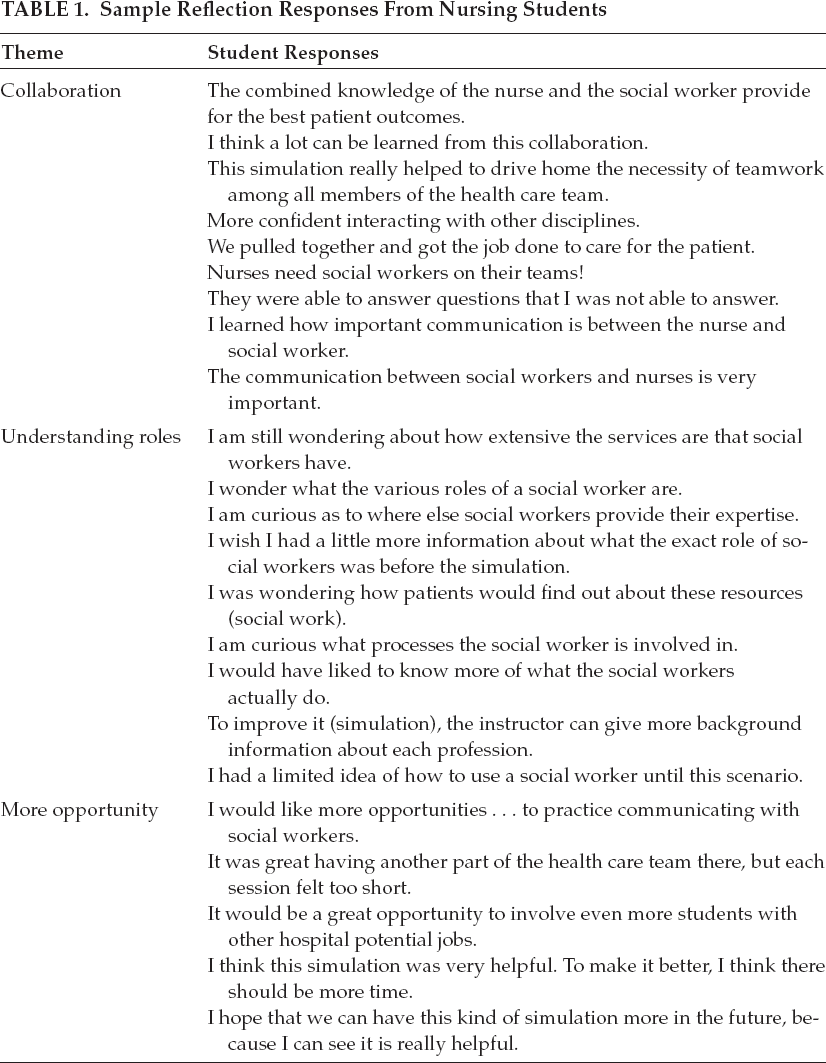
Data analysis revealed learner value for the interprofessional simulation. Both nursing and social work students reported gaining understanding of the need to collaborate with other health care team members. Students suggested including preparation prior to the simulation to enhance understanding of the scope of practice of nurses and social workers, which would increase the value of this learning experience and enhance collaboration. The study participants also expressed desire for an increase in collaborative learning experiences.
Nursing students were encouraged to consult with the social work students in the care of this patient and family to achieve the outcome of discharge to the most suitable living arrangement with the necessary resources.
Social Work Reflection
Social work students were asked to provide general reflections about their experience with the simulated learning activity. They reported multiple positive outcomes from the simulation experience. They reported a lack of understanding of the role of professional nurses and that having a better understanding of nurses ‘scope of practice would facilitate increased collaboration. Social work students also expressed some surprise at the nurses ‘ability to address patients ‘holistic needs while providing immediate physical care, and reported seeing an overlap between themselves and the nurses in some of the engagement skills used with patients and their families.
Students also reported ways that simulation built on their developing social work skills. Several mentioned learning to adapt patient needs (e.g., a patient- or nurse-reported concern or a family conflict) rather than rigidly sticking to their own agendas for the simulation. For example, students saw conflict issues requiring immediate mediation arising between the mother and daughter in the simulation and reported setting aside their assessment questions to mediate the conflict. Social work students also reported enjoying the opportunity to practice their general social work skills such as engagement, empathic responding, and assessment. They valued the opportunity to receive immediate feedback and to apply those skills for holistic care in acute care. The social work students found the dual nature of the feedback (assessment of both the skills used and how their work fed into the interprofessional work) helpful.
Discussion
The identified need for IPE, with a focus on teamwork, was a precursor to this experience. Faculty from two disciplines came together to prompt collaboration between students of the two professions in the care of an 84-year-old woman.
Reflections were gathered from both nursing and social work students to understand the experience of simulation-enhanced IPE. Students identified the opportunity to collaborate between professions as instructive learning, which facilitated collaboration among interprofessional team members. To facilitate increased collaboration of the interprofessional team, both social work and nursing students identified the need for increased understanding and information about the role and scope of practice of other health care professionals.
In summary, simulation-enhanced IPE may be a promising addition for health care educators. Improvement in attitudes related to collaboration as members of an interprofessional team were reported in the reflections after this simulated exercise. Additional education prior to the simulated exercise on the scope of practice of other health care professionals would be even more beneficial.
Social work students expressed some surprise at the nurses ‘ability to address patients ‘holistic needs while providing immediate physical care.
Footnotes
Mary Beth Kuehn, EdD, RN, PHN, is an associate professor and program chair in the Department of Nursing at St. Olaf College in Northfield, Minnesota.
Susan Huehn, PhD, RN, PHN, is an assistant professor in the Department of Nursing at St. Olaf College in Northfield, Minnesota.
Susan Smalling, PhD, MSW, LISW, is an associate professor, director of field education, and acting chair of the Department of Social Work and Family Studies at St. Olaf College in Northfield, Minnesota.