







Abstract
Background
The transition from student to professional nurse is an important milestone in the development of newly graduated nurses. Mindfulness-based stress reduction (MBSR) has been shown to reduce symptoms of stress in those engaged in regular practice (Bazarko, Cate, Azocar, & Kreitzer, 2013; Kabat-Zinn, 1990).
Method
The quality improvement project used a one-group pre-test/posttest design to measure newly graduated registered nurses’ awareness of mindfulness and perceived stress.
Results
Mindfulness awareness improved from pre-intervention (M = 3.66, SD = .81) to post-innovation (M = 4.03, SD = .69) although this was not statistically significant, (t[67] = 1.93, p = .057). There was a statistically significant decrease in perceived stress from pre-innovation (M = 19.47, SD = 7.16) to post-innovation (M = 15.71, SD = 6.90), (t[66] = 2.16, p = .034). Qualitative themes of increased patient safety communication, and teamwork were identified.
Conclusion
MBSR has the potential to increase mindfulness and decrease perceived stress in newly graduated registered nurses, encouraging improved patient safety communication, and teamwork.
The future of the nursing profession is reliant on newly graduated registered nurses (RNs) continuing to deliver safe, effective, and efficient patient care (Spence Laschinger, Grau, Finegan, & Wilk, 2012). New graduate nurses may experience a variety of negative emotions, including an elevated level of stress, discouragement, and disillusionment, during their introduction to professional nursing (Mellor & Gregoric, 2016; Ortiz, 2016). Penprase, Johnson, Pittiglio, and Pittiglio (2015) outlined various stressors, including physical and emotional problems nurses experience as part of the current health-care environment. In particular, student nurse transition to the professional RN role is an important milestone in the development of new nurses. The importance of transition to practice has been documented as a key component in the development of confidence when practicing in an extraordinarily stressful environment (Chandler, 2012; Ortiz, 2016). As such, mindfulness-based stress reduction (MBSR) has been shown to reduce symptoms of stress, encourage presence in the moment, and improve positive affect in those engaged in regular practice (Bazarko et al., 2013; Kabat-Zinn, 1990).
Purpose and Aims
The purpose of this quality improvement (QI) project was to implement an enhanced MBSR program based on Kabat-Zinn's original 8-week program (Kabat-Zinn, 1990). The PICO (Population, Intervention or Issue of interest, Comparison intervention or group, Outcome) question for this project was: Does enhanced mindfulness training improve mindfulness and decrease perceived stress in newly graduated registered nurses? There were five aims for the project: (a) an improvement in mindfulness at the project completion as measured by the pre-and posttest results of the Mindfulness Attention Awareness Scale (MAAS); (b) a decrease in perceived stress at project completion as measured by the pre-test and posttest results of the Perceived Stress Scale (PSS); (c) a 50% participation in the weekly MBSR innovation that would support innovation fidelity; (d) a discovery of qualitative themes regarding MBSR practice; and (e) an overall goal of satisfaction with the innovation.
Literature Review
The literature indicates that mindfulness has the potential to impact nurses and patients through improved delivery of care; improved communication with patients, families, peers and colleagues; and increased overall job satisfaction, for those who engage in the practice with regularity (Ponte & Koppel, 2015). Mindfulness-based practices such as yoga, meditation, deep breathing, and walking have been encouraged not only as complementary therapies for physical ailments, mental health coping skills, and long-term physical conditions, but as a means of dealing with the daily stressors of life (Atanes et al., 2015; Crowe et al., 2015; Klainin-Yobas, Cho, & Creedy, 2012; Simpson et al., 2014). Mindfulness-based practices incorporated into daily routines promote communication, foster compassion, and encourage empathy in even the most demanding situations (Ponte & Koppel, 2015). Research suggests that this refocus can encourage an increased sense of security and self-confidence as well as support safe patient care (Chandler, 2012).
Methods
Design and Participants
The project used a one-group pre- and posttest design to measure mindfulness and perceived stress. The target audience was newly graduated RNs hired at a regional hospital in rural North Carolina. The hospital employs approximately 900 nurses; it hired 88 newly graduated RNs in 2016. The convenience sample for the innovation included all newly hired RNs present for the mandatory orientation session. The target audience included all newly graduated nurses who identified themselves as being licensed less than 1 year as an RN and being recently hired at the hospital as their first RN position. There were no exclusion criteria for this study.
The Intervention
A 30-minute presentation about MBSR was scheduled during the mandatory orientation session for all newly hired RNs. The presentation was led by the author and began with a 10-minute video describing the importance of mindfulness, followed by a discussion of MBSR (Puddicombe, 2012). The presentation concluded with audience questions and answers. Following the presentation, a request was made for volunteers to participate in the 8-week intervention. The MAAS (Brown & Ryan, 2003) and the PSS (Cohen, Kamarck, & Mermelstein, 1983) were administered to the volunteers prior to leaving the session that day.
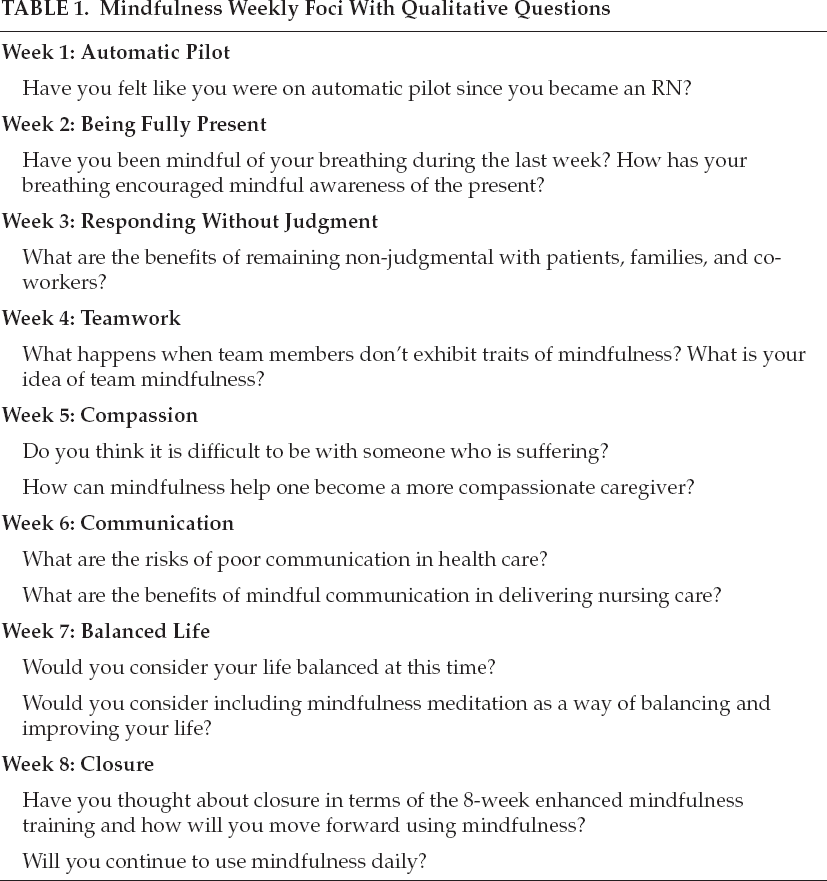
Qualitative themes concerning mindfulness and perceived stress were also of interest. Therefore, various questions were posed to the project participants on a weekly basis. The participants were contacted via email and provided with an online survey link containing the Mindfulness Awareness Innovation Weekly Foci with questions (see Table 1) and instructions on MBSR practice. All participants received the same questions during the same time and had 7 days to respond. At the conclusion of the innovation, the participants attended a final 30-minute follow-up session to complete the post-test MAAS, PSS, and satisfaction survey.
Mindfulness Weekly Foci With Qualitative Questions
Data Collection and Procedures
Participant mindfulness was measured utilizing the MAAS, a collection of 14 statements in a Likert scale. It has been validated for use with college students and community adults, with a Cronbach's α of .87 (Brown & Ryan, 2003). Participants’ perceived stress was measured utilizing the PSS (Cohen et al., 1983), a collection of 10 statements presented in a Likert scale. It is the most widely used psychological instrument for assessing the perception of stress, with a Cronbach's α of >.70 (Cohen & Williamson, 1988; Lee, 2012).
Mindfulness-based practices such as yoga, meditation, deep breathing, and walking have been encouraged not only as complementary therapies for physical ailments, mental health coping skills, and long-term physical conditions, but as a means of dealing with the daily stressors of life.
Intervention fidelity was measured by participant responses to three questions that were sent electronically via the online survey link. The three yes or no questions were: (a) Did you use mindfulness during the first half of the last shift? (b) Did you use mindfulness during the last half of the last shift? and (c) Did you perceive less stress using mindfulness? The participant's satisfaction with the MBSR innovation was measured at the innovation conclusion. The satisfaction tool was developed and approved in cooperation with the hospital educational liaison. It was composed of five statements presented in a Likert scale, from 1 (totally disagree) to 6 (totally agree). This QI project was deemed exempt by the hospital's institutional review board (IRB).
The importance of transition to practice has been documented as a key component in the development of confidence when practicing in an extraordinarily stressful environment.
Data Analysis
Pre- and post-innovation scores on the MAAS and PSS were compared using independent samples t test. To ensure accuracy of data, 20% of the total pretest and posttest MAAS, PSS, and satisfaction survey scores were confirmed by one of the co-authors. To evaluate fidelity, survey results were analyzed using descriptive statistics (n, %). Descriptive statistics using frequency distribution (median, minimum, and maximum) were used to analyze the satisfaction survey results. Open-ended questions were posed weekly to project participants to ascertain their perception of mindfulness. Verbatim comments were reviewed and analyzed for common themes and anecdotal relationships.
Results
This study sought to discover whether exposure to enhanced mindfulness training would increase mindfulness and decrease perceived stress in newly graduated RNs. Eighty-eight newly hired RNs were present for the innovation presentation. Forty participants (37 female, 3 male) completed the MAAS and PSS tool. Of the 40 participants, 20 (18 female, 2 male) agreed to provide an e-mail address that could be used to communicate with them weekly.
Mindfulness
The posttest MAAS was answered by 40 participants. However, 11 questionnaires were not completed and were not included in the statistical analysis (N = 29). Mindfulness awareness improved slightly from pre-intervention (M = 3.66, SD = .81) to post-intervention (M = 4.03, SD = .69) although this was not statistically significant (t[67] = 1.93, p = .057).
Perceived Stress
The posttest PSS was answered by 40 participants. However, 12 questionnaires were not completed and were not included in the statistical analysis (N = 28). There was a statistically significant decrease in stress from pre-intervention (M = 19.47, SD = 7.16) to post-intervention (M = 15.71, SD = 6.90), (t[66] = 2.16, p = .034).
Fidelity
Data were gathered through weekly survey questions. Once weekly, an email was sent to each participant (N = 20) which included each of the three questions listed below. The participants were asked to answer yes or no to each question. At the end of the 8 weeks, the answers to each question were tallied and used to assess intervention fidelity.
Question 1 asked whether mindfulness was used during the first half of the shift; 58 responses (72%) were yes, 22 (28%) were no. Question 2 asked whether mindfulness was used during the second half of the shift; 56 responses (70%) were yes, 24 (30%) were no. Question 3 asked whether there was a decrease in perceived stress using mindfulness; 73 responses (92.41%) were yes, 6 (7.59%) were no.
Satisfaction
Thirty (34%) completed the satisfaction survey for the mindfulness-based intervention. The survey items were presented in a Likert scale beginning with 1 (totally disagree) and ending with 6 (totally agree). Overall, respondents were satisfied with the MBSR innovation, as shown in Table 2.
Satisfaction Survey Results
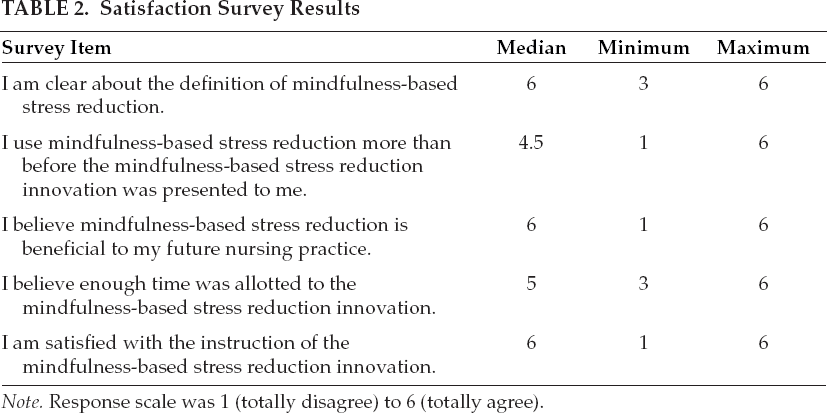
Note. Response scale was 1 (totally disagree) to 6 (totally agree).
Mindfulness has the potential to impact delivery of care; communication with patients, families, peers and colleagues; and overall job satisfaction.
Regarding the qualitative results, of the 20 participants who provided their emails, six (34%) regularly answered the weekly questions. Qualitative themes are subjective and difficult to apply to the general RN population. Moreover, reordering the weekly questions, beginning with the assessment of current MBSR knowledge, rather than autopilot, might have provided an improved baseline valuation. Three overarching themes were identified. First, participants described the connection between mindfulness and safe patient care. “(The benefits of mindful communication) are accurate and safe patient care” and “Autopilot can lead to distraction, unsafe practice and burnout.” Second, participants acknowledged the positive impact of mindfulness with communication between professionals, families, and patients. Participant comments included: “Effective positive communication also makes the experience better for the patient”; “They (the patients) feel like they have a voice”; “(Communication leads to) accurate and safe patient care”; and “Effective positive communication also makes the experience better for the patient and thus results in better survey reviews of the hospital.” Finally, participants noted the contribution of mindfulness to teamwork. There were several pertinent statements on this last theme: “When we all work together and utilize mindfulness, everything seems to run very smoothly” and “Balance and mindfulness complement each other.”
“Balance and mindfulness complement each other.”
Discussion
This project examined whether an enhanced mindfulness training program would improve mindfulness and decrease perceived stress in newly graduated RNs. Although not statistically significant, there was a slight improvement in the posttest MAAS. This was consistent with the satisfaction survey Question 2 that asked whether the participants utilized mindfulness more after receiving the 8-week innovation. A statistically significant improvement was noted in the posttest PSS scores of the participants. This finding was also consistent with the online survey Question 3 that inquired whether the participants perceived less stress utilizing mindfulness. The online survey Questions 1 and 2 inquired whether the participant was engaging in mindfulness during the first half of the last shift and the second half of the last shift throughout the 8-week innovation. The percentages of “yes” responses were 72.5% and 70%, respectively, supporting innovation fidelity. An overall average of 71.25% fidelity of innovation was achieved. As supported by the literature (Crowe et al., 2015; Kabat-Zinn, 1990; Penprase et al., 2015), regular practice of mindfulness is necessary to develop a habit leading to a change in behavior. When asked about the benefits of MBSR practice during the shift in weekly open-ended questions, project participant responses reflected themes of safety, communication, and teamwork noted in the literature (Atanes et al., 2015).
The satisfaction survey results revealed that project survey respondents understood the definition of MBSR. Most participants utilized mindfulness more after the innovation than prior to the innovation. Most respondents believed that enough time had been allotted to the innovation. All respondents had an overall satisfaction with the MBSR innovation. Project results support the ongoing need to incorporate an extended instructional component beyond the 30-minute time frame originally utilized for newly graduated RNs.
Limitations
This QI project has several limitations that should be addressed in future work.
Less than 50% of potential participants actually participated. Thus, generalizability of the project results is limited.
Only six respondents completed the weekly qualitative questions. Thus, the themes cannot be generalized.
Qualitative themes are subjective and difficult to apply to the general RN population. Moreover, reordering the weekly questions to begin with the assessment of current MBSR knowledge, rather than autopilot, might have provided an improved baseline valuation.
Members of the audience were permitted to move in and out of the session. Improved control of the instructional environment might have encouraged more RN participation.
Matched-pair MAAS and PSS pre-test and posttest scores may have demonstrated a closer correlation between the innovation and the results produced. Without matched pairs, it is difficult to determine whether the improvement of perceived stress was attributable to the innovation, time spent in the nursing profession, or other extraneous variables.
It is unknown whether the respondents that provided the satisfaction survey results actually participated in the weekly intervention.
Extending the initial presentation to 60 minutes allowing for improved demonstration of mindfulness engagement might have encouraged audience members to participate more fully.
Specific demographic information, including age, ethnic background, work history, and previous mindfulness training might, improve the applicability to a more specific group of RNs.
Half of the participants agreed to weekly email messages by providing their email addresses and half did not, creating an additional selection bias.
It is unknown how many of the respondents had prior MBSR exposure and/or training.
Conclusion and Recommendations
Newly graduated RNs are met with a variety of stressful situations. Lack of experience and self-confidence can lead to increased stress, impacting patient care and safety. The results of this project support the importance of increasing the time devoted to MBSR training during orientation of newly hired RNs.
Future projects and continuing education focusing on mind-fulness-based stress reduction may reveal a rich arena in which to improve the experience of newly graduated RNs as well as experienced nurses.
Additionally, continuing education and professional development that includes MBSR training would be a valuable component for all nurses. Future projects and continuing education focusing on the enhanced delivery of this intervention may reveal a rich arena in which to improve the experience of newly graduated RNs as well as experienced nurses. Professional development with MBSR as a core component will most certainly improve all RN experiences.
Footnotes
Joanne M. Kulka, DNP, APRN-BC, is a Professor of Nursing at Sandhills Community College in Pinehurst, North Carolina.
Jennie Chang De Gagne, PhD, DNP, RN-BC, CNE, ANEF, FAAN, is an associate professor of nursing at Duke University, Durham, North Carolina.
Cydney K. Mullen, PhD, RN, research interests include how nurses create actionable knowledge about their patients, nursing education, mindfulness, and families of critically ill patients.
Karen Robeano, DNP, RN, NEA-BC is the Chief Nursing Officer and VP, Patient Care Services at FirstHealth Moore Regional Hospital in Pinehurst, NC.