







Abstract
The demand for Advanced Practice Registered Nurses, nursing faculty, and nursing leaders is driving the increase in nurses seeking doctoral degrees (Bednash, Brelin, Kirschling, & Rosseter, 2014). A variety of programs have emerged to prepare nurses for careers in health administration, research, and advanced clinical practice. Prospective graduate level nursing students can choose from doctoral programs focused on research or practice. Potential doctoral students now have several different degrees to choose from, and deciding which one is right for them can be a daunting task.
In 2010, The Institute of Medicine (IOM) and the Robert Wood Johnson Foundation released The Future of Nursing: Leading Change, Advancing Health (IOM, 2010), which calls on nurses to play an essential role in the transformation of the nation's health-care system. As a major focus of this transformation, the IOM recommended that nurses seek higher levels of education and training. A specific goal identified in the report was to increase the number of nurses with doctoral degrees by 100% by the year 2020 (IOM, 2010).
Historically, doctoral degrees pursued by nurses were in other fields of study, such as education, psychology, economics, sociology, biology, or health education (Rice, 2016). In 1922, Harvard University developed the Doctor of Education (EdD) degree (Levine, 2007), which was adopted in 1934 by Columbia University. The EdD was designed to differentiate advanced graduate study in the field of education, and was originally conceptualized as a program of study for individuals who intended to be practitioners in the field of education. The EdD program is designed to mirror the rigor involved in a Doctor of Philosophy (PhD) course of study, but differs in regard to program content and the focus in course requirements (Mayhew & Ford, 1974).
A few years following the inception of the first nursing EdD, offered by Columbia University in 1924, the University of Pittsburg and New York University conceptualized and implemented the nursing PhD (Ketefian & Redman, 2015). In the 1970s, the Doctor of Nursing Science (DNS) degree was introduced at Boston University (Rice, 2016), and Margaret Newman at New York University developed a practice-based nursing doctorate (ND) (Rice, 2016). The ND and DNS degrees are designed to combine clinical practice and research, differentiating them from the EdD and PhD degrees, which are structured with a focus on research and theory development (Rice, 2016). In 2014, the American Association of Colleges of Nursing (AACN) reported 132 research-based nursing programs, including PhD and DNS degrees (AACN, 2014).
The Doctorate in Nursing Practice
Advantages
The Doctor of Nursing Practice (DNP) degree focuses on clinical practice and methods to improve patient outcomes. However, a clinical doctorate provides much more than preparation for clinical practice; it also prepares graduates to function as professional role models, change agents, educators, and leaders (AACN, 2006). The DNP-prepared nurse contributes to translational science by implementing research outcomes in clinical practice (Nicholes & Dyer, 2012).
Disadvantages
Disadvantages of the DNP degree include abbreviated orientation to formal teaching, classroom management, and research. DNP graduates who attain academic positions may have greater difficulty transitioning from practice to classroom without previous teaching or pedagogical development (Kahanov, Eberman, Yoder, & Kahanov, 2012), placing them at a disadvantage for promotion and tenure.
The Doctorate in Education
Advantages
The Carnegie Project on the Education Doctorate (CPED) defines EdD scholars as practitioners who blend practical wisdom with professional skills and knowledge to name, frame, and solve problems of practice (Carnegie Project for the Educational Doctorate, 2010). For the nurse whose professional goal is to transition from clinical practice to the role of educator, the EdD degree provides foundational knowledge focused on curriculum development, pedagogy, student success, and technology (Graves et al., 2013). In addition to preparation as an academician in nursing education, coursework also supports the application of nursing research through scholarly endeavors and dissemination of findings.
Disadvantages
For the practicing nurse whose career goal is to transition into academia, the length of an EdD program may prove overwhelming. A program that requires a minimum of 4 years of continuous coursework may be cost prohibitive and fatiguing, yielding results of burnout and program withdrawal. Such consequences negatively affect institutional retention rates as well as the volume of doctorally prepared nurses. Nurses may find more opportunity to utilize knowledge attained from an EdD as university administrators and change agents rather than as nursing faculty (Education Degree, 2017). A primary reason behind this distinction is that the EdD is structured to prepare the graduate with a deeper understanding of systems change and leadership within the academic setting (Education Degree, 2017).
The Doctor of Philosphy Degree
Advantages
The PhD is often looked upon as the “gold standard” of terminal degrees, and is recognized as a “distinction of academic scholarship and achievement” globally (Smith, 2015, p. 22).
The EdD and PhD degrees are an essential commitment for research-focused academicians, providing the data on which evidence-based practice is founded.
The PhD program focuses on research, which prepares the graduate to hypothesize, prepare formal research plans, analyze data, and present research findings for application in the appropriate settings. Nurses with PhD degrees enjoy a wide variety of career opportunities including scholarship, clinical and academic research, administration, and faculty positions (Smith, 2015). Therefore, PhD-prepared nurses can move seamlessly among different areas of employment, depending on their interest.
Disadvantages
The time required to complete a PhD degree varies depending on the university granting the degree. Longer programs require more money and time, increasing expenses for the student. As with all doctoral programs, the PhD curriculum tends to be very rigorous, which students may find overwhelming.
Degrees at a Glance
Table 1 presents a side-by-side comparison of the doctoral degrees discussed in this article, and how the nurse with a terminal degree can apply each.
Comparison of DNP, PhD, and EdD Programs
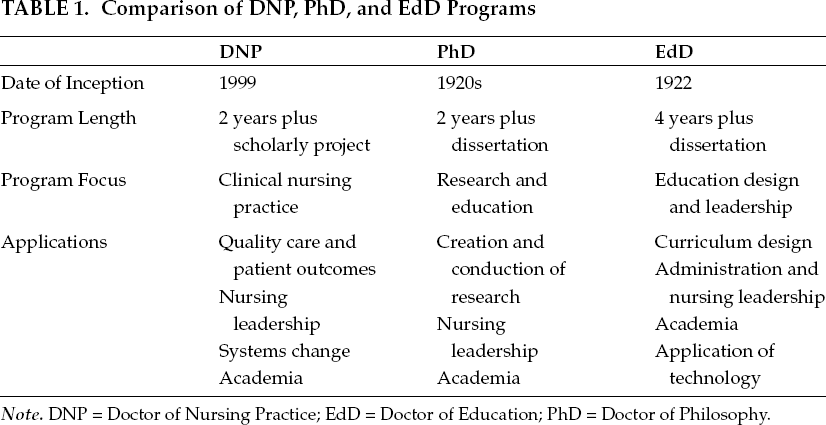
Note. DNP = Doctor of Nursing Practice; EdD = Doctor of Education; PhD = Doctor of Philosophy.
Implications for Nursing Education
Nursing professionals consistently seek to promote health and well-being. As lifelong learners, nurses also continually seek out higher levels of learning and understanding. The DNP degree is an option for professional advancement in a clinical setting, focusing on the translation of research into practice. The EdD and PhD degrees are an essential commitment for research-focused academicians, providing the data on which evidence-based practice is founded.
Recommendations and Conclusions
For nurses considering attaining terminal degrees, the choice of which degree to pursue can be perplexing. The degree choice should be driven by personal and professional factors, taking into consideration one's area of interest, and the financial and time commitments each degree involves. Nurses currently working in an academic setting need to determine which terminal degrees that university recognizes.
As recognized by the AACN (2014), the nursing profession needs to increase the number of doctorally prepared nurses. The task for individual nurses becomes determining which doctoral degree is best for them. The purpose of this article is to provide a brief comparison of the PhD, EdD, and DNP degrees and their application to the academic and clinical settings. When choosing which degree is better for themselves, nurses need to look at the length of time to degree completion, total cost to completion, and applicability to their specific professional goals. One size does not fit all.
Footnotes
Disclosure. The authors have no relevant financial interest or affiliations with any commercial interests.
Diane Young, PhD, MSN, currently serves as ASN program coordinator for Troy University. She has been an educator for over 15 years with over 20 years of nursing experience.
Natasha Colvin, EdD, MSN, RN-BC, CNL, serves as an assistant professor for Auburn University of Montgomery's BSN program. She has been in academia for 5 years with over 15 years of nursing experience.
Sherry Seibenhener, DNP, FNP-BC, WHNP-BC, RN, is an assistant professor with Troy University's graduate nursing program. She maintains a clinical practice as an advanced practice nurse with over 30 years of nursing experience. She has been in academia for 5 years.
Andrea Johnson, MSN, RN, serves as an assistant professor in Troy University's ASN program. She has 5 years of experience in nursing education. She has over 15 years of nursing experience.