







Abstract
Conceptual frameworks in nursing help shape the thinking and behavior of nursing practice. They also facilitate understanding about nursing's unique contributions that complement the way of medicine. Current health crises illuminate the need for disruptive change, and consequently the need for new conceptual frameworks to guide disruptive practice. The Way of Nursing conceptual framework moves nursing beyond the nursing metaparadigm and the nursing process toward the necessary thinking to address the complex health challenges of individual patients, families, communities, and the planet. The Way of Nursing affirms nurses’ capacity to lead change and disrupt systems for the benefit of all.
Keywords
Health care is in a constant state of change. Nurses are very familiar with new medications and treatments, evolving evidence-based policies and practices, and shifts in reimbursement models. Most of these changes are designed to improve outcomes, decrease the cost of care, and enhance the patient and provider experience of care.
When the fundamental concepts, approaches, and assumptions of an industry change, this is called a disruptive change. Sudden paradigm shifts are often sparked by innovation, such as telehealth, or overwhelming external pressures like the SARS-CoV-2 pandemic or climate change. Once the shift has occurred, the system rarely returns to its previous state; there has been a disruptive change.
Nursing schools currently prepare nurses to implement quality improvement changes throughout their careers. However, these same students may be ill-prepared to leverage their unique thinking to innovate and lead change that is disruptive. This article proposes a conceptual framework, The Way of Nursing, to illuminate the unique thinking of a nurse and emphasize the role of nurses in leading disruptive change. The framework maximizes holistic thinking, appreciates interprofessional differences, and leverages the unique BASE of Nursing Practice (Eisler & Potter, 2014) to lead disruptive and transformative change.
Conceptual Frameworks
A conceptual framework is neither a model nor a theory. According to Jabareen (2009), “A conceptual framework provides not a causal/analytical setting but, rather, an interpretive approach to social reality. Rather than offering a theoretical explanation, as do quantitative models, conceptual frameworks provide understanding” (p. 51). What does this mean for nursing?
The core concepts of nursing, or the “nursing metaparadigm,” were first defined by Jaqueline Fawcett (1984). These core concepts are person, environment, health, and nursing. Fawcett also drew from the work of nursing theorists to define three major themes or relationships between the concepts: person-health, person-health-environment, and person-health-nursing.
However, Fawcett's work has been criticized for failing to fully acknowledge the previous work of others and for narrowly defining the elements of the nursing discipline (Bender, 2018). In “Re-conceptualizing the Nursing Metaparadigm: Articulating the Philosophical Ontology of the Nursing Discipline that Orients Inquiry and Practice,” Bender (2018) emphasizes the interdependency and dynamism between the concepts of nursing. She writes:
What exists for the nursing discipline is not already-demarcated domains of nursing, person, health, and environment, but rather interdependent relations that constitute people, including nurses, in their health/environment circumstance, which comprises nursing's unique, fundamental point of access in the world. (p. 6).
Sudden paradigm shifts are often sparked by innovation, such as telehealth, or overwhelming external pressures like the SARS-CoV-2 pandemic or climate change.
Bender's (2018) work moves us closer to a nursing conceptual framework by defining the nature of the relationships between elements.
The BASE of Nursing Practice Conceptual Framework
Before discussing The Way of Nursing, a new conceptual framework, it is important to examine the independent relationships that shape nursing. Professional nursing education generally focuses on the nursing process to guide holistic, person-centered care. The steps of the process include assessment, diagnosis, planning, implementation, and evaluation (American Nurses Association, n.d.). This may be an iterative process as new data emerges through further assessment and reflection. The nursing process is very useful in developing a plan of care, but it fails to describe the act of being a nurse and the unique interdependent dynamic between nurse, patient, environment, and health.
To capture the dynamic elements of nursing, Potter developed the BASE of Nursing Practice, (Eisler & Potter, 2014). This model proposes the discipline of nursing has two primary ways of knowing, evidence from stories and evidence from science (see Figures 1 and 2). Nursing also has two dominant ways of being, present, and active caring (see Figures 3 and 4).
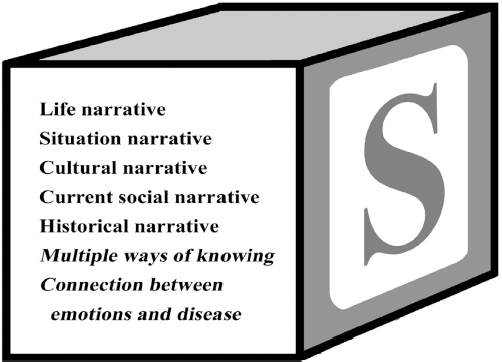
Evidence from Stories or Patient and Family Narratives (S).
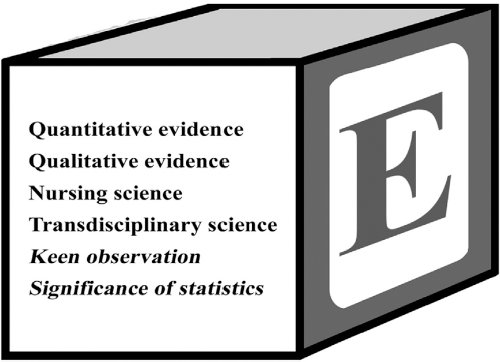
Evidence from Science (E).
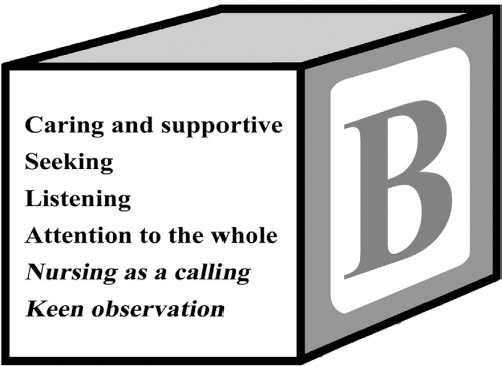
Being Present (B).
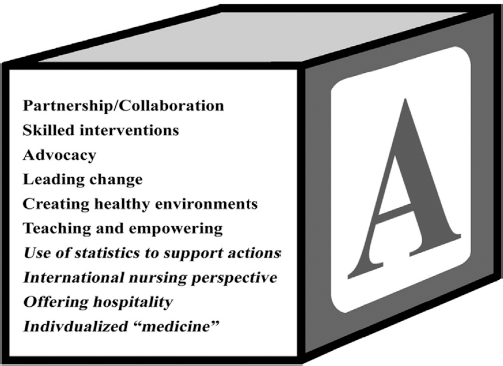
Active Caring (A).
Nurses are deeply present with the patients, families, and communities they serve. This presence earns them trust, which invites them to hear sense-making stories that illuminate the lived experience. The lived experience, communicated through stories or narratives, is an important way of knowing. Stories help nurses filter vast amounts of evidence from science to determine the most appropriate and effective acts of caring. When nurses apply these four elements in practice, they are nursing from their BASE.
All health professions utilize evidence from science, and all value active caring, but nurses are uniquely positioned to build a trusting relationship through deep presence (B) resulting in access to significant stories (S) that can inform each patient's unique path to healing. These two interdependent relationships—being present and compassionate consideration of the patient's story—may be “nursing's unique, fundamental point of access in the world” (Bender, 2018). These relationships may also be one reason why nurses are consistently ranked the most trusted profession, far above other professions including those in health care (Gallup, 2021).
The Way of Nursing
The Way of Nursing is a new conceptual framework designed to highlight nursing's fundamental orientation and compare it with the orientation of medicine. The framework is not meant to describe the practice of individual nurses, but rather to provide a general comparison of the nursing approach to practice and the approach used by physicians. The purpose of this new conceptual framework is to comment on an existing social reality and promote understanding; it therefore aligns with Jabareen's (2009) definition of conceptual framework: “a network, or 'a plane,’ of interlinked concepts that together provide a comprehensive understanding of a phenomenon or phenomena” (p. 51). Furthermore, these frameworks inform our understanding of the ways that phenomena relate to one another in the real world.
The Way of Medicine and Cure
Physicians are educated to conduct a comprehensive history and physical that provides rich data including the patient's chief complaint; a history of related medical, behavioral, psychological, and social content; and a thorough physical exam. Based on the findings, the physician may choose to gather additional data from tests, lab work, and/or scans (National Cancer Institute, n.d.). The aim of the medical process is to eliminate possible or “differential” diagnoses, eventually confirming a diagnosis or diagnoses that can be treated. This is the point where collection of stories about the unique lived experience of individual and family frequently stops. This is the way of medicine and cure (see Figure 5).
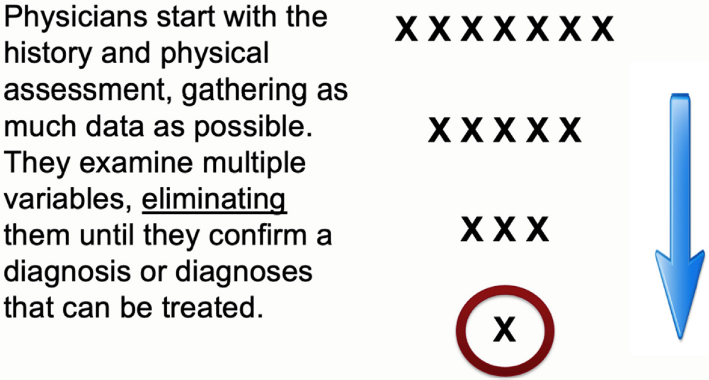
The way of medicine and cure.
The Way of Nursing
Nursing begins with a similar comprehensive assessment. Unlike medicine, the nursing assessment is not standardized across the profession and may differ from setting to setting. Even when nurses use the same assessment tools, they are still listening for the unique story that the patient, family, or community brings (the S in BASE of Nursing Practice). The goal is the most comprehensive and holistic understanding of the patient, family, or community. In addition to standard assessment questions about medical diagnoses, allergies, and vital signs, nurses gather information about the patient's cultural, social, and environmental contexts—factors such as the patient's:
Even when nurses use the same assessment tools, they are still listening for the unique story that the patient, family, or community brings.
Primary language
Education and literacy level
Understanding of their medical diagnoses
Medication knowledge
Medication adherence
Adequacy of housing
Use of assistive devices
Spiritual tradition
Social relationships: Family, friends, neighbors, colleagues
Occupation
Hobbies and interests
History of trauma/racism
Military/veteran status
Management of stress
Home environment: Hazards, exposures, experience of disasters such as natural disasters and disasters related to climate change
Compared to the way of medicine which uses a process of elimination, nursing's way is clearly holistic, based on the assumption that “the whole is more than the sum of its parts.” Unlike medicine, nurses continue to collect data, both clinical and narrative, the entire time a person, family, or community is receiving care. The more one knows the person, the more effective the care provided. This is the Way of Nursing; it is the essence of care (see Figure 6).
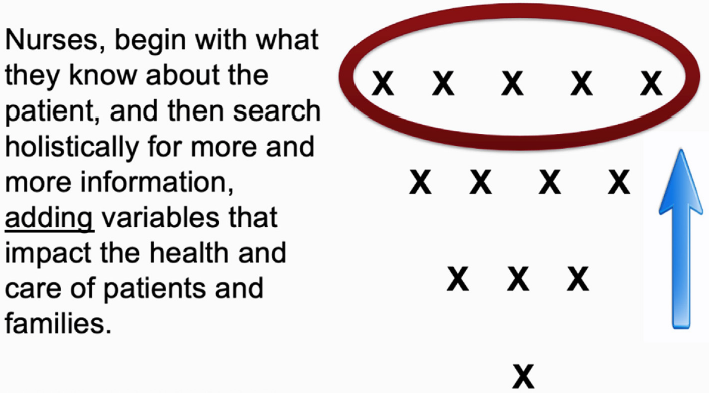
The Way of Nursing.
Benefits of the Way of Nursing
The Way of Nursing conceptual framework helps nurses disrupt old patterns of hierarchical ranking of the medical profession over the nursing profession. Instead of nursing being “less than” and nurses being “just the nurse,” nurses learn to see care and cure as two equal and necessary approaches to restoring health and healing (see Figure 7). When nurses are taught to practice The Way of Nursing, they are prepared to act as full members of interprofessional teams. In interprofessional practice, nurses represent and advocate for patients, families, and communities based on a holistic understanding of their needs and goals.
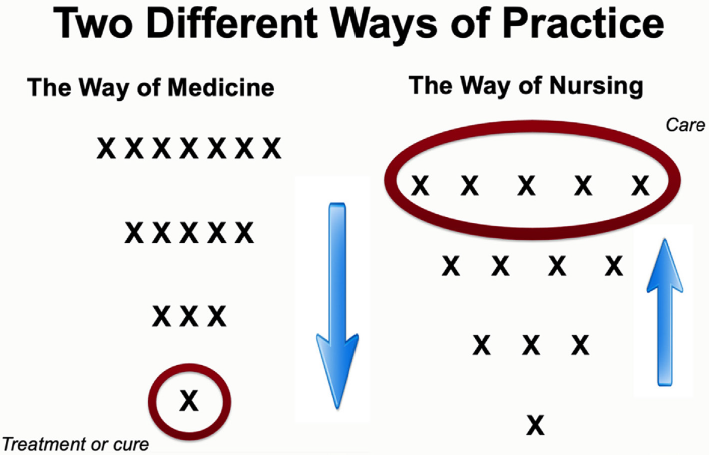
Comparison of two different ways of practice.
When nurses apply The Way of Nursing to population health, they collect ever-expanding data related to multiple systems. They incorporate transdisciplinary knowledge and form networks of diverse stakeholders. The Way of Nursing prepares nurses to detect trends and anticipate change. It also prepares nurses who are skilled in systems expertise and capable of addressing complex social and even planetary health issues. When nurses learn The Way of Nursing, they do not minimize their contributions but instead see opportunities to lead change. The Way of Nursing maximizes holistic thinking, promotes appreciation of interprofessional differences, and creates an opportunity to leverage nursing's thinking and the BASE of Nursing Practice to create disruptive change for all.
Disruptive thinking requires the ability to collect and connect large amounts of data, noticing trends and possibilities for change.
Conclusion
Transformative change requires systems-based thinking capable of impacting both micro and macro challenges. Disruptive thinking requires the ability to collect and connect large amounts of data, noticing trends and possibilities for change. For individual patients, The Way of Nursing ensures that their unique needs are better understood. For public and population health, The Way of Nursing supports development of innovative models of care to restore the health of patients, families, communities, and the planet. The Way of Nursing positions nurses to actualize their full potential, with a framework to support them in leading disruptive change that will advance the health of all.
Footnotes
Disclosure.
The author has no relevant financial interest or affiliations with any commercial interests related to the subjects discussed within this article.
Funding.
The author received no specific grant or financial support for the research, authorship, and/or publication of this article.
Teddie Potter PhD, RN, FAAN, FNAP, (she/her), is Director of Planetary Health and Coordinator of the Doctor of Nursing Practice DNP in Health Innovation and Leadership Specialty in the University of Minnesota School of Nursing in Minneapolis, MN.