







Abstract
Music is a powerful emotional tool that can be used as an effective coping mechanism, as “medicine.” Musical interventions are used in many areas of health care and medical sciences to meet the physical, psychological, social, and emotional needs of individuals. This article provides a theoretical definition of the concept of music as medicine: The use of music as a non-pharmacological strategy for coping and healing, based on its therapeutic properties, using a modification of Walker and Avant's method to identify antecedents, attributes, consequences, and empirical referents. Music as a coping strategy involves the use of music intervention and is an example of an emotion-focused, adaptive, coping strategy. The article concludes with a discussion of the implications of music as medicine for practice and research. Increased awareness of the concept of music as medicine as a strategy to manage stress offers an inexpensive non-pharmacological intervention to many organizations such as nursing care facilities, schools, and hospitals.
Music is a fundamental attribute of the human species and is considered both a “science and art of ordering tones or sounds in succession, in combination, and in temporal relationships, to produce a composition having unity and continuity” (Merriam-Webster, 2021b). An intervention is the “act of interfering with the outcome or course especially of a condition or process to prevent harm or improve functioning” (Merriam-Webster, 2021a). Florence Nightingale used music as an intervention to improve patient outcomes and healing (Murrock & Bekhet, 2016). Research conducted on this topic continues to validate Nightingale's anecdotal observations in Notes on Nursing: What It Is and What It Is Not (1898), describing music as a powerful tool for health care and healing. Han et al. (2010) suggested that listening to music generates an aesthetic pleasure in the brain that causes the pituitary gland to release endorphins, producing analgesia and a sense of well-being. Monerris et al. (2020) stated that music is a unique way to link to the societal interactions of humans and can serve as a function towards healing.
Music has been studied as an intervention to alter mood (Warren, 2016), to provide distraction (Millett & Gooding, 2017), and as a cue for movement (Devlin et al., 2019). However, the therapeutic properties of music as a “medicinal” strategy are not clearly defined. Listening to music may be thought of as noninvasive and nonpharmacological but should be considered a form of medicine. Managing stress is important for individuals’ well-being; this article focuses on a strategy that can offer a solution to managing stress. Finding and using a unique coping strategy such as music intervention can be a form of therapy for future stressful situations. Music as medicine can promote self-care, enhance moods, promote well-being, and increase relaxation (Ince & Cevik, 2017). The purpose of this article is to clarify the concept of music used as medicine by defining attributes, antecedents, consequences, and empirical referents.
Methods
Concept Analysis
This article follows six of the eight steps outlined in Walker and Avant's (2019) Strategies for Theory Construction in Nursing. The six steps are: (1) selecting the concept, (2) describing the utilization of the concept in the literature, (3) identifying the significance of the concept, (4) describing and defining the attributes, (5) identifying the antecedents and consequences of the concept, and (6) identifying the empirical referents of the concept. The steps that involve constructing and presenting a model, and presenting borderline and contrary cases are not included in this analysis (Levoy et al., 2020).
Review of Literature
An initial literature search of PubMed and Cumulative Index to Nursing and Allied Health Literature (CINAHL) databases was conducted using the search terms “music AND stress AND anxiety,” “music AND pain,” “music AND depression,” “music AND healing.” A total of 251 articles in PubMed and 721 articles in CINAHL were identified. Inclusion criteria were English language, published from 2010 through January 2021, and studies involving infants, children, adolescents, and adults. Titles and abstracts were reviewed to determine relevance for this review and any duplicates were removed. A total of 57 articles remained.
Music as medicine can promote self-care, enhance moods, promote well-being, and increase relaxation.
Elements of Concept Analysis
Uses of Concept
According to Howland (2016), music exposure has many measurable neurobiological effects that are linked to systems regulating reward, motivation, and pleasure; stress and arousal; and immunity. Studies have examined the effects of music interventions on stress-related outcomes in specific patient groups or settings such as patients diagnosed with dementia (Li et al., 2019), patients with cancer (Li et al., 2020), patients undergoing endoscopic procedures (Wang et al., 2014), the neonatal population (Yue et al., 2020), patients experiencing pain (Poulsen & Coto, 2018), and patients on mechanical ventilators (Bradt & Dileo, 2014). A meta-analysis by these latter authors suggested that consistently listening to music reduced mechanically ventilated patients’ respiratory rate and systolic blood pressure, possibly reducing the need for sedatives and analgesics (Bradt & Dileo, 2014).
Significance of the Concept
The concept of music as medicine offers a supportive holistic strategy to decrease negative feelings of stress and anxiety. Ab Latif and Mat Nor (2019) found that individuals cope with stressors differently based on how they perceive stress, and their past experiences. Encouraging a positive perspective about stressors may facilitate positive coping responses to help improve overall health, well-being, and even academic performance. According to Han et al. (2010) and Waterman (2020), endorphins and oxytocin are released while listening to music and/or singing, significantly reducing feelings of stress and anxiety. Amid a pandemic, a coping strategy such as music as medicine can have a positive effect for people suffering from isolation and depression (Schwantes et al., 2014).
Attributes of Music as Medicine
Defining attributes are critical characteristics that help differentiate a concept from another related concept and clarify its meaning (Walker & Avant, 2019). Three key defining attributes of the concept of music as medicine are (1) music therapy and music intervention, (2) coping strategy, and (3) healing.
Music Therapy and Music Intervention.
Although the terms are used interchangeably, music therapy differs from music intervention. Music therapy is an evidence-based, art-based health profession that uses music experiences within a therapeutic relationship to address clients’ physical, emotional, cognitive, and social needs; this intervention is performed by a professional music therapist (Stegemann et al., 2019). Music interventions are musical exercises or methods such as music listening, music making, or singing, that are used for stress reduction. Music interventions can have positive effects on both physiological and psychological responses (de Witte et al., 2019).
Coping Strategy.
Music can be an emotion-focused, adaptive coping strategy for many health conditions such as stress, anxiety, pain, or depression. Coping strategies are considered actions or thought processes used to tolerate, reduce, or minimize a stressful or unpleasant situation (American Psychological Association, 2022).
Healing.
Is the act of health restoration or returning to a sound state (Merriam-Webster, 2021c). Egnew (2005) defined healing as the “the personal experience of the transcendence of suffering” (p. 255).
Music as medicine can thus be conceptualized as “the use of music as a non-pharmacological strategy for coping and healing.”
Antecedents of Music as Medicine
Walker and Avant (2019) define antecedents as the events that must arise before a concept's occurrence. The identified antecedents of music as medicine are the presence of psychological and/or physiological disequilibrium, such as stress, anxiety, pain or depression, and ability to sense the music either through hearing or touch.
The ability to use one's senses, specifically touch and hearing, is expected to be present for the concept to arise and/or to be beneficial. According to Clements-Cortes and Pascoe (2020), music therapy's focus is on auditory and vibrotactile information. Participation in music therapy sessions may provide pleasure for those who are visually and/or hearing impaired while offering an accessible outlet for addressing one's cognitive and emotional needs (Clements-Cortes & Pascoe, 2020; Park et al., 2015). Palmer et al. (2017) stated that “feeling and experiencing the vibrations produced by music helps patients who may be impaired to understand what the concept of music is” (p. 178).
Based on the conceptual model of music as medicine (Figure 1), the antecedents impact the attributes, which in turn impact the consequences of the psychological and/or physiological responses in the human body. Thus, these two antecedents are the foundation for the therapeutic properties of using music as medicine.
Consequences
According to Walker and Avant (2019), consequences are events or incidents that can occur because of the occurrence of a concept and that can often stimulate new ideas or pathways for research about certain concepts. Strategies such as music intervention can be effective in promoting self-care (Ince & Cevik, 2017), enhancing mood (Lilley, 2014), promoting well-being (MacDonald, 2013), and increasing relaxation (Murrock & Bekhet, 2016). Music and musical activities are used today in many areas of health care and medical sciences to meet the physical, psychological, social, and emotional needs of individuals (Cigerci et al., 2019).
The calming effect of music can have a positive impact on a person's mood and quality of work; an increase in perceived level of relaxation may help students focus on academic performance and help nurses focus on patient care (Lilley et al., 2014). “Music can alter mood as positive emotional states enhance parasympathetic activity to reduce heart rate, blood pressure, respiratory rate, and pain, boost immunity, and decrease cortisol levels and stress” (Murrock & Bekhet, 2016, p. 50). Listening to music can induce pleasant and positive feelings through activation of the limbic system (Murrock & Beckhet, 2016). Listening to relaxing music also decreases cortisol, which in turn can reduce anxiety and promote relaxation; research on the impact of music in occupational settings revealed that a single music relaxation session decreased participants’ state of anxiety significantly, compared to a control group with no music intervention (Lilley et al., 2014).
The calming effect of music can have a positive impact on mood and quality of work; an increase in perceived level of relaxation may help students focus on academic performance and help nurses focus on patient care.
Empirical Referents
The final step in analyzing the concept of music as medicine is identifying empirical referents, measurable indicators of a concept (Walker & Avant, 2019). The physiological and psychological presence of stressors such as stress and anxiety are measured with various tools such as the State-Trait Anxiety Inventory tool (STAI) (Galal et al., 2021), obtaining vital signs (Liu & Petrini, 2015), and/or measuring cortisol levels (Hasanah et al., 2020), following the implementation of a musical intervention. Pain levels are measured with individual scores/ratings. A meta-analysis by Kühlmann et al. (2018) examined pain levels reported after a music intervention. The Beck Depression Inventory is frequently used to measure depression (Leubner & Hinterberger, 2017). These measurements can all be utilized to assess the effectiveness of music as medicine, to determine whether a link exists between music interventions and the promotion of self-care, enhancement of mood, promotion of health and well-being, and increase in relaxation.
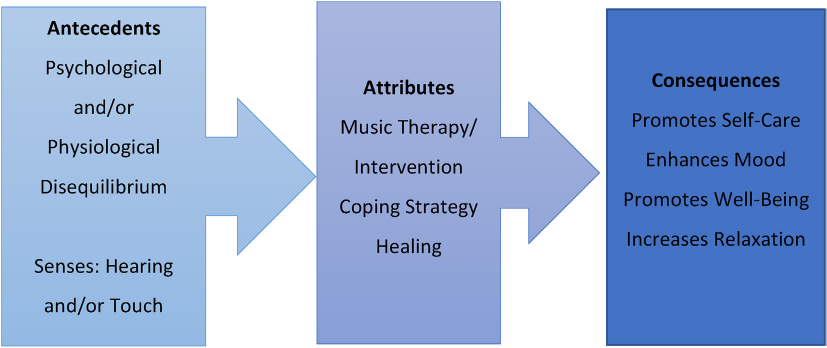
Model of the concept of music as medicine.
Implications for Nursing Practice and Research
Music offers an inexpensive non-pharmacological intervention in various health-care settings. For patients, families, students, and health-care workers, who are at high risk for exposure to various stressors, music has the potential to offset negative consequences that can ultimately affect the quality of patient care.
Music has been utilized in hospitals and in the field of nursing education (Ince & Cevik, 2017). However, the number of studies addressing the effects of music in academic settings and with other health-care disciplines is limited. Understanding the power of music as medicine can allow health-care professionals and educators to study and to make appropriate therapeutic use of this tool.
Conclusion
Music is a powerful emotional tool that can be used as an effective coping mechanism, but further research is needed about its use as medicine. Music has been shown to have beneficial effects on stress-related physiological, cognitive, and emotional processes. Thus, the use of music as an economical, non-invasive intervention has received special interest in the management of stress and stress-related health issues (Thoma et al., 2013).
This concept analysis has been used to clarify the use of music as medicine, examining its significance, antecedents, attributes, consequences, and empirical referents. For individuals experiencing physiological and/or psychological disequilibrium who can use senses of touch and hearing (antecedents), music interventions can be used as a coping strategy for healing (attributes), leading to the promotion of self-care, enhancement of mood, promotion of well-being, and increased relaxation (consequences). Music as medicine can serve as a framework for music interventions that have practical application in nursing research and practice to improve health outcomes for patients, nurses, other health-care providers, student populations, and other disciplines.
Footnotes
Disclosure
The authors have no relevant financial interest or affiliations with any commercial interests related to the subjects discussed within this article.
Funding
The author(s) received no specific grant or financial support for the research, authorship, and/or publication of this article.
Jorgie Ann Contreras, MSN, RN, CPN, (she/her), is a Clinical Assistant Professor in the School of Nursing at the University of Texas Health Science Center at San Antonio.