







Abstract
Background
Current research indicates that structured yoga practice may improve physical and emotional symptoms related to cancer treatment. Yoga is recommended for patients with cancer, yet there are barriers to participation in community- and hospital-based classes. Wellness interventions such as yoga are easy to access via the internet, but information can be overwhelming and not tailored to people with cancer.
Purpose
The purpose of this study was to develop a nurse-led, breast cancer-specific, web-based gentle yoga video for home use, and to understand the feasibility, utilization, and safety of the video in a sample of breast cancer survivors.
Method
Data was collected via open-ended telephone interviews three times over a 4-week period.
Results
The 14 women participating in the study reported that the web-based video was safe in that it resulted in no injury, and was easy to use, and convenient to access. However, most did not continue to practice the video for the full 4 weeks of the study. A knowledge deficit about gentle yoga as a structured mindful movement-based practice rather than a vigorous exercise was identified.
Implications
Nurses can provide tailored wellness interventions for cancer survivors via video stream. Future work should include instruction that yoga is a mindfulness-based self-care activity requiring regular practice.
As defined by the National Cancer Institute (2018), survivorship encompasses the time after acute treatment of cancer through the end of life, and includes issues of treatment effects and quality of life (QOL). Approximately 80% of breast cancers are estrogen receptor-positive (Barcenas, 2016; Kohler et al., 2015), requiring 5–10 years of adjuvant endocrine-based oral therapy, including tamoxifen and/or aromatase inhibitors (AIs). Adjuvant therapy can make the transition from the acute phase of treatment to survivorship more challenging; while this therapy reduces breast cancer recurrence and increases survival, it is not without distressing side effects such as arthralgias, myalgias, vaginal dryness, and hot flashes (Bodai & Tuso, 2015; Friese et al., 2017). Survivors in transition may experience side effects impacting QOL at the same they are trying to restore normalcy in their lives, but with less support and guidance from their care providers.
The depth of clinical research supporting the use of yoga during and after cancer care is growing (Greenlee et al., 2017). Oncology care providers who are aware of yoga are more likely to recommend it for cancer patients (Koula & Knight, 2018) for symptom management. As compared to no intervention, yoga may help improve health-related QOL and reduce fatigue and sleep disturbance in cancer survivors (Cramer et al., 2017), yet survivors may be unaware of it or lack access to yoga as a self-care intervention. Nurses have a key role in closing this gap by recommending interventions such as yoga to reduce symptoms related to cancer treatment. They are also well suited to help ease the transition from the acute phase of treatment to survivorship. To date there are limited reports of nurse-led interventions aimed at improving the care experience after acute treatment for breast cancer.
Background and Significance
There are 15.5 million cancer survivors in the United States, 3.8 million of whom are female with breast cancer; the total number is projected to increase to 20.3 million by 2026 (National Institutes of Health Office of Cancer Survivorship, 2016). The physical and psychosocial side effects experienced years after acute breast cancer treatment challenge survivorship (Lester et al., 2015; Runowicz et al., 2016). Work by Flanagan and colleagues (2016; 2012) found breast cancer survivors on adjuvant therapy reported life stressors in addition to having to manage treatment-related symptoms such as co-occurring chronic conditions and/or being a caregiver to children or elderly parents. Participants in these studies reported a need for provider support, but were relieved to have fewer in-person visits, instead preferring a combination of accurate provider-developed web-based information and telecommunication (Flanagan, Tetler, Winters, Post, & Habin, 2016; Flanagan, Winters, Habin, & Cashavelly, 2012).
Adjuvant therapy for breast cancer can make the transition from the acute phase of treatment to survivorship more challenging; while this therapy reduces recurrence and increases survival, it is not without distressing side effects such as arthralgias, myalgias, vaginal dryness, and hot flashes.
Yoga as a Strategy to Improve Care
There are estimates that 50% of cancer survivors in the United States use some form of complementary or alternative medicine (Fouladbakhsh & Stommel, 2010; Mao, Palmer, Healy Desai, & Amsterdam, 2011) and of those, yoga is among the most popular modalities (Mao et al., 2011). The American Society of Clinical Oncology endorses yoga for anxiety/stress reduction, depression/mood disorders, and to improve QOL (Lyman et al., 2018). Yoga may be helpful in reducing treatment-induced myalgia/arthralgia and improving balance and flexibility (Galantino et al., 2012). Randomized controlled trials indicate that yoga had a positive impact on sleep quality and reduced use of sleep aids in patients treated for breast cancer (Mustian et al., 2013); improved QOL in patients undergoing radiation for breast cancer (Chandwani et al., 2014); increased vitality (Kiecolt-Glaser et al., 2014); and reduced fatigue and improved vigor (Bower et al., 2012). Yoga may also be useful in breast cancer-related lymphedema (Fisher et al., 2014; Mazor et al., 2017). No detrimental effects of yoga have been reported in cancer survivors, and yoga has been found to be as safe as usual care and exercise (Cramer et al., 2016).
Bridging the Gap in Care
Research supports that yoga is a helpful mind-body intervention. However, Flanagan et al. (2016) reported that patients with breast cancer prefer to have access to symptom management interventions that are recommended by trusted providers and are easy to fit into their busy lives. Web-based delivery of survivorship care (SC) interventions may be a way to facilitate this goal. Web-based SC interventions that are feasible, effective, and acceptable to breast cancer survivors have the potential to overcome many of the known barriers such as travel to the clinic and time constraints of patients and providers (Post & Flanagan, 2016). A web-streamed yoga video developed by cancer care providers may help bridge the gap in providing symptom management in a convenient, effective, and acceptable format.
Study Process
Yoga Video Development
A 17-minute video of gentle yoga practice was developed by a multi-disciplinary team led by oncology nurse practitioners, a lymphedema-cerrified physical therapist, and a certified yoga instructor experienced in teaching cancer patients. Filming was done in the yoga room at a large academic medical center in the northeast United States by a local production company who also assisted with production, editing, and placing on a web-based video platform. The video featured the certified yoga instructor and a student model.
The video begins with a short description of the practice as a gentle flow. For safety, participants were advised to remove their socks to avoid slipping, as well as to avoid any poses that they prefer not to do or that cause discomfort. This was followed by the demonstration of the yoga sequence, and finally a guided relaxation. Verbal instructions and demonstrations were provided throughout. The postures were chosen specifically to incorporate movements consistent with exercises prescribed postoperatively. The practice was intended for all fitness levels, including beginners. A chair with no arms, a wall, and a device with internet access were the only required items.
Method
An open-ended survey was designed to assess the feasibility, utilization, and self-report of safety of the web-based yoga video. A demographic tool captured participant characteristics of those who enrolled.
Sample and Setting
After institutional review board approval, the direct care providers invited all patients from their breast oncology practices at the academic medical center who met inclusion criteria to participate. The inclusion criteria were 18 years of age or older; English-speaking; diagnosis of stage I, II, or III breast cancer; initiated endocrine-based oral therapy in the past year; and cleared for participation in an exercise program. They also needed to have Internet access at home, be willing to do a web-based yoga intervention at least two times per week for 4 weeks, and be willing and able to discuss the experience of using a web-streamed yoga video. Consistent with other studies on survivorship, this study excluded persons with stage IV breast cancer; while wellness interventions including yoga may be appropriate for some people with stage IV breast cancer, they are not considered a routine part of the care.
Data Collection
If a recruited patient expressed interest in participation, the provider notified the principal investigator, who obtained informed consent and completed the demographic tool. Participants were then emailed a link to the web-streamed yoga video with instructions on how to use it.
A member of the study team interviewed participants by telephone three times, asking questions about the use of the video, whether it was helpful, and whether the person experienced any discomforts during use. See Figure 1 for interview questions.
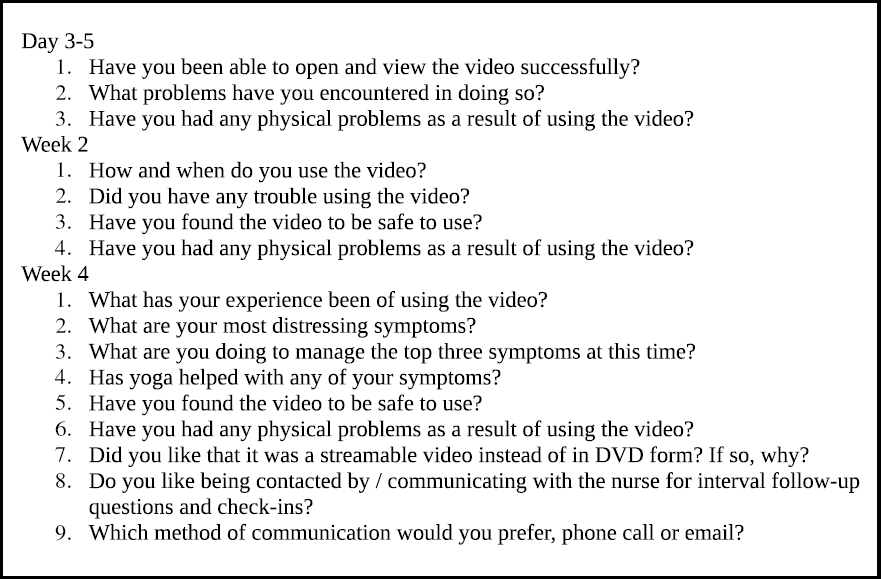
Interview questions and time points.
Data Analysis
All data was coded, de-identified, and kept on a password-protected computer to which only members of the study team had access. Descriptive statistics were utilized to analyze the demographic variables. The responses to the survey
Randomized controlled trials indicate that yoga had a positive impact on sleep quality and reduced use of sleep aids, improved quality of life, increased vitality, and reduced fatigue and improved vigor.
Results
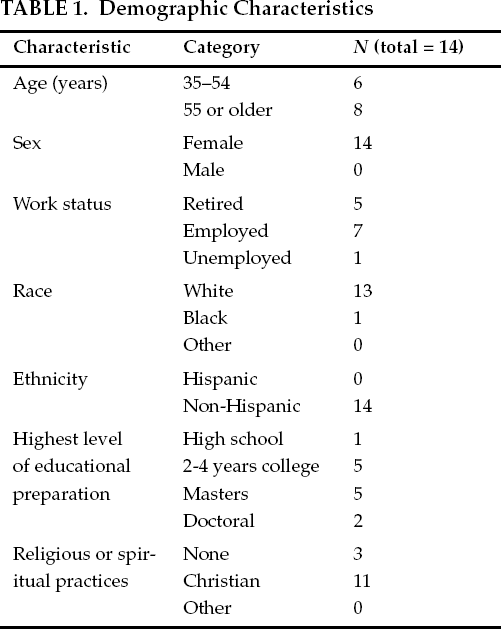
Fourteen women met eligibility criteria, consented, and were enrolled. The average age was 54. Of the 14 participants, 11 participated in all three telephone interviews. Demographic characteristics are included in Table 1.
Demographic Characteristics
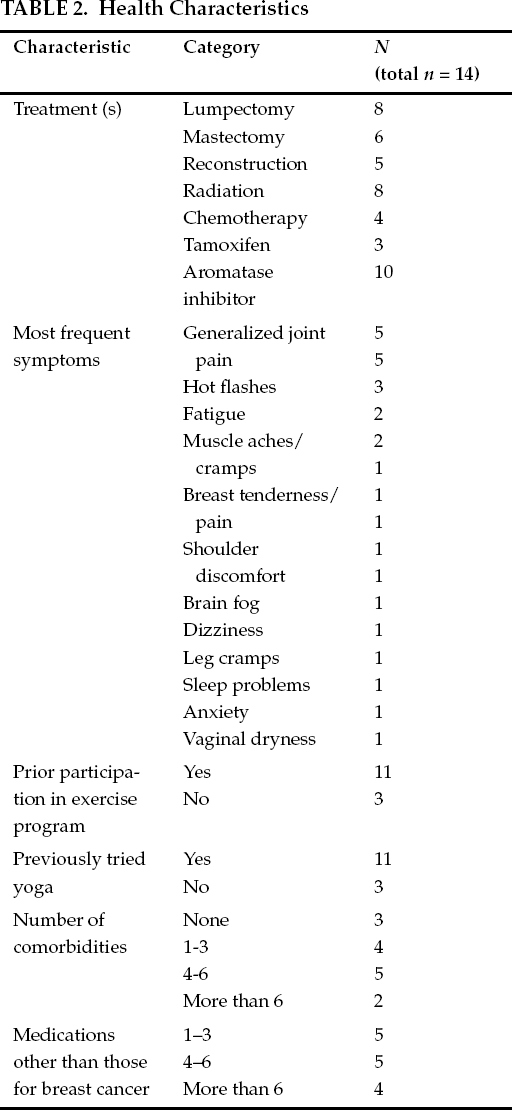
In terms of health characteristics, 14 were on some type of oral adjuvant therapy, 11 reported having at least one other medical problem beside their breast cancer, and 9 were taking four or more medications in addition to their cancer treatment. Eleven reported some form of exercise program. The two most common symptoms reported were hot flashes and joint pain. Other symptoms and health characteristics of the sample are presented in Table 2.
Health Characteristics
Technical problems with the video were minimal. Two participants reported minor technical difficulties that were resolved at the first follow-up call. Otherwise, participants reported being able to open and view the video, and found streaming video in this way convenient and enjoyable. Of the 11 women who reported they did regular vigorous exercise prior to their diagnosis, 3 reported that the yoga video was not challenging enough. Eight of the participants reported using the video in its entirety 1–2 times per week. One participant reported nearly daily use. She stated, “I use it before lunch or whenever the spirit moves me. I play an exercise, do the exercise 10 times then move on to the next.” Another participant described incorporating the yoga poses introduced in the video into her own yoga practice.
Participants were unsure whether the yoga helped to relieve their most distressing symptoms. One participant stated, “It has not helped me, not yet, maybe if I did it more it would help.” Some of the participants indicated that the yoga did help them in some way (relaxing/calming, reduced joint soreness, improved sleep). They particularly liked the aspects of slow breathing and gentle stretching, but wanted more instruction: “I would have liked more guidance on the relaxation and what it really is.” Participants liked the communication with the study team during the telephone interviews, and reported that they were happy for the intervention even if they did not find it wholly satisfying. In the follow-up calls, all participants denied safety concerns about the video.
Discussion
The web-streamed video for delivering this yoga intervention was easy for participants to access and follow. They liked that it was made by their providers, and reported that they enjoyed receiving follow-up calls from the study team, suggesting the ongoing connection was important.
The video introduced concepts consistent with yoga practice (mindful movement and breathing, guided relaxation). Those who described using the video in this way seemed to enjoy the video more than those who expected a vigorous exercise video. Participants who previously had a vigorous exercise regimen found the yoga video not challenging enough to meet their needs, indicating a knowledge deficit about gentle yoga as a mindful movement strategy. This also indicates that yoga is not a “one size fits all” intervention, and may requiring tailoring based on individual yoga experience.
Implications
Future work replicating this study should focus on tailoring the instruction to participants about yoga as a mindfulness practice, as well as measuring the effect of the intervention on specific outcomes (e.g., improved well-being, reduced fatigue, or anxiety). Individualized nurse coaching may be required to improve awareness of yoga as a self-care tool and improve utilization.
The video introduced concepts consistent with yoga practice (mindful movement and breathing, guided relaxation); those who described using the video in this way seemed to enjoy it more than those who expected a vigorous exercise video.
Limitations
This was a small feasibility trial with a homogenous convenience sample and, as such, findings are limited. Further work with larger, more diverse samples is indicated to determine how accessible a web-based intervention is across populations and to understand differences in the experiences across social determinants of health.
Conclusion
This web-streamed video was a safe, feasible, and easily utilized approach to delivering an at-home yoga intervention. Further work is needed to understand the efficacy of this intervention as well as how best to communicate the goals of yoga. Outcome measures such as well-being and anxiety sensitive to this intervention are needed to determine intervention effectiveness.
Footnotes
Acknowledgment
s. We would like to thank Luba Zagachin, MGH Cancer Center Yoga instructor for her inspiration, assistance with yoga practice content, and video instruction; Erin Sullivan, NP, and Cheryl Brunelle, PT, CCS, CLT for their assistance with the creation of the yoga video; and Emily Pepe for her help in data collection.
Loren Winters, MSN, ANP-BC, OCN, she, is an advanced practice oncology nurse and Associate Director of Breast Cancer Survivorship at the Massachusetts General Hospital Center for Breast Cancer in Boston, Massachusetts. She is also a Yoga Alliance registered yoga teacher and an Ayurvedic Health Counselor.
Kathryn Post, PhD, ANP-BC, she, has been a nurse practitioner in breast oncology at Massachusetts General Hospital in Boston, Massachusetts since 2007. She is a post-doctoral fellow at the Massachusetts General Hospital Cancer Outcomes for Research and Education Group .
Jane Flanagan, PhD, RN, AHN-BC, ANP-BC, FAAN, she, is an associate professor in the William F. Connell School of Nursing at Boston College and has an appointment as a nurse scientist at the Yvonne Munn Center for Nursing Research at Massachusetts General Hospital in Boston, Massachusetts.
Disclosure. The authors have no relevant financial interest or affiliations with any commercial interests related to the subjects discussed within this article.
Funding. The author(s) disclosed receipt of the following financial support for the research, authorship, and/or publication of this article: This work was supported by the Massachusetts General Hospital n/a, awarded to Loren Winters.