







Abstract
Clinical professors are a particularly important determinant of student success in becoming a proficient nurse. The clinical professor is responsible for helping students apply didactic knowledge to clinical skills. This article discusses strategies clinical professors can use to maximize undergraduate nursing students ‘skills and competencies and to raise awareness of healthy behaviors affecting patient care. Applying effective and fun strategies can help students decrease anxiety, apply critical thinking, develop autonomy, and learn time management. These applied strategies help students develop delegation skills required to be professional, competent nurses, while promoting health and well-being.
Remember as a nursing student that clinical professor who was approachable and took extra time and effort to create ways to help you retain clinical skills knowledge? Creating and incorporating activities that strengthen core competencies are essential for students to develop autonomy and confidence. Students award a fundamental value to the clinical environment in terms of their professional development; instructors ‘caring relationships are important elements for success (Arrigoni et al., 2017).
A nursing student's first clinical placement experience is of critical importance in their educational and professional journey; however, some students ‘clinical experiences do not yield the desired outcome (Levett-Jones et al., 2015) and/or are substantial sources of stress (Morrell & Ridgway 2014). Nursing education presents theoretical information in the classroom, and clinical pracricums process that theoretical information into practice (Kelly, 2007).
Clinical instructors may wonder if they are educating their students in the most proficient way to maximize all the skills needed to become competent, prudent nurses. There are numerous qualities that align with good clinical instruction, incorporating strategies and interpersonal skills to encourage students to thrive, thus enhancing learning and promoting health and wellness in the clinical environment.
Qualities of an Effective Clinical Professor
Attitude
A teacher's attitude influences the teacher-student relationship. Students feel stress about making clinical mistakes (Kleehammer et al., 1990), being accepted as a nursing student (Gilmarrin, 2000), and evaluation from the health team members. A teacher's supportive and friendly attitude enables student well-being.
Focus
Students need a caring and supportive environment, with instructors who are approachable, allowing students to feel safe asking questions. Educators must display caring, respect, responsibility, morality, and patience. Students feel safe when instructors are open to new ideas, motivated, and willing to go the extra mile (Froneman et al., 2016).
Role Modeling
Students may learn therapeutic approaches more readily when instructors serve as role models. When instructors and students work together, using open, honest communication based on trust, a collaborative team is formed. Mutual self-disclosure enhances the growth of the personal and professional relationship and promotes students ‘therapeutic use of self.
Clinical instructors may wonder if they are educating their students in the most proficient way to maximize all the skills needed to become competent, prudent nurses.
A paradigm shift in nursing education today is the move from a passive to an active, self-directed, participative learner; nursing faculty are shifting from a teacher-dominated to a learner-centered teaching approach. Many nurse educators consider themselves facilitators for active participants through the learning experience, rather than vessels pouring wisdom into passive listeners (Zimmermann, 2003).
Providing a Caring Learning Environment
A caring learning environment can mitigate students ‘anxiety and feelings of stress. In a study by Froneman et al. (2016), participants reported that they needed constructive interaction; a nurse educator who is approachable, respectful, friendly, and nonthreatening can promote this atmosphere. Del Prato et al. (2011) stated that creating a caring environment that demonstrates value, respect, and support as a collaborative enterprise between faculty and learners not only fosters relationships but also promotes learning in a nonstressful manner.
Allowing Students a Voice
Bastable (2008) stated that a learner-centered educational environment enhances students ‘critical thinking capabilities if they have a voice in the learning process. For example, a different student each week can introduce postconference, asking fellow students questions about their patients. Experiencing this leadership role helps students develop a sense of belonging and of being a member of the interdisciplinary team. Lamont et al. (2015) suggested that facilitating the concept of belonging is central to students ‘positive experiences, as it demonstrates an interest in their learning, allowing them to feel supported and to concentrate on learning nursing skills instead of figuring out how to fit in with staff.
Helping Students Develop Self-Esteem
Burnard et al. (2001) stated that although diminished self-esteem is common throughout nurse training, the quality of care a patient receives is dependent on the nurse's self-esteem, so nurses must feel comfortable with themselves if they are to encourage, care for, and help others. Peters et al. (2015) noted that although clinical placements provide obvious benefits to students, poor working relationships between mentor and student, lack of supervision and support, and/or environments that fail to promote belonging are factors associated with elevated stress levels. Supporting students by encouragement and positive feedback lays the foundation for development of confidence, knowledge, and new skills.
Decreasing Anxiety on the Clinical Unit
Li et al. (2011) suggested that student nurse stress can interfere with learning, integrating, and performing successfully, thus decreasing quality of patient care. Therefore, it is necessary to identify effective coping skills quickly in order to deal with future clinical stress. Interaction between students and mentors can be difficult, because the pace of learning differs among individuals. In a study by Froneman et al. (2016), students reported that they needed constructive interactions with an approachable, patient, nonthreatening educator.
Prepare for the clinical experience before the semester begins by visiting the clinical site. Tour the unit, introducing yourself to the charge nurse and nursing staff. Discuss the students ‘goals and the clinical skills pertinent for their academic level. Express gratitude for being allowed this clinical experience. Developing rapport with the staff is one of the most crucial aspects in affording students a good clinical experience.
Preclinical Simulation Day
Create simulation activities that correlate with the skills students will encounter on the clinical unit. Simulation will help ease students ‘anxiety, allowing them to review important clinical skills and meet their instructor before entering the clinical environment. Simulation offers students low-risk opportunities to practice care and critical events in a controlled environment (Decker et al., 2008).
Set Clear Expectations
Create a document stating clinical expectations so that students are aware of their responsibilities. Dennis (2003) proposed that mentors need to provide clear guidelines, realistic expectations, and consistent and timely feedback to ensure students ‘optimal performance. Create a checklist of skills students need to learn during the semester. Every time a student demonstrates competence in a skill, document the date of accomplishment. At the end of the semester when completing final evaluations, include all the skills the individual student has mastered.
Demonstrate Organization
Chow and Suen (2001) noted that the most important role of clinical mentors is organizing facilitation of learning. Good clinical mentors help students apply their theoretical knowledge to practice, provide learning opportunities, and help students to do their best (Nahas & Yam, 2001). Organization by the clinical professor sets the tone for the students. After students have received their patient assignments, discuss the plan of care, prioritize needs, and assist with time management. Organize assignments so that clinical instruction coincides with didactic material, even if you must venture off the unit to find other experiences. Moving about the facility helps to develop rapport with other departments, allowing a broader experience for the students.
Good clinical mentors help students apply their theoretical knowledge to practice, provide learning opportunities, and help students to do their best.
Specific Tools and Strategies to Assist Students
Table 1 lists specific tools and strategies to help student learning in the clinical environment.
Learning Tools and Strategies for the Clinical Site
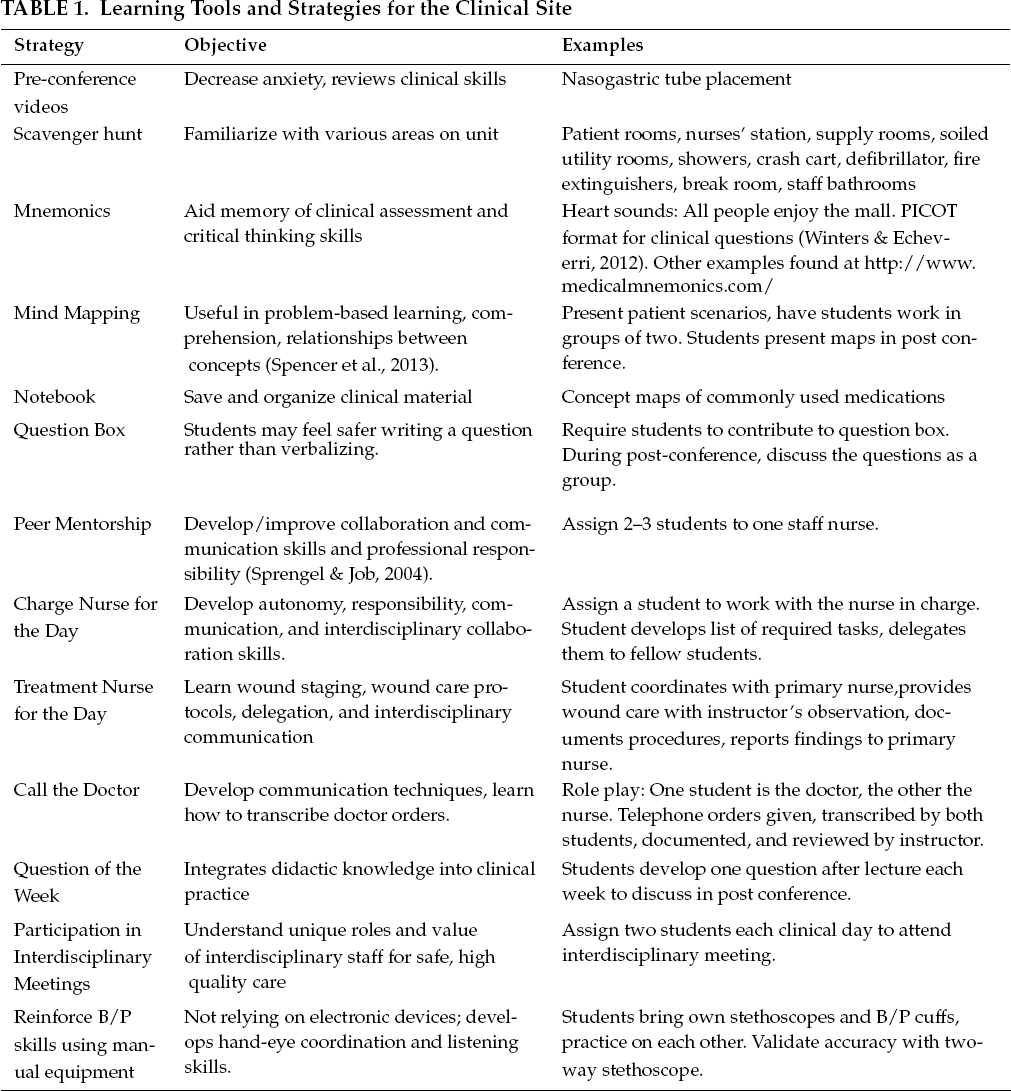
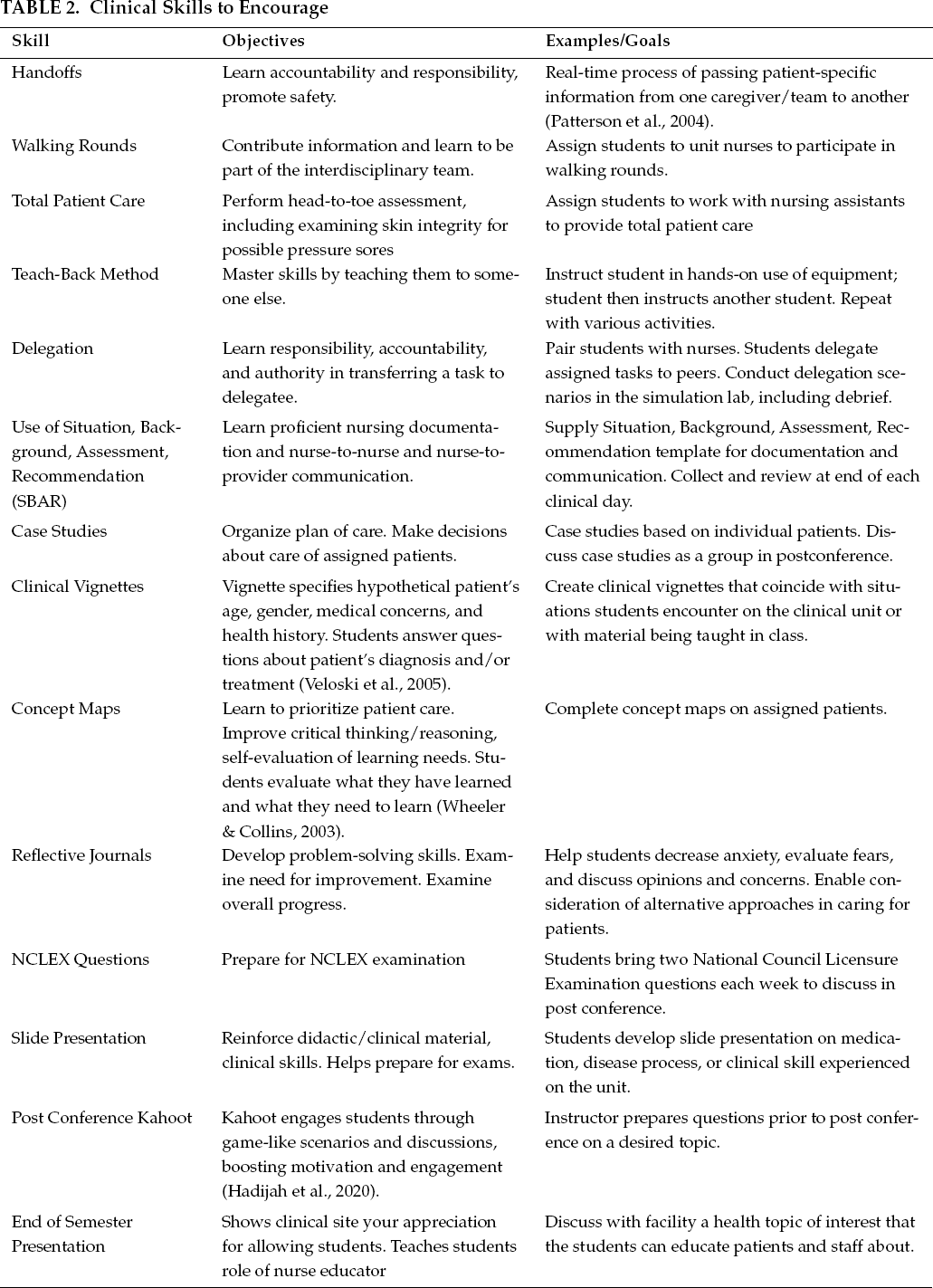
Table 2 lists specific clinical skills that the clinical professor should encourage.
Clinical Skills to Encourage
Conclusion
Clinical professors have the responsibility to ensure that students have a quality educational experience. They can be powerful mentors to students, creating a sense of enjoyment in learning while leaving a lifelong impression on students ‘nursing careers. Applying effective and fun strategies can help students decrease anxiety, apply critical thinking, develop autonomy, and acquire the time management and delegation skills that are required to be a professional, competent nurse, while raising awareness about healthy behaviors affecting their patient care.
Footnotes
Disclosure. The authors have no relevant financial interest or affiliations with any commercial interests related to the subjects discussed within this article.
Funding. The author(s) received no specific grant or financial support for the research, authorship, and/or publication of this article.
Diane R. Logan, MSN, RN, BSN, CSN, (she/her), is a clinical nursing instructor in the undergraduate and graduate CNL programs at Seton Hall University in South Orange, New Jersey.